I Doubt Hillary Clinton Plans to Close Half of All Public Schools – But She Does Want to Close Some

www.usnews.com


“This school district, and these schools throughout Iowa, are doing a better than average job. Now, I wouldn’t keep any school open that wasn’t doing a better than average job. If a school’s not doing a good job, then, you know, that may not be good for the kids.”
-Hillary Clinton

The above comments have caused a tremendous stir in the media lately.

Hillary Clinton wants to close half of all public schools!? She wants to shutter all public houses of learning that are average or below average!?

The Federalist even did some quick math and decided this means Clinton would shutter 50,000 schools. They even put that number in the headline of their article!

But hold your horses, media backlash.

I’m not really a Hillary supporter, but this has gotten a little out of hand.

Maybe I’m being too generous here, but I’m going to assume that Clinton may be a lot of things, but stupid isn’t one of them.

She made a gaffe. She said something that doesn’t make much sense mathematically. Close all schools below average? Average means 50%. That’s half of all schools.

It was a blunder, a mistake, a foot-in-the-mouth moment.

I can believe a lot about Clinton, but not that her education policy includes shuttering half of our nation’s schools.

However, don’t take my word for it. Seriously! Ask her. She should clarify what she meant. But give her a chance to do so. Don’t mob her just looking to trip her up.

I doubt I’ll vote for Hillary in the primary, but she deserves a certain modicum of respect. She is an impressive person. She’s accomplished a heck of a lot in her life under some pretty intense circumstances.

As a college student in the 1960s, she volunteered to teach reading to children in poor Boston neighborhoods. She fought to ensure voting access for African Americans and even worked at an alternative newspaper in the black community. As First Lady and in Congress, she pushed for universal pre-kindergarten, arts education, after-school tutoring, smaller class sizes and the rights of families.

And in 2008 she ran an impressive – if ultimately unsuccessful – campaign for President.

As one of the most prominent women in the nation, she’s made some enemies.

Remember that Benghazi nonsense! Conservatives have been out for her blood because an American diplomatic compound in Libya was attacked in 2012 while Clinton was Secretary of State. They’ve trumped up a crazy amount of lies and innuendo that she was somehow responsible when it was the Republican-controlled Congress that voted to reduce security at these installations.

Heck! Michael Bay has a hatched job movie coming out during this election season just to wound Clinton’s current bid for president!

So give the woman some credit. She’s proven she’s a serious-minded, intelligent and capable politician.

However, like every human being she misspeaks from time-to-time. George W. Bush couldn’t open his mouth without English teachers and grammarians hiding under the sofa.

I think this explains much of what she said in Iowa trying to consolidate votes for the first Democratic primary on Feb. 1, 2016.

It explains much – but not all.

Clinton may have fudged her math momentarily forgetting that 50% of all schools are – and always will be – below average. If tomorrow every school in the country provided the greatest education the world has ever seen, half of them would still be below average. That’s what average means.

What bothers me is that Clinton thinks we should be closing schools at all.

That’s not a slip. That’s not a blunder or a miscalculation.

She really seems to believe you can improve public education by closing schools. And THAT is much more dangerous than any nonsense about her going on a nationwide school shuttering spree – something of which she would not, by the way, even have the power to do as President.

This idea that we can close schools to improve education is one of the founding principles of corporate education reform. And it’s demonstrably untrue.

Never has a school ever been improved by being closed. Student academic outcomes do not increase when children are displaced. In fact, they suffer.

If schools are struggling, a sensible strategy would be to find out what’s wrong. What is the reason kids are having trouble reaching academic success?

Spoiler Alert: nine times out of ten the problem is disinvestment. The school doesn’t have adequate resources to meet students’ needs.
More than half of our nation’s public school children live in poverty. Their schools don’t get equitable funding with districts that serve the rich. Moreover, privatization, charterization, increased efforts at vouchers, tax breaks and school choice have segregated our schools to such a degree that these problems disproportionately affect our students of color to a much larger degree than white children.

THAT is the problem with American education. It’s been proven time and again in study after study. Yet corporate education reformers like Michelle Rhee, Campbell Brown, Bill Gates, and Andrew Cuomo continue to ignore the facts in favor of simply closing more schools. In his time as Mayor, Rahm Emanuel has closed 50 Chicago schools46 of which serve mostly black and brown students. And he’s a close Clinton friend.

It is no accident that so many of these corporatists are Democrats. The entire neoliberal wing of the party is sick with these sorts of conservative policies. And Clinton can be connected with many of them.

Since getting the support of the American Federation of Teachers (AFT) and National Education Association (NEA), Clinton’s tried to distance herself from her disaster capitalist buddies. But it isn’t working.

On the one hand, she criticized charter schools for ignoring the most difficult students. On the other, she still champions keeping privatized education in the mix.

On one hand, she thinks there should be a federal investigation of the Chicago Police Department for civil rights abuses. On the other hand, she thinks Rahm is doing a heck-of-a job.

I am deeply troubled that Clinton seems to think we can close our way to academic success. She should know better than that by now. Everyone should. It is absolutely unacceptable that any candidate with such teacher support should hold these views. Quite frankly, it’s a deal breaker.

The ball’s in your court, Hillary. You need to explain what you meant by your Iowa comments.

I admire Clinton’s bravery for actually talking about K-12 education – something her rival Bernie Sanders seems much less inclined to do. However, we all know Clinton’s endorsements by the AFT and NEA don’t represent the views of the rank-and-file. These were top down decisions made without much member input. If Hillary wants those endorsements to translate into votes, she’d better do some serious convincing.

Otherwise it won’t be schools that are shuttered. It will be her campaign.


NOTE: This article also was published on the Badass Teachers Association Blog and mentioned on Diane Ravitch’s blog.


 

Standardized Tests Every Day: the Competency Based Education Scam

rocketship-charter-schools

IN THE NOT TOO DISTANT FUTURE:

Welcome to class, children.

Please put your hands down, and sit at your assigned seat in the computer lab.

Yes, your cubicle partitions should be firmly in place. You will be penalized if your eyes wander into your neighbors testing… I mean learning area.

Now log on to your Pearson Competency Based Education (CBE) platform.

Johnny, are you reading a book? Put that away!

Are we all logged on? Good.

Now complete your latest learning module. Some of you are on module three, others on module ten. Yes, Dara, I know you’re still on module one. You’ll all be happy to know each module is fully aligned with Common Core State Standards. In fact, each module is named after a specific standard. Once you’ve mastered say Module One “Citing Textual Evidence to Determine Analysis” you will move on to the next module, say “Determining Theme or Central Idea for Analysis.”

Johnny, didn’t I tell you to put away that book? There is no reading in school. You’re to read the passages provided by the good people at Pearson. No, you won’t get a whole story. Most of the passages are non-fiction. But I think there is a fun passage about a pineapple coming up in your module today. Isn’t that nice?

Laquan, you haven’t put on your headphones and started your module yet? You’ve been on module three for the past week. How can you learn at your own rate if you never progress beyond module three?

What’s that? Your mother wrote me a note? Let me see that.

Huh. So she wants to know how come you never get beyond module three. You should be able to answer that question for her, yourself, Laquan. (At least you could get that one right.)

Laquan, tell your mother that you haven’t passed the proficiency standard yet. You’ve taken all the remediation available on the computer program, haven’t you? Yes, that fun game where you answered multiple choice questions and when you got one correct the spaceship blasts an asteroid. And then you took the daily assessment but you just haven’t received a passing score yet. But don’t worry. I’m sure if you continue to do the same thing again today… eventually… you’ll get it right. It’s how the state and federal government determine whether you’ve learned anything on a daily basis.

In ancient times, teachers like me used to make up our own assignments. We’d give you books to read… Johnny, have you started yet? …whole books, novels, literature. And then we’d hold class discussions, class projects, act out scenes, draw posters, relate the books to your lives, write essays. But now all that silliness is gone.

Thanks to the good people at the American Legislative Exchange Council (ALEC), the Gates Foundation, and the Foundation for Excellence in Education, The state and federal government have mandated a much more efficient way of determining student learning. Back in the day, they forced schools to give one big standardized test in Reading and Math every year. Teachers would have to scramble with test prep material to make sure all learners could pass the test, because if students didn’t get passing marks, the teacher was out on her butt.

We’ve done away with such silliness now. Thankfully the government got rid of yearly high stakes standardized testing. What we do now is called Competency Based Education. That’s what this program is called. It’s kind of like high stakes standardized testing every day. So much more efficient, so much more data to use to prove you know this set of basic skills written by the testing companies with hardly any input from non-experts like classroom teachers.

That’s how the district became composed of 100% charter schools. No more inefficient school boards made up of community members. Today our schools are run by corporate CEOs who are experts at finding ways to cut corners and increase profits for their shareholders. And, ugh, make you learn good.

Hm. I seem to be talking too much. No one’s paying me to impart any information. I’m just supposed to make sure you’re all hooked up to the program and making satisfactory daily progress. Otherwise, I’ll be out of a job again.

You laugh, but it’s hard to get minimum wage work like this. Since the U.S. Supreme Court made labor unions all but illegal and public schools instituted CBE programs, teachers like me could no longer demand such exorbitant salaries. Now I make an honest living. Speaking of which, I may have to get out of here a few minutes early today to make it to my shift at WalMart. I’m greeter today!

And if you work hard, someday you can be, too!


NOTE: This article also was published on the Badass Teachers Association Blog and quoted extensively on Diane Ravitch’s blog.


National Academic Standards – Turning Public Education into McSchools


FullSizeRender

America is obsessed with standardization.

Let’s make everything the same – neat and uniform.

It’s ironic coming from a country that’s always been so proud of its rugged individualism.

But look almost anywhere in the US of A, and you’ll see a strip mall with almost all of the same stores and fast food restaurants selling the same crusty burgers and fries left waiting for the consumer under a heat lamp.

Somehow this has become THE model for public education, as well. Corporations have convinced our lawmakers that the disposable franchise business schematic is perfect to increase student learning.

That’s where we got the idea for Common Core. All schools should teach the same things at the same times in the same ways.

It’s been a horrendous failure.

But this article isn’t about the Common Core per se. It isn’t about how the Core is unpopular, expensive, developmentally inappropriate, created by non-experts or illegal. It’s about the very idea of national academic standards. After all, if the Core is flawed, one might suggest we simply fix those flaws and institute a better set of national standards. I contend that this would be a failure, too.

The problem with standardization is that it forces us to make uniform choices. In situation A, we always do THIS. In Situation B, we always do THAT. There are some areas where this is a good thing, but education is not one of them.

For instance, we can all agree that children need to read books, but what kind of books? Should they read mostly fiction or nonfiction? Should books be limited by subjects or should they be chosen by interest? Should they be ebooks or hardcopies? Should they be organized by grade level or an individual’s reading level?

These are decisions that are best made in class by the teacher. However, when we write national standards, we’re taking away educators’ autonomy and giving it to some nameless government entity. This isn’t smart. Teachers are the scientists of the classroom. They can use their observational skills to determine what a child needs and how best to meet those needs. If we remove this, we’re forced to guess what hypothetical children will need in hypothetical situations. Even under the best of circumstances, guesses will not be as good as empiricism.

But, some will say, standards should be broad. They shouldn’t determine what children will learn in detail. They just set a framework. For instance, they’ll detail that all children should learn how to add and subtract. All children will learn how to read and write.

There is some truth to this. We can all agree to a basic framework of skills children need before graduation. However, if the framework is this broad, is it even necessary?

Do you really think there are any public schools in this country that don’t attempt to teach adding and subtracting? Are there any schools that don’t teach reading and writing?

I doubt such educational institutions exist, and even if they did, you wouldn’t need national academic standards to change them. By any definition, they would be cheating their students. If the community found out this was going on, voters would make sure things changed.

What about evolution, someone asks. This is a central scientific concept vital to a modern understanding of the field that in many places isn’t being taught in our public schools. Don’t we need national standards to ensure things like evolution are part of the curriculum?

The short answer is no.

For a moment, let me remove my ban on talking about Common Core – our current attempt at national standards. Some people defend the Core with this same argument. However, it should be noted that the Core has no science and history standards. It does nothing to ensure evolution is taught in schools.

But could we ever have standards that did ensure evolution was taught? Yes, we could.

Why don’t we? Why doesn’t Common Core explicitly address this? Because enacting such standards would take political power of a sort that doesn’t exist in this country. Too many voters oppose it. No state or federal legislature would be able to pass it.

But let’s assume for a moment that the political stars had aligned, and we could get lawmakers to vote for this. Why would they need to? This is a central theory to so many fields of science. Do we need an act of Congress to make sure all schools teach about gravity? Do we need one for Nuclear force? Friction?

You don’t need a Congressional order to teach science. If the community wants it, teachers will just do it. That’s their jobs. You can’t legislate that everyone believes in evolution. You have to convince people that it should be taught. National standards won’t change that. You can’t sneak it in under Newton’s laws of motion. We need to come to consensus as a society. As much as I truly believe evolution should be taught in schools, national standards are not going to make that happen.

Even if I were wrong, the cost would be far too high. We shouldn’t want all of our public schools to be uniform. When everyone teaches the same things, it means we leave out the same things. There is far too much to know in this world than can ever be taught or learned in one lifetime. Choices will always need to be made. The question is who should make them?

If we allow individuals to make different choices, it diversifies what people will know. Individuals will make decisions, which will become the impetus to learning, which will then become intrinsic and therefore valued. Then when you get ten people together from various parts of the country, they will each know different things but as a whole they will know so much more than any one member. If they all know the same things, as a group they are no stronger, no smarter than each separate cog. That is not good for society.

We certainly don’t want this ideal when going out to eat. We don’t want every restaurant to be the same. We certainly don’t want every restaurant to be McDonalds.

Imagine if every eatery was a burger joint. That means there would be no ethnic food. No Mexican. No Chinese. No Italian. There would be nothing that isn’t on that one limited menu. Moreover, it would all be prepared the same way. Fast food restaurants excel in consistency. A Big Mac at one McDonalds is much like a Big Mac at any other. This may be comforting but – in the long run – it would drive us insane. If our only choices to eat were on a McDonald’s Value Menu, we would all soon die of diabetes.

But this is what we seem to want of our public schools. Or do we?
There is a bait and switch going on in this argument for school standardization. When we talk about making all schools the same, we’re not talking about all schools. We’re only talking about traditional public schools. We’re not talking about charter schools, parochial schools or private schools.

How strange! The same people who champion this approach rarely send their own children to public schools. They want sameness for your children but something much different for their own.

I have never heard anyone say this approach should be applied to all schools across the board. That’s very telling. These folks want your kids to be limited to the McDonald’s Value Menu while their kids get to go to a variety of fancy restaurants and choose from a much daintier display.

If standardization were so great, why wouldn’t they want it for their own children? I think that proves how disingenuous this whole argument is. Standardization makes no one smarter. It only increases the differences between social classes.

The rich will get a diverse individualized education while the poor get the educational equivalent of a Happy Meal.

Think about it. Every generation of American that has ever gone to public school managed to get an excellent education without the need for national academic standards. Steve Jobs, Jeff Bezos, Bill Clinton, Ronald Reagan, Carl Sagan, Ruth Bader Ginsberg, Spike Lee, Larry King, and Stan Lee along with 90% of the United States population went to public school. None of them needed national academic standards to succeed.

This is a solution in search of a problem. The only reason we’re being sold the need for these standards is because it makes it easier for corporations to profit off federal, state and local tax dollars set aside for education. New standards mean new text books, new tests, new test prep materials, new software, and new computers. In the case of Common Core, it also means failing as many children as possible to secure a never ending supply of the above and an open door to privatization.

We must wake up to the lies inherent in these sorts of policies. Yes, the Common Core is horrible, but the problem goes far beyond the Common Core.

National Academic Standards are a terrible idea propagated by the 1% to turn the rest of us into barely educated subhumans and boost the bottom line.

Do you want fries with that?


NOTE: This article also was published on the Badass Teachers Association Blog and quoted extensively on Diane Ravitch’s blog.


Education Does Not Cure Poverty – It Cures Ignorance

Screen shot 2015-10-17 at 11.36.22 PM

What good is an education?

Will it get you money? Will it make you rich?

No. Not really.

And that’s one of the biggest problems with American public school policy of the last 15 years. It misunderstands the purpose of the very thing it purports to promote.

Poverty is skyrocketing. It’s been on the rise for at least three decades, but since the economy collapsed in 2008, the ranks of the poor have swollen like an untreated wound left to fester and rot.

We could be doing something about that. We could be working on a jobs package – on something to get people back to work. Instead we crowd around unemployment data and clap each other on the back because on paper it looks like we’ve overcome this obstacle.

Unfortunately, we haven’t.

Since President Barack Obama took office, there have been less people out of work than during the disastrous Bush years. However, most new jobs created since the crash only pay minimum wage. The good jobs are drying up and being replaced by poverty wage employment. And that’s not even counting the hordes of people who’ve given up even looking for a job but don’t merit a mention in these Pollyanna publications!

So how do we truly answer this dilemma? How do we get America back to work?

According to our policymakers, through magic.

Provide people more training, they say. Make sure those out of work obtain new skills and the next generation receives a rigorous education.

It’s the kind of solution our grandparents – who lived through the Great Depression – would have laughed to silence. Give someone a book, put them in a school, place them before a teacher and – POOF – they’ll be able to get one of the nonexistent well paying jobs that – may I repeat – DON’T EXIST!

It’s not that we have an unskilled workforce. We have more people than ever with Doctorates and Masters degrees living on food stamps. The problem is lack of well paying jobs. We’ve tax sheltered, down sized, and corporatized America into a land where the rich play Monopoly with all our cash while the rest of us subsist on McJobs.

Claiming that education alone can resolve this problem is like saying all a starving person really needs is a fork and spoon. But that won’t help if he has nothing to eat!

It should be no surprise that those championing our school system as a silver bullet to our jobless nation speak out of both sides of their mouths. On the one hand, they say, education can save us. On the other, they say, if education was better we wouldn’t need saving. And since they’re almost exclusively employed by the same people who gobbled up all the jobs in the first place and then spat them out to China, it’s a travesty that anyone listens to them.

They’re not offering a solution. They’re making a last ditch effort to clear the board of any remaining public money – education dollars.

If only the teachers had taught us better, they say, we’d all be able to have a corner office in the sky. But since those evil, lazy educators are doing such a bad job, we need to close as many schools as possible to save those kids. And then we can privatize them and swipe even more of that sweet, sweet public money to the 1% who can run charter schools and cut student services while scarfing up the rest as yummy profit.

To prove this thesis, policymakers force untested and irrational reforms on public schools – standardized testing, computerized test prep, Common Core. When none of this works (as planned), they simply blame the educators who never wanted any of this in the first place. But it helps us serve up teachers on a silver platter as the scapegoat of the day.

These so-called reforms solve nothing – they just make things worse.

Furthermore, they’re a distraction, smoke and mirrors so we won’t see the real issue of how we’re being swindled by the 1%. After all, THEY were the ones who got us into this mess in the first place! They were the ones who crashed the economy – not Mrs. Jones, the local science teacher.

We should know this already. It’s out in the open and easy to see. The media is not doing its job of reporting the truth. The public is being dazzled by propaganda that appeals to our basest selves. But most importantly, we’re being fooled because we no longer remember what education is for!

Even under the best of circumstances, education does not make someone rich. That’s not it’s goal. It never has been. Education seeks to enrich people’s minds, not their bank accounts.

Yes, there is a relationship between the two, but its several steps removed. A well educated person may be able to more easily obtain money than an uneducated one. She may be more prepared for a well-paying job. However, being prepared is rarely what makes someone rich.

People gain wealth most often by inheriting it (See Paris Hilton, Bill Marriott, Mitt Romney and Donald Trump). Others get money by cheating the public out of it. This takes a person with a weak moral code, not necessarily strong book smarts. For instance, look to the Walmart model of selling groceries cheaply by paying poverty wages to employees who then must rely on the federal government to survive and thus can only afford to shop at Walmart. That’s not smart. It’s sociopathic. Anyone could have thought that up, but it takes a person with a stunted conception of the value of other people to actually do it.

More important than a college degree are connections. The Rich know the right people. They have contacts in high places with whom they can barter for lucrative tips, jobs and partnerships. They have friends on Wall Street who can tip them off when a stock is about to rise or fall. They know editors at prominent papers who have no problem changing the headlines to match a preconceived narrative rather than the facts on the ground.

Again, that doesn’t require all A’s on your report card. It’s the result of a lottery of birth, social standing and an undeveloped sense of fairness.

There are some people who actually do gain riches on the merits of their intellects. But they are few and far between. Even among them there is a large portion who are more lucky than genius. I love Ben and Jerry’s ice cream, but it doesn’t take an Einstein to come up with it. Sometimes the gods of finance just smile on hippy dippy flavors with fun names.

Since the ancient world, thinkers have postulated that the purpose of education is not to increase material gain – it is to become a better person. The Ancient Greeks believed that there is value in knowledge and wisdom that doesn’t translate into gold. Aristotle called it eudaimonia or human flourishing. The best life includes wisdom.

This builds on the philosophy of Socrates – one of the founders of Western thought – who famously said, “The unexamined life is not worth living.” We have strayed far from these ideals. Today we might say the unreciprocated action is unworth doing. If something doesn’t translate into cold, hard cash, it is considered weak, a wasted effort. Even philanthropy has become a way to gain control over the industry you’re ostensibly trying to help. (See Bill Gates immense influence on Education policy.)

In their hearts, most teachers would side with Aristotle and Socrates over the Waltons and Gates’. And that’s why our corporate masters look down on us. We represent an ethos that they have abandoned and tried to destroy.

They tell themselves the fairy tale that wisdom means cheating others out of money. The removal of ignorance, they say, is the removal of any obstacles toward clawing and punching your way to the top.

But true wisdom recognizes that people are more than mere animals. We do not need to continue the Darwinian struggle of survival of the fittest among ourselves. We can cooperate. We can value each others lives. We can love.

If people valued this kind of knowledge over money, what would happen to the rich? Wouldn’t it prove that they have wasted their lives betraying and manipulating the less fortunate? Wouldn’t it reveal the poverty of their souls?

Because if people were truly educated, they would see these sick, twisted individuals for whom they really are. And we would demand justice. Not so that we could replace these penny-ante tycoons with our own wealth addiction. But instead so that we could all live in peace and bask in the joy of knowledge, compassion and an unending quest to chip away at our own ignorance.


NOTE: This article also was published in the LA Progressive and on the Badass Teachers Association blog.


If School Computer Use Reduces Standardized Test Scores, Doesn’t That Prove the Tests are Inadequate?

ipad-kids

Melvin’s hand is up.

He’s a 13-year-old African American with too much energy and not enough self-control.

He’s often angry and out of his seat. He’s usually in trouble. But today he’s sitting forward in his chair with his hand raised high and a look on his face like he’ll explode if I don’t pick him right this second.

So I do.

“Mr. Singer! Can I show my imovie now!?”

This is a first. He hasn’t turned in a lick of homework all month.

“Wow! You’re really excited about this, aren’t you?” I say.

“Yeah,” he responds. “I was up all night finishing it.”

I start to doubt this, but he does look awfully tired underneath that urgent need to share.

Airdrop it to me from your ipad,” I say, “and I’ll put it up on the SMART Board.”

This takes a few minutes.

Let’s face it.

We live in a world of high technology.

Our cell phones have more computing power than the Apollo missions to the moon.

The best, high paying jobs opening up on the world stage require increasing levels of computer literacy.

Yet according to a new study, America’s students don’t succeed as well academically if they have access to computers at school.

How can this be?

How can exposure to new technologies cause a nation of young people to fail at a system supposedly designed to prepare them for the jobs of the future?

Doesn’t real world experience usually make you better prepared?

A future chef would be helped by more time in the kitchen.

A future doctor would be helped by more access to dissection.

But a future computer-user is hurt by more time at a computer!?

Something is very wrong here.

But according to a new study by the Organization for Economic Cooperation and Development (OECD), students who use computers more at school earn both lower reading and math scores on the Program for International Student Assessment (PISA).

The organization studied 15-year-olds across 31 nations and regions from 2012. The study just released in September even controlled for income and race.

Yet here in my classroom I see the exact opposite. Computer use increases my students test scores – on my teacher-created tests.

Melvin’s movie was ready. He had been tasked with explaining the differences between external and internal conflict. I pressed play.

High adrenaline music poured from the speakers. Pictures flashed across the screen of boxers and football players.

“This is external conflict,” came rushing forward followed by a brief definition. Then an image of Homer Simpson with an angel and devil on his shoulders. “This is internal conflict,” came zooming by our eyes.

The film might not win any Academy Awards, but it was pretty impressive work for 40 minutes of class time and however long Melvin decided to spend at home.

It’s the kind of thing my students never could have done before they each had ipads. And when they took my test, few of them got the questions wrong about conflict.

Yet according to the OECD, I was somehow hurting my students academically!?

Even in my high poverty district, students have always had access to technology. But the nature of that technology and how we use it has changed dramatically this school year.

I used to have eight computers in my classroom, but they were slowly becoming obsolete and inoperable. Some days they functioned best as extra illumination if we shut out the overhead light to show a movie.

Still, I tried to incorporate technology into my lessons. I used to have my students make their own Webpages, but reserving time in the computer lab became almost impossible. And even then, the district couldn’t afford to keep the devices in the lab updated enough to run anything but the most rudimentary software.

The one lab in the building that had new devices was reserved almost exclusively for a drill and kill test prep program we had received a state grant to operate. THIS was the apex of school technology – answering multiple choice look-a-like questions. It bored students to tears and didn’t even accomplish the stipulated goal of increasing standardized test scores. Yet we were blackmailed by the state government into initiating the program so we could gain additional funding to keep the school operational.

THIS is the kind of technology use you’ll find at most poor schools like mine. And it’s one of the reasons the authors of the OECD study came to their conclusion. It’s also one of the reasons why teachers like me have been skeptical of technological initiatives offered to impoverished districts.

However, the best use of technology is something quite different.

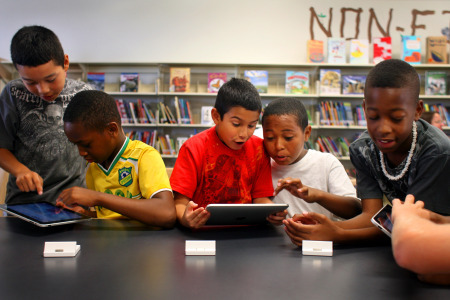
This year my district received a gift of ipads for all the students, and it’s changed everything. No longer do I have to beg and plead to get computer lab time for real high tech lessons. I don’t need it. The technology is already in the classroom in the palm of their hands.

But policymakers clutching their pearls because of this study have already began to make changes to international school curriculum. Schools in Asia have begun cutting back on student computer time. Should America follow suit?

Absolutely not.

The problem clearly is not computers. It’s the antiquated method we use to measure success.

Standardized testing has been around since 206 BC as an assessment for civil servants in ancient China. The same process spread to England in the 19th Century and then to the United States during WWI. Through all that time, the main process of rewarding rote learning through multiple choice questioning has remained the same.

But the world hasn’t. We’ve moved on a bit since the Han Dynasty. We no longer live in a medieval society of peasants and noblemen where the height of technology is an abacus. We live in an ever-changing interconnected global community where a simple search engine provides more information than could be stored in a thousand Libraries at Alexandria.

How can we possibly hope to rely on the same assessments as the ancients? Heck! Even as far back as 970 AD, standardized testing was criticized as being inadequate.

But a global multi-billion dollar industry relies on these primitive assessments. It’s the basis of an exceedingly lucrative business model.

So it shouldn’t be surprising that the same people who promise standardized testing and Common Core will best prepare students to be college and career ready are passing the blame.

They claim this report isn’t an indictment of their cash cow industry. It’s a warning against over-reliance on computers. And, yes, they’re right that technology is not a panacea. The mere presence of a computer won’t make a child smarter. Likewise, the mere presence of a book won’t make a person wiser. One must know how to use said computer and book.

But what I’m seeing in my classroom primarily is an opportunity – not a danger. Students like Melvin are more engaged and willing to take chances. They have greater freedom, intrinsic motivation and excitement about learning.

Many times when sharing Keynote presentations, after one or two, students ask to have their work back so they can improve them. That doesn’t happen with test prep.

They often elect to take ipad assignments to lunch and work on them between bites. That doesn’t happen with Pearson worksheets.

I’m not saying it’s easy. It’s up to me, my colleagues and administration to ensure technology is used to its full potential. Never should these devices be time fillers or babysitters. Nor can they ever replace the guidance of a thoughtful, creative educator to determine their best use. Teachers need to create and assign lessons that promote creativity and critical thinking skills.

Education professionals are constantly advised to individualize their lessons to meet the needs of diverse learners. Technology allows them a unique opportunity to do so. With district ipads I can talk to an English Language Learner in his own language. A struggling reader can have the device read test questions aloud. A student with poor motor control can type journal responses and have his writing be understood.

And these opportunities for enrichment don’t even need to be planned ahead of time. For instance, when discussing a short story about a character that was exceedingly proud, one of my students brought up the Seven Deadly Sins. She wasn’t exactly sure what they were or how exactly they related to pride, but one of her classmates quickly looked it up on her ipad. Then another found a medieval woodcarving to which someone else found a related manga text. The subsequent discussion was much deeper and relevant to these children’s lives than it would have been otherwise. And none of it was pre-packed, planned or standardized. It was individualized.

This is really no surprise. Administrators in charter or private schools aren’t asking themselves if they should close their computer labs and put their devices on ebay. They know the value technology can provide in the classroom, but they aren’t constrained by high stakes testing.

Even rich public schools don’t have to worry to the same degree because their students already score well on federally mandated assessments – after all, standardized tests are designed to favor children with wealthy parents over those from impoverished or minority backgrounds. It’s only in poor school districts where technology is either second hand or a charitable donation that administrators and school directors are being pressured to cut back.

As usual, best practices for the privileged become questionable when applied to the poor and minorities. You want technology? Prove it will boost your test scores!

It’s nonsense.

Think about it. Even the best use of computers won’t boost standardized scores. Computer skills aren’t on the tests.

Nor could these things ever be assessed effectively in this manner.

Yet such skills are exactly what education researchers tell us demonstrate the deepest levels of understanding and an ability to meet the demands of the best jobs of the future.

I wonder what Bill Gates thinks of this report. The Microsoft co-founder is also one of the biggest advocates for school standardization. If he had to pick between his two favorite children, which would he choose – laptops or Common Core tests? Maybe we needn’t wonder. His own children go to a private school with no standardization and a plethora of technology.

There comes a time when you have to admit the truth staring you in the face: standardized tests are poor measures of academic achievement. They are suitable only for turning our children into factory drones. They are for pawns, patsies and robots.

If we really want to prepare the next generation for the jobs of the future, we need to scrap high stakes testing. We need to invest in MORE technology, not less. We need to ensure technological lessons are being overseen by trained educators and the devices aren’t used as a babysitting tool. As such, we need to provide teachers with support and professional development so they can best take advantage of the technology they have.

America can prepare its children for the world’s high level management and administrative positions or we can prepare them to do only menial work that will soon by replaced by machines.

Computers do the former. Tests the latter.

Choose.


NOTE: This article also was published on the Badass Teachers Association blog.


Why Were So Many Education Reformers Bad Students?


Screen shot 2015-09-12 at 7.33.08 AM

Bad students often hate school.

Not exactly shocking, I know.

But perhaps more surprising is the pattern of low, sloppy or inconsistent academic achievement by so many of those adults who consider themselves education reformers, particularly corporate school reformers.

Our ideas of school are certainly formed during our years in it. Those working so diligently to destroy the public school system and reshape it to resemble the business model are so often people who didn’t fit in. They earned low grades or only excelled in subjects they really liked. Perhaps school failed them or perhaps they failed school. There’s no way to know for sure since school records are almost always kept private. But details do trickle through and display a clear pattern – a pattern that certainly gives the appearance of an ulterior motive.

Are these former bad students more interested in fixing the perceived problems they see with the system? Or are they consciously or unconsciously seeking revenge against a system that found them to be inadequate?

Take Scott Walker.

The Wisconsin Governor-cum-Presidential candidate has been one of the most virulent enemies of public education and public school teachers in the past decade.

But when he was a lowly student, he wasn’t anywhere near the head of the class. His grade school years are mostly shrouded in mystery, but his college career is ablaze in controversy.

He claims to have been a solid C-student with a 2.59 grade point average. Contemporaries say it was closer to a 2.3.

“I had some classes I was more interested in than others, I suppose,” he admits.

In any case, college wasn’t for him. He attended Marquette University for almost four full years before dropping out. He only had a year or more to go before earning a bachelors degree.

Why did he quit? Numerous contemporaries allege he was expelled for cheating in student government. Walker says he simply accepted a full-time job and had to devote his time there.

The facts are these: Walker unsuccessfully ran for student body president with a tumultuous campaign. He was found guilty of campaigning a week early thereby losing campaign privileges at one facility and a day of campaigning at another.
When the student paper endorsed his opponent, the edition mysteriously vanished from the stands. Students reported seeing Walker staff taking almost all of the papers and replacing them with campaign literature against his opponent.

An investigation was conducted but the university refuses to release it saying the results are either private or have been destroyed.

However, the university denies that Walker was ever in bad standing or that he had been expelled.

The matter could easily be cleared up if Walker released his academic records to the public, but unlike most Presidential candidates of either major political party, he refuses to do so. (All while continuing to criticize President Barrack Obama for not releasing a birth certificate that the President clearly released to the public.)

Not exactly student of the year. Nor would the preacher’s son ever win “Most Ethical” in the student superlative section of his college yearbook.

It’s easy to see why someone who had such difficulty in college would spend so much time as Governor attacking that world.

He reduced state funding to Wisconsin colleges by 13% and then mandated they freeze tuition for 4 years. He recommending replacing University of Wisconsin leadership with a private authority governed by his own appointees. He proposed the university change its fundamental commitment from “a search for truth” to the goal of workforce readiness.

That’ll show ‘em, I guess.

But he didn’t just attack post-secondary education. He went after high, middle and elementary schools, too. He signed a law mandating high stakes reading testing begin in kindergarten. That’s right – kindergarten! Teachers and principals, of course, had to be evaluated based on these scores. Oh and don’t forget the massive school budget cuts.

He also presided over the largest roll back of collective bargaining rights in state history – and who make up the biggest unions? Teachers. Other working people are just more grist for the mill of his petty power trip.

If Walker had studied harder, spent less time on extra-curricular politics and finished his degree – I wonder if he wouldn’t have such animosity towards education. Maybe then he wouldn’t spend his days congratulating himself for hobbling colleges and public schools while trampling on workers rights.

Moving from politics to punditry, few people have devoted their careers to destroying the teaching profession as much as former anchorperson Campbell Brown.

Since being quietly let go from CNN when her news program was cancelled for low ratings, Brown has become an outspoken corporate education reformer. School choice, the destruction of teacher tenure and labor unions – there are few supply side education ideas she doesn’t support. Most notably, she serves on the board of directors for the infamous Success Academy Charter Schools – a system that uses student humiliation to ensure children swallow a curriculum consisting almost entirely of standardized test prep. Moreover, her husband, Dan Senor, is on the board of StudentsFirstNY, a corporate school reform organization affiliated with Michelle Rhee.

How anyone so personally invested in the factory schools model could possibly claim she was impartial enough to serve in a journalistic capacity on this matter is beyond belief. But that’s just what Brown does. This summer she even co-founded The Seventy Four – a news site dedicated to covering education. She claims it’s all “non-partisan” and “non-profit.” Ha! Her husband is a former adviser to the Romney campaign and spokesman for the Bush administration’s Coalition Provisional Authority in Iraq! Her “news” site is like Fox News for schools – which given the supply side bias of MOST news organizations is really saying something!

Is it any surprise that when Brown was in school, herself, she wasn’t exactly honor roll material?

She describes herself as a “terrible student” in Catholic school, but immediately justifies her academic performance by saying the teachers were awful, too. Since she had such a horrible parochial school experience, it’s a wonder she reserves her rancor for the public school system where she has little first hand knowledge. A child of privilege, Brown was a private school girl.

At Virginia’s elite Madeira School, she was kicked out for sneaking off campus for a party. She eventually earned a GED, and briefly attended Louisiana State University before waitressing in Colorado and enrolling in a Catholic college in Denver. It was there that a priest who taught political philosophy finally reached her. She eventually earned a B.S. in political science.

It was a long, difficult academic road for Brown. I wonder how she would have done at Success Academy where mostly poor Black and Hispanic students must sit with hands clasped and eyes following the speaker; where reading passages must be neatly annotated with a main idea; where her teachers would be inexperienced drones forced to work 11-hour days and face high turnover.

Something tells me as a student she’d find those teachers just “awful,” too. It’s a hard thing to take responsibility for one’s own actions especially as a child. If only the teacher had taught me better, if only I had gone to the good school, if only someone had done this or that. Poor little rich girl.

Now Brown is a professional at casting blame on our public school system in favor of unproven or disastrous education models. She’s come from the back of the class to the front – where she can criticize and wag her finger.

But to do the most damage to the school system, you need to be more than a politician or a pundit – you need to be an ideologue. And you need so much cash you don’t now what to do with it all.

No one has had a greater negative impact on public education than Bill Gates and his billions in so-called philanthropic contributions. As one of the richest men in the world, he has steered the course of education policy away from research-based policies to a business-minded approach favored by corporate raiders.

Common Core State Standards would not exist without his backing and financial bribery of federal and state governments. The man of ideas who instinctively understands the world of computers extends his hubris to encase all subjects. For clearly, what is true of a network of calculating machines must be true of young minds. Gates knows best, and where he is contradicted by one peer-reviewed study, he can pay for several independent ones to back up his pet ideas.

But whatever you say of Gates, he differs dramatically from Walker and Brown. Gates is clearly brilliant. He was a National Merit Scholar who scored a 1590 out of 1600 on his SATs. One would think his academic record must be impeccable. But one would be wrong.

While he excelled in subjects he cared about, he neglected others that weren’t immediately interesting. According to a college friend:

Gates was a typical freshman in many ways, thrown off pace by the new requirements and a higher level of competition. He skipped classes, spent days on end in the computer lab working on his own projects, played poker all night, and slept in a bed without sheets when he did go
 to bed. Other students recall that he often went without sleep for 18 to 36 hours.

Even at Harvard, Gates continued his pattern of 
getting good grades in the subjects he liked and disdaining those that were of little interest. His heart didn’t seem to be in his studies. Gates joined few college activities unless his friend Steve Ballmer dragged him off to a party.

School was of little interest to him. He dropped out of Harvard before getting a degree to start his computer software company.

Some tell it as a story of an eccentric’s unstoppable rise, but few tarry long enough to remark on the privilege from which Gates emerged. He didn’t have a public school education. He attended an elite preparatory school since he was 13. Once again someone with such little experience of public school is a self-appointed expert in reforming it.

His parents also instilled in him a peculiar marker for success. In his home, the family encouraged competition. One visitor reported, “it didn’t matter whether it was hearts or pickleball or swimming to the dock … there was always a reward for winning and there was always a penalty for losing.” How interesting that this same philosophy has become Gate’s vision for all school children! Schools must compete against each other for resources and the losers get shut down. Yet what irony that his own personal success relies on ignoring his weaknesses and focusing solely on his successes! We excuse the inconsistent grades and dropping out of college. But would Gates-backed education policies do the same for other children?

Gates, the student, easily might have wilted under the education policies of Gates, the edu-preneur. How hard it is to see oneself clearly. How hard to admit one has limitations. Especially when one is brilliant in one narrow field and has too much money and free time.

And so the enemies of America’s public education system gather round. Many of them may have axes to grind. Of course this doesn’t hold in every case. New Jersey Governor Chris Christie, for example, is no friend to schools. Yet by all accounts he personally had a relatively trouble free academic experience.

However, the case holds often enough to be instructive. An awful lot of C-students think corporate education reform is needed to fix our schools. Heck! Most of these policies come from No Child Left Behind legislation proposed by the most infamous C-student in American history – President George W. Bush!

These kinds of psychological conflicts of interest should give us pause. Do we really want to support such personal crusades? Should all the power of public policy really back the revenge of indifferent students?

Corporate education reform policies don’t work. They never have worked. They’re destroying our system of public education.

Doesn’t there come a time when you have to get over your personal childhood traumas and pay attention to the facts?


NOTE: This article also was mentioned on Diane Ravitch’s blog and published in the LA Progressive and the Badass Teachers Association blog.

Parents and Children Occupy Puerto Rican School Refusing to Let Corporate Vultures Raid Its Contents

Screen shot 2015-08-22 at 9.09.36 AM

For more than 80 days, about 35 parents and children have been camping out in front of their neighborhood school in the U.S. Territory of Puerto Rico.

The Commonwealth government closed the Jose Melendez de Manati school along with more than 150 others over the last 5 years.

But the community is refusing to let them loot it.

They hope to force lawmakers to reopen the facility.

Department of Education officials have been repeatedly turned away by protesters holding placards with slogans like “This is my school and I want to defend it,” and “There is no triumph without struggle, there is no struggle without sacrifice!”

Officials haven’t even been able to shut off the water or electricity or even set foot inside the building.

The teachers union – the Federación de Maestros de Puerto Rico (FMPR) – has called for a mass demonstration of parents, students and teachers on Sunday, Aug. 23. Protesters in the capital of San Juan will begin a march at 1 p.m. from Plaza Colón to La Fortaleza (the Governor’s residence).

11212175_538567642948296_6542092169551987830_o

The schools being closed are all in low income areas, said union president Mercedes Martinez. “This is detrimental to education, because the necessities of the community, the investment in infrastructure in recent years, the technology, have not been taken into consideration, and neither the parents nor the teachers have been consulted.”

The Jose Melendez de Manati school, for instance, served students 92% of whom live in poverty.

Now that the building has been closed, parents say they can’t afford the cost to transport their children to a new school miles away. And those schools that remain open have been forced to make drastic cuts to remain functional. Class sizes have ballooned to 35 students or more. Amenities like arts, music, health and physical education have typically been slashed.

Why?

The island territory is besieged by vulture capitalists encouraging damaging rewrites to the tax code while buying and selling Puerto Rican debt.

Hundreds of American private equity moguls and entrepreneurs are using the Commonwealth as a tax haven.

Since 2012, U.S. citizens who live on the island for at least 183 days a year pay minimal or no taxes, and unlike those living in Singapore or Bermuda, they get to keep their U.S. passports. After all, they’re still living in the territorial U.S. These individuals pay no local or federal capital gains taxes and no local taxes on dividend interest for 20 years. Even someone working for a mainland company who resides on the island is exempt from paying U.S. federal taxes on his salary.

puerto_rico_teachers_strike.jpg_1718483346

Big corporations are taking advantage of the situation, too.

Worldwide, American companies keep 60 percent of their cash overseas and untaxed. That’s about $1.7 trillion annually.

Microsoft, for instance, routes its domestic operations through Puerto Rican holdings to reduce taxes on its profits to 1.02 percent – a huge savings from the U.S. corporate tax rate of 35 percent! Over three years, Microsoft saved $4.5 billion in taxes on goods sold in the U.S. alone. That’s a savings of $4 million a day!

Meanwhile, these corporate tax savings equal much less revenue for government entities – both inside and outside of Puerto Rico – to use for public goods such as schooling.

Public schools get their funding from tax revenues. Less tax money means less money to pay for children’s educations. As the Puerto Rican government borrowed in an attempt to shore up budget deficits, the economy tanked.

But have no fear! In swooped Hedge Funds to buy up that debt and sell it for a profit.

When this still wasn’t enough to prop up a system suffering from years of neglect, the Hedge Fund managers demanded more school closures, firing more teachers, etc.

Of course, this is only one interpretation of events.

If you ask Wall Street moguls, they’ll blame the situation on declining student enrollment. And they have a point.

Some 450,000 people have left the island in the last decade as the economy suffered an 8-year depression.

There were 423,000 students in the Puerto Rican school system in 2013. That’s expected to drop to 317,000 by 2020.

But is this the cause of the island’s problems or a symptom?

Unfortunately, things look to get much worse before they’ll get any better.

The government warns it may be out of money to pay its bills by as early as 2016. Over the next five years, it may have to close nearly 600 more schools – almost half of the remaining facilities!

Right on cue, Senate President Eduardo Bhatia is proposing corporate education reform methods to justify these draconian measures. This includes privatizing the school system, tying teacher evaluations to standardized test scores and increasing test-based accountability.

“Our interest is to promote transparency and flow of data through the implementation of a standardized measurement and accountability system for all agencies,” Bhatia said, adding that the methodology has been successful in such cities as Chicago.

Despite such overwhelming opposition, protesters are taking the fight to the capitol. “Tax the Rich!” is a popular slogan on signs for Sunday’s march.

11029506_1679179132316825_4270916741405376334_n

“It’s unacceptable that the rich and powerful that created our crisis are the ones asking the working class for more sacrifices,” said Martinez.

“The foreign companies that pay no taxes or a less amount to evade paying their due in contributions – impose a tax on them now!”

This is just a beginning, she adds. Stronger actions will be coming.

In the meantime, those brave parents and children still refuse to give up their shuttered school.

They dream of a day when that empty building once again rings with the laughter of students and the instruction of teachers.

In a country being used by the wealthy to increase their already swollen bank statements, is that really so much to ask?


You can show your solidarity with these Puerto Rican protestors by spreading the word through social media. Post a picture of yourself with a sign saying you’re with them in their fight. Tweet the Commonwealth Secretary of Education @Rafaelroman6. Use the hashtags #EducacionEnPR #SOSdocente.

NOTE: This article was mentioned on Diane Ravich’s blog and was also published on CommonDreams.org and the Badass Teachers Association blog.

We Shall Overcome… Our Lack of Standardized Tests!?

Screen shot 2015-07-19 at 12.34.34 AM

Civil Rights groups have long championed the needs of people of color, women and minorities.

Segregated schools, voting rights, police brutality – all of these have been the subject of long and brutal fights for equality.

Perhaps the strangest turn in 2015 has been the fight for standardized testing.

That’s right. Organizations that you’d expect to see fighting against racism have been clamoring for access to multiple choice bubble exams.

In fact, the Democrats have used this as an excuse for their failed attempts to keep the much maligned Test and Punish policies of Presidents George W. Bush and Barack Obama in the rewrite of the Elementary and Secondary Education Act (ESEA).

The law – currently called No Child Left Behind (NCLB) – is a testing corporation’s dream filled with policies that have been failing our children for 13 years. Unsurprisingly, teachers, parents and students are demanding relief.

But do Civil Rights groups who fought against unfair testing as a prerequisite to vote now really demand unfair testing as a prerequisite for a high school diploma?

The answer is yes and no.

SOME Civil Rights groups have demanded more testing, and others have demanded LESS.

The Journey for Justice Alliance (JJA), a group made up of 38 organizations of Black and Brown parents and students in 23 states, wrote Congress an open letter in July asking for an end to high stakes testing. And the JJA wasn’t alone. The alliance was joined by 175 other national and local grassroots community, youth and civil rights organizations who signed on to the letter to “…call on the U.S. Congress to pass an ESEA reauthorization without requiring the regime of oppressive, high stakes, standardized testing and sanctions that have recently been promoted as civil rights provisions within ESEA.”

However, the JJA’s call has been largely ignored by lawmakers and the media. A much smaller coalition of Civil Rights organizations in favor of testing, on the other hand, has been given so much press you’d be excused if you thought they represented the entire activist community.

Yes, 19 Civil Rights organizations wrote to Congress in January, 2015, asking lawmakers to preserve annual testing.

However, 11 Civil Rights groups – many of them the exact same groups – wrote to Obama in October, 2014, asking him to reduce standardized testing.

What happened in less than 3 months, to change their minds?

It’s hard to say, but in October the prospect of rewriting the ESEA – the federal law that governs K-12 schools – seemed impossible. Neither Democrats nor Republicans could find any common ground. It looked like the law – which was last reauthorized in 2007 – would be pushed aside until at least the next president was sworn in.

But then like magic when the political situation changed and reauthorization seemed like it might actually happen, suddenly a coalition of Civil Rights organizations found their love for standardized testing.

It seems highly unlikely that these two events are unrelated.

But why would these organizations change their tune so quickly?

One very real possibility is money.

Most of the groups now backing standardized assessments accept huge sums of money from one of the richest men in the world – Bill Gates. And Bill loves standardized tests.

In many ways, his business profits from them. Common Core State Standards (CCSS) wouldn’t exist without his backing, and they depend on standardized tests. Moreover, most states give these assessments on computers – many of which have Microsoft emblazoned on the hard drive. And this doesn’t even count the test preparation software sold to help students get higher test scores.

The sad fact is that standardized testing is big business in this country. Everyone from book publishers to software manufacturers to professional development providers to for-profit prisons depend on the continuation of the testocracy.

And many of these Civil Rights groups would be crippled without that Gates funding. Others seem more like think tanks that really have nothing to do with Civil Rights.

Take Education Trust – an advocacy group that helped create NCLB and CCSS. It should be no surprise the organization took $49 million from Gates and thinks bubble tests are just wonderful.

However, even laudable groups like the United Negro College Fund (UNCF) owe Gates a debt.

UNCF took more than $1.5 billion from Gates. Ostensibly that money is supposed to go to scholarships. And there’s nothing wrong with that. But how could the organization go against the wishes of perhaps its biggest donor? The consequences could be disastrous for UNCF’s entirely worthy mission.

One can imagine administrators stuck between a rock and a hard place having to compromise their stance against testing in order to continue helping people of color fulfill their dreams of going to college.

Other suddenly pro-test organizations taking money from Gates include: La Raza, The Leadership Conference, National Urban League, and Children Defense Fund.

And that’s only the half of it.

To make matters worse, standardized tests don’t enhance students’ Civil Rights. They violate them.

Test scores are used as an excuse to continue spending less money on poor schools who serve mostly minority populations.

Proponents say these assessments hold schools accountable for providing children with a quality education. But how can you provide an education of equal quality with a rich school when you don’t receive even close to the same amount of funding to begin with?

Moreover, test scores have been shown countless times to be poor indicators of academic success. They are, however, excellent predictors of parental income. Poor kids score low. Rich kids score high. So when we take away funding based on low test scores and increase it based on high test scores, we only reinforce the status quo and compound the hurt against people of color.

But this sudden public mea culpa from some Civil Rights organizations is being used by political pundits to justify continuing the practices that would make Martin Luther King, Jr., turn in his grave.

And it’s not over. As Congress continues to hobble together a new version of the ESEA, politicians – mostly Democrats – are bound to lobby for as much federally mandated testing as possible. Even Obama has promised to veto the bill if it doesn’t contain enough love for the testing industry.

It’s up to education voters to educate themselves on the subject and demand real Civil Rights reforms.

End the system of Test and Punish.

Remove or reduce standardized testing from our schools.

Provide equitable funding for schools serving impoverished children.

And give our students of color a fighting chance to achieve the American Dream.


NOTE: This article also was published in the LA Progressive and on the Badass Teachers Association blog.