
Student Projects are Better Than Tests 


The class was silent. 


Students were hunched over their desks writing on paper, looking in books, consulting planners.  


I stood among them ready to help but surprised at the change that had overcome them.  


Maybe 10 minutes before I had heard groans, complaints and the kind of whining you only get from students at the end of the year.  


“Do we have to keep doing work!?” 


“Can’t we just watch a movie!?” 


“Ms. X- isn’t doing anything with her students!” 


And then I dropped the bomb on them.  


We had less than 3 weeks left in the school year. We had just finished our last text. In 8th grade that was “To Kill a Mockingbird” by Harper Lee. In 7th grade it was “Silent to the Bone” by E.L. Konigsburg.  


Now was the time for the infamous final project.  


Some kids asked me about it at the beginning of the year having heard about it from a brother or sister who had already graduated from my class. 


“Mr. Singer,” they’d say, “Is it true you give a 1,000 point project at the end of the year?” 


I’d laugh and ask who told them that, or if that sounded credible.  


“Do you really think I’d give a 1,000 point project!?” I’d say in my most incredulous voice, and they’d usually laugh along with me.  


But some of them still believed it.  


That was nearly 9 months ago. Yet it all came flooding back when I passed out the assignment sheet.  


In the world of education there are few truths more self-evident than this


Projects are better than tests. 


Just think about it for a minute. 


On the one hand you have a project – an extended group of related assignments demonstrating learning and culminating in a product of some sort – a paper, a poster, a movie, a presentation or some mix of these. 


On the other hand you have a test – a quick snapshot of skills taken out of context.  


Which do you think is the better assessment? 


Imagine a musician.  


You could have her answers questions about notation, rhythm and theory…. Or you could just have her play music.  


Which would best demonstrate that she can play? 


It’s the same with other subjects.  


Take a test on reading – or actually read.  


Take a test on writing – or actually write.  


Take a test on math – or actually….  


You get the picture.  


And so did my students.  


I place a huge emphasis on writing in my English Language Arts classes. In 8th grade, my students have already written at least a dozen single paragraph and two multi-paragraph essays. So they’re pretty familiar with the format. I try to get them to internalize it so that it’s almost second nature.  


So when the final project comes along, it’s really a culmination of everything we’ve done.  


In Harper Lee’s book, there is the symbol of the mockingbird: 


“Your father’s right,” she said. “Mockingbirds don’t do one thing but make music for us to enjoy. They don’t eat up people’s gardens, don’t nest in corncribs, they don’t do one thing but sing their hearts out for us. That’s why it’s a sin to kill a mockingbird.” 


We already discussed how several characters in the book could count as mockingbirds – Tom Robinson, Atticus Finch, Boo Radley, etc.  


So I have students write about mockingbirds in all of the texts we’ve read this year. That includes “The Outsiders” by S. E. Hinton, “The Diary of Anne Frank” and several short stories.  


In 7th grade, we’re at a slightly different place. 


At the end of the year, students have written nearly as many single paragraph essays but no multi-paragraph ones yet. I use the final project to introduce them to the concept and explain how it’s the culmination of what we’ve done before.  


Students write about characters that they like from all the stories we’ve read throughout the year. These would be characters from texts as diverse as the one by Konigsburg, “The Giver” by Lois Lowery, “A Christmas Carol” by Charles Dickens and several short stories.  


As projects go, it’s kind of narrow.  


In the past, I’ve had students make movies together interviewing various characters from their texts. I’ve had them design posters extolling various aspects of the Civil Rights movement. I’ve had them design graphics explaining the difference between internal and external conflict.  


But this is the end of the year – time to keep it simple.  


There’s actually a lot of research supporting this kind of assessment. 


Two separate studies were published by Lucas Education Research with Michigan State University (MSU), the University of Southern California (USC), and the University of Michigan. Researchers took either high school students or third graders and put them through a Project Based Learning (PBL) curriculum. 


The high school experiment conducted by MSU and USC involved 6,000 students in science and humanities from 114 schools about half of which were from low-income households. Students who were taught Advanced Placement (AP) U.S. Government and Politics and AP Environmental Science with a PBL approach outperformed their peers on AP exams by 8 percentage points in the first year and were more likely to earn a passing score of 3 or above, giving them a chance to receive college credit. In the second year, the gap widened to 10 percentage points. One key finding of the study, which included large urban school districts, was that the higher scores were seen among both students of color and those from lower-income households. 


The experiment with third-graders produced similar results. Students from a variety of backgrounds in PBL classrooms scored 8 percentage points higher than peers on a state science test. These results held regardless of a student’s reading level. 


In some ways, this should be obvious.  


When you put assessment in context it is more accurate. When you divorce it from its academic context (as you do with tests) it’s more abstract and less accurate. 


The problem is one of time and ease of execution. 


Put simply – tests are easy to give and grade. Projects are difficult.  


Even designing a good project can take lots of trial and error. Tests are often prepackaged and easy to design – you just have questions clustered around whatever skills you were hoping students would learn. 


It is very difficult for teachers to design entire courses with projects at every step of the way. Some might say it isn’t even desirable since such a course would probably not be able to cover as much material as traditional curriculum and it is generally preferable to use different modes of assessment in a single course. Let’s not forget that some students excel at tests and would suffer academically if the only kind of assessments were project based.  


My personal philosophy is one of moderation. Use projects when you can and when appropriate – but not always. And if you’re going to test, a teacher created assessment is orders of magnitude more valuable than a standardized one. 


And in terms of projects, the best is at the end. What better way to demonstrate the cumulative learning of a course than through a cumulative project?  


My students seem to agree. 


After the initial anxiety of such a hefty project, my kids in both grades settle down pretty quickly and get to work. I think they find the project comfortable because they’ve been exposed to almost every part of it before. This just brings it all together under one project.  


It’s the opposite of learned helplessness. Students already know they can do it. All they have to do is step up and get it done. 


That’s also why I make the project worth such a huge amount of points.  


I already double points for the last grading period. Doing that and having such a hefty final project sends the message to kids that they can’t slack off now. The work they do in the closing days of school will have an outsized impact on their grade. If kids care at all about that – and most still do in middle school – they’ll make the effort.  


It also helps fill the last few days and weeks with a focus on process. Nothing has to be memorized. Nothing is beyond anyone’s ability. We’re going to work together – each student and me – to make sure the final project gets done.  


Usually they accomplish it with flying colors.  


It’s something they often remember and pass on in legend to their younger siblings who bring it up in hushed tones when they enter my classroom for the first time. 


Like this post?  You might want to consider becoming a Patreon subscriber. This helps me continue to keep the blog going and get on with this difficult and challenging work.

Plus you get subscriber only extras!

Just CLICK HERE.

Patreon+Circle

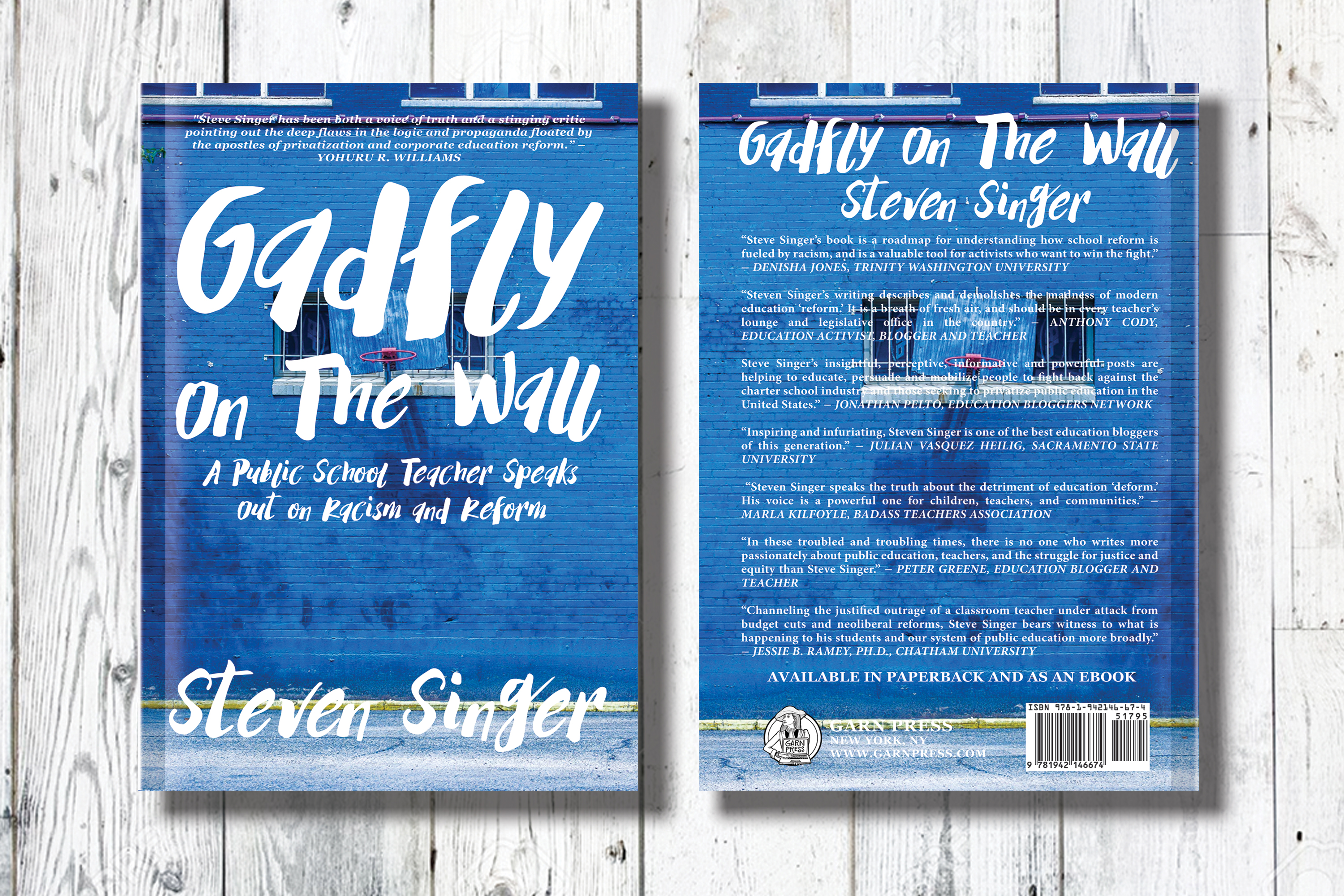
I’ve also written a book, “Gadfly on the Wall: A Public School Teacher Speaks Out on Racism and Reform,” now available from Garn Press. Ten percent of the proceeds go to the Badass Teachers Association. Check it out!

 

Grades and Test Scores Don’t Matter. A Love of Learning Does.

Screen Shot 2018-05-04 at 8.28.42 AM


My daughter probably would be shocked to discover what I truly think about grades.


They don’t matter all that much.


The other day she brought home a pop quiz on sloths from her third grade class. It had a 40% F emblazoned on the top in red ink.


I grabbed the paper from her book bag and asked her to explain what had happened.


She smiled nervously and admitted that she had rushed through the assignment.


I told her I knew she could do better and was very disappointed.


Then we reread the article in her weekly reader and found the right answers to the questions she’d missed.


But if my little girl would be stunned, my students would probably be even more gobsmacked!


As a 7th grade Language Arts teacher, it’s my job to hand out grades. And I don’t give my students too much slack.


Just this morning, I turned to one of my kiddos placidly drawing a Spider-Man doodle in homeroom and asked if he had given me yesterday’s homework.


He wasn’t sure, so I pulled up the gradebook and surprise, surprise, surprise – no homework.


So he took out the half-completed packet, promised to get it done by the end of the day and promptly began working on it.


Don’t get me wrong. No one would ever confuse me for a teacher obsessed with grades and test scores.


I’m way too laid back for that. But my students know I will penalize them if they don’t hand in their assignments. And if it isn’t their best work, I’ll call them out on it.


The way I see it, grades and test scores offer an approximation of how well a student tries to achieve academic goals.


In Language Arts classes like mine, that’s reading, writing and communicating.


After a year of study, I want my students to leave me with an increased ability to read and understand what they’ve read. I want them to form a thoughtful opinion on it and be able to communicate that in multiple ways including verbally and in writing.


An overreliance on testing and grading can actually get in the way of achieving that goal.


According to a University of Michigan study from 2002, a total of 80% of students base their self worth on grades. The lower the grades, the lower their self-esteem.


Common Core fanatics like Bill Gates and David Coleman probably would say that’s a good thing. It provides incentive for children to take school seriously.


However, I think it transforms a self-directed, authentic pursuit of knowledge into grade grubbing. It makes an intrinsic activity purely extrinsic.


Learning no longer becomes about satisfying your curiosity. It becomes a chase after approval and acceptance.


We already know that measuring a phenomena fundamentally changes that phenomena. With a constant emphasis on measurement, children become less creative and less willing to take risks on having a wrong answer.


That’s one of the reasons I prefer teaching the academic track students to the honors kids. They aren’t used to getting all A’s, so they are free to answer a question based on their actual thoughts and feelings. If they get a question wrong, it’s not the end of the world. It hasn’t ruined a perfect GPA and put valedictorian forever out of reach.


Too much rigor (God! I hate that word!) creates academic robots who have lost the will to learn. Their only concern is the grade or the test score.


It also increases the motivation to cheat.


According to a national survey of 24,000 students from 70 high schools, 64% admitted to cheating on a test.


But if the goal is authentic learning, cheating doesn’t help. You can’t cheat to understand better. You can only fool the teacher or the test. You can’t fool your own comprehension.


If you find a novel way of realizing something, that’s not cheating – it’s a learning strategy.


I know this is heresy to some people.


Even some of my colleagues believe that grading, in general, and standardized testing, in particular, are essential to a quality education.


After all, without an objective measure of learning, how can we predict whether students will do well once they move on to college or careers?


Of course, some of us realize standardized testing doesn’t provide an objective measurement. It’s culturally and racially biased. Those test scores don’t just correlate with race and class. They are BASED on factors inextricably linked with those characteristics.


When the standard is wealth and whiteness, it should come as no surprise that poor students of color don’t make the grade. It’s no accident, for example, that American standardized testing sprung out of the eugenics movement.


Yet you don’t need to crack open a book on history or pedagogy to see the uselessness of testing.


High stakes assessments like the SAT do NOT accurately predict future academic success.


Kids with perfect scores on the SAT or ACT tests don’t do better than kids who got lower scores or never took the tests in the first place.


Numerous studies have shown this to be true. The most recent one I’ve seen was from 2014.


Researchers followed more than 123,000 students who attended universities that don’t require applicants to take these tests as a prerequisite for admission. They concluded that SAT and ACT test scores do not correlate with how well a student does in college.


However, classroom grades do have predictive value – especially when compared to standardized tests. Students with high grades in high school but middling test scores do better in college than students with higher test scores and lower grades.


Why? Because grades are based on something other than the ability to take one test. They demonstrate a daily commitment to work hard. They are based on 180 days (in Pennsylvania) of classroom endeavors, whereas standardized tests are based on the labor of an afternoon or a few days.


Yet even classroom grades have their limits.


I remember my high school graduation – sitting on the bleachers in my cap and gown listening to our valedictorian and salutatorian give speeches about the glorious future ahead of us.


Yet for each of those individuals, the future wasn’t quite so bright. Oh, neither of them burned out, but they didn’t exactly set the world on fire, either.


In fact, when I went to college, I found a lot of the highest achievers in high school struggled or had to drop out because they couldn’t adjust. The new freedom of college was too much – they partied and passed out. Yet a middle-of-the-road student like me (Okay, I was really good in English) did much better. I ended up in the honors college with a double major, a masters degree and graduating magna cum laude.


And it’s not just my own experience. The research backs this up.


A Boston College study tracked more than 80 valedictorians over 14 years. These high school high achievers all became well-adjusted professional adults. But none of them made major discoveries, lead their fields or were trailblazers.


For that, you need someone willing to take risks.


The folks the researchers followed admitted that this wasn’t them. Many confessed that they weren’t the smartest people in their classes. They just worked really hard and gave teachers exactly what they thought they wanted.


So what’s the point?


Some people will read this and think I’m against all testing and grading.


Wrong.


I give tests. I calculate grades. And I would do this even if I had the freedom to do whatever I wanted. (Though I would throw every standardized test right in the garbage.)


I think grades and testing have their place. But they aren’t the end, they are a means to an end.


They are crude estimations of learning. They’re an educated guess. That’s all.


We need to move beyond them if we are to modernize our public schools.


Don’t get rid of grades and testing, just change the emphasis. Put a premium on curiosity and creativity. Reward academic risk taking, innovation and imagination. And recognize that most of the time there may be several right answers to the same question.


Heck other countries like Finland already do this.


For the first six years of school, Finnish children are subjected to zero measurement of their abilities. The only standardized test is a final given at the end of senior year in high school.


As a result, their kids have some of the highest test scores in the world. By not focusing on standards and assessments, they counterintuitively top the charts with these very things.


There’s a lesson here for American education policy analysts.


And that lesson is the title of this article.


Like this post? I’ve written a book, “Gadfly on the Wall: A Public School Teacher Speaks Out on Racism and Reform,” now available from Garn Press. Ten percent of the proceeds go to the Badass Teachers Association. Check it out!

book-3


Putting the Arts Back in Language Arts – One Journal at a Time

d3493c8db7e1e4b423ce6b5e87f14eb6

This is the fifth in a series of blog posts focused on the value of art in our lives, and the role art can play in resisting the test and punish model of education.  See the intro and links to other posts in the series here.


Sometimes in public school you’ve just got to cut the crap.

No testing. No close reading. No multiple choice nonsense.

Get back to basics – pass out notebooks, crack them open and students just write.

Not an essay. Not a formal narrative. Not an official document. Just pick up a pencil and see where your imagination takes you.

You’d be surprised the places you’ll go.

You might invent a new superhero and describe her adventures in a marshmallow wonderland. You might create a television show about strangers trapped in an elevator. You might imagine what life would be like if you were no bigger than a flea.

Or you might write about things closer to home. You might describe what it’s like to have to take care of your three younger brothers and sisters after school until just before bedtime when your mom comes back from her third minimum wage job. You might chronicle the dangers of walking home after dismissal where drug dealers rule certain corners and gangs patrol the alleys. You might report on where you got those black and blue marks on your arms, your shoulders, places no one can see when you’re fully clothed.

My class is not for the academic all stars. It’s for children from impoverished families, kids with mostly black and brown skin and test scores that threaten to close their school and put me out of work.

So all these topics and more are fair game. You can write about pretty much whatever you want. I might give you something to get you started. I might ask you a question to get you thinking, or try to challenge you to write about something you’ve never thought about or to avoid certain words or phrases that are just too darn obvious. I might ask your opinion of something in the news or what you think about the school dress code or get your thoughts about how things could improve.

Because I actually care what you think.

Strange, I know.

At times like these, I’m not asking you to dig through a nonfiction text or try to interpret a famous literary icon’s grasp of figurative language. It’s not the author’s opinion that matters – it’s yours – because you are the author. Yes, YOU.

You matter. Your thoughts matter. Your feelings. YOU MATTER!

And sometimes students raise their hands and ask me to read what they’ve written. And sometimes – more often than not – the first thing they say is, “It’s no good.” “I don’t like it.” “I did bad on this.”

So I stop reading, I look them right in the eyes and ask them who wrote it.

“Me?” they say.

And I respond, “Then I’m sure it’s excellent.” And it usually is.

My 8th grade students have been ground down so low under the weight of a society that could care less about their well being that they’ve begun to internalize it. They think their thoughts and feelings are worthless. No one cares about what they think.

But I do.

So I offer them a chance to share what they’ve written. I don’t demand. I don’t force anyone to read anything. I know that some things that spill out on the page aren’t for sharing. But I want them to know that I value what they’ve just put down and that I think it’s worth taking the class time to let others hear it, too.

“Mr. Singer, I wrote five pages,” Jaquae tells me this afternoon. “That’s too long to share.”

“I disagree,” I say. “If you think it’s worth our time, you should read it. You deserve our attention.”

So he reads, blows out a cleansing breath and smiles.

In the process, we all become ennobled. We become more. We become a community. We get a peak at our common humanity.

It’s so easy to look at others as mere adversaries. Even our national education policy sees things in terms of a competition, a race. We set children against each other for points, for grades, for attention, just to feel valuable. You’re a Proficient. You’re a Basic. You’re a Below Basic. And somewhere along the way they lose the sense that they’re all valuable because they’re all human beings with thoughts, feelings and experiences that no one else has ever gone through before – but with which everyone can relate.

So I write, too. Every time I set my students a journal, I put pen to paper, as well.

At the beginning of the year, I share what I wrote to show them that it’s okay. At the middle of the year I ask them if they want me to share. And at the end of the year I remain silent unless they ask me to do otherwise.

Because these class moments aren’t about me. They’re about them. I’m willing to be as much a part of their creative space as they want, but it’s a choice, not a dictate.

In my class I will make you learn, but I don’t control what you learn or how you feel about it.

I extend my students this respect because I know that what we’re really doing isn’t some meaningless exercise. We’re creating art.

Not just scribbles on a page. Not something done just to please the teacher. This is an excavation of the soul. We dive into the depths of ourselves and come back all the better for it.

That’s why my students journal almost every day.

That’s why we put mechanics and spelling and grammar aside for a few moments and just write what we need to say.

Because Language Arts, after all, is an Art. It says that right in the title.

My students are artists. I am their muse. I hold a mirror up to their fractured and beaten spirits to show them the grandeur of what resides inside them.

And hopefully they come away inspired.

Because they are wonders. They are joyous. They are little pieces of my heart.


NOTE: This article was also published in Living in Dialogue, the Badass Teachers Association Blog and mentioned on Diane Ravitch’s blog.