Blame the Victim – America’s Favorite Pastime

officer-ben-fields

I watched a little girl at school refuse to get out of her seat and get pounded by the police.

I watched a teenager in his car try to zoom away from a cop and get shot dead through the driver’s side window.

I watched all of these things and more from the safety of my cell phone. I wasn’t there in person, but I felt like I was.

And I am not alone.

It seems these two events were on everyone’s lips yesterday.

This is one of the fruits of self surveillance – the selfie, the dashcam, the youtube video. Events that would have been shrouded in the haze of he-said-she said are now public domain. The shadowy corners and back alleys are now just as flooded with spotlights as the most crowded theater on Broadway.

In some ways, that’s a really good thing. So many events that only a decade ago would have been hidden forever are now open to public view.

You’d think that would solve a lot of our society’s problems. No more secrets. No more lies. Just objective facts. THIS is what happened. No denying it. We’ll need context, but facts are facts. Now we can come together and decide with clarity what really happened, why it happened and who’s to blame.

However, things don’t always work out as you’d expect.

We can – in fact – agree on the facts but not necessarily on their meaning.

We all see the same images but we somehow don’t see the same things. The same light enters our eyes and forms the same images, but our brains process those images very differently.

We all see a little girl forcibly removed by an officer of the law. We all see a victim and a perpetrator. But which is which?

We all see a police officer exit his car, approach another vehicle which flees from him before he draws his gun and shoots. But who is to blame – the cop or the driver?

We come to different conclusions. And I think the reasons why depend on deep human truths about each of us.

Which side you take says something about you. It shows what kind of person you are, what you value, what assumptions you make about human nature.

When I watch that South Carolina police officer violently grab the little girl and throw her from the room, I focus on the child. Here is a 16-year-old black teen. She apparently was told to leave the room and refused to do so. She was wrong. But my heart won’t let me side against her.

Maybe she hit the officer. Maybe she was verbally abusive. It doesn’t matter. I don’t think a police officer – or any adult – should manhandle a child. If she had a gun, a knife or some weapon, that would be different. But she was just sitting peacefully in her seat. She probably deserved some sort of punishment for insubordination – but not one that would cause her physical harm. I’d be furious if someone treated my daughter that way. And so I am angry at this police officer and all the bystanders who took pains to ignore what was going on.

In a similar manner, when I watch another South Carolina officer approach 19-year-old Zachary Hammond’s car, I begin on the adult’s side. When the teen starts to drive away, I’m with the police officer. The teen is breaking the law. He should listen to the cop who is reasonably asking to question him. However, when the officer draws his gun, things get muddy for me. As the car drives away and the officer shoots into the window, I demand answers. All ambiguity disappears when I discover the teen was unarmed. He wasn’t pointing a gun at the officer. As you can clearly see, the car was not pointed at the cop. The adult was obviously in no danger.

The officer overstepped his bounds. Despite his claims of self defense, despite prosecutors siding with him, I cannot. It seems to me this 19-year-old boy out on a first date was victimized. Yes, he may have had drugs in his system. Yes, he may have possessed drugs with the intention of selling them. None of that justifies murder by a public servant who is charged with protecting and serving society. It may justify arrest, but it does not give the officer the right to be judge, jury and executioner. Imagine if death was the consequence for your own 19-year-old misdeeds! Far too high a price.

However, there are many who disagree. They side in both cases with the adult, with the police. And I see their point to an extent. Police have very difficult and dangerous jobs. They put their lives on the line to uphold laws that are sometimes ambiguous and of dubious value. But there needs to be limits to their authority.

What I find even more troubling is the dynamic between adults and children. Too often grown ups act as if they can do whatever they want to young people. They can touch, hit, belittle. And all in the name of discipline and order.

But maybe this says more about me than anything else. I care deeply about children. Not only am I a parent, I’m a public school teacher. I’ve devoted my life to helping young people get a good start in life. As such, I think violence against children is the most heinous thing anyone can do. It is despicable beyond words. Harming or killing an adult is bad. But do the same thing to a child and it is much worse.

This should be a shared value. It should be a tenet upon which our society is built. But instead too many of us blame the child or the parents. We’re presented with facts but lapse into assumptions about the child’s upbringing and the parents shortcomings. If the youngsters parents had done this or that, things would have been different. And – heck! – that may even be true! However, unlike our infinite surveillance of moments, the facts are not there. We have no record of mass parental neglect. We have just the opposite. In so many cases parents work multiple jobs to feed and clothe these children. They work night shifts. They take classes to improve themselves. So they can’t be present to the degree they’d like. But here we are passing the blame with nothing to support our assumptions but a feeling in our bellies. And we’re so deadly certain about it.

It’s sad really. We all can see the same events but remain unclear about the blame. We share the same senses and most of the same values. But our life experiences and prejudices make all the difference.

When an adult looks at these situations and sides against the child, I think it shows a terrible blindness. When some people look at the student roughed up in the classroom, they automatically side against her for a variety of reasons – race, gender, age, etc. among them. They have preconceptions about how black people act. Preconceptions about little girls. Preconceptions about poor children and their parents. And frankly it shows their moral judgment to be sick, diseased and untrustworthy.

Likewise, when some people see the teen gunned down in his car, they have preconceptions about the police and young people. Anyone on the other side of a police officer’s barrel is wrong simply by virtue of the direction in which he is pointing his gun, they might say. Police are defined as right. Suspects are defined as wrong. This is deeply troubling. It’s counterfactual. It’s untrue. Police are just humans, too. They can be wrong. They have been wrong. If we always assume they are correct in every situation, we are being morally lazy and willfully blind. We’re refusing to look at the facts and then judge accordingly. We stop at who is involved and not at what they did.

It’s so easy to blame the victim. It’s reassuring and safe. It means nothing is out of sorts with the world. Everything is just as it should be. Only this one person who was beaten by the police or shot dead – only that person is to blame. The social order remains intact and proper and good and justified.

It takes a kind of intellectual and moral honesty to look the world in the face and accept that which is uncomfortable but true. Sometimes those charged with protecting us actually do harm. Sometimes adults know less than children. Sometimes actions are racially motivated.

Because when we watch the world, the world looks back. We reveal ourselves. And sometimes we show the world exactly how ugly and depraved we can be as a nation.


NOTE: This article also was published on the Badass Teachers Association blog.
 

White Fragility Frames the Media Narrative of the Million Man March Forward

12139070_1233888909971346_1493116541_n

White people will go a long way to avoid talking about racism.

Not only does it seem invisible to most melanin deficient folks like myself, but we refuse to acknowledge it when someone tries to bring it to our attention.

That’s not racism. There is no racism. Stop stirring up trouble.

Unless someone is wearing a white sheet and burning a cross on a black person’s lawn, most Caucasians close their eyes, stick their fingers in their ears and stay willfully blind.

Sociologists call this White Fragility, and it was on full display in the media response to the Million Man March Forward on Saturday.

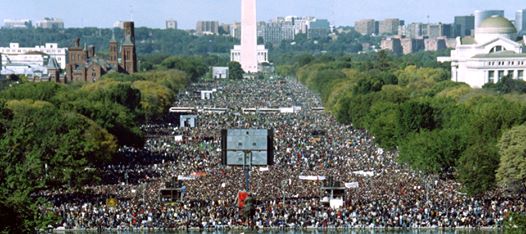
Thousands of African Americans and a smattering of people of other races and ethnicities gathered in the National Mall in Washington, D.C., to demand “Justice or Else” and commemorate the 20th anniversary of the original Million Man March.

Like during that 1995 gathering, today’s media was quick to frame the narrative in a way that silenced legitimate black concerns while benefiting White America.

First, most media outlets refused to cover the event at all. I guess to them there was nothing newsworthy going on. Just tens of thousands of black folks gathering in the nation’s capital. No saggy pants. No guns. Nothing to see here.

When the mainstream news covered it at all, it was to minimized its importance. Short articles basically saying – Here were some black people. Remember that time they did this before? In other news…

I remember the first march back in the 90s. I wasn’t there, but I remember how white folks talked about it. At first there was a genuine fear – black people with a united purpose coming together to better their social standing!? But we quickly found a way to negate everything they were doing.

How? Math.

Har! Har! Look at all those black folks gathered in front of the Capital steps. They held a Million Man March and didn’t even get a million men!

And therefore by the logic of white fragility we can ignore everything they did and said.

Institutionalized racism? Sorry not a million people!

Racial prejudice in hiring and firing employees? Not a million. Can’t hear you!

Police brutality? Come back when you’ve got more people!

12087324_1675832909318901_8512279402781528158_o

Of course it’s still a major point of contention exactly how many bodies showed up that first time. Estimates of the original rally put between 400,000 to 2 million folks on the scene. Unsurprisingly white people almost always go with the smaller number. I guess they don’t think black people can count that high.

But what if the lower estimation is true? Is there some racial math that bestows relevance on a moral crusade based only on sheer numbers? Is it okay to deny a handful of people their rights, a thousand or even a hundred thousand – but somehow a million is the tipping point where I have to say “No more”?

Even if only hundreds of thousands of people showed up, that’s something. Quite a lot, really. Doesn’t that demonstrate an attempt at racial unity, at addressing a shared list of problems? After all, how many people need to attend for White America to take them seriously?

This weekend journalists were careful not to make estimates of the number of attendees at the March Forward. But they’d subtly state that it was less well attended than the previous rally which – given the pictures I’ve seen of both events and the above mentioned disparity – seems somewhat hard to corroborate.

Still the media didn’t stop there. They found other ways to invalidate the event.

For instance, who is leading these marches? The Nation of Islam? Louis Farrakhan? Oh my! White people don’t approve of that! Therefore the whole gathering is unjustified. Poof!

Funny how that works. Black leaders must be perfect. White leaders? Not so much. George W. Bush was a C-student. Bill Clinton had extramarital affairs. Both men served as two-term presidents, and somehow the Republicans and Democrats go on.

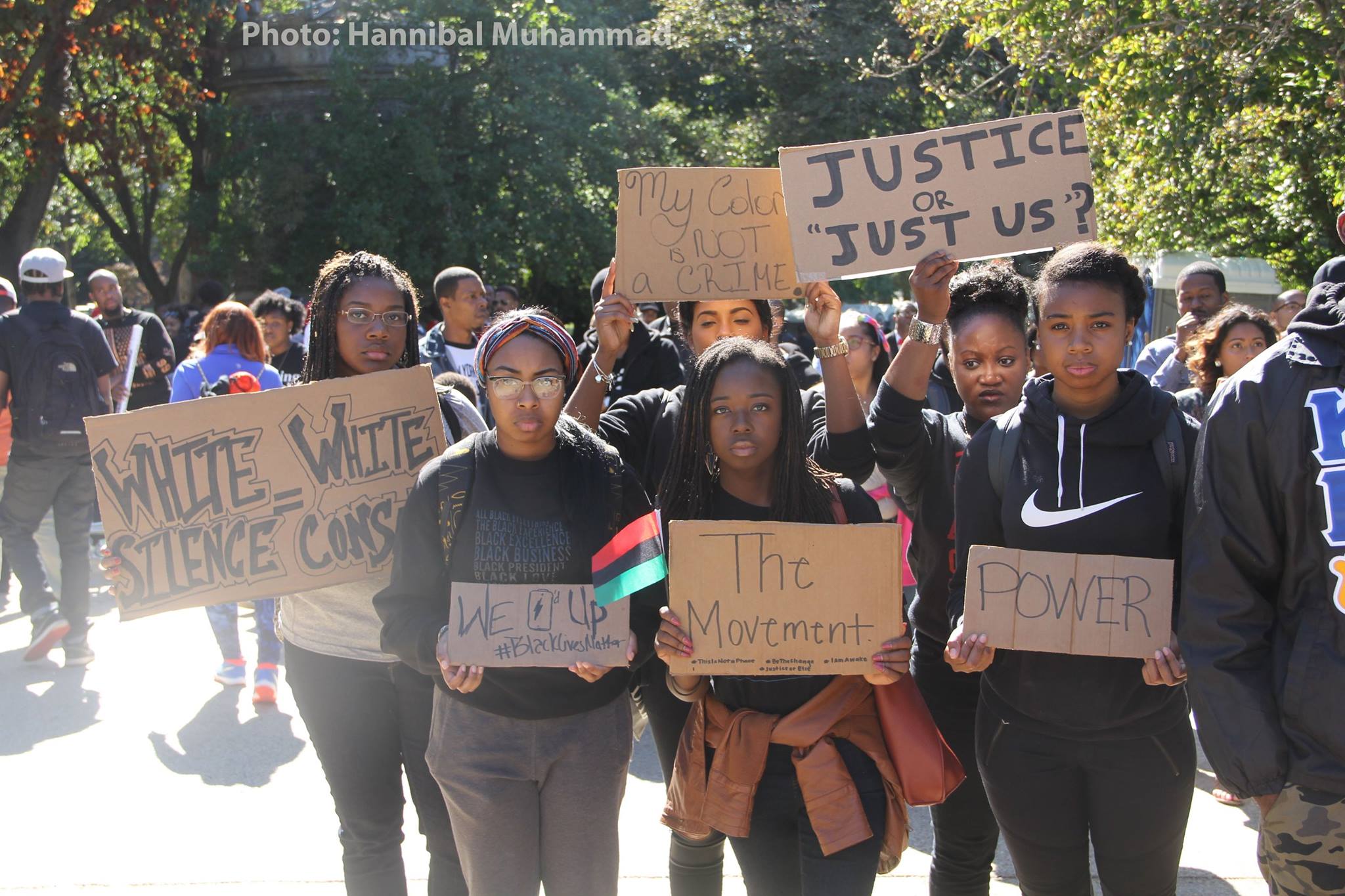
Finally there was the rhetoric. This rally was subtitled “Justice or Else.”

That just won’t do. Angry black people demanding justice? No, white people simply will not respond to that kind of tone. If only they had been more polite about it, we might listen, but “Justice or else”!? Nope.

Any rational human being should be able to comprehend why black folks are demanding justice; They aren’t getting much of it from our courts. Unarmed black people are increasingly being murdered by the police and white citizens which prompts the debate of whether a crime has even been committed – a debate in which the answer is often, “No.”

The Black Lives Matter movement has grown because of just such concerns and the group was even represented at the rally.

But white folks – in the guise of analysis – ask what that phrase means “justice or else.” Are black people threatening to attack white people if they don’t get justice? What justice is there beyond a court of law? Do they really expect us to change our laws and hold our courts accountable?

No. Nothing to see here, folks. This throng of humanity peacefully assembling clearly has no valid points to make. Turn the cameras off. Let’s go home.

But had these thousands suddenly thrown bottles, overturned cars or started fires, the spot light would have been turned on full force.

“Another black riot,” newscasters would have proclaimed with glee. CNN would have devoted 24-hour news coverage. Expensive graphics would show the exact extent of the damage between interviews with scared white folks wondering why black people were allowed to misbehave so!

But a peaceful rally of African Americans coming together to share their pain, commemorate their history of struggle and commit to solutions?

Who cares about that? It doesn’t fit the media narrative. It doesn’t help white people ignore their black brothers and sisters problems. It doesn’t help our system of white supremacy remain invisible.

As a representative of the white race, may I make a suggestion? Could we possibly consider listening to what these people have to say? And before rejecting it out of hand, might we look at it objectively and even find a valid point or two? Could we then try to offer our black brothers and sisters a hand?

But the answer is always the same from white folks. Excuse after excuse to ignore, reject, repulse and keep our fragile white eyes firmly shut.

12105954_10106301025970309_961760835270051441_n


NOTE: This article also was published in the LA Progressive and on the Badass Teachers Association blog.
 

White People Need to Stop Snickering at Black Names

baby-and-parents

As a public school teacher, few things give me as much anxiety as getting my student rosters for the first time.

I look over the list of names for my incoming children and cringe.

How do I pronounce that?

Every year it never fails – there’s always at least four or five names I’ve never seen before – or at least never spelled quite like THAT!

As a white teacher in a district with a majority of black students but very few black teachers, there’s not really many people to turn to for guidance.

And if I don’t figure it out soon, I’ll be making a pretty terrible first impression. No one likes to have their name butchered, especially children, especially if an adult is doing it, especially if that adult is white.

The only solution I’ve found is to soldier on with the first day’s attendance and just try my best:

Me: Shah-NEE-Qwa?

Child: Shah-NAY-Qwa.

Me: JAY-Marcus?

Child: JAH-Marcus.

It’s uncomfortable, but I get through it and eventually learn.

However, one thing I’ve stopped doing is going to other white people for help. That’s a recipe for disaster.

It almost always turns into an exercise in subtle racism and white supremacy. No matter who the person is, no matter how kind, caring or empathetic, the reaction to unique black names is most often derision.

White people snicker and use the situation as the impetus for telling stories about other black names that they thought were even more outrageous.

It’s not that we’re trying to be hateful. I don’t think we even recognize it as racist, but it is.

We use the situation as an opportunity for bonding. THOSE people who are not like you and me – THEY name their children things like THIS! Not like you and me who name our children more respectably.

Make no mistake. This is racist behavior. We are emphasizing the otherness of an entire group of people to put ourselves over and above them.

It’s bigoted, discriminatory, prejudicial and just plain dumb.

What’s wrong with black names anyway? What about them is so unacceptable?

We act as if only European and Anglicized names are reasonable. But I don’t have to go far down my rosters to find white kids with names like Braelyn, Declyn, Jaydon, Jaxon, Gunner or Hunter. I’ve never heard white folks yucking it up over those names.

I can’t imagine why white people even expect people of color to have the same sorts of names as we do. When you pick the label by which your child will be known, you often resort to a shared cultural history. My great-great-grandfather was David, so I’ll honor his memory by calling my firstborn son the same. Jennifer is a name that’s been in my family for generations so I’ll reconnect with that history by calling my daughter by the same name.

Few black people in America share this same culture with white people. If a black man’s great-great-grandfather’s name was David, that might not be the name he was born with – it may have been chosen for him – forced upon him – by his slave master. It should be obvious why African Americans may be uncomfortable reconnecting with that history.

Many modern black names are, in fact, an attempt to reconnect with the history that was stolen from them. Names like Ashanti, Imani and Kenya have African origins. Others are religious. Names like Aaliyah, Tanisha and Aisha are traditionally Muslim. Some come from other languages such as Monique, Chantal, and Andre come from French. I can’t understand why any of that is seen as worthy of ridicule.

Still other names don’t attempt to reconnect with a lost past – they try to forge ahead and create a new future. The creativity and invention of black names is seldom recognized by White America. We pretend that creating names anew shows a lack of imagination when in reality, it shows just the opposite!

Creating something new can be as simple as taking an Anglicized name and spelling it in inventive ways. Punctuation marks also can be utilized in unusual positions to add even more distinctiveness such as in the names Mo’nique and D’Andre.

At other times, they follow a cultural pattern to signify as uniquely African American using prefixes such as La/Le, Da/De, Ra/Re, or Ja/Je and suffixes such as -ique/iqua, -isha, and -aun/-awn.

And for the ultimate in creativity, try mixing and matching various influences and techniques. For instance, LaKeisha has elements from both French and African roots. Other names like LaTanisha, DeShawn, JaMarcus, DeAndre, and Shaniqua were created in the same way.

This is something all cultures do. They evolve to meet the needs of people in a given time and place. Yet when it comes to people of color, we, white folks, whoop and guffaw at it. Heck! When we can’t find black names far enough out of our mainstream, we even make them up!

Don’t believe me? Have you heard of La-a? The story goes that a black girl was given that name and a white person asked how it was pronounced. The black woman said her name was La-DASH-ah. This is often followed by a punchline of black vernacular.

Har! Har! Har!

But it’s not even true! According to Snopes, this is a made up story. It’s the American version of a Polish joke and demonstrates how far white people will go to laugh at black culture.

The great comedy duo Key and Peele tried to call attention to this in their outstanding substitute teacher sketches. In a series of short routines, an almost exclusively white classroom gets a black substitute teacher from the inner city schools. Mr. Garvey is expecting black names, so he pronounces the students’ middle class white names as if they were African American.

Almost everyone loves this sketch. It gets universal laughs, but wait until it’s over. Too many white folks try to continue the giggles by then talking about crazy black names they’ve encountered. But that’s not at all the point Key and Peel were trying to make! They were trying to show how cultural context shapes our expectations of proper names. Mr. Garvey is worthy of our laughter because his expectations are out-of-sync with his surroundings. When we expect all African Americans to have European or Anglicized names, we’re just as out of touch as Mr. Garvey. But like Dave Chapelle’s comedy, sometimes the person laughing the loudest is getting something the comedian didn’t intend at all.

Maybe it wouldn’t be so bad if black names just generated snickers. However, white culture actually selects against people with black sounding names.

Countless studies have shown how much more difficult it is for someone with a black sounding name to get a job, a loan or an apartment than it is for someone with a white sounding name. It’s one of the most obvious features of white supremacy. You may not like black names, personally, but do these people deserve to suffer for embracing their own culture?

Moreover, having a European or Anglicized name is no guarantee of fair treatment. It certainly didn’t help Michael Brown or Freddie Gray.

If we’re really going to treat people equitably, an easy place to begin is with black names. White people, stop the laughter and giggles. I used to do it, myself, until I thought about it. Yes, I’m guilty of the same thing. But I stopped. You can, too.

It’s not the biggest thing in the world. It’s not even the most pressing thing. It’s not a matter of guilt. It’s a matter of fairness.

Because when the final role is taken of all America’s racists and bigots, do you really want your name to be on it?


NOTE: This article also was published on Everyday Feminism and the Badass Teachers Association blog.

Why You Should Thank Harper Lee for Tearing Down Your Childhood Hero

Screen shot 2015-08-27 at 10.47.03 PM

It’s been more than 50 years since Harper Lee published her Pulitzer Prize winning novel “To Kill a Mockingbird.”

In that time, a lot has changed and nothing has changed.

Our schools are still highly segregated and unequal – but we justify that with standardized test scores. Our prisons are still disproportionately filled with black and brown people – but we justify that with the War on Drugs. Racial minorities are still gunned down in the street while their killers get off scot-free – but we justify that with a dysfunctional justice system.

Yes, we have our first black president but most people of color still live under the shadow of white privilege and a government sanctioned caste system.

Now comes “Go Set a Watchman” a book Lee wrote before “Mockingbird” but that works best as a sequel.

Does it matter? Is it still relevant?

I’d say yes.  After all, the original was written as people across the nation were struggling to overthrow the old racist system. And today many of their grandchildren and great-grandchildren are still engaged in that same struggle.

In a world where the majority cling desperately to colorblindness, it’s refreshing to read a book that proclaims black lives matter – even if it was written in the 1950s.

The most striking thing about the new novel is its portrayal of Atticus Finch. In “Mockingbird” he’s described as the quintessential hero – a white lawyer putting himself at great personal risk in a doomed attempt to defend an innocent black man. In “Watchman” Atticus is… well… a bit of a racist.

He’s 20 years older, has joined a neighborhood committee dedicated to keeping the races separate and we learn that at one time he had even been a member of the Ku Klux Klan.

How can we reconcile THIS Atticus with the one we remember from our childhoods? Is it even worth trying? Is the book worth reading?

Let’s start with the book’s literary value. Questions abound about its publication. Lee, 88, lives in a nursing home and is reportedly in ill health. After all this time, did she really want this book out there now or is that the result of overzealous publishers who know any book with her name on it will be a best seller? Moreover, her sister, Alice, served as a protector of Harper’s legacy but almost as soon as she died, the book was slated for publication.

And when you actually crack it open, it’s clear that certain passages are almost identical to others in “Mockingbird.” You can see how the one book lead to the other. Moreover, there are places that could use expansion and others that could use a bit of editing.

However, despite its shortcomings, from the first page to the last “Watchman” is like returning home to Maycomb County.

In the first chapter, we share a 20-something Jean Louise’s excitement on the train from New York south to visit her family, because we want to see these people again, too. Unlike a simple rereading of the classic “Mockingbird,” this time the characters have grown, changed and act in unexpected ways. Like our protagonist, though, we’re in for many a rude awakening.

Scout’s brother, Jem, is dead, and his absence is felt throughout most of the book. At first, I was angry about this. I thought it was simply bad writing, trying to artificially limit the characters. But then I realized Lee had already set up Jem’s demise back in “Mockingbird.” After all, their mother died around the same age from a heart attack – a congenital defect on her side of the family.

Jem’s absence is irksome because it’s real. Too many times in life people who mean so much to us just disappear leaving a hole never to be filled again.

Likewise, Dill is hardly to be seen. However, this shouldn’t be surprising. Both books are semi-autobiographical and his character is modeled after Harper’s childhood friend – Truman Capote. In the novel just as in life, our heroine, Scout/Harper, and Dill/Truman grew apart.

In his place we get Hank – a character never mentioned in “Mockingbird” but who apparently was around – somewhere. He serves as Scout’s boyfriend. Though he’s drawn a bit vaguely, through him we get to see the kind of woman Jean Louise has grown into.

The Scout of “Watchman” is different than her 6-8-year-old self, too. But it’s easy to see how the little girl of the previous book could become the intelligent but restless woman in this text.

Calpurnia is much changed. She no longer works for the family. In fact, she seems to have enclosed herself in the Quarter – the part of town where only the black people live.

With the U.S. Supreme Court ruling in Brown vs. Board of Education,  Maycomb’s black folks seem much less inclined to smile and nod and serve every passing whim of white people. They have an inkling that maybe things could be different, that maybe they’re entitled to equal rights, after all. And these new possibilities come between Jean Louise and the woman who raised her more than any other.

Calpurnia is the one who explained to her what it means to be a woman. She explained everything from menstruation to sexual intercourse. Yet these new possibilities in social justice make it impossible for the two women to have a proper homecoming.

I wonder: would Jean Louise really not begrudge Calpurnia all the rights and privileges she so easily expects as her own right? It’s hard to say but still very sad.

On the other hand, Aunt Alexandra hasn’t changed much. She’s still disapproving, tyrannical yet emotional. Likewise, Uncle Jack is much the same. He’s grown more eccentric but it’s easy to recognize the friendly doctor who bandaged Scout’s hand after she punched her cousin for calling her father a racial epithet in “Mockingbird.” And neither does Atticus seem drastically different at first. He’s older and suffers from terrible arthritis. But at first glance he’s the same caring, wise paternal figure of our remembrances.

For about 100 pages the book is a mostly meandering return to a world we never thought we’d see again. Then everything changes with the bombshell of Atticus’ recent pro-segregation activities.

How can it be possible? Can this really be Atticus Finch? Or is this just bad writing?

We know the character is based on Harper’s own father, Amasa Lee. Is this really more of a portrait of the real man than the fictional one?

It’s hard to say. But as we read on it becomes clear that, yes, this is still the Atticus we remember. But we didn’t know him as well as we thought.

(WARNING: Limited spoilers ahead.)

The heart of the novel is when Jean Louise confronts her father about his seemingly new attitude. In typical Atticus style, he argues with her almost like he was defending himself in court. Some of his defense makes a weird kind of sense. He says he briefly joined the Klan just to see who was behind those hoods. He wanted to know whom he was dealing with. Moreover, his participation in this segregation society was to serve as a moderating influence. He wanted to make sure they didn’t get up to too much trouble.

But this is only half an answer. As he continues, it becomes clear that Atticus actually does believe some of the racist rhetoric of his times. He really doesn’t want black people and white people to be put on an equal footing. He justifies this by saying black people aren’t ready yet. They haven’t been prepared for the rights and privileges of white folks. Maybe some day they will be, but not today.

It’s a disgusting and patronizing argument – infantilizing an entire people. And hearing this out of Atticus mouth – it’s like seeing a spider crawl across a gorgeous face.

Similarly creepy is his appeal to state’s rights – an argument we still hear today from our Tea Party friends. Perhaps it WAS Southern white people’s responsibility to raise up the people of color in their midst – but if they weren’t going to do it, it was past time that someone did!

Scout doesn’t let her father get away with any of this. She does her best to verbally destroy him and run away forever.

But before she can escape, she runs into her Uncle Jack. What he does is equal parts rationality and sexism. I can’t imagine any modern author resolving the story this way. Perhaps that’s for the best. In some ways, Uncle Jack’s actions are more disturbing than Atticus’ opinions.

In the end, Scout learns to accept her father for who he is. Yes, he is dead wrong about black people, but most of the time he’s still the same loving Atticus. It’s a good point. How many people do you love who believe reprehensible things? Probably a lot. That doesn’t mean you stop loving them.

I’d say that’s the central point of the novel. Each of us is responsible for creating our own conscience. We can’t rely on any value system that comes to us prepackaged. We have to examine every facet of our worlds and decide what it is we truly believe. And in doing so we’ll probably reach divergent opinions.

The only way Lee could do that was by showing us the heroic Atticus as nothing but a flesh and blood human being, full of the same frailties and mistaken thinking.

In the end, Scout’s thoughts seem more modern than anyone else’s in the book, more in line with our own views about social justice. But her conclusion only goes so far. We’re still left with questions. How do we reach loved ones who disagree with us? How can we tell if our own ethical intuitions are correct? How can white folks best help people of color secure their rightful place in society?

None of these have answers, but Lee is still asking the right questions. More than 50 years later, we’re still searching for solutions.

Why are Black Lives Matter Activists Targeting Bernie Sanders? Because He Gets It – Almost

bernie-sanders-black-lives-matter-seattle

Why?

Why would two Black Lives Matter protestors disrupt Bernie Sanders’ campaign speech on Saturday?

It’s the question everyone seems to be trying to answer.

Marissa Johnson and Mara Willaford, two women of color fighting for the destruction of white privilege.

Sanders, a 73-year-old Jewish former Civil Rights activist-cum-Presidential candidate.

You’d think they’d have plenty in common. You’d think they’d be on the same side.

And even after this weekend’s confrontation, you might still be right.

But the questions remain: Why shout down Bernie’s speech on social security? And why did they do almost the same thing to him and fellow Democratic presidential candidate Martin O’Malley at Netroots Nation a few weeks ago? Why haven’t they targeted the Democratic frontrunner Hillary Clinton? Why not Republicans? What do they hope to accomplish? Is someone putting them up to this?

Frankly, I don’t know the answers to most of these questions. But I can make some educated guesses.

So here goes.

Is someone putting Black Lives Matter up to this?

No. I don’t think so. All you have to do is watch the video of this weekend’s action to see these two women weren’t playing at anything. They weren’t following anyone’s orders. They’re either really good actors or they believe in what they’re doing.

What do they hope to accomplish?

Here I don’t need to guess. Black Lives Matter’s Seattle chapter put out a press release explaining this very thing. In short:

“BLM Seattle… held Bernie Sanders publicly accountable for his lack of support for the Black Lives Matter movement and his blatantly silencing response to the ‪#‎SayHerName‬ ‪#‎IfIDieInPoliceCustody‬ action that took place at Netroots this year.”

The activists are protesting Sanders because they think he isn’t supportive enough of their cause.

However, the U.S. Senator from Vermont probably has spoken more on this topic than any other Presidential candidate of either major political party.

For instance, he specifically addressed physical violence against people of color, saying:

“Sandra Bland, Michael Brown, Rekia Boyd, Eric Garner, Walter Scott, Freddie Gray, Tamir Rice, Samuel DuBose. We know their names. Each of them died unarmed at the hands of police officers or in police custody. The chants are growing louder. People are angry and they have a right to be angry. We should not fool ourselves into thinking that this violence only affects those whose names have appeared on TV or in the newspaper.”

Why haven’t they targeted Hillary Clinton?

I don’t know. My guess is access. As a former First Lady, Hillary is protected by the secret service. Sanders isn’t. Moreover, both events where activists shouted down candidates had minimal security. They weren’t even individual candidates’ events. They were rallies with multiple speakers.

I don’t think they’re ignoring Hillary. It’s simply that they can’t get to her.

Some people, however, are inferring from this that her campaign may be behind these disruptions. Black Lives Matter is aligned with the Clintons and she’s using them to take out her biggest rival, they say. There are even a slew of articles accusing BLM of taking money from liberal billionaire George Soros, a long-time Clinton backer.

Here’s the problem with this theory: it’s completely unsubstantiated. There is not a shred of evidence linking BLM and Soros or Clinton.

I don’t doubt that Hillary would like to get BLM’s support. She’s clearly made overtures to them, changed her campaign rhetoric and otherwise tried to get them on her side. However, all the changes she’s made don’t amount to the degree BLM is already in line with Sanders. All Hillary really did was stop saying “All lives matter.” That’s not exactly a lot.

Moreover, BLM is not a political party. It is not nearly as organized as some people seem to believe. There are many chapters claiming to be part of BLM. There are many activists who consider themselves part of BLM. But there does not appear to be any major central organization sending out formal marching orders to these chapters.

I know it would be comforting to believe this is a political power grab by Clinton, but that just doesn’t appear to be the case.

Why not target Republicans?

This would make political sense, wouldn’t it? If you watched the GOP Presidential debate last week, you saw plenty of targets. There was lots of white privilege on display but very little talk about it. Dr. Ben Carson, the only African American candidate, even rhapsodized about how much society is over all that racial disparity nonsense these days. In an interview with Meet the Press, he called BLM “Silly.” You might expect activists to go after him or his colleagues.

Here’s why I think they haven’t done that so far. They know Republicans don’t care. Seriously. Why would they waste their time going after people who won’t listen, never have listened and never will? Unless you were doing it to make a bigger political point. Unless you were trying to contrast the Republican view with another one. But what other view is there to contrast it against?

Which brings me to…

Why target Bernie Sanders?

I think the answer is that Bernie almost gets it. He’s accessible, he’s mentioned these issues before and he seems willing to listen and evolve.

Think about it. When activists took the microphone this weekend, he could have called the police. He could have had them forcibly removed. But he didn’t. He gave them the podium and when it looked like they weren’t going to give it back, he left.

Do you think Chris Christie would have done that? Heck No!

So What’s Going on?

I think it comes down to this: the Obama Presidency is ending.

When he ran for office the first time, his campaign was transformative. It was a moment of incredible optimism. He wasn’t promising some tired old party agenda. He was promising Hope and Change. And his very candidacy and people’s reaction to it were proof that change really was coming.

For a few months there it seemed like White America actually cared about black people’s problems. We were all going to walk hand-in-hand into the promised land together.

But it didn’t actually work out that way. Though Obama has been a good president in many ways, he isn’t the transformative figure we thought he would be. When push comes to shove, he didn’t really do all that much for black people, either. And his very presence in the White House stirred up long repressed racist feelings from low class whites.

There’s a great moment in Richard Wright’s Native Son where the main character looks at a plane flying in the sky and can’t imagine how a black person could ever be up there at that height. For many people, Obama’s highest function has been a symbol. The most powerful man in the world is black. He shows that, yes, black folks actually can attain those heights undreamed of by past generations.

But it’s coming to an end. The next President will almost certainly not be African American. And those who do have a chance don’t even seem to be talking about issues that are important to the black community.

It’s as if American society is getting ready to sweep black folks back under the rug for another 200 years.

So yeah. I can understand why Black Lives Matter protestors are angry. People of color are still locked away in prison much more frequently and with much harsher sentences than white folks. That’s if they even make it to prison. Too many are being gunned down in the street and their killers are left to walk away free and clear. They’re even murdered in their own churches.

And we’re doing next to nothing to help.

Everywhere you look white privilege cages them in, and all these smiling, well meaning white faces don’t seem to care enough to do anything about it.

So here comes Bernie Sanders. Is he a man who seems to kinda get it? Does that make him more attractive or more infuriating?

Because though Bernie will talk about these issues, his main focus is not racial equality, it’s economic. He’s most concerned with balancing the scales monetarily.

Certainly this is important, but it’s not the same as destroying white privilege. You could reform the tax code and make sure everyone pays their fair share, but there would still be police officers barrel rolling on top of black teenage girls with the audacity to go to a mostly white swim party.

These are related issues, certainly, but not identical. In fact, if American society were a wall, the bricks might be income inequality, but the mortar would be racism. Why do poor white folks put up with the 1% trampling on them? Because the powers that be have given those poor whites someone they can trample – black folks. If you’re a white person working three jobs just to make ends meet, at least you can look at a black man and know you’ve probably got it better than him. You don’t have any money, but at least if the police pull you over, you’re probably going to survive the encounter.

That’s why I think Black Lives Matter activists are angry. That’s why they’re targeting Bernie.

It’s not that they hate him or want him to fail. He represents the one thing in which it is most painful to believe – hope.

I know people are angry on both sides. I know we can argue about tactics and timing, but we’re missing a real opportunity here.

Imagine if Bernie worked WITH Black Lives Matter. Imagine if he made dismantling white privilege a major plank of his campaign. Imagine if we were all united again.

And this time, imagine if we stayed that way well past election day.


NOTE: This article also was published in the LA Progressive and on the Badass Teachers Association Blog.

We Shall Overcome… Our Lack of Standardized Tests!?

Screen shot 2015-07-19 at 12.34.34 AM

Civil Rights groups have long championed the needs of people of color, women and minorities.

Segregated schools, voting rights, police brutality – all of these have been the subject of long and brutal fights for equality.

Perhaps the strangest turn in 2015 has been the fight for standardized testing.

That’s right. Organizations that you’d expect to see fighting against racism have been clamoring for access to multiple choice bubble exams.

In fact, the Democrats have used this as an excuse for their failed attempts to keep the much maligned Test and Punish policies of Presidents George W. Bush and Barack Obama in the rewrite of the Elementary and Secondary Education Act (ESEA).

The law – currently called No Child Left Behind (NCLB) – is a testing corporation’s dream filled with policies that have been failing our children for 13 years. Unsurprisingly, teachers, parents and students are demanding relief.

But do Civil Rights groups who fought against unfair testing as a prerequisite to vote now really demand unfair testing as a prerequisite for a high school diploma?

The answer is yes and no.

SOME Civil Rights groups have demanded more testing, and others have demanded LESS.

The Journey for Justice Alliance (JJA), a group made up of 38 organizations of Black and Brown parents and students in 23 states, wrote Congress an open letter in July asking for an end to high stakes testing. And the JJA wasn’t alone. The alliance was joined by 175 other national and local grassroots community, youth and civil rights organizations who signed on to the letter to “…call on the U.S. Congress to pass an ESEA reauthorization without requiring the regime of oppressive, high stakes, standardized testing and sanctions that have recently been promoted as civil rights provisions within ESEA.”

However, the JJA’s call has been largely ignored by lawmakers and the media. A much smaller coalition of Civil Rights organizations in favor of testing, on the other hand, has been given so much press you’d be excused if you thought they represented the entire activist community.

Yes, 19 Civil Rights organizations wrote to Congress in January, 2015, asking lawmakers to preserve annual testing.

However, 11 Civil Rights groups – many of them the exact same groups – wrote to Obama in October, 2014, asking him to reduce standardized testing.

What happened in less than 3 months, to change their minds?

It’s hard to say, but in October the prospect of rewriting the ESEA – the federal law that governs K-12 schools – seemed impossible. Neither Democrats nor Republicans could find any common ground. It looked like the law – which was last reauthorized in 2007 – would be pushed aside until at least the next president was sworn in.

But then like magic when the political situation changed and reauthorization seemed like it might actually happen, suddenly a coalition of Civil Rights organizations found their love for standardized testing.

It seems highly unlikely that these two events are unrelated.

But why would these organizations change their tune so quickly?

One very real possibility is money.

Most of the groups now backing standardized assessments accept huge sums of money from one of the richest men in the world – Bill Gates. And Bill loves standardized tests.

In many ways, his business profits from them. Common Core State Standards (CCSS) wouldn’t exist without his backing, and they depend on standardized tests. Moreover, most states give these assessments on computers – many of which have Microsoft emblazoned on the hard drive. And this doesn’t even count the test preparation software sold to help students get higher test scores.

The sad fact is that standardized testing is big business in this country. Everyone from book publishers to software manufacturers to professional development providers to for-profit prisons depend on the continuation of the testocracy.

And many of these Civil Rights groups would be crippled without that Gates funding. Others seem more like think tanks that really have nothing to do with Civil Rights.

Take Education Trust – an advocacy group that helped create NCLB and CCSS. It should be no surprise the organization took $49 million from Gates and thinks bubble tests are just wonderful.

However, even laudable groups like the United Negro College Fund (UNCF) owe Gates a debt.

UNCF took more than $1.5 billion from Gates. Ostensibly that money is supposed to go to scholarships. And there’s nothing wrong with that. But how could the organization go against the wishes of perhaps its biggest donor? The consequences could be disastrous for UNCF’s entirely worthy mission.

One can imagine administrators stuck between a rock and a hard place having to compromise their stance against testing in order to continue helping people of color fulfill their dreams of going to college.

Other suddenly pro-test organizations taking money from Gates include: La Raza, The Leadership Conference, National Urban League, and Children Defense Fund.

And that’s only the half of it.

To make matters worse, standardized tests don’t enhance students’ Civil Rights. They violate them.

Test scores are used as an excuse to continue spending less money on poor schools who serve mostly minority populations.

Proponents say these assessments hold schools accountable for providing children with a quality education. But how can you provide an education of equal quality with a rich school when you don’t receive even close to the same amount of funding to begin with?

Moreover, test scores have been shown countless times to be poor indicators of academic success. They are, however, excellent predictors of parental income. Poor kids score low. Rich kids score high. So when we take away funding based on low test scores and increase it based on high test scores, we only reinforce the status quo and compound the hurt against people of color.

But this sudden public mea culpa from some Civil Rights organizations is being used by political pundits to justify continuing the practices that would make Martin Luther King, Jr., turn in his grave.

And it’s not over. As Congress continues to hobble together a new version of the ESEA, politicians – mostly Democrats – are bound to lobby for as much federally mandated testing as possible. Even Obama has promised to veto the bill if it doesn’t contain enough love for the testing industry.

It’s up to education voters to educate themselves on the subject and demand real Civil Rights reforms.

End the system of Test and Punish.

Remove or reduce standardized testing from our schools.

Provide equitable funding for schools serving impoverished children.

And give our students of color a fighting chance to achieve the American Dream.


NOTE: This article also was published in the LA Progressive and on the Badass Teachers Association blog.

You Can’t Solve Prejudice With a Cookie-Cutter: Celebrate Diversity

057 soft chocolate chip cookies for blog

If America was a cookie, it would probably be chocolate chip.

Sure it’s mostly dough, but the chips are what give it flavor!

I mean, come on! Who wants a plain sugar cookie!? Yuck!

Maybe that’s what they meant all those years ago when they described us as a melting pot. All these different races and nationalities blending together to form a delicious whole.

However, some flavors just don’t mix – or at very least are slow to come together.

In fact, since the very beginning, much of America has been obsessed with ensuring we DON’T mix! Chips and dough can’t melt together! We must preserve the purity of the batter. In fact, let’s send those chips back to Belgium!

But times have changed. We’ve tried to legislate our way to equality. Voting Rights Acts. Anti-Segregation Acts. Non-Discrimination Laws. But the legal system is far from perfect, and it can only do so much. If we’re really going to become one big tasty treat, we’ve got to do something about it – each and every one of us.

So how do we all come together? What should be our goal?

For some people, the answer is silence. We shouldn’t talk about this stuff at all.

There’s very little scientific justification for categorizing ourselves into different races, anyway. Just button your lip and it will all go away.

To which I say, yeah, many things such as race, nationality, even sexuality are to a large extent man-made. They’re the product of culture and society, but that doesn’t make them unreal. They’re totems, archetypes, symbols we use to navigate the social universe. If you think a social constraint is unreal, try violating it.

Moreover, ignoring inequality won’t solve it. That only ensures that the status quo continues to reproduce itself.

In short, if we don’t talk about prejudice, we’ll never get over it. Our biases will never go away.

Other folks – many with the best of intentions – think not that our differences are unreal, but that we should ignore them. Don’t talk about us and them. It’s all just us.

No more twitter campaigns proclaiming #AllChipsMatter. We should instead join hands and proclaim #AllIngredientsMatter.

And I do see your point. We are all important regardless of race, nationality, gender, religion, sexual orientation, etc. But is this really the best way to come together as a nation? If all of us taste the same, we’ll certainly be one – one bland and lousy confection sitting in the bakery that no one in their right mind would really want to eat.

Homogenization has its strengths. Look at white folks. We used to be very different. Czech, Slovak, German, Russian, etc. Now we’re one indistinguishable whole. Sometimes we venture outside of that label for a few hours to celebrate some ethnic festival, but most of the time we’re just white, White, WHITE. Having a beer and a Wiener Schnitzel during Oktoberfest doesn’t change how you usually identify and how you are identified in the world.

But something has been lost here. You can only be blind to the differences in people if you wipe away the rough edges. People become less distinct, more similar. That’s not the best way to be.

There’s another way.

Instead of ignoring the differences between people, we should embrace them. Don’t hide your nationality, your race, etc. Celebrate them!

I am the proud product of this culture! I am the son or daughter of this type of person! I love this! I believe that! I am not just anyone – I am ME!

There is a danger when anyone suggests conformity as a way to fight racism, sexism or any form of prejudice. It puts the responsibility on those who are different. If you don’t want to be discriminated against, YOU need to conform.

I think this is wrong. You have the right to be yourself. Instead it is the responsibility of those who would discriminate to STOP.

If you’re racist, YOU need to stop.

If you’re sexist, YOU need to stop.

If you’re homophobic, YOU need to stop.

And so on.

This isn’t as easy as it sounds. You can’t just walk it off. Prejudice is the result of years of enculturation, socialization and bigotry. It takes time. It takes a loving heart. But most of all it takes two very important things that few people in America have truly achieved:

1) Willingness to try.

2) Acknowledging that there is a problem in the first place.

That’s where we are today.

Very few people exist in the United States without some prejudice. People feel uncomfortable around those unlike themselves. We have preconceptions about how certain people will act. We think we know better how other people should live their lives.

These are all prejudices. And what’s worse, many of them are actually unconscious. I didn’t even recognize that I got nervous around black people – and now that I do, I don’t want to feel that way. I know it’s not justified, but I still can’t help the feeling!

So there is much to be done here in the USA to make us the best we could be. And it is our job to do that work.

Because the cookie of America has lots of cracks in it and more than a few nuts.

Why Are Black People So Nonviolent? And Why Aren’t Whites?

th

If hate were a sport, I’d bet on white.

Really. We’re good at it.

White people have been hating, brutalizing and killing people way more effectively than black people for – well – ever.

Don’t be modest, Caucasians. The Holocaust, ethnic cleansing, colonization of Africa and the Caribbean, American slavery, Native American Genocide, Jim Crow – we’re the world freakin’ champions!

But somehow in the media it’s the black man who is portrayed as the savage.

It’s just not fair. We white folks are so much better at race-based aggression than our darker complected brothers.

Just this Wednesday a white guy walked into a historic African American Church in South Carolina, was accepted as part of the service, stayed for about an hour before shouting a spiteful message and gunning down several parishioners!

Now that’s some hate right there!

But at first the people on my TV refused to give us white folks credit. They were questioning everything from the killer’s motives to his race! As if this had to be a black man in white face persecuting the faithful! Not some kind of hate crime!

Maybe it shouldn’t be surprising that the media narrative always runs counter to the truth of the violent white man and in favor of the myth of the savage black man.

Whenever anyone brings up race and violence, the first thing people mention is crime.

There is more black-on-black crime than white-on-black crime, they say. And they’re correct!

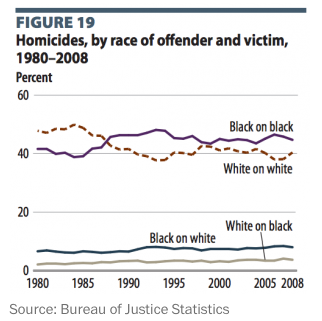
According to a 2013 FBI Uniform Crime Report, when it comes to murder, 90 percent of black victims were killed by black offenders.

However, what people fail to mention is that according to the very same report, 83 percent of white victims were killed by white offenders, too.

These numbers don’t show black people are more violent than white people. They show that BOTH white and black people would rather kill within their own race.

Screen shot 2015-06-18 at 10.33.37 PM

In terms of raw numbers, black people and white people actually commit about the same number of murders. But you wouldn’t know that from the media.

I don’t know why these media types aren’t wringing their hands over the spurt of white violence in this country instead of spending valuable broadcasting minutes exclusively on black people.

You’d almost think they were biased or something, trying to spin the truth, tell you a story that wasn’t entirely factual.

And speaking of bad arguments, this one has suddenly shifted.

We started talking about race-based aggression and we suddenly shifted to all violence. Let’s get back to hate crimes, because that’s really the area where white people excel.

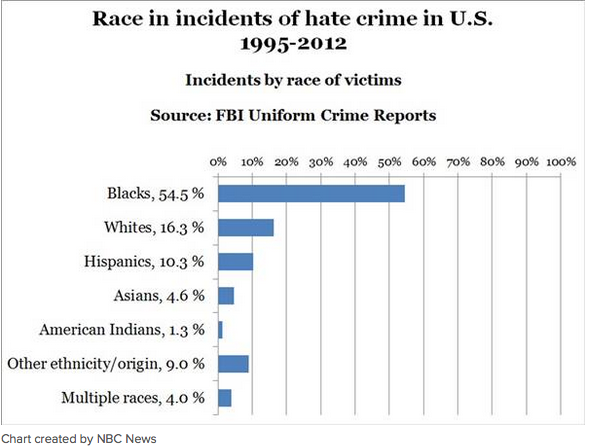
The FBI is charged under the Hate Crime Statistics Act with compiling statistics on spite-based legal transgressions. In its most recent report, for 2013, hate crimes based on race are far more numerous than any other kind.

Screen shot 2015-06-18 at 10.28.45 PM

Moreover, bias-motivated infractions against black folks far exceed those against white people.

According to the FBI statistics, 54.5 percent of the reported single-bias hate crimes that were racially motivated in 2013 targeted blacks. Only 16.3% target whites.

Screen shot 2015-06-18 at 10.28.26 PM

But you really didn’t need an FBI report to tell you that, did you? American history is littered with the bodies of beaten and brutalized people of color. You could make a very convincing argument that these dead souls make up the foundation of our country. Would our economy really have been so robust without the free labor of all those slaves? Heck! Would we even have a country at all if we hadn’t murdered all those indigenous peoples in the first place?

I know. You’re going to say that other predominately white countries have violent histories, too. And you’d be right. But notice the difference in our attitudes about it today!

Historically, Germany is no slacker when it comes to racial violence, but is there any government building in the German Republic today that continues to fly a Nazi flag? Absolutely not. In fact, it is illegal to do so.

By contrast, in America we love the stars and bars of the Confederate flag. It still waves proudly over the South Carolina capital building. (But I’m sure that has nothing to do with the violence we saw at that Charleston church I mentioned earlier!)

So let’s put it to rest. When it comes to hate crimes, white folks kill! But don’t feel too bad, black folks. There are things you’re good at, too. Like nonviolent resistance.

Heck! You’re amazing at that!

Langston Hughes wrote, “Negroes – Sweet and docile, Meek, humble, and kind: Beware the day – They change their mind.”

After all this time, black people have very rarely used violence as a means to achieve their ends, to try to secure the rights and freedoms white America guards so jealously.

In just the past year or so, unarmed black folks have been assaulted or killed for holding toy guns, being suspected of selling loose cigarettes, listening to music at a gas station, asking for help after a car accident, wearing hoodies, wearing bikinis, running, and now just going to church!

And the response from the black community has been pretty darn nonviolent. Yeah there’s been some shouting and looting, but very little beating or killing.

White folks, can you imagine having to undergo such indignity on a daily basis and NOT responding in kind!?

No wonder a blonde white girl from a Christian fundamentalist home darkened her skin, curled her hair and tried to pass as black! Sometimes – often really – it’s darn embarrassing to be white! Black folks have the moral high ground.

Somehow they live in an American society that heaps hatred on their every move and they respond with dignity and perseverance.

So why are black people so nonviolent?

Damned if I know! But I wish us white folks would take a lesson from them.


NOTE: This article also was published on the Badass Teachers Association blog.


UPDATE: There has been a criticism of this article I’d like to address. I have claimed, “In terms of raw numbers, black people and white people actually commit about the same number of murders.” Some say this works against my argument that black people are less violent than white people. After all, there are fewer black people in the country, yet they commit about the same number of murders as white people. Doesn’t that make them more violent?


I think if you factor in poverty, the numbers wash. After all, poor people are generally more violent than those in better circumstances. Since most black people experience higher levels of poverty than most white people, we can only expect higher proportions of murders from them. When your options are limited between working several minimum wage jobs to squeak by or to engage in the drug trade for a higher income bracket, well it’s not surprising. If black folks weren’t subjected to such high poverty rates, we would expect the black murder rate to plummet.


I know some readers won’t accept that answer. And if so, fine. However, this doesn’t affect at all my assertion that black people commit a fraction of the country’s hate crimes. Whether you look at it proportionately or numerically, white folks are MUCH more likely to commit hate crimes than black folks. I think that’s significant.


However, I have received enough correspondence from readers of this article to know that many don’t care. This article has been surprisingly popular. It still gets hundreds of hits every week. Unfortunately, many of the people who seem to find it appear to be those with an axe to grind. WordPress allows me to see what readers type into a search engine to find this article. I can see what sites lead you here. I know that white supremacists and far right conservatives are loving this article as an example of “liberal, white self hate.” The responses to this article in some of the darker corners of the Internet have been as hilarious as they are badly argued. It appears that some people are so committed to the idea that black people are violent that nothing anyone says could convince them otherwise. Moreover, they are so enamored with white violence that they see it as evidence of white superiority or else they try to argue it away as being perpetrated by people who are not truly white.


To those people I have only pity. Love is stronger than hate. I honestly hope that one day you will understand.


The School-to-Prison Pipeline: Turning Kids into Cash

Screen shot 2015-06-07 at 10.34.48 PM
For too many children, public school is just a “GO DIRECTLY TO JAIL” card.

Do not pass GO. Do not collect $200.

The institution that should be raising kids to the skies is chaining them to the ground.

It’s called the School-to-Prison Pipeline, and it disproportionately affects students of color and the poor.

School policy at the highest levels is designed to sort and rank students. Some go to the college track. Some go to the industrial track. And even more end up on the prison track.

We actually have procedures that prepare certain children for life behind bars.

Why? Because people make money from it.

Think about it. The United States represents only 4.4% of the world population but we house 22% of the world’s prisoners. We’re the number one jailor!

It’s not that our citizens are out of control. It’s not a rise in violent crime. In fact, the crime rate has decreased to 1970s levels.

But instead someone has found a way to convert prisoners into cash.

Since the 1980s, we’ve been handing over our prison system to private companies to run for a profit.

The number of inmates in privatized prisons has increased by 44% in the last decade alone, according to a 2013 Bloomberg report.

This creates a market. Without a steady stream of prisoners, these institutions would go bankrupt. And corporations such as Corrections Corporation of America and The GEO Group spend tons of cash lobbying our government to ensure just that.

It’s no accident that our national education policy meets the needs of the for-profit prison industry.

Look at the so-called education reforms of the last decade: increasing standardization, efforts to close schools serving poor and minority children, cutting school budgets and narrowing the curriculum. All of these serve to push kids out of school and into the streets where they are more likely to engage in criminal activity and enter the criminal justice system.

Federal education policy – whether it be No Child Left Behind or Race to the Top – continually doubles down on privatization and standardization. These policies consistently have failed to produce academic gains but are offered as the only possible solution in school reform initiatives.

Question: Why do we keep enacting the same failed policies?

Answer: Because they are not MEANT to succeed. They are meant to fail a certain percentage, race and economic bracket.

If we had effective education procedures that increased academic success, we wouldn’t have enough prisoners to feed our for-profit prisons. Lawmakers would loose valuable lobbying revenue.

Call it what you will – misplaced priorities, profiteering or an outright scam. But the reform-to-profit cycle is advocated, perpetrated and championed by the most prominent figures in the so-called education reform movement.

Take Bill Gates – the monetary force behind Common Core State Standards (CCSS), one of the leading policies in education.

The Bill and Melinda Gates Foundation also is an investor in The GEO Group – one of the biggest for-profit prison providers in the country. It’s most recent tax filing (2013) shows a more than $2 million investment.

Nominally a philanthropic organization, the Gates Foundation refuses to admit if it still backs the industry or by how much. Sure Gates underwriting is just a drop in the bucket, but it proves how the organization’s interest is economic and not charitable. It is one of a herd of Trojan horses stampeding over the cries of critics under a banner of largesse.

Likewise, Common Core essentially isn’t concerned with increasing the quality of children’s education. CCSS has never been proven to be effective and is – in fact – developmentally inappropriate. But it’s touted as a panacea to a host of ills when its real concern is to continue fortifying the prison machine.

We live in a country where more than half of the children attending public school live below the poverty line. They need proper nutrition, social assistance, tutoring, counseling and a host of wrap around services. But instead they get so-called “higher” academic standards and standardized tests.

It’s like a sporting goods store withholding wheelchairs to the Special Olympics and instead donating extra hurdles – all the while claiming it was trying to help participants become better hoppers!

Even worse, these standards aren’t actually better. They’re just confusing, ignorant and ill-conceived. After all, they weren’t developed by educators. They were made by ideologues who admit they were unqualified for the task.

Was this a huge mistake? No. These standards and the associated bubble tests that drive them do exactly what they were meant to do.

They increase the numbers of failing students. They push more kids out of school and into the waiting arms of the prison industry.

And when kids have difficulty sitting through the hours, days, and months of test prep that are increasingly replacing a well-rounded curriculum, they face unfair discipline practices.

We treat misbehaving kids like little criminals.

Can’t sit still in class? Can’t keep quiet? Can’t control your frustration?

Out you go! Detentions, suspensions, expulsions!

We have zero tolerance for your childish behavior – even if you are still a child.

And unsurprisingly the majority of the children who are crushed by the hammer of discipline have dark skin.

Let me be clear. I’m not saying that misbehaving children shouldn’t be disciplined. Far from it.

But we need to stop criminalizing their misbehavior.

If we can’t provide them with schools that teach in a developmentally appropriate manner – it’s not the children who are misbehaving. It’s us! The school system!

Moreover, when a child has a problem conforming to the norm, our first reaction shouldn’t be punishment. It should be understanding. The goal should be to find ways to change the negative behavior, not weed the kid out of the system.

But this means treating children as ends not means.

We have to care about their well-being. They have to be more than just piggy banks for big business.

Otherwise, it is our sick society that really deserves to be sent to jail.


NOTE: This article also appeared in the LA Progressive, ConversationED and the Badass Teachers Association blog.

I am Racist and (If You’re White) You Probably Are, Too

Screen shot 2015-06-02 at 1.42.34 PM

I am a white man.

I am racist.

But that’s kind of redundant.

It’s like saying, “I am a fish, and I am soaking wet.

In some ways, I can’t help it. I don’t even notice it. I live my life immersed in a world of white privilege that most of the time I frankly can’t even see.

That doesn’t excuse me. It doesn’t mean I should just shrug and say, “What are you gonna’ do?”

But it does mean that the first step in removing that racism – in undoing the systematic subjugation of people of color – is recognizing my own culpability in that system.

It’s like being an alcoholic. The first step is admitting the truth.

I know I’ve pissed off a lot of people with what I’ve just written. This article isn’t about gaining new friends. But I’m sure I’ll have a lot of death threats to delete from the comments section tomorrow.

The initial reaction white people usually have to being called racist is – Who? Me? I can’t be racist! I have a black friend! I dated a black girl once! I listen to rap music!

Or a whole host of other excuses.

First of all, relax. I don’t know you. For all I know you’re that one white guy out there who has somehow escaped the pervasive societal attitudes that the rest of us unknowingly took in with our baby formula.

But chances are – yeah, you’re a racist, too.

Second of all, I’m not talking to people of color. None of you are racist. Congratulations!

You might be a hate-filled bigoted, misogynistic, xenophobic, homophobic, prejudiced asshole.

Again, I don’t know you. But racist? No. You can’t really be that.

Here’s why. Racism doesn’t mean hating someone because of their race. That’s a kind of prejudice. And anyone can be prejudiced.

Racism is hate plus power. If a black person says, “I hate white people,” he is prejudiced. However, there is no system that then backs up his hatred. The police don’t arrest white people more than black people for the same crimes. The judicial system doesn’t give harsher sentences to white people than it does black people for the same crimes. Public schools serving a majority of white students aren’t chronically underfunded. It isn’t harder to get a loan or a job if you have a white-sounding name. If it did, THAT would be racism!

Get it?

So I’m sorry, white people. This means there is no such thing as reverse racism. Despite what you may see on Fox News, the only racists in America have white skin.

Don’t get me wrong. There are degrees of racism. If you have a Confederate flag prominently displayed in your home in front of your personally autographed picture with David Duke, well you’re probably a bit more racist than most Caucasians. But no matter what, if you’re white, you’ve probably benefited from white supremacy and are de facto racist.

Maybe your folks gave you a middle class upbringing in a quiet suburb. Maybe you went to a well-funded public school in a wealthy neighborhood. Maybe your dad was convicted of white collar crime and got little to no jail time. Heck! Maybe you just walked down the street once and the police didn’t follow you through a convenience store or reached for their guns.

If your upbringing was in any way favored due to wealth amassed over a few generations, you benefited from white privilege. If the judicial system let you or a loved one go with a lighter sentence, you benefited. If you were not harassed by law enforcement because of your complexion, you benefited. And when you benefit from a system, you’re part of it.

For every white person in America, it is almost certain that something like this happened to you at some point in your life. And you probably had no idea it was even occurring.

Good fortune becomes a self-fulfilling prophecy. People start to think they deserve it. And maybe they do, maybe they don’t. But people of color who don’t have such privileges certainly don’t deserve their inequitable treatment.

When we fail to acknowledge that white supremacy exists or that it benefits us, white folks, we’re just perpetuating that same system.

Some of you will say I’m putting too much emphasis on race. We’re all the same under the skin. We shouldn’t bring up the topic of racism. It just makes things worse.

Easy for you to say! You’re on top of the social food chain! If we don’t talk about the inherent inequalities entrenched in the system, nothing will change. Us, white folks, will continue to benefit, and black folks will continue to get the short end of the stick.

One of the biggest obstacles to solving racism is its invisibility – to white folks.

We’re shielded from it because its negative effects don’t reach us, and its positive effects to us are either shrugged off or we assume we deserve them.

Being racist rarely involves overt action anymore. It’s become covert, an entrenched sickness in all our social systems. And the only way to cure it is to make it visible – to recognize, isolate and destroy it.

I know. Some of you will say you had it tough, too. And you probably did. Few people live charmed lives. There are poor white folks. There are white people who are discriminated against because of their gender, nationality, sexual preference and/or religion. But this doesn’t mean you didn’t benefit. There is a crossroads of American prejudice and racism is only one of many intersecting avenues.

Maybe you were the victim sometimes, but you were probably the victor in others, and you never even saw it coming.

The point isn’t to say which malady is worse. They’re all bad and all deserving of a cure. But if you really don’t want to be a racist, you have to look it straight in the eye and call it by its rightful name.

You probably didn’t ask to be treated differently. Most of us just want fairness. But to be on that side we have to proclaim our allegiance. We have to take a stand.

Whenever you see injustice against people of color, you must call it out. You must make yourself a part of the solution and not the problem. You must be a voice demanding the citadel of white privilege be burned to the ground.

It’s not easy. You’ll be called all sorts of names: bleeding heart, libtard, self-hating white, maybe even cracka. Because even people of color may not understand what you’re trying to do. After so many years of racial oppression by people with melanin deficiency, they may not trust an open hand when they’ve been so used to expecting a fist.

But that’s okay. It’s understandable. The only thing to do is press on. Understanding will come – eventually.

Racism is a problem for black folks, but the solution is mostly in the hands of white people. We’re the ones doing – or allowing – racism. It’s our job to fix it.

And much of that work will not be in the public sphere. It will be in our own hearts.

Many of us have been socialized to be afraid of black folks. We get this from the news, movies, television, the internet, often even our own relatives and friends. We’re constantly told how dangerous black people are, how untrustworthy, how violent. But the facts don’t bare this out. Given the degree of aggression – both overt and covert – black people have endured from white people over time, they have been incredibly non-violent. It is us, white people, who have been violent and inhuman. That is the legacy we hide under our fear of dark skin. We’re really afraid that one day our black brothers and sisters will have had enough and give back to us all the accumulated hate of centuries.

No. We aren’t responsible for slavery or Jim Crow or lynchings or a host of other horrible things. But we still benefit from them.

So it is up to us to even the scales, to treat black folks fairly and equitably with a loving heart.

That is why I make this confession. That is why I write this article that will probably be roundly criticized or maybe just ignored.

That’s why I admit I’m a racist.

It’s the only way to stop being one.


NOTE: This article also was published on commondreams.org.