No TEST Left Behind – Why the Senate ESEA Reauthorization is Unacceptable

student_reading_ap_img_0
Testing.

Testing.

One, two, three…

How about four? Maybe more.

There’s never enough testing for you and me!

And that’s exactly the problem with the Senate reauthorization of the Elementary and Secondary Education Act (ESEA) – the federal law that governs K-12 schools.

The Senate draft of the law (currently called No Child Left Behind) doesn’t do a single thing to limit or reduce standardized testing.

It keeps annual testing in place, untouched.

The legislation needs reauhorized every five years. After epochs of political stalling, the House and Senate are both hammering out versions of the law.

If this Senate version were enacted, public school students across the country would still be subjected to standardized tests in grades 3-8 and once in high school.

And legislators have the gall to call this the “Every Child Achieves Act of 2015.”

Ha! They should call it what it really is – No TEST Left Behind.

Now is the perfect moment to rein in our nationwide addiction to fill-in-the-bubble multiple choice tests. There is a national consensus that these sorts of assessments do more damage than good. Legislators should listen.

The Senate even asked concerned parents, teachers and people of conscience to write in with suggestions to improve the law. But instead of actually doing the most important thing on everyone’s list – the one thing that almost everyone who isn’t profiting off of the testing industry wants – they chickened out.

Why?

Education historian Diane Ravich has an interesting theory. In a comment on her blog, she says, “I have spoken to people directly involved in the negotiations who told me that President Obama made known that he would veto any bill that does not include annual testing.”

It wouldn’t be the first time the President’s threatened to veto this legislation. Just a few months ago he promised to return the House’s version of the ESEA if it left open the Title I piggy bank to privatizers.

That much-publicized threat was a sane response to an insane suggestion by partisans. But veto the ESEA if it didn’t have enough testing? That would be highly controversial.

Can I prove he said it? No, but Ravich is a reputable source. After all, she was U.S. Assistant Secretary of Education under President George H. W. Bush. She served under Lamar Alexander – then Secretary of Education and now one of the U.S. Senators chairing this reauthorization project. She’s in a unique position to know.

Moreover, this alleged threat is right in line with comments made by Obama’s own Secretary of Education, Arne Duncan.

“I believe parents, teachers, and students have both the right and the need to know how much progress all students are making each year towards college-and career-readiness.” Duncan said in a January speech.

“That means all students need to take annual, statewide assessments that are aligned with their teacher’s classroom instruction in reading and math in grades 3-8, and once in high school.”

Duncan’s assertion – clearly supported by President Obama – is that annual testing is necessary to show if kids are learning. Without it, we wouldn’t know if schools were teaching them.

This is absurd.

The ONLY way to tell if a child can read is a standardized test? The ONLY way to tell if a child can add and subtract is if they can choose between A, B, C or D?

Such an assertion is not only a slap in the face of every classroom teacher who grades their students on actual work done in the classroom, it’s also an insult to the intelligence of the American people.

Students do a variety of assignments throughout the year to demonstrate their learning – book reports, essays, group projects, reading aloud, homework, power point presentations – heck – even just walking up to the blackboard and solving a problem with a piece of old fashioned white chalk!

All of these things show nothing!? They provide no significant data with which to determine if a child is learning!?

I guess teachers just wander around all year saying “I’ll find out if my students learned anything when they take their state assessments. In the meantime I’ll just throw darts at the wall to determine the grades to put on their report cards.”

Moreover, where is the proof that standardized tests are such good indicators? Which peer-reviewed studies have ever proven that the results of these tests are – in fact – valid?

The answer: there are no such studies. In fact, there is a mountain of evidence that proves just the opposite. Standardized test scores are highly correlated with a child’s parental income. Rich kids generally score highly and poor kids score lower.

That’s what these tests measure – not academic achievement.

And it should be no surprise considering how they’re scored. Go on Craig’sList and find yourself an advertisement seeking test scorers. You need have no experience or degree in education. What counts as a passing score changes from year-to-year based on the whim of the scorers.

The whole system is set up to fail as many kids as possible in order to justify the need for more test prep materials which are often provided by the same giant corporations that make the tests in the first place.

And THIS is what Obama is demanding we keep in our public schools or else he’ll veto the legislation?

I say, “Fine! Veto it!”

Obama is already the testing president. He hides behind his lap dog, Duncan, but it is and always has been his policy to double down on George W. Bush’s bad educational ideas.

So I say we force him to own up. Make him admit it to the world, shout it to the heavens – I am President Barrack Obama, and I will do anything for standardized testing!

Then for once critics could actually blame him for something he really did.

Annual testing!? Thanks, Obama!

The President and Duncan claim to hear these testing criticisms, but they’re talking out of both sides of their mouths.

Duncan says he’ll ask Congress to include language in the ESEA to call on states to set limits on how much time can be spent on testing.

They demand we keep it, but let’s spend less time doing it!?

So we’ll still take all those math and reading tests, but maybe there will be less questions? We’ll force schools to spend less time on test prep by timing them and punishing those who don’t comply?

Which brings me to the best thing about the Senate version of the ESEA. It puts a stop to this kind of federal meddling. No more top down we-know-better-than-you federal mandates.

Annual testing is still in there, but the act leaves it up to states how to use the scores. No more Adequate Yearly Progress (AYP). The act forbids the federal government from dictating to states and districts how to help improve schools where kids are struggling.

Moreover, it no longer requires states to create new teacher evaluation systems, though it allows them to do so if they wish. And the fed cannot mandate or incentivize states to adopt particular standards such as Common Core. States are required to have standards but are free to determine their content.

These – at least – are positive revisions. They demonstrate why some education advocates are expressing cautious optimism about this Senate version of the ESEA.

But it’s just not enough. Sorry.

I could be political and say “It’s a good first step,” but that’s all it would be. A first step on a long and treacherous journey. Don’t start patting yourself on the back just yet. There’s a long way to go.

There’s no mystery what needs to be done to improve public education – fund it.

Stop wasting tax dollars trying to determine where the problem is. That’s obvious! It would be like a fire department spending all it’s money on a high tech machine to scan the city in infrared to determine where the maximum heat sources are and thus where they should dispatch the fire truck. But all they have to do is take the call and follow the smoke, screams and flames!

The high poverty schools are the ones that are struggling the most. More than half of our public school students live below the poverty line. They need help!

And stop offering funding with strings attached! We’ll let you buy books for your students if you use these fancy new standards that have never been tried or proven to work.

It’s time for action.

We must be bold. No more chasing after scraps. We must demand Congress get this right – regardless of presidential threats.

And please no grade span testing!

Even organizations like Fair Test – who rightly criticize the Senate ESEA for similar reasons outlined here – don’t go far enough in their demands of Congress.

Instead of asking for an end to standardized testing, they request a reduction. Not tests yearly in grades 3-8 and once in high school, but once in elementary, middle and high school.

Yes, it’s better than annual testing, but have some courage.

There is no need for our children to take even one standardized test. That should be our demand.

Zero standardized tests. Not six, not three, not one. ZERO.

We might not get it, but we’ll get a whole lot more than if we start from a compromise position.

The time is now. Write your Congresspeople. Write the President. Tell them in no uncertain terms – NO MORE STANDARDIZED TESTING!

PUT CHILDREN FIRST! LEAVE ALL TESTS BEHIND!


NOTE: This article also appeared in the LA Progressive and the Badass Teachers Association blog.

Not My Daughter – One Dad’s Journey to Protect His Little Girl from Toxic Testing

FATHERS-AND-DAUGHTERS

I’ll admit it – I was scared.

I’m a nationally board certified teacher with a masters degree in education. I’ve taught public school for over a dozen years. But I’ve only been a daddy for half that time.

Would making this call get my little girl in trouble?

I didn’t want to rock the boat. I didn’t want my daughter to suffer because her old man is making a fuss. I didn’t want her teachers and principal giving her a hard time because of something I did.

But I couldn’t deny what I know.

Standardized testing is destroying public education. It’s stressing kids out by demanding they perform at levels they aren’t developmentally ready to reach. And its using these false measures of proficiency to “prove” how bad public schools are so they can be replaced by for-profit charters that will reduce the quality of kids’ educations to generate profits.

No. There was no doubt about it. I had to make this phone call.

I used my most professional voice on the line with the principal.

“Hi, Mr. Smith. This is Steven Singer. I’m Amy’s father. I know she’s just in kindergarten but it’s come to my attention she’s taking standardized tests, and I’d like to opt her out.”

Before my little girl started school, I hadn’t even realized there were standardized tests in kindergarten. She takes both the DIBELS and the GRADE test.

He seemed surprised, even a bit fearful, but he quickly suggested a meeting with me, my daughter’s teacher, the councilor and a few others to get it done.

It was my turn to be surprised. I had expected to be asked to review the tests before writing a formal letter citing my “religious” reason for refusal. But I guess things are different before students reach third grade. Without legislation mandating a formal process, we needed to meet and discuss like adults.

And a few weeks later, here I was waiting for that meeting to begin.

It wasn’t long before my daughter’s teacher arrived. We chatted briefly about a fire drill and how my sweetheart hadn’t been afraid. Then the councilor, principal and others came in and ushered us into the conference room.

Most of the space was taken up by a long rectangular table surrounded by black leather chairs on wheels. It looked like the kind of place where important decisions are made – a bit imposing really.

We sat down and Mr. Smith introduced me to the team and told them I had some concerns about standardized testing.

He paused letting me know it was my turn to speak. I took out my little notebook, swallowed and began.

“Let me start by saying I think the education my daughter is receiving here is top notch,” I said.

“Her teacher is fabulous, the support staff do a wonderful job, and I could not be happier with the services she’s receiving here.

“My ONLY concern is standardized tests. In general, I’m against them. I have no problem with teacher-created tests, just not the standardized ones.

“It’s come to my attention that my daughter takes the DIBELS and GRADE test. Is that correct?”

They nodded.

“As you know, I teach at the secondary level and proctor the GRADE test to my own students. I’m sure the version given to elementary children is somewhat different, but I know first hand how flawed this assessment is.

“Put simply, it’s not a good test. It doesn’t assess academic learning. It has no research behind it to prove its effectiveness and it’s a huge waste of time where kids could be learning.”

I paused to see them all nodding in agreement.

In many ways, the GRADE is your typical standardized test. Vocabulary, sentence completion, passage comprehension – fill-in-the-bubble nonsense.

Mr. Smith blushed in agreement. He admitted that he probably shouldn’t be so candid but the district probably wouldn’t give the GRADE test if it didn’t receive a Keystone to Opportunity Grant for doing so. When and if the grant runs out, the district probably would stop giving the test, he said.

It’s an old story – the same as at my own district. Two school systems serving high poverty populations bribed with extra money if they spend a large chunk of it on Pearson testing and remediation.

“As to the DIBELS,” I went on, “I had to really do some research. As something that’s only given at the elementary level, it’s not something I knew much about.

“However, after reading numerous scholarly articles on the subject, I decided it wasn’t good for my daughter either.”

When taking the DIBELS, the teacher meets with a student one-on-one while the child reads aloud and is timed with a stopwatch. Some of the words the child is asked to read make sense. Some are just nonsense words. The test is graded by how many words the child pronounces correctly in a given time period.

“My concern is that the test doesn’t assess comprehension,” I said. “It rewards someone who reads quickly but not someone who understands what she’s reading.

“Moreover, there is a political side to the test since it’s owned by Rupert Murdoch. Cut scores are being artificially raised to make it look like more students are failing and thus our schools aren’t doing a good job.

“Finally, focusing on pronunciation separate from comprehension narrows the curriculum and takes away time from proven strategies that actually would help my daughter become a better reader.”

I closed my notebook and looked around the table.

Silence.

I thought that maybe I hadn’t done enough research. I had been too quick and simple.

But the team quickly agreed with me. And when Mr. Smith saw that, I noticed his cheeks darkening.

He stuttered a few words before giving up. “I’ve never had a parent ask to opt out of the DIBELS before,” he said.

He said the DIBELS is a piece of the data teachers use to make academic decisions about their students. Without it, how would they know if their children could read, were hitting certain benchmarks?

“I know I teach secondary and that’s different than elementary,” I said, “but there is not a single standardized test that I give my kids that returns any useful information.

“I don’t need a test to tell me if my students can read. I don’t need a test to know if they can write or spell. I know just by interacting with them in the classroom.”

The fear was still in his eyes. He turned to my daughter’s teacher. “I don’t mean to put you on the spot here, but what do you think? Does the DIBELS provide you with useful information?” he asked.

The look on her face was priceless. It was like someone had finally asked her a question she had been waiting years to answer.

“No,” she said. “I don’t need the DIBELS to know if my kids can read.”

It was all down hill from there.

I agreed to revisit the situation if a problem arose but teacher recommendation will take the place of the DIBELS in the meantime.

Conversation quickly turned to hilarious anecdotes of my daughter’s school antics. What she said to get in trouble last week. How she tries to get adults to put on her coat when she’s perfectly capable of doing it herself.

I left the building feeling really good. This is the way it’s supposed to be.

Before we signed up my little girl for school, I had been nervous about her attending my home district. I wasn’t sure it was good enough for her. The papers said it was a failing school. I wanted so much to ensure my baby would have the best of everything – the best I could provide.

My district may not have the most up-to-date facilities. It may not have the smallest classes. But it has a team of dedicated educators and administrators who are committed to meeting the needs of their students.

Even Mr. Smith’s hesitancy is understandable. I don’t blame him one bit. He probably thinks DIBELS scores make an elementary principal like him look good. Kids starting from scratch only can go up. The scores can only improve.

Moreover, he sat down with me and heard me out. He may not have entirely agreed with me – in fact at times he looked at me like I had a third arm growing out of my forehead – but he respected my parental rights.

It wasn’t until then that I realized the power parents truly have. Mr. Smith might have refused a TEACHER who brought up all of the concerns I had. He’s their boss. He trusts his own judgment.

But I don’t work for him. In fact, he works for me. And – to his credit – he knows that.

I know everyone isn’t as lucky as me. Some people live in districts that aren’t as receptive. But if parents rose up en masse and spoke out against toxic testing, it would end tomorrow.

If regular everyday Dads and Moms stood up for their children and asked questions, there would be no more Race to the Top, Common Core or annual standardized testing.

Because while teachers have years of experience, knowledge and love – parents have the power.

Imagine if we all worked together! What a world we could build for our children!


NOTE: Small details may have been changed to protect the innocent.

ADDITIONAL NOTE: This article also was published in the Washington Post, Diane Ravich’s blog and the Badass Teachers Association blog.

Coming Soon – Badass Films!

11025643_1787964744761514_7757764095588311307_n

Quick! Somebody microwave Bill Gates a bag of popcorn!

Fluff up Arne Duncan’s favorite pillow!

Get Chris Christie some Sour Patch Kids!

A lot of Sour Patch Kids!

Because the show is about to begin!

Coming Friday, March 6, I’ll be launching Badass Films.

This new venture is a division of the Badass Teachers Association (BATs). Your humble blogger is a member of the leadership team.

I’ve made 12 very short films about corporate school reform and the grassroots movement that fights against it.

They’re nothing fancy – just something I whipped up with imovie. But I hope they’ll help spread the message and get people up to speed on the damage being done to our school system by standardization and privatization. I also hope to shine a light on some of the amazing people out there – parents, teachers, students, and people of conscience – who are fighting against factory schools with all their might.

I already released this film called “Opt Out of Standardized testing:

Friday I’ll release the remaining 11.

Here are the working titles and a few mock movie posters made by our incredible BAT Meme Team:

COMMON CORE

11025657_10203268816873981_1262629182399128973_n

(Meme by Lisa Smith)

CHARTER SCHOOL TREASURE HUNT

11018333_1787967094761279_1927574463641915875_n

(Meme by Deb Escobar)

V.A.M. SHAM

10407708_1787964788094843_6197962986326075342_n

(Meme by Lisa Smith)

SCHOOL TO PRISON PIPELINE

11041805_1787967058094616_9048113339296113831_n

(Meme by Lisa Smith)

SOCIAL JUSTICE

11021256_10203265686555725_803665120896316326_n

(Meme by Lisa Smith)

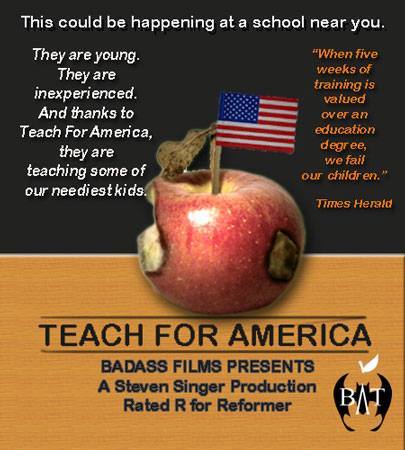
TEACH FOR AMERICA

13153_1787964821428173_6920343151965987041_n

(Meme by Deb Escobar)

TEACHERS UNIONS

11038394_1004294866247425_5874150282235233581_n

(Meme by Deb Escobar)

TEACHER TENURE

11024651_1787967144761274_6689401375953386379_n

(Meme by Deb Escobar)

PENSION THEFT

11021097_1004792002864378_1669790349007334121_n

(Meme by Deb Escobar)

SCHOOL “CHOICE!?”

11050259_1787967254761263_453569343639332923_n

(Meme by Lisa Smith)

BADASS TEACHERS ASSOCIATION

11025643_1787964744761514_7757764095588311307_n

(Meme by Lisa Smith)

I hope you’re as excited as I am! I always wanted to be in the movies! Move over, Orson Welles! Here comes a BAT with an ipad!

See you Friday at the movies! ^O^


This article also was published on the Badass Teachers Association blog.

Forget Education Saviors – They Aren’t Coming

NmJlMmQwODM3ZiMvV0pRd3NWcUpFaDMzSE9jMnJVQURzQVBmdi13PS82M3gzMjoyNDk3eDEyMDgvMTI4MHg2MjAvczMuYW1hem9uYXdzLmNvbS9wb2xpY3ltaWMtaW1hZ2VzL3A5Y3k0bWZhaG1yNndvd2dzd3pqdG1rbzZqNnk4ZnV1dDJ6ZG8zbmt5b2J6YzF5bGJ0bXk0cnRpMmF0M2YwMnMuanBn

I feel so left out.

I get the emails just like you:


Run Warren Run!

Run Sanders Run!


Are You Ready for Hillary?

But I just can’t get excited about any of them as potential presidential candidates in 2016.

Sure I like Elizabeth Warren’s stance to hold Wall Street accountable. I like Bernie Sanders‘ New Deal rhetoric. I even like Hillary Clinton’s overwhelming confidence and competence.

But none of them pass the most important test.

None of them are really committed to supporting our public school system.

For education advocates like me, it’s a case of being once bitten, twice shy.

One of President Obama’s campaign promises was that he would reform our education system. And he did! If by “Reform” you mean “make things much worse!”

I remember watching him at a 2008 rally in my hometown as he spoke about standardized testing overload and how we needed to support teachers. He promised to improve No Child Left Behind, hold charter schools accountable, provide better resources for struggling schools instead of punishing them, etc.

I was so overwhelmed that a politician actually cared about the same things I did, as he was leaving the arena I reached over the barrier and shook his hand. (Personal Note: he moisturizes.)


I hung signs, I passed out “Hope” buttons, I took to the phones – things I had never before done for a political candidate. And the results are less than overwhelming.

Sure he’s done some good things. Obamacare’s not bad. It’s a good first step toward universal single-payer healthcare. Yes, it’s nice we finally got Osama bin Laden, federal stimulus, drawing down troops on foreign soil – it’s all a step up from his predecessor.

But when it comes to education, Obama is actually worse than George W. Bush.

It’s so liberating to say that out loud. Liberating and scary.

Standardized testing, national curriculum, privatization – all of these have become worse under Obama. While he and his laughably unqualified Education Secretary Arne Duncan still pay lip service sometimes to the problem of toxic testing, they make no move to reduce it. They just increase their support year-after-year.

Whenever you say this to a hardcore Democrat, they usually respond that it’s not his fault. He was blocked from initiating the policies he wanted by a Republican Congress, they say. And this is true on some issues, but education isn’t one of them. He’s chief executive. He controls the US Department of Education and thus national policy.

Race to the Top and all its failures belong squarely at his feet. It will be interesting to see him try to distance himself from these policies in his retirement years attempting to preserve a legacy as a liberal lion. Nice growl. Toothless bite.

So I hope I may be forgiven for looking toward the horizon. Is there anyone on the political scene who promises to change this situation in 2016?

The short answer: no.

There are Republican legislators who oppose Common Core, but their criticism often comes down to – Ooooh! Yuck! A black man touched it!


I fear that if a member of the GOP somehow gains our highest office, Common Core will suddenly be rebranded as something Saint Reagan thought of – or perhaps something Jesus told W. to bring to the people along with endless war and tax cuts for the rich.

Those few conservatives who actually do have a reasoned argument against Common Core lose me when they talk about what should replace it. Because it’s usually school choice.

I guess it makes sense. They hate any kind of national curriculum or standards but have no problem with leaving it all in the hands of big business privatizers. They take it too far like someone whose boots are too tight so he spends the rest of his life barefoot in all weather.

So I turn back to my Democrats – the party of my father. And I’ll admit it proudly – I’m a lifelong, FDR-loving, donkey riding, social policy supporting Dem. But when I look around at the current crop of democratic presidential hopefuls, there’s not much support for education.

Take Hillary Clinton – the clear frontrunner for the party nomination.

This is not her first rodeo. Her positions are no mystery. All you have to do is a little bit of research to see what she’s championed in her long career in public service.

And she’s been on the right side from time-to-time.

She’s pushed for universal pre-kindergarten, arts education, after-school tutoring, smaller class sizes and the rights of families.

As a college student in the 1960s, she even volunteered to teach reading to children in poor Boston neighborhoods. She fought to ensure voting access for African Americans and even worked at an alternative newspaper in the black community.

However, at core she’s a true political animal. Whatever her real feelings on the issues, she never lets that get in the way of an expedient compromise.

Sometimes that’s a good thing – but when it comes to education, that usually means someone’s losing big – and that someone’s usually a child.

For example, she opposes religious instruction in public schools – but sees no problem with school-led prayers.

She is against merit pay for individual teachers but champions it for entire schools.

She opposes using taxes to fund students attending private or parochial schools but thinks parents should be able to choose among public schools.

And she is a strong advocate for charter schools as a solution to the media-driven fallacy of “failing” public schools.

But perhaps worst of all is her support for Common Core. Both she and her husband backed national standards before they were even called Common Core.

One of President Bill Clinton’s central education policies (to which Hillary gave her full support) was a push for national voluntary education standards – something that Republicans in Congress vehemently opposed and squashed. Then George W. Bush became president and the Republicans suddenly loved the idea until Obama championed it, too.

As much as I admire Hillary Clinton, the person, I cannot trust Hillary Clinton, the politician. Even if she changed her stated views on all education issues and received the full support of the NEA and AFT, I could never trust that if the winds changed she wouldn’t change her positions right back.

That takes us to Elizabeth Warren – Clinton’s main challenger for the nomination.

Warren hasn’t announced that she’s running. In fact, she’s denied it many times. However, my buddies on the left are completely enamored of her.

Moveon.org is trying to generate support on the Left for Warren to challenge Clinton. And they have good reasons. There’s plenty to like about her.

She was an early advocate for the Consumer Financial Protection Bureau. She’s opposed big banks being labeled “too big to fail” and pushed to hold Wall Street accountable for the risky business practices that crashed our economy. She’s in favor of increasing the minimum wage and fighting against income inequality.

But for all that, she’s strangely quiet on education policy.

The only major education legislation she’s supported in her time in the Senate is reducing loan rates for college students.

Strange for someone who actually worked as a teacher!

For a year she taught children with disabilities in a public elementary school in New Jersey. Though she had originally aspired to be a teacher, she didn’t finish her degree. She used an emergency certification. Then she moved on to law school.

With a personal story like that, it’s not surprising the NEA supported her successful run for John Kerry’s Senate seat.

So what’s the problem?

She wrote a book – not a minor article, not an off-the-cuff remark – an entire book championing school choice.

It’s called The Two-Income Trap: Why Middle-Class Mothers and Fathers are Going Broke. In it, she makes a case for a universal school voucher program. She strongly supported giving parents taxpayer-funded vouchers they could use at any school – public, private or parochial. This would “relieve parents from the terrible choice of leaving their kids in lousy schools or bankrupting themselves to escape those schools.”

Not exactly the kind of policy you’d expect from a far left liberal – but she was a Republican then. As soon as she changed parties, her support for school choice was stashed in the closet.

When asked about it, she said she was misunderstood. Like Clinton, she said she never intended taxpayer money to go to private or parochial schools – only that parents could chose an adjacent public school for their children if they wished.

It’s a huge stain on an otherwise nearly blank book. Like Obama, she can rhapsodize on the importance of public schools as much as she wants at her stump speeches. I’d like to see her support some real education policies before backing her horse for president.

Could she convince me? Maybe. If I’m honest, I want to be convinced. But I need more than words. I need deeds.

Which brings me to the last populist champion for the Democratic Presidential nomination – Bernie Sanders.

The Vermont Senator is technically an Independent but he caucuses with the Democrats. In fact, unlike most on the left who cringe at the label “Socialist,” Sanders actually uses it to describe himself as a Democratic Socialist.

He’s been a leader calling for breaking up media monopolies, and a staunch supporter of universal healthcare. He was against the bank bailout and a warrior against income inequality.

Though education policy has never been his forte, his voting record is mostly positive. He voted to increase federal funding for public schools, in favor of grants to Black and Hispanic colleges, in favor of reducing class size in the early grades, against school prayer, and against school choice. In fact, he is one of the most aggressive enemies of school vouchers in Congress.

Most recently, when President Obama suggested making two years of community college free for everyone, Sanders championed going even further– free tuition at any public college or university!

It’s a pretty impressive record. However, it’s not perfect.

In 1998, he voted to expand funding for charter schools. Considering that his home state of Vermont had zero charters at one point – yes, zero – it’s unclear how knowledgeable he was on the issue. It certainly doesn’t sound like the kind of thing he’d be for now. That was 17 years ago. Has he learned more in the meantime? Is he now for or against charters? It’s unclear.

Even more damning, in May 2001, he voted for No Child Left Behind requiring states to conduct annual standardized testing. That’s hardly an unforgivable sin. You’d be hard pressed to find anyone in Congress fully against testing – especially back in 2001.

But that wasn’t his only misstep. Sanders also showed brief support for Common Core. As recently as 2011, he explicitly supported legislation to expand it in Vermont. However, lately he has refused to give an opinion either for or against it.

Could he be souring on corporate education reform? The most tantalizing answer lies in legislation he helped author in 2013.

In a bid to reauthorize the Elementary and Secondary Education Act, he developed legislation that would have allowed states to demonstrate student learning through innovative projects instead of standardized testing. The bill fizzled, however, with lack of Congressional will.

Is Sanders evolving away from the testocracy of Bush and Obama or is he just playing it close to the vest? I would like to know more. Sanders would need to do some work to convince me he is on the side of public schools, but he might be able to do it. If that’s what he really wanted.

Of the three candidates examined here, he is most likely to become a true education advocate. But he is also least likely to receive the party’s nomination or to win a general election.

So where does that leave us? Who can I support as a possible education savior in 2016?

The answer again: no one.

We have to face it, people. No one is coming to save us and our children. There never will be. Politicians aren’t made of that kind of self-sacrificing stuff. Not Democrats, Republicans or Independents.

Those of us who cherish public education will have to push 2016 hopefuls to move as far our way as possible. But when it comes to the actual election, we may have to face the distinct possibility that there will be no one in whom we can safely vote.

We may have to run our own independent candidate – someone with no chance of winning, but who might continue to push the mainstream candidates toward education. Because no matter who wins, chances are he or she won’t be as friendly toward public schools as they are toward the lobbying dollars of the privatizers and standardization movement.

We can’t elect our way to sound education policy. It will take a massive popular movement of parents, teachers, students and people of conscience. Demands will be made. Protests will be staged. Revolutions may be waged.

Because the only education savior we can count on is us.


This article also was published in the LA Progressive and the Badass Teachers Association blog.

Saturday Night Lame – Sucker Punching Teachers for a Laugh No One Made

Screen shot 2015-02-03 at 5.20.57 PM

Go ahead.

Make jokes about teachers.

Please.

But make them fair. No sucker punches.

And – goddammit – make them funny!

However, all we got on Saturday Night Live this week during the “Teacher Snow Day” segment were unconvincing lame low blows.

In the rap video parody, we see educators boasting of all the money they’re making for doing nothing, telling their students to “go to Hell,” having sex on school property, using meth they made in the science lab, and bragging that there’s nothing you can do about it because they have tenure so can’t be fired – all while students have the day off because of snow.

Are you freakin’ kidding me?

As a public school teacher of more than a decade, I wasn’t laughing. Nor was I alone. Ratings plummeted yet again from an already dismal viewership.

I hesitated writing this article at all because so few people saw the segment the first time, and I certainly don’t want to encourage anyone to go back and view this groan-fest.

But address it I must, because it’s part of a larger problem: the idea that teachers are fair game as a target for just about any dishonest criticism you can imagine.

And that’s the problem – dishonesty.

Jokes work best when they attack the powerful, not the powerless.

That’s the whole point of satire – to allow an attack on the dominant from below. When a mighty person attacks someone less powerful, that’s not satire and it’s not funny. It’s bullying.

We all remember teachers from school. When we were students, they were authority figures and – as such – fair targets of criticism.

But in a larger social context, teachers are one of the most vulnerable and disenfranchised groups in our society.

Educators are under constant onslaught from all sides.

Every problem of our public school system is heaped on top of them. No matter what’s wrong, it’s always their fault. And we’re quick to prove it by stacking the cards against them.

Just look at how we evaluate them. Our federal and state governments mandate we base teachers’ effectiveness substantially on their students’ standardized test scores. Statisticians call this approach “junk science” because it uses a test created to evaluate students as an assessment for something it was never meant to assess – their instructors. But that doesn’t stop the continued use of these value-added measures to “prove” how crappy teachers are at their jobs. And when educators gather together in a union to demand real proof of wrongdoing before they can be fired, they’re accused of insisting we give them a job for life.

Teachers don’t even have control over their own curriculum anymore. In many schools, educators can’t choose which books to use, which skills to teach or how to assess student learning. Often they’re even denied the choice of their own words since they’re forced to read from scripted lessons provided by multinational for-profit testing corporations.

Education policy doesn’t come from teachers. Do you think educators came up with Common Core? Of course not! That was a billionaire philanthropist’s pet project created with the help of think tanks and policy wonks. But teachers are expected to follow it regardless of their years of classroom experience that tell them it’s nonsense – at best – and developmentally inappropriate – at worst!

And if a teacher wants to speak up, the venues open to him are few and far between. Turn on any media program about education and you’ll see half a dozen talking heads offering their opinions but not one of them will be a teacher! Heck! Congress just held hearings on the federal law that governs K-12 schools (ESEA) and only let a handful of teachers testify.

Why?

Because if they don’t blame teachers, they’d have to face the facts of income inequality and child poverty.

More than half of all public school students are impoverished. Instead of providing extra resources to help those students, budgets have been slashed. Less tutoring. Less arts and music. Less extra curricular activities. Less social services. But instead larger class sizes! And we expect teachers to magically make our uncaring budgetary priorities work!

Yet, the “not ready for prime time” crew at SNL thought it was funny to target one of the only groups to stand up for these children.

You’d never see them make jokes at the expense of our troops, but teachers are soldiers on the front line of the war on poverty.

Yes! Soldiers!

When troubled teens denied the proper mental health services use our lax gun laws to take a semi-automatic with them in their book bags to school, it’s these same teachers who literally give their lives to save our children!

And these unsung heroes, these public punching bags, these scapegoats for all of society’s ills were your choice of target for feeble clowning?

I expect that from dark money fueled privatizers and corporate backed union busters. I don’t expect it from someone who’s supposed to help me get through another week with a few good laughs.

Snow day? You should have called it snow job because the only ones laughing were the Koch Brothers!

Sure, if you want to joke that teachers are too stuffy, fine! We deserve that criticism. As a whole, we are unhip, mostly white, sometimes pedantic and give too much homework.

But don’t you dare criticize us for being uncaring or lazy or criminal.

While you’re making jokes, our nations children are forced to go without – unless a teacher somehow manages to help.

That’s no joke, and the punchline may well be the future of this nation.

So while I’m out using my own money to buy supplies for my students…

While I’m staying hours late at school almost every day…

While I’m counseling a student with severe emotional problems…

While I’m doing my job, why don’t you do yours, SNL?

Make me laugh.


This article was also published in the LA Progressive.

Why We Should Have ZERO Standardized Tests in Public Schools


Screen shot 2015-01-30 at 4.35.10 PM

Zero.

That’s the number.

No annual testing. No grade span testing. Not even one measly graduation requirement.

Zero.

We need exactly ZERO standardized tests in our public schools.

I know that sounds extreme. We’ve been testing our children like it was the only thing of academic value for more than a decade. When the question finally arises – how many tests do we need? – it can sound radical to say “none.”

But that’s the right answer.

And finally Congress is asking the right question.

The U.S. Senate is holding hearings to rewrite the Elementary and Secondary Education Act (ESEA) – the federal law that governs K-12 schools. One of the biggest issues at stake is exactly this – how many standardized tests should we give students?

Sen. Lamar Alexander – head of the Senate Education Committee – is asking the public to email testimony to FixingNCLB@help.senate.gov. Parents, teachers and concerned citizens are writing in with their concerns about testing.

But will they have the courage to tell the whole truth in this – our moment of truth?

We’ve fought so long just to get someone to recognize there is a problem. Will we be able to honestly assess the solution?

We’re like a lifetime smoker who’s been diagnosed with lung cancer being asked how many packs he needs.

Or an alcoholic waking in a puddle of vomit being asked how many drinks he needs.

Or a junkie after a near-death overdose being asked how many crack pipes he needs.

We all know the right answer in those situations – and it’s the same for us about standardized testing.

We need None. Nada. Negatory.

But our hands shake. We get cold sweats. Withdrawal sets in.

Will we face our national addiction? Or again double down in denial?

Remember there is no positive benefit for forcing our children to go through this mess. It is not for them that we mandate these policies. It is for us – so that we can pretend we have control over something that is uncontrollable.

Learning is not something measurable in the same way as water being poured into a glass. It defies the precision of our instruments.

Don’t think so? Then answer me this: which unit of measurement should we use to determine how much learning has been accomplished? Pounds? Grams? Liters? Hectares?

Billy got hisself 20 pounds of book learnin‘ at the school today?

Not really.

We use grades like A, B, C – but there’s nothing precise about them. They’re just a percentage of assignments completed to the teacher’s satisfaction.

I don’t mean to say that you can’t tell if learning has taken place. But how much? That’s difficult to gauge – especially as the complexity of the skill in question increases.

You can tell if your dog knows how to sit by commanding it to sit and observing what it does. It’s a much different matter to ask someone to evaluate the themes of a novel and determine how much literary analysis that person understands based on his answer.

Of course teachers do it every day, but that determination is, itself, subjective. You’re required to trust the judgment of the educator. You have to believe the instructor knows what she’s talking about.

That’s the best you can get in the humanities – and teaching is a humanity – more an art than a science.

Perhaps some day neuroscientists will allow us to determine the relationship between firing synapses and brain events to internal states like learning. At such time, perhaps the very act of comprehension will be closer to loading a program onto your hard drive. But until that day, education is a social science.

The push for increased standardized testing, however, is an attempt to hide this fact. And the results are less – not more – valid than a teacher’s classroom grades.

Why?

Cut scores.

Most people don’t know how you score a standardized test. If they did, they wouldn’t automatically trust the results.

Fact: standardized tests are graded by temporary workers – many of whom have no education background – determining at will what counts as passing and failing in any given year. In fact, they have an incentive to fail as many people as possible to increase the market for their employer’s test prep material.

That is NOT objective. In fact, it is LESS objective than the grade provided by the classroom teacher. After all, what is the educator’s incentive to pass or fail a student other than successful completion of the work?

In fact, statistics back this up. Taken as a whole, standardized test scores do NOT demonstrate mastery of skills. They show a students’ parental income. In general, poor kids score badly and rich kids score well.

Moreover, the high stakes nature of testing distorts the curriculum students receive. Instead of a well-rounded course of study focusing on higher order thinking skills, high stakes testing narrows what is taught to that which can most easily be tested. This creates a market for the test prep materials that are often created and distributed by the same corporations who create, distribute and grade the standardized tests. It’s a conflict of interests, a feedback loop, a Ponzi scheme – in short, fraud perpetrated on the public as if it were education reform.

Honestly, we know all this at heart. Every teacher, politician, statistician, and student. But as a society, instead of devising a better method, we continually reach for the same failing solutions.

When No Child Left Behind failed to produce results, we doubled down with Race to the Top. When a focus on state standards didn’t help, we created Common Core.

That’s an addiction.

Likewise calls to reduce testing without ending it are just cries from the junkie for another fix.

Yes, grade span testing (three exams spaced out over elementary, middle and high school) is better than annual testing (once in each grade from 3-8th and once in high school). So is a single graduation test. But why do it at all?

The burden of proof is on those defending tests. If these assessments really are as toxic as we’ve shown, why would less of them be more beneficial than none?

I see no reason to suppose that even limited testing would avoid these criticisms. Grade span testing would still be appraised with cut scores, still assess socioeconomics – not academics, still deform the curriculum… Why keep it – even in smaller quantities?

But what’s the alternative, naysayers will complain. If we don’t standardize test our children to death, what do we do?

Answer: focus on the problem – poverty.

More than half of all US public school students live below the poverty line. These children have increased needs for tutoring, counseling, nutrition, and wraparound services. Moreover, these are exactly the children who go to the most underfunded schools. They have the largest class sizes and the smallest offerings of arts, music, foreign languages and extra-curricular activities. The equipment and often buildings which serve these kids are overwhelmingly out-of-date and in need of repair, remodeling or replacement.

If you really wanted to improve the US education system, you’d address this glaring problem.

Equally, you need to elevate the profession of teaching, not denigrate it. Return the creation and execution of education policy to the experts – educators. Provide them with the resources they need to get the job done. Equip them with professional development that helps instruction, not testing. Help them individualize students’ educational experience, not standardize it. And offer racial sensitivity training to maximize cultural understanding between teachers and students.

How would we tell if any of this worked?

Easy. First, stop pretending that our current system of accountability works. It’s a sham.

Despite a media narrative of failing schools, comparisons with international education systems put American students at the very top – not the bottom – if you take poverty into account. Of course, no one wants to do that because we’d have to admit these comparisons are based on – you guessed it – standardized test scores, which AGAIN show economic disparity not intellectual achievement!

So we deify testing as the only thing that can hold schools accountable, then ignore data that disproves our findings and pretend like we have some hard-nosed system that keeps educators responsible. It doesn’t. It’s just a story like The Three Little Pigs, Little Red Riding Hood or Climate Change Denial.

So how do we start to actually tell if our education system works? Easy. Trust our nations parents, students and teachers to tell us. And actually listen to what they say!

Now is the time.

Speak or forever hold your peace.

Whether our policymakers will even listen to us is a separate question. If WE’RE strung out on testing, they’re at least as dependent on the lobbying dollars of the assessment industry.

But we have to try.

Our collective hands may shake. A quaver may creep into our voices. We may get hot and cold sweats.

But the truth must come out.

How many standardized tests do we need?

NONE.


This article was also published on the Education Bloggers Network page and the Badass Teachers Association blog.

Confession of a Standardized Test Proctor

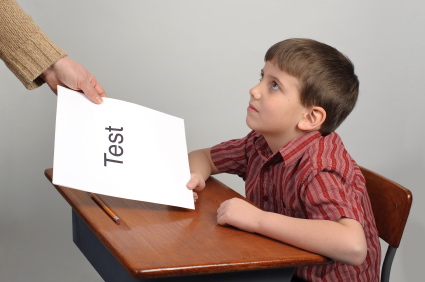
A boy receiving a failing test score

Hello. My name is Steven.

HI, STEVEN!


And I’m a standardized test proctor.

(Clapping!)

I’ve been a proctor for over 10 years now. I used to be a teacher. Some days I still get to be one, but most of the time… I’m just a proctor.

(Clapping. Shouts of “YEAH!”)


I give my students standardized tests.

WOO-HOO!


And I make them do test prep.

(Cheers!)

But…

(Breaks down. Someone walks up behind him, claps him on the back and whispers in his ear. Encouraging noises from the crowd of people sitting in folding chairs around the room.)


Let me start with the box.

(Laughter)


The box came to my middle school classroom right before Christmas break. You know the one. Like a cinder block made of cardboard. 

A high school student brought it down from administration. She shook it like a huge maraca and asked, “Mr. Singer, where do you want it?”

For a second I had no idea what it was. Then I remembered – it was almost time again to take the GRADE Test. And I knew what it was – a box full of those black and green test booklets, Scantron sheets wrapped in plastic, a box of No. 2 pencils, a monitor’s booklet, scratch paper, student rosters and ID numbers… Everything I wanted for Christmas.

(Laughter)


So I put it on the shelf, went on teaching and forgot about it until December was over, until after the holiday break.

I didn’t want to even think about it.

But when I came back to school in January all rested and raring to go, I saw it there like some sinister Elf on the Shelf.

So I put it off for another week. No rush. I had until the end of the month to make my students take it.

I just…

I couldn’t have them come into my classroom and first thing take a standardized test. That would have been heartless. They didn’t come back to school to fill in bubbles. They wanted to do something interesting, something that they really cared about.

They wouldn’t admit it, but they wanted to learn Goddammit!

And I wanted to teach!

(Grumbling) TELL US ABOUT IT!


What?

TELL US ABOUT THE WEEK BEFORE YOU TESTED!


Okay. I…

It was great. We read S. E. Hinton’s The Outsiders. Or at least a few chapters of it. 

The kids couldn’t put it down. If there were only a few minutes left in class, they didn’t want to stop reading – they wanted to keep going. 

We wrote journal entries about what we might have done in the characters’ places, examined the use of slang and how it has evolved over time.

We participated in a Socratic Seminar discussion where we made connections between the novel and our own lives, explored gender issues, the role of socioeconomic status and race – it was higher level thinking all around. You know? The stuff they tells us we’re supposed to teach – the stuff all the research tells us helps learners grow.

But it didn’t last. The week ended. And I had to give the GRADE Test.

OOOH! (a few claps)

You know, it’s funny. Working in a poor school district like mine, you hear a lot about accountability. If administrators don’t enact this reform, or teachers don’t do that paperwork or students don’t score this high – they’ll close us down. But no one talks about holding politicians accountable for making sure we have the resources we need.

Case in point: when I came back from break, the fan in my room’s cooling system had broken down. I have no windows and the air wasn’t circulating. It was hot and muggy and miserable. Yes, in January with arctic temperatures outside!

I asked the grounds keeper and administrators to do something about it, but was told repeatedly “the part is on order.” Nothing happened.

The first week wasn’t too bad. We managed. But it wasn’t until the second week – when I gave out the test – that it went from annoying to miserable!

(He pauses, shaking his head.)

I don’t know. Maybe it wouldn’t be so bad if it was a different test, but the GRADE…

…. is such a waste of time!


(good natured laughter. Mumbling.)


They call it a reading diagnostic test because it’s supposed to diagnose the kids’ deficiencies in reading. But it doesn’t do that for a host of reasons – chief among them the fact that kids take the same exact test over-and-over again for at least three years!

That’s right! No variation! The same questions in the same order three times a year – year-after-year. Heck! This was the second time they were taking this same test just this year alone!

Sure there’s one alternative version we COULD give to mix things up, but administration rarely lets us do that. And even if we did, it wouldn’t help that much.

(Snickers!)


What’s worse, it isn’t even aligned with the high-stakes tests kids have to take in March and April!

Yeah! They stick a gun to our heads and say if your students don’t score well on the all-or-nothing, win-or-lose state tests, we’ll label you a “failure,” cut your funding or close you down.

So you’d think we’d practice – try to do look-alikes and get comfortable with the format and everything.

But the rehearsal we’re forced to do is the GRADE test! That’s like practicing a layup when you’re getting ready for the chess tournament!

The preparation doesn’t reflect what students will be asked to do when it comes to the make-or-break exams!

It wasn’t always like this.

We used to have kids take a diagnostic test called the 4SIGHT. It wasn’t perfect. Kids took it on computers, but there was an essay section they’d write on paper, too, that I was actually allowed to grade, myself!

I thought there were better uses of class time, but at least the 4SIGHT was actually a good dry run for the kind of high-stakes tests they were going to take later in the year. And sections they took on the computer gave you a score immediately. 

It was something you could look at as a rehearsal, as reducing test anxiety, as providing you data you could use to make decisions about the students.

(Laughter)


Yeah! As if you’d need it! Any teacher who knows his students so poorly that he needs standardized tests to tell their strengths and weaknesses is a pretty poor teacher.

The only reason we changed to the GRADE Test in the first place is because the district got a grant from the state. 

First, the governor and legislature slashed our budget, then they offered to give us back a small portion of it if we enacted certain reforms – one of which was to replace our somewhat helpful diagnostic test with a totally useless Pearson product.

(clapping. A few catcalls of “PEARSON! OOOH! OOOH!”)

Come to think of it – 4SIGHT was also made by Pearson.

(Laughter)


And the time it takes to give this thing! There are only four sections – Vocabulary, Sentence Completion, Listening Comprehension and Passage Comprehension. But it takes a minimum of two days – and I have double periods! That’s two 80-minute sections – actually more like three so I can give the make-ups!


(unhappy noise from crowd)


That’s right! If a student is absent, I have to somehow proctor the whole thing over again just for him. Administration says it’s too hard for them to pull students out of class and give the make-ups, themselves. So I’m forced to give busy work to students who completed the assessment so they have something to do while the stragglers catch up.

(grumbles)

So to review: today was day three of testing. Day six if you count the first time I proctored this darn thing. And three more days will be coming in May.

This is day seven of no air flow. Kids sitting at their desks like they’re half dead. Sad, bored looks on their faces, and I completely sympathize but I’m the one who’s forced to do this to them!

Every now and then one of them asks, “Why are we doing this, Mr. Singer? Will this affect my grade?” 

And I find the lies hard to get out. Because, no, it won’t affect your grade. There’s really no good reason you’re taking this, except that some of those books on the shelf you enjoy during sustained silent reading were bought with money we get for making you go through this nonsense.

I used to believe in standardized testing. I did!

When I first started teaching it made a certain kind of sense. We had the Pennsylvania System of School Assessment (PSSA) tests then. My 8th grade kids took one in Reading and one in Writing.

It was challenging but at least the expectations were clear. I knew exactly what kinds of things they would be tested on and what they were expected to do. 

There were reams of remediation material available, and I could have my pick of the best – the clearest and most engaging – as test prep materials go.

But then Pennsylvania adopted Common Core – or at least it adopted the look-a-like PA Core – and had to develop new tests! 

Today, high school students take a test called the Keystone and middle schoolers still take the PSSA. But they’re both just different versions of the PARCC test with a Pennsylvania-sounding name on it. We just pretend it’s something new and ground breaking.

That might be acceptable if the PARCC was a valid assessment. However, it’s notorious throughout the country for being designed to fail students – not fairly evaluate them. 

Moreover, the state Department of Education is extremely stingy with examples teachers can look at so we know what’s on the test. I doubt even they know what’s on it because they keep changing it from year-to-year.

So all of my remediation material is almost useless. I can’t even buy something new because it takes several years after a test is developed for the preparatory material to appear, and we’re still chasing a moving target!

And on top of all that – the state is forcing all schools to use the scores from these tests to evaluate teachers performance!

We use incomplete test prep and unaligned pretests to prepare for more tests that don’t fairly assess student learning – and then use these invalid scores to blame teachers and bemoan the state of education!

WHAT THE HELL!?

Yeah! So…

(Someone walks up behind him and whispers in his ear. Hands him something.)

I get this… chip?

(Cheers! He looks it over.)

One week. I’m a one week man!

(Clapping. People standing.)

I’ve accepted my lot for one week?

(Volume gets louder on applause.)

I’m a test proctor.

(Catcalls. ONE OF US! ONE OF US!)

I’m a test proctor!

(Insane yelling!)

I’M A PROCTOR! A PROCTOR! A TESTING PROCTOR!

(The crowd rushes to the stage and engulfs the speaker. More and more approach. They just keep coming – more than could possibly fit in this room. The clamor continues to gain in volume until its unclear whether its celebratory cheering or out of control insanity. One word is heard through it all until even it cannot be made out in any distinctness.)

PROCTOR!

(curtain.)


This article also appeared in the LA Progressive, Education Bloggers Network, Public School Shakedown and the Badass Teachers Association blog.

Trust Tests, Not Teachers – Accountability for Dummies

Blame-Criticize-and-Judge

This week, the American Federation of Teachers decided – after years of opposing high-stakes testing – to embrace it.

That’s right. The second largest teachers union in the country took everything their constituent educators hate and gave it a big old sloppy wet kiss.

They call it grade span testing. Tests would still be given almost every year, but only three – one in elementary, one in middle and one in high school – would be high-stakes. The rest would just be “informational.”

Why not get rid of all high stakes tests?

Why not at least get rid of the “informational” ones and reduce the total to three?

ACCOUNTABILITY!

The idea goes something like this. We have to ensure our schools are serving the needs of all our students. And the ONLY way to do that is through standardized tests!

Huh!? The ONLY way!?

That’s what they’re saying. Anything else – unless it is coupled with test scores – is unreliable.

Classroom grades? Insufficient!

Portfolios of student work? Insufficient!

A sworn affidavit by classroom teachers on the lives of their firstborn children!? Probably insufficient, too!

To be fair, one could argue at least the AFT is trying to reduce the number of high-stakes tests. But the total number of tests will remain the same as it is now – ridiculously high! Kids will still test just about every year – much more than any other comparable country. Test prep will remain the de facto curriculum at most schools.

Moreover, the very idea that all the other non-high stakes tests could somehow remain purely informational is naive at best!

Even if the terrorists only put the gun to your head occasionally, that still perverts the whole process.

Why would the AFT change its long-held position now?

It’s no accident. The law that governs our entire K-12 school system is about to be rewritten.

Congress is trying to reauthorize the Elementary and Secondary Education Act (ESEA). When the law went through its last rewrite, it was called No Child Left Behind – a classic Bush era euphemism to hide that the legislation did exactly the opposite of its name.

Simply put: it was a disaster.

It made annual standardized testing the centerpiece of our whole school system. We couldn’t do anything without it. Bubble tests became the only measure of success.

Forget that all the evidence shows standardized tests don’t actually measure student learning. They show parental income. Rich kids generally score high and poor kids score low.

Forget that they’re based on highly subjective cut scores that fluctuate each year and are determined by temporary workers most of whom have no education degree and have an incentive to fail the most students they can.

Forget that they steal time from actual learning, create an environment of fear and are the prime excuse to punish and close schools serving minorities and the poor.

But ACCOUNTABILITY!

Standardized tests return a score, yes. And if you ignore how that score is subjective and educationally inaccurate, you can pretend it’s a universal measure of learning. Then you can use it to justify almost anything as being educationally necessary.

Skimp on education funding? They deserved it because Accountability.

Privatize a school? They deserved it because Accountability.

Bust a union? They deserved it because Accountability.

That’s nonsense!

We used to know better.

Students used to be accountable to teachers and parents. If you didn’t do your homework or try your best in school, you’d earn a failing grade.

Teachers used to be accountable to their principals. Administrators would observe their teachers throughout the year and determine if they were doing a good job.

Principals were then accountable to superintendents who were, in turn, accountable to the school board and finally the community of voters.

The buck stopped at the voting booth. But not anymore!

Now the student, teacher, principal, superintendent, etc. are all at each others throats being held accountable to the standardized tests.

Who’s accountable for the tests? The for-profit corporation that developed them. And who is the corporation accountable to? It’s shareholders.

So we’ve gone from a system where the buck stopped at the community to one where it stops at investors.

Does no one else see a problem with this? Communities are made up of people many of whom have a vested interest in the children who live and go to school there. We’re talking about parents, teachers and taxpayers who want to live among other educated people.

But shareholders only care about getting a return on their investment. They don’t care about the quality of the service they’re providing – only that they can make money providing it. And if lowering the quality will raise the payout, so be it!

So when people justify standardized testing based on accountability, they’re really deifying the bottom line – profits.

But, of course, you can’t say that aloud.

The move is being cloaked in the costume of Civil Rights and progressive politics. The AFT partnered with the Center for American Progress – a privatization cheerleader that poses as a bastion of liberalism. Likewise, 19 Civil Rights organizations including the ACLU and NAACP were convinced to sign on.

Silly me. I thought Dr. King had a dream that everyone would be judged by the content of their character – not the results of their bubble tests!

But – say-it-with-me – Accountability.

There can be no alternative but standardized tests.

We can’t trust classroom grades. We can only trust cut scores.

We can’t trust teachers. We can only trust corporations.

We can’t trust the school board. We can only trust the shareholders.

And thank goodness! Otherwise, Congress might listen to what ordinary folks have to say!

Heck! Congress is starting hearings on it next week! They could vote to stop mandating annual standardized testing! Can you imagine how that would hurt the testing industry!? Billions of dollars might be lost! Imagine the kickbacks and political favors at risk!

So raise your glass to the bottom line, and say a prayer that the parents, teachers and taxpayers don’t do anything to hold us accountable…

Like, for example, emailing testimony against testing to the US Senate at FixingNCLB@help.senate.gov by Monday, Feb. 2.


-Special thanks to Aixa Rodriquez and Owen Jackman for being extra sets of eyes when my own couldn’t stay open anymore. If there are remaining errors, they are mine alone.

-This article also appeared in the LA Progressive, Public School Shakedown and the Badass Teachers Association Blog.


Dear Gov. Wolf – 10 Ways to Help Pennsylvania’s Schools

wolf-edu-infographic-blog-photo

Dear Gov. Tom Wolf:

It’s so nice to hear your name. Wolf. Wolf. Wolf.

I could write it all day. It’s so much better than Corbett.

As one of millions who voted for you, campaigned for you and even posted a yard sign for you – I want to offer my most cordial congratulations and welcome to office.

I know it may take a few weeks to get used to the new job. Heck! It could take a month just cleaning out all the skeletons left by your predecessor. It’s no coincidence that most of them are child sized.

Your forerunner treated public education like his own private piggy bank. He slashed education budgets with glee blaming it on federal stimulus dollars, Gov. Rendell or anyone but himself. Moreover, he trashed a newly created funding formula designed to ensure needy districts received adequate support. He stopped partially reimbursing poverty-stricken districts for the extra costs of having charter schools drain their coffers. And for a candidate who campaigned on limited government, he dramatically expanded the state role in education policy.

In short, it was a disaster. As a public school teacher, those were the four longest years of my life. I dearly hope we can expect better from you. One could easily make the case that you owe your position as governor to your stance against all these policies and the expectation that you would reverse course.

So let me offer some help. This is what I’d like to see you do as governor. I know it won’t be easy. I know you’ll probably have to compromise to work with a Republican legislature that enabled all these disasters to take place.

But you play a vital role – to set the agenda. And I fully expect you to do that for the children of Pennsylvania.

These are the top 10 ways to Help Pennsylvania’s schools:

1) Reverse Course in York

Talk about an American tragedy! York City Schools is a victim of your predecessor’s Draconian budget cuts. But instead of actually helping the district recover from years of underfunding, it was further hobbled by ideologues and profiteers.

First, Pennsylvania underfunds the already impoverished York Schools. Then when the district can’t cope with the lack of support, it’s labeled a “failure” and forced into a ridiculous recovery program. How does this make sense: tighten your belt, try a few targeted reforms and if that doesn’t work, give control of the district to a for-profit charter operator with a record of failure!?

And when the duly-elected school board has second thoughts, the state snatches control away from them and sends the school into receivership so this ridiculous privatization scheme can be instituted unmolested by Democracy!?

No. You need to listen to the taxpayers. Give control of the district back to the school board. Give the so-called Chief Recovery Officer his walking papers, throw his “Recovery Plan” into the trash and properly fund the district. No charters. Just common sense reform.

2) Return All Schools to Local Control

Public schools should be exactly that – public. Their actions should be governed by the community – not the state. Within certain Constitutionally mandated limits, the state has no business deciding what schools should be doing. The state’s main job is to ensure schools have what they need to function.

Yet Pennsylvania is running a handful of districts. Philadelphia Schools have been under control of the School Recovery Commission and appointed CEO for almost two decades with no improvement. Likewise, Duquesne and Chester Upland districts have struggled through receivership with nothing to show for it but misery and lack of services.

That’s why these schools were taken over in the first place. New leadership was never the problem. It was lack of funds.

Restore all Pennsylvania districts to the taxpayers and democratically elected school boards. Fund properly and stand back. Watch them flourish.

3) Increase the Education Budget

You campaigned on it. It’s time to do it. Bring funding back to pre-Corbett levels. In fact, increase it to reflect the increased costs of services. And bring back the charter school reimbursement.

A small increase will not be enough. Our schools have suffered through too much neglect. We need to lower class sizes and restore arts and music, extra-curricular activities, school nurses, librarians – everything we lost under your forerunner.

Critics will say this is throwing money at the problem. The rest of us call it an investment. We need to put more money toward educating children than locking up high school dropouts. We need to put all the strength and power of the Commonwealth into ensuring the next generation will have a better chance at succeeding than the current one.

That takes money. It takes taxes – especially on the wealthy and corporations that have had a tax holiday for the past four years. It’s time to pay up.

4) Institute a Fair Funding Formula

This is another of your campaign promises. Even your predecessor eventually came around to supporting it – after he trashed the one that had already been in place.

We need to make sure schools get the money they need to operate. This means the state has to provide more funding to cash-strapped schools than rich ones. After all, wealthy districts can rely more on local taxes. Poor districts cannot.

Start by re-instituting the funding formula the legislature created in 2008.

5) Halt Charter School Expansion

Speaking of money, it makes no sense to have two separate educational systems. It’s unnecessary and wasteful. We don’t need traditional public schools AND charters.

It’s all about performance. Traditional public schools often do much better or as well as charters – especially cyber charters.

So put a moratorium on new charter schools. Then make the ones we have transparent and accountable. You know? Like we already do for public schools!

No more holding board meetings in private, keeping budgets secret and discouraging difficult students from enrolling. Otherwise, the potential for malfeasance is huge – especially at those organized for-profit.

Direct the state Department of Education to investigate all existent charter schools to determine which are exemplary and which substandard. Close the bad, keep the good.

We simply can’t afford letting profiteers suckle on Pennsylvania’s school budgets.

6) Divest from Common Core. Return to PA Standards

Technically Pennsylvania never adopted Common Core State Standards. It just plagiarized them. We pretend our wonderful PA Core Standards are something new and innovative. They’re not. They’re just Common Core with Pennsylvania in the name.

What a waste of time and money! We don’t need the state telling districts what to do. There’s nothing wrong with benchmarks – suggested goals to which districts can aim. But unfunded mandates? No, thank you.

The Pennsylvania Standards that preceded PA Core were closer to the benchmark ideal. They were a guide – not a high-stakes mandated gun-to-your-head de facto curriculum.

Every teacher knows you don’t help children by simply changing the bar. But you do help textbook publishers by making them uniform. You create a market.

It’s time to do what’s best for children, not corporations. Throw out Common Core. Return to PA State Standards.

7) Cut Back on Standardized Testing

Everyone is sick of standardized tests. Teachers are sick of them. The kids and parents are sick of them. Even politicians are sick of them.

It’s time to do something about it.

Pennsylvania’s standardized test system is a joke. We took our own Pennsylvania System of School Assessments (PSSAs) – flawed as they were – and threw them away in favor of copying the horrific PARCC tests. The PSSAs weren’t exactly fair, nor did they accurately evaluate student learning. But at least they held reasonable goals.

The new state tests are so much like the PARCC, they expect students to be far above what is developmentally appropriate. Kids just aren’t ready for certain concepts until they’re older. These new tests ignore everything we know about how the growing mind works in favor of a scheme to fail more kids and sell more remedial textbooks.

We need to scrap these new tests and – in fact – dramatically reduce the number of standardized tests we give. In a perfect world, we’d give only one standardized test in high school and call it a day. Let kids in elementary and middle school learn their basic skills without the sword of Damocles hanging over their heads.

Moreover, don’t attach high-stakes to any test. That corrupts the score. Use it as a tool. It’s a way of checking the oil on a school’s educational engine. But you don’t throw a temper tantrum and blame the car when it’s low on oil. You add more oil. (See increase school funding.)

8) Abolish VAM Teacher Evaluations. Let Districts Design Their Own Evaluations.

When experts like those in the American Statistical Association are complaining that you’re using statistics incorrectly, you need to listen. Value-Added Measures are a horrible way to evaluate teachers. You simply can’t use student test scores to judge the effectiveness of teachers. It’s like measuring the size of the potholes on your work route to determine if you’re a good driver.

Moreover, the evaluation system now in place is a gothic, baroque mess. It’s cumbersome, takes way too much time from teachers and administrators and ultimately doesn’t provide a fair evaluation.

Let each school district come up with its own evaluation system. Yes, this probably means going back to relying on principals to actually observe their own teachers in their own ways.

Critics will complain this system is flawed because too many teachers get positive evaluations. So what? Most principals, parents and students are well satisfied with the quality of the teachers in their districts. Who are these corporate bureaucrats to tell them they’re wrong?

9) Appoint a Teacher as Secretary of Education

The state should have a limited role in setting education policy. You’d think your predecessor would agree seeing how he downsized the state Department of Education. But those employees he did keep – especially at the highest levels – had little to no education background.

In the rare case when an educator was hired, that background was almost completely in management positions – hardly any time in the classroom.

The Secretary of Education and the majority of staff running the Department of Education should be teachers – not CEOs, political advocacy nuts with an agenda – not even principals, superintendents, or academics. They should have real world experience doing the job recently. No more corporate shills. If you want the state to do what’s right for children, you need to employ their best advocates, people who know what’s needed and how to achieve it – teachers.

10) Kick Out TFA

Speaking of teachers – that’s who should be running our classrooms – Not lightly trained temps who have no intention of staying in the field.

It is a sad joke that our politicians have valued Teach for America recruits equally or more than educators. Teachers graduate from intensive education programs at our best colleges. TFA recruits go through a few weeks of training.

It is ridiculous and insulting to accept TFA as a substitute for well-trained staff – especially at our poorest schools. As governor, you should push for a moratorium on any new TFA recruits at our public schools. Every student matters. Every student deserves a real teacher.

In closing, thank you for your time. I hope you will consider enacting these reforms. You would be doing what’s truly in the best interests of the citizens, parents, teachers and children of the Commonwealth.

But be warned. We have had enough of politicians who come into office on a promise and a smile but don’t back it up with real action. We gave you our overwhelming support in the last election. Now it’s up to you to keep it.

Yours,

Steven Singer


This article appeared in its entirety on the Badass Teachers Association blog, and a shortened version was published in the York Daily Record. I also did a radio interview on the Rick Smith Show where I went over all 10 points. 

Off the Beaten Gadfly – the Best Education Blog Pieces You Never Read in 2014

Wonderfull illusion art painting
So you’re interested in education.

You’ve read your Diane Ravich. You peruse Peter Greene’s blog with your morning coffee. You have a Badass Teachers Association jersey on under your button down work shirt and tie.

But you need something more.

Well, friend, have I got a treat for you!

Please to enjoy Gadflyonthewallblog! This is the site where all the cool intellectuals go – the folks who want an edge to fight corporate school reform.

You probably already read Gadfly’s Top 10 Posts of 2014. That wouldn’t get by a discerning customer like you. But have you seen this – Gadfly Deep Tracks?

That’s right! These are the five posts selected by the author that maybe didn’t get the page views of the popular articles but are really worth your time.

Take a look. There’s some really good stuff here!

So for your continued edification, elucidation and just plain old enjoyment, I present to you the Top 5 Gadfly Rarities:


5) RAIDERS OF YOUR LOST PENSION

Views: 50  shutterstock_pickpocket
Publication: July 22

Description: Have you ever wished you could be a fly on the wall and listen to a secret meeting of corporate education reformers to hear what they REALLY think? Well, here’s your chance. I came across a conservative think tank paper that outlines ways to manipulate school boards to reduce teachers pension benefits. It’s all right here: Teach for America, Disaster Capitalism, Reducing School Budgets, etc. This is a smoking gun.

Fun Facts: My first post. It’s where I got the name for my blog. I thought this was really important, but not many people saw it. Here’s my attempt to change that.


4) FORGET CORPORATIONS… UNIONS REALLY ARE PEOPLE

Views: 152  Labor-Unions
Publication: Nov. 1

Description: Why do some people hate labor unions so much? Maybe it’s because they don’t understand them. In this article I outline the philosophy behind unions and debunk many common criticisms.

Fun Facts: Strong union folks loved this. Randi Weingarten was a fan. But it never gained the audience I feel it deserves. This is important. At best, it’s a way to convince reasonable people that unions are relevant and in fact indispensable to our economy. At worst, it’s at least a good tool to use to help explain your support of unions. It’s worth noting that this article is about unions in general – not any particular union.


3) THE MULTIPLE CHOICE MIND

Views: 356  Scanning of a human brain by X-rays
Publication: July 29

Description: What’s the problem with standardized tests? What do they do to growing minds? This article answers those questions and more. The basic thesis is that bubble tests are horrible ways to help create thinkers, but excellent for creating consumers.

Fun Facts: Standardized testing is central to all corporate education reform. But few people question its purpose. I think it’s important the public understand that none of this is about education. It’s about creating a permanent underclass just smart enough to be customers at Walmart but not smart enough to question the status quo.


2) A CURRICULUM OF COMPASSION

Views: 623  05_A1CP_t400
Publication: Nov. 8

Description: This is just a simple story about a poor, damaged student who entered my class needing so much more than just an education. I got her to smile. That’s it.

Fun Facts: This girl was in my class about a third of the time last year, and only two days this year. I hope she returns someday soon. It just breaks my heart. Wherever she is I send this article out to her as a virtual hug so my readers might love her as much as I do. Sometimes that’s more important than lesson plans, etc.


1) FRANZ KAFKA AND THE METAMORPHOSIS OF TEACHER EVALUATIONS  kafka-drawing-251x300

Views: 775
Publication: Aug. 30

Description: Value-Added Measures of teachers are absurd. So I mixed them up with the master of absurdity – Franz Kafka. Thrill as a teacher wakes up in class transformed into a giant insect about to be evaluated by a reformy principal.

Fun Facts: This is one of my own personal favorites. I think if more people actually saw it, they’d feel the same. I hope you enjoy it, too.


P.S. – I stole the idea for this Top 5 list from the excellent blogger Russ Walsh. He came up with the concept of writing a list of hidden gems – not a typical Top 10 list. His Russ on Reading is well worth your time.


P.S.S. – Diane Ravich gave this article a shout out on her blog.