Charter School Champion Hates Bernie Sanders, Prefers Hillary Clinton

Screen shot 2016-02-20 at 12.36.03 AM

Bernie Sanders doesn’t like charter schools enough.

To me that’s an endorsement.

But to Shavar Jeffries, it’s a condemnation.

Jeffries took to the pages of the New York Daily News to decry Sanders position and champion Hillary Clinton’s.

Jeffries is the executive director of Democrats for Education Reform (DFER), a hedge fund front promoting the privatization of public education.

Despite its name, the group doesn’t represent the views of most Democrats. It represents the neoliberal branch of the party that has heavily influenced the education policy of Barack Obama, Arne Duncan, Cory Booker, Bill Gates and other prominent so-called liberals.

One can see why Jeffries isn’t Feeling The Bern. Sanders famously said THIS in January about the industry DFER promotes:

I’m not in favor of privately run charter schools. If we are going to have a strong democracy and be competitive globally, we need the best educated people in the world. I believe in public education; I went to public schools my whole life, so I think rather than give tax breaks to billionaires, I think we invest in teachers and we invest in public education. I really do.

More to Jeffries’ taste is Hillary Clinton who he says backed off on her own charter school criticism.

Back in November, Clinton correctly condemned most charter schools for not enrolling the most challenging students.

She said:

Most charter schools — I don’t want to say every one — but most charter schools, they don’t take the hardest-to-teach kids, or, if they do, they don’t keep them. And so the public schools are often in a no-win situation, because they do, thankfully, take everybody, and then they don’t get the resources or the help and support that they need to be able to take care of every child’s education.

Anne O-Leary, a Clinton aide, eventually clarified these comments saying Clinton supports those charters that are both equitable and accountable.

Neither candidate for the Democratic nomination for President has given an in-depth policy speech on K-12 education.

These statements on charter schools are some of the most substantial made by either candidate on the issue.

Clinton has been lambasted in the media for her comments. Many publications – leaning both left and right – complained that she was caving in to powerful teachers unions like the National Education Association (NEA) and the American Federation of Teachers (AFT) both of which endorsed her in the primaries. On the other hand, Clinton also has been criticized for not going far enough against the school privatization industry. Some observers highlight her continuing ties to Wall Street and many of the same neoliberal figures responsible for our disastrous corporate education reform policies.

By contrast, Bernie’s comments have been met with mostly praise from his base and shrugs from his opponents.

Both candidates views on the subject have evolved over the years. Sanders has gone from being pro- to anti-charter. Clinton has gone from being pro-charter to pro-charter with some provisos.

Back in 1998, Congressman Sanders voted in favor of the Charter School Expansion Act. Now he’s against the industry. Meanwhile, Clinton has long been a champion of charter schools. Her criticism of some of these schools is a new wrinkle.

It’s nice to see the issue getting some attention.

Charter schools have increased exponentially across the country in the last two decades, but they have little transparency or accountability. As a result, monetary scandals have exploded like wildfire from state-to-state. Millions of public dollars have disappeared into private corporations’ bank accounts leaving little to show for it.

Nationally, research shows that charter schools do no better at educating children than public schools. In fact, in many cases they do a much worse job. And when it comes to cyber charter schools, the situation is even more unevenly stacked in traditional public school’s favor.

Scandals also are surfacing about how charters treat their students. Stories of harsh discipline policies and violating students rights are emerging everyday. Moreover, there are countless accusations that – as Clinton points out – many charters select only the easiest students to educate and sometimes expel struggling students before state-mandated standardized tests.

Finally, charters increase the cost of educating children in a particular district by adding another parallel school system. However, these extra costs are taken out of the traditional public school’s budget thereby further destabilizing it and forcing less services and higher class sizes for students who don’t enroll in new charters.

I’m glad both Democratic candidates are critical of this status quo.

However, Jeffries denunciation of Sanders and defense of Clinton may backfire.

If an odious organization like DFER is in favor of Clinton, shouldn’t the rest of us back Sanders?


NOTE: This article also was published on the Badass Teachers Association blog.


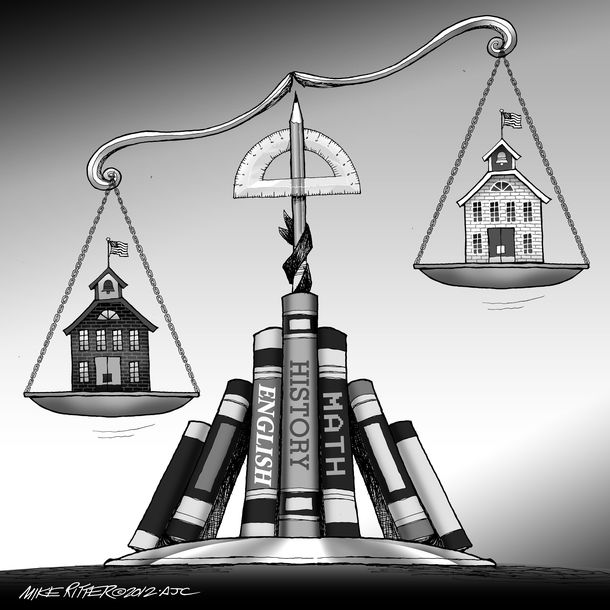
Most Charter Schools are Public Schools in Name ONLY

charterart

Charter schools are public schools.

But are they?

Really?

They don’t look like a duck. They don’t quack like a duck. Do you really want to serve them confit with a nice orange sauce?

Sure, charters are funded by tax dollars. However, that’s usually where the similarities end.

They don’t teach like public schools, they don’t spend their money like public schools, they don’t treat students or parents like public schools – in fact, that’s the very reason they exist – to be as unlike public schools as possible.

Advocates claim charters exist as laboratory schools. They are free to experiment and find new, better ways of doing things. Once they’ve proven their successes, these improved practices will eventually trickle down to our more traditional houses of learning.

At least, that’s the ideal behind them. But to my knowledge it’s never happened.

As a public school teacher, I can never recall being at a training where charter operators taught us how to do things better with these time-tested strategies. I do, however, recall watching excellent co-workers furloughed because my district had to meet the rising costs of payments to our local charters.

Moreover, if the freedom to experiment is so important, why not give that privilege to all public schools, not just a subset?

The reality is much different than the ideal. In the overwhelming majority of cases, charter schools are vastly inferior to their more traditional brethren. To understand why, we need to see the differences between these two kinds of learning institutions and why in every case the advantage goes to our much-maligned, long suffering traditional public schools:

1) Charters Don’t Accept all Students

Charter schools are choosey. They don’t take just any old students. They only accept the ones they want. And the ones they want are usually easy and less expensive to teach.

The process is called “Creaming” because they only pick the cream of the crop. Then when these students who are already doing well continue to do well at a charter, the administrators take all the credit. It’s as if they were saying – Look how well we teach. All these former A-students continue to get A’s here at our school. It’s really quite an achievement. (Not.)

However, sometimes the bait-and-switch isn’t so obvious. Occasionally, charters actually do accept special needs and/or difficult students – for a few months. Then when the big standardized test is coming up, they quietly give these kids the boot. That way they can claim they accept everyone but still get excellent standardized test scores.

Ironically, that’s what they mean by “School Choice.” It’s usually touted as a way of giving alternatives to parents and students. In reality, the choice only goes to administrators. Not “Which school do YOU want to attend?” but “Which students do WE want to accept to make our charter look good?”

Keep in mind, this situation is allowed by law. Charters are legally permitted to discriminate against whichever students they want.

By contrast, traditional public schools accept all students who live within the district. It doesn’t matter if children have special needs and therefore cost more to educate. If a child lives within district boarders, your neighborhood public school will take him or her in and provide the best experience possible.

Bean counters complain about poor test scores, but traditional public schools aren’t gaming the system. They aren’t weeding out difficult students. They take everyone. Administrators have no choice. This is dictated by law. Public schools are equal opportunity educators.

2) Charters Have No Transparency

Have you ever been to a school board meeting? Ever listened to school directors debate the merits of one course of action versus another? Ever looked over public documents detailing district finances and how money is spent? Ever read over bids vendors provide for services? Ever spoken at a public meeting to school directors about what you think is the best way to proceed in a given situation? Ever had a school director or two disappoint and then worked to vote him or her out of office?

At traditional public schools, you can do all of this – even if you don’t have any children in the school system! At a charter school, you’re out of luck.

Charters rarely have to tell you how they spend their money, rarely debate management decisions in public, rarely invite or even permit you a seat in the audience. Heck! They don’t have to!

Charters survive on public money, but once that money goes in those charter doors, the public never sees it again. If you don’t like how the charter is treating your child, you can remove the little dear from the school. But if a non-parent doesn’t like how they suspect the charter is spending his or her tax money, there is absolutely no recourse. You are taxed without any representation. Wars have been fought over such things. It’s hard to imagine how that can be Constitutional.

In sum, traditional public schools are like most other government organizations. They are required by law to be transparent to the public. Charter schools, however, are money pits and what goes down those gaping holes is lost forever from public view.

3) Charters Advertise

Have you ever seen those huge billboards by the side of the road trying to convince motorists to send their children to a charter chain? Ever hear a radio advertisement about how happy little kiddos are at Brand X Charter School?

Those advertisements cost money. Your money, to be exact. You paid for those commercials. And what’s more, every penny spent on those glossy advertisements is one less that actually goes to educate your child.

By contrast, traditional public schools are not allowed to advertise. All their budget dollars have to be spent on things broadly educational. They have to spend on books, teachers, building upkeep, etc.

Not only are charters allowed to keep quiet about how they spend their money, even if they told you, it doesn’t all have to be spent on the children in their care. What could possibly go wrong with that?

4) Charters Defraud the Public

Despite all their best efforts at secrecy, charter school operators have been caught in countless financial scandals in recent years. According to Integrity in Education$200 million in taxpayer money was lost, misused, or wasted in just 15 of the 42 states that have charter schools.

These aren’t mere allegations. These abuses are well documented. The report states: “Charter operators have used school funds illegally to buy personal luxuries for themselves, support their other businesses, and more.”

Mountains of evidence demonstrate fraud throughout the country: Schoolchildren defrauded in Pennsylvania; “out-of-control” charters in Michigan and Florida; rampant misspending in Ohio; bribes and kickbacks, also in Ohio; revenues directed to a for-profit company in Buffalo, NY; subpoenas for mismanaged charters in Connecticut. Heck! In California alone, $100 million in fraud losses were expected just last year.

And that’s just the fraud we can see!

I’m not saying our traditional public schools are scandal free, but nothing like this level of malfeasance has been revealed. Traditional schools are under much stricter regulations. People are actually watching to make sure nothing like these charter scandals happen at our time-tested neighborhood schools. They are much better value for your money.

5) Charters Often Get Worse Results

It all comes down to teaching and learning. When we compare the results at charters versus traditional public schools, who does better?

Bottom line: the research shows that the overwhelming majority of charter schools are no better – and often much worse than traditional public schools. This is true even of studies backed by the charter school industry, itself!

For example, a recent study by charter-friendly CREDO found that in comparison to traditional public schools “students in Ohio charter schools perform worse in both reading and mathematics.”

In a study of Chicago’s public schools, the University of Minnesota Law School found that “Sadly the charter schools, which on average score lower that the Chicago public schools, have not improved the Chicago school system, but perhaps made it even weaker.”

Another report from Data First – part of the Center for Public Education – says, “the majority of charter schools do no better or worse than traditional public schools.”

However, there is plenty of evidence of charter schools producing dismal academic results for students. For instance, a Brookings report showed low performance in Arizona’s charter schools. A District of Columbia researcher for In the Public Interest group, “could not provide a single instance in which its strategy of transferring a low-performing school to a charter management organization had resulted in academic gains for the students.” The Minnesota Star Tribune reported that “Students in most Minnesota charter schools are failing to hit learning targets and are not achieving adequate academic growth.” Over 85 percent of Ohio’s charter students were in schools graded D or F in 2012–2013. In the celebrated New Orleans charter experiment, the Investigative Fund found that “eight years after Hurricane Katrina…seventy-nine percent of RSD charters are still rated D or F by the Louisiana Department of Education.”

That’s not exactly a record of success!

Meanwhile, our traditional public schools often do a much better job.

The National Assessment of Educational Progress (NAEP) reports that U.S. math and reading skills have improved for all levels of public school students since the 1970s, with the greatest gains among minority and disadvantaged students. Other results indicate that our schools achieve even greater success when properly funded.

The facts seem pretty clear. Charter schools are not like traditional public schools at all.

Most charter schools are a losing prospect for our children and our Democracy. Yet well-funded corporate lobbying interests continue to push charters as a public policy solution while instigating the closure of an increasing number of traditional public schools.

This is like closing hospitals and opening clinics on the power of crystals, snake oil and phrenology.

We need a national moratorium on new charter schools. We need to investigate every existent charter to determine if each are providing a quality service to students and not just the charter’s corporate share holders.

We know what works, and it isn’t charter schools. Support your friendly, neighborhood, traditional public school.
Top 10 Reasons School Choice is No Choice

LittleKidThumbsDown

On the surface of it, school choice sounds like a great idea.

Parents will get to shop for schools and pick the one that best suits their children.

Oh! Look, Honey! This one has an exceptional music program! That one excels in math and science! The drama program at this one is first in the state!

But that’s not at all what school choice actually is.

In reality, it’s just a scam to make private schools cheaper for rich people, further erode the public school system and allow for-profit corporations to gobble up education dollars meant to help children succeed.

Here’s why:

1) Voucher programs almost never provide students with full tuition.

Voucher programs are all the rage especially among conservatives. Legislation has been proposed throughout the country taking a portion of tax dollars that would normally go to a public school and allowing parents to put it toward tuition at a private or parochial school. However, the cost of going to these schools is much higher than going to public schools. So even with your tax dollars in hand, you don’t have the money to go to these schools. For the majority of impoverished students attending public schools, vouchers don’t help. Parents still have to find more money somewhere to make this happen. Poor folks just can’t afford it. But rich folks can so let’s reduce their bill!? They thank you for letting them buy another Ferrari with money that should have gone to give poor and middle class kids get an education.

2) Charter and voucher schools don’t have to accept everyone

When you choose to go to one of these schools, they don’t have to choose to accept you. In fact, the choice is really all up to them. Does your child make good grades? Is he or she well-behaved, in the special education program, learning disabled, etc.? If they don’t like your answers, they won’t accept you. They have all the power. It has nothing to do with providing a good education for your child. It’s all about whether your child will make them look good. By contrast, public schools take everyone and often achieve amazing results with the resources they have.

3) Charter Schools are notorious for kicking out hard to teach students

Charter schools like to tout how well they help kids learn. But they also like to brag that they accept diverse students. So they end up accepting lots of children with special needs at the beginning of the year and then giving them the boot before standardized test season. That way, these students’ low scores won’t count against the charter school’s record. They can keep bragging about their high test scores without actually having to expend all the time and energy of actually teaching difficult students. Only public schools take everyone and give everyone their all.

4) Voucher and charter schools actually give parents less choice than traditional public schools

Public schools are governed by different rules than charter and voucher schools. Most public schools are run by a school board made up of duly-elected members from the community. The school board is accountable to that community. Residents have the right to be present at votes and debates, have a right to access public documents about how tax money is being spent, etc. None of this is true at most charter or voucher schools. They are run by executive boards or committees that are not accountable to parents. If you don’t like what your public school is doing, you can organize, vote for new leadership or even take a leadership role, yourself. If you don’t like what your charter or voucher school is doing, your only choice is to withdraw your child. See ya.

5) Charter Schools do no better and often much worse than traditional public schools

Pundits and profiteers love to spout euphoric about how well charter schools teach kids. But there is zero evidence behind it. That is nothing but a marketing ploy. It’s like when you’re in a bad neighborhood and walk past a dive that claims to have the best cup of coffee in the city. Yuck. Surely, some charter schools do exceptionally well. However, most charters and almost all cyber charters do worse than their public school counterparts. Fact.

6) Charters and voucher schools increase segregation

Since the 1950s and ’60s, we used to understand there was no such thing as separate but equal education. Before then we had Cadillac schools for white kids and broken down schools for black kids. The Supreme Court ruled that unconstitutional. But today we have Cadillac schools for rich and middle class kids (most of whom are white) and broken down schools for the poor (most of whom are black or brown.) After making tremendous strides to integrate schools and provide an excellent education for everyone, our public schools have been resegregated. Charter and voucher schools only make this problem worse. They either aid in white flight or leach away minority students. This just makes it easier to give some kids a leg up while keeping others down.

7) Charter and voucher schools take away funding at traditional public schools

It costs almost the same amount of money to run a school building of a given size regardless of the number of kids in it. When students leave the public schools for charter or voucher schools, the public school loses valuable resources. It now has less revenue but the same overhead. So even if you found an excellent charter or voucher school to send your child, you would be hurting the chances of every other student in the public school of having their own excellent education. This is what happens when you make schools compete for resources. Someone ends up losing out on an education.

8) Properly funding parallel school systems would be incredibly wasteful and expensive

We could fix this problem by providing adequate funding for all levels of the school system – traditional public schools, charters, voucher schools, etc. However, this would be exorbitantly expensive. We don’t adequately fund our schools now. Adding additional layers like this would mean increasing national spending exponentially – maybe by three or four times the current level. And much of that money would go to waste. Why have three fully stocked school buildings in one community when one fully stocked building would do the job? I don’t imagine residents would relish the tax hike this would require.

9) School choice takes away attention from the real problems in our public schools – poverty and funding equity

We have real problems. More than half of public school students live below the poverty line. They are already several grade levels behind their non-impoverished peers before they even enter kindergarten. They need help – tutoring, counseling, wraparound services, nutrition, etc. The predicament is even more complicated by the way we fund our schools. Throughout the country, poor districts get less money than wealthy or middle class ones. The students who go to these schools are systematically being cheated out of resources and opportunities. And instead of helping them, we’re playing a shell game with charter and voucher schools. The problem isn’t that parents don’t have several excellent choices. If they’re poor, they often don’t have one.

10) School choice is not supported by a grass roots movement. It is supported by billionaires.

The proponents of school choice will tell you that they are only doing the will of the people. This is what parents want, they say. Baloney. While there are individuals who support school choice, the overwhelming majority of money behind this movement comes from conservative billionaires actively trying to dismantle the public education system. They want to steal the public system and replace it with a private one. They don’t care about your child. They just want to steal the hundreds of billions of tax dollars we pay to educate our children. This is not philanthropy. It is a business transaction meant to screw you and your child out of your rights.

If we really want to ensure every child in this country gets an excellent education, the answer isn’t school choice. Instead, we need to commit to supporting our public school system. We all need to be in this together. Yes, our schools should look at the needs of each child and tailor education to fit appropriately. But that shouldn’t be done in parallel school systems. It should be done under the same umbrella. That way, you can’t defund and defraud one without hurting all. It can’t just be about your child. It has to be about all children.

That’s the only choice worth making.


NOTE: This article was given a shout out on Diane Ravitch’s blog and published on the Badass Teachers Association blog.