
Much Ado About an Enigma – No One Really Knows What Impact the ESSA Will Have on Public Schools

ESSA-Obama

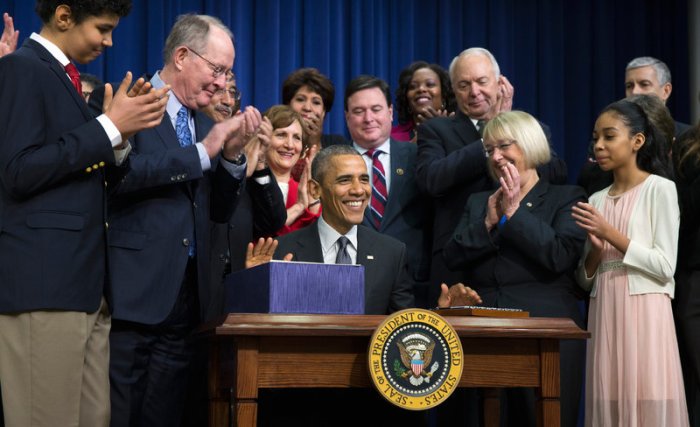
President Barack Obama signed the Every Student Succeeds Act (ESSA) this week.

The new legislation reauthorizes federal law governing K-12 public education.

In 1965 we called it the Elementary and Secondary Education Act (ESEA). Until today we called it No Child Left Behind (NCLB). And now after a much-hyped signing ceremony, the most definitive thing we can say about it is this: federal education policy has a new name.

Seriously. That’s about it.

Does it reduce the federal role in public schools? Maybe.

Does it destroy Common Core State Standards? Possibly.

Is it an improvement on previous policies? Potentially.

Will it enable an expansion of wretched charter schools and unqualified Teach for America recruits? Likely.

The problem is this – it’s an over 1,000 page document that’s been open to public review for only two weeks. Though it was publicly debated and passed in the House and Senate, it was finalized behind closed doors and altered according to secure hurried Congressional votes. As such, the final version is full of legal jargon, hidden compromise, new definitions and verbiage that is open to multiple meanings.

How one reader interprets the law may be exactly the opposite of how another construes it.

Take the much-touted contention that the ESSA reduces the federal role in public schools. Even under the most positive reading, there are limits to this freedom.

The document continues to mandate testing children each year in grades 3-8 and once in high school. It also mandates academic standards and accountability systems. However, what these look like is apparently open to the states.

For instance:

The Secretary [of Education] shall not have the authority to mandate, direct, control, coerce, or exercise any direction or supervision over any of the challenging State academic standards adopted or implemented by a State.

That seems pretty clear. The federal government will not be able to tell states what academic standards to adopt or how student test scores should be used in teacher evaluations.

But it also says that states will have to submit accountability plans to the Department of Education for approval. It says these accountability plans will have to weigh test scores more than any other factor. It says states will have to use “evidence-based interventions” in the schools where students get the lowest test scores.

That sounds an awful lot like the test-and-punish system we have now.

What if your state decides to take a different road and reject the high stakes bludgeon approach to accountability? In that case, some readers argue schools could lose Title I funds – money set aside to help educational institutions serving impoverished populations.

Will that actually happen? No one knows.

It may depend on who will be President in 2017 and whom that person picks as Secretary of Education. And even if the Feds try to take advantage of these potential loopholes, the matter could end up being decided by the U.S. Supreme Court.

What about Common Core?

Some readers interpret the new law as destroying forever the possibility of national academic standards. If states are allowed to pick their own standards, it is highly unlikely they’ll all pick the ones found in the deeply unpopular Common Core. However, the law does force each state to have academic standards of some kind, and it defines what those standards must look like. One interpretation of this is that they must look a lot like the Common Core.

They must be “state-developed college- and career-ready standards.” You read that right – “College and career ready.” That’s the Common Core catchphrase. If someone says they want to eat lunch at “the golden arches,” they haven’t said McDonalds, but you know they’re craving a Big Mac.

Will the Fed allow states to choose standards radically different than the Core? Again only time and – possibly – the courts can tell.

This same problem occurs throughout the document. As the public painstakingly combs through it, new legal wiggle room may be found. And I am not so naive as to suppose we’ve found all of the loopholes yet. Some of these may be the result of poorly chosen wording. Others may be purposefully hidden time bombs waiting for opportunists to exploit.

This uncertainty about exactly what the ESSA will eventually mean for our public schools may help explain the range of reactions to the formative law – from ecstasy to despair to shrugs and snores.

I’m not sure what to think of the thing, myself. I started the whole process disgusted but came around to accepting it if the final result was any kind of improvement over previous legislation. And now that it’s the law of the land, I look at this Frankenstein’s monster of a bill – stitched together pieces of mystery meat – and I don’t know whether to laugh or cry.

I still hope it will live up to the limited promise it holds to bring us some relief from NCLB. But I admit this thing could go sour. Anyone’s guess is as good as mine.

Which brings me to perhaps the biggest problem with this law that no one seems to be talking about.

Education needs reformed. We need to repeal the bogus policies that have been championed by the 1% and their lapdog lawmakers. We need to get rid of test-based accountability. We need to trash high stakes testing, Common Core, value added measures, charter schools and a host of other pernicious policies. We need to initiate a real anti-poverty program dedicated to attacking the actual problem with our schools – inequality of resources.

But more than any of that, we need to reform our government.

We need to find a better way to make our laws. The process that shat out this ESSA must go.

Think about it. No Child Left Behind was an abject failure by any metric you want to use. It didn’t close achievement gaps – it increased them. And the major policy of this law – annual standardized testing – remains intact in the reauthorization!

There has been massive public outcry against annual testing. Parents are leading an exponentially growing civil disobedience movement shielding their children from even taking these assessments. Everyone seems to agree that we test kids too much – even President “I’ll-veto-any-bill-that-deletes-testing” Obama.

Yet our legislators did next to nothing to fix this problem.
Instead preference was given to lobbyists and corporatists interested in making a buck off funding set aside to educate children. The focus was on smaller government – not better government. These aren’t mutually exclusive, but they aren’t exactly one-and-the-same, either.

This can’t continue if we are to keep pretending we have a representative Democracy. The voice of lobbyists must not be louder than voters. Money must be barred from the legislative process. Demagoguery must not overshadow the public good. We need transparency and accountability for those making our laws.

Until that happens, we will never have a sound and just education policy, because we don’t have a sound and just government.

Unfortunately, that is the biggest lesson of the ESSA.


NOTE: This article also was published in the LA Progressive, Badass Teachers Association Blog and quoted extensively on Diane Ravitch’s blog.


 

Standardized Tests Every Day: the Competency Based Education Scam

rocketship-charter-schools

IN THE NOT TOO DISTANT FUTURE:

Welcome to class, children.

Please put your hands down, and sit at your assigned seat in the computer lab.

Yes, your cubicle partitions should be firmly in place. You will be penalized if your eyes wander into your neighbors testing… I mean learning area.

Now log on to your Pearson Competency Based Education (CBE) platform.

Johnny, are you reading a book? Put that away!

Are we all logged on? Good.

Now complete your latest learning module. Some of you are on module three, others on module ten. Yes, Dara, I know you’re still on module one. You’ll all be happy to know each module is fully aligned with Common Core State Standards. In fact, each module is named after a specific standard. Once you’ve mastered say Module One “Citing Textual Evidence to Determine Analysis” you will move on to the next module, say “Determining Theme or Central Idea for Analysis.”

Johnny, didn’t I tell you to put away that book? There is no reading in school. You’re to read the passages provided by the good people at Pearson. No, you won’t get a whole story. Most of the passages are non-fiction. But I think there is a fun passage about a pineapple coming up in your module today. Isn’t that nice?

Laquan, you haven’t put on your headphones and started your module yet? You’ve been on module three for the past week. How can you learn at your own rate if you never progress beyond module three?

What’s that? Your mother wrote me a note? Let me see that.

Huh. So she wants to know how come you never get beyond module three. You should be able to answer that question for her, yourself, Laquan. (At least you could get that one right.)

Laquan, tell your mother that you haven’t passed the proficiency standard yet. You’ve taken all the remediation available on the computer program, haven’t you? Yes, that fun game where you answered multiple choice questions and when you got one correct the spaceship blasts an asteroid. And then you took the daily assessment but you just haven’t received a passing score yet. But don’t worry. I’m sure if you continue to do the same thing again today… eventually… you’ll get it right. It’s how the state and federal government determine whether you’ve learned anything on a daily basis.

In ancient times, teachers like me used to make up our own assignments. We’d give you books to read… Johnny, have you started yet? …whole books, novels, literature. And then we’d hold class discussions, class projects, act out scenes, draw posters, relate the books to your lives, write essays. But now all that silliness is gone.

Thanks to the good people at the American Legislative Exchange Council (ALEC), the Gates Foundation, and the Foundation for Excellence in Education, The state and federal government have mandated a much more efficient way of determining student learning. Back in the day, they forced schools to give one big standardized test in Reading and Math every year. Teachers would have to scramble with test prep material to make sure all learners could pass the test, because if students didn’t get passing marks, the teacher was out on her butt.

We’ve done away with such silliness now. Thankfully the government got rid of yearly high stakes standardized testing. What we do now is called Competency Based Education. That’s what this program is called. It’s kind of like high stakes standardized testing every day. So much more efficient, so much more data to use to prove you know this set of basic skills written by the testing companies with hardly any input from non-experts like classroom teachers.

That’s how the district became composed of 100% charter schools. No more inefficient school boards made up of community members. Today our schools are run by corporate CEOs who are experts at finding ways to cut corners and increase profits for their shareholders. And, ugh, make you learn good.

Hm. I seem to be talking too much. No one’s paying me to impart any information. I’m just supposed to make sure you’re all hooked up to the program and making satisfactory daily progress. Otherwise, I’ll be out of a job again.

You laugh, but it’s hard to get minimum wage work like this. Since the U.S. Supreme Court made labor unions all but illegal and public schools instituted CBE programs, teachers like me could no longer demand such exorbitant salaries. Now I make an honest living. Speaking of which, I may have to get out of here a few minutes early today to make it to my shift at WalMart. I’m greeter today!

And if you work hard, someday you can be, too!


NOTE: This article also was published on the Badass Teachers Association Blog and quoted extensively on Diane Ravitch’s blog.


National Academic Standards – Turning Public Education into McSchools


FullSizeRender

America is obsessed with standardization.

Let’s make everything the same – neat and uniform.

It’s ironic coming from a country that’s always been so proud of its rugged individualism.

But look almost anywhere in the US of A, and you’ll see a strip mall with almost all of the same stores and fast food restaurants selling the same crusty burgers and fries left waiting for the consumer under a heat lamp.

Somehow this has become THE model for public education, as well. Corporations have convinced our lawmakers that the disposable franchise business schematic is perfect to increase student learning.

That’s where we got the idea for Common Core. All schools should teach the same things at the same times in the same ways.

It’s been a horrendous failure.

But this article isn’t about the Common Core per se. It isn’t about how the Core is unpopular, expensive, developmentally inappropriate, created by non-experts or illegal. It’s about the very idea of national academic standards. After all, if the Core is flawed, one might suggest we simply fix those flaws and institute a better set of national standards. I contend that this would be a failure, too.

The problem with standardization is that it forces us to make uniform choices. In situation A, we always do THIS. In Situation B, we always do THAT. There are some areas where this is a good thing, but education is not one of them.

For instance, we can all agree that children need to read books, but what kind of books? Should they read mostly fiction or nonfiction? Should books be limited by subjects or should they be chosen by interest? Should they be ebooks or hardcopies? Should they be organized by grade level or an individual’s reading level?

These are decisions that are best made in class by the teacher. However, when we write national standards, we’re taking away educators’ autonomy and giving it to some nameless government entity. This isn’t smart. Teachers are the scientists of the classroom. They can use their observational skills to determine what a child needs and how best to meet those needs. If we remove this, we’re forced to guess what hypothetical children will need in hypothetical situations. Even under the best of circumstances, guesses will not be as good as empiricism.

But, some will say, standards should be broad. They shouldn’t determine what children will learn in detail. They just set a framework. For instance, they’ll detail that all children should learn how to add and subtract. All children will learn how to read and write.

There is some truth to this. We can all agree to a basic framework of skills children need before graduation. However, if the framework is this broad, is it even necessary?

Do you really think there are any public schools in this country that don’t attempt to teach adding and subtracting? Are there any schools that don’t teach reading and writing?

I doubt such educational institutions exist, and even if they did, you wouldn’t need national academic standards to change them. By any definition, they would be cheating their students. If the community found out this was going on, voters would make sure things changed.

What about evolution, someone asks. This is a central scientific concept vital to a modern understanding of the field that in many places isn’t being taught in our public schools. Don’t we need national standards to ensure things like evolution are part of the curriculum?

The short answer is no.

For a moment, let me remove my ban on talking about Common Core – our current attempt at national standards. Some people defend the Core with this same argument. However, it should be noted that the Core has no science and history standards. It does nothing to ensure evolution is taught in schools.

But could we ever have standards that did ensure evolution was taught? Yes, we could.

Why don’t we? Why doesn’t Common Core explicitly address this? Because enacting such standards would take political power of a sort that doesn’t exist in this country. Too many voters oppose it. No state or federal legislature would be able to pass it.

But let’s assume for a moment that the political stars had aligned, and we could get lawmakers to vote for this. Why would they need to? This is a central theory to so many fields of science. Do we need an act of Congress to make sure all schools teach about gravity? Do we need one for Nuclear force? Friction?

You don’t need a Congressional order to teach science. If the community wants it, teachers will just do it. That’s their jobs. You can’t legislate that everyone believes in evolution. You have to convince people that it should be taught. National standards won’t change that. You can’t sneak it in under Newton’s laws of motion. We need to come to consensus as a society. As much as I truly believe evolution should be taught in schools, national standards are not going to make that happen.

Even if I were wrong, the cost would be far too high. We shouldn’t want all of our public schools to be uniform. When everyone teaches the same things, it means we leave out the same things. There is far too much to know in this world than can ever be taught or learned in one lifetime. Choices will always need to be made. The question is who should make them?

If we allow individuals to make different choices, it diversifies what people will know. Individuals will make decisions, which will become the impetus to learning, which will then become intrinsic and therefore valued. Then when you get ten people together from various parts of the country, they will each know different things but as a whole they will know so much more than any one member. If they all know the same things, as a group they are no stronger, no smarter than each separate cog. That is not good for society.

We certainly don’t want this ideal when going out to eat. We don’t want every restaurant to be the same. We certainly don’t want every restaurant to be McDonalds.

Imagine if every eatery was a burger joint. That means there would be no ethnic food. No Mexican. No Chinese. No Italian. There would be nothing that isn’t on that one limited menu. Moreover, it would all be prepared the same way. Fast food restaurants excel in consistency. A Big Mac at one McDonalds is much like a Big Mac at any other. This may be comforting but – in the long run – it would drive us insane. If our only choices to eat were on a McDonald’s Value Menu, we would all soon die of diabetes.

But this is what we seem to want of our public schools. Or do we?
There is a bait and switch going on in this argument for school standardization. When we talk about making all schools the same, we’re not talking about all schools. We’re only talking about traditional public schools. We’re not talking about charter schools, parochial schools or private schools.

How strange! The same people who champion this approach rarely send their own children to public schools. They want sameness for your children but something much different for their own.

I have never heard anyone say this approach should be applied to all schools across the board. That’s very telling. These folks want your kids to be limited to the McDonald’s Value Menu while their kids get to go to a variety of fancy restaurants and choose from a much daintier display.

If standardization were so great, why wouldn’t they want it for their own children? I think that proves how disingenuous this whole argument is. Standardization makes no one smarter. It only increases the differences between social classes.

The rich will get a diverse individualized education while the poor get the educational equivalent of a Happy Meal.

Think about it. Every generation of American that has ever gone to public school managed to get an excellent education without the need for national academic standards. Steve Jobs, Jeff Bezos, Bill Clinton, Ronald Reagan, Carl Sagan, Ruth Bader Ginsberg, Spike Lee, Larry King, and Stan Lee along with 90% of the United States population went to public school. None of them needed national academic standards to succeed.

This is a solution in search of a problem. The only reason we’re being sold the need for these standards is because it makes it easier for corporations to profit off federal, state and local tax dollars set aside for education. New standards mean new text books, new tests, new test prep materials, new software, and new computers. In the case of Common Core, it also means failing as many children as possible to secure a never ending supply of the above and an open door to privatization.

We must wake up to the lies inherent in these sorts of policies. Yes, the Common Core is horrible, but the problem goes far beyond the Common Core.

National Academic Standards are a terrible idea propagated by the 1% to turn the rest of us into barely educated subhumans and boost the bottom line.

Do you want fries with that?


NOTE: This article also was published on the Badass Teachers Association Blog and quoted extensively on Diane Ravitch’s blog.