Surprised by Charlottesville? You Haven’t Been Paying Attention

 Charlottesville-neo-Nazis-alt-right


America is a funny place.


On the one hand, we’re one of the first modern Democracies, a product of Enlightenment thinking and unabashed pluralism and cultural diversity.


On the other, we’ve built our entire society on a cast system that is the basis of our economics, politics and cultural mores.


We’re the land of Benjamin Franklin, the Wright brothers, Duke Ellington, Toni Morrison, and Sandra Day O’Connor.


But we’re also the land of Andrew Jackson, Jefferson Davis, Charles Lindberg, Bull Connor, and David Duke.


Tolerance and love are as American as apple pie. But so are racism, sexism, prejudice and anti-Semitism.


“It is not as though the United States is the land of opportunity, or a hypocritical racist state,” says sociologist John Skrentny. “It is one or both, depending on context.”


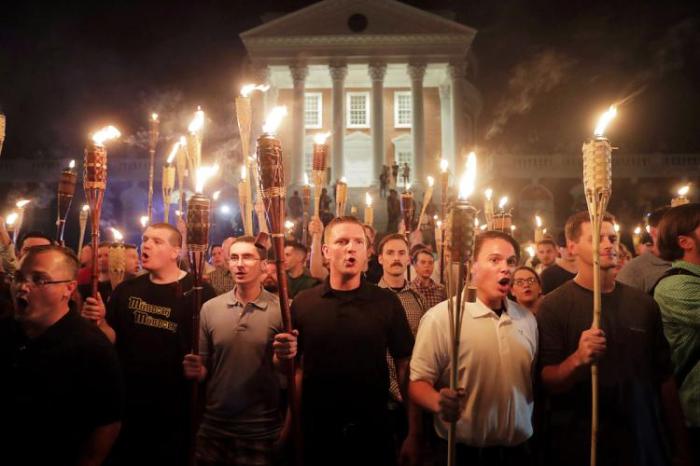
So this week when people saw Nazis marching openly in Charlottesville, Virginia, the only thing that was really so surprising about it was how surprised so many people seem to be.


“That’s not my America!” they seem to be saying.


To which I reply, “Hell, yes, it is! Where have you been the last 241 years!?”


We base our salary scales on genitalia! You think we’re really so freaking advanced!?


The shade of your epidermis determines the likelihood of police arresting you, charging you, even killing you regardless of your having a weapon, whether you resist arrest or simply lay on the ground with your hands in the air.


Regardless of the evidence, if you’re convicted, the length and severity of the sentence are all partially determined by the amount of melanin in your skin. The cultural derivation of the name on your resume determines the likelihood of employers calling you back for an interview. In many places, your rights are legislated based on whom you love.


Our schools are segregated. Our taxes are levied most heavily on those with the least means to pay. Our prisons house more black people today than did slave plantations in the 1860s.


Yet a bunch of white dudes carrying Tiki torches shouting hate filled puns (“Jew will not replace us”? Seriously?) somehow doesn’t compute?


Come on.


This is America.


Racism and prejudice are not threats smuggled in past border security. They’ve always been here. At least since Europeans came offering trade and peace with one hand and guns and smallpox with the other.


The land of the free was stolen from the Native Americans. Our national wealth was built on the backs of slaves. Our laws and electoral system were built to empower one group at the expense of others.


Yet reformations in this process are rarely met with celebration. Instead of memorializing the end of slavery, we embrace the institution with fond remembrance.


Nor did prejudice and bigotry end when Rosa Parks refused to give up her seat, after Brown vs. Board, the Voting Rights Act, Freedom Rides, sit-ins or civil rights protests.


America has always been a place hostile to the under privileged, the second sex, religious dissenters, the brown skinned.


At most, we had become less confrontational in recent years, but we never really changed our core values, our social structures, who has power and who does not.


During my lifetime, people started to equate having a black President with the end of racism. Somehow they ignored the everyday reality for most black people.


They ignored the constant prejudice against the poor, the continued bigotry against LGBTs, the Islamophobia, the increase in hate crimes.


If there has been any change during the past eight months, it hasn’t been with the degree to which Americans are prejudiced. It’s the degree with which we’re willing to hide it.


Whereas before racists would claim to be colorblind, that their actions were completely devoid of racial bias, today they sigh and repeat the dusty slogans of Jim Crow Alabama or 1930s Berlin.


And somehow people are actually surprised about this.


It’s because too many of us have swallowed the lies about living in a post-racial society.


You thought we were beyond all that. It was a brave new world, morning in America, and we were finally treating everyone equally – unless you looked at what we were actually doing.


Mainly this is the reaction you get from white people. They rub their eyes and just can’t believe it.


You don’t see this too often from people of color, Muslims, LGBTs and some Jews. Why? Because they never had the luxury to ignore it.


That’s what we white folks have been doing since the beginning.


Whenever these issues come up, we have a knee jerk reaction to minimize it.


Things aren’t that bad. You’re just blowing it out of proportion.


But, no. I’m not.


That’s why you’re so damn shocked, son.


You haven’t been looking reality square in the face.


So when we’ve got undeniable video footage of angry white males (mostly) marching through Southern streets brandishing swastikas and assault rifles, it catches many white folks off guard.


They’re not prepared for it – because they haven’t been doing their homework.


We’ve been living in a bubble. Especially those living in major metropolitan areas.


That kind of thing never happens around here, right?


Of course it does!


Just because you live above the Mason Dixon Line doesn’t mean you’re safe.


You have a black friend, you like authentic Mexican food and you laugh while watching “Modern Family.”


But you haven’t opened your eyes to the reality outside your door.


You send your kids to private school or live in a mostly upper class white district. You have an exclusive gym membership that keeps out the riff-raff. You work in an office where that one token person of color makes you feel sophisticated and open-minded.


You’ve got to wake up.


You’ve got to educate yourself about race and class in America.


Because those people you saw in Charlottesville aren’t an anomaly.


They are an authentic part of this country, and if you don’t like it, you have to do something about it.


You can’t hide behind denial.


You have to take a stand, pick a side, and be counted.


Because one day soon, the torches will be outside your door.


You have to decide now – do you want to brandish or extinguish them?

I’m a Public School teacher. Hands Off My Trans Students!

ct-transgender-students-met-20150425

I’m a public school teacher.

I have a lot of different girls and boys in my classes.

In fact, some of them are neither girls nor boys.

Does that mean they should be discriminated against? Does it mean we should judge them, tell them they’re somehow less valuable than the other kids? Tell them who they are by telling them where to pee?

Heck, No!

Some kids don’t feel comfortable with a traditional gender identity. And it’s more common than you’d think.

It’s certainly more widespread than I ever would have thought until a little girl taught me a lesson… well, not a little girl, really.

A few months ago, I would have said she’s the cutest little girl in the lunch line.

Bright, vivacious, always a friendly smile and a kind word.

But she’s not a little girl.

And I didn’t know until she told me.

As a teacher given the unenviable role of line monitor, I have to find the bright spots where I can.

Letting only two hungry 5th graders in to get their lunch at a time and making the rest wait does not make you popular.

“Aaaargh! Why you always stopping me!?” They often say.

“Because you were third,” I reply.

“But why?” They often insist.

“It’s not personal. It’s numerical.”

And I let them through to continue the game tomorrow.

It goes on like that for about a half hour with little variation – until she gets to the front of the line.

“Hey, Mr. Singer!” Big smile and a wave.

And we’d be off on a conversation. She’d ask me how my day was, what I was teaching my students, how my daughter was. I’d ask how her day was so far, about pets, homework.

She’s actually not in my class. I only see her at lunch, but she always brightens my day.

For months, it went like clockwork. Until a few weeks ago when she appeared at the front of the line with her long hair chopped off into a bob.

“Nice haircut,” I said encouragingly.

“Thanks,” she replied. “You want to know why I got it?”

“Sure. Why?”

“I’m agender.”

“Oh,” I responded cluelessly. “What’s that?”

And she proceeded to explain that she didn’t feel comfortable identifying as male or female.

I nodded and then it was time to let her get her lunch.

I’ll admit it was unsettling. Here was this cute little thing and I didn’t even know what to call her now.

But the next day things progressed as usual. Ze came through the line with the same big smile. We had the same innocuous conversation and ze went to eat.

It made me think.

I’ve been teaching for more than a decade. Ze was probably not the first transgender student I’ve met. And when I thought back to all the children who’ve come through my classes over the years, faces started to pop up and hit me.

Gender is not black and white. (Come to think of it, neither is race.) No one is 100% male or female. I mean, sure people have a fixed range of sexual parts, but gender identity is more than that.

We each feel comfortable acting and identifying certain ways, and if you think about it, some of those ways don’t always line up with our cultural gender designation.

For instance, I cry my eyes out at certain movies. My daughter – who’s 8 – heard the song “Boys Don’t Cry,” the other day and said, “Well that isn’t true. Daddy cries all the time.”

Moreover, my wife loves football, basketball and hockey. Me? I could take them or leave them. If she wants me to watch the game with her, she’s got to beg or promise or put out the right snacks.

Wouldn’t it just make sense that some people are much further to one side or other of the gender spectrum than others? Wouldn’t it just make sense that sometimes your identity and your physical parts don’t match? Or maybe you’re so in the middle that it makes no sense to take a side?

I say again, I teach in a public school. We don’t push any kids away. We take everyone. And that means taking those kids who aren’t so easy to label.

I teach middle school. Transgenderism doesn’t come up too often.

Last year when bathroom bills were all the rage, some of my 8th graders brought it up during our Socratic Seminar discussion groups. And I let them talk about it.

We talked about why some people might think this is a good idea, why some might oppose it, etc. There were some boys who were hysterically against trans students using the bathroom with them, but most of my kids had zero problem with it. In fact, they knew that it had already happened.

Trans students are everywhere. You just rarely hear about them.

I don’t know which bathroom my lunchline buddy uses. I wouldn’t presume to ask. But it hurts me that there are people out there who want to limit hir.

These children have rights. They are little sweethearts. They’re full of life and joy. We should respect their humanity.

And to those who say letting them use a bathroom that corresponds with their identity will lead to kids being molested, let me ask – has that ever really happened?

The way I see it, the problem is people – any people – molesting others, no matter what room they do it in, no matter if they’re transgender or not.

Frankly, it doesn’t happen a lot at school, nor is it more pronounced with trans kids.

This has nothing to do with children. It has to do with old men and women who refuse to broaden their views about the world. It’s about the ancient making the young do as they say regardless of how doing so may trample on their right to be themselves.

Well, I won’t be a part of it.

You want to attack my trans students? You’ll have to do it through me.

I’m a guardian of kid’s rights. I’m a defender of children from whoever wants to do them harm.

I’m a public school teacher. That’s just what we do.

Truth Bomb: Democrats Need to Embrace Progressivism or Else Move Out of the Way

screen-shot-2016-12-03-at-12-15-35-am

“Democrats: Are we the party of the donor class or the working class? This is value clarification time. It’s now or never!”

Nina Turner, former OH State Senator

Democrats, liberals and progressives of every stripe – you’re not going to want to hear this, but hear it you must.

We’ve gone around for too long thinking we’ve got all the answers, but obviously we don’t.

Hillary Clinton lost. Donald Trump won. There’s something seriously wrong with what we’ve been doing to get that kind of result.

There are some hard truths we’ve got to understand, that we’ve got to learn from. Hearing them may be painful. Many of us will fight against it. But we can’t keep fooling ourselves anymore. All that “hope” and “change” we’ve been waiting for – it has to start with us, first.
We’re stuck in a loop and we’ve got to break ourselves out of it. And the only way to get there is to break the track wide open.

It’s time to stop mourning.

Trump is President-elect.

Yeah, that sucks. Hard.

He’s going to protect us by enacting policies to hurt brown people. He’s going to make it harder to get healthcare. He’s going to trample the Constitution. He’s going to offer up our schools to private companies to do with as they please in secret using our tax dollars. He’s going to legitimize white nationalism and embolden racists, bigots, sexist, xenophobes, homophobes and every kind of hate group imaginable. He’s going to hand out tax cuts to his megarich campaign contributors and tax us with the loss of government services. He’s going to use the office as an opportunity to enrich himself and his billionaire buddies and then go on social media and tweet about how he’s fighting for working people.

I don’t like it any better than you. But it’s time to face it.

Sure, Clinton won the popular vote. Sure, there’s a recount going on in Michigan, Pennsylvania and Wisconsin. I’d love for it to overturn Trump’s victory. But I have zero confidence that it will. And I refuse to let it blind me to the urgent need for change.

The first thing we have to do is own up to one essential thing: Hillary Clinton was a bad candidate.

The people were crying out for a populist champion. We had one in Bernie Sanders. He would have destroyed Trump, but we blew it.

I’m not going to rehash it all again, but there’s no way you can honestly say the Democratic primary process was fair. Party leaders were clearly in the bag for Clinton. They ignored her negatives and what their constituency were trying to tell them.

This loss belongs squarely on the shoulders of establishment Democrats. It’s not the fault of the electorate. It was the party’s job to convince people to vote for their candidate. They didn’t do that. Instead they told people who to vote for – or more accurately who NOT to vote for. It was clearly a losing strategy. It lost us the Presidency, Congress and the Supreme Court. Own it.

Next we have to acknowledge that this problem is not new. The Democrats haven’t been what they were or what they could be for a long time.

Since at least President Bill Clinton, many Democrats have traded in their progressive principles for neoliberal ones. They have sold out their concern for social justice, labor and equity in favor of slavish devotion to the same market-driven principles that used to characterize the other side.

Bill Clinton approved NAFTA. He deregulated Wall Street paving the way for the economic implosion. He expanded the failing war on drugs, increased the use of the death penalty, used the Lincoln bedroom as a fundraising condo, ignored the genocide in Rwanda while escalating conflicts abroad in Russia and the middle east. He dramatically and unfairly increased the prison population. He pushed poor families off welfare and into permanent minimum wage jobs. And when people had clearly had enough of it and wanted a change, we gave them Al Gore a.k.a. Bill Clinton part 2.

THAT’S why an idiot like George W. Bush won in 2000. It wasn’t because of Green Party challenger Ralph Nader. It was because people were sick of the Democrats not being real progressives.

But we clearly didn’t learn that lesson, because we did the same damn thing in 2016.

President Barack Obama is just as neoliberal as Bill. He gets credit for bringing back 16 million jobs lost under Bush. But we haven’t forgotten that they’re mostly minimum wage jobs. He gets credit for reducing unemployment to only 4.7%. But we haven’t forgotten that nearly 50 million Americans aren’t included in those statistics because they haven’t been able to find a job in two years and have given up even looking for one.

Obama rolled back legal protections that used to stop the government from spying on civilians, that used to stop the military from being used as a police force against civilians, that used to stop the military from assassinating U.S. citizens, that used to protect whisteblowers, that guaranteed free speech everywhere in the country not just in designated “free speech zones.” Not only did he fail to close Guantanamo Bay, his administration opened new black sites inside the U.S. to torture citizens.

Obama continued the endless wars in the middle east. Sure, he had fewer boots on the ground, but infinite drone strikes are still a continuation of Bush’s counterproductive and unethical War on Terror.

And when it comes to our schools, Obama continued the same corporate education reform policies of Bush – even increasing them. He pushed for more standardized testing, more Common Core, more privatization, more attacks on unions, more hiring unqualified Teach for America temps instead of authentic educators.

Voters clearly wanted a change. We wanted a real progressive champion who would roll back these neoliberal policies. Instead we got Hillary Clinton a.k.a. Obama part 2.

The Democrats didn’t learn a thing from 2000. We just repeated the same damn mistake. And some of us still want to blame third party candidates like Jill Stein.

It wasn’t her fault, and it wasn’t voters faults. It was the Democratic establishment that refused to listen to their constituency.

So here’s the question: will we do it again? Will we let party insiders continue in the same neoliberal direction or will we change course?

Re-electing Nancy Pelosi to House Democratic leadership isn’t a good sign. She represents the same failed administration. But we’ve kept her in place for another term, repeating our mistakes.

Maybe we’ll make a change with U.S. Rep Keith Ellison as DNC chair. It would certainly be a good start to put a real progressive in charge of the party. What better way to challenge Trump’s anti-Muslim propaganda than by promoting the only Muslim representative in the House to the head of our movement! That’s a sure way of showing that Democrats include all peoples, creeds and religions in contrast to the Republicans insularity. But there’s no guarantee we’re going to do it, and even if we did, it would only be a start.

It’s time to clean house.

We need to take back what it means to be a Democrat. We can’t have organizations funded by hedge fund managers and the wealthy elite pretending to be in our camp while espousing all the beliefs of Republicans. We can’t have Democrats for Education Reform, a group promoting the policies of George W. Bush, the economics of Milton Friedman and prescribing laws crafted by the American Legislative Exchange council. We don’t need Cory Booker going on Meet the Press to defend Mitt Romney against income inequality and then pretending to champion working people while taking in contributions from the financial sector. The brand needs to mean something again.

The party needs to move in an authentic progressive direction. So we need to get rid of all the neoliberals. They can go become Republicans. All it would take is exchanging in their blue ties for red ones. They’re functional Republicans already.

We’ve got leaders who can take their place. We’ve got longtime progressives like Bernie and sometime progressives like Elizabeth Warren. We’ve got younger statesmen like Nina Turner, Tulsi Gabbard, Jeff Merkley, John Fetterman, and Jesus “Chuy” Garcia, to name a few. But we need new blood.

Of course none of this matters if we don’t take steps to secure the validity of our elections in the first place.

We need to reform our entire electoral process. Ancient and hackable voting machines, voter suppression laws and efforts, rampant gerrymandering and, yes, that stupid relic of the slave states, the Electoral College – all of it must go. We’ve got to ensure that people can vote, people do vote and it actually counts. And if something goes wrong, we need a way to double check. Recounts in close races should be standard and automatic.

We’ve got to fight Citizens United and other Supreme Court rulings equating money with speech. We’ve got to run people-powered campaigns like Sanders did so our politicians aren’t so beholden to corporate and wealthy interests. We’ve got to make it easier for third parties to be part of the process, to include their candidates in debates, etc.

These are some of the many challenges ahead.

Sure, we have to fight Trump. But the best way to do that is to reinvent ourselves.

If the Democrats aren’t willing to do that, many of us will go elsewhere. The party cannot continue to exists if it continually ignores its base. It’s not enough to give us a charismatic leader to latch onto – we need real progressive policies.

The next four years are going to be hard. Trump is going to make things very difficult for the people we love. But in a way that’s a blessing.

We have a real opportunity to create an authentic resistance. People will be untied in their dissatisfaction and anger at what Trump is doing to the country. They’ll be looking for somewhere to turn, for a revolutionary movement to lead them through it.

We can give them another fake insurgency as we did against Bush. Or we can learn the lessons of history.

We can move forward. We can change. We can become a party of real progressives.

Or if we need – we can start a new one from the ground up.

Why the Rich Need Racists: Prejudice as Social Control

Screen Shot 2016-07-17 at 1.55.00 AM

HELP WANTED: RACISTS
Anywhere, USA

-Must have an irrational fear and hatred of all things African American.

-Must honestly believe black people get all the breaks, have it easier than whites.

-Must believe black people are naturally inferior to whites, lazy, prone to criminality, less intelligent, etc.

-Must believe racism ended with either (1) the civil rights movement or (2) slavery.

But must hide these beliefs under a thin veneer of civility. For instance:

-must never use the N-word (in public)

-must never beat or kill a black person (unless on the police force)

-must never light a burning cross on a black person’s lawn (and get caught)

-must never tweet or express these views publicly in a way that can be traced back to you.

Enjoyment of rap music, black culture or black sexual partners optional. Fox News viewership preferred.

Bonus pay if racism is unrecognized by the applicant.

No experience necessary. Apply within.”


If you saw an advertisement like the above posted in your local shop window, it really wouldn’t be so surprising. Would it?


Well maybe because of its bluntness. But it’s not really that different from campaign fliers for Republican Presidential candidate Donald Trump vowing to “Make America Great Again!”


Throughout its history, when exactly was America great for black and brown people who have been denied equal rights? When was it great for women or LGBTs or a host of other non-cis/non-male/non-white people?


A pledge to make America great again is just a pledge to make America white again – or at least to propel male whiteness back to the center of normativity.


(In fact, much of what I’m going to say about racism here could also be said of all kinds of prejudice. But for the interest of clarity, I’ll try to contain myself to focusing on racism, though I acknowledge the high degree of intersectionality of the phenomena.)


Yep. A lot of folks are riled up because the flower of white male privilege is wilting, and they think too many are suggesting we let it die.


What can they do? White people’s only remaining claim on supremacy is based on a fleeting numerical majority that is fast coming to an end. Soon they’ll be outnumbered.


They’re so mad about even an incremental loss of white power, they’re willing to blind themselves to obvious injustices against people of color.


For instance, black people are killed by the police at twice the rate of white people. Unarmed black people are killed at five times the rate. Yet somehow it’s black folk’s own doggone fault.


What if he has a legal weapon, but it’s not anywhere in use? HIS FAULT.


What if he has no weapon? HIS FAULT.


What if he’s just a child? HIS FAULT.


What if it’s a woman mysteriously found hanged in her prison cell with no possible motive for suicide? HER FAULT.


What if he’s screaming in pain from an injury sustained in the police encounter? HIS FAULT.


What if he’s complaining on video that police are choking him and he dies as a result of those injuries? HIS FAULT.


I mean come on, people! How does a brotha’ got to die before white folks will admit to some culpability by police?

 
And that’s just one type of example. Consider: There are more black people in prison today than were slaves before the Emancipation Proclamation. Black people get harsher prison sentences than whites for the exact same crimes. Black people are segregated into poor communities with underfunded schools. People with black-sounding names are less likely to get a job than white counterparts with the same experience.


And on-and-on-and-on.


Yet you’ll find white apologists everywhere who will see no evil, hear no evil, and speak no evil of the racial caste system under which their black brothers and sisters are forced to live. They refuse to acknowledge it, get angry when you bring it up and will actively support it at the polls.


That’s racism, people.


It’s 2016. Legal slavery ended more than 150 years ago in this country. The civil rights movement ended more than 60 years ago. Why do we still have systematic racism baked into the fabric of America?


In 1963, the African American writer James Baldwin asked the same question. He said:


“The future of the Negro in this country is precisely as bright or as dark as the future of the country. It is entirely up to the American people, and our representatives, it is entirely up to the American people whether or not they’re going to face and deal with and embrace the stranger who they’ve maligned for so long. What white people have to do is try to find out in their own hearts why it was necessary to have the n****r in the first place. I am not a n****r. I am a man. But if you think I’m a n****r, it means you need it… You, the white people, invented him, and you have to find out why. And the future of the country depends on that.”


Why do white people need racism?


Today we have an answer. The short version would be this: because it’s useful.


It serves a function in society.


When people conceptualize each other into these highly dubious and unjustifiable categories of black and white, it provides a valuable service to the status quo. In fact, we couldn’t have the status quo without it.


When historians look back at the ancient Spartan empire of 900 -192 BC, there is little confusion why their society was so highly militarized. Few historians wonder why such a small population organized themselves into a military state. They needed to control the vast network of slaves dispersed throughout their community. The conquerors were massively outnumbered by the conquered so they resorted to militarized fear to keep their social structure intact. They weren’t afraid of invaders from without. They were afraid of invaders from within.


Likewise, if humanity survives our current moment in time, historians of the future will undoubtedly be in agreement about the reasons for American racism. It’s the same reason found in ancient Sparta. We need it to keep our society together.

 
In America today, the top one percent own more than the bottom 90 percent. The richest 85 people have as much wealth as the bottom half of the country. And it’s only getting worse.


A country with such vast wealth inequality cannot survive without a scapegoat – black people. The majority of the population would not let the top one percent gorge themselves on our riches unless they had distracted us with something.


Don’t pay any attention to the Wall Street bailout. Look at those welfare queens, which is code for black people sucking away our wealth.


Don’t pay attention to the overt militarization of the police force. Look at those violent black criminals they have to deal with by pulling their service pistols and shooting them into submission.


Don’t pay attention to the inequitable distribution of education funding to your public schools. Look at how these black kids don’t pull up their pants, and if they manage to graduate, they’re given undeserved preference over more qualified white people through affirmative action.


Think about it. Why do we have a sizable black population in the first place?


Slavery. The very presence of a substantial black population is attributable to market forces. We needed a cheap workforce for our agricultural industry – especially tobacco and cotton. It was a labor intensive process and the only way to make a substantial profit at it was immoral thrift. And you can’t get much cheaper than forced, generational servitude.


Why weren’t black people treated equally after the Civil War?


We still needed that cheap workforce. The wealth of our nation depended on it. We needed legal ways to keep them subjugated. We needed to keep them on the farm or in prison so the economic engine of agriculture could continue unabated. If they all had the right to vote or could protest their conditions, that would hurt the bottom line. They’d gain freedom, but we’d lose money. Not gonna’ happen.


Why didn’t equality come after the civil rights movement?


Agricultural mechanization had decreased the need for cheap labor, but having an underclass is profitable for whoever can take advantage of them. The invisible hand of the market will preserve human subjugation for as long as it can and as long as it turns a profit.


Moreover, throughout the entire history of this country, the rich have needed something to keep white labor in check, too. Fair wages, overtime pay, child labor laws, vacation pay, workplace safety – all of these rights had to be fought for tooth and nail – usually by the most demonized of social institutions, the labor unions. We needed something to stop the rising tide of economic fairness. Giving white workers someone to kick around made them more satisfied with their own lot in life and less willing to fight for a larger share of the pie.


It went something like this: You may have to work in the factory all day, but at least you aren’t one of THEM. You might be bone tired while the bosses get rich off of your labor, but at least you can feel proud of your race.


What an amazing swindle! The rich have actually convinced many hard-working white people to feel proud of the pigmentation of their skin! No. Not their cultural heritage. Not the struggle of their moms and dads, their ties to a homeland across the sea, their religion or ethnicity. No. The color of their skins!


If intelligent aliens ever crossed light years of space and time to investigate the intellect of human beings, that one fact would have them rushing back home shaking their tentacles and multiple heads in disbelief!


Just look at how racism has been used to justify the actions of the wealthy throughout history!


Europeans discover a New World in 1492 full of riches to plunder and exploit. But how do you justify doing that when it’s already populated? How can you do that morally? After all, doesn’t our God command we love our neighbors as ourselves? Isn’t murder and theft a… gulp… sin?


Well obviously the indigenous peoples don’t count. They’re not like us. They’re not Christians. They’re heathens.


But wait a minute! The church is forcing them to adopt our religion. This justification has a sell-by date. It won’t last long enough for us to suck every drop of wealth out of the Americas.


So we came up with a new way to dehumanize people – racism. It’s not just that they’re heathens. They’re subhuman, too. FWEW! Problem solved.


Then comes 1776. The American colonies revolt and write up some high minded language about all men being equal. If we actually believed that, it would necessitate a new social order. Much easier to find new justifications for the old one.


Well we already agreed the Native Americans are naturally inferior. These African slaves we stole are likewise beneath our high ideals. The same with women. And the poor. And immigrants. And homosexuals. And whoever else we need to subjugate. They just don’t count.


When idealism and capitalism have come into conflict, the rich have invariably chosen capitalism. And when the rest of us choose racism, prejudice, sexism, xenophobia and homophobia, we’re doing them a favor. We’re backing up their interests.


Stop being such chumps, white people!


A racist is invariably a traitor to his own class. A sexist is a sycophant to the smart set. A xenophobe is a diversion to the hands buried in your pocket robbing you blind.
Your interests have much more in common with all those people you’ve been taught to hate. You could be coming together in common cause with all those black and brown people. You could be rising up and demanding your due. We could join together and demand a fair shake, an equitable piece of our gross national product.


But instead we are content to protect an ever shrinking share of our national wealth if we can just keep that ridiculous and childish pride in our lack of melanin.


During the same interview, Baldwin was asked if he thought there was any hope America would change it’s ways. He said:


“I can’t be a pessimist because I’m alive. To be a pessimist means that you have agreed that human life is an academic matter, so I’m forced to be an optimist. I’m forced to believe that we can survive whatever we must survive.”


I agree.


It’s all up to us, white people.


Racism doesn’t serve us. It subjugates us just like it does everyone else.


They throw us a bone and we jealously guard it like its a prime cut of steak.


When are we going to wake up? When are we going to put away hate and choose love?


When are we going to join our brothers and sisters in the struggle and demand what’s ours?


The rich may need racists, but we don’t.

Florida Shooter’s Strongest Ally Was The American Gun Lobby

os-orlando-shooting-pulse-nightclub

“America is absolutely awash with easily obtainable firearms. You can go down to a gun show at the local convention center and come away with a fully automatic assault rifle, without a background check, and most likely without having to show an identification card. So what are you waiting for?”

-American-born al-Qaeda spokesmen Adam Yahiye Gadahn


Omar Mateen considered himself a terrorist.


He wanted to make that clear to posterity before ending a shooting rampage he initiated in Florida yesterday that left 50 dead and dozens more injured – the worst mass shooting in U.S. history (so far).


During the carnage at an Orlando gay nightclub, he allegedly called 911 to pledge his allegiance to ISIS. He just wanted us to know that.


Now that the shooter’s gone, just as he would have wished, pundits are making a lot of this phone call. Though his family claims he wasn’t particularly religious, media talking heads are seizing upon this one action by an unhinged young man in order to denigrate all American Muslims.


ISIS is a militant organization. Islam is a religion.


By contrast, the KKK is a militant organization. Christianity is a religion.


But never mind that. In Mateen’s case, an entire religion is somehow responsible for the actions of one man. If he had been a white Christian – as most mass shooters are – we probably wouldn’t be seizing on his race or creed. But even though Mateen was born in this country, his family is from Afghanistan, his skin is brown, he was one of THEM.


However, there is no evidence that anyone in the Islamic community helped Mateen conduct his reign of terror. He allegedly saw two men kissing several months earlier, became enraged and planned accordingly.


But we can pinpoint one American institution that gave the self-proclaimed terrorist much aide and comfort in his scheme – the American gun lobby.


In fact, firearm powerbrokers are helping terrorists kill civilians all over the country.


No. I don’t meant to say they are working hand-in-hand with international terrorist organizations like al-Qaeda and ISIS.


But they might as well be.


Our lax gun laws are the direct result of the lobbying efforts of the National Rifle Association (NRA) and other organizations closely associated with the gun industry. Those laws are being exploited by individuals like Mateen bent on murdering as many American civilians as possible.


Before Mateen opened fire, he had been on a terrorist watch list. In fact, the FBI had monitored his past activities.


You might think someone like that would not have been permitted to buy a gun in the first place. But you’d be wrong.


Just six months ago, the U.S. Senate had considered a law to restrict suspected terrorists from buying firearms and explosives, but it was defeated largely by Republican lawmakers accepting huge campaign contributions from the gun industry.


Mateen might have found it much more difficult to carry out this terrorist attack without the help he received from the NRA and so-called conservative lawmakers.


But don’t take my word for it.


Gadahn (quoted above) was killed in a drone strike in 2015, but he was not the only terrorist praising the efforts of the American gun lobby.


A six-page recruiting pamphlet found in terrorist safe houses in Kabul, Afghanistan, called “How Can I Train Myself for Jihad” instructs would-be terrorists “on the advantages the United States offers for firearms training and advises readers on how to exploit them.”


Maybe that’s why a measure like that recently defeated in the Senate to stop suspected terrorists from accessing guns was strongly supported by the George W. Bush administration.


It’s strange. Bush pushed the PATRIOT Act as an invaluable tool to keep America safe from terrorism despite the concerns that it trampled civil liberties. If lawmakers on both sides of the aisle are willing to weaken the 4th amendment’s provisions against unreasonable search and seizures in order to stop terrorism, then why do they oppose much more reasonable restrictions on the 2nd? What makes the right to bear arms so much more important than other privileges enumerated in the Bill of Rights?


In truth, it’s not a philosophical debate. It’s an economic one.


There is simply too much money being made by gun manufacturers – and thus being funneled into political campaigns – to allow for sane firearm policy.


Take the AR-15, one of two firearms used by Mateen yesterday. The same semi-automatic model he used was illegally modified and used to kill 14 and wound 21 in the San Bernardino shootings in late 2015. In 2012, it was also used in the murder of 20 children and six adults at Sandy Hook elementary school in Newtown, Connecticut.


It’s the most popular rifle in the country, and the weapon of choice for mass shooters.


As such, there have been calls to reinstitute the federal assault weapons ban from 1994 – 2004. Some claim that the ban was ineffective, allowing too many loopholes. Others say despite weaknesses it resulted in less people being killed by these types of weapons during the time of the ban.


Though several attempts have been made to reinstitute the ban, it has been stalled by the gun industry largely because of wordplay and minutiae.


They claim the term “assault weapons” is inaccurate at best and propaganda at worst. (Never mind that it was coined by the gun manufacturers, themselves, to increase sales.)

 
Rifles designated as “assault weapons” are not easily distinguishable from other kinds of rifles, they say, so banning them would lead to a slippery slope of banning all guns.


The most basic difference is the firearm’s ability to expel multiple rounds quickly. Because of this, the rifles included under assault weapons bans are usually semiautomatic – a new round is automatically reloaded into the chamber but is not fired until the trigger is squeezed again. The weapons also have detachable magazines, allowing them to fire 10, 20, 30 rounds or more without the need to reload.


However, bans often include “military style” rifles that are not necessarily semiautomatic. Gun advocates claim these rifles are similar to firearms excluded from bans except for cosmetic features to make them appear more militaristic.


Those could include features like a pistol grip, designed to allow a weapon to be fired from the hip; a collapsible or folding stock, which allows the weapon to be shortened and concealed; a flash suppressor, which keeps the shooter from being blinded by muzzle flashes; a muzzle brake, which helps decrease recoil; and a threaded barrel, which can accept a silencer or a suppressor. Bayonet lugs or grenade launchers are also sometimes included.


But are these features truly just cosmetic? Or do they actually make these rifles much more dangerous? No one needs a grenade launcher to hunt for game or protect their home.


When people call for gun regulations, they aren’t necessarily calling for a ban on all guns.


People want a degree of safety in public spaces. They don’t want to be cut down by one or two gunmen causing exponential carnage in seconds.


That seems a reasonable expectation.


Gun industry surrogates claim safety is best assured if everyone is packing heat – an endless stalemate.


In point of fact, there was an armed police officer working security yesterday at the gay club when Mateen sprayed the crowd with bullets. Though he traded fire with Mateen, he was unable to stop the carnage.


It’s absurd. The people who initiate mass shootings rarely survive them. They don’t care about being killed. They only care about spreading death and terror.


Moreover, adding more guns to public spaces only increases the chances of more shootings, many of which would probably be accidental.


The rest of the world has figured this out. There really is no argument to be made here. Polls show that most of the public wants some kind of gun control.


But it won’t happen so long as the gun industry is allowed to buy our lawmakers.


It won’t happen so long as we allow gun industry trolls to drown out all reasonable discussion with their circular zombie arguments.


Mateen couldn’t stand the sight of two men publically expressing their love for each other.


The gun lobby can’t stand the idea of reduced profits.


And together those two aims make up the twin pillars sheltering American terrorists everywhere.

Judging the Judge: What Antonin Scalia’s Death Means to the People I Love

antonin-scalia-26

I am not sad Antonin Scalia is dead.

Wow! It feels so good to say that out loud!

Come on. Admit it. You probably feel the same way.

I know. I know. Everywhere you turn, people are going out of their way to talk about the ramifications of the 79-year-old Supreme Court Justice’s death without passing judgement on him.

“Let’s keep it classy,” they say.

Oh. Stop it.

In his 30 years on the bench, Scalia hurt an awful lot of people. And I mean real, live people – not ideological constructs, not hypotheticals – but moms, dads, husbands, wives, daughters, and sons.

The aggregate amount of misery in the world was drastically increased by his being in it. And now that he’s gone, much of that misery may be relieved.

So please curb any shock you may feel at my thesis. And spare me the false praise of a truly reprehensible human being.

He was against women controlling their own bodies, efforts to desegregate our schools, an individual’s right to love whomever they choose, refraining from executing mentally disabled or teenage prisoners. Heck! He was even against police reading suspects their Miranda Rights!

This was a person who said black people should go to “slower” colleges, homosexuality was the same as murder or bestiality, sex discrimination is constitutional, and maybe we have a right to all carry around rocket launchers in public.

If it is outrageous to feel relief at the death of this man, you may call me outrageous.

I’m not usually the kind of person who celebrates someone else’s death. Not even a famous person.

But you have to admit that the people we love are a lot better off without Scalia in the world.

It’s not like he kept all this to himself. He wasn’t some lone drunkard in the back of the bar mumbling sexist, racist views. He wasn’t your ancient uncle who you only see twice a year making people uncomfortable at the dinner table. He was a judge in the highest court in the land, and his demented and warped world view drove public policy impacting… well… everyone.

He was the deciding vote in several 5-4 decisions that – if they had gone differently – would have greatly benefited every person in this country.

You can thank him for the Presidency of George W. Bush and Citizens United. Let that sink in for a moment.

Imagine all the horrific blunders of the Bush Presidency – easily the worst administration in my lifetime. If the Supreme Court hadn’t given the highest office in the land to Dubya, arguably we wouldn’t have had the Irag War, the Great Recession, No Child Left Behind, the slow response to Hurricane Katrina – maybe even 9-11.

And if you hate what our elections have become, imagine if we didn’t have the Citizens United verdict. Campaign donations would have to be made in public with some limits on how much individuals and corporations can contribute.

How much better the world would have been without these terrible decisions!

I’m not saying Scalia wasn’t a good man in his personal life. I have no idea what he was like to the people he loved. For all I know he may have been a good friend, a loving husband, father and grandfather. He probably had people he cared about and who cared about him. And to those people I send my condolences.

However, he did great harm to just about everyone else. And for that I feel nothing but relief at his death.

Who am I to bask in such schadenfreude?

I am a father and public school teacher.

I have a seven-year-old daughter and several classes full of mostly impoverished and minority students.

And Scalia’s death is good for everyone I care about.

If he were still alive, there was so much more damage he could have done. Take the Friedrichs case, an important one for teachers like me.

The case is an attempt to strip teachers unions of the right to charge members for their services. If the court rules in favor of Friedrichs, it would overturn decades of established law against free riders. People would be allowed to be in a union, enjoy higher salary and benefits negotiated by that union, but not pay dues. It would be absurd. Yet with Scalia still on the bench, most court watchers seem to think we would have had another terrible 5-4 decision.

However, with Scalia’s death, the best anti-union forces would probably receive is a 4-4 decision – not enough to overturn established law. True the case has already been heard by the justices, but a ruling has not yet been handed down. According to the Supreme Court blog, even if Scalia had already written a ruling on this matter, it would be void. Any rulings he wrote that have not yet been made public don’t count.

So the most likely outcome now is that millions of people will continue to be protected from unfair labor practices. And you expect me not to have a big ‘ol smile on my face!?

So where do we go from here?

President Barack Obama will select who is to succeed Scalia. Numerous excellent choices have been floated. If Obama chooses any one of them, he would probably tilt the court fractionally to the left.

Before the body was even cold, Republicans vowed to block any nominee Obama makes until the next President is sworn in. Some are trying out the talking point that Supreme Court Justices have never been sworn in during an election year. But if that were true, we wouldn’t have Justice Anthony Kennedy who was confirmed during the last year of Reagan’s presidency.

Funny. The U.S. Constitution clearly states that the President has the right to nominate Supreme Court Justices with the advice of Congress. Yet so many of these right leaning partisans who considered themselves Constitutionalists last week suddenly find themselves against that revered document today.

I wonder how Scalia would have argued such a situation.

Not really. He was the one who taught the rest of his party how to twist the words of the founding fathers to mean whatever the far right favors this week.

Obama still has more than 300 days in office. If Republicans try to block his nomination until a new face tops the Executive, it would be the longest such obstruction in a century. Of sitting justices, the longest confirmation period was for Clarence Thomas who took 106 days to be approved by Congress.

And that brings us to the 2016 Presidential race.

Scalia’s death is likely to have a huge impact on whom becomes our next President.

If Republicans block Obama’s Supreme Court nominee, it would probably increase voter turnout. Whenever that happens, it favors Democrats since they have more registered members than the GOP.

Either way, Scalia’s death is probably beneficial to whomever the Democratic nominee will be. If either Hillary Clinton or Bernie Sanders get the nomination, supporters of the defeated candidate are more likely to support the reigning Democrat.

Even if voters don’t like the winner’s policies as much as their preferred candidate, they’re likely to support the nominee in order to continue tipping the Supreme Court to the left. After all, three additional justices are 70 or older. Stephen Breyer is 77, Anthony Kennedy is 79, and Ruth Bader Ginsburg is 82.

We have had a long haul these last 15 years. Much social progress has been stalled.

But now that Scalia is out of the picture, the future looks bright.

Maybe things really will turn out alright. Maybe we’ll actually have a chance to build that better world we’ve all been dreaming about.

Rest in Peace, Scalia. The nation can’t wait to move on without you.

What Antonin Scalia’s Death Means to the People I Love

antonin-scalia-26

I’m not sad Antonin Scalia is dead.

Wow! It feels so good to say that aloud!

Come on. Admit it. You feel exactly the same way.

I know. I know. Everywhere you turn, people are going out of their way to talk about the ramifications of the 79-year-old Supreme Court Justice’s death without passing judgement on him.

“Let’s keep it classy,” they say.

Oh. Stop it.

In his 30 years on the bench, Scalia hurt an awful lot of people. And I mean real, live people – not ideological constructs, not hypotheticals – but moms, dads, husbands, wives, daughters, and sons.

The aggregate amount of misery in the world was drastically increased by his being in it. And now that he’s gone, much of that misery may be relieved.

So spare me any shock at my thesis. Spare me the false praise of a truly reprehensible human being.

He was against women controlling their own bodies, efforts to desegregate our schools, an individual’s right to love whomever they choose, refraining from executing mentally disabled or teenage prisoners. Heck! He was even against police reading suspects their Miranda Rights!

This was a person who said black people should go to “slower” colleges, homosexuality was the same as murder or bestiality, sex discrimination is constitutional, and maybe we have a right to all carry around rocket launchers in public.

If it is outrageous to feel relief at the death of this man, you may call me outrageous.

I’m not usually the kind of person who celebrates someone else’s death. Not even a famous person.

But you have to admit that the people we love are a lot better off without Scalia in the world.

It’s not like he kept all this to himself. He wasn’t some lone drunkard in the back of the bar mumbling sexist, racist views. He wasn’t your ancient uncle who you only see twice a year making people uncomfortable at the dinner table. He was a judge in the highest court in the land, and his demented and warped world view drove public policy impacting… well… everyone.

He was the deciding vote in several 5-4 decisions that – if they had gone differently – would have greatly benefited every person in this country.

You can thank him for the Presidency of George W. Bush and Citizens United. Let that sink in for a moment.

Imagine all the horrific blunders of the Bush Presidency – easily the worst administration in my lifetime. If the Supreme Court hadn’t given the highest office in the land to Dubya, arguably we wouldn’t have had the Iraq War, the Great Recession, No Child Left Behind, the slow response to Hurricane Katrina – maybe even 9-11.

And if you hate what our elections have become, imagine if we didn’t have the Citizens United verdict. Campaign donations would have to be made in public with some limits on how much individuals and corporations can contribute.

How much better the world would have been without these terrible decisions!

I’m not saying Scalia wasn’t a good man in his personal life. I have no idea what he was like to the people he loved. For all I know he may have been a good friend, a loving husband, father and grandfather. He probably had people he cared about and who cared about him. And to those people I send my condolences.

However, he royally screwed just about everyone else. And for that I feel nothing but relief at his death. If only it had come sooner.

Who am I to bask in such schadenfreude?

I am a father and public school teacher.

I have a seven-year-old daughter and several classes full of mostly impoverished and minority students.

And Scalia’s death is good for everyone I care about.

If he were still alive, there was so much more damage he could have done. Take the Friedrichs case, an important one for teachers like me.

The case is an attempt to strip teachers unions of the right to charge members for their services. If the court rules in favor of Friedrichs, it would overturn decades of established law against free riders. People would be allowed to be in a union, enjoy higher salary and benefits negotiated by that union, but not pay dues. It would be absurd. Yet with Scalia still on the bench, most court watchers seem to think we would have had another terrible 5-4 decision.

However, with Scalia’s death, the best anti-union forces would probably receive is a 4-4 decision – not enough to overturn established law. True the case has already been heard by the justices, but a ruling has not yet been handed down. According to the Supreme Court blog, even if Scalia had already written a ruling on this matter, it would be void. Any rulings he wrote that have not yet been made public don’t count.

So the most likely outcome now is that millions of people will continue to be protected from unfair labor practices. And you expect me not to have a big ‘ol smile on my face!?

So where do we go from here?

President Barack Obama will select who is to succeed Scalia. Numerous excellent choices have been floated. If Obama chooses any one of them, he would probably tilt the court fractionally to the left.

Before the body was even cold, Republicans vowed to block any nominee Obama makes until the next President is sworn in. Some are trying out the talking point that Supreme Court Justices have never been sworn in during an election year. But if that were true, we wouldn’t have Justice Anthony Kennedy who was confirmed during the last year of Reagan’s presidency.

Funny. The U.S. Constitution clearly states that the President has the right to nominate Supreme Court Justices with the advice of Congress. Yet so many of these right leaning partisans who considered themselves Constitutionalists last week suddenly find themselves against that revered document today.

I wonder how Scalia would have argued such a situation.

Not really. He was the one who taught the rest of his party how to twist the words of the founding fathers to mean whatever the far right favors this week.

Obama still has more than 300 days in office. If Republicans try to block his nomination until a new face tops the Executive, it would be the longest such obstruction in a century. Of sitting justices, the longest confirmation period was for Clarence Thomas who took 106 days to be approved by Congress.

And that brings us to the 2016 Presidential race.

Scalia’s death is likely to have a huge impact on whom becomes our next President.

If Republicans block Obama’s Supreme Court nominee, it would probably increase voter turnout. Whenever that happens, it favors Democrats since they have more registered members than the GOP.

Either way, Scalia’s death is probably beneficial to whomever the Democratic nominee will be. If either Hillary Clinton or Bernie Sanders get the nomination, supporters of the defeated candidate are more likely to support the reigning Democrat.

Even if voters don’t like the winner’s policies as much as their preferred candidate, they’re likely to support the nominee in order to continue tipping the Supreme Court to the left. After all, three additional justices are 70 or older. Stephen Breyer is 77, Anthony Kennedy is 79, and Ruth Bader Ginsburg is 82.

We have had a long haul these last 15 years. Much social progress has been stalled.

But now that Scalia is out of the picture, the future looks bright.

Maybe things really will turn out alright. Maybe we’ll actually have a chance to build that better world we’ve all been dreaming about.

Rest in Peace, Scalia. The nation can’t wait to move on without you.

Taking Back Your Name – The Pros and Cons of Political Correctness

introduction


“What I think the political correctness debate is really about is the power to be able to define. The definers want the power to name. And the defined are now taking that power away from them.”
Toni Morrison

“Never trust anyone who says they do not see color. This means to them, you are invisible.”
Nayhyirah Waheed


Call me Steve.

Not Steven. Not Stephen. Certainly not Steveareno.

It’s a preference. My preference. My choice. And if people want to be in my good graces, they’ll comply with my wishes.

There’s nothing strange or unreasonable about this. We do it all the time – usually when we’re being introduced to someone.

“Hi. I’m Steve.”

“Nice to meet you, Steve. I’m Elisha.”

“Elisha? What a beautiful name!”

“Thank you, Steven.”

“Please. Call me Steve.”

Is there anything wrong with that? Does that stifle conversation? Does it stop people from talking freely to each other?

No. Certainly some names are hard to pronounce or – in my case – remember. But overcoming those hurdles is just common decency. It’s not too much to ask – especially if you’re going to be dealing with this person for an extended length of time.

The idea that allowing people to define themselves somehow shuts down conversation is rather strange. But it’s the essence of opposition to political correctness.

“Political correctness is tyranny with manners,” said conservative icon Charlton Heston.

I wonder if he would have felt the same if we’d called him Charlie Hessywessytone.

A more fleshed out criticism comes from President George H. W. Bush who said, “The notion of political correctness declares certain topics, certain expressions, even certain gestures off-limits. What began as a crusade for civility has soured into a cause of conflict and even censorship.”

Is that true? Is political correctness really censorship? That’s the conflation made by many conservatives and even some liberals. After all, popular Left-wing comedian Bill Maher sarcastically calls his HBO show “Politically Incorrect,” and he often rails against the practice.

There’s a kernel of truth to it. We are asked to change the way we speak. We’re asked to self-censor, but we already do this frequently without wailing against a loss of free speech.

Human beings are subject to various impulses, but as adults, we learn which ones we can act on and which we shouldn’t. I may think it would be hilarious to run into a crowded movie theater and yell, “FIRE!” However, I know that doing so – while possibly funny to a certain kind of person – would result in injuries and trauma as moviegoers stampede out of the theater. So I don’t do it. Is that censorship? Maybe. But it’s censorship with a small c.

The Hestons, Bushes and Mahers of the world seem to think political correctness is more like Capital C Censorship. But this is demonstrably false.

That kind of Censorship is the act of officials, possibly agents of the government, a corporation or some other formal bureaucracy. But political correctness has nothing to do with officials. There are no censors. There are only people who ask to be named a certain way.

A censor looks at a news report of military operations in Iraq and deletes material that would give away the army’s location. Political correctness is nothing like that. It involves someone asking others to refer to themselves THIS WAY and not THAT WAY.

The penalties for violating Censorship are official. Ask Chelsea Manning who is serving a 35-year prison sentence for doing just that. The penalties for violating political correctness are social. You may be criticized, condemned or disliked.

If you criticize Manning for releasing classified documents to Wikileaks, you’re not violating political correctness. That’s your opinion, and you’re entitled to it. However, Manning is a trans woman who is going through hormone replacement therapy. If you refer to her as “him” you are violating political correctness. You’re naming her in a way that violates her wishes. The penalty is not a prison sentence. It’s a sour look.

So political correctness is not Censorship. In some ways, the confusion comes from the term “political correctness,” itself.

Though its origins are hard to pin down, it appears to have been coined by the Soviets to mean judging “the degree of compatibility of one’s ideas or political analysis with the official party line in Moscow.” At least that’s what the International Encyclopedia of Social Studies says.

The term came to prominence in the United States in conservative writer Dinesh D’Souza’s book “Illiberal Education.” He disparaged affirmative action as a kind of political correctness that gave preference to (what he saw as) unqualified minority students over whites in college admissions.

So the first mention of the term in the USA was simply to disparage liberal political policies. It was a ham-handed way of comparing the Left with the Soviets. Yet somehow this term has become the handle by which we know simple civility. It’s kind of hard to feel positively about a concept that begins with a mountain of unearned negative connotations.

Conservatives know the power of getting to name something. It’s their go-to propaganda tactic and lets them control much of the debate. For instance, that’s why the Right loves to call Social Security an “entitlement.” There’s truth to it because you’re entitled to getting back the money you pay in, but it’s full of unearned negative connotations as if these people were somehow demanding things they don’t deserve.

In essence, political correctness shouldn’t be political at all. It’s just kindness. It’s just being a decent human being. Don’t purposefully call someone by a name they wouldn’t appreciate. Respect a person’s ownership of their own identity.

And for some people that’s hard to do. Their conceptions of things like gender, sexuality, race and religion are extremely rigid. The only way to be a man is THIS WAY. The only way to be spiritual is THAT WAY. But if they give voice to these ideas in the public square – especially in the presence of people who think differently – they will be frowned upon.

But is this really so dissimilar to the crowded movie theater? Refusing to acknowledge someone else’s identity is harmful to that person. It tramples the soul similarly to the way their body would be trampled in a stampeded exit. So you shouldn’t do it.

The result is an apparently much more tolerant society. It’s no longer okay to use racial, cultural, gender and sexual stereotypes in public. You’re forced to give other people consideration – or else face the consequences of being disliked. And on the surface, that’s a much more inviting world to live in.

However, there is a glaring problem. In some ways, this has made public discourse more antiseptic. People don’t always say what they mean in the public square. It’s not that they’ve changed the way they think about the world. They’ve just learned to keep it to themselves until they’re around like-minded individuals. They reserve their racist, classist, sexist language for use behind closed doors.

This is why when I’m at a party peopled exclusively by white folks, some partygoers may let racial epithets slip out. And we all laugh nervously to be polite. Or maybe it’s more than politeness. Maybe for some it’s to relieve the tension of such refreshing candor like taking off a girdle. Fwew! Here, at least, I can say what I really think without having to worry about people looking down on me for it!

Since such reactions occur mostly in homogeneous groups, it makes the world look much more enlightened than it really is. Pundits and policymakers look around and cheer the end of these social ills when they haven’t ended at all. They’ve merely gone underground.

And so we have an epidemic of colorblind white people who can’t see racism because of the gains of political correctness. Somehow they forget those unguarded moments. Somehow they haven’t the courage to examine their own souls. Or perhaps they don’t care.

And so we have the conundrum: which is better – to live in a world where all individuals have the right to name themselves or to live in a world where our most basic prejudices are on display for all to see?

Personally, I pick political correctness, and here’s why.

Words are important. We think in words. We use them to put together our thoughts. If we continue to respect individuals’ names in word, eventually we’ll begin to do so in thought and deed.

This isn’t mind control. It’s habit. It’s recognizing an ideal and working toward it. As Aristotle taught, the way to become a good person is to act like one. Eventually, your preferences will catch up with your habits.

I think that’s what’s happening today. Look at the children. They’re so much less prejudiced and racist than we, adults. This is because they’ve learned political correctness first. They didn’t have to unlearn some archaic white-cisgender-centrism. This is normal to them, and I think that’s a good thing.

Obviously some people will balk at this idea. They will look at this ideal as reprehensible. They want to return to a world where women were little more than property, a world where black people knew their place, where sexual identity was as simple as A or B.

But I think most of us recognize that this is not a world where we’d want to live. Modern society can be scary and confusing but trying to respect everyone as a person isn’t a bad thing. It’s consideration, concern, warmth.

Perhaps the best way to love your fellow humans is to call them by their proper names.

You Can’t Solve Prejudice With a Cookie-Cutter: Celebrate Diversity

057 soft chocolate chip cookies for blog

If America was a cookie, it would probably be chocolate chip.

Sure it’s mostly dough, but the chips are what give it flavor!

I mean, come on! Who wants a plain sugar cookie!? Yuck!

Maybe that’s what they meant all those years ago when they described us as a melting pot. All these different races and nationalities blending together to form a delicious whole.

However, some flavors just don’t mix – or at very least are slow to come together.

In fact, since the very beginning, much of America has been obsessed with ensuring we DON’T mix! Chips and dough can’t melt together! We must preserve the purity of the batter. In fact, let’s send those chips back to Belgium!

But times have changed. We’ve tried to legislate our way to equality. Voting Rights Acts. Anti-Segregation Acts. Non-Discrimination Laws. But the legal system is far from perfect, and it can only do so much. If we’re really going to become one big tasty treat, we’ve got to do something about it – each and every one of us.

So how do we all come together? What should be our goal?

For some people, the answer is silence. We shouldn’t talk about this stuff at all.

There’s very little scientific justification for categorizing ourselves into different races, anyway. Just button your lip and it will all go away.

To which I say, yeah, many things such as race, nationality, even sexuality are to a large extent man-made. They’re the product of culture and society, but that doesn’t make them unreal. They’re totems, archetypes, symbols we use to navigate the social universe. If you think a social constraint is unreal, try violating it.

Moreover, ignoring inequality won’t solve it. That only ensures that the status quo continues to reproduce itself.

In short, if we don’t talk about prejudice, we’ll never get over it. Our biases will never go away.

Other folks – many with the best of intentions – think not that our differences are unreal, but that we should ignore them. Don’t talk about us and them. It’s all just us.

No more twitter campaigns proclaiming #AllChipsMatter. We should instead join hands and proclaim #AllIngredientsMatter.

And I do see your point. We are all important regardless of race, nationality, gender, religion, sexual orientation, etc. But is this really the best way to come together as a nation? If all of us taste the same, we’ll certainly be one – one bland and lousy confection sitting in the bakery that no one in their right mind would really want to eat.

Homogenization has its strengths. Look at white folks. We used to be very different. Czech, Slovak, German, Russian, etc. Now we’re one indistinguishable whole. Sometimes we venture outside of that label for a few hours to celebrate some ethnic festival, but most of the time we’re just white, White, WHITE. Having a beer and a Wiener Schnitzel during Oktoberfest doesn’t change how you usually identify and how you are identified in the world.

But something has been lost here. You can only be blind to the differences in people if you wipe away the rough edges. People become less distinct, more similar. That’s not the best way to be.

There’s another way.

Instead of ignoring the differences between people, we should embrace them. Don’t hide your nationality, your race, etc. Celebrate them!

I am the proud product of this culture! I am the son or daughter of this type of person! I love this! I believe that! I am not just anyone – I am ME!

There is a danger when anyone suggests conformity as a way to fight racism, sexism or any form of prejudice. It puts the responsibility on those who are different. If you don’t want to be discriminated against, YOU need to conform.

I think this is wrong. You have the right to be yourself. Instead it is the responsibility of those who would discriminate to STOP.

If you’re racist, YOU need to stop.

If you’re sexist, YOU need to stop.

If you’re homophobic, YOU need to stop.

And so on.

This isn’t as easy as it sounds. You can’t just walk it off. Prejudice is the result of years of enculturation, socialization and bigotry. It takes time. It takes a loving heart. But most of all it takes two very important things that few people in America have truly achieved:

1) Willingness to try.

2) Acknowledging that there is a problem in the first place.

That’s where we are today.

Very few people exist in the United States without some prejudice. People feel uncomfortable around those unlike themselves. We have preconceptions about how certain people will act. We think we know better how other people should live their lives.

These are all prejudices. And what’s worse, many of them are actually unconscious. I didn’t even recognize that I got nervous around black people – and now that I do, I don’t want to feel that way. I know it’s not justified, but I still can’t help the feeling!

So there is much to be done here in the USA to make us the best we could be. And it is our job to do that work.

Because the cookie of America has lots of cracks in it and more than a few nuts.