Why You Should Thank Harper Lee for Tearing Down Your Childhood Hero

Screen shot 2015-08-27 at 10.47.03 PM

It’s been more than 50 years since Harper Lee published her Pulitzer Prize winning novel “To Kill a Mockingbird.”

In that time, a lot has changed and nothing has changed.

Our schools are still highly segregated and unequal – but we justify that with standardized test scores. Our prisons are still disproportionately filled with black and brown people – but we justify that with the War on Drugs. Racial minorities are still gunned down in the street while their killers get off scot-free – but we justify that with a dysfunctional justice system.

Yes, we have our first black president but most people of color still live under the shadow of white privilege and a government sanctioned caste system.

Now comes “Go Set a Watchman” a book Lee wrote before “Mockingbird” but that works best as a sequel.

Does it matter? Is it still relevant?

I’d say yes.  After all, the original was written as people across the nation were struggling to overthrow the old racist system. And today many of their grandchildren and great-grandchildren are still engaged in that same struggle.

In a world where the majority cling desperately to colorblindness, it’s refreshing to read a book that proclaims black lives matter – even if it was written in the 1950s.

The most striking thing about the new novel is its portrayal of Atticus Finch. In “Mockingbird” he’s described as the quintessential hero – a white lawyer putting himself at great personal risk in a doomed attempt to defend an innocent black man. In “Watchman” Atticus is… well… a bit of a racist.

He’s 20 years older, has joined a neighborhood committee dedicated to keeping the races separate and we learn that at one time he had even been a member of the Ku Klux Klan.

How can we reconcile THIS Atticus with the one we remember from our childhoods? Is it even worth trying? Is the book worth reading?

Let’s start with the book’s literary value. Questions abound about its publication. Lee, 88, lives in a nursing home and is reportedly in ill health. After all this time, did she really want this book out there now or is that the result of overzealous publishers who know any book with her name on it will be a best seller? Moreover, her sister, Alice, served as a protector of Harper’s legacy but almost as soon as she died, the book was slated for publication.

And when you actually crack it open, it’s clear that certain passages are almost identical to others in “Mockingbird.” You can see how the one book lead to the other. Moreover, there are places that could use expansion and others that could use a bit of editing.

However, despite its shortcomings, from the first page to the last “Watchman” is like returning home to Maycomb County.

In the first chapter, we share a 20-something Jean Louise’s excitement on the train from New York south to visit her family, because we want to see these people again, too. Unlike a simple rereading of the classic “Mockingbird,” this time the characters have grown, changed and act in unexpected ways. Like our protagonist, though, we’re in for many a rude awakening.

Scout’s brother, Jem, is dead, and his absence is felt throughout most of the book. At first, I was angry about this. I thought it was simply bad writing, trying to artificially limit the characters. But then I realized Lee had already set up Jem’s demise back in “Mockingbird.” After all, their mother died around the same age from a heart attack – a congenital defect on her side of the family.

Jem’s absence is irksome because it’s real. Too many times in life people who mean so much to us just disappear leaving a hole never to be filled again.

Likewise, Dill is hardly to be seen. However, this shouldn’t be surprising. Both books are semi-autobiographical and his character is modeled after Harper’s childhood friend – Truman Capote. In the novel just as in life, our heroine, Scout/Harper, and Dill/Truman grew apart.

In his place we get Hank – a character never mentioned in “Mockingbird” but who apparently was around – somewhere. He serves as Scout’s boyfriend. Though he’s drawn a bit vaguely, through him we get to see the kind of woman Jean Louise has grown into.

The Scout of “Watchman” is different than her 6-8-year-old self, too. But it’s easy to see how the little girl of the previous book could become the intelligent but restless woman in this text.

Calpurnia is much changed. She no longer works for the family. In fact, she seems to have enclosed herself in the Quarter – the part of town where only the black people live.

With the U.S. Supreme Court ruling in Brown vs. Board of Education,  Maycomb’s black folks seem much less inclined to smile and nod and serve every passing whim of white people. They have an inkling that maybe things could be different, that maybe they’re entitled to equal rights, after all. And these new possibilities come between Jean Louise and the woman who raised her more than any other.

Calpurnia is the one who explained to her what it means to be a woman. She explained everything from menstruation to sexual intercourse. Yet these new possibilities in social justice make it impossible for the two women to have a proper homecoming.

I wonder: would Jean Louise really not begrudge Calpurnia all the rights and privileges she so easily expects as her own right? It’s hard to say but still very sad.

On the other hand, Aunt Alexandra hasn’t changed much. She’s still disapproving, tyrannical yet emotional. Likewise, Uncle Jack is much the same. He’s grown more eccentric but it’s easy to recognize the friendly doctor who bandaged Scout’s hand after she punched her cousin for calling her father a racial epithet in “Mockingbird.” And neither does Atticus seem drastically different at first. He’s older and suffers from terrible arthritis. But at first glance he’s the same caring, wise paternal figure of our remembrances.

For about 100 pages the book is a mostly meandering return to a world we never thought we’d see again. Then everything changes with the bombshell of Atticus’ recent pro-segregation activities.

How can it be possible? Can this really be Atticus Finch? Or is this just bad writing?

We know the character is based on Harper’s own father, Amasa Lee. Is this really more of a portrait of the real man than the fictional one?

It’s hard to say. But as we read on it becomes clear that, yes, this is still the Atticus we remember. But we didn’t know him as well as we thought.

(WARNING: Limited spoilers ahead.)

The heart of the novel is when Jean Louise confronts her father about his seemingly new attitude. In typical Atticus style, he argues with her almost like he was defending himself in court. Some of his defense makes a weird kind of sense. He says he briefly joined the Klan just to see who was behind those hoods. He wanted to know whom he was dealing with. Moreover, his participation in this segregation society was to serve as a moderating influence. He wanted to make sure they didn’t get up to too much trouble.

But this is only half an answer. As he continues, it becomes clear that Atticus actually does believe some of the racist rhetoric of his times. He really doesn’t want black people and white people to be put on an equal footing. He justifies this by saying black people aren’t ready yet. They haven’t been prepared for the rights and privileges of white folks. Maybe some day they will be, but not today.

It’s a disgusting and patronizing argument – infantilizing an entire people. And hearing this out of Atticus mouth – it’s like seeing a spider crawl across a gorgeous face.

Similarly creepy is his appeal to state’s rights – an argument we still hear today from our Tea Party friends. Perhaps it WAS Southern white people’s responsibility to raise up the people of color in their midst – but if they weren’t going to do it, it was past time that someone did!

Scout doesn’t let her father get away with any of this. She does her best to verbally destroy him and run away forever.

But before she can escape, she runs into her Uncle Jack. What he does is equal parts rationality and sexism. I can’t imagine any modern author resolving the story this way. Perhaps that’s for the best. In some ways, Uncle Jack’s actions are more disturbing than Atticus’ opinions.

In the end, Scout learns to accept her father for who he is. Yes, he is dead wrong about black people, but most of the time he’s still the same loving Atticus. It’s a good point. How many people do you love who believe reprehensible things? Probably a lot. That doesn’t mean you stop loving them.

I’d say that’s the central point of the novel. Each of us is responsible for creating our own conscience. We can’t rely on any value system that comes to us prepackaged. We have to examine every facet of our worlds and decide what it is we truly believe. And in doing so we’ll probably reach divergent opinions.

The only way Lee could do that was by showing us the heroic Atticus as nothing but a flesh and blood human being, full of the same frailties and mistaken thinking.

In the end, Scout’s thoughts seem more modern than anyone else’s in the book, more in line with our own views about social justice. But her conclusion only goes so far. We’re still left with questions. How do we reach loved ones who disagree with us? How can we tell if our own ethical intuitions are correct? How can white folks best help people of color secure their rightful place in society?

None of these have answers, but Lee is still asking the right questions. More than 50 years later, we’re still searching for solutions.

“Talking Crap” Focus on Teacher Bathroom Breaks Misses the Point on Problems Impacting Teachers

stressed-teacher

By Yohuru Williams and Steven Singer

Nearly 18 years ago in his 1997 State of the Union address, President Bill Clinton urged Americans to prioritize education. He suggested beginning with building respect for the teaching profession. To “have the best schools,” he observed, “we must have the best teachers.” He continued, “most of us in this chamber would not be here tonight without the help of those teachers.”

Despite Clinton’s eloquence, respect for the teaching profession steadily declined due primarily to a narrative of failure constructed by the proponents of corporate education reform. They consistently blame the power of teachers’ unions and teacher tenure for society’s woes. They use both as a justification to construct a multi-billion dollar industry to standardize and privatize our public schools.

For the most part, the mainstream media has been reluctant to challenge this narrative and point to the real obstacles that exist for teachers. Such is the case with a recent article in The Atlantic by Alia Wong entitled “Using the Restroom – a Privilege If You’re a Teacher” that completely misses the point of a recent survey highlighting some of the substantive issues facing the nation’s teachers.

Tens of thousands of professionals responded to the 2015 survey. The survey was conducted collaboratively by two groups: the Badass Teachers Association, a grassroots network of more than 55,000 educators, parents and students and the American Federation of Teachers, the nation’s second largest teachers union. The survey yielded shocking results that powerfully illustrate the collateral damage of the “test and punish” environment engulfing public education. This includes such serious allegations regarding workplace conditions that it prompted a meeting between the authors and the U.S. Department of Education. A team of educators working with both BATS and the AFT launched the 80 plus question survey in April. Some 91,000 public school teachers responded and 31,000 completed the survey. The unprecedented response revealed that there are indeed major problems with our current education policy and its impact on education practitioners.

Perhaps, the most startling revelation from the survey is what prompted it to be conducted in the first place – the increasing incidence of teachers and administrators who committed suicide due to bullying and abuses stemming from national school policy and other work place stressors. These are often the hidden casualties in the war on public education.

In October of 2010, for example, a California elementary school teacher named Rigoberto Ruelas, Jr. took his own life after the Los Angeles Times published a report labeling him a “less effective teacher.” Despite the fact that students and parents praised Ruelas, who taught in one of poorest schools in his district and who also was born, raised and continued to live in area where his school was located, the Times targeted him among other so-called “less effective” teachers as part of a major propaganda campaign. Publishing their names and ranking them according to their students’ test scores was supposed to encourage “reform”.

The Ruelas case is far from an isolated incident. Just last month, a New York City principal under investigation for altering Common Core test scores, killed herself by jumping in front of a subway car.

If U.S. teachers are the proverbial canary in the coalmine, then we may already be too late. Pressures related to high stakes testing are not the only stresses educators face. Teachers also reported significant bullying and hostility from city officials and administrators. Equally disturbing were reports concerning the infamous teacher jails where educators can languish for months under conditions, leaving them “broken, depressed,” and “suicidal, according to one California teacher observer. Statements recently made by New Jersey Governor and Republican Presidential Candidate Chris Christie reveals the scope of the problem. He said he would like to punch the national teachers union in the face. Rather than enjoying esteem as valued members of the communities they serve, educators have become convenient scapegoats. They fight on multiple fronts to provide their students a superior education and make a stable living.

It’s no wonder 73 percent of teachers in the Quality of Work Life Survey said they often find themselves stressed at work.

More than half of those surveyed, 55%, highlighted the “negative portrayal of teachers and school employees in the media” as a source of stress. The pejorative portrayal of teachers in a publication like The Atlantic is especially problematic. That a national periodical elected to do a piece on the survey but limit its scope to toilet restrictions trivializes other results. It’s not that this isn’t an important factor, but Wong’s coverage of other pertinent issues get short shrift. In her words educators tend to be, “known for their tendency to complain about and perhaps over-exaggerate their stress levels.”

To be fair, Wong eventually deleted that remark from subsequent editions of the article. However, she cautioned her readers to be skeptical of the survey because of potential bias. It’s a survey of teachers conducted by teachers. This is an odd critique however given the survey takers expressed intent to use the data collected as a means to spur the Department of Education to conduct a full scientific survey of the profession and then take appropriate action to rectify these concerns.

Rather than reporting squarely on the survey, Wong picked over the evidence. Rather than heeding the call that there is a real need for a much larger and more focused study of these problems, she either ignored or debunked its claims. Rather than treat educators as professionals, she belittled them.

Wong is not a bad journalist. Like most people, she has bought into the notion that teachers don’t know how good they have it. The public still doesn’t understand why teachers have “summers off.” They still misunderstand tenure to mean “a job for life” when it’s really only a guarantee of due process. Instead of helping the public better understand these issues, Wong and other representatives of the media often become entangled in the snare of the same myths.

Once again those entrusted with the most important job of preparing the next generation through our system of public education are losing a public relations campaign that can’t or won’t distinguish truth from falsity.

In short, our problems are much worse than inadequate bathroom time. We’re turning our public schools into factories and blaming teachers when it doesn’t work. We’re allowing billionaire philanthropists to set education policy but holding educators accountable for the results. We’re segregating our schools, providing Cadillac funding for the rich and bicycle funding for the poor and minorities but expecting teachers to somehow make up the difference. We’re letting corporate raiders run charter schools with no transparency or accountability and when that proves a disaster, we point our fingers at teachers. The result is a nation of frustrated educators who are increasingly leaving the profession in droves. “The average teacher,” writer Robert Brault once observed, “explains complexity” while “the gifted teacher reveals simplicity.” The data collected from the teacher survey reveals the complexity of the issues facing public education but they also highlight a simple truth. For if the survey is indeed accurate in illustrating just how debilitating these issues are to adults, we can only imagine what it’s doing to our children.


Yohuru Williams is an author, Dean, Professor of History and Black Studies, and education activist. Steven Singer is a husband, father, teacher, and blogger, education advocate. Both are members of the Badass Teachers Association.

williams-singer


NOTE: This article also was published in the LA Progressive and on the Badass Teachers Association Blog.

Do Americans “Throw Money” At Their Schools? A Fair Funding Primer

Screen shot 2015-07-06 at 11.05.59 PM

“Don’t throw money at schools.”

It’s a common rejoinder when lobbying for an increase in public education budgets.

You offer facts why schools need it: both the state and federal government continue to reduce K-12 funds, class sizes are increasing, the curriculum is being narrowed, buildings are crumbling – real world consequences to spending deficits.

And some guy (it’s often a dude) stands up with a cock-eyed grin and says, “You know, we really need to stop throwing money at schools.”

And he pauses as if we all need a moment to take that in.

Is there anything to this? We hear it often enough, but does he have a point?

Let’s see.

“Don’t throw money at schools.”

First, is it true? Is anyone actually throwing money at our schools?

I’ve worked as a public school teacher for over a decade. To my great disappointment never once has anyone hurled greenbacks through a window in my building. I have never had to dodge, duck or otherwise exercise gymnastics to avoid being thunked in the head by a stack of airborne bills.

Origami ninja stars made out of $100 notes do not routinely fly through the air in my classroom. No government representative has ever shown up in the auditorium during a professional development and said, “Yeah baby! Let’s make it rain!” before showering my coworkers and myself in Benjamin’s.

No. This has never happened. Not even coins. More change is thrown at the fountain in my local mall than at any public school where I’ve ever worked.

At this point, you’re probably saying, but, Steven, that’s not what this guy meant. He wasn’t implying someone literally tossed bills at foundations of learning. He was just being colorful.

To which I respond: was he? Because there are lots of ways to phrase that idea. He simply could have said, “We shouldn’t increase education funding.”

He could have said, “We need to spend school money more wisely before increasing it.”

He could have said, “Additional learning revenues are a waste because schools do such a bad job.”

He could have said, “We spend too much on education already.”

He could have said, “Kids don’t deserve more of my cash.”

But he didn’t say any of those things. Instead he conjured an image out of a Roman orgy or a rap video. He purposefully tried to frame this as a ridiculous situation. He wasn’t just trying to make an argument. He wanted to paint anyone who could possibly disagree with him as a fool.

“Can you believe these guys crying about public school funding?” he implied. “They’re having money thrown at them and they actually want more!?”

So before we even start to study the content of his phrase, we must remember it’s coated in bias and malicious intent. He is not really calling for a rational argument. He is appealing to emotions – most probably the emotions of those listening to the debate.

But we cannot sink to his level. We need reasons.

This is difficult because it’s not entirely clear what exactly he was getting at. Let’s examine what his statement might mean in plain English and try to determine if – underneath all this spin – he has a point or not.

Here are some possibilities.

1) “We need to spend education money more wisely before increasing it.”

This might be what he intended to say. And if so, he does have a bit of a point.

There is a problem with how school funding is spent. There is waste and misappropriation. At the local level, school boards and administrators do not always do things in the most efficient manner. But you could say the same thing at every level of democratic government. Fascist states have much less waste. Shall we just burn up the Constitution, then?

At the state and federal level, the problem is compounded by the ignorance of those allowed to write our laws. Education policy is rarely made by those who know what they’re talking about, thus funding often is wasted on useless initiatives. Common Core, standardized testing, punitive accountability systems – these were all created by business interests without regard to educational validity or efficacy and – as such – waste taxpayer money that could be better spent on things that would actually help children learn.

And speaking of waste, may I introduce you to charter schools? Favored by lawmakers yet rocked by fiscal scandals, charters are legal means of sucking up tax dollars for a profit. While public schools have to account for every penny spent and prove funds went to better the educations of real live students, charters are not just permitted but encouraged to withhold some tax money from going to student services and instead bolstering administrators’ bank accounts. Anyone who speaks of fiscal accountability in education yet is in favor of its further privatization is either disingenuous or in need of a basic math course!

The solution, however, is not to withhold additional funding. The solution is more oversight. And I don’t mean only government oversight and regulations. I mean oversight by the public.

Democracy only works if people participate. People need to push for transparency and less wasteful policies. They need to educate themselves about what’s going on. They need to investigate. They need to lobby, protest, and criticize. They need to vote. And they need a free and interested media to give them the facts to make smart decisions.

Clearly we’re lacking some of these things today. But that’s a national problem not limited to education funding.

In the meantime, we can’t wait for a perfect government before increasing school spending. Our children need help now!

If we do nothing, we doom another generation to getting less than they deserve, less than what we could have provided. Why? Because we were afraid some of it wouldn’t reach them!?

A deep sea diver with a kink in his air hose, doesn’t shrug and turn off his oxygen. He turns it up!

2) “Additional learning revenues are a waste because schools do such a bad job.”

This might have been his criticism. Let’s look at the facts.

International comparisons of national school systems are all the rage in political circles. And raw data suggests that children from the United States are not at the top. We are somewhere in the middle.

That’s all true. But what pundits refrain from admitting is that it’s been true for a long time – in fact, for as long as we’ve been making these types of comparisons. Our schools have not gotten worse. They have stayed the same.

This brings up an important issue. How does one compare national school systems to each other, anyway? What do we use to make these comparisons? Income prospects? Student portfolios? Measures of critical thinking? Classroom grades?

No. We use standardized test scores – the PISA test to be exact.

However, we’ve known for decades that standardized tests are poor measures of academic success. Bubble tests can assess simple things but nothing complex. After all, they’re scored based on answers to multiple choice questions. In fact, the only thing they seem to measure with any degree of accuracy is the parental income of the test-taker. Kids from rich families score well, and poor kids score badly.

So these comparisons are suspect.

But even if we accept them, we are leaving out a very important factor: Poverty.

Virtually all of the top scoring countries taking the PISA exam have much less child poverty than the U.S. As we’ve seen, this will boost their scores. If we adjust our scores for poverty, our students jump to the top of the list.

Let me repeat that: U.S. students do the best in the world on international tests – IF THEY ARE NOT POOR.

Moreover, the U.S. education system does something that many international systems do not. We educate everyone! Foreign systems often weed children out by high school. They don’t let every child get 13 years of grade school (counting kindergarten). They only school their highest achievers.

So when we compare ourselves to these countries, we’re comparing ALL of our students to only SOME theirs – their best academic pupils, to be exact. Yet we still hold our own given these handicaps!

In short, U.S. public schools do an excellent job educating children. They overcome incredible obstacles to achieve near miraculous ends often with very few resources.

Imagine what they could achieve if our schools were properly funded.

3) “We spend too much on education already.”

This one is a favorite of politicians of both parties. We already spend a lot on education. Some lawmakers and media personalities go so far as to claim that we spend more than any other country in the world.

Is that true? No.

We are near the top, but according to the most recent OECD study, four countries – Austria, Luxembourg, Norway and Switzerland – spend more.

Additionally, the study was released in 2014 but used data from 2011. Since that time, the U.S. has cut its school spending by leaps and bounds while most other advanced nations have been increasing it. Look for many more countries to pass us up when the next study is released.

But even using current figures, there are troubling social, economic and political differences between nations that impact how school funding needs to be spent. While most advanced countries spend their education budgets on actual instruction, the United States mandates public schools use a larger portion of their budgets on things outside the classroom.

For example, many international schools don’t have metal detectors or security staff. Given the U.S. problem with mass shootings and gun violence, our schools need to spend a significant portion of their monies in this way. I’m not suggesting we stop. Clearly we need to continue these practices, but that’s less money to help kids learn.

In addition, unfunded legislative mandates and court decisions have made U.S. public schools responsible for many things that international schools are not. About one third of all budget increases in recent years has gone to support special education students; 8 percent went to dropout prevention programs, alternative instruction, and counseling aimed at keeping students in school; another 8 percent went to expand school lunch programs; and so forth. Very few additional dollars were provided for needs associated with basic instruction.

Again, I’m not saying we should stop. Given our national epidemic of child poverty – an epidemic not shared by other advanced nations – we have to address these adjacent issues. But without additional funding, we’re letting the very heart of our schools – the classroom – go to waste while other countries are providing significantly more support.

Unfortunately, the problem doesn’t end there. Not only does the U.S. have unique problems that other nations do not share, we also are unique in how we allocate the funding we already have. And this difference only worsens the problem and increases the need for more money.

While most advanced countries divide their education dollars evenly between students, the United States does not. Some students get more, some get less. It all depends on local wealth.

The average per pupil expenditure for U.S. secondary students is $12,731. But that figure is deceiving. It is an average. Some kids get much more. Many get much less. It all depends on where you live. If your home is in a rich neighborhood, more money is spent on your education than if you live in a poor neighborhood.

The U.S. is one of the only countries in the world – if not probably the ONLY country – that funds schools based largely on local taxes. Other developed nations either equalize funding or provide extra money for kids in need. In the Netherlands, for example, national funding is provided to all schools based on the number of pupils enrolled. But for every guilder allocated to a middle-class Dutch child, 1.25 guilders are allocated for a lower-class child and 1.9 guilders for a minority child – exactly the opposite of the situation in the U.S.

So even though we spend more than many countries, we spend it so unevenly that poor and minority children are being left out.

Therefore, we have a choice: either do away with funding based on local property taxes or increase funding to poor school districts – or both.

4) “Kids don’t deserve more of my cash.”

Dollars to doughnuts, this is probably what he really means.

The United States has a moral failing. And we’re proud of it. We call it libertarianism. It means – Screw you! I’ve got mine.

We don’t care about helping others, we don’t care about the common good, we only look out for ourselves and our immediate friends and families. Everyone else can eat crap and die.

It’s ethical immaturity and, frankly, there’s not much you can say to someone who feels this way except that you disagree.

At most you can try to appeal to his self interest. Do you really want to live in a society full of uneducated people? Do you really want your kids to grow up in a world like that?

But that’s as far as it goes. You can’t help emotionally and intellectually stunted people – especially adults. Most children go through this phase. Some never grow out of it.

The good news is that most of us aren’t so far gone. If you can show that our interlocutor’s statement really comes down to this, you may be able to convince some people to agree with you simply because no one wants to be such an odious troll.

You need to pull back the curtain and show the truth.

How do we best spend these education dollars? How do we raise the money? Those are valid questions, but only a truly horrible person simply refuses to help children learn.

Because we’re not “throwing money” at schools. We’re throwing certain kids away.


NOTE: This article also was published in the LA Progressive, Commondreams.org and on the Badass Teachers Association blog.

Playing Games With Our Children’s Future: A Pennsylvania Budget Parable

Yellow-car-with-elephant-driver

So let’s say I have this friend.

Let’s call her Ellie.

Ellie borrowed my car last week without my permission. She went off-roading and flattened all my tires.

So I’m understandably mad at Ellie, but we’ve been friends for a long time. In fact, we have plans to go on a road trip next weekend.

So I tell Ellie I’m not going to go with her unless she pays for new tires.

Sounds fair, right? And she agrees.

Well the day of the trip arrives, and Ellie shows up with my car. We tow it to the garage and the auto technician puts on brand new Michelins.

I turn to Ellie and say, “May I please have money for the tires now?”

She says, “Yeah. I already paid for them. I filled up the car with gas before we got here.”

“Wait a minute!” I reply. “You promised to pay for new tires!”

“I did,” she reassures me. “I used the tire money to fill up the tank.”

“But the technician still needs money for the tires?”

“Yep.”

“Do you have any extra money to pay him with?”

“No. And you should be thanking me. I filled up the entire tank. It was on empty. I gave you more tire money than I’ve ever given you before. I’m not giving you another penny.”

Do you have a friend like Ellie?

Well everyone in Pennsylvania does. As the license plate used to say, “You’ve got a friend in Pennsylvania,” and her name is Ellie. Ellie Phont.

She’s your Republican party, everyone!

And she’s been pulling shit like this for years.

She slashes money for public schools but pays for pensions. And she’s suddenly thinks she increased school funding!

It was the common refrain under Gov. Tom Corbett, and tax payers liked it so much we rode him out of town on a rail.

Now we have a new Democratic governor, Tom Wolf, but the state House and Senate are still overflowing with Ellies!

In 4 years, Corbett and his GOP legislature slashed almost $1 billion a year from K-12 public schools. We lost 25,000 teachers70% of schools cut staff and increased class size. Kids lost music, arts, sports, extra curriculars, nurses, councilors, etc.

So this year, Wolf suggested we put that money back. Ellie refused.

Instead, she suggested adding $120 million. Not bad, but not nearly what she and Corbett sliced out of our children’s education.

Unfortunately, Ellie is still being Ellie.

Of that $120 million, $87 million would go to Social Security and $25 million would go to pension obligations.

Schools would get just enough to give every public school student in the Commonwealth a whooping 3 extra cents a year!

Oh Ellie! It’s the tires all over again!

Well, Gov. Wolf isn’t putting up with her crap. He vetoed the budget she passed.

In addition, it’s a budget that:

  • creates a $3 billion deficit.
  • doesn’t tax natural gas drillers (something every other state abundant in gas does.)
  • offers no property tax relief.

Poor Ellie. She looks so sad. How could she have known mean old Gov. Wolf would ruin her fun (Except that he told her he would do this if she tried anymore of her nonsense)?

So she turns to all her friends – all her friends in Pennsylvania.

With tear streaked eyes she cries about how much money she wanted to add to schools. She cries about how much her typical Ellie schemes would help the Commonwealth.

Now that the budget’s been vetoed, Ellie will have to come back to work on her vacation. She’ll have to sit down with Wolf and come to some sort of compromise.

And the taxpayers? We’re in the same position as the hypothetical narrator above with the busted tires.

Are we going to let Ellie get away with just filling up the tank? Or are we going to force her to do what’s right and pay for those darn tires she destroyed!?

It’s up to you, Pennsylvania.

But I, for one, am tired of her bullshit.


If you’re state representative or senator is an Ellie, please get on the phone, send an email, and/or make an appointment to tell her to stop playing games with our children’s future.

Why Are Black People So Nonviolent? And Why Aren’t Whites?

th

If hate were a sport, I’d bet on white.

Really. We’re good at it.

White people have been hating, brutalizing and killing people way more effectively than black people for – well – ever.

Don’t be modest, Caucasians. The Holocaust, ethnic cleansing, colonization of Africa and the Caribbean, American slavery, Native American Genocide, Jim Crow – we’re the world freakin’ champions!

But somehow in the media it’s the black man who is portrayed as the savage.

It’s just not fair. We white folks are so much better at race-based aggression than our darker complected brothers.

Just this Wednesday a white guy walked into a historic African American Church in South Carolina, was accepted as part of the service, stayed for about an hour before shouting a spiteful message and gunning down several parishioners!

Now that’s some hate right there!

But at first the people on my TV refused to give us white folks credit. They were questioning everything from the killer’s motives to his race! As if this had to be a black man in white face persecuting the faithful! Not some kind of hate crime!

Maybe it shouldn’t be surprising that the media narrative always runs counter to the truth of the violent white man and in favor of the myth of the savage black man.

Whenever anyone brings up race and violence, the first thing people mention is crime.

There is more black-on-black crime than white-on-black crime, they say. And they’re correct!

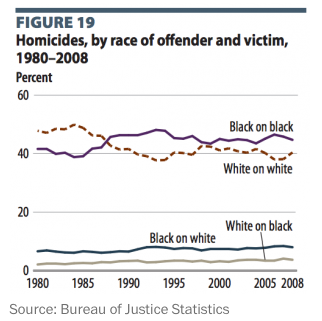
According to a 2013 FBI Uniform Crime Report, when it comes to murder, 90 percent of black victims were killed by black offenders.

However, what people fail to mention is that according to the very same report, 83 percent of white victims were killed by white offenders, too.

These numbers don’t show black people are more violent than white people. They show that BOTH white and black people would rather kill within their own race.

Screen shot 2015-06-18 at 10.33.37 PM

In terms of raw numbers, black people and white people actually commit about the same number of murders. But you wouldn’t know that from the media.

I don’t know why these media types aren’t wringing their hands over the spurt of white violence in this country instead of spending valuable broadcasting minutes exclusively on black people.

You’d almost think they were biased or something, trying to spin the truth, tell you a story that wasn’t entirely factual.

And speaking of bad arguments, this one has suddenly shifted.

We started talking about race-based aggression and we suddenly shifted to all violence. Let’s get back to hate crimes, because that’s really the area where white people excel.

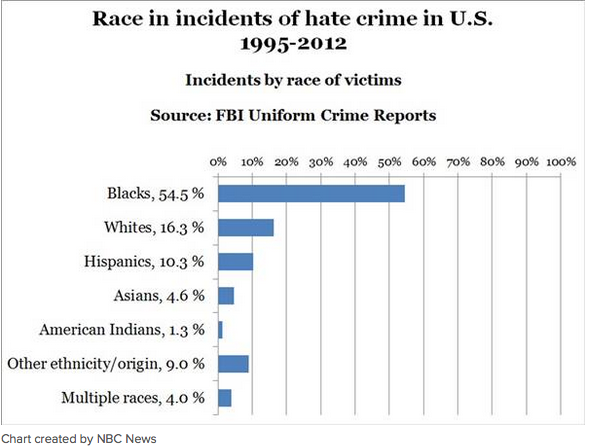
The FBI is charged under the Hate Crime Statistics Act with compiling statistics on spite-based legal transgressions. In its most recent report, for 2013, hate crimes based on race are far more numerous than any other kind.

Screen shot 2015-06-18 at 10.28.45 PM

Moreover, bias-motivated infractions against black folks far exceed those against white people.

According to the FBI statistics, 54.5 percent of the reported single-bias hate crimes that were racially motivated in 2013 targeted blacks. Only 16.3% target whites.

Screen shot 2015-06-18 at 10.28.26 PM

But you really didn’t need an FBI report to tell you that, did you? American history is littered with the bodies of beaten and brutalized people of color. You could make a very convincing argument that these dead souls make up the foundation of our country. Would our economy really have been so robust without the free labor of all those slaves? Heck! Would we even have a country at all if we hadn’t murdered all those indigenous peoples in the first place?

I know. You’re going to say that other predominately white countries have violent histories, too. And you’d be right. But notice the difference in our attitudes about it today!

Historically, Germany is no slacker when it comes to racial violence, but is there any government building in the German Republic today that continues to fly a Nazi flag? Absolutely not. In fact, it is illegal to do so.

By contrast, in America we love the stars and bars of the Confederate flag. It still waves proudly over the South Carolina capital building. (But I’m sure that has nothing to do with the violence we saw at that Charleston church I mentioned earlier!)

So let’s put it to rest. When it comes to hate crimes, white folks kill! But don’t feel too bad, black folks. There are things you’re good at, too. Like nonviolent resistance.

Heck! You’re amazing at that!

Langston Hughes wrote, “Negroes – Sweet and docile, Meek, humble, and kind: Beware the day – They change their mind.”

After all this time, black people have very rarely used violence as a means to achieve their ends, to try to secure the rights and freedoms white America guards so jealously.

In just the past year or so, unarmed black folks have been assaulted or killed for holding toy guns, being suspected of selling loose cigarettes, listening to music at a gas station, asking for help after a car accident, wearing hoodies, wearing bikinis, running, and now just going to church!

And the response from the black community has been pretty darn nonviolent. Yeah there’s been some shouting and looting, but very little beating or killing.

White folks, can you imagine having to undergo such indignity on a daily basis and NOT responding in kind!?

No wonder a blonde white girl from a Christian fundamentalist home darkened her skin, curled her hair and tried to pass as black! Sometimes – often really – it’s darn embarrassing to be white! Black folks have the moral high ground.

Somehow they live in an American society that heaps hatred on their every move and they respond with dignity and perseverance.

So why are black people so nonviolent?

Damned if I know! But I wish us white folks would take a lesson from them.


NOTE: This article also was published on the Badass Teachers Association blog.


UPDATE: There has been a criticism of this article I’d like to address. I have claimed, “In terms of raw numbers, black people and white people actually commit about the same number of murders.” Some say this works against my argument that black people are less violent than white people. After all, there are fewer black people in the country, yet they commit about the same number of murders as white people. Doesn’t that make them more violent?


I think if you factor in poverty, the numbers wash. After all, poor people are generally more violent than those in better circumstances. Since most black people experience higher levels of poverty than most white people, we can only expect higher proportions of murders from them. When your options are limited between working several minimum wage jobs to squeak by or to engage in the drug trade for a higher income bracket, well it’s not surprising. If black folks weren’t subjected to such high poverty rates, we would expect the black murder rate to plummet.


I know some readers won’t accept that answer. And if so, fine. However, this doesn’t affect at all my assertion that black people commit a fraction of the country’s hate crimes. Whether you look at it proportionately or numerically, white folks are MUCH more likely to commit hate crimes than black folks. I think that’s significant.


However, I have received enough correspondence from readers of this article to know that many don’t care. This article has been surprisingly popular. It still gets hundreds of hits every week. Unfortunately, many of the people who seem to find it appear to be those with an axe to grind. WordPress allows me to see what readers type into a search engine to find this article. I can see what sites lead you here. I know that white supremacists and far right conservatives are loving this article as an example of “liberal, white self hate.” The responses to this article in some of the darker corners of the Internet have been as hilarious as they are badly argued. It appears that some people are so committed to the idea that black people are violent that nothing anyone says could convince them otherwise. Moreover, they are so enamored with white violence that they see it as evidence of white superiority or else they try to argue it away as being perpetrated by people who are not truly white.


To those people I have only pity. Love is stronger than hate. I honestly hope that one day you will understand.


The Only Teaching Evaluation That Matters

Screen shot 2015-06-12 at 10.40.16 PM

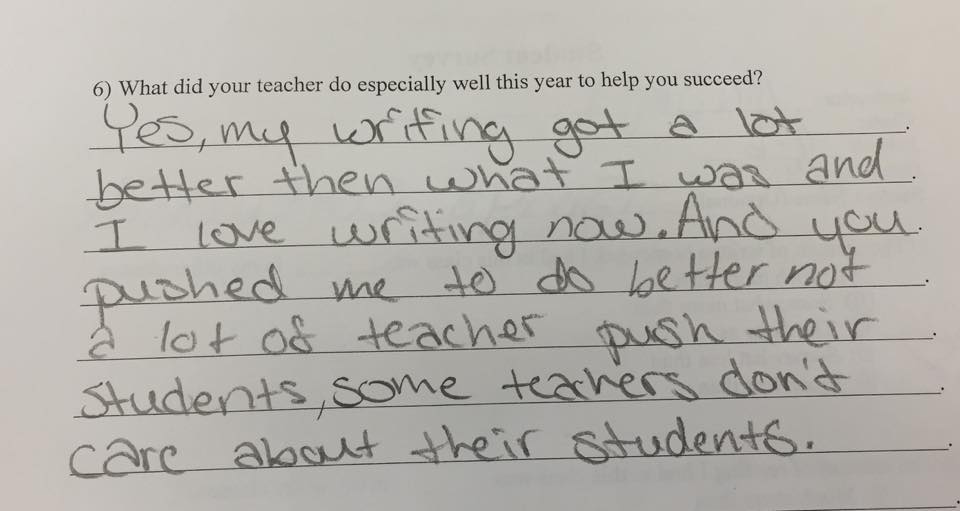
“Yes, my writing got a lot better than what I was, and I love writing now. And you pushed me to do better. Not a lot of teachers push their students, some teachers don’t care about their students.”

11280008_10153046535243860_104612156_n

One of my 8th graders wrote that to me on the last day of school.

I had asked her class to fill out an anonymous survey about my teaching. I said that all year I get to grade THEM, but this was their chance to grade ME.

I made sure to explain that they didn’t need to put their names on it. This would not be graded. Spelling and grammar didn’t count. The only thing I wanted was honesty.

I told them I wouldn’t personally collect the surveys. They should NOT hand them to me; they should put them in a pile on the desk by the door when they leave. I promised I wouldn’t even look at what they’d written until class was over. That way they could feel free to write whatever they wanted. If I did something bad or there was some way I could improve, I wanted them to tell me. If I did something exceptionally well, they should tell me that, too.

“Please help me become a better teacher,” I said.

As an 8th grade public school educator, I get evaluated a lot. I’ve spent countless hours gathering evidence that I’m “proficient” at my job.

I’ve had to endure formal observations, informal observations, H.E.A.T. observations, Student Learning Objectives (SLOs), written explanations of specific lessons with appeals to which Common Core standards I would be teaching – and there always seems to be a new one added to this list next year.

But I’ve been giving a version of this simple student survey to my classes on the last day of school for over a decade.

It’s not something I’m required to do. I don’t share the results with administration. The responses don’t go on file, increase my pay or get recorded in the newspaper. They don’t become part of the district’s ranking in the Business Times. No one is going to withhold funding from my district or close my building and convert it into a charter school based on these results. No one ever will be on television decrying the state of public education referencing these surveys. They are low stakes, class-based, teacher-centered and personal.

But I do this because I think it actually gives me useful information. I really want to know what my students think. That’s one of the things that truly drives my instruction. Not politically motivated standards monetarily incentivized and adopted before they were even completely written. Not standardized tests that measure little more than parental income. Not the latest fad handed down by the superintendent. Not a threat shouted at us through an email or at a faculty meeting.

No. I’m motivated by my kids in the classroom and the answer to the question, “Have I helped you learn?”

The survey is quite simple really. It’s two-sided.

On the front page are 5 multiple choice questions:

1) The amount of written homework I had in this class was                             in my other classes.

A) much more than
B) Somewhat more than
C) The same as
D) Somewhat less than
E) Much less than

2) The amount of reading I had in this class was                                in my other classes.

A) much more than
B) Somewhat more than
C) The same as
D) Somewhat less than
E) Much less than

3) The amount of studying I did for this class was                                 in my other classes.

A) much more than
B) Somewhat more than
C) The same as
D) Somewhat less than
E) Much less than

4) I received                                    instruction and comments on my written work.

A) much more than enough
B) Somewhat more than enough
C) Just enough
D) Somewhat less than enough
E) Much less than enough

5) In this class, I learned                                         in my other classes.

A) much more than
B) Somewhat more than
C) The same as
D) Somewhat less than
E) Much less than

When it comes to homework, students almost always say I give too much. The majority (68%) gave me an A or B.

I only require about an hour of extra-class work a week. I don’t think that’s too bad. However, many teachers give less or none. I go back and forth on the value of homework, myself, but I know that once my students get to 9th grade, they’ll have a tremendous load of it. I figure if I don’t prepare them for that, I’m doing them a disservice. So an avalanche of (one hour a week) homework it remains.

Likewise, kids often say I give a lot of reading. A language arts class should give a substantial amount of reading. So I’m glad most kids (69%) give me an A or B. I require my students to read one self-selected book a month. I don’t think that’s too burdensome. If the book is too tough or boring – hey! You picked it! Pick another one. I also provide them with 15 minutes per day to read in class.

Studying is not something I emphasize. But students are almost evenly divided whether I require too much, just enough or too little. I’m not big on having kids memorize something and then regurgitate that on a test. I’d rather spend time getting them to take good notes that they can use on the test. I’m a big fan of open notes or open book tests. But I hardly ever use the word “Test.” I give frequent short quizzes. I think tests (and even quizzes) are limited evaluation tools. I’d much rather assign a multi-day project. That tells me much more than a brief snapshot of what students were thinking at any one given point in time.

I do assign a lot of essays so I’m always anxious to know if I’ve given enough written feedback. The research seems to show that if you mark every error on an essay, you get diminishing returns. You discourage students. So instead I try to focus on a few trouble areas we’ve already discussed per essay. And students seem to appreciate it. Most of my kids (85%) gave me an A or B or C in this area.

Then comes the cumulative question. How much did you learn? I used to have my classes assign me a letter grade A-E. However, answers were all over the place. When I compared the results with surveys from students who had revealed their identities, I found that kids usually gave me the same grade they received in my class. A-students gave me As. C-students gave me Cs, and so on.

When I changed the question to “how much have you learned?” the results changed drastically. Most students (84%) gave me an A or B. Yes, that’s the result I’m aiming for, but I think it’s a more honest answer, too. It doesn’t focus on grades. It focuses on each child’s assessment of his or her own progress. That’s really what I want to know.

But this side of the survey still provides very limited answers. It is multiple choice, after all. It’s useful for a brief overview but not very deep.

The second side of my questionnaire only has two open-ended queries. Students can write as much or as little as they want to the following questions:

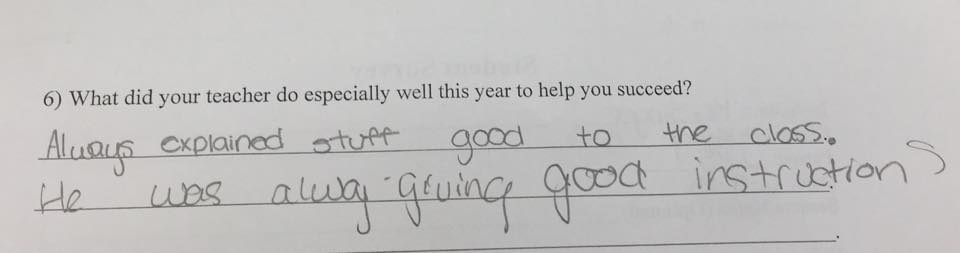
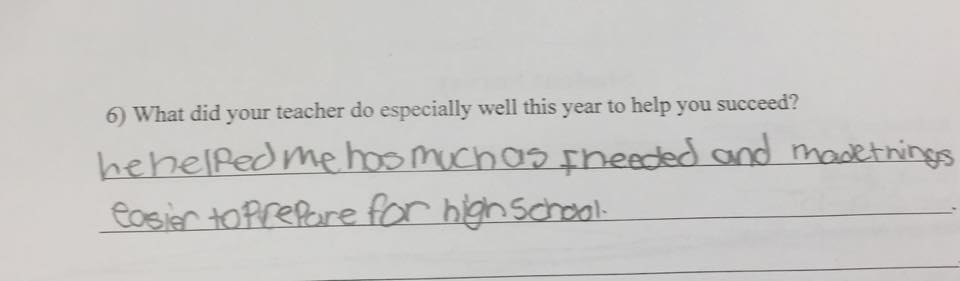
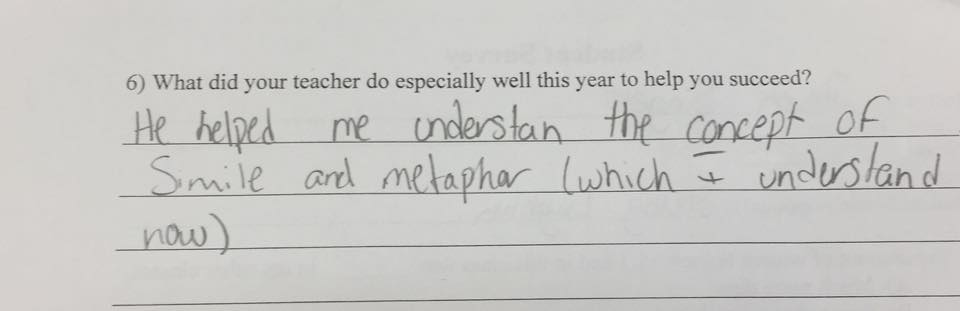
6) What did your teacher do especially well this year to help you succeed?

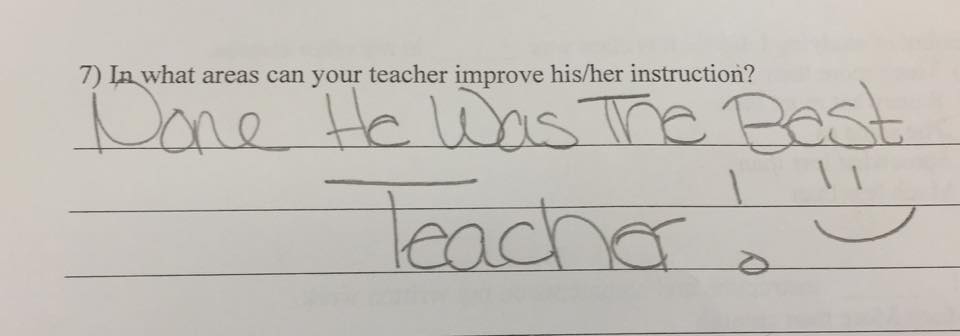
7) In what areas can your teacher improve his/her instruction?

To be honest, when looking at the surveys, I usually skip right to these questions. This is what I want to see – not a bunch of alphabet soup. I want to know what they really think.

What have I done well? Here are some answers from this year’s kids:

-He understood the learning abilities of certain students and helped them to the best of his ability.

11122062_10153046535213860_65835541_n

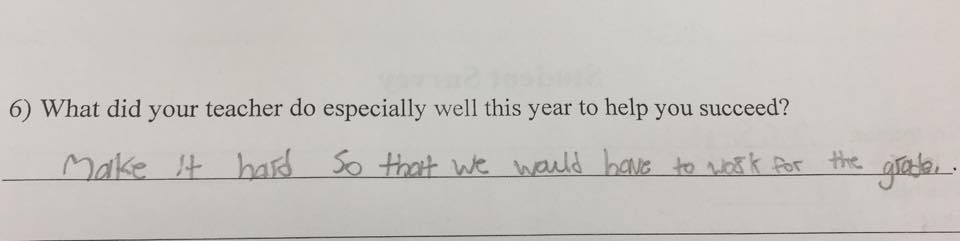
-You made it hard so that we would have to work for the grade.

11208874_10153046535223860_1052817053_n

-Before we could ask him for help, he asked us if we needed help. He’d help everyone, even the person who didn’t ask for it.

11310977_10153046535218860_807785160_n

-He was really good at explaining and pushed me to never give up. Therefore, Mr. Singer is one of my favorite teachers.

11329696_10153046535238860_1253356423_n

-Well, I didn’t like as much work as he was giving us, but then I understood he was trying to help us with our grades and trying to make our grades higher.

11348779_10153046535183860_857789294_n

-Always explained stuff good in class. He was always giving good instructions.

11358887_10153046535198860_689871876_n

-He helped me as much as I needed and made things easier to prepare for high school.

11418417_10153046535203860_1321510136_n

-He helped me understand the concept of simile and metaphor (which I understand now)

11420058_10153046535208860_229100346_n
-What my teacher especially helped me do to succeed is writing essays.

FullSizeRender

I was just floored by these responses. Talk about data I can use! But there was one answer that stood out above even these:

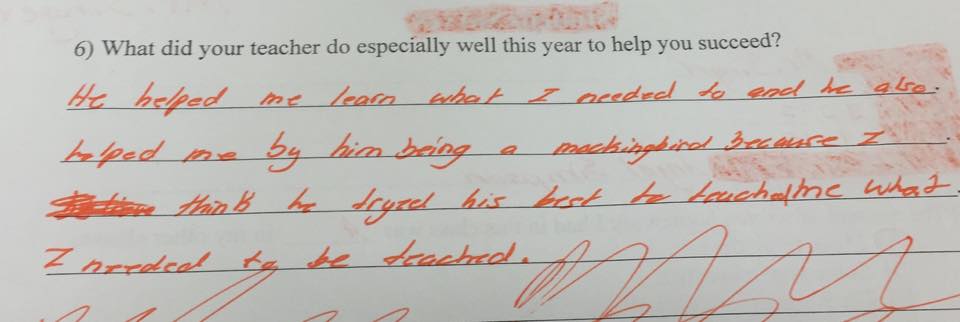
-He helped me learn what I needed to do and he helped me by being a mockingbird because I think he tried his best to teach me what I needed to be taught.

11280625_10153046535248860_1666870003_n

No, she wasn’t literally calling me a bird. She was relating me to our last novel – To Kill a Mockingbird. In the text, some characters are innocent victims. They try to help others but come under fire because of it. The author, Harper Lee, symbolizes them as “mockingbirds.” These include: Tom Robinson, the black man wrongly accused of rape; Atticus Finch, the lawyer standing up for a fair trial despite social criticism; Arthur “Boo” Radely, the recluse who saved lives at the expense of his privacy.

And here my sweet little student was including ME in this venerable list!

That choked me up a bit I can tell you.

When it comes to areas for improvement, my students aren’t the most forthcoming. Answers include:

-I don’t think he needs to because he already does his best to teach us kids what we need to be taught and his instruction is easy to understand.

11418657_10153046535193860_238476660_n
-None. He was the best teacher! 🙂

11419982_10153046535228860_393598543_n

I appreciate the approbation but I wouldn’t mind constructive criticism. I do get complaints about the amount of homework and writing I assign. I also get requests for more free time.

I think if I wasn’t in the room when students took the survey, I might get more criticism. Ideally, I would leave the room for the last 15 minutes of the class, and kids could fill out their surveys. However, this is impractical. I don’t see how I could arrange it given the current climate, lack of subs and skeleton crew staff.

These surveys have given me much to think about over the summer. Maybe I should try to include more group work in next year’s class. Maybe I should revisit the homework situation.

But as June turns to July and then August, I know I’ll be thinking about all that happened this school year.

Some kids came in and out of shelters and juvenile detention. Some were present at a shooting at the local mall. Parents and I had to fight administration over valuing standardized test scores over classroom grades for student placement. The School board enacted a pointless student uniform policy. Students were demoralized and angry over national racial tensions involving Michael Brown, Eric Garner and the Baltimore uprising. Teachers had an active shooter drill for the first time as part of our professional development.

But most of all I’ll think about my students – well, no longer mine – off to the high school and bigger, better things.

For a brief moment I was an important part of their lives and they were an important part of mine. I’ll forget their names. (It’s like my mind is making space for the new ones I’ll have to learn.) But I’ll never forget their struggles and triumphs.

It’s easy to lose sight with all the privatizers and standardizers trying to dismantle our public schools. But even with all the political nonsense, selfishness and small-mindedness, teaching is the best job in the world.

Yes, it really is!

Every day I get a chance to positively impact dozens of lives!

I am truly blessed.

That’s what these surveys tell me.

And that’s why they’re the only evaluation that really matters.


NOTE: Here is a copy of the survey I use in class.

Student Survey

-This article also was published on the Badass Teachers Association blog.

The School-to-Prison Pipeline: Turning Kids into Cash

Screen shot 2015-06-07 at 10.34.48 PM
For too many children, public school is just a “GO DIRECTLY TO JAIL” card.

Do not pass GO. Do not collect $200.

The institution that should be raising kids to the skies is chaining them to the ground.

It’s called the School-to-Prison Pipeline, and it disproportionately affects students of color and the poor.

School policy at the highest levels is designed to sort and rank students. Some go to the college track. Some go to the industrial track. And even more end up on the prison track.

We actually have procedures that prepare certain children for life behind bars.

Why? Because people make money from it.

Think about it. The United States represents only 4.4% of the world population but we house 22% of the world’s prisoners. We’re the number one jailor!

It’s not that our citizens are out of control. It’s not a rise in violent crime. In fact, the crime rate has decreased to 1970s levels.

But instead someone has found a way to convert prisoners into cash.

Since the 1980s, we’ve been handing over our prison system to private companies to run for a profit.

The number of inmates in privatized prisons has increased by 44% in the last decade alone, according to a 2013 Bloomberg report.

This creates a market. Without a steady stream of prisoners, these institutions would go bankrupt. And corporations such as Corrections Corporation of America and The GEO Group spend tons of cash lobbying our government to ensure just that.

It’s no accident that our national education policy meets the needs of the for-profit prison industry.

Look at the so-called education reforms of the last decade: increasing standardization, efforts to close schools serving poor and minority children, cutting school budgets and narrowing the curriculum. All of these serve to push kids out of school and into the streets where they are more likely to engage in criminal activity and enter the criminal justice system.

Federal education policy – whether it be No Child Left Behind or Race to the Top – continually doubles down on privatization and standardization. These policies consistently have failed to produce academic gains but are offered as the only possible solution in school reform initiatives.

Question: Why do we keep enacting the same failed policies?

Answer: Because they are not MEANT to succeed. They are meant to fail a certain percentage, race and economic bracket.

If we had effective education procedures that increased academic success, we wouldn’t have enough prisoners to feed our for-profit prisons. Lawmakers would loose valuable lobbying revenue.

Call it what you will – misplaced priorities, profiteering or an outright scam. But the reform-to-profit cycle is advocated, perpetrated and championed by the most prominent figures in the so-called education reform movement.

Take Bill Gates – the monetary force behind Common Core State Standards (CCSS), one of the leading policies in education.

The Bill and Melinda Gates Foundation also is an investor in The GEO Group – one of the biggest for-profit prison providers in the country. It’s most recent tax filing (2013) shows a more than $2 million investment.

Nominally a philanthropic organization, the Gates Foundation refuses to admit if it still backs the industry or by how much. Sure Gates underwriting is just a drop in the bucket, but it proves how the organization’s interest is economic and not charitable. It is one of a herd of Trojan horses stampeding over the cries of critics under a banner of largesse.

Likewise, Common Core essentially isn’t concerned with increasing the quality of children’s education. CCSS has never been proven to be effective and is – in fact – developmentally inappropriate. But it’s touted as a panacea to a host of ills when its real concern is to continue fortifying the prison machine.

We live in a country where more than half of the children attending public school live below the poverty line. They need proper nutrition, social assistance, tutoring, counseling and a host of wrap around services. But instead they get so-called “higher” academic standards and standardized tests.

It’s like a sporting goods store withholding wheelchairs to the Special Olympics and instead donating extra hurdles – all the while claiming it was trying to help participants become better hoppers!

Even worse, these standards aren’t actually better. They’re just confusing, ignorant and ill-conceived. After all, they weren’t developed by educators. They were made by ideologues who admit they were unqualified for the task.

Was this a huge mistake? No. These standards and the associated bubble tests that drive them do exactly what they were meant to do.

They increase the numbers of failing students. They push more kids out of school and into the waiting arms of the prison industry.

And when kids have difficulty sitting through the hours, days, and months of test prep that are increasingly replacing a well-rounded curriculum, they face unfair discipline practices.

We treat misbehaving kids like little criminals.

Can’t sit still in class? Can’t keep quiet? Can’t control your frustration?

Out you go! Detentions, suspensions, expulsions!

We have zero tolerance for your childish behavior – even if you are still a child.

And unsurprisingly the majority of the children who are crushed by the hammer of discipline have dark skin.

Let me be clear. I’m not saying that misbehaving children shouldn’t be disciplined. Far from it.

But we need to stop criminalizing their misbehavior.

If we can’t provide them with schools that teach in a developmentally appropriate manner – it’s not the children who are misbehaving. It’s us! The school system!

Moreover, when a child has a problem conforming to the norm, our first reaction shouldn’t be punishment. It should be understanding. The goal should be to find ways to change the negative behavior, not weed the kid out of the system.

But this means treating children as ends not means.

We have to care about their well-being. They have to be more than just piggy banks for big business.

Otherwise, it is our sick society that really deserves to be sent to jail.


NOTE: This article also appeared in the LA Progressive, ConversationED and the Badass Teachers Association blog.

I am Racist and (If You’re White) You Probably Are, Too

Screen shot 2015-06-02 at 1.42.34 PM

I am a white man.

I am racist.

But that’s kind of redundant.

It’s like saying, “I am a fish, and I am soaking wet.

In some ways, I can’t help it. I don’t even notice it. I live my life immersed in a world of white privilege that most of the time I frankly can’t even see.

That doesn’t excuse me. It doesn’t mean I should just shrug and say, “What are you gonna’ do?”

But it does mean that the first step in removing that racism – in undoing the systematic subjugation of people of color – is recognizing my own culpability in that system.

It’s like being an alcoholic. The first step is admitting the truth.

I know I’ve pissed off a lot of people with what I’ve just written. This article isn’t about gaining new friends. But I’m sure I’ll have a lot of death threats to delete from the comments section tomorrow.

The initial reaction white people usually have to being called racist is – Who? Me? I can’t be racist! I have a black friend! I dated a black girl once! I listen to rap music!

Or a whole host of other excuses.

First of all, relax. I don’t know you. For all I know you’re that one white guy out there who has somehow escaped the pervasive societal attitudes that the rest of us unknowingly took in with our baby formula.

But chances are – yeah, you’re a racist, too.

Second of all, I’m not talking to people of color. None of you are racist. Congratulations!

You might be a hate-filled bigoted, misogynistic, xenophobic, homophobic, prejudiced asshole.

Again, I don’t know you. But racist? No. You can’t really be that.

Here’s why. Racism doesn’t mean hating someone because of their race. That’s a kind of prejudice. And anyone can be prejudiced.

Racism is hate plus power. If a black person says, “I hate white people,” he is prejudiced. However, there is no system that then backs up his hatred. The police don’t arrest white people more than black people for the same crimes. The judicial system doesn’t give harsher sentences to white people than it does black people for the same crimes. Public schools serving a majority of white students aren’t chronically underfunded. It isn’t harder to get a loan or a job if you have a white-sounding name. If it did, THAT would be racism!

Get it?

So I’m sorry, white people. This means there is no such thing as reverse racism. Despite what you may see on Fox News, the only racists in America have white skin.

Don’t get me wrong. There are degrees of racism. If you have a Confederate flag prominently displayed in your home in front of your personally autographed picture with David Duke, well you’re probably a bit more racist than most Caucasians. But no matter what, if you’re white, you’ve probably benefited from white supremacy and are de facto racist.

Maybe your folks gave you a middle class upbringing in a quiet suburb. Maybe you went to a well-funded public school in a wealthy neighborhood. Maybe your dad was convicted of white collar crime and got little to no jail time. Heck! Maybe you just walked down the street once and the police didn’t follow you through a convenience store or reached for their guns.

If your upbringing was in any way favored due to wealth amassed over a few generations, you benefited from white privilege. If the judicial system let you or a loved one go with a lighter sentence, you benefited. If you were not harassed by law enforcement because of your complexion, you benefited. And when you benefit from a system, you’re part of it.

For every white person in America, it is almost certain that something like this happened to you at some point in your life. And you probably had no idea it was even occurring.

Good fortune becomes a self-fulfilling prophecy. People start to think they deserve it. And maybe they do, maybe they don’t. But people of color who don’t have such privileges certainly don’t deserve their inequitable treatment.

When we fail to acknowledge that white supremacy exists or that it benefits us, white folks, we’re just perpetuating that same system.

Some of you will say I’m putting too much emphasis on race. We’re all the same under the skin. We shouldn’t bring up the topic of racism. It just makes things worse.

Easy for you to say! You’re on top of the social food chain! If we don’t talk about the inherent inequalities entrenched in the system, nothing will change. Us, white folks, will continue to benefit, and black folks will continue to get the short end of the stick.

One of the biggest obstacles to solving racism is its invisibility – to white folks.

We’re shielded from it because its negative effects don’t reach us, and its positive effects to us are either shrugged off or we assume we deserve them.

Being racist rarely involves overt action anymore. It’s become covert, an entrenched sickness in all our social systems. And the only way to cure it is to make it visible – to recognize, isolate and destroy it.

I know. Some of you will say you had it tough, too. And you probably did. Few people live charmed lives. There are poor white folks. There are white people who are discriminated against because of their gender, nationality, sexual preference and/or religion. But this doesn’t mean you didn’t benefit. There is a crossroads of American prejudice and racism is only one of many intersecting avenues.

Maybe you were the victim sometimes, but you were probably the victor in others, and you never even saw it coming.

The point isn’t to say which malady is worse. They’re all bad and all deserving of a cure. But if you really don’t want to be a racist, you have to look it straight in the eye and call it by its rightful name.

You probably didn’t ask to be treated differently. Most of us just want fairness. But to be on that side we have to proclaim our allegiance. We have to take a stand.

Whenever you see injustice against people of color, you must call it out. You must make yourself a part of the solution and not the problem. You must be a voice demanding the citadel of white privilege be burned to the ground.

It’s not easy. You’ll be called all sorts of names: bleeding heart, libtard, self-hating white, maybe even cracka. Because even people of color may not understand what you’re trying to do. After so many years of racial oppression by people with melanin deficiency, they may not trust an open hand when they’ve been so used to expecting a fist.

But that’s okay. It’s understandable. The only thing to do is press on. Understanding will come – eventually.

Racism is a problem for black folks, but the solution is mostly in the hands of white people. We’re the ones doing – or allowing – racism. It’s our job to fix it.

And much of that work will not be in the public sphere. It will be in our own hearts.

Many of us have been socialized to be afraid of black folks. We get this from the news, movies, television, the internet, often even our own relatives and friends. We’re constantly told how dangerous black people are, how untrustworthy, how violent. But the facts don’t bare this out. Given the degree of aggression – both overt and covert – black people have endured from white people over time, they have been incredibly non-violent. It is us, white people, who have been violent and inhuman. That is the legacy we hide under our fear of dark skin. We’re really afraid that one day our black brothers and sisters will have had enough and give back to us all the accumulated hate of centuries.

No. We aren’t responsible for slavery or Jim Crow or lynchings or a host of other horrible things. But we still benefit from them.

So it is up to us to even the scales, to treat black folks fairly and equitably with a loving heart.

That is why I make this confession. That is why I write this article that will probably be roundly criticized or maybe just ignored.

That’s why I admit I’m a racist.

It’s the only way to stop being one.


NOTE: This article also was published on commondreams.org.

The Killer in my Classroom

Screen Shot 2015-05-20 at 2.29.49 PM

Some nights sleep just won’t come.

I toss and turn, crumpling the blankets until I have to get up and read or pour myself a glass of water.

Sitting up in the pre-morning gloom, that’s when they come back to me.

A parade of faces. No names. Words are all lost in the haze of time.

But the faces remain.

Kids I’ve taught and wondered about.

What ever happened to Jason? Did Rayvin ever get into dance school? I wonder if the army took Tyler…

But there’s one face that always comes last.

A strong straight lip. Soft nose. Brooding eyes.

Terance… Terrell… TYRELL.

Yes. That’s his name.

One of my first students. One of my biggest failures.

And I don’t have to wonder what happened to him. I know with a dread of certainty.

He never got to play professional basketball like he wanted. He never even made it out of high school.

No, not dead – though I do have I gaggle of ghosts on my class roster.

He’s a murderer. Life in prison.

I was his 8th grade language arts teacher. It was my first year teaching in the district.

I had a reputation for being able to relate with hard to reach kids so they put me in the alternative education classroom.

I had a bunch of students from grades 6-8 who simply couldn’t make it in the regular school setting.

These were kids with undiagnosed learning disabilities, appalling home environments, and/or chips on their shoulders that could cut iron.

But I loved it.

I taught the Read 180 curriculum – a plan designed for students just like mine. We had three stations: silent reading, computer remediation and small group instruction.

The class was divided in three – students rotated through each group. Though I somehow monitored the whole thing, I spent most of my time meeting with kids in small group instruction.

I had an aide who helped the whole thing run smoothly, too. Lots of planning time, support and resources.

Everyday was exhausting. I could barely stay awake on the ride home. But it was worth it, because I felt like I was making a difference.

And there was Tyrell.

Few days went by without at least one of the children having to be disciplined. Sometimes it was just a simple redirection or even standing in close proximity to kids who seemed set to explode. Other times it was a brief one-on-one counseling session to find out why someone was misbehaving. And sometimes it was so bad kids had to be sent to the office. Once we even had a child escorted out of the building in handcuffs because he brought a weapon to class.

If you’d told me one of those children would end up killing someone, I wouldn’t have blinked. If you told me it would be Tyrell, I wouldn’t have believed you.

He was a gentle giant.

Almost always calm and in control. He was well above the others academically. When one of the others lost his cool, Tyrell would help talk him down.

I wondered why he was there. Turns out he was involved in a bloody fight on the way home from school the year before.

But that rarely made its way into the classroom. It was like he was already doing time – serving out his sentence with these misfits until he could be placed back with the rest of the student population.

I remember when Carlos got caught with the knife, Tyrell’s back had stiffened but he hadn’t moved.

The knife had fallen from Carlos’ pocket across the table and slid to the floor.

Tyrell watched it slide across his desk but said nothing.

“Is that a knife, Carlos?” I asked.

“No!” he said picking it up and putting it back in his pocket.

“Why do you have a knife, Carlos?” I asked.

He shrugged and refused to say anything.

Then Tyrell spoke up.

“It’s for the walk home, Mr. Singer.”

“What?” I asked.

“He needs it,” Tyrell said.

And the look in both of their eyes said it was true.

But what could I do? If he used that knife, I’d be liable.

I had to report it, and I did.

Would I still do that? Was it a mistake?

I don’t know.

But I went to the administration and told them the truth – that I BELIEVED the knife was for self-defense. That something had to be done to protect these kids on the walk home.

Nothing changed. Our district saves a ton of money by forgoing buses. Richer kids get a ride to school. Poorer kids walk.

And Carlos got charged.

Tyrell never said anything about it. But I wondered what we’d find if we searched HIM.

We have metal detectors, but they are far from 100% effective.

I remember one day Tyrell stayed after class to talk to me. Talk quickly turned from grades and assignments to what he wanted to do with his life.

Tyrell loved B-ball. Often wore a Kobe jersey to school. And always the cleanest, brightest Jordans on his feet.

He was going to play ball, he said. No doubt about it.

I tried to convince him to have a backup plan, but he just shook his head.

“What kind of options you think there is out there for a guy like me, Mr. Singer?”

I’ll never forget it. Me trying to convince him he could do anything he wanted, and he just smiling.

“Guy like me only do one of two things,” he said, “He plays some ball or he runs out on the streets.”

I asked him to explain, and he told me about his brothers – how they sold drugs, bought fancy cars, took care of the family.

I kept insisting there was another way – a better way. And finally he agreed but said that his way was easier, safer, more of a sure thing.

“Why should I work my ass off on all this?” he said pointing to his books, “I can make a stack on the street.”

Was there anything I could have said to change his mind?

I don’t know. But I tried.

And that was it, really. I never had another chance. They moved him back to regular ed. a few weeks later.

He finished the year with a different teacher in a different part of the building.

I saw him occasionally, and he’d dap me up, but that was about it.

The next year there was an opening for me in regular ed., too.

Eighth grade with the academic track population.

I had to really think about it. My colleagues thought I was crazy not jumping on it at the first opportunity.

But it was no easy decision.

What finally pushed me over the edge was the rumor that alternative ed. was being downsized.

They would no longer pay for the Read 180 curriculum. No more aides. No more resources and extra planning time.

So I put in for the move and have been there ever since.

Of course, with a much reduced alternative ed. most of the students I would have taught had moved up with me to the regular ed. classroom. Now they’re just bunched in with the regular population.

But I don’t regret it. I love these kids. I love being there for them.

And Tyrell? About a year later, I read about him in the newspaper.

Police think it was a drug related hit. Tyrell was in the backseat. He put his gun to the driver’s head and pulled the trigger.

Bam.

No more future for either of them.

Except on restless nights when Tyrell’s face keeps coming back to me.

Is there something I could have done? Do the words exist for me to have convinced him to change his path? Would he have listened if I hadn’t reported Carlos?

And most importantly – why am I the only one who seems to care?


NOTE: A slightly condensed version of this article was published on Nancy Flanagan’s blog “Teacher in a Strange Land” in Education Week. The expanded version seen here also was published on the Badass Teachers Association blog.

The Longest Lasting Lesson – A Thank You to All the Excellent Teachers I’ve Ever Had

student-teacher

They say teaching is the one profession that creates all the others.

That teachers affect eternity; no one can tell where their influence stops.

And it’s certainly true in my life.

I wouldn’t be the person I am today without a string of excellent educators.

For better or worse, I am the product of decades of first-rate instruction and inspiration.

There are so many teachers who made a profound impact on my life.

Mr. Mitchell taught me how to express my opinion, listen to others and consider their point of view before responding.

Ms. Robb taught me how to organize my thoughts so they make sense to someone else.

Mr. Geissler taught me how money and politics work together.

Ms. Neuschwander taught me the value of a good story.

And there are so many more. I wish I could remember them all.

If we’re honest, everyone had a plethora of powerful pedagogues in their lives.

Their names are legion – even if we can’t remember most of them.

During this Teacher Appreciation Week, the one that keeps popping into my head is Ms. Zadrel.

She was my third grade teacher.

I don’t remember what she looked like. I don’t remember most of her lessons. I’m not even sure if I’m spelling her name right.

But I do remember how she organized her class.

The room was a separate town called Zadrelville. The rows of desks were streets. Each student had a job and we earned play money.

We could send each other letters, play the lottery, vote for class mayor – almost everything you’d do in a small town. Everyday tasks were jobs – emptying the pencil sharpener, passing out papers, cleaning the blackboard, etc.

And me? I wrote the newspaper. “The News of 201” it was called.

It was a fairly gossipy rag. Headlines included things like who liked whom, if someone got paddled in gym, and which was better – Indiana Jones or Star Wars movies.

I made the paper myself, ran it off on the copier and delivered it to subscribers’ desks.

I published about once a week. Any day a new edition would roll hot off the press (and it actually was warm), everyone in the class had to have one. It was essential reading.

There even may have been a few fights caused by some of my articles.

“You like Beth!? She’s got cuties!”

I never got a chance to see Ms. Zadrel’s lesson plans. I’m not sure exactly what she had in mind for us from this classroom management model. But I learned a lot.

Perhaps the longest lasting lesson was about myself. I learned how much I love being creative and how important it is for me to impact people’s lives.

Would I have become a teacher, myself, if I hadn’t had this experience? Maybe not.

I’d always enjoyed writing, but seeing such a demand for my work probably changed my life.

I wasn’t just writing for ME. I was writing for an audience. I gauged what the class wanted from a newspaper and provided it.

My articles may have caused a stir, but no one ever unsubscribed. By putting all that everyday ephemera in one place, we all learned much more about each other.

I loved it so much that when I went to fourth grade, I kept up the paper. It didn’t have quite the same magic in a class that wasn’t its own self-contained city, but I’d already been bitten by the bug.

You might say that this blog, itself, is really just a continuation of that adolescent newspaper I started in Ms. Zadrel’s class.

I’ve been a professional journalist, a freelancer and now a blogger. But I’m really just writing a classroom newspaper for people who are interested in another edition.

Ms. Zadrel is long retired. I don’t know what happened to her or if she’s even still around somewhere.

I don’t know what she’d say if she could read this blog.

But I know what I’d say to her.

Thank you.

With all my heart – thank you.


NOTE: This article also was published on the Badass Teachers Association blog.