The Only Teaching Evaluation That Matters

Screen shot 2015-06-12 at 10.40.16 PM

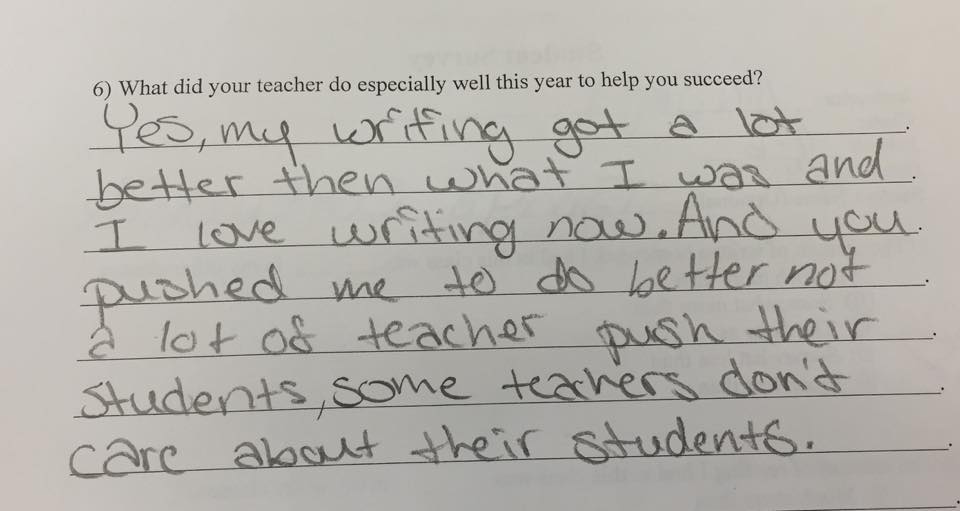
“Yes, my writing got a lot better than what I was, and I love writing now. And you pushed me to do better. Not a lot of teachers push their students, some teachers don’t care about their students.”
11280008_10153046535243860_104612156_n

One of my 8th graders wrote that to me on the last day of school.

I had asked her class to fill out an anonymous survey about my teaching. I said that all year I get to grade THEM, but this was their chance to grade ME.

I made sure to explain that they didn’t need to put their names on it. This would not be graded. Spelling and grammar didn’t count. The only thing I wanted was honesty.

I told them I wouldn’t personally collect the surveys. They should NOT hand them to me; they should put them in a pile on the desk by the door when they leave. I promised I wouldn’t even look at what they’d written until class was over. That way they could feel free to write whatever they wanted. If I did something bad or there was some way I could improve, I wanted them to tell me. If I did something exceptionally well, they should tell me that, too.

“Please help me become a better teacher,” I said.

As an 8th grade public school educator, I get evaluated a lot. I’ve spent countless hours gathering evidence that I’m “proficient” at my job.

I’ve had to endure formal observations, informal observations, H.E.A.T. observations, Student Learning Objectives (SLOs), written explanations of specific lessons with appeals to which Common Core standards I would be teaching – and there always seems to be a new one added to this list next year.

But I’ve been giving a version of this simple student survey to my classes on the last day of school for over a decade.

It’s not something I’m required to do. I don’t share the results with administration. The responses don’t go on file, increase my pay or get recorded in the newspaper. They don’t become part of the district’s ranking in the Business Times. No one is going to withhold funding from my district or close my building and convert it into a charter school based on these results. No one ever will be on television decrying the state of public education referencing these surveys. They are low stakes, class-based, teacher-centered and personal.

But I do this because I think it actually gives me useful information. I really want to know what my students think. That’s one of the things that truly drives my instruction. Not politically motivated standards monetarily incentivized and adopted before they were even completely written. Not standardized tests that measure little more than parental income. Not the latest fad handed down by the superintendent. Not a threat shouted at us through an email or at a faculty meeting.

No. I’m motivated by my kids in the classroom and the answer to the question, “Have I helped you learn?”

The survey is quite simple really. It’s two-sided.

On the front page are 5 multiple choice questions:

1) The amount of written homework I had in this class was                             in my other classes.

A) much more than
B) Somewhat more than
C) The same as
D) Somewhat less than
E) Much less than

2) The amount of reading I had in this class was                                in my other classes.

A) much more than
B) Somewhat more than
C) The same as
D) Somewhat less than
E) Much less than

3) The amount of studying I did for this class was                                 in my other classes.

A) much more than
B) Somewhat more than
C) The same as
D) Somewhat less than
E) Much less than

4) I received                                    instruction and comments on my written work.

A) much more than enough
B) Somewhat more than enough
C) Just enough
D) Somewhat less than enough
E) Much less than enough

5) In this class, I learned                                         in my other classes.

A) much more than
B) Somewhat more than
C) The same as
D) Somewhat less than
E) Much less than

When it comes to homework, students almost always say I give too much. The majority (68%) gave me an A or B.

I only require about an hour of extra-class work a week. I don’t think that’s too bad. However, many teachers give less or none. I go back and forth on the value of homework, myself, but I know that once my students get to 9th grade, they’ll have a tremendous load of it. I figure if I don’t prepare them for that, I’m doing them a disservice. So an avalanche of (one hour a week) homework it remains.

Likewise, kids often say I give a lot of reading. A language arts class should give a substantial amount of reading. So I’m glad most kids (69%) give me an A or B. I require my students to read one self-selected book a month. I don’t think that’s too burdensome. If the book is too tough or boring – hey! You picked it! Pick another one. I also provide them with 15 minutes per day to read in class.

Studying is not something I emphasize. But students are almost evenly divided whether I require too much, just enough or too little. I’m not big on having kids memorize something and then regurgitate that on a test. I’d rather spend time getting them to take good notes that they can use on the test. I’m a big fan of open notes or open book tests. But I hardly ever use the word “Test.” I give frequent short quizzes. I think tests (and even quizzes) are limited evaluation tools. I’d much rather assign a multi-day project. That tells me much more than a brief snapshot of what students were thinking at any one given point in time.

I do assign a lot of essays so I’m always anxious to know if I’ve given enough written feedback. The research seems to show that if you mark every error on an essay, you get diminishing returns. You discourage students. So instead I try to focus on a few trouble areas we’ve already discussed per essay. And students seem to appreciate it. Most of my kids (85%) gave me an A or B or C in this area.

Then comes the cumulative question. How much did you learn? I used to have my classes assign me a letter grade A-E. However, answers were all over the place. When I compared the results with surveys from students who had revealed their identities, I found that kids usually gave me the same grade they received in my class. A-students gave me As. C-students gave me Cs, and so on.

When I changed the question to “how much have you learned?” the results changed drastically. Most students (84%) gave me an A or B. Yes, that’s the result I’m aiming for, but I think it’s a more honest answer, too. It doesn’t focus on grades. It focuses on each child’s assessment of his or her own progress. That’s really what I want to know.

But this side of the survey still provides very limited answers. It is multiple choice, after all. It’s useful for a brief overview but not very deep.

The second side of my questionnaire only has two open-ended queries. Students can write as much or as little as they want to the following questions:

6) What did your teacher do especially well this year to help you succeed?

7) In what areas can your teacher improve his/her instruction?

To be honest, when looking at the surveys, I usually skip right to these questions. This is what I want to see – not a bunch of alphabet soup. I want to know what they really think.

What have I done well? Here are some answers from this year’s kids:

-He understood the learning abilities of certain students and helped them to the best of his ability.

11122062_10153046535213860_65835541_n

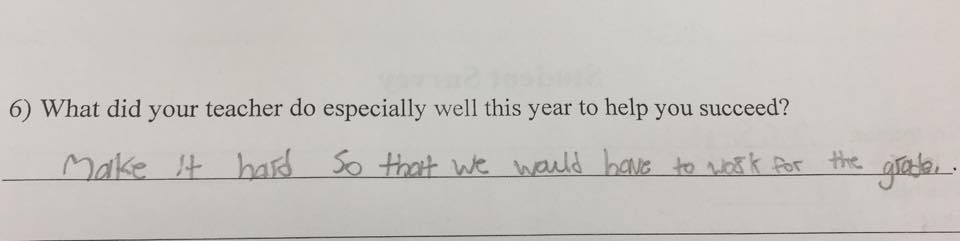
-You made it hard so that we would have to work for the grade.
11208874_10153046535223860_1052817053_n

-Before we could ask him for help, he asked us if we needed help. He’d help everyone, even the person who didn’t ask for it.

11310977_10153046535218860_807785160_n

-He was really good at explaining and pushed me to never give up. Therefore, Mr. Singer is one of my favorite teachers.

11329696_10153046535238860_1253356423_n

-Well, I didn’t like as much work as he was giving us, but then I understood he was trying to help us with our grades and trying to make our grades higher.

11348779_10153046535183860_857789294_n

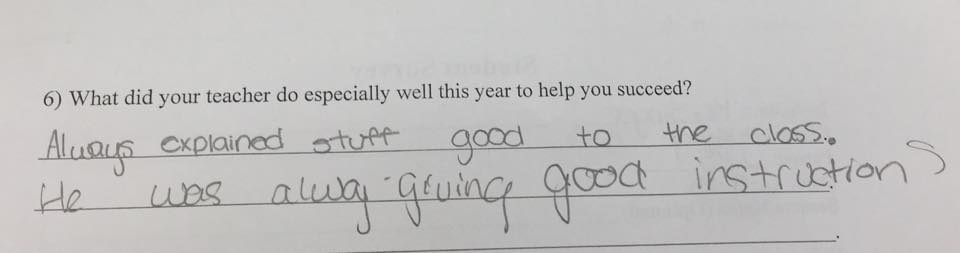
-Always explained stuff good in class. He was always giving good instructions.
11358887_10153046535198860_689871876_n

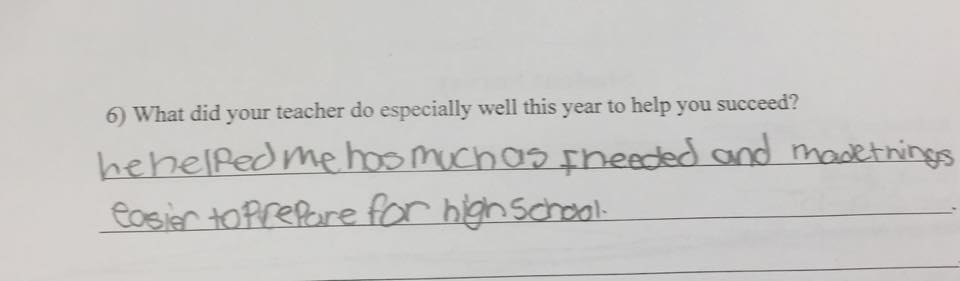
-He helped me as much as I needed and made things easier to prepare for high school.
11418417_10153046535203860_1321510136_n

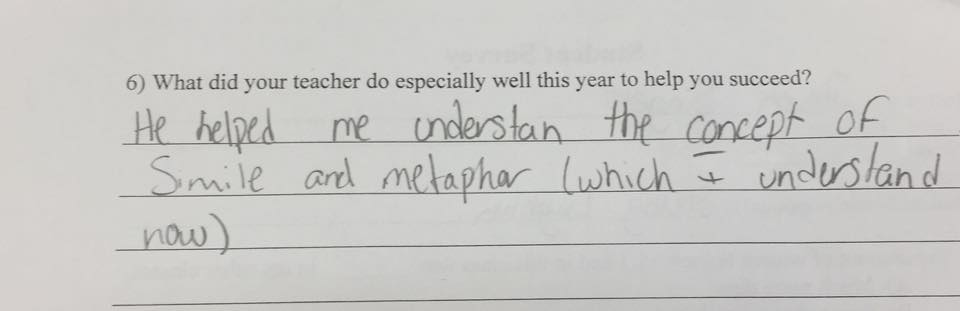
-He helped me understand the concept of simile and metaphor (which I understand now)
11420058_10153046535208860_229100346_n
-What my teacher especially helped me do to succeed is writing essays.

FullSizeRender

I was just floored by these responses. Talk about data I can use! But there was one answer that stood out above even these:

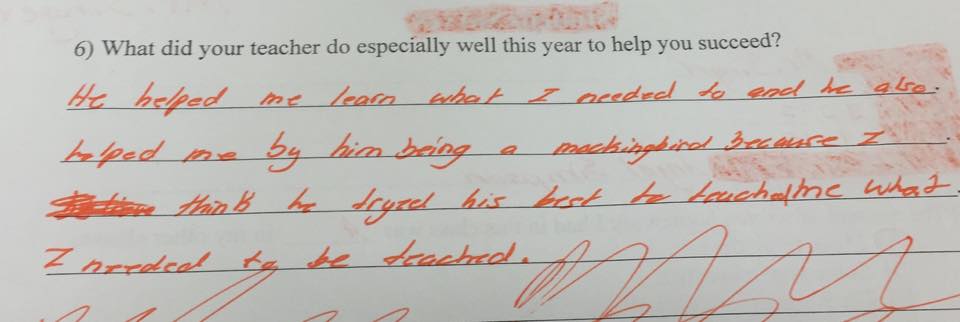
-He helped me learn what I needed to do and he helped me by being a mockingbird because I think he tried his best to teach me what I needed to be taught.
11280625_10153046535248860_1666870003_n

No, she wasn’t literally calling me a bird. She was relating me to our last novel – To Kill a Mockingbird. In the text, some characters are innocent victims. They try to help others but come under fire because of it. The author, Harper Lee, symbolizes them as “mockingbirds.” These include: Tom Robinson, the black man wrongly accused of rape; Atticus Finch, the lawyer standing up for a fair trial despite social criticism; Arthur “Boo” Radely, the recluse who saved lives at the expense of his privacy.

And here my sweet little student was including ME in this venerable list!

That choked me up a bit I can tell you.

When it comes to areas for improvement, my students aren’t the most forthcoming. Answers include:

-I don’t think he needs to because he already does his best to teach us kids what we need to be taught and his instruction is easy to understand.

11418657_10153046535193860_238476660_n
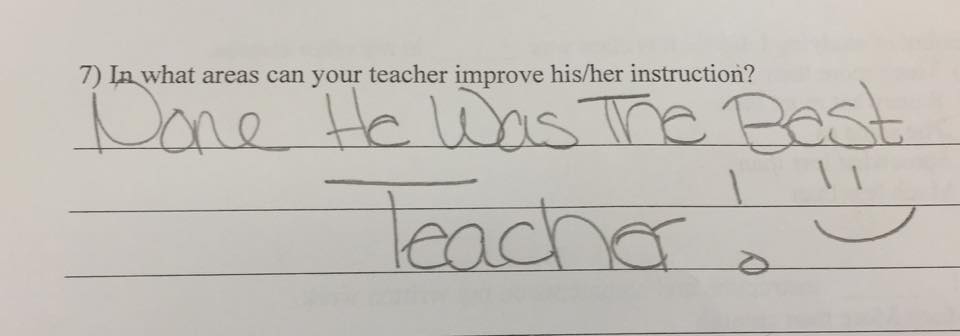
-None. He was the best teacher! 🙂

11419982_10153046535228860_393598543_n

I appreciate the approbation but I wouldn’t mind constructive criticism. I do get complaints about the amount of homework and writing I assign. I also get requests for more free time.

I think if I wasn’t in the room when students took the survey, I might get more criticism. Ideally, I would leave the room for the last 15 minutes of the class, and kids could fill out their surveys. However, this is impractical. I don’t see how I could arrange it given the current climate, lack of subs and skeleton crew staff.

These surveys have given me much to think about over the summer. Maybe I should try to include more group work in next year’s class. Maybe I should revisit the homework situation.

But as June turns to July and then August, I know I’ll be thinking about all that happened this school year.

Some kids came in and out of shelters and juvenile detention. Some were present at a shooting at the local mall. Parents and I had to fight administration over valuing standardized test scores over classroom grades for student placement. The School board enacted a pointless student uniform policy. Students were demoralized and angry over national racial tensions involving Michael Brown, Eric Garner and the Baltimore uprising. Teachers had an active shooter drill for the first time as part of our professional development.

But most of all I’ll think about my students – well, no longer mine – off to the high school and bigger, better things.

For a brief moment I was an important part of their lives and they were an important part of mine. I’ll forget their names. (It’s like my mind is making space for the new ones I’ll have to learn.) But I’ll never forget their struggles and triumphs.

It’s easy to lose sight with all the privatizers and standardizers trying to dismantle our public schools. But even with all the political nonsense, selfishness and small-mindedness, teaching is the best job in the world.

Yes, it really is!

Every day I get a chance to positively impact dozens of lives!

I am truly blessed.

That’s what these surveys tell me.

And that’s why they’re the only evaluation that really matters.


NOTE: Here is a copy of the survey I use in class.

Student Survey

-This article also was published on the Badass Teachers Association blog.

The School-to-Prison Pipeline: Turning Kids into Cash

Screen shot 2015-06-07 at 10.34.48 PM
For too many children, public school is just a “GO DIRECTLY TO JAIL” card.

Do not pass GO. Do not collect $200.

The institution that should be raising kids to the skies is chaining them to the ground.

It’s called the School-to-Prison Pipeline, and it disproportionately affects students of color and the poor.

School policy at the highest levels is designed to sort and rank students. Some go to the college track. Some go to the industrial track. And even more end up on the prison track.

We actually have procedures that prepare certain children for life behind bars.

Why? Because people make money from it.

Think about it. The United States represents only 4.4% of the world population but we house 22% of the world’s prisoners. We’re the number one jailor!

It’s not that our citizens are out of control. It’s not a rise in violent crime. In fact, the crime rate has decreased to 1970s levels.

But instead someone has found a way to convert prisoners into cash.

Since the 1980s, we’ve been handing over our prison system to private companies to run for a profit.

The number of inmates in privatized prisons has increased by 44% in the last decade alone, according to a 2013 Bloomberg report.

This creates a market. Without a steady stream of prisoners, these institutions would go bankrupt. And corporations such as Corrections Corporation of America and The GEO Group spend tons of cash lobbying our government to ensure just that.

It’s no accident that our national education policy meets the needs of the for-profit prison industry.

Look at the so-called education reforms of the last decade: increasing standardization, efforts to close schools serving poor and minority children, cutting school budgets and narrowing the curriculum. All of these serve to push kids out of school and into the streets where they are more likely to engage in criminal activity and enter the criminal justice system.

Federal education policy – whether it be No Child Left Behind or Race to the Top – continually doubles down on privatization and standardization. These policies consistently have failed to produce academic gains but are offered as the only possible solution in school reform initiatives.

Question: Why do we keep enacting the same failed policies?

Answer: Because they are not MEANT to succeed. They are meant to fail a certain percentage, race and economic bracket.

If we had effective education procedures that increased academic success, we wouldn’t have enough prisoners to feed our for-profit prisons. Lawmakers would loose valuable lobbying revenue.

Call it what you will – misplaced priorities, profiteering or an outright scam. But the reform-to-profit cycle is advocated, perpetrated and championed by the most prominent figures in the so-called education reform movement.

Take Bill Gates – the monetary force behind Common Core State Standards (CCSS), one of the leading policies in education.

The Bill and Melinda Gates Foundation also is an investor in The GEO Group – one of the biggest for-profit prison providers in the country. It’s most recent tax filing (2013) shows a more than $2 million investment.

Nominally a philanthropic organization, the Gates Foundation refuses to admit if it still backs the industry or by how much. Sure Gates underwriting is just a drop in the bucket, but it proves how the organization’s interest is economic and not charitable. It is one of a herd of Trojan horses stampeding over the cries of critics under a banner of largesse.

Likewise, Common Core essentially isn’t concerned with increasing the quality of children’s education. CCSS has never been proven to be effective and is – in fact – developmentally inappropriate. But it’s touted as a panacea to a host of ills when its real concern is to continue fortifying the prison machine.

We live in a country where more than half of the children attending public school live below the poverty line. They need proper nutrition, social assistance, tutoring, counseling and a host of wrap around services. But instead they get so-called “higher” academic standards and standardized tests.

It’s like a sporting goods store withholding wheelchairs to the Special Olympics and instead donating extra hurdles – all the while claiming it was trying to help participants become better hoppers!

Even worse, these standards aren’t actually better. They’re just confusing, ignorant and ill-conceived. After all, they weren’t developed by educators. They were made by ideologues who admit they were unqualified for the task.

Was this a huge mistake? No. These standards and the associated bubble tests that drive them do exactly what they were meant to do.

They increase the numbers of failing students. They push more kids out of school and into the waiting arms of the prison industry.

And when kids have difficulty sitting through the hours, days, and months of test prep that are increasingly replacing a well-rounded curriculum, they face unfair discipline practices.

We treat misbehaving kids like little criminals.

Can’t sit still in class? Can’t keep quiet? Can’t control your frustration?

Out you go! Detentions, suspensions, expulsions!

We have zero tolerance for your childish behavior – even if you are still a child.

And unsurprisingly the majority of the children who are crushed by the hammer of discipline have dark skin.

Let me be clear. I’m not saying that misbehaving children shouldn’t be disciplined. Far from it.

But we need to stop criminalizing their misbehavior.

If we can’t provide them with schools that teach in a developmentally appropriate manner – it’s not the children who are misbehaving. It’s us! The school system!

Moreover, when a child has a problem conforming to the norm, our first reaction shouldn’t be punishment. It should be understanding. The goal should be to find ways to change the negative behavior, not weed the kid out of the system.

But this means treating children as ends not means.

We have to care about their well-being. They have to be more than just piggy banks for big business.

Otherwise, it is our sick society that really deserves to be sent to jail.


NOTE: This article also appeared in the LA Progressive, ConversationED and the Badass Teachers Association blog.

I am Racist and (If You’re White) You Probably Are, Too

Screen shot 2015-06-02 at 1.42.34 PM

I am a white man.

I am racist.

But that’s kind of redundant.

It’s like saying, “I am a fish, and I am soaking wet.

In some ways, I can’t help it. I don’t even notice it. I live my life immersed in a world of white privilege that most of the time I frankly can’t even see.

That doesn’t excuse me. It doesn’t mean I should just shrug and say, “What are you gonna’ do?”

But it does mean that the first step in removing that racism – in undoing the systematic subjugation of people of color – is recognizing my own culpability in that system.

It’s like being an alcoholic. The first step is admitting the truth.

I know I’ve pissed off a lot of people with what I’ve just written. This article isn’t about gaining new friends. But I’m sure I’ll have a lot of death threats to delete from the comments section tomorrow.

The initial reaction white people usually have to being called racist is – Who? Me? I can’t be racist! I have a black friend! I dated a black girl once! I listen to rap music!

Or a whole host of other excuses.

First of all, relax. I don’t know you. For all I know you’re that one white guy out there who has somehow escaped the pervasive societal attitudes that the rest of us unknowingly took in with our baby formula.

But chances are – yeah, you’re a racist, too.

Second of all, I’m not talking to people of color. None of you are racist. Congratulations!

You might be a hate-filled bigoted, misogynistic, xenophobic, homophobic, prejudiced asshole.

Again, I don’t know you. But racist? No. You can’t really be that.

Here’s why. Racism doesn’t mean hating someone because of their race. That’s a kind of prejudice. And anyone can be prejudiced.

Racism is hate plus power. If a black person says, “I hate white people,” he is prejudiced. However, there is no system that then backs up his hatred. The police don’t arrest white people more than black people for the same crimes. The judicial system doesn’t give harsher sentences to white people than it does black people for the same crimes. Public schools serving a majority of white students aren’t chronically underfunded. It isn’t harder to get a loan or a job if you have a white-sounding name. If it did, THAT would be racism!

Get it?

So I’m sorry, white people. This means there is no such thing as reverse racism. Despite what you may see on Fox News, the only racists in America have white skin.

Don’t get me wrong. There are degrees of racism. If you have a Confederate flag prominently displayed in your home in front of your personally autographed picture with David Duke, well you’re probably a bit more racist than most Caucasians. But no matter what, if you’re white, you’ve probably benefited from white supremacy and are de facto racist.

Maybe your folks gave you a middle class upbringing in a quiet suburb. Maybe you went to a well-funded public school in a wealthy neighborhood. Maybe your dad was convicted of white collar crime and got little to no jail time. Heck! Maybe you just walked down the street once and the police didn’t follow you through a convenience store or reached for their guns.

If your upbringing was in any way favored due to wealth amassed over a few generations, you benefited from white privilege. If the judicial system let you or a loved one go with a lighter sentence, you benefited. If you were not harassed by law enforcement because of your complexion, you benefited. And when you benefit from a system, you’re part of it.

For every white person in America, it is almost certain that something like this happened to you at some point in your life. And you probably had no idea it was even occurring.

Good fortune becomes a self-fulfilling prophecy. People start to think they deserve it. And maybe they do, maybe they don’t. But people of color who don’t have such privileges certainly don’t deserve their inequitable treatment.

When we fail to acknowledge that white supremacy exists or that it benefits us, white folks, we’re just perpetuating that same system.

Some of you will say I’m putting too much emphasis on race. We’re all the same under the skin. We shouldn’t bring up the topic of racism. It just makes things worse.

Easy for you to say! You’re on top of the social food chain! If we don’t talk about the inherent inequalities entrenched in the system, nothing will change. Us, white folks, will continue to benefit, and black folks will continue to get the short end of the stick.

One of the biggest obstacles to solving racism is its invisibility – to white folks.

We’re shielded from it because its negative effects don’t reach us, and its positive effects to us are either shrugged off or we assume we deserve them.

Being racist rarely involves overt action anymore. It’s become covert, an entrenched sickness in all our social systems. And the only way to cure it is to make it visible – to recognize, isolate and destroy it.

I know. Some of you will say you had it tough, too. And you probably did. Few people live charmed lives. There are poor white folks. There are white people who are discriminated against because of their gender, nationality, sexual preference and/or religion. But this doesn’t mean you didn’t benefit. There is a crossroads of American prejudice and racism is only one of many intersecting avenues.

Maybe you were the victim sometimes, but you were probably the victor in others, and you never even saw it coming.

The point isn’t to say which malady is worse. They’re all bad and all deserving of a cure. But if you really don’t want to be a racist, you have to look it straight in the eye and call it by its rightful name.

You probably didn’t ask to be treated differently. Most of us just want fairness. But to be on that side we have to proclaim our allegiance. We have to take a stand.

Whenever you see injustice against people of color, you must call it out. You must make yourself a part of the solution and not the problem. You must be a voice demanding the citadel of white privilege be burned to the ground.

It’s not easy. You’ll be called all sorts of names: bleeding heart, libtard, self-hating white, maybe even cracka. Because even people of color may not understand what you’re trying to do. After so many years of racial oppression by people with melanin deficiency, they may not trust an open hand when they’ve been so used to expecting a fist.

But that’s okay. It’s understandable. The only thing to do is press on. Understanding will come – eventually.

Racism is a problem for black folks, but the solution is mostly in the hands of white people. We’re the ones doing – or allowing – racism. It’s our job to fix it.

And much of that work will not be in the public sphere. It will be in our own hearts.

Many of us have been socialized to be afraid of black folks. We get this from the news, movies, television, the internet, often even our own relatives and friends. We’re constantly told how dangerous black people are, how untrustworthy, how violent. But the facts don’t bare this out. Given the degree of aggression – both overt and covert – black people have endured from white people over time, they have been incredibly non-violent. It is us, white people, who have been violent and inhuman. That is the legacy we hide under our fear of dark skin. We’re really afraid that one day our black brothers and sisters will have had enough and give back to us all the accumulated hate of centuries.

No. We aren’t responsible for slavery or Jim Crow or lynchings or a host of other horrible things. But we still benefit from them.

So it is up to us to even the scales, to treat black folks fairly and equitably with a loving heart.

That is why I make this confession. That is why I write this article that will probably be roundly criticized or maybe just ignored.

That’s why I admit I’m a racist.

It’s the only way to stop being one.


NOTE: This article also was published on commondreams.org.

Broken Promises! Pennsylvania Republicans Ready to Renege on Pension Deal Even if It Means Breaking the Law

 F91E3E25-2DD6-4B65-A7D488D759E216F2

Pennsylvania lawmakers are considering breaking the law.

In fact, they may have already done it.

The reason? Pension debt.

The Commonwealth owes an estimated $50 million in unpaid pension obligations to state employees.

Instead of doing the responsible thing and paying off the state debt, Republican legislators are trying to rip up the bill and pay whatever they want.

If you or I did that, they’d put us in jail. But I guess the rules are different in Harrisburg.

As a public school employee, I work for the commonwealth. So do the state’s troopers, judges, university staff, etc. When I took this job, I signed a contract. I agreed to certain things (i.e. teaching, keeping up my certification, etc.) if the state agreed to certain things (i.e. pay, benefits, etc.).

But now GOP lawmakers – I don’t mean to be partisan but it is ONLY Republicans – want to renege on that deal.

Let’s say I came into school one day and said, “You know what? I just don’t feel like teaching today. But you still have to pay me.” No reasonable person would expect the state to cut me a check.

I need to live up to my end of the bargain. Otherwise, the state doesn’t have to give me one dollar.

And I have no problem with that. I love teaching. There’s nothing else I’d rather do.

But the state has to live up to its end, too. That goes beyond common sense. It’s one of the key principals of any civilized society. Each party to a contract has to abide by the agreement.

That’s really the issue – breach of contract. Legislators want to reduce benefits for both new employees – which is shortsighted but legal – and current employees – which has NEVER been permissible.

This isn’t just my interpretation. When lawmakers in Oregon and Illinois tried to rip up their state employee pensions, their state Supreme Courts ruled it unconstitutional.

State constitutions in both Oregon and Illinois specifically prohibit violation of contracts. Pennsylvania’s state constitution has an almost identical provision.

1+1=2.

That is not serious lawmaking. It’s theater.

This legislation has already passed the state Senate with all Democrats and one Republican voting against it. If it somehow were to pass the state House (which is by no means a sure thing) and if Gov. Wolf signed it into law (which he has said he would NOT do), it would go straight to court.

There would be no cost savings. In fact, the state would have to spend additional taxpayer money to defend legislators’ disdain for their own laws and 370,000 state workers.

So why do it?

Politics.

Gov. Wolf has proposed a budget that would right the wrongs of the previous Republican administration. Among other things, Wolf would restore $1 billion in annual cuts to public schools.

With this, we could reduce class size by rehiring the 25,000 teachers we unnecessarily sacked four years ago. We could ensure all children get arts, music, science labs, foreign languages, sports and extra-curricular activities. Even amenities like school nurses and guidance counselors could be restored.

But from the moment the governor made this promise, Republicans have vowed to oppose it. They had no problem four years ago voting to cripple our state education system. The result: Pennsylvania has the most inequitable school spending in the nation.

The commonwealth spends only 36.1% of the cost to educate students. That’s far below the national average of 45.5%, and ranks 45th in the country. The remaining cost is absorbed by local property taxes. Not only does this put an enormous tax burden on residents, it ensures schools in richer communities are better funded than those in poorer ones.

In fact, Pennsylvania has the worst disparity in the nation between dollars spent on rich vs. poor children.

But our Republican lawmakers are refusing to do anything about that…

Unless!

Unless the Democrats allow them to pilfer state workers pensions.

Republicans are holding the budget hostage to this criminal pension scheme.

Realistically, they need no help in the House and Senate. They control both bodies and in theory could pass whatever they want. However, this is the first year we have a Democrat in the governor’s mansion, so they need to bargain with him.

Funny when Republicans controlled both the executive and legislative branches, they didn’t have the guts to do this alone. Once it failed, who would they have had to blame?

That’s the reason for this elaborate hoax of a bill. They know it’s illegal. They know it won’t make it through court. They know it won’t save the state a dime because it will never be enacted.

But they are putting on a show for the voters.

Look how hard we tried to save the state money, but the Democrats (i.e. Wolf) wouldn’t let us do it. Look how hard we tried to increase school spending, but the Democrats (i.e. Wolf) wouldn’t pass our pension bill so we just couldn’t do it.

Excuse me while I go vomit all over myself!

How did we get in such a situation?

Basically, the legislature stopped paying the bills for 17 years.

pa_required_vs_actual_contributions_pew_600

Both the state government and commonwealth employees are responsible for paying into the pension system. And state workers made all their payments. They put aside 7.5% of their salaries every year to pay for their retirement.

But the legislature didn’t make its payments. It pushed them off to the future, and now that the future’s here, lawmakers have the gall to act like they have no idea where this cost is coming from!?

You ran up the bill! Time to pay! But instead of doing that, you blame the hardworking men and women who do all the state’s actual J.O.B.’s. And you practice Al-Qaeda tactics against labor, teachers and students!

Is that too harsh?

Who else holds people hostage to their demands?

This is terrorism as governmental policy. Our course of action should be the same with guerrilla extremists at home as it is with those on foreign soil: We don’t bargain with fanatics.

Gov. Wolf has a plan to pay off the pension debt. It’s nothing fancy. It’s the same kind of advice you might get from your accountant – or your mom. Refinance, reduce costs elsewhere and pay your bills.

That’s certainly a more sound strategy than holding a knife to workers and kids.


If you live in the commonwealth, please write your Senator and State Representative asking them not to support the GOP pension plan and to pass Gov. Wolf’s budget.

NOTE: This article was also published on the Badass Teachers Association blog. I also talked at length about this subject on the Rick Smith Show.

BONUS VIDEO:

https://www.youtube.com/watch?v=JhUPs6SJQMc

Common Core Does Not Cure Student Mobility

Common-Core

We have real problems.

We need real solutions.

But we get deceptions instead. And if anyone tries to complain, they get blamed for trying to avoid solving the problem!

Take Common Core.

Badly designed, unproven, flying in the face of human psychology. It is all that and more.

However, there’s a good reason for its existence – student mobility.

We have too many children attending our public schools that don’t stay put. They move from district-to-district and therefore miss valuable instruction.

And that’s no deception.

This is a real problem that we need to do something to fix. But before any experts in the field – psychologists, sociologists, or (God forbid!) educators – can speak, billionaire philanthropists chime in with Common Core.

If we just had national standards for each grade level in each core subject, they say, it would greatly reduce the amount of material transient students miss.

If an 8th grade student at School A moves to School B, for instance, Common Core would ensure that he misses virtually nothing. Both schools would be teaching the same thing.

Good try. But it doesn’t work.

Common Core only ensures that the same standards are taught in each school during a single year. If a transfer student’s old teacher hasn’t gotten to something yet and his new teacher has already covered it, he might miss the concept entirely – even with Common Core.

Take it from me.

I am a teacher in a state that has adopted Common Core-look-alike standards. I get many transfer students from Common Core states. There is a definite and often profound gap in their grasp of the material.

Pause for a moment and digest that.

Common Core – as it is now – does not solve the problem of student mobility.

However, if we reinterpret that concept, if we appeal to the spirit of the Core, we may find a “solution” to this problem. And in some places this has already begun.

Our billionaire philanthropist friend might look at this problem and say, we need to further homogenize the curriculum at both schools. Educators at both districts should teach the exact same things at the exact same times. On Sept 12, all 8th grade instructors should teach about figurative language. On Sept 13, there will be a lesson on text structures, and so on.

In fact, having the same curriculum at two schools is not enough. We need to coordinate the curriculum at ALL public schools.

But even if we do that at our public schools, there will be gaps for transient students. A student who left School A after Sept. 12 would have had a lesson on figurative language, but what form did the lesson take? It may have been ineffective. Perhaps the text used by the teacher was subpar. Perhaps the teacher didn’t explain the lesson sufficiently. There is just too much room for human error.

What we need, explains the philanthropist – who incidentally made his billions designing computer systems and is not known for mastery of the human psyche – what we need is uniformity. In short, we need scripted lessons.

Then-and-only-then will transient students miss the least possible curriculum moving from one school to another.

Of course this assumes the move from School A to School B is nearly instantaneous. Day 1 you’re at the old school. Day 2 you’re at the new school. But this rarely happens. Under the best circumstances it can take a week or two. Realistically, I’ve seen students who have been out of school months even a whole academic year between moves.

Yes, Mr. Gate…  – I mean the philanthropist – may admit reluctantly, transient students will still inevitably miss some school work. The transition from School A to School B may take a couple days, maybe months, but scripted lessons will reduce the gap to the absolute minimum.

And here, he may be correct.

Common Core taken to its logical and extreme conclusion – scripted lessons – may solve student mobility.

Or so it seems.

But is the cure worse than the disease?

If all public school students have scripted, uniform, standardized lessons, what will happen to the quality of those lessons?

As the holder of a masters degree in education, as a recipient of a National Board Certification in teaching, as a teacher with over a decade of experience in the classroom, I say this: the quality of education will plummet under these conditions.

Everyone will suffer – transient students, non-transient students, EVERYONE.

The best possible learning environment is NOT one in which teachers read from a script. It is NOT one where teachers stick to the lesson plan come Hell or high water. It is NOT one where the educator has little to no say in what she is teaching.

It is important to have academic standards, just as it’s important to have lesson plans. However, these MUST be created by the teachers, themselves. Otherwise they imprison instructors in straight jackets and make them less – not more – effective.

Anyone who has spent any time in front of a class knows that good instruction necessitates instant changes in the lesson to meet the needs of your students. You can plan – and you should plan – but you have to be free to move beyond it.

For instance, if you’re teaching students how to write a complete sentence and you have some children who do not understand what a subject and a verb are, you need to adapt. Immediately. On the spot. Otherwise, your lesson will fail.

If you’re asking your students to perform a close read of a science text and they cannot read, you must adapt. Immediately. That very second. Or else you’re just wasting everyone’s time.

Rigid academic standards cannot do this. Sacrosanct lesson plans cannot do this. Only teachers can.

This is one of the major areas where Common Core fails.

But what of our transient students? Won’t we fail them if we repeal Common Core?

No. There is a better way. But more on that in a moment.

Say Common Core is the only way. Say scripted curriculum is the only manner in which to meet their needs. It would still be better to get rid of Common Core to meet the needs of the non-transients. Moreover, even transient children will benefit, because the education they receive when they are in a given school will be of a higher quality than the minimally interrupted lessons they’d receive with national academic standards and scripted lessons.

However, let us return to the better solution. Because there is one, and it is easy to see when you aren’t blinded by billionaire’s pet projects.

Instead of homogenizing everyone’s schools to help transient students, reduce the instances of transience.

That’s right. Reduce student mobility.

Stop so many children from moving from school-to-school.

That’s impossible, whines our billionaire savior.

No. It’s not.

You may never be able to stop every student from moving between schools, but you can greatly reduce it.

All it takes is an examination of the root causes.

Why are so many students transient?

It turns out this is a symptom of a larger problem affecting the majority of our public school students. If you can help alleviate this problem – even slightly – you’d greatly increase students’ chances of success.

That problem? Child poverty.

Students don’t move around to see the world. They do it because their parents can’t get a job or can’t afford to live where they are.

If you undertook programs to create more jobs for their parents, you would decrease student mobility. If you provided cheap, safe, stable housing, you would decrease mobility. If you started social programs to bring transients into a community and stop them from being eternal outsiders, many more of them would put down roots.

And if you helped reduce child poverty, you would actually increase the quality of education most children are receiving – even the ones not constantly on the move.

We used to understand that poverty isn’t a defect of character – it’s a product of circumstance. We used to understand that most poor people aren’t to blame for their own poverty. We used to understand that a helping hand is better than a pointed finger.

Common Core is just another great lie told to obscure these simple truths.

Student mobility is just another excuse given to justify this lie.

The time for deceptions and half-truths has passed. Instead, we need to roll up our sleeves and actually do something about poverty.

It’s time to leave Common Core to the pages of history’s failed social engineering experiments.

Because we don’t need national academic standards.

We need a shared morality.


NOTE: Thank you to all my readers who responded to my article “Data Abuse – When Transient Kids Fall Through the Cracks of Crunched Numbers.” Today’s article is the result of your efforts to push me to revisit this subject. Being a blogger isn’t just about writing articles and putting them out there. It’s also about creating a community and entering into a dialogue. I am so grateful to the people who read what I write and engage with it. I can’t do this without you.

-This article also was published in the LA Progressive and on the Badass Teachers Association blog.

The Killer in my Classroom

Screen Shot 2015-05-20 at 2.29.49 PM

Some nights sleep just won’t come.

I toss and turn, crumpling the blankets until I have to get up and read or pour myself a glass of water.

Sitting up in the pre-morning gloom, that’s when they come back to me.

A parade of faces. No names. Words are all lost in the haze of time.

But the faces remain.

Kids I’ve taught and wondered about.

What ever happened to Jason? Did Rayvin ever get into dance school? I wonder if the army took Tyler…

But there’s one face that always comes last.

A strong straight lip. Soft nose. Brooding eyes.

Terance… Terrell… TYRELL.

Yes. That’s his name.

One of my first students. One of my biggest failures.

And I don’t have to wonder what happened to him. I know with a dread of certainty.

He never got to play professional basketball like he wanted. He never even made it out of high school.

No, not dead – though I do have I gaggle of ghosts on my class roster.

He’s a murderer. Life in prison.

I was his 8th grade language arts teacher. It was my first year teaching in the district.

I had a reputation for being able to relate with hard to reach kids so they put me in the alternative education classroom.

I had a bunch of students from grades 6-8 who simply couldn’t make it in the regular school setting.

These were kids with undiagnosed learning disabilities, appalling home environments, and/or chips on their shoulders that could cut iron.

But I loved it.

I taught the Read 180 curriculum – a plan designed for students just like mine. We had three stations: silent reading, computer remediation and small group instruction.

The class was divided in three – students rotated through each group. Though I somehow monitored the whole thing, I spent most of my time meeting with kids in small group instruction.

I had an aide who helped the whole thing run smoothly, too. Lots of planning time, support and resources.

Everyday was exhausting. I could barely stay awake on the ride home. But it was worth it, because I felt like I was making a difference.

And there was Tyrell.

Few days went by without at least one of the children having to be disciplined. Sometimes it was just a simple redirection or even standing in close proximity to kids who seemed set to explode. Other times it was a brief one-on-one counseling session to find out why someone was misbehaving. And sometimes it was so bad kids had to be sent to the office. Once we even had a child escorted out of the building in handcuffs because he brought a weapon to class.

If you’d told me one of those children would end up killing someone, I wouldn’t have blinked. If you told me it would be Tyrell, I wouldn’t have believed you.

He was a gentle giant.

Almost always calm and in control. He was well above the others academically. When one of the others lost his cool, Tyrell would help talk him down.

I wondered why he was there. Turns out he was involved in a bloody fight on the way home from school the year before.

But that rarely made its way into the classroom. It was like he was already doing time – serving out his sentence with these misfits until he could be placed back with the rest of the student population.

I remember when Carlos got caught with the knife, Tyrell’s back had stiffened but he hadn’t moved.

The knife had fallen from Carlos’ pocket across the table and slid to the floor.

Tyrell watched it slide across his desk but said nothing.

“Is that a knife, Carlos?” I asked.

“No!” he said picking it up and putting it back in his pocket.

“Why do you have a knife, Carlos?” I asked.

He shrugged and refused to say anything.

Then Tyrell spoke up.

“It’s for the walk home, Mr. Singer.”

“What?” I asked.

“He needs it,” Tyrell said.

And the look in both of their eyes said it was true.

But what could I do? If he used that knife, I’d be liable.

I had to report it, and I did.

Would I still do that? Was it a mistake?

I don’t know.

But I went to the administration and told them the truth – that I BELIEVED the knife was for self-defense. That something had to be done to protect these kids on the walk home.

Nothing changed. Our district saves a ton of money by forgoing buses. Richer kids get a ride to school. Poorer kids walk.

And Carlos got charged.

Tyrell never said anything about it. But I wondered what we’d find if we searched HIM.

We have metal detectors, but they are far from 100% effective.

I remember one day Tyrell stayed after class to talk to me. Talk quickly turned from grades and assignments to what he wanted to do with his life.

Tyrell loved B-ball. Often wore a Kobe jersey to school. And always the cleanest, brightest Jordans on his feet.

He was going to play ball, he said. No doubt about it.

I tried to convince him to have a backup plan, but he just shook his head.

“What kind of options you think there is out there for a guy like me, Mr. Singer?”

I’ll never forget it. Me trying to convince him he could do anything he wanted, and he just smiling.

“Guy like me only do one of two things,” he said, “He plays some ball or he runs out on the streets.”

I asked him to explain, and he told me about his brothers – how they sold drugs, bought fancy cars, took care of the family.

I kept insisting there was another way – a better way. And finally he agreed but said that his way was easier, safer, more of a sure thing.

“Why should I work my ass off on all this?” he said pointing to his books, “I can make a stack on the street.”

Was there anything I could have said to change his mind?

I don’t know. But I tried.

And that was it, really. I never had another chance. They moved him back to regular ed. a few weeks later.

He finished the year with a different teacher in a different part of the building.

I saw him occasionally, and he’d dap me up, but that was about it.

The next year there was an opening for me in regular ed., too.

Eighth grade with the academic track population.

I had to really think about it. My colleagues thought I was crazy not jumping on it at the first opportunity.

But it was no easy decision.

What finally pushed me over the edge was the rumor that alternative ed. was being downsized.

They would no longer pay for the Read 180 curriculum. No more aides. No more resources and extra planning time.

So I put in for the move and have been there ever since.

Of course, with a much reduced alternative ed. most of the students I would have taught had moved up with me to the regular ed. classroom. Now they’re just bunched in with the regular population.

But I don’t regret it. I love these kids. I love being there for them.

And Tyrell? About a year later, I read about him in the newspaper.

Police think it was a drug related hit. Tyrell was in the backseat. He put his gun to the driver’s head and pulled the trigger.

Bam.

No more future for either of them.

Except on restless nights when Tyrell’s face keeps coming back to me.

Is there something I could have done? Do the words exist for me to have convinced him to change his path? Would he have listened if I hadn’t reported Carlos?

And most importantly – why am I the only one who seems to care?


NOTE: A slightly condensed version of this article was published on Nancy Flanagan’s blog “Teacher in a Strange Land” in Education Week. The expanded version seen here also was published on the Badass Teachers Association blog.

Data Abuse – When Transient Kids Fall Through the Cracks of Crunched Numbers

Screen shot 2015-05-16 at 9.13.34 AM

I was teaching my classes.

I was grading assignments.

I was procrastinating.

I should have been working on my class rosters.

My principals wanted me to calculate percentages for every student I had taught that year and submit them to the state.

How long had each student been in my grade book? What percentage of the year was each learner in my class before they took their standardized tests?

If I didn’t accurately calculate this in the next few days, the class list generated by the computer would become final, and my evaluation would be affected.

But there I was standing before my students doing nothing of any real value – teaching.

I was instructing them in the mysteries of subject-verb agreement. We were designing posters about the Civil Rights movement. I was evaluating their work and making phone calls home.

You know – goofing off.

I must not have been the only one. Kids took a half-day and the district let us use in-service time to crunch our numbers.

Don’t get me wrong. We weren’t left to the wolves. Administrators were very helpful gathering data, researching exact dates for students entering the building and/or transferring schools. Just as required by the Commonwealth of Pennsylvania.

But it was in the heat of all this numerological chaos that I saw something in the numbers no one else seemed to be looking for.

Many of my students are transients. An alarming number of my kids haven’t been in my class the entire year. They either transferred in from another school, transferred out, or moved into my class from another one.

A few had moved from my academic level course to the honors level Language Arts class. Many more had transferred in from special education courses.

In total, these students make up 44% of my roster.

“Isn’t that significant?” I wondered.

I poked my head in to another teacher’s room.

“How many transient students are on your roster?” I asked.

She told me. I went around from room-to-room asking the same question and comparing the answers.

A trend emerged.

Most teachers who presided over lower level classes (like me) had about the same percentage of transients – approximately 40%. Teachers who taught the advanced levels had a much lower amount – 10% or below.

Doesn’t that mean something?

Imagine if you were giving someone simple instructions. Let’s say you were trying to tell someone how to make a peanut butter and jelly sandwich. But in the middle of your instruction, a student has to leave the room and go right next door where someone is already in the middle of trying to explain how to do the same thing.

Wouldn’t that affect how well a student learned?

If someone was trying to give me directions how to get somewhere under those circumstances, I’m willing to bet I’d get lost.

And this assumes the break between Teacher A and Teacher B is minimal, the instruction is disrupted at the same point and both teachers are even giving instruction on the exact same topics.

None of that is usually true.

I did some more digging. Across the entire building, 20% of our students left the district in the course of this school year. About 17% entered mid-year. So at least 37% of our students were transients. That’s 130 children.

The trend holds district wide. Some schools have more or less transients, but across the board 35% – 40% of our students pop in and out over the year.

Taking an even broader view, student mobility is a national problem. Certainly the percentage of student transience varies from district to district, but it is generally widespread.

Nationally, about 13 percent of students change schools four or more times between kindergarten and eighth grade, according to a 2010 Government Accountability Office analysis. One-third of fourth graders, 19 percent of eighth graders, and 10 percent of twelfth graders changed schools at least once over two years, according to the 1998 National Assessment of Educational Progress (NEAP).

And it gets worse if we look at it over a student’s entire elementary or secondary career. In fact, more students moved than remained in a single school, according to a national longitudinal study of eighth graders.

This problem is even more widespread among poor and minority students. The type of school is also a factor. Large, predominantly minority, urban school districts attract the most student mobility. In Chicago public schools, for instance, only about 47 percent of students remained in the same school over a four-year period. Fifteen percent of the schools lost at least 30 percent of their students in only one year.

And this has adverse affects on children both academically and psychologically.

Several studies at both the elementary and secondary levels conclude student mobility decreases test scores and increases the drop out rate.

A 1990s Baltimore study found, “each additional move” was associated with a .11 standard deviation in reading achievement. A similar 1990s Chicago study concluded that students with four or more moves had a .39 standard deviation. Highly mobile students were as much as four months behind their peers academically in fourth grade and as much as a full year behind by sixth grade, according to a 1993 Chicago study by David Kerbow.

It just makes sense. These students have to cope with starting over – fitting in to a new environment. They have to adjust to new peers and social requirements.

Moreover, transients have an increased likelihood of misbehaving and participating in violence. After all, it’s easier to act out in front of strangers.

What causes this problem? Most often it is due to parental job insecurity.

Parents can’t keep employment or jobs dry up resulting in the need to move on to greener pastures.

In my own district, one municipality we serve is mostly made up of low-cost housing, apartments and slums. It is a beacon  for mobility. Few people who haven’t lived here their whole lives put down roots. We’re just another stop on a long and winding road.

“We should be doing something about this,” I thought.

Our legislators should help promote job security. We should make it easier to afford quality housing. We should try to encourage new-comers to become part of the community instead of remain eternal outsiders.

At our schools, we need resources to help this population make the necessary adjustments. We should encourage them to participate in extra-curricular activities, provide counseling and wraparound services.

But we don’t do any of that.

Instead, we gather mountains of data.

We sort and sift, enter it into a computer and press “submit.”

And off it goes to the Pennsylvania Value Added Assessment System (PVAAS).

We don’t use it to help kids.

We use it to blame school teachers for things beyond their control.

Data has value but that doesn’t mean all data is valuable.

We need to know what we’re looking for, what it means and how to use it to make our world a better place.

Otherwise it’s just a waste of precious class time.

And an excuse to continue ignoring all the children who fall through the cracks.


NOTE: This article also was published on the LA School Report and the Badass Teachers Association blog.

Public School Takeovers – When Local Control is Marked ‘White Only’

segregated

Do you like Democracy?

Then you’d better not be poor or have brown skin.

Because in America today we only allow self-government to rich white folks.

Sad but true.

American public schools serving large populations of impoverished and minority children are increasingly being taken over by their respective states.

People of color and people living in poverty are losing their right to govern their own schools. They are losing a say in how their own children are educated. They are losing elective governance.

Why? No other reason than that they are poor and brown skinned.

The most recent example is Holyoke Public Schools in Massachusetts.

Just two weeks ago, the state education board moved to place Holyoke schools in receivership.

So later this spring out goes the elected school board and in comes either an individual or non-profit organization to take over running the district.

On what grounds?

Well, Holyoke is a city of about 40,000 residents in the western part of the state. According to the most recent U.S. Census Bureau figures, 31.5% of the city’s residents live below the poverty level – nearly three times the state average.

Nearly half of Holyoke students do not speak English as a first language and nearly 30 percent are English-language learners. Eighty-five percent of Holyoke students come from low-income households.

But those aren’t the reasons given for the state takeover. It’s poor test scores and high dropout rates.

The state board can’t just come out and admit it’s waging class and race warfare against its own citizens. Instead, out comes the racist dog whistle of test scores and accountability.

If those kids had just filled in the right bubbles on their standardized tests, freedom would continue to ring in Holyoke. If more kids didn’t become frustrated and drop out, the district would be a haven to rival ancient Athens.

Never mind that poor students almost always score lower on standardized tests than rich kids. Never mind that children trying to learn English don’t score as high as kids who have been speaking it since before preschool.

However, these “alarming trends” are actually improving – just not fast enough for the state.

The graduation rate climbed from 49.5 percent in 2011 to 60.2 percent in 2014. The dropout rate also has improved. However, when compared with richer, whiter districts, this “performance” still leaves much to be desired.

But Holyoke isn’t alone.

In January, the Arkansas Board of Education did the same to the Little Rock district.

The state dissolved the local school board but at first kept Superintendent Dexter Suggs in an interim capacity.

Little Rock – one of the flashpoints of desegregation in the Civil Rights movement of the 1950s and ‘60s – is the state’s largest school district, with about 25,000 students.

Once again, African-American and Latino students are about three-fourths of the city’s student body. About 70% of students meet the federal government’s definition of poverty.

Yet the state cited low standardized test scores as the reason for the takeover.

About 45% of Little Rock high school students attend schools designated as “underperforming.” Last year, the Arkansas state board classified six of its 48 schools as being in “academic distress” after fewer than half their students scored at the “proficient” level on achievement tests.

So out with democracy and in with bureaucracy.

Does it work?

Not really.

Across the country, more than half of all states have laws allowing the dissolution of local control for districts that meet certain academic and economic parameters. However, even after decades of receivership, most districts still don’t improve their test scores.

In New Jersey, for instance, the Newark school district has been under state control since 1995 but still registers low test scores and graduation rates. Pennsylvania took over Philadelphia’s public schools in 2001, and test scores have actually dropped while the creation of new charter schools have drained state coffers. In 2013, district officials had to borrow $50 million to avoid delaying the beginning of the new school year.

Nationally, takeovers tend to improve administrative and financial practices but have less of an effect on classroom instruction, according to a 2004 report from the Education Commission of the States.

Academic performance for state-controlled districts is usually mixed, the report concluded, with increases in some areas, and decreases in others. “The bottom line is that state takeovers, for the most part, have yet to produce dramatic and consistent increases in student performance,” the report concluded.

Q: If state-takeovers don’t actually improve academic outcomes, why do we continue to allow them?

A: It’s cheaper than actually fixing the problem – poverty.

Poor students need resources they aren’t getting.

Fact: across the country, we spend more money to educate our rich children than we do our poor ones.

Fact: Poor students need MORE resources to learn than rich ones. They need access to food and nutrition, stability, tutoring and wraparound social services.

In short, we’re ignoring the needs of our impoverished children, because many of them are children of color.

And we’re selling this whole-sale neglect as the impartial product of “accountability” measures. We say that schools and teachers aren’t doing their jobs, so we’re taking over poor districts – where nothing much improves – but at least we made a show of doing something.

The people behind this sham are actually selling it as a Civil Rights issue. And it IS a Civil Rights issue – but not the one they claim. Standardization and privatization of public schools and the blatant government overreach involved in state takeovers are Civil Rights ABUSES.

We should be helping high-poverty schools meet the needs of their students. Instead we put on a show and hope no one peeks behind the curtain.

We liberally dole out blame and conservatively hide our pocketbooks. We point the finger at easy targets – poor and minority parents and children. We demonize the one group devoting their lives to actually helping improve the situation – teachers. And instead of empowering neighborhoods, we steal their vote and call it “help.”

Until we recognize these facts, our public schools will remain “separate but equal.” Ensuring an adequate education for all will remain a privilege of the elite. And the dream of racial and social equality will remain stifled under the boot of false accountability.


NOTE: This article also was published on the Badass Teachers Association Blog.

It’s Not Nothing: Why I Support the ‘Every Child Achieves Act’

not-perfect1

No more federal intervention.

No more reducing schools to a number.

That’s the promise of the Every Child Achieves Act (ECAA).

Sure, it’s not perfect. But this Senate proposed rewrite of the Elementary and Secondary Education Act (ESEA) could do a lot of good – even if it includes some bad.

Imagine it.

States would be in control of their own public schools. The U.S. Department of Education and its appointed Secretary would lose much of their power to impose unfunded federal mandates.

For example, the federal government could no longer force states to tie teacher evaluations to student test scores. It could no longer force states to adopt Common Core or Common Core look-a-like standards. It could no longer label high poverty schools “Failing” and then demand they be closed.

That’s not nothing.

But to realize these goals, we may have to compromise.

This federal law (currently known as No Child Left Behind) governs K-12 public schools. It has to be reauthorized.

We tried in 2007, but no one could agree. So the Obama administration took over – offering states a waiver from the worst consequences of the current disastrous law if they just doubled down on those same failing policies.

The result? Seven years of continued educational failure. Policies to privatize, punish the poor and enrich profiteers.

And now we have another chance to reauthorize the law!

We can change course! We can right the ship! We can get our heads out of our collective asses and actually do what’s right for our children!

But this is politics. It’s never that simple.

We have a divided Congress. We have a President who never met a corporate school reform scheme he didn’t like.

But we also have a citizenry who is fed up with all the bullshit. People are demanding change.

We have a real opportunity. If we can seal the deal, a generation of children will be the better for it. If not, the current calamitous law will stay in place for at least 7 more years.

That’s just unacceptable.

The biggest flaw in this proposed act is that it keeps annual testing in place. If approved in its current form, public schools would still have to give standardized tests to children in grades 3-8 and once in high school.

If you’re like me, you just threw up in your mouth a little bit.

However, supporting ECAA doesn’t have to mean supporting testing. There is an amendment proposed by Senator Jon Tester (D-Montana) that would replace annual testing with assessments only once at the elementary, middle and high school levels.

Yes. It’s not enough. We really should have zero standardized tests in our schools. If we have to accept Grade Span Testing – as Tester’s proposal is called – it should be done by a random sample. Don’t test all kids. Just test some small group and extrapolate their scores to the whole.

But Tester’s amendment is not nothing.

Even if it weren’t approved – even if all schools are mandated to continue annual testing as is – the ECAA requires no minimum length for those tests.

How many questions do we need to have on our exams? How many sections? Right now, most states have three sections in both Reading and Math of around 30-40 questions each.

If I’m reading this correctly, it’s conceivable that states that disagree with standardized testing could give assessments of only one section with only one question.

Talk about opting out!

That’s not nothing.

Moreover, the proposed law does not require states to continue evaluating teachers based on student test scores. States are free to stop using the same junk science evaluations currently championed by U.S. Secretary of Education Arne Duncan or not. It’s totally up to the states.

That’s not nothing.

If the proposed act were passed, Common Core State Standards (CCSS) would lose much of their backing.

We all know the sad story of how these supposedly “state” standards were pushed on states from the federal government. We know how states were bribed with federal money to enact these standards before many of them had even finished being written. We know how the U.S. Department of Education has required states to either adopt CCSS or come up with their own academic standards. Moreover, any state that decides to go its own way and write its own standards must then have these standards approved by the federal government, thereby ensuring that regardless of the name you slap on them, they are usually Common Core lite.

However, the ACAA removes the requirement that state standards need federal approval. Therefore, it allows states to actually lead their own quest for real, consequential standards. They no longer have to follow in the footsteps of CCSS. They can set their own agenda.

That’s not nothing.

The proposed act also improves the situation for at risk students. It would establish appropriate class size, specifically in low-income areas. It would give clear/expanded rights to homeless children so they could continue attending their original schools. It would allow English Language Learners to appropriately remain in their classes longer. It would continue Head Start and Early Start programs. It would provide adequate support for gifted and talented students. It would add early intervention services and support early childhood programs.

That’s not nothing.

But the ACAA isn’t the only version of the rewrite being considered. The House has it’s own version called HR 5 or the Student Success Act (SSA).

The biggest difference between the two is Title I Portability – the House version allows it, the Senate one does not.

Currently Title I funds are allocated by the federal government to states each year based on the numbers of children living in poverty in each district. The goal is to provide billions of dollars to poor schools to help them meet students’ needs often left neglected because of lack of local tax revenue.

Title I portability found in the SSA would mandate this money follow the students instead of going to districts. That would be a budgetary and economic nightmare. It would decrease money going to poor schools and increase funds going to rich districts. It would pave the way for nefarious and misnamed “school choice” measures.

That’s why the Senate ECAA is better. It doesn’t allow this wrongheaded scheme.

That’s not nothing.

But – I know – you’re still pinning for that one pristine act that would right all the wrongs of the current law.

Me, too.

In dreams, we can get everything we want.

In waking life, we sometimes have to compromise and accept less.

But at least here you get SOMETHING!

Quite a lot actually.

And as we support the general outline of the ACAA, we can push to make it better by adopting the Tester Amendment and other improvements that may come along the way.

We have to be realistic. A perfect law probably wouldn’t get through Congress. Our lawmakers just wouldn’t vote for it. They couldn’t agree.

We’d be where we were in 2007.

And that would mean more of the status quo.

I can accept the problems with the ACAA, but I cannot accept that.


Please consider joining the Badass Teachers Association in writing your Congresspeople to approve the ACAA with the Tester Amendment.

NOTE: This article also has appeared in the La Progressive, the Badass Teachers Association Blog and was written about on Diane Ravich’s blog.

The Longest Lasting Lesson – A Thank You to All the Excellent Teachers I’ve Ever Had

student-teacher

They say teaching is the one profession that creates all the others.

That teachers affect eternity; no one can tell where their influence stops.

And it’s certainly true in my life.

I wouldn’t be the person I am today without a string of excellent educators.

For better or worse, I am the product of decades of first-rate instruction and inspiration.

There are so many teachers who made a profound impact on my life.

Mr. Mitchell taught me how to express my opinion, listen to others and consider their point of view before responding.

Ms. Robb taught me how to organize my thoughts so they make sense to someone else.

Mr. Geissler taught me how money and politics work together.

Ms. Neuschwander taught me the value of a good story.

And there are so many more. I wish I could remember them all.

If we’re honest, everyone had a plethora of powerful pedagogues in their lives.

Their names are legion – even if we can’t remember most of them.

During this Teacher Appreciation Week, the one that keeps popping into my head is Ms. Zadrel.

She was my third grade teacher.

I don’t remember what she looked like. I don’t remember most of her lessons. I’m not even sure if I’m spelling her name right.

But I do remember how she organized her class.

The room was a separate town called Zadrelville. The rows of desks were streets. Each student had a job and we earned play money.

We could send each other letters, play the lottery, vote for class mayor – almost everything you’d do in a small town. Everyday tasks were jobs – emptying the pencil sharpener, passing out papers, cleaning the blackboard, etc.

And me? I wrote the newspaper. “The News of 201” it was called.

It was a fairly gossipy rag. Headlines included things like who liked whom, if someone got paddled in gym, and which was better – Indiana Jones or Star Wars movies.

I made the paper myself, ran it off on the copier and delivered it to subscribers’ desks.

I published about once a week. Any day a new edition would roll hot off the press (and it actually was warm), everyone in the class had to have one. It was essential reading.

There even may have been a few fights caused by some of my articles.

“You like Beth!? She’s got cuties!”

I never got a chance to see Ms. Zadrel’s lesson plans. I’m not sure exactly what she had in mind for us from this classroom management model. But I learned a lot.

Perhaps the longest lasting lesson was about myself. I learned how much I love being creative and how important it is for me to impact people’s lives.

Would I have become a teacher, myself, if I hadn’t had this experience? Maybe not.

I’d always enjoyed writing, but seeing such a demand for my work probably changed my life.

I wasn’t just writing for ME. I was writing for an audience. I gauged what the class wanted from a newspaper and provided it.

My articles may have caused a stir, but no one ever unsubscribed. By putting all that everyday ephemera in one place, we all learned much more about each other.

I loved it so much that when I went to fourth grade, I kept up the paper. It didn’t have quite the same magic in a class that wasn’t its own self-contained city, but I’d already been bitten by the bug.

You might say that this blog, itself, is really just a continuation of that adolescent newspaper I started in Ms. Zadrel’s class.

I’ve been a professional journalist, a freelancer and now a blogger. But I’m really just writing a classroom newspaper for people who are interested in another edition.

Ms. Zadrel is long retired. I don’t know what happened to her or if she’s even still around somewhere.

I don’t know what she’d say if she could read this blog.

But I know what I’d say to her.

Thank you.

With all my heart – thank you.


NOTE: This article also was published on the Badass Teachers Association blog.