The Killer in my Classroom

Screen Shot 2015-05-20 at 2.29.49 PM

Some nights sleep just won’t come.

I toss and turn, crumpling the blankets until I have to get up and read or pour myself a glass of water.

Sitting up in the pre-morning gloom, that’s when they come back to me.

A parade of faces. No names. Words are all lost in the haze of time.

But the faces remain.

Kids I’ve taught and wondered about.

What ever happened to Jason? Did Rayvin ever get into dance school? I wonder if the army took Tyler…

But there’s one face that always comes last.

A strong straight lip. Soft nose. Brooding eyes.

Terance… Terrell… TYRELL.

Yes. That’s his name.

One of my first students. One of my biggest failures.

And I don’t have to wonder what happened to him. I know with a dread of certainty.

He never got to play professional basketball like he wanted. He never even made it out of high school.

No, not dead – though I do have I gaggle of ghosts on my class roster.

He’s a murderer. Life in prison.

I was his 8th grade language arts teacher. It was my first year teaching in the district.

I had a reputation for being able to relate with hard to reach kids so they put me in the alternative education classroom.

I had a bunch of students from grades 6-8 who simply couldn’t make it in the regular school setting.

These were kids with undiagnosed learning disabilities, appalling home environments, and/or chips on their shoulders that could cut iron.

But I loved it.

I taught the Read 180 curriculum – a plan designed for students just like mine. We had three stations: silent reading, computer remediation and small group instruction.

The class was divided in three – students rotated through each group. Though I somehow monitored the whole thing, I spent most of my time meeting with kids in small group instruction.

I had an aide who helped the whole thing run smoothly, too. Lots of planning time, support and resources.

Everyday was exhausting. I could barely stay awake on the ride home. But it was worth it, because I felt like I was making a difference.

And there was Tyrell.

Few days went by without at least one of the children having to be disciplined. Sometimes it was just a simple redirection or even standing in close proximity to kids who seemed set to explode. Other times it was a brief one-on-one counseling session to find out why someone was misbehaving. And sometimes it was so bad kids had to be sent to the office. Once we even had a child escorted out of the building in handcuffs because he brought a weapon to class.

If you’d told me one of those children would end up killing someone, I wouldn’t have blinked. If you told me it would be Tyrell, I wouldn’t have believed you.

He was a gentle giant.

Almost always calm and in control. He was well above the others academically. When one of the others lost his cool, Tyrell would help talk him down.

I wondered why he was there. Turns out he was involved in a bloody fight on the way home from school the year before.

But that rarely made its way into the classroom. It was like he was already doing time – serving out his sentence with these misfits until he could be placed back with the rest of the student population.

I remember when Carlos got caught with the knife, Tyrell’s back had stiffened but he hadn’t moved.

The knife had fallen from Carlos’ pocket across the table and slid to the floor.

Tyrell watched it slide across his desk but said nothing.

“Is that a knife, Carlos?” I asked.

“No!” he said picking it up and putting it back in his pocket.

“Why do you have a knife, Carlos?” I asked.

He shrugged and refused to say anything.

Then Tyrell spoke up.

“It’s for the walk home, Mr. Singer.”

“What?” I asked.

“He needs it,” Tyrell said.

And the look in both of their eyes said it was true.

But what could I do? If he used that knife, I’d be liable.

I had to report it, and I did.

Would I still do that? Was it a mistake?

I don’t know.

But I went to the administration and told them the truth – that I BELIEVED the knife was for self-defense. That something had to be done to protect these kids on the walk home.

Nothing changed. Our district saves a ton of money by forgoing buses. Richer kids get a ride to school. Poorer kids walk.

And Carlos got charged.

Tyrell never said anything about it. But I wondered what we’d find if we searched HIM.

We have metal detectors, but they are far from 100% effective.

I remember one day Tyrell stayed after class to talk to me. Talk quickly turned from grades and assignments to what he wanted to do with his life.

Tyrell loved B-ball. Often wore a Kobe jersey to school. And always the cleanest, brightest Jordans on his feet.

He was going to play ball, he said. No doubt about it.

I tried to convince him to have a backup plan, but he just shook his head.

“What kind of options you think there is out there for a guy like me, Mr. Singer?”

I’ll never forget it. Me trying to convince him he could do anything he wanted, and he just smiling.

“Guy like me only do one of two things,” he said, “He plays some ball or he runs out on the streets.”

I asked him to explain, and he told me about his brothers – how they sold drugs, bought fancy cars, took care of the family.

I kept insisting there was another way – a better way. And finally he agreed but said that his way was easier, safer, more of a sure thing.

“Why should I work my ass off on all this?” he said pointing to his books, “I can make a stack on the street.”

Was there anything I could have said to change his mind?

I don’t know. But I tried.

And that was it, really. I never had another chance. They moved him back to regular ed. a few weeks later.

He finished the year with a different teacher in a different part of the building.

I saw him occasionally, and he’d dap me up, but that was about it.

The next year there was an opening for me in regular ed., too.

Eighth grade with the academic track population.

I had to really think about it. My colleagues thought I was crazy not jumping on it at the first opportunity.

But it was no easy decision.

What finally pushed me over the edge was the rumor that alternative ed. was being downsized.

They would no longer pay for the Read 180 curriculum. No more aides. No more resources and extra planning time.

So I put in for the move and have been there ever since.

Of course, with a much reduced alternative ed. most of the students I would have taught had moved up with me to the regular ed. classroom. Now they’re just bunched in with the regular population.

But I don’t regret it. I love these kids. I love being there for them.

And Tyrell? About a year later, I read about him in the newspaper.

Police think it was a drug related hit. Tyrell was in the backseat. He put his gun to the driver’s head and pulled the trigger.

Bam.

No more future for either of them.

Except on restless nights when Tyrell’s face keeps coming back to me.

Is there something I could have done? Do the words exist for me to have convinced him to change his path? Would he have listened if I hadn’t reported Carlos?

And most importantly – why am I the only one who seems to care?


NOTE: A slightly condensed version of this article was published on Nancy Flanagan’s blog “Teacher in a Strange Land” in Education Week. The expanded version seen here also was published on the Badass Teachers Association blog.
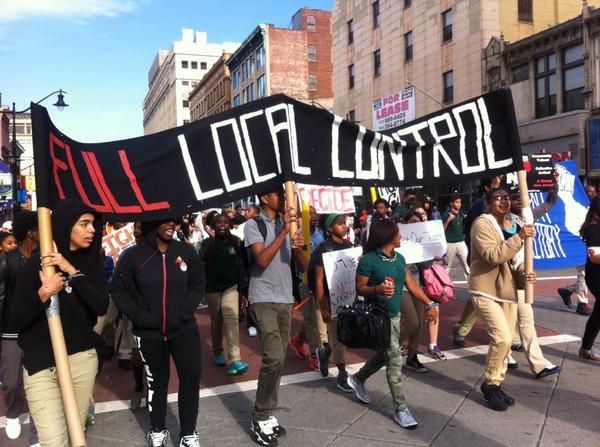
When Kids Teach Adults – Lessons from the Newark Student Union Sit-in

Newark-student-walkout-3-9-9-141

If ISIS extremists flew in from the Middle East and took over our public schools, we wouldn’t stand for it.

But if those extremists are from our own state or federal government, we just yawn and change the channel.

Though not for the last three nights.

A handful of plucky Newark school students have demanded our attention, and, Brother, do they have it!

At least six Newark students have staged a sit-in at the offices of Superintendent Cami Anderson demanding she step down and the district be returned to the voters. The district has been under state control for the last two decades.

This could have been handled easily. Anderson could have met with the students to talk about their concerns. After all, she is a public servant and even school kids are members of the public.

But instead she’s abandoned her office, sent threatening letters to the children’s parents and blocked or held up shipments of food to the young protestors.

Undeterred, the youngsters have set up a live feed on youtube to broadcast their action to the world, tweeting with the hashtags #OccupyNPS and #OurNewark. And the world has been paying attention. Local officials including Mayor Ras Baracka are calling for Anderson’s resignation. The teachers union is discussing holding an illegal strike if the students are forcibly removed.

But more importantly, people all over the country are talking about something they haven’t talked about – maybe – ever: local control.

What gives the state or federal government the right to come in and take over your public school?

Sure if there’s some kind of malfeasance going on, it makes sense to oust a particular school director. If the entire board is working in collusion against the public interest, maybe then it makes sense to get rid of all of them. A temporary acting school board might be necessary in such an unlikely case.

But why not then just hold another election and be done with it? Why would the state keep control over a public school for years or decades after a crisis?

The answer: many of our state and federal government officials don’t believe in local control.

Don’t worry. They’re not against it for everyone.

They don’t come in and take over just any school. If you live in a rich neighborhood, you can breathe easy. No state has ever taken over a posh district.

However, if you live in a poor community with a school that struggles to get by on the contributions of the impoverished local tax base, then the state may be gunning for you.

In my home state of Pennsylvania this has happened numerous times: Duquesne, Chester Upland and Philadelphia spring immediately to mind. In fact, Philly schools have been under control of the State Recovery Commission almost as long as Newark. At the same time Newark students were settling in for their second night in Anderson’s office, the Philadelphia SRC was having citizens arrested for protesting the state-appointed directors decision to expand charter schools.

What gives these people the right to take over our schools?

Poverty.

The excuse is always that the democratically-elected school board didn’t manage the district’s finances well enough. That’s why there were dwindling services for students.

However, the truth is more simple. School directors weren’t able to get blood from a stone. While rich districts rely heavily on a fat tax base that could support whatever services their children need, poor ones limp by. The state and federal government – seeing the trouble our poor districts are in – have a responsibility to come forward and provide financial assistance. After all, every child in this country has the right to a free and appropriate public school education. This doesn’t change just because your folks are poor.

But instead of facing up to their responsibilities, the state and federal government have used this monetary crisis to steal control of the poorest public schools.

And what’s worse, they haven’t improved the quality of services for students under their care! Instead they make sure any moderate increase in funding gets siphoned off to the corporate education reform movement before it ever reaches kids.

The standardized testing industry has increased 57% in the last three years alone to a $2.5 billion a year market. And that doesn’t even count the billions more being raked in by textbook companies (many of them are the same ones producing and grading the tests) with test prep materials and Common Core.

So why does the state and federal government unconstitutionally swipe away local control from people living in poor districts?

Because they can make money off of it!

This is exactly the abomination that the Newark Student Union is shinning light on.

Five years ago, Newark Schools received a $100 million gift from Facebook’s Mark Zuckerberg to turn around the district. The project is called One Newark. The director is Anderson.

However, instead of turning the district around, it has been responsible for closing or relocating schools, opening new charter schools and displacing staff. And no improvement to district services!

Where’s the money going? Here’s a hint: Anderson has been sharply criticized for spending $37 million on consulting fees to prominent factory school reformers.

It’s time to end the practice of public school takeovers. There is no good reason for the state or federal government to snatch away our local schools. This is clearly a violation of the almost every state constitution (including New Jersey and Pennsylvania’s) and the rights of citizens and students. Public schools should remain public.

This is what our children are trying to tell us there in Cami Anderson’s office.

As they continue for a third night, I find myself with two distinct opposite emotions.

I feel an overwhelming shame for my generation. We have let greed get the better of us. How dare we trample the future of countless generations of children for financial gain! When I think of people like Anderson and ex-Mayor Cory Booker, people like my own ex-Governor Tom Corbett, I want to throw up.

However, at the same time I’m also filled with such immense hope! These children have shown us that we can be so much more than the sum of our base natures! We can overcome our menial immediate needs and put the suffering of others over that of ourselves!

I can’t express enough the joy and admiration I have for the members of the Newark Student Union! They represent the future we might attain – if only us adults will let them shine!


UPDATE: The sit-in ended after three days when Anderson met with students. They continue to call for her resignation.

This article was also published on the Badass Teachers Association blog.

Fight Corporate Education Reform and Meme It!

20-beach-sea-photography

Sometimes words alone aren’t enough.

Has this ever happened to you? You’re arguing with someone and just not able to get your point across. You know if you could just show them the picture in your brain, they’d understand what you meant with the force of a bullet. But lacking psychic abilities, you’re reduced to the efforts of your poor twisted, tangled tongue.

That’s where memes make all the difference.

A meme is “an idea, behavior, or style that spreads from person to person within a culture.” Though originally coined as a term to describe genes, the expression has expanded to encompass anything that can carry ideas from one mind to another with a mimicked theme.

I know that sounds daunting, but you’ve probably seen hundreds or thousands of memes already. At least half of the images on Facebook and Twitter are memes – Grumpy Cat, Condescending Wonka, One Does Not Simply, Conspiracy Keanu and enough facepalms to break your jaw.

As a meme-maker, myself, I’ve been surprised that some of my efforts have taken on lives of their own. By no means am I a master at the art, but a few of my 50 plus memes have been surfing the Internet on their own for a year or more. I’ll go on a nationwide education organization’s Facebook page and see my little meme staring back at me. “Hi, Daddy!”

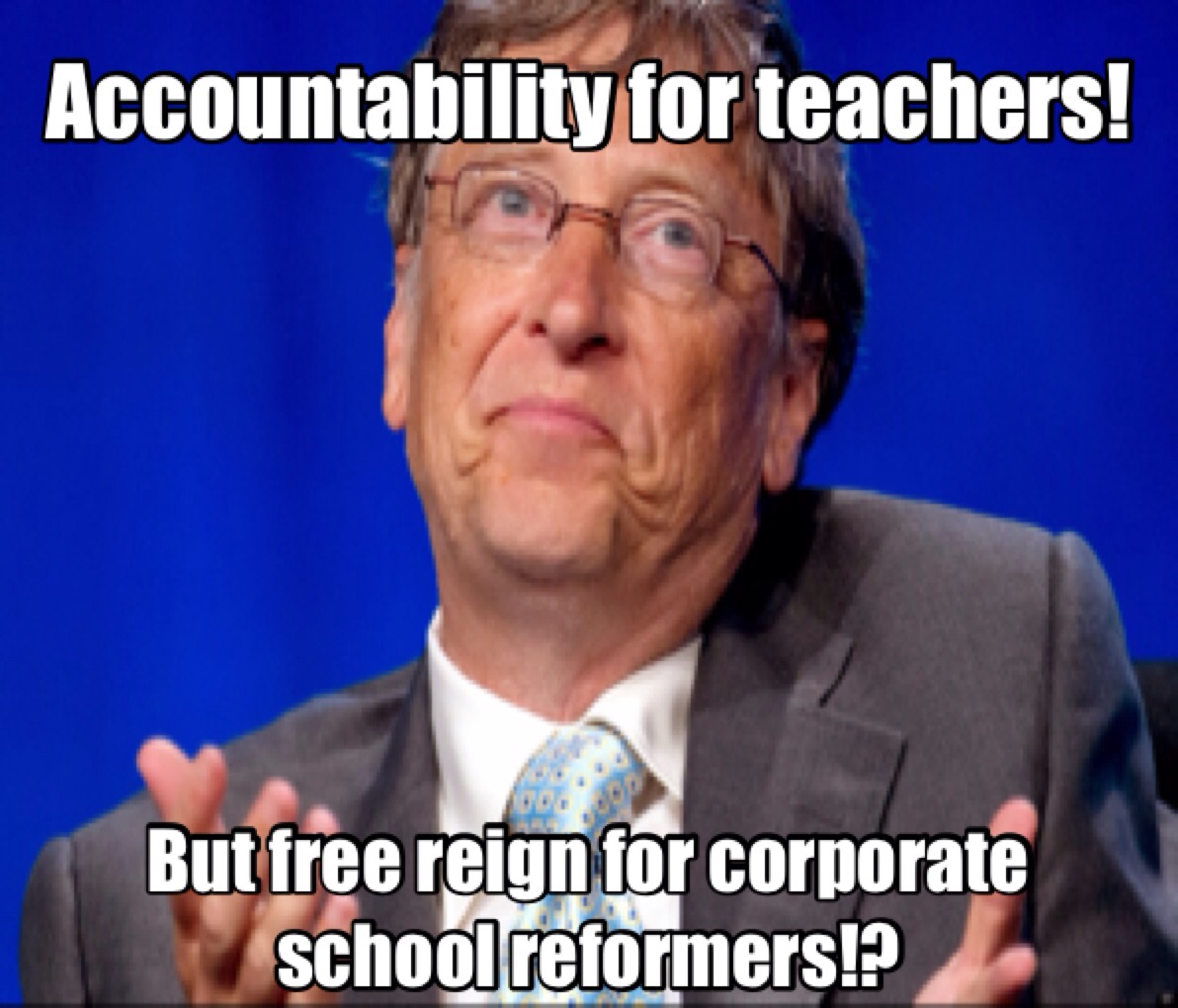
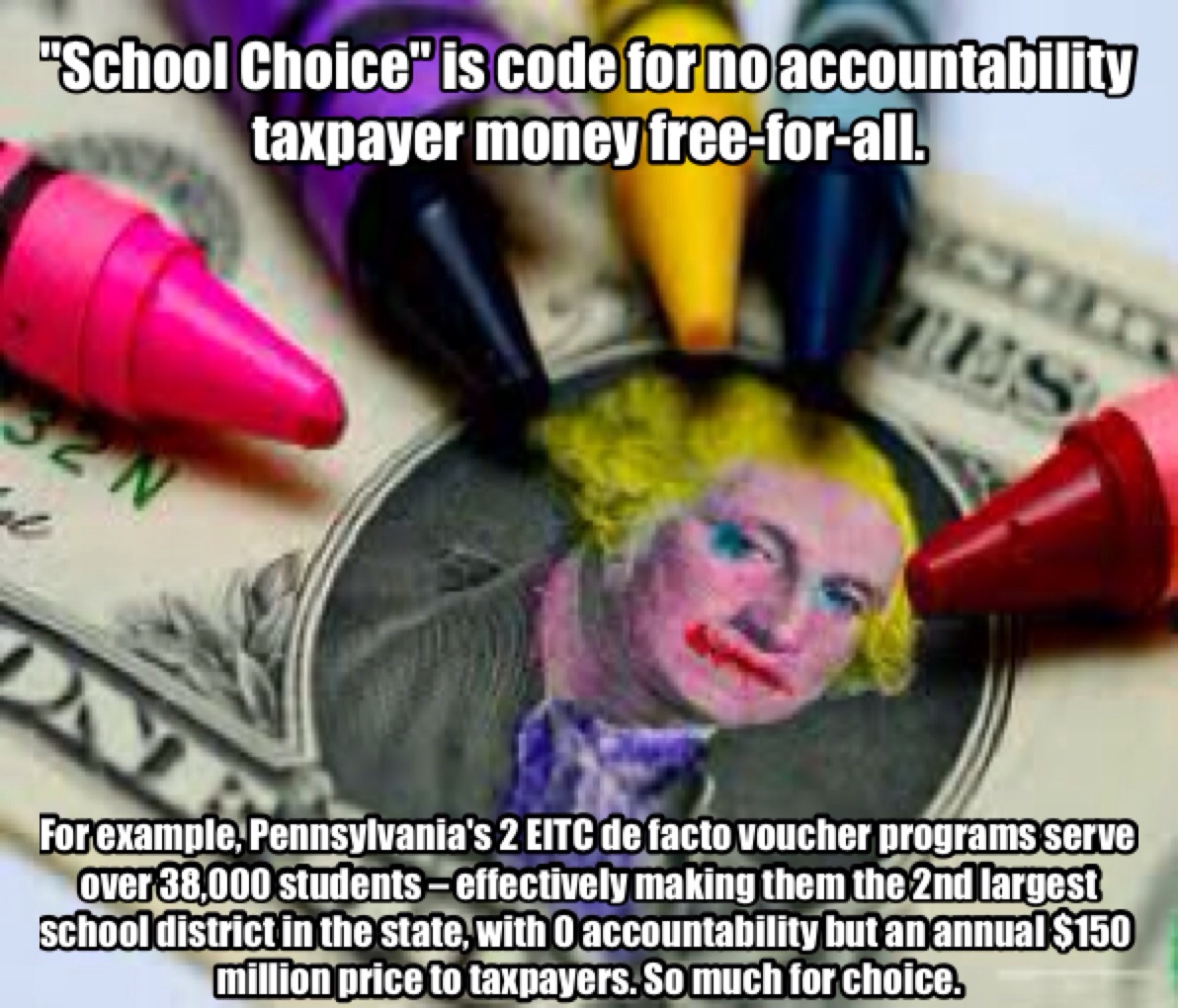
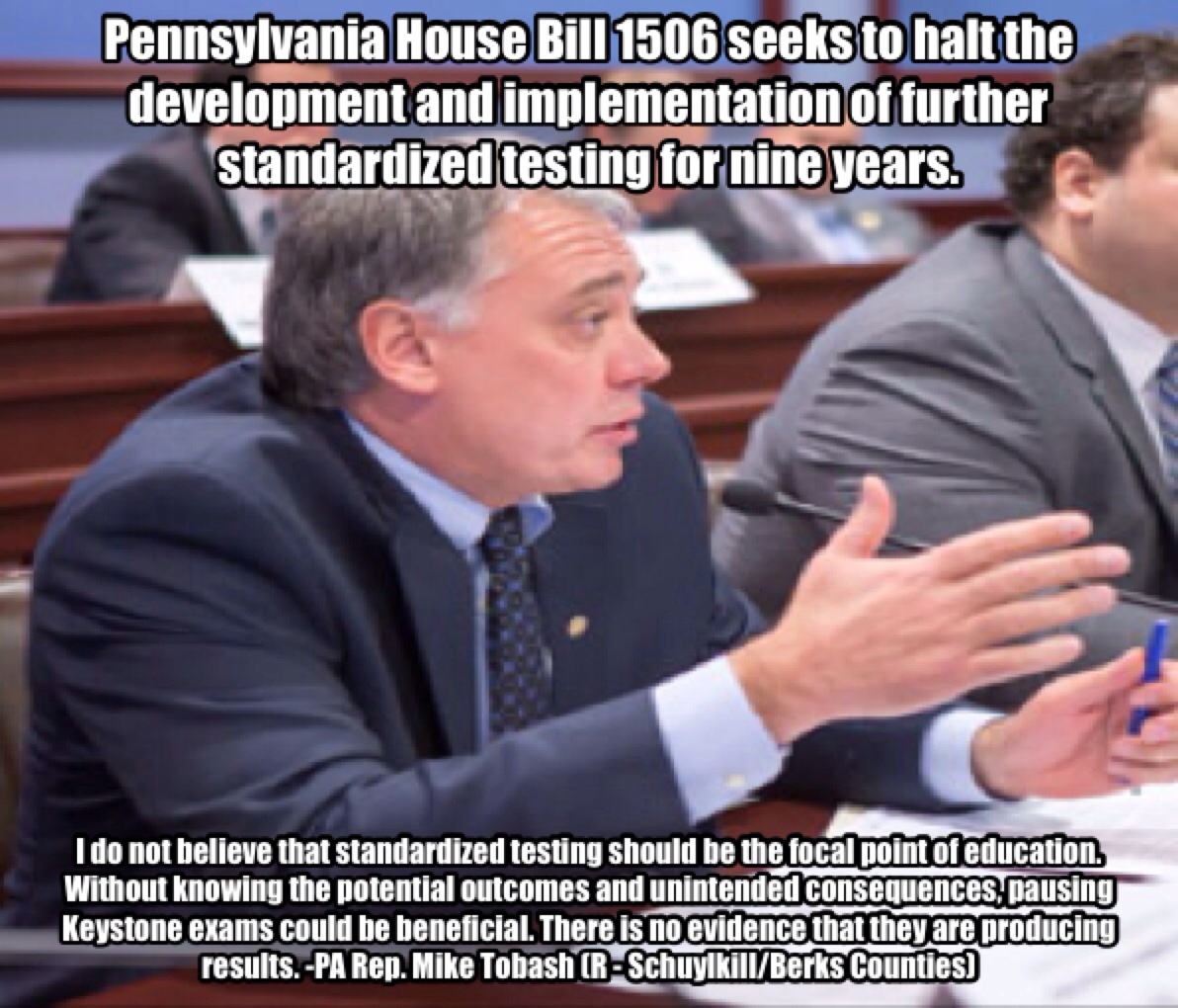
I leave you with an experiment. Here is a collection of some of my favorite creations. I’ve limited myself here to memes on the subject of education. I’ve also organized them to some degree based on subtopics.

Please feel free to browse. If you see a meme that you like – that helps make your point about the errors of corporate education reform – you have my blessing to take it. Post it on your Facebook page, in a tweet, on Tumbler, whatever you please. Send my little message off again into the great sea of interconnected webs and communication nets. Maybe one day it’ll return to me.

Happy shopping!


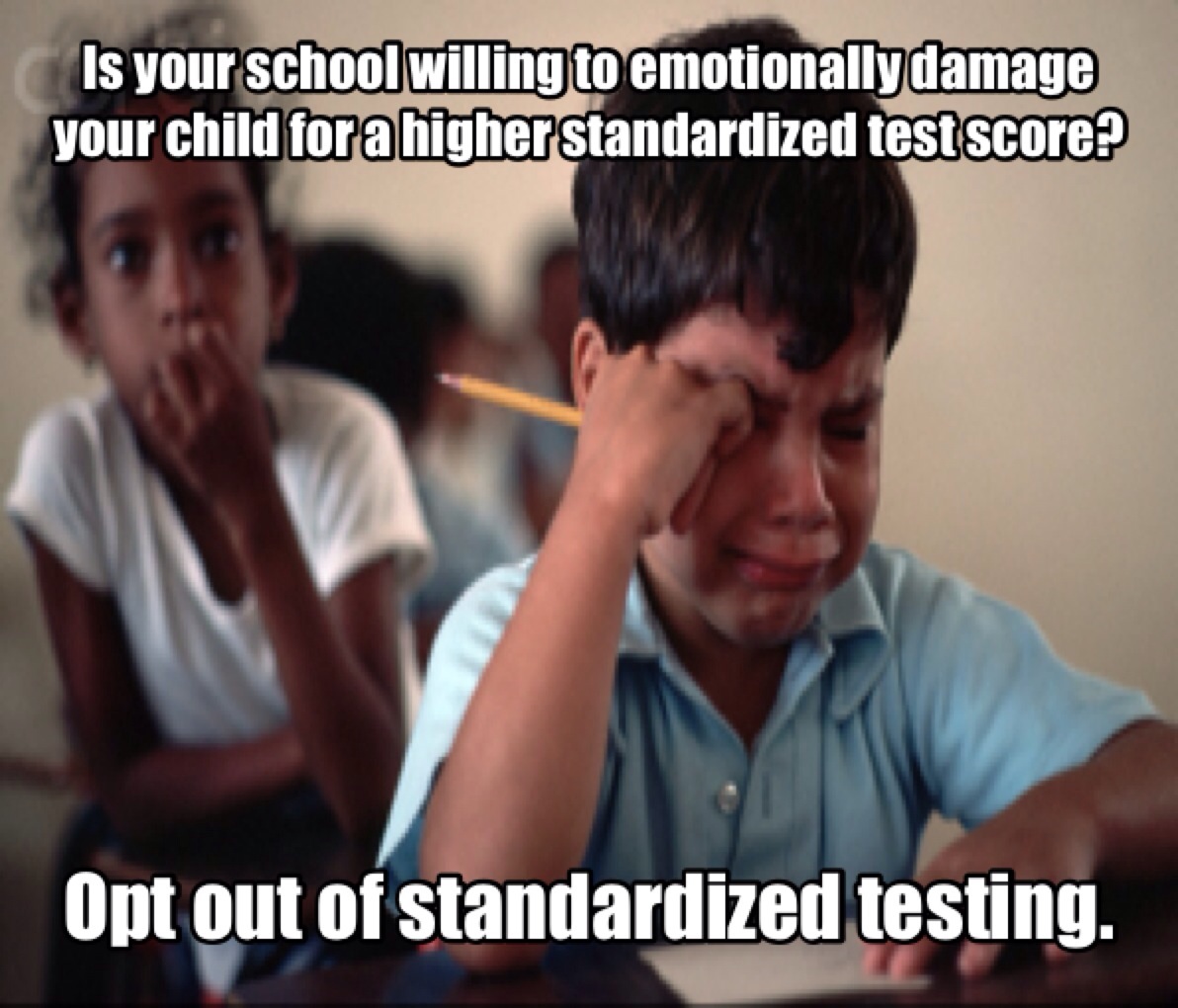
STANDARDIZED TESTING
1
IMG_0975.JPG

2
IMG_2013.JPG

3
IMG_1262.JPG

4
IMG_1782.JPG

5
IMG_1903.JPG

BUDGETS
6
IMG_1764.JPG

7

IMG_2040.JPG

8
IMG_0559.JPG

COMMON CORE
9
IMG_1972.JPG

10
IMG_1295.JPG

11
IMG_1710.JPG

TENURE

12
IMG_1800.JPG

13
IMG_1696.JPG
14
IMG_1603.JPG

VALUE-ADDED MEASURES (VAM)

15
IMG_1489.JPG

16
IMG_1106.JPG

17
IMG_0476.JPG

CORPORATE EDUCATION REFORM

18
IMG_1817.JPG

19
IMG_1492.JPG

20
IMG_0901.JPG

ACCOUNTABILITY

21
IMG_2023.JPG

22
IMG_2101.JPG

23
IMG_1072.JPG

PENNSYLVANIA ISSUES
24
IMG_1793.JPG

25
IMG_1776.JPG

26
IMG_1222.JPG
27
IMG_0919.JPG
28
IMG_1420.JPG

MISCELLANEOUS

29
IMG_1927.JPG

30
IMG_1891.JPG

31
IMG_1950.JPG

32
IMG_1392.JPG

33
IMG_1446.JPG

34
IMG_1912.JPG

The Final Straw: Cancel Our Labor Contracts, We Cancel Your Tests

the-straw-that-broke-the-ca1-300x273

You can’t do that.

All the fear, frustration and mounting rage of public school teachers amounts to that short declarative sentence.

You can’t take away our autonomy in the classroom.

You can’t take away our input into academic decisions.

You can’t take away our job protections and collective bargaining rights.

You can’t do that.

But the state and federal government has repeatedly replied in the affirmative – oh, yes, we can.

For at least two decades, federal and state education policy has been a sometimes slow and incremental chipping away at teachers’ power and authority – or at others a blitzkrieg wiping away decades of long-standing best practices.

The latest and greatest of these has been in Philadelphia, Pennsylvania.

Earlier this week, the state-led School Reform Commission simply refused to continue bargaining with teachers over a new labor agreement. Instead, members unilaterally cancelled Philadelphia teachers contract and dictated their own terms – take them or get out.

The move was made at a meeting called with minimal notice to hide the action from the public. Moreover, the legality of the decision is deeply in doubt. The courts will have to decide if the SRC even has the legal authority to bypass negotiations and impose terms.

One doesn’t have to live or work in the City of Brotherly Love to feel the sting of the state SRC. For many educators across the nation this may be the last straw.

For a long time now, we have watched in stunned silence as all the problems of society are heaped at our feet.

Nearly half of all public school children in the United States live in abject poverty. This is not our fault. We did not pass the laws that allowed this to happen.

We did not crash the economy and then allow the guilty parties to get away Scott free – in most cases to continue the same risky financial practices all over again.

We did not cut funding to programs designed to help the poor – public assistance, childcare, counseling , job placement, etc.

We did not slash state and federal taxes for the wealthiest Americans, corporations and big businesses resulting in less public money to do the jobs we give the government.

We didn’t even get to provide more than the most minimal input into the dominant education policies of the land. School Choice, No Child Left Behind, Common Core, Race to the Top – those were written and enacted by bureaucrats, politicians and billionaire philanthropists.

But somehow we’re to blame.

Teachers dedicate their lives to fight the ignorance and poverty of the next generation and are found guilty of the very problem they came to help alleviate. It’s like blaming a doctor when a patient gets sick, blaming a lawyer because his client committed a crime or blaming a firefighter because an arsonist threw a match.

The Philadelphia decision makes clear the paranoid conspiracy theories about school privatization are neither paranoid nor mere theories. We see them enacted in our local newspapers and media in the full light of day.

Step 1: Poor schools lose state and federal funding.

Step 2: Schools can’t cope with the loss, further reduce services, quality of education suffers.

Step 3: Blame teachers, privatize, cancel union contracts, reduce quality of education further.

Ask yourself this: why does this only happen at poor schools?

You never see a rich school dissolve its contract with its teachers. You never see a rich school declare it will become a charter to increase educational outcomes.

Why is that? Is it because rich schools are so poorly managed they can’t see the benefits of these excellent strategies – or is it because no one cares about the poor?

Poverty has been the driving factor behind the Philadelphia Schools tragedy for decades.  Approximately 70% of district students are at or near the poverty line.

To meet this need, the state has bravely chipped away at its share of public school funding. In 1975, Pennsylvania provided 55% of school funding statewide; in 2014 it provides only 36%. Nationally, Pennsylvania is 45th out of 50 for lowest state funding for public education.

Such chronic neglect by the state left poorer Philadelphia neighborhoods unable to make up the difference financially. In 1998, exasperated school administrators threatened to close the district unless the state paid its fair share.

The matter went to the courts with the district suing the state for not providing “thorough and efficient” funding and discriminating against the district’s largely non-White population. After a long series of negotiations, in 2001 lawmakers quickly created contentious legislation to take over management of the district.

Since the schools were in distress (read: poor), the state decided it could do the following: put the district under the control of a School Reform Commission; hire a CEO; enable the CEO to hire non-certified staff, reassign or fire staff; allow the commission to hire for-profit firms to manage some schools; convert others to charters; and move around district resources.

And now after 13 years of state management with little to no improvement, the problem is once again the teachers. It’s not mismanagement by the SRC. It’s not the chronic underfunding. It’s not crippling, generational poverty. It’s these greedy people who volunteer to work with the children most in need.

We could try increasing services for those students. We could give management of the district back to the people who care most: the citizens of Philadelphia. We could increase the districts portion of the budget so students could get more arts and humanities, tutoring, wraparound services, etc. That might actually improve the educational quality those children receive.

Nah! It’s the teachers! Let’s rip up their labor contract!

Take my word for it. Educators have had it.

There will come a time – that time may have come already – when teachers refuse to be the scapegoats for poor policies made by poor decision-makers to fleece and rob the poor.

It all comes down to standardized tests. Bureaucrats don’t know how to measure educational achievements without them. After all, they’re not, themselves, educators. That’s why every major educational “reform” of recent years requires more-and-more of these fill-in-the-bubble falsely objective, poorly written and cheaply graded tests.

In fact, standardized test scores are used to determine whether a school is “failing” or not. It was, after all, one of the chief justifications used for the state takeover of Philly schools.

However, educators know the emperor has no clothes. We know the best predictor of high test scores is a student’s parental income. Rich kids score well, poor kids score badly. Standardized tests don’t measure knowledge. They measure economics.

That’s why parents across the nation are increasingly refusing to let their children take them. It’s why colleges are increasingly lifting the requirement that applicants even take the SAT.

Teachers, too, have begun refusing to administer the tests. However, this is risky because in doing so they are in jeopardy of being fired for insubordination.

But times are changing. The two biggest teachers unions in the country recently came out in favor of protecting educators who take this principled stance.

Alice O’Brien, head of the NEA Office of the General Counsel:

“NEA supports parents who chose to exercise their legal right to opt their children out of standardized tests. When educators determine that a standardized test serves no legitimate educational purpose, and stand in solidarity with their local and state association to call for an end to the administration of that test in their schools, NEA will support those educators just as it did in the case of the teachers who protested the administration of the MAP test at Garfield High School.”

AFT President Randi Weingarten:

“We supported teachers at Garfield High School in Seattle when they refused to give redundant tests. We supported early childhood teachers in New York when they shined the light on how abusive it is to give bubble tests to 5-year-olds. On the testing madness that’s sapping the joy from our classrooms, teachers are the canaries in the coal mines, and we support their advocacy. Ultimately, though, it’s up to parents to make the decision whether to opt out.”

It follows then that educators should refuse to administer standardized tests across the country – especially at poor schools.

What do we have to lose? The state already is using these deeply flawed scores to label our districts a failure, take us over and then do with us as they please.

Refuse to give them the tools to make that determination. Refuse to give the tests. How else will they decide if a school is succeeding or failing? They can’t come out and blame the lack of funding. That would place the blame where it belongs – on the same politicians, bureaucrats and billionaire philanthropists who pushed for these factory school reforms in the first place.

This would have happened much sooner if not for fear teachers would lose their jobs. The Philadelphia decision shows that this may be inevitable. The state is committed to giving us the option of working under sweatshop conditions or finding employment elsewhere. By unanimously dissolving the union contract for teachers working in the 8th largest district in the country, they have removed the last obstacle to massive resistance.

Teachers want to opt out. They’ve been chomping at the bit to do this for years. We know how destructive this is to our students. But we’ve tried to compromise – I’ll do a little test prep here and try to balance it with a real lesson the next day. Testing is an unfortunate part of life and I’m helping my students by teaching them to jump through these useless hoops.

But now we no longer need to engage in these half measures. In fact, continuing as before would go against our interests.

Any Title 1 district – any school that serves a largely impoverished population – would be best served now if teachers refused to give the powers that be the tools needed to demoralize kids, degrade teachers and dissolve their work contracts. And as the poorer districts go, more affluent schools should follow suit to reclaim the ability to do what’s best for their students. The standardized testing machine would ground to a halt offering an opportunity for real school reform. The only option left would be real, substantial work to relieve the poverty holding back our nation’s school children.

In short, teachers need to engage in a mass refusal to administer standardized tests.

“But you can’t do that,” say the politicians, bureaucrats and billionaire philanthropists.

Oh, yes, we can.


This article was published on Diane Ravich’s blog and the Badass Teachers Association blog.

The Best Evidence Against Common Core

Classroom-Management2

There were hands in the air. Lots of them.

It wasn’t just the same one or two I was used to seeing, either. It was almost all of them.

My classroom of 8th grade Language Arts students had something to say, and they could barely contain it.

We sat together in a circle, the desks piled in the center and forgotten. We peered across that distance at each other’s faces and waited for someone to be called on.

It wasn’t me who did it.

The student who had just spoken picked a girl across the room from him. A smile cracked her face wide open as she began to speak.

This wasn’t the norm in my room. At least not yet.

We had only been together a few weeks. In that short time, this group of children from impoverished families – many of whom had criminal records, behavior contracts and folders full of write up slips in the office – had really been putting me through my paces.

If you left them in a room alone, there would probably be a fist fight in 5 minutes. If you peeked at their IEPS, you’d see a host of pharmaceuticals needed just to get them through the day. And if you only looked at their standardized test scores, you’d assume they’d need help to tie their own shoes.

But here they were sitting comfortably, discussing societal racism, gender roles, and how we treat the disabled.

If you closed your eyes and just listened, you’d think it was a class of college freshmen.

That’s what a Socratic Seminar does to a class full of troubled teens.

For the uninitiated, Elfie Israel succinctly defines Socratic Seminars as follows:

The Socratic Seminar is a formal discussion, based on a text, in which the leader asks open-ended questions.  Within the context of the discussion, students listen closely to the comments of others, thinking critically for themselves, and articulate their own thoughts and their responses to the thoughts of others.  They learn to work cooperatively and to question intelligently and civilly. (89)1

Socratic Seminars acknowledge the highly social nature of learning and align with the work of John Dewey, Lev Vygotsky, Jean Piaget, and Paulo Friere.

In short, it’s the kind of thing teachers used to do all the time before No Child Left Behind, Common Core and Race to the Top replaced it with something more rigorous – test prep.

The text we were discussing was “Raymond’s Run” by Toni Cade Bambera. The story centers around Squeaky, an African American girl tasked with looking after her mentally challenged brother, Raymond. At first this is just a chore assigned by her parents. Her real goal is to defeat all comers in various track and field events. However, by the end of the story, she discovers that helping others is its own reward.

But hush. Destiny is speaking.

“Squeaky is kind of a Tomboy,” she read from the question sheet I provided. “Should girls do girly things like being ‘flowers or fairies or strawberries’ or should they be allowed to do more masculine things like play sports? Why or why not?”

“Girls should be allowed to do whatever they want,” she answered. “If they want to play sports or do things that we usually think of as boy things, no one should stop them.”

“In fact,” she went on, “boys should be able to do girl things if they want, too. It’s just like in the story when Squeaky says girls can’t be real friends with other girls because they’re too busy being something other people expect them to be. If people were allowed to be themselves, there’d be less fights.”

Destiny was a girl who only last week sullenly sat with her head down refusing to answer any of my classroom questions with a suck of the teeth. Now she sounded like Gloria Steinem.

And she wasn’t alone. She chose Pablo to continue answering the question about gender roles. He brought up how people in our school treat gay kids.

Pablo said it made him sad that other boys were afraid to be seen hanging around with some kids because they thought their friends would call them gay. “Two girls can hug and hold hands and no one says anything, but if boys did that – they’re gay.”

This from a child who is often absent from school and still had the remains of a black eye that the guidance councilor would only explain by saying the school was aware of it.

Serina took the floor next and had to actually calm herself down before speaking. She told us about her brother, who is gay, and how it makes her cry when people make fun of him. In fact, there may have been a tear or two she calmly rubbed out of her eye with her palm.

At this point – had he been there – David Coleman would put a halt to our discussion.

The co-author of the Common Core famously said, “People don’t really give a shit about what you feel or think.

So shut up, kids. No one cares what you have to say.

Drawing from his deep zero years of training in the field of education, Coleman said:

Do you know the two most popular forms of writing in the American high school today?…It is either the exposition of a personal opinion or the presentation of a personal matter. The only problem, forgive me for saying this so bluntly, the only problem with these two forms of writing is as you grow up in this world you realize people don’t really give a shit about what you feel or think. What they instead care about is can you make an argument with evidence, is there something verifiable behind what you’re saying or what you think or feel that you can demonstrate to me. It is a rare working environment that someone says, “Johnson, I need a market analysis by Friday but before that I need a compelling account of your childhood.”

This attitude is reflected in the standards Coleman helped write and Bill Gates coerced state and federal governments to force on our public schools.

It’s embodied in an emphasis on close reading – going over a text multiple times to squeeze every drop of intention from the author. It’s a fine way of understanding what the author may have meant. It’s not a fine way of teaching or even understanding the full scope of a literary text.

To be honest, this isn’t exactly cutting edge stuff. It comes from the New Criticism of literary theory of the 1940s. Most schools of education replaced this outdated orthodoxy with Reader-Response theory thirty or forty years ago. Reader-Response sees the author as merely one of many factors making meaning in a text. Of equal importance is the world in which the author lived and the particular point of view of the reader.

Think about it. To Kill a Mockingbird is a very different book written during the Civil Rights Movement than had it been written in the 1990s. It’s important to know that many of the characters are based on real people in the author’s life. It’s important to know about the violence and civil unrest that came to a head at the time of the book’s publication. Moreover, an inner city African American boy has a different experience reading it than a privileged white suburbanite.

Reader-Response criticism opens up the act of reading and allows for classroom activities like the Socratic Seminar. But Coleman wouldn’t know anything about that. He was an English Literature major, and when given the chance to write education standards, he paid no attention to what was most pedagogically significant. He simply favored his pet literary theory over those of more modern thinkers.

But if Coleman and the architects of Common Core could be in my classroom, they might see the error of their ways.

Allowing students ownership of the text – allowing them to take their proper place as part of a complex relationship between the text, author and the world – is so much more engaging an experience than just being an authorial archeologist.

When we insist on strict adherence to the author’s message – and only that – we create a false objectivity. Language Arts is a subject that is at most times open to interpretation. But Coleman makes it a guessing game to get the “right answer.”

Literature is not math. We shouldn’t try to turn it into something it isn’t.

This is why at the beginning of the year, my students take my innocent questions about the meaning of a text as an affront. They see me as just another adult trying to trick them. They assume I’m trying to get them to guess what I’m thinking – about what the author was thinking. There has to be only one true answer, they suppose, and if they haven’t been good at guessing it in the past, why try now?

It takes a while, but through lessons like the Socratic Seminar, I try to broaden their horizons, to show them that they have a vital place in this dynamic. Without a reader, a text is nothing but words on paper. Without a larger societal context, those words lack their full meaning.

Moreover, not all texts are created equal. By this I don’t mean that some aren’t rigorous enough. I mean that literary texts are richer and deeper if they come from a multitude of cultural points of view.

We used to know this. Schools used to encourage students to read works by the full spectrum of Americans – African Americans, Latino-Americans, Asian Americans, Jewish Americans, Muslim Americans, etc. Now we shove all that under the carpet in favor of “rigorous” works by the same safe vanilla European Caucasian males.

Common Core doesn’t stop schools from using multicultural texts, but it doesn’t value them, either. There is no standard about the importance of reading diverse authors. In fact, the only diversity I see valued is that students should view diverse kinds of media!

Great! Read an essay, watch a video, play a song. But what about being exposed to diverse cultures and points of view?

Oh! I almost forgot. Coleman says no one gives a shit about that stuff.

My students do. When they read a work by an African American woman like Toni Cade Bambera, they can see themselves in her work. I’ve taught an awful lot of Squeakies in my years as a teacher. (I’ve even taught a few David Colemans.)

When you can open a book and see yourself looking back, what a motivation to read! But how unfair that we only value providing this experience for the white kids!

If we had truly high standards, we’d recognize this. We wouldn’t ignore the value of multiculturalism. We wouldn’t dumb down Language Arts to a simplistic and anachronistic formula designed to fail and humiliate.

Coleman and the Common Core designers would know that if they had ever led a classroom of students. But hardly any of them are educators. They’re bureaucrats, politicians and millionaire philanthropists.

They’re missing the true picture.

Because the best evidence against Common Core is denied them.

Because the best evidence against Common Core is in the classroom.


NOTES:

1 – Israel, Elfie.  “Examining Multiple Perspectives in Literature.”  In Inquiry and the Literary Text: Constructing Discussions n the English Classroom.  James Holden and John S. Schmit, eds.  Urbana, IL: NCTE, 2002.

-For more information about Socratic Seminars, professional development and even ideas about how to extoll their Common Core benefits (lesson plans, people!) please visit Socratic Seminars International.

This article was also published on Diane Ravich’s blog and the Badass Teachers Association blog.
No Pineapple left Behind – the Consolation of Satire and Video Games

altersplash3

Q: What’s the difference between a pineapple and a human child?

A: Pineapples are more profitable.

Let’s face it – kids have.. yuck … needs! Maslow even came up with a hierarchy of needs that must be met before you can get the little tykes to do anything. Physical well-being, safety, emotional… Argh! It’s just so much work!

Pineapples, however, are money-makers from the get go.

Chop them up, and you’ve got a tropical fruit salad.

Juice them, and you can make about a hundred different premium cocktails.

Heck! Just plop one in a hat and you’ve got an island-themed mascot!

But kids!? You can’t even get them to take a lucrative standardized test without… bleugh … educating them first.

Imagine if you could make pineapples take tests and get grades instead. Schooling would be like a gardening contest. Who has the best recipe for success? There would be no intangibles like the effects of poverty, home-life, special needs. It would all be neat, measurable and objective.

Yes, sir. Pineapples would be great for business – especially if your business is education.

That’s the premise of Subaltern Games current project No Pineapple Left Behind.

The satirical fantasy video game is the brainchild of former teacher, Seth Alter.

Alter taught at a Boston middle school before giving up the classroom for the programmer’s chair. According to his blog, he “became fed up with the callous administration” and decided he could teach more effectively through video games.

His first game, Neocolonialism, was inspired by world history and economics. The goal is to extract as much wealth as possible from the world through any means necessary. While many video games invite the player to engage in senseless violence, Neocolonialism inevitably forces players to consider the consequences of their actions. In fact, the game’s tagline is “Ruin Everything.”

The project was completed through a $10K Kickstarter campaign in January 2013 and released in November of the same year.

Now Alter and his 4-person team are writing No Pineapple Left Behind (NPLB) – a game he calls his “response to his old teaching job.”

While still in the early stages, the company has provided some video of what the game may look like when completed:

A Kickstarter campaign is anticipated to help the company finish this ambitious project.

Even in its early stages, NPLB confronts us with a host of essential questions about education:

1) WHO ARE PUBLIC SCHOOLS DESIGNED FOR – CHILDREN OR WIDGETS?

2) WHAT IS THE PURPOSE OF OUR SCHOOLS – EDUCATING KIDS OR MAKING MONEY?

Examine the state and federal education policies of the last dozen years and you’ll be forgiven for thinking we’re servicing widgets.

Federal programs like No Child Left Behind and Race to the Top increase high-stakes standardized testing to absurd lengths. Public schools are repeatedly defunded at the state and federal level, forcing them to rely on local taxes to survive. This is fine for affluent districts that can just raise property taxes, but it is unsustainable for the 99%.

To make up the difference, poorer schools are forced to compete for the remaining funds by enacting reforms that don’t benefit children but enrich the special interests that lobbied for them. Test companies like Pearson rake in the cash creating and scoring the tests on the one hand, and then earn even more profit providing the inevitable remedial test prep materials districts are forced to buy on the other.

Microsoft billionaire Bill Gates poses as a disinterested philanthropist funding Common Core, but then increases his company’s market share by providing the computers and technology necessary to take the standardized tests required by Common Core.

Moreover, for-profit companies entice away students to charter schools in order to garnish their per student funding. Then just before it comes time to take their standardized tests and thus be judged as effective or not based on these scores, charters boot the lowest achievers back to the public schools. The money, however, they keep. And they get to boast of how well they teach kids since the only ones left are the cream of the crop!

Children then become little more than a means to school funding. Schools are forced to use children to earn money for the district to remain open.

But schools are supposed to be places where funding is used to educate kids – not places where kids are used to earn funding.

3) IS COMPETITION THE BEST MOTIVE FOR A PUBLIC SERVICE?

No. Emphatically not. When you have competition, you by necessity have winners and losers. The goal of public schooling is to educate EVERYONE. Didn’t we call this nonsense No Child Left Behind? How can it be about doing that, if the goal is to see who wins the Race to the Top? In a race, the objective is to leave everyone else behind!

4) WHAT IS THE ROLE OF THE CLASSROOM TEACHER – GUIDE OR SORCERER?

In the early draft of NPLB, teachers will cast spells on their pineapple classes to get them to learn. This works well, apparently, for fruit. However, if classes are left unattended, the pineapples will turn back into children who are much harder to educate in this manner.

Go to any school of education in any university in the country and you’ll learn this simple fact: Education is not something someone does to you. No one can put a finger to your head and make you learn. There are no mystical words to engender wholesale epiphanies. Learning is a complex process that requires a relationship between the teacher and student. It happens gradually over time. There is no magic here.

However, our national education policy acts as if all children go to Hogwarts. Teachers are evaluated on how much their students learn. That’s only looking at one part of this complex relationship. What about the children? Aren’t they part of this equation, too?

Moreover, the metric administrators are being forced to use to determine if this learning has actually taken place is… standardized test scores! These are tests graded by temps who may or may not have an education degree working for corporations that make more money if more kids fail the tests! That’s a classic case of conflict of interests.

So we have a faulty evaluation method that is using faulty data to come up with faulty conclusions that will determine whether a teacher gets to keep his job or not. The ONLY way that works is through magic!

And so we’re left with the consolation of satire and video games. Will No Pineapple Left Behind be a big hit on the market? It’s still to early to tell.

However, the concept shows tremendous promise.

Perhaps players will recognize their own schools in the game.

Perhaps policy-makers will become embarrassed and discredited as the objects of virtual ridicule.

Perhaps encountering such everyday absurdism in video game form will serve as a wakeup call to the slumbering masses.

Otherwise, it may be game over for American Education.

UPDATE: No Pineapple Left Behind is now on Kickstarter looking to raise $35,000 to finish the project. New pictures, promos and information is available on the site.

Standardized Dress – School Uniforms and Conformity as Social Norm

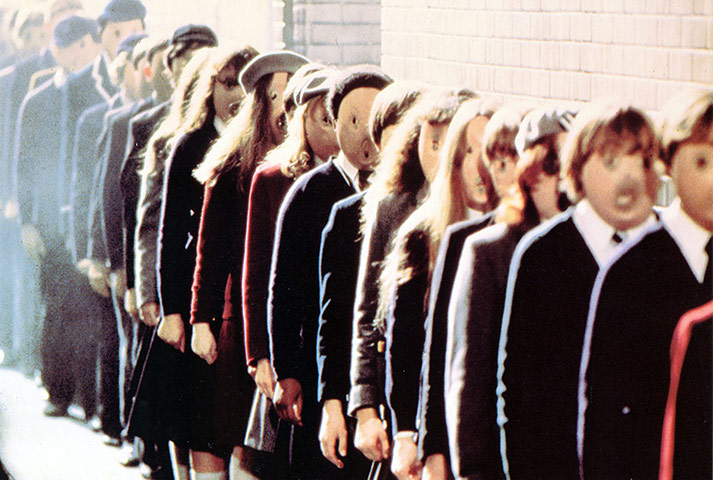
Pink-Floyd-The-Wall1982The-groups-musical-film-starred-Bob-Geldof-and-Bob-Hoskins

It was just a normal Monday. Two emotionally disturbed students chased each other into my classroom playing keep away with each others’ belongings.

I stopped them, reprimanded them and sent them to opposite corners of the room. Meanwhile the rest of the class hadn’t bothered to begin their warmup activity. I explained the assignment and got them back on track.

Finally, a girl sitting in the front row raised her hand and offered a solution to the problem on the board.

We were back in business and learning could continue.

At the end of class, an administrator stormed in. There was an urgent problem that needed solving immediately.

It wasn’t that the emotionally disturbed students were misplaced in the regular education setting. It wasn’t that the other students had needed redirection. It was the girl in the front row.

She was wearing a pink shirt!

When board members enact a school uniform policy – as was just accomplished at my district – they turn every educator in the building into the fashion police.

Individualized instruction, classroom management, content knowledge – all become secondary to the driving force of our schools: who isn’t conforming to the norm?

When did this become our educational philosophy? We should be doing just the opposite.

Schools should be engines of self-discovery and self-expression. In a world of stifling poverty and dangers from within and without, our schools should be places where kids can be themselves. We should be providing them safe places to learn who that is and what their relationship is to the rest of the world.

Instead, we standardize the curriculum with test prep and Common Core. We standardize their assessments with days of fill-in-the-bubble state-mandated testing and pretesting and post-testing.

To be fair, much of this is forced on us from the state and federal government. But now when your local school directors get an opportunity to make a rare decision about how to run their own community schools, they decide to standardize student dress!? They think having everyone look the same in drab colors and similar outfits is going to improve the situation!?

No! It simply continues the trend of turning our children into prisoners and turning our teachers into their wardens.

Case-in-point: my classroom is very cold. Even in summer the air conditioning blows out too much frigid air, and the maintenance department never seems able to adjust it properly.

I’ve almost given up complaining to administrators. After a few introductory attempts, I move on to things I can actually control.

In the past, I’ve simply told my students to bring a jacket. Most of them end up bringing a hoodie, but this year that’s against the dress code. They can wear a certain kind of plain sweatshirt or sweater, but they can’t wear one with a hood.

The result is a class of shivering children many of whom still try gamely to learn. I must admit, even standing there, myself, wearing a suit jacket, I go numb after a while.

So I took pity on my class and allowed them to discretely bring hoodies into class if that was all they had available. Almost immediately after the first student donned the verboten clothing, an administrator looked into my room and saw it. She pulled the student into the hall yelling and screaming that this was the second time the child had been seen wearing a hoodie, and disciplinary action would be taken.

The child turned to me with lost, helpless eyes before I spoke up and took the blame. He got off with a warning and shivered through the rest of my lesson.

Is this really the best use of our educational resources? We have real problems – such as dealing with the consequences of our “lowest responsible bidder” air conditioning service. But instead of tackling any of that, we’re pounding children into submission for a school uniform policy that doesn’t make any sense.

What lesson does it teach? Hoodies are evil? Wearing pink or – God help you! – navy blue will ruin your life!?

No. You must be the same as everyone else or you will be punished for being different.

This is what happens when school directors glance at the mountain of insurmountable problems they’ve volunteered to correct. But instead of solving any of them, they opt for a measure that solves nothing but looks good on paper – the newspaper, specifically.

A school uniform policy allows them to talk tough. We’re taking a strong stance against misbehavior by forcing student to dress the same way. We won’t put up with shenanigans at our school like gangs, violence and freedom of expression!

It’s ludicrous.

Do uniforms reduce violence and increase positive behaviors? There is no proof that they do. In every study that claims to prove the efficacy of uniforms for positive behaviors, districts made additional rule and administrative changes to the school environment at the same time. There is no way to isolate uniforms as the one factor among many that caused better behaviors.

What’s worse, there are long-standing, well respected studies that go further and conclude that uniforms are – at best – ineffective and – at worst – actually INCREASE negative behaviors.

Take this 1998 statistical study produced by the University of Notre Dame‘s Sociology Department that studied 10th grade students. Researchers showed that uniforms had no direct effect on “substance abuse, behavioral problems or attendance.” In fact, uniforms actually had a negative effect on student achievements for those students who previously considered themselves ‘pro-school’.

Researchers concluded:

“Student uniform use was not significantly correlated with any of the school commitment variables such as absenteeism, behavior, or substance use (drugs). In addition, students wearing uniforms did not appear to have any significantly different academic preparedness, proschool attitudes, or peer group structures with proschool attitudes than other students.”

What about academics? Supporters claim uniforms will boost academic achievement by removing distractions to learning.

It’s a curious claim to make.

Statistics show that mandatory school uniforms actually work AGAINST learning. States that require uniforms rank at the bottom for academic achievement. States without mandatory school uniforms rank at the top.

This is why school districts that adopt mandatory school uniforms often see a drop in property values. Mandatory uniforms are a hallmark of failing schools.

Consider what kinds of schools require uniforms. Hint: it’s not the rich suburban ones. It’s the poverty-stricken inner city ones. Specifically, 47% of high-poverty schools reported requiring school uniforms. While only 6% of low poverty schools did the same, according to the US Department of Education.

The National Center for Educational Statistics surveyed both primary and secondary school students from 1988 to 2004. Their conclusion: “Once I control for a number of factors, including race, sex and socioeconomic status… there is little evidence that school uniforms have an impact on student outcomes.”

In short, it’s time to stop reform for reform’s sake. We need to stop reaching for easy answers. Our children deserve better.

We need to give up this strange notion that in the land of the free, the home of the brave, the best ideal we can drum up for our schools is everyone marching in line, wearing the same clothing, thinking the same thoughts. That’s not the American dream. That’s the Communist one!

We’ve got to be okay with difference. In fact, we need to encourage it. Yes, there are limits, but they should be placed back as far as possible.

John Mason wrote, “You were born an original. Don’t die a copy.” Let’s not force our children into a mold.

Let’s guide them, nurture them to become independent thinkers who sometimes shock us with their originality.

Let our decisions today be worthy of the adults they may one day become.

Let them be free.

The Real American Education Crisis

Arne Duncan

“There’s a crisis in education…”

“Our schools are in crisis…”

“Schools are failing…”

“We’re failing our kids…”

You hear some variation of the above almost every time the subject turns to American education – especially the public schools. It’s usually the first thing out of a corporate education reformer’s mouth before he/she unveils the disruptive, top-down, data-driven solution that will save us all. Davis Guggenheim made a famous corporate reform propaganda film claiming we were all “Waiting for Superman” to come save education. Well, if we’re waiting for superman, the above phrase and its variations are his theme music.

However, when we hear these words, the gut level reaction is to deny them. “What? Our schools are failing? Of course not!”

And then we look like deluded pollyannas trying to hide our heads in the sand from an obvious problem. Our schools are failing. It MUST be true. I heard Wolf Blitzer say it on CNN. The US Secretary of Education says it. The President even says it!

So I’d like to make a suggestion the next time you hear someone say this ubiquitous phrase. Agree with him.

Say, “Yes. Our schools are failing. Our state and federal education policy has failed them.”
Say, “We’ve spent billions of dollars on No Child Left Behind and Race to the Top and none of it has helped kids learn any better!”

Say, “We’ve been trying high-stakes standardized testing, test prep and teacher accountability programs for at least the last dozen years with the sole goal of bringing up student test scores. It hasn’t worked.”

Give them the old saw that “Insanity is repeating the same mistakes and expecting different results.” Tell them this is exactly what we’re doing in our school system. Common Core, value-added measures, school vouchers, charter schools – it’s all the same failed educational scheme that just doesn’t work.

They may want proof. Turn their attention to International PISA scores. (They’ll love that! Data! Drooool!)

We know that students from wealthy districts earn some of the best test scores in the world. It’s the kids entrenched in poverty that don’t do so well. AND (This will probably be news to your corporate education reformer interlocutor) a majority of all public school students in one third of America’s states now come from low-income families.

Social science research over the last several decades has shown that two thirds of student achievement is a product of out-of-school factors — and among the most powerful of those is economic status. That’s not exactly shocking: Kids exposed to destitution and all that comes with it have enough trouble just surviving, much less succeeding in school.

Then you can turn to real reform tactics – things that might actually help kids learn!
Things like increasing public money to fund extra tutoring, child care, basic health programs and other wraparound services at low-income schools.

Talk about equity (They’ll love that! They try to sell their snake oil as a cure for our Civil Rights abuses. Hit them with a real one!) Tell them high-poverty schools must finally receive the same amount of funding as schools in wealthy neighborhoods. Tell them we actually should do like the rest of those high achieving PISA nations and give high-poverty districts MORE funds than rich districts because combating poverty is expensive.

Tell them we need to help impoverished students’ parents – we need to expand the social safety net, raise the minimum wage, provide funding for daycare, single-payer healthcare, introduce a real jobs bill to get people back to work.

And if they shy away from poverty (Because they will! They don’t really want to solve society’s ills!) tell them how we need to change the antiquated school system, itself.

Yes, antiquated. Our public schools are still organized as if they were preparing kids to work in a factory. The industrial revolution has been over for some time now. Those mill jobs mostly have been shipped overseas and they aren’t coming back. Our schools need to educate kids for the jobs of the future – science and technology jobs, for instance.

How do you do that? You do exactly the opposite of what the corporate education reformers propose. When they say “standardize,” we should say “individualize.” It’s a head scratcher in the teaching profession these days that educators are told to individualize their lessons but standardize their tests.

We can change the paradigm by allowing students to have more of a say in their own educations as they get older. For instance, instead of arbitrarily forcing teachers to make their students read a certain percentage of nonfiction texts (i.e. Common Core), let the students pick a certain percentage of the texts they read based on… gulp… personal interest.

Let children follow their hearts. Teach them to be media savvy and computer literate, but don’t give them any answers. Help them find the answers.

That’s what a 21st Century education should look like, not children sitting all in a row filling in bubbles on a standardized test.

I offer this bit of advice not because I think we’ll convince the reformers. Let’s face it. They’re in the pockets of the rich and powerful who are making billions off of the poison these shills are selling. However, if we challenge this basic assumption, if we change the narrative, we may begin to convince the voting pubic.

To be fair, I think this has already begun. The tolerance for these top-down reform methods has started to wane. If we can shut down their schemes before they’ve even begun, we may have a chance of increasing erosion to their policies acceptance.

And then the crisis in education may actually find a solution.