We Shall Overcome… Our Lack of Standardized Tests!?

Screen shot 2015-07-19 at 12.34.34 AM

Civil Rights groups have long championed the needs of people of color, women and minorities.

Segregated schools, voting rights, police brutality – all of these have been the subject of long and brutal fights for equality.

Perhaps the strangest turn in 2015 has been the fight for standardized testing.

That’s right. Organizations that you’d expect to see fighting against racism have been clamoring for access to multiple choice bubble exams.

In fact, the Democrats have used this as an excuse for their failed attempts to keep the much maligned Test and Punish policies of Presidents George W. Bush and Barack Obama in the rewrite of the Elementary and Secondary Education Act (ESEA).

The law – currently called No Child Left Behind (NCLB) – is a testing corporation’s dream filled with policies that have been failing our children for 13 years. Unsurprisingly, teachers, parents and students are demanding relief.

But do Civil Rights groups who fought against unfair testing as a prerequisite to vote now really demand unfair testing as a prerequisite for a high school diploma?

The answer is yes and no.

SOME Civil Rights groups have demanded more testing, and others have demanded LESS.

The Journey for Justice Alliance (JJA), a group made up of 38 organizations of Black and Brown parents and students in 23 states, wrote Congress an open letter in July asking for an end to high stakes testing. And the JJA wasn’t alone. The alliance was joined by 175 other national and local grassroots community, youth and civil rights organizations who signed on to the letter to “…call on the U.S. Congress to pass an ESEA reauthorization without requiring the regime of oppressive, high stakes, standardized testing and sanctions that have recently been promoted as civil rights provisions within ESEA.”

However, the JJA’s call has been largely ignored by lawmakers and the media. A much smaller coalition of Civil Rights organizations in favor of testing, on the other hand, has been given so much press you’d be excused if you thought they represented the entire activist community.

Yes, 19 Civil Rights organizations wrote to Congress in January, 2015, asking lawmakers to preserve annual testing.

However, 11 Civil Rights groups – many of them the exact same groups – wrote to Obama in October, 2014, asking him to reduce standardized testing.

What happened in less than 3 months, to change their minds?

It’s hard to say, but in October the prospect of rewriting the ESEA – the federal law that governs K-12 schools – seemed impossible. Neither Democrats nor Republicans could find any common ground. It looked like the law – which was last reauthorized in 2007 – would be pushed aside until at least the next president was sworn in.

But then like magic when the political situation changed and reauthorization seemed like it might actually happen, suddenly a coalition of Civil Rights organizations found their love for standardized testing.

It seems highly unlikely that these two events are unrelated.

But why would these organizations change their tune so quickly?

One very real possibility is money.

Most of the groups now backing standardized assessments accept huge sums of money from one of the richest men in the world – Bill Gates. And Bill loves standardized tests.

In many ways, his business profits from them. Common Core State Standards (CCSS) wouldn’t exist without his backing, and they depend on standardized tests. Moreover, most states give these assessments on computers – many of which have Microsoft emblazoned on the hard drive. And this doesn’t even count the test preparation software sold to help students get higher test scores.

The sad fact is that standardized testing is big business in this country. Everyone from book publishers to software manufacturers to professional development providers to for-profit prisons depend on the continuation of the testocracy.

And many of these Civil Rights groups would be crippled without that Gates funding. Others seem more like think tanks that really have nothing to do with Civil Rights.

Take Education Trust – an advocacy group that helped create NCLB and CCSS. It should be no surprise the organization took $49 million from Gates and thinks bubble tests are just wonderful.

However, even laudable groups like the United Negro College Fund (UNCF) owe Gates a debt.

UNCF took more than $1.5 billion from Gates. Ostensibly that money is supposed to go to scholarships. And there’s nothing wrong with that. But how could the organization go against the wishes of perhaps its biggest donor? The consequences could be disastrous for UNCF’s entirely worthy mission.

One can imagine administrators stuck between a rock and a hard place having to compromise their stance against testing in order to continue helping people of color fulfill their dreams of going to college.

Other suddenly pro-test organizations taking money from Gates include: La Raza, The Leadership Conference, National Urban League, and Children Defense Fund.

And that’s only the half of it.

To make matters worse, standardized tests don’t enhance students’ Civil Rights. They violate them.

Test scores are used as an excuse to continue spending less money on poor schools who serve mostly minority populations.

Proponents say these assessments hold schools accountable for providing children with a quality education. But how can you provide an education of equal quality with a rich school when you don’t receive even close to the same amount of funding to begin with?

Moreover, test scores have been shown countless times to be poor indicators of academic success. They are, however, excellent predictors of parental income. Poor kids score low. Rich kids score high. So when we take away funding based on low test scores and increase it based on high test scores, we only reinforce the status quo and compound the hurt against people of color.

But this sudden public mea culpa from some Civil Rights organizations is being used by political pundits to justify continuing the practices that would make Martin Luther King, Jr., turn in his grave.

And it’s not over. As Congress continues to hobble together a new version of the ESEA, politicians – mostly Democrats – are bound to lobby for as much federally mandated testing as possible. Even Obama has promised to veto the bill if it doesn’t contain enough love for the testing industry.

It’s up to education voters to educate themselves on the subject and demand real Civil Rights reforms.

End the system of Test and Punish.

Remove or reduce standardized testing from our schools.

Provide equitable funding for schools serving impoverished children.

And give our students of color a fighting chance to achieve the American Dream.


NOTE: This article also was published in the LA Progressive and on the Badass Teachers Association blog.

The Democrats May Have Just Aligned Themselves With Test and Punish – We Are Doomed

sanders_warren-620x412

Almost every Democrat in the US Senate just voted to keep Test and Punish.

But Republicans defeated them.

I know. I feel like I just entered a parallel universe, too. But that’s what happened.

Some facts:

No Child Left Behind (NCLB) is a disaster.

It took the Elementary and Secondary Education Act (ESEA) – a federal law designed to ensure all schools get equitable resources and funding – and turned it into a law about standardized testing and punishing schools that don’t measure up.

This was a Republican policy proposed by President George W. Bush.

But now that the ESEA is being rewritten, those pushing to keep the same horrendous Bush era policies are the Democrats.

Almost all of the Democrats!

That includes so-called far left Dems like Bernie Sanders and Elizabeth Warren!

It comes down to the Murphy Amendment, a Democratically sponsored change to the ESEA.

This provision was an attempt to keep as many Test and Punish policies as possible in the Senate rewrite.

The amendment, “reads more like NCLB, with its detailed prescription for reporting on student test results, for ‘meaningfully differentiating among all public schools’ (i.e., grading schools), including publicly identifying the lowest five percent, and, among interventions, potentially firing staff and offering students the option to transfer to other schools and using part of the budget to pay for the transportation,” according to blogger Mercedes Schneider.

Education historian Diane Ravich adds, “This amendment would have enacted tough, federal-mandated accountability, akin to setting up an ‘achievement school district’ in every state.”

Thankfully it was voted down. The ESEA will probably not be affected. The rewrite was passed by both the House and Senate without these provisions. Once the two versions of the bill are combined, it is quite possible – maybe even probable – that we’ll have a slight improvement on NCLB. Sure there is plenty of crap in it and plenty of lost opportunities, but the ESEA rewrite looks to be a baby step in the right direction.

The problem is this: the failed Murphy Amendment shows the Democrats’ education vision. Almost all of them voted for it. Warren even co-sponsored it!

When it was defeated and the Senate approved the ESEA rewrite, Warren released a statement expressing her disapproval. But if you didn’t know about the Murphy Amendment, you could have read her criticisms quite differently.

She says the (ESEA rewrite) “eliminates basic, fundamental safeguards to ensure that federal dollars are actually used to improve both schools and educational outcomes for those students who are often ignored.”

That sounds good until you realize what she means. “Educational outcomes” mean test scores. She’s talking about test-based accountability. She is against the ESEA rewrite because it doesn’t necessarily put strings on schools’ funding based on standardized test scores like NCLB.

She continues, “Republicans have blocked every attempt to establish even minimum safeguards to ensure that money would be used effectively. I am deeply concerned that billions in taxpayer dollars will not actually reach those schools and students who need them the most…”

She is upset because Republicans repeatedly stripped away federal power to Test and Punish schools. The GOP gave that power to the states. So Warren is concerned that somewhere in this great nation there may be a state or two that decides NOT to take away funding if some of their schools have bad test scores! God forbid!

And Warren’s about as far left as they come!

What about liberal lion Bernie Sanders? I’d sure like an explanation for his vote.

It makes me wonder if when he promised to “end No Child Left Behind,” did he mean the policies in the bill or just the name!?

The Democrats seem to be committed to the notion that the only way to tell if a school is doing a good job is by reference to its test scores. High test scores – good school. Bad test scores – bad school.

This is baloney! Test scores show parental income, not academic achievement. Virtually every school with low test scores serves a majority of poor children. Virtually every school with high test scores serves rich kids.

Real school accountability would be something more akin to the original vision of the ESEA – making sure each district had what it needs to give kids the best education possible. This means at least equalizing funding to poverty schools so they have the same resources as wealthy ones. Even better would be ending our strange reliance on local property taxes to provide the majority of district monies.

But the Dems won’t hear it. The Murphy Amendment seems to show that they’re committed to punishing poor schools and rewarding rich ones.

I really hope I’m wrong about this. Please, anyone out there, talk me down!

Up until now I’ve always been with the Democrats because they had better – though still bad – education policies than the Republicans. I’m not sure I can say that anymore. In fact, it may be just the opposite.

Which party is most committed to ending Common Core? The Republicans!

Which party has championed reducing federal power over our schools and giving us a fighting chance at real education reforms? Republicans!

Which party more often champion’s parental rights over the state? Republicans!

Sure, most of them still love vouchers and charter schools. But increasingly so do the Democrats.

This vote has me rethinking everything.

Our country’s education voters may have just been abandoned by their longest ally.

Where do we go from here?


NOTE: This article also was published on Commondreams.org and on the Badass Teachers Association blog. It was also mentioned in the Washington Post.

Do Americans “Throw Money” At Their Schools? A Fair Funding Primer

Screen shot 2015-07-06 at 11.05.59 PM

“Don’t throw money at schools.”

It’s a common rejoinder when lobbying for an increase in public education budgets.

You offer facts why schools need it: both the state and federal government continue to reduce K-12 funds, class sizes are increasing, the curriculum is being narrowed, buildings are crumbling – real world consequences to spending deficits.

And some guy (it’s often a dude) stands up with a cock-eyed grin and says, “You know, we really need to stop throwing money at schools.”

And he pauses as if we all need a moment to take that in.

Is there anything to this? We hear it often enough, but does he have a point?

Let’s see.

“Don’t throw money at schools.”

First, is it true? Is anyone actually throwing money at our schools?

I’ve worked as a public school teacher for over a decade. To my great disappointment never once has anyone hurled greenbacks through a window in my building. I have never had to dodge, duck or otherwise exercise gymnastics to avoid being thunked in the head by a stack of airborne bills.

Origami ninja stars made out of $100 notes do not routinely fly through the air in my classroom. No government representative has ever shown up in the auditorium during a professional development and said, “Yeah baby! Let’s make it rain!” before showering my coworkers and myself in Benjamin’s.

No. This has never happened. Not even coins. More change is thrown at the fountain in my local mall than at any public school where I’ve ever worked.

At this point, you’re probably saying, but, Steven, that’s not what this guy meant. He wasn’t implying someone literally tossed bills at foundations of learning. He was just being colorful.

To which I respond: was he? Because there are lots of ways to phrase that idea. He simply could have said, “We shouldn’t increase education funding.”

He could have said, “We need to spend school money more wisely before increasing it.”

He could have said, “Additional learning revenues are a waste because schools do such a bad job.”

He could have said, “We spend too much on education already.”

He could have said, “Kids don’t deserve more of my cash.”

But he didn’t say any of those things. Instead he conjured an image out of a Roman orgy or a rap video. He purposefully tried to frame this as a ridiculous situation. He wasn’t just trying to make an argument. He wanted to paint anyone who could possibly disagree with him as a fool.

“Can you believe these guys crying about public school funding?” he implied. “They’re having money thrown at them and they actually want more!?”

So before we even start to study the content of his phrase, we must remember it’s coated in bias and malicious intent. He is not really calling for a rational argument. He is appealing to emotions – most probably the emotions of those listening to the debate.

But we cannot sink to his level. We need reasons.

This is difficult because it’s not entirely clear what exactly he was getting at. Let’s examine what his statement might mean in plain English and try to determine if – underneath all this spin – he has a point or not.

Here are some possibilities.

1) “We need to spend education money more wisely before increasing it.”

This might be what he intended to say. And if so, he does have a bit of a point.

There is a problem with how school funding is spent. There is waste and misappropriation. At the local level, school boards and administrators do not always do things in the most efficient manner. But you could say the same thing at every level of democratic government. Fascist states have much less waste. Shall we just burn up the Constitution, then?

At the state and federal level, the problem is compounded by the ignorance of those allowed to write our laws. Education policy is rarely made by those who know what they’re talking about, thus funding often is wasted on useless initiatives. Common Core, standardized testing, punitive accountability systems – these were all created by business interests without regard to educational validity or efficacy and – as such – waste taxpayer money that could be better spent on things that would actually help children learn.

And speaking of waste, may I introduce you to charter schools? Favored by lawmakers yet rocked by fiscal scandals, charters are legal means of sucking up tax dollars for a profit. While public schools have to account for every penny spent and prove funds went to better the educations of real live students, charters are not just permitted but encouraged to withhold some tax money from going to student services and instead bolstering administrators’ bank accounts. Anyone who speaks of fiscal accountability in education yet is in favor of its further privatization is either disingenuous or in need of a basic math course!

The solution, however, is not to withhold additional funding. The solution is more oversight. And I don’t mean only government oversight and regulations. I mean oversight by the public.

Democracy only works if people participate. People need to push for transparency and less wasteful policies. They need to educate themselves about what’s going on. They need to investigate. They need to lobby, protest, and criticize. They need to vote. And they need a free and interested media to give them the facts to make smart decisions.

Clearly we’re lacking some of these things today. But that’s a national problem not limited to education funding.

In the meantime, we can’t wait for a perfect government before increasing school spending. Our children need help now!

If we do nothing, we doom another generation to getting less than they deserve, less than what we could have provided. Why? Because we were afraid some of it wouldn’t reach them!?

A deep sea diver with a kink in his air hose, doesn’t shrug and turn off his oxygen. He turns it up!

2) “Additional learning revenues are a waste because schools do such a bad job.”

This might have been his criticism. Let’s look at the facts.

International comparisons of national school systems are all the rage in political circles. And raw data suggests that children from the United States are not at the top. We are somewhere in the middle.

That’s all true. But what pundits refrain from admitting is that it’s been true for a long time – in fact, for as long as we’ve been making these types of comparisons. Our schools have not gotten worse. They have stayed the same.

This brings up an important issue. How does one compare national school systems to each other, anyway? What do we use to make these comparisons? Income prospects? Student portfolios? Measures of critical thinking? Classroom grades?

No. We use standardized test scores – the PISA test to be exact.

However, we’ve known for decades that standardized tests are poor measures of academic success. Bubble tests can assess simple things but nothing complex. After all, they’re scored based on answers to multiple choice questions. In fact, the only thing they seem to measure with any degree of accuracy is the parental income of the test-taker. Kids from rich families score well, and poor kids score badly.

So these comparisons are suspect.

But even if we accept them, we are leaving out a very important factor: Poverty.

Virtually all of the top scoring countries taking the PISA exam have much less child poverty than the U.S. As we’ve seen, this will boost their scores. If we adjust our scores for poverty, our students jump to the top of the list.

Let me repeat that: U.S. students do the best in the world on international tests – IF THEY ARE NOT POOR.

Moreover, the U.S. education system does something that many international systems do not. We educate everyone! Foreign systems often weed children out by high school. They don’t let every child get 13 years of grade school (counting kindergarten). They only school their highest achievers.

So when we compare ourselves to these countries, we’re comparing ALL of our students to only SOME theirs – their best academic pupils, to be exact. Yet we still hold our own given these handicaps!

In short, U.S. public schools do an excellent job educating children. They overcome incredible obstacles to achieve near miraculous ends often with very few resources.

Imagine what they could achieve if our schools were properly funded.

3) “We spend too much on education already.”

This one is a favorite of politicians of both parties. We already spend a lot on education. Some lawmakers and media personalities go so far as to claim that we spend more than any other country in the world.

Is that true? No.

We are near the top, but according to the most recent OECD study, four countries – Austria, Luxembourg, Norway and Switzerland – spend more.

Additionally, the study was released in 2014 but used data from 2011. Since that time, the U.S. has cut its school spending by leaps and bounds while most other advanced nations have been increasing it. Look for many more countries to pass us up when the next study is released.

But even using current figures, there are troubling social, economic and political differences between nations that impact how school funding needs to be spent. While most advanced countries spend their education budgets on actual instruction, the United States mandates public schools use a larger portion of their budgets on things outside the classroom.

For example, many international schools don’t have metal detectors or security staff. Given the U.S. problem with mass shootings and gun violence, our schools need to spend a significant portion of their monies in this way. I’m not suggesting we stop. Clearly we need to continue these practices, but that’s less money to help kids learn.

In addition, unfunded legislative mandates and court decisions have made U.S. public schools responsible for many things that international schools are not. About one third of all budget increases in recent years has gone to support special education students; 8 percent went to dropout prevention programs, alternative instruction, and counseling aimed at keeping students in school; another 8 percent went to expand school lunch programs; and so forth. Very few additional dollars were provided for needs associated with basic instruction.

Again, I’m not saying we should stop. Given our national epidemic of child poverty – an epidemic not shared by other advanced nations – we have to address these adjacent issues. But without additional funding, we’re letting the very heart of our schools – the classroom – go to waste while other countries are providing significantly more support.

Unfortunately, the problem doesn’t end there. Not only does the U.S. have unique problems that other nations do not share, we also are unique in how we allocate the funding we already have. And this difference only worsens the problem and increases the need for more money.

While most advanced countries divide their education dollars evenly between students, the United States does not. Some students get more, some get less. It all depends on local wealth.

The average per pupil expenditure for U.S. secondary students is $12,731. But that figure is deceiving. It is an average. Some kids get much more. Many get much less. It all depends on where you live. If your home is in a rich neighborhood, more money is spent on your education than if you live in a poor neighborhood.

The U.S. is one of the only countries in the world – if not probably the ONLY country – that funds schools based largely on local taxes. Other developed nations either equalize funding or provide extra money for kids in need. In the Netherlands, for example, national funding is provided to all schools based on the number of pupils enrolled. But for every guilder allocated to a middle-class Dutch child, 1.25 guilders are allocated for a lower-class child and 1.9 guilders for a minority child – exactly the opposite of the situation in the U.S.

So even though we spend more than many countries, we spend it so unevenly that poor and minority children are being left out.

Therefore, we have a choice: either do away with funding based on local property taxes or increase funding to poor school districts – or both.

4) “Kids don’t deserve more of my cash.”

Dollars to doughnuts, this is probably what he really means.

The United States has a moral failing. And we’re proud of it. We call it libertarianism. It means – Screw you! I’ve got mine.

We don’t care about helping others, we don’t care about the common good, we only look out for ourselves and our immediate friends and families. Everyone else can eat crap and die.

It’s ethical immaturity and, frankly, there’s not much you can say to someone who feels this way except that you disagree.

At most you can try to appeal to his self interest. Do you really want to live in a society full of uneducated people? Do you really want your kids to grow up in a world like that?

But that’s as far as it goes. You can’t help emotionally and intellectually stunted people – especially adults. Most children go through this phase. Some never grow out of it.

The good news is that most of us aren’t so far gone. If you can show that our interlocutor’s statement really comes down to this, you may be able to convince some people to agree with you simply because no one wants to be such an odious troll.

You need to pull back the curtain and show the truth.

How do we best spend these education dollars? How do we raise the money? Those are valid questions, but only a truly horrible person simply refuses to help children learn.

Because we’re not “throwing money” at schools. We’re throwing certain kids away.


NOTE: This article also was published in the LA Progressive, Commondreams.org and on the Badass Teachers Association blog.

The Only Teaching Evaluation That Matters

Screen shot 2015-06-12 at 10.40.16 PM

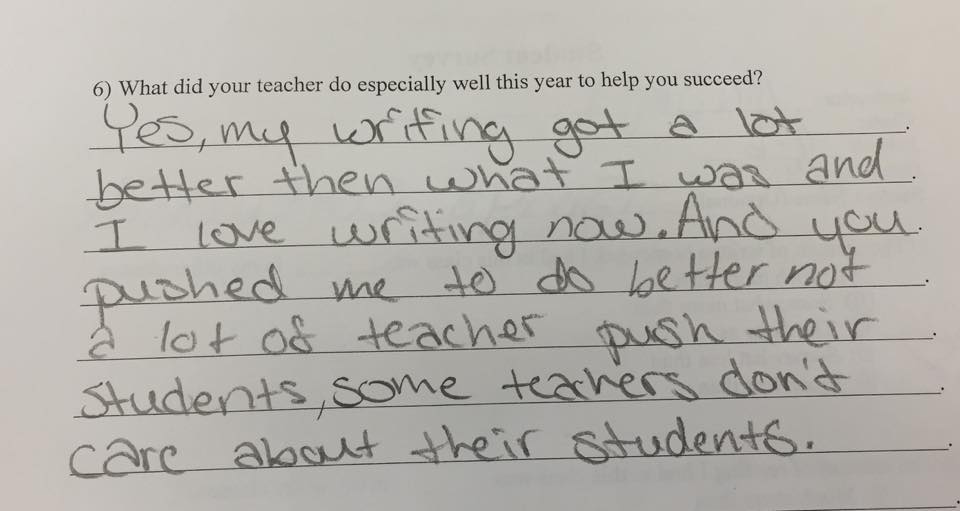
“Yes, my writing got a lot better than what I was, and I love writing now. And you pushed me to do better. Not a lot of teachers push their students, some teachers don’t care about their students.”

11280008_10153046535243860_104612156_n

One of my 8th graders wrote that to me on the last day of school.

I had asked her class to fill out an anonymous survey about my teaching. I said that all year I get to grade THEM, but this was their chance to grade ME.

I made sure to explain that they didn’t need to put their names on it. This would not be graded. Spelling and grammar didn’t count. The only thing I wanted was honesty.

I told them I wouldn’t personally collect the surveys. They should NOT hand them to me; they should put them in a pile on the desk by the door when they leave. I promised I wouldn’t even look at what they’d written until class was over. That way they could feel free to write whatever they wanted. If I did something bad or there was some way I could improve, I wanted them to tell me. If I did something exceptionally well, they should tell me that, too.

“Please help me become a better teacher,” I said.

As an 8th grade public school educator, I get evaluated a lot. I’ve spent countless hours gathering evidence that I’m “proficient” at my job.

I’ve had to endure formal observations, informal observations, H.E.A.T. observations, Student Learning Objectives (SLOs), written explanations of specific lessons with appeals to which Common Core standards I would be teaching – and there always seems to be a new one added to this list next year.

But I’ve been giving a version of this simple student survey to my classes on the last day of school for over a decade.

It’s not something I’m required to do. I don’t share the results with administration. The responses don’t go on file, increase my pay or get recorded in the newspaper. They don’t become part of the district’s ranking in the Business Times. No one is going to withhold funding from my district or close my building and convert it into a charter school based on these results. No one ever will be on television decrying the state of public education referencing these surveys. They are low stakes, class-based, teacher-centered and personal.

But I do this because I think it actually gives me useful information. I really want to know what my students think. That’s one of the things that truly drives my instruction. Not politically motivated standards monetarily incentivized and adopted before they were even completely written. Not standardized tests that measure little more than parental income. Not the latest fad handed down by the superintendent. Not a threat shouted at us through an email or at a faculty meeting.

No. I’m motivated by my kids in the classroom and the answer to the question, “Have I helped you learn?”

The survey is quite simple really. It’s two-sided.

On the front page are 5 multiple choice questions:

1) The amount of written homework I had in this class was                             in my other classes.

A) much more than
B) Somewhat more than
C) The same as
D) Somewhat less than
E) Much less than

2) The amount of reading I had in this class was                                in my other classes.

A) much more than
B) Somewhat more than
C) The same as
D) Somewhat less than
E) Much less than

3) The amount of studying I did for this class was                                 in my other classes.

A) much more than
B) Somewhat more than
C) The same as
D) Somewhat less than
E) Much less than

4) I received                                    instruction and comments on my written work.

A) much more than enough
B) Somewhat more than enough
C) Just enough
D) Somewhat less than enough
E) Much less than enough

5) In this class, I learned                                         in my other classes.

A) much more than
B) Somewhat more than
C) The same as
D) Somewhat less than
E) Much less than

When it comes to homework, students almost always say I give too much. The majority (68%) gave me an A or B.

I only require about an hour of extra-class work a week. I don’t think that’s too bad. However, many teachers give less or none. I go back and forth on the value of homework, myself, but I know that once my students get to 9th grade, they’ll have a tremendous load of it. I figure if I don’t prepare them for that, I’m doing them a disservice. So an avalanche of (one hour a week) homework it remains.

Likewise, kids often say I give a lot of reading. A language arts class should give a substantial amount of reading. So I’m glad most kids (69%) give me an A or B. I require my students to read one self-selected book a month. I don’t think that’s too burdensome. If the book is too tough or boring – hey! You picked it! Pick another one. I also provide them with 15 minutes per day to read in class.

Studying is not something I emphasize. But students are almost evenly divided whether I require too much, just enough or too little. I’m not big on having kids memorize something and then regurgitate that on a test. I’d rather spend time getting them to take good notes that they can use on the test. I’m a big fan of open notes or open book tests. But I hardly ever use the word “Test.” I give frequent short quizzes. I think tests (and even quizzes) are limited evaluation tools. I’d much rather assign a multi-day project. That tells me much more than a brief snapshot of what students were thinking at any one given point in time.

I do assign a lot of essays so I’m always anxious to know if I’ve given enough written feedback. The research seems to show that if you mark every error on an essay, you get diminishing returns. You discourage students. So instead I try to focus on a few trouble areas we’ve already discussed per essay. And students seem to appreciate it. Most of my kids (85%) gave me an A or B or C in this area.

Then comes the cumulative question. How much did you learn? I used to have my classes assign me a letter grade A-E. However, answers were all over the place. When I compared the results with surveys from students who had revealed their identities, I found that kids usually gave me the same grade they received in my class. A-students gave me As. C-students gave me Cs, and so on.

When I changed the question to “how much have you learned?” the results changed drastically. Most students (84%) gave me an A or B. Yes, that’s the result I’m aiming for, but I think it’s a more honest answer, too. It doesn’t focus on grades. It focuses on each child’s assessment of his or her own progress. That’s really what I want to know.

But this side of the survey still provides very limited answers. It is multiple choice, after all. It’s useful for a brief overview but not very deep.

The second side of my questionnaire only has two open-ended queries. Students can write as much or as little as they want to the following questions:

6) What did your teacher do especially well this year to help you succeed?

7) In what areas can your teacher improve his/her instruction?

To be honest, when looking at the surveys, I usually skip right to these questions. This is what I want to see – not a bunch of alphabet soup. I want to know what they really think.

What have I done well? Here are some answers from this year’s kids:

-He understood the learning abilities of certain students and helped them to the best of his ability.

11122062_10153046535213860_65835541_n

-You made it hard so that we would have to work for the grade.

11208874_10153046535223860_1052817053_n

-Before we could ask him for help, he asked us if we needed help. He’d help everyone, even the person who didn’t ask for it.

11310977_10153046535218860_807785160_n

-He was really good at explaining and pushed me to never give up. Therefore, Mr. Singer is one of my favorite teachers.

11329696_10153046535238860_1253356423_n

-Well, I didn’t like as much work as he was giving us, but then I understood he was trying to help us with our grades and trying to make our grades higher.

11348779_10153046535183860_857789294_n

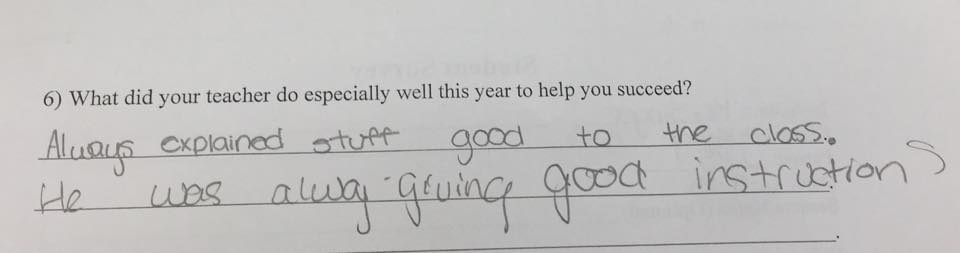
-Always explained stuff good in class. He was always giving good instructions.

11358887_10153046535198860_689871876_n

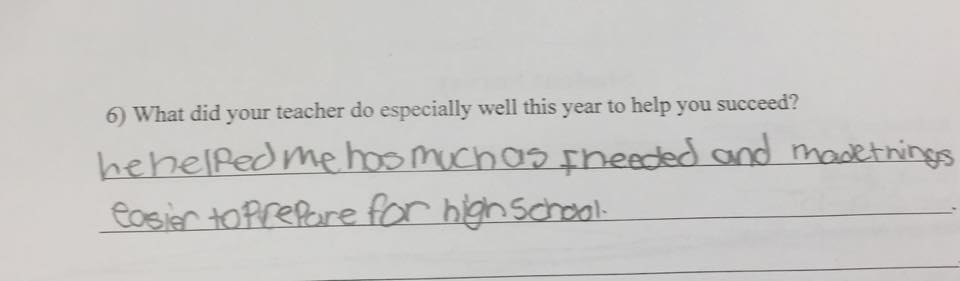
-He helped me as much as I needed and made things easier to prepare for high school.

11418417_10153046535203860_1321510136_n

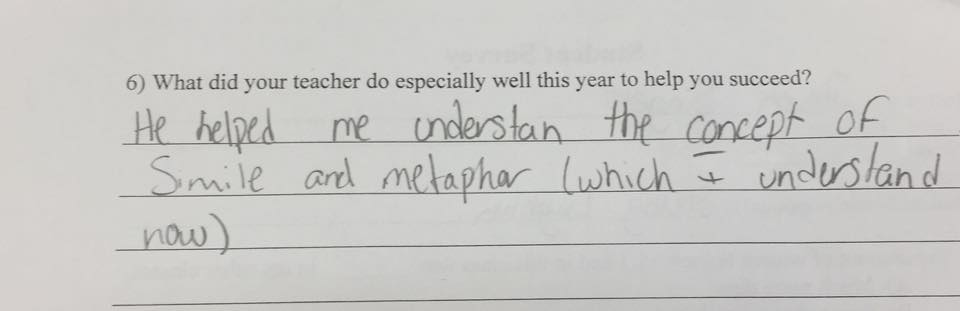
-He helped me understand the concept of simile and metaphor (which I understand now)

11420058_10153046535208860_229100346_n
-What my teacher especially helped me do to succeed is writing essays.

FullSizeRender

I was just floored by these responses. Talk about data I can use! But there was one answer that stood out above even these:

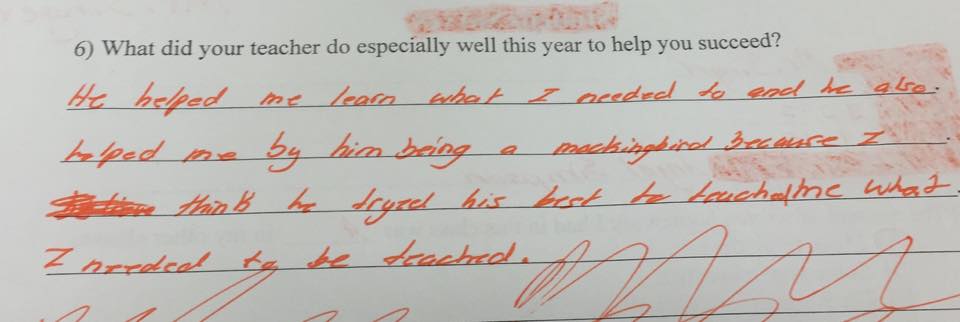
-He helped me learn what I needed to do and he helped me by being a mockingbird because I think he tried his best to teach me what I needed to be taught.

11280625_10153046535248860_1666870003_n

No, she wasn’t literally calling me a bird. She was relating me to our last novel – To Kill a Mockingbird. In the text, some characters are innocent victims. They try to help others but come under fire because of it. The author, Harper Lee, symbolizes them as “mockingbirds.” These include: Tom Robinson, the black man wrongly accused of rape; Atticus Finch, the lawyer standing up for a fair trial despite social criticism; Arthur “Boo” Radely, the recluse who saved lives at the expense of his privacy.

And here my sweet little student was including ME in this venerable list!

That choked me up a bit I can tell you.

When it comes to areas for improvement, my students aren’t the most forthcoming. Answers include:

-I don’t think he needs to because he already does his best to teach us kids what we need to be taught and his instruction is easy to understand.

11418657_10153046535193860_238476660_n
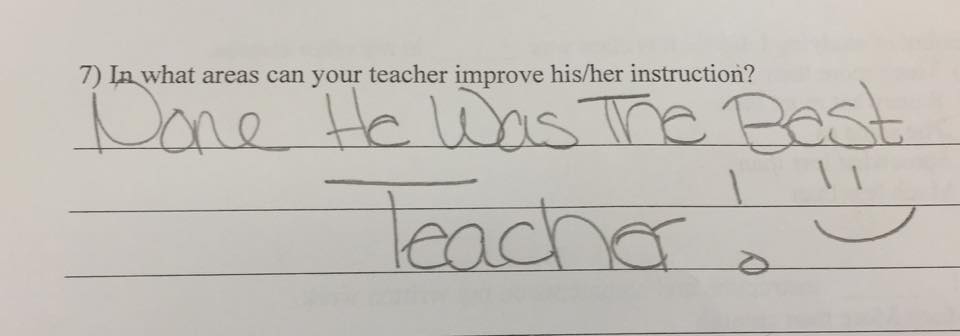
-None. He was the best teacher! 🙂

11419982_10153046535228860_393598543_n

I appreciate the approbation but I wouldn’t mind constructive criticism. I do get complaints about the amount of homework and writing I assign. I also get requests for more free time.

I think if I wasn’t in the room when students took the survey, I might get more criticism. Ideally, I would leave the room for the last 15 minutes of the class, and kids could fill out their surveys. However, this is impractical. I don’t see how I could arrange it given the current climate, lack of subs and skeleton crew staff.

These surveys have given me much to think about over the summer. Maybe I should try to include more group work in next year’s class. Maybe I should revisit the homework situation.

But as June turns to July and then August, I know I’ll be thinking about all that happened this school year.

Some kids came in and out of shelters and juvenile detention. Some were present at a shooting at the local mall. Parents and I had to fight administration over valuing standardized test scores over classroom grades for student placement. The School board enacted a pointless student uniform policy. Students were demoralized and angry over national racial tensions involving Michael Brown, Eric Garner and the Baltimore uprising. Teachers had an active shooter drill for the first time as part of our professional development.

But most of all I’ll think about my students – well, no longer mine – off to the high school and bigger, better things.

For a brief moment I was an important part of their lives and they were an important part of mine. I’ll forget their names. (It’s like my mind is making space for the new ones I’ll have to learn.) But I’ll never forget their struggles and triumphs.

It’s easy to lose sight with all the privatizers and standardizers trying to dismantle our public schools. But even with all the political nonsense, selfishness and small-mindedness, teaching is the best job in the world.

Yes, it really is!

Every day I get a chance to positively impact dozens of lives!

I am truly blessed.

That’s what these surveys tell me.

And that’s why they’re the only evaluation that really matters.


NOTE: Here is a copy of the survey I use in class.

Student Survey

-This article also was published on the Badass Teachers Association blog.

The School-to-Prison Pipeline: Turning Kids into Cash

Screen shot 2015-06-07 at 10.34.48 PM
For too many children, public school is just a “GO DIRECTLY TO JAIL” card.

Do not pass GO. Do not collect $200.

The institution that should be raising kids to the skies is chaining them to the ground.

It’s called the School-to-Prison Pipeline, and it disproportionately affects students of color and the poor.

School policy at the highest levels is designed to sort and rank students. Some go to the college track. Some go to the industrial track. And even more end up on the prison track.

We actually have procedures that prepare certain children for life behind bars.

Why? Because people make money from it.

Think about it. The United States represents only 4.4% of the world population but we house 22% of the world’s prisoners. We’re the number one jailor!

It’s not that our citizens are out of control. It’s not a rise in violent crime. In fact, the crime rate has decreased to 1970s levels.

But instead someone has found a way to convert prisoners into cash.

Since the 1980s, we’ve been handing over our prison system to private companies to run for a profit.

The number of inmates in privatized prisons has increased by 44% in the last decade alone, according to a 2013 Bloomberg report.

This creates a market. Without a steady stream of prisoners, these institutions would go bankrupt. And corporations such as Corrections Corporation of America and The GEO Group spend tons of cash lobbying our government to ensure just that.

It’s no accident that our national education policy meets the needs of the for-profit prison industry.

Look at the so-called education reforms of the last decade: increasing standardization, efforts to close schools serving poor and minority children, cutting school budgets and narrowing the curriculum. All of these serve to push kids out of school and into the streets where they are more likely to engage in criminal activity and enter the criminal justice system.

Federal education policy – whether it be No Child Left Behind or Race to the Top – continually doubles down on privatization and standardization. These policies consistently have failed to produce academic gains but are offered as the only possible solution in school reform initiatives.

Question: Why do we keep enacting the same failed policies?

Answer: Because they are not MEANT to succeed. They are meant to fail a certain percentage, race and economic bracket.

If we had effective education procedures that increased academic success, we wouldn’t have enough prisoners to feed our for-profit prisons. Lawmakers would loose valuable lobbying revenue.

Call it what you will – misplaced priorities, profiteering or an outright scam. But the reform-to-profit cycle is advocated, perpetrated and championed by the most prominent figures in the so-called education reform movement.

Take Bill Gates – the monetary force behind Common Core State Standards (CCSS), one of the leading policies in education.

The Bill and Melinda Gates Foundation also is an investor in The GEO Group – one of the biggest for-profit prison providers in the country. It’s most recent tax filing (2013) shows a more than $2 million investment.

Nominally a philanthropic organization, the Gates Foundation refuses to admit if it still backs the industry or by how much. Sure Gates underwriting is just a drop in the bucket, but it proves how the organization’s interest is economic and not charitable. It is one of a herd of Trojan horses stampeding over the cries of critics under a banner of largesse.

Likewise, Common Core essentially isn’t concerned with increasing the quality of children’s education. CCSS has never been proven to be effective and is – in fact – developmentally inappropriate. But it’s touted as a panacea to a host of ills when its real concern is to continue fortifying the prison machine.

We live in a country where more than half of the children attending public school live below the poverty line. They need proper nutrition, social assistance, tutoring, counseling and a host of wrap around services. But instead they get so-called “higher” academic standards and standardized tests.

It’s like a sporting goods store withholding wheelchairs to the Special Olympics and instead donating extra hurdles – all the while claiming it was trying to help participants become better hoppers!

Even worse, these standards aren’t actually better. They’re just confusing, ignorant and ill-conceived. After all, they weren’t developed by educators. They were made by ideologues who admit they were unqualified for the task.

Was this a huge mistake? No. These standards and the associated bubble tests that drive them do exactly what they were meant to do.

They increase the numbers of failing students. They push more kids out of school and into the waiting arms of the prison industry.

And when kids have difficulty sitting through the hours, days, and months of test prep that are increasingly replacing a well-rounded curriculum, they face unfair discipline practices.

We treat misbehaving kids like little criminals.

Can’t sit still in class? Can’t keep quiet? Can’t control your frustration?

Out you go! Detentions, suspensions, expulsions!

We have zero tolerance for your childish behavior – even if you are still a child.

And unsurprisingly the majority of the children who are crushed by the hammer of discipline have dark skin.

Let me be clear. I’m not saying that misbehaving children shouldn’t be disciplined. Far from it.

But we need to stop criminalizing their misbehavior.

If we can’t provide them with schools that teach in a developmentally appropriate manner – it’s not the children who are misbehaving. It’s us! The school system!

Moreover, when a child has a problem conforming to the norm, our first reaction shouldn’t be punishment. It should be understanding. The goal should be to find ways to change the negative behavior, not weed the kid out of the system.

But this means treating children as ends not means.

We have to care about their well-being. They have to be more than just piggy banks for big business.

Otherwise, it is our sick society that really deserves to be sent to jail.


NOTE: This article also appeared in the LA Progressive, ConversationED and the Badass Teachers Association blog.

Common Core Does Not Cure Student Mobility

Common-Core

We have real problems.

We need real solutions.

But we get deceptions instead. And if anyone tries to complain, they get blamed for trying to avoid solving the problem!

Take Common Core.

Badly designed, unproven, flying in the face of human psychology. It is all that and more.

However, there’s a good reason for its existence – student mobility.

We have too many children attending our public schools that don’t stay put. They move from district-to-district and therefore miss valuable instruction.

And that’s no deception.

This is a real problem that we need to do something to fix. But before any experts in the field – psychologists, sociologists, or (God forbid!) educators – can speak, billionaire philanthropists chime in with Common Core.

If we just had national standards for each grade level in each core subject, they say, it would greatly reduce the amount of material transient students miss.

If an 8th grade student at School A moves to School B, for instance, Common Core would ensure that he misses virtually nothing. Both schools would be teaching the same thing.

Good try. But it doesn’t work.

Common Core only ensures that the same standards are taught in each school during a single year. If a transfer student’s old teacher hasn’t gotten to something yet and his new teacher has already covered it, he might miss the concept entirely – even with Common Core.

Take it from me.

I am a teacher in a state that has adopted Common Core-look-alike standards. I get many transfer students from Common Core states. There is a definite and often profound gap in their grasp of the material.

Pause for a moment and digest that.

Common Core – as it is now – does not solve the problem of student mobility.

However, if we reinterpret that concept, if we appeal to the spirit of the Core, we may find a “solution” to this problem. And in some places this has already begun.

Our billionaire philanthropist friend might look at this problem and say, we need to further homogenize the curriculum at both schools. Educators at both districts should teach the exact same things at the exact same times. On Sept 12, all 8th grade instructors should teach about figurative language. On Sept 13, there will be a lesson on text structures, and so on.

In fact, having the same curriculum at two schools is not enough. We need to coordinate the curriculum at ALL public schools.

But even if we do that at our public schools, there will be gaps for transient students. A student who left School A after Sept. 12 would have had a lesson on figurative language, but what form did the lesson take? It may have been ineffective. Perhaps the text used by the teacher was subpar. Perhaps the teacher didn’t explain the lesson sufficiently. There is just too much room for human error.

What we need, explains the philanthropist – who incidentally made his billions designing computer systems and is not known for mastery of the human psyche – what we need is uniformity. In short, we need scripted lessons.

Then-and-only-then will transient students miss the least possible curriculum moving from one school to another.

Of course this assumes the move from School A to School B is nearly instantaneous. Day 1 you’re at the old school. Day 2 you’re at the new school. But this rarely happens. Under the best circumstances it can take a week or two. Realistically, I’ve seen students who have been out of school months even a whole academic year between moves.

Yes, Mr. Gate…  – I mean the philanthropist – may admit reluctantly, transient students will still inevitably miss some school work. The transition from School A to School B may take a couple days, maybe months, but scripted lessons will reduce the gap to the absolute minimum.

And here, he may be correct.

Common Core taken to its logical and extreme conclusion – scripted lessons – may solve student mobility.

Or so it seems.

But is the cure worse than the disease?

If all public school students have scripted, uniform, standardized lessons, what will happen to the quality of those lessons?

As the holder of a masters degree in education, as a recipient of a National Board Certification in teaching, as a teacher with over a decade of experience in the classroom, I say this: the quality of education will plummet under these conditions.

Everyone will suffer – transient students, non-transient students, EVERYONE.

The best possible learning environment is NOT one in which teachers read from a script. It is NOT one where teachers stick to the lesson plan come Hell or high water. It is NOT one where the educator has little to no say in what she is teaching.

It is important to have academic standards, just as it’s important to have lesson plans. However, these MUST be created by the teachers, themselves. Otherwise they imprison instructors in straight jackets and make them less – not more – effective.

Anyone who has spent any time in front of a class knows that good instruction necessitates instant changes in the lesson to meet the needs of your students. You can plan – and you should plan – but you have to be free to move beyond it.

For instance, if you’re teaching students how to write a complete sentence and you have some children who do not understand what a subject and a verb are, you need to adapt. Immediately. On the spot. Otherwise, your lesson will fail.

If you’re asking your students to perform a close read of a science text and they cannot read, you must adapt. Immediately. That very second. Or else you’re just wasting everyone’s time.

Rigid academic standards cannot do this. Sacrosanct lesson plans cannot do this. Only teachers can.

This is one of the major areas where Common Core fails.

But what of our transient students? Won’t we fail them if we repeal Common Core?

No. There is a better way. But more on that in a moment.

Say Common Core is the only way. Say scripted curriculum is the only manner in which to meet their needs. It would still be better to get rid of Common Core to meet the needs of the non-transients. Moreover, even transient children will benefit, because the education they receive when they are in a given school will be of a higher quality than the minimally interrupted lessons they’d receive with national academic standards and scripted lessons.

However, let us return to the better solution. Because there is one, and it is easy to see when you aren’t blinded by billionaire’s pet projects.

Instead of homogenizing everyone’s schools to help transient students, reduce the instances of transience.

That’s right. Reduce student mobility.

Stop so many children from moving from school-to-school.

That’s impossible, whines our billionaire savior.

No. It’s not.

You may never be able to stop every student from moving between schools, but you can greatly reduce it.

All it takes is an examination of the root causes.

Why are so many students transient?

It turns out this is a symptom of a larger problem affecting the majority of our public school students. If you can help alleviate this problem – even slightly – you’d greatly increase students’ chances of success.

That problem? Child poverty.

Students don’t move around to see the world. They do it because their parents can’t get a job or can’t afford to live where they are.

If you undertook programs to create more jobs for their parents, you would decrease student mobility. If you provided cheap, safe, stable housing, you would decrease mobility. If you started social programs to bring transients into a community and stop them from being eternal outsiders, many more of them would put down roots.

And if you helped reduce child poverty, you would actually increase the quality of education most children are receiving – even the ones not constantly on the move.

We used to understand that poverty isn’t a defect of character – it’s a product of circumstance. We used to understand that most poor people aren’t to blame for their own poverty. We used to understand that a helping hand is better than a pointed finger.

Common Core is just another great lie told to obscure these simple truths.

Student mobility is just another excuse given to justify this lie.

The time for deceptions and half-truths has passed. Instead, we need to roll up our sleeves and actually do something about poverty.

It’s time to leave Common Core to the pages of history’s failed social engineering experiments.

Because we don’t need national academic standards.

We need a shared morality.


NOTE: Thank you to all my readers who responded to my article “Data Abuse – When Transient Kids Fall Through the Cracks of Crunched Numbers.” Today’s article is the result of your efforts to push me to revisit this subject. Being a blogger isn’t just about writing articles and putting them out there. It’s also about creating a community and entering into a dialogue. I am so grateful to the people who read what I write and engage with it. I can’t do this without you.

-This article also was published in the LA Progressive and on the Badass Teachers Association blog.

It’s Not Nothing: Why I Support the ‘Every Child Achieves Act’

not-perfect1

No more federal intervention.

No more reducing schools to a number.

That’s the promise of the Every Child Achieves Act (ECAA).

Sure, it’s not perfect. But this Senate proposed rewrite of the Elementary and Secondary Education Act (ESEA) could do a lot of good – even if it includes some bad.

Imagine it.

States would be in control of their own public schools. The U.S. Department of Education and its appointed Secretary would lose much of their power to impose unfunded federal mandates.

For example, the federal government could no longer force states to tie teacher evaluations to student test scores. It could no longer force states to adopt Common Core or Common Core look-a-like standards. It could no longer label high poverty schools “Failing” and then demand they be closed.

That’s not nothing.

But to realize these goals, we may have to compromise.

This federal law (currently known as No Child Left Behind) governs K-12 public schools. It has to be reauthorized.

We tried in 2007, but no one could agree. So the Obama administration took over – offering states a waiver from the worst consequences of the current disastrous law if they just doubled down on those same failing policies.

The result? Seven years of continued educational failure. Policies to privatize, punish the poor and enrich profiteers.

And now we have another chance to reauthorize the law!

We can change course! We can right the ship! We can get our heads out of our collective asses and actually do what’s right for our children!

But this is politics. It’s never that simple.

We have a divided Congress. We have a President who never met a corporate school reform scheme he didn’t like.

But we also have a citizenry who is fed up with all the bullshit. People are demanding change.

We have a real opportunity. If we can seal the deal, a generation of children will be the better for it. If not, the current calamitous law will stay in place for at least 7 more years.

That’s just unacceptable.

The biggest flaw in this proposed act is that it keeps annual testing in place. If approved in its current form, public schools would still have to give standardized tests to children in grades 3-8 and once in high school.

If you’re like me, you just threw up in your mouth a little bit.

However, supporting ECAA doesn’t have to mean supporting testing. There is an amendment proposed by Senator Jon Tester (D-Montana) that would replace annual testing with assessments only once at the elementary, middle and high school levels.

Yes. It’s not enough. We really should have zero standardized tests in our schools. If we have to accept Grade Span Testing – as Tester’s proposal is called – it should be done by a random sample. Don’t test all kids. Just test some small group and extrapolate their scores to the whole.

But Tester’s amendment is not nothing.

Even if it weren’t approved – even if all schools are mandated to continue annual testing as is – the ECAA requires no minimum length for those tests.

How many questions do we need to have on our exams? How many sections? Right now, most states have three sections in both Reading and Math of around 30-40 questions each.

If I’m reading this correctly, it’s conceivable that states that disagree with standardized testing could give assessments of only one section with only one question.

Talk about opting out!

That’s not nothing.

Moreover, the proposed law does not require states to continue evaluating teachers based on student test scores. States are free to stop using the same junk science evaluations currently championed by U.S. Secretary of Education Arne Duncan or not. It’s totally up to the states.

That’s not nothing.

If the proposed act were passed, Common Core State Standards (CCSS) would lose much of their backing.

We all know the sad story of how these supposedly “state” standards were pushed on states from the federal government. We know how states were bribed with federal money to enact these standards before many of them had even finished being written. We know how the U.S. Department of Education has required states to either adopt CCSS or come up with their own academic standards. Moreover, any state that decides to go its own way and write its own standards must then have these standards approved by the federal government, thereby ensuring that regardless of the name you slap on them, they are usually Common Core lite.

However, the ACAA removes the requirement that state standards need federal approval. Therefore, it allows states to actually lead their own quest for real, consequential standards. They no longer have to follow in the footsteps of CCSS. They can set their own agenda.

That’s not nothing.

The proposed act also improves the situation for at risk students. It would establish appropriate class size, specifically in low-income areas. It would give clear/expanded rights to homeless children so they could continue attending their original schools. It would allow English Language Learners to appropriately remain in their classes longer. It would continue Head Start and Early Start programs. It would provide adequate support for gifted and talented students. It would add early intervention services and support early childhood programs.

That’s not nothing.

But the ACAA isn’t the only version of the rewrite being considered. The House has it’s own version called HR 5 or the Student Success Act (SSA).

The biggest difference between the two is Title I Portability – the House version allows it, the Senate one does not.

Currently Title I funds are allocated by the federal government to states each year based on the numbers of children living in poverty in each district. The goal is to provide billions of dollars to poor schools to help them meet students’ needs often left neglected because of lack of local tax revenue.

Title I portability found in the SSA would mandate this money follow the students instead of going to districts. That would be a budgetary and economic nightmare. It would decrease money going to poor schools and increase funds going to rich districts. It would pave the way for nefarious and misnamed “school choice” measures.

That’s why the Senate ECAA is better. It doesn’t allow this wrongheaded scheme.

That’s not nothing.

But – I know – you’re still pinning for that one pristine act that would right all the wrongs of the current law.

Me, too.

In dreams, we can get everything we want.

In waking life, we sometimes have to compromise and accept less.

But at least here you get SOMETHING!

Quite a lot actually.

And as we support the general outline of the ACAA, we can push to make it better by adopting the Tester Amendment and other improvements that may come along the way.

We have to be realistic. A perfect law probably wouldn’t get through Congress. Our lawmakers just wouldn’t vote for it. They couldn’t agree.

We’d be where we were in 2007.

And that would mean more of the status quo.

I can accept the problems with the ACAA, but I cannot accept that.


Please consider joining the Badass Teachers Association in writing your Congresspeople to approve the ACAA with the Tester Amendment.

NOTE: This article also has appeared in the La Progressive, the Badass Teachers Association Blog and was written about on Diane Ravich’s blog.

Clash of the Titans – Unionism at the Network for Public Education

Screen shot 2015-04-27 at 1.03.47 AM

It was billed as the fight of the century.

Or at very least – the weekend.

Lily Eskelsen Garcia vs. Randi Weingarten.

National Education Association vs. American Federation of Teachers.

Union president vs. union president.

All moderated by education historian Diane Ravich.

“Oh snap!” cried six hundred voices in tandem at the Network for Public Education conference in Chicago.

“It’s goin’ down!”

No soft pitches coming from Diane, either. These were going to be tough questions. No politicking. Only candid truth.

And the interview actually seemed to live up to its hype in one shinning moment.

Will you both commit to no longer taking any money from the Gates, Broad and Walton Foundations?

Ravich’s question hung in the air a second before the crowd erupted into a standing ovation.

We cheered so loudly at the question, we didn’t hear the answers – two quick short yeses.

When it quieted down somewhat, Lily nodded and Randi cupped her hands around her mouth and shouted “YES!”

At the time, I was overjoyed. But in retrospect something keeps bugging me.

That wasn’t as candid and organic as it appeared.

There’s no way the heads of the two largest labor unions in the country could commit to something like that off the cuff. They were expecting that question and they had already agreed in private on the answer.

Does it matter?

Maybe not. If the NEA and AFT actually follow through with this promise, who cares if the presentation was staged?

But there were other cracks in the facade along the way.

It started well enough. Both women said some really supportive things about teachers and our unions.

ROUND 1: LOVEFEST

Randi:

-Teachers are first responders to poverty. Never say I’m just a teacher. (NOTE: activist parent Rosemary Vega says she used almost the exact same words to Randi in a private conversation.)

-All middle class workers have to realize we’re all in it together.

-The other side lives in an evidence free zone. We need to keep pushing the truth.

Lily:

-Privatizers have to get people to distrust teachers. This is hard because most people naturally trust our profession.

-It’s strange that some celebrities want to make the world a better place by making it easier to fire more teachers.

-People who say teachers go into this profession for a cushy job are “idiots.” (Randi then countered that these folks are “morons.”)

-Teachers need tenure so they won’t be fired for helping kids.

-We talk about the progress gap – what about the resource gap?

-They say if kids had better teachers, they wouldn’t need resources!

-There are three pillars of corporate school reform:
1) privatize
2) standardize
3) delegitimize (teachers)

RESULT: Lily takes it. She came off more eloquent and genuine than Randi who seemed a bit strident and defensive. Judging by the mediocre applause and even outright hissing Randi earned from the audience, New York teachers may still blame her for Gov. Cuomo who she supported in the last election.

ROUND 2: STANDARDIZED TESTING

Randi:

-We need to get rid of high stakes tests. We need tests that are diagnostic. I took tests when I was a child, but they were about ME – not my teacher.

-We wanted three things from the Elementary and Secondary Education Act (ESEA) rewrite – no federalization of teacher evaluations, school closings or Common Core.

Lily:

-If we have standardized testing at all – and I’m not sure we should – we should use them for general trends. Not to fire teachers, close schools, etc.

-The NEA is against annual testing in the ESEA rewrite. Instead we want informational grade span testing at the state level. That means testing reading and math once in elementary school, once in the middle school and once in the high school.

-Lawmakers say you need to test kids every year. They think we need the data. However, the NEA told them that we don’t test that much even now! We only test kids in grades 3-8 every year. We test high school students only once. So we already have grade span testing in the high school. If that’s working, why not do the same in the elementary and middle schools?

RESULT: Yuck and yuck. Are these really the same rabble rousers from Round 1? They both agree on grade span testing. Yes, it’s clearly better than annual testing but it leaves so many unanswered questions:

1) If we had grade span testing, would our test-obsessed country really only test once at each academic level? Right now, standardized tests aren’t required in Kindergarten, first or second grade – yet in most schools WE HAVE THEM! To paraphrase Lily – we already have literally annual testing through 8th grade! Prove to me that grade span testing won’t be that!

2) How can you be sure grade span testing will actually remove high stakes? Just because you say something doesn’t have high stakes doesn’t mean it isn’t actually de facto high stakes. I can call a cat a “dog,” but it still won’t use the litter box.

3) Do we really need any of this “demographic”, “purely informational,” nothing-to-see-here-folks data? Do we? Why? To prove kids are learning? We give them grades for that. To prove kids are getting the proper resources? We do audits for that.

So let’s call this one a sloppy and ugly draw with few punches thrown.

ROUND 3: COMMON CORE

Randi: Standardized testing is ruining the potential of the Common Core. (Ravich responded that it is an outrage that so few kids pass Common Core tests who passed the tests they replaced.)

Lily: Many Common Core standards can’t be evaluated on standardized tests. They ignore the best parts. Organize a project, give an opinion, do a multi-media presentation. You can’t assess that with a multiple choice fill-in-the-bubble test.

RESULT: They agree again. The rank and file hate Common Core. The majority of teachers are against it or uncertain, but our largest union leaders think it’s just swell. It’s so gosh darn great, but toxic testing is ruining it. Are you freaking kidding me!? Why are the leaders of our biggest unions – who are supposed to represent us – defending standards that were not developed by educators, are developmentally inappropriate and have never been proven to work!?

Standardized tests are bad, but standardized curriculum is good!?

Once again light starts to shine through the cracks here. Somewhere, sometime ago, a decision was reached between these two ladies and parties unknown to make a compromise. Save Common Core by lightly ribbing standardized tests. Champion a slight decrease in testing (that may not actually reduce testing at all) in exchange for saving standardized curriculum.

I’m sorry. I’m calling the fight. No winners here.

BUT WAIT!

OFF THE TOP ROPES COMES RANK AND FILE UNIONISTS FROM THE BREAKOUT SESSION ON SOCIAL JUSTICE UNIONISM!

Michelle Gunderson chaired an incredible session about the need to transform our labor unions around the issues of social justice.

Remarks included:

-Get Up! Get down! Chicago is a union town!

-After Gov. Walker, there weren’t supposed to be any unions. But WE’RE STILL HERE!

Rosemary Vega: true leaders don’t make more followers. They make more leaders.

-Everyone is a worker. Everyone deserves rights – whether you’re in a union or not.

-Fighting for social justice is key to building strong unions.

-Do you want a service union or an activist one? Associations shouldn’t just be about salary and benefits. They need to be about Justice.

-People of color used to be banned from joining unions. Now they’re leaders.

-You’d never know how much our unions had to fight for the rights we have today. We don’t pass that on to the next generation. We should.

Michelle: Union members aren’t friends. They’re brothers and sisters.

RESULT: Randi and Lily are teetering on their feet! They’re almost down! Somehow they’re still standing! How can they still be standing!?

OH! IS THAT KAREN LEWIS ENTERING THE RING!? NO WAY!

Diane had a brief talk with the Chicago Teachers Union president to end the entire NPE conference. Karen didn’t say anything revolutionary.

In fact, she deflected any kind of praise back to someone else. When Diane said Karen was her hero, Karen said she felt the same way about Diane. When Diane asked her about being attacked in the media, Karen thanked the Badass Teachers Association for coming to her aide on Twitter.

She was poise, finesse and grace.

The strength she demonstrated! The power! The integrity!

RESULT: Boom! It’s all over! It’s all over! Ring the bell! Ring the Bell!

Unions still have an important place in our fight as teachers. But it’s not top down. Unions work best when they’re bottom up – just like any Democracy.

Lily and Randi seem like very nice ladies. In many ways they DO stand up for teachers and students. But there is more to their stories. They have seats at the table in the smoke filled rooms where decisions are made at the highest level about how our country will be lead. And to keep those seats, they have to make compromises. They have to sell these compromises to you and me as if these were their own ideas. They want to convince us that these are really OUR ideas.

But it’s not true. It’s showmanship.

We have to be smart enough to see through it and call them out on the bullshit when it comes.

Unions have always been about people power – and what powerful people we have on our side!

The audience at NPE was full of these courageous, big hearted activists and organizers. I’m so honored to have been included in this tremendous event.

Power to the people!


11162512_10152937234238860_7518395441325908836_n11156203_10152936787818860_1648857924322277718_n

NOTE: This article also was published on the Badass Teachers Association blog.
WANTED: Progressive Candidate With the Guts to Stand Up For Public Education

weird-help-wanted-9

Wanted:

Progressive presidential candidate.

MUST SUPPORT PUBLIC EDUCATION.

No. Not just the words. Not as a soundbite. Must actually support policies that help public schools – not tear them apart and sell them away piece-by-piece while you smile and brag about how much you support education.

This means you must:

1) Repudiate and Vow to Repeal Common Core State Standards

-Must know how they were created by unqualified partisans with little input from real educators.

-Cash strapped states were coerced into accepting them – in many cases even before they were done being written – as a condition for increased funding.

-They have never been proven to help kids learn and are in fact a massive social experiment at taxpayers’ expense and students’ peril.

-They are a huge payday for the testing and test prep industry who provide the new standardized assessments and new textbooks necessary for their implementation.

-They are developmentally inappropriate, demanding all students to learn at the same rate and at a time frame that is inconsistent with the way children cognitively develop.

2) End Annual Standardized Testing

-Must promise to end policies forcing public schools to give standardized tests in reading and math to all students in grades 3-8 and once in high school. Ideally, standardized tests should be completely eliminated.

-Must understand that standardized tests are poor assessments that have never been proven to measure academic achievement. However, they do an excellent job of demonstrating a student’s parental income – rich kids do well, poor kids less so.

-Must realize these tests are nothing but a money-maker for private industry and are used as an excuse to close under-funded schools predominantly serving children of color.

MUST REPUDIATE THE MEDIA NARRATIVE OF FAILING SCHOOLS, which is not supported by facts and merely the propaganda of an industry feeding off of our public taxes and children’s misery.

3) Stop the Expansion of Charter Schools

-Must understand how for-profit charters siphon away public money for use as private profits. Charters reduce services for children to increase the bottom line.

-Must vow to protect funding meant for traditional public schools that is lost when charters open in the district.

-Must know that no research has ever shown charters to be better than public schools, and many studies have shown them to be drastically worse.

-Must appreciate the lack of transparency charters are afforded feeds the growing plague of national charter financial scandals.

4) Work to Stop School Segregation

-Our public schools are more segregated now than they were before Brown vs. Board of Education 60 years ago. This is intolerable and makes it easy to disenfranchise students of color.

-Must not only recognize this, but have a plan to solve the problem.

5) Promise to Increase Public School Funding – Especially to the Poorest Districts

-Must understand that nationwide, rich schools spend on average 15.6% more than high poverty schools. Being born poor should not mean you get a worse education. In fact, impoverished students have greater needs than wealthy ones. It costs MORE to educate them.

-Must champion an effective plan to address funding inequalities with an emphasis an equity.

6) Have a Plan to Address Child Poverty

-Must understand that more than half of public school students live below the poverty line.

-Must have an effective plan to help children, parents and families rise out of poverty.

7) Allow Teachers Autonomy and Recognize Them as Professionals

-Must support letting teachers run their own classrooms, champion teacher-created tests over standardized ones – in short, LET TEACHERS TEACH.

-Must vow to eliminate any so-called teacher accountability programs that evaluate educators based on student test scores. Let teachers be evaluated by their own administrators based on classroom observations.

8) Stop Supporting Teach For America

-Must admit six weeks training for college graduates without education degrees is not good preparation to become classroom teachers. All students deserve a teacher with a 4-year degree specializing in education.

-Must condemn valuing TFA recruits who have only promised to be in the classroom for two years over teachers who have devoted their whole lives to their students.

9) Repudiate Any So-called School Choice or Voucher Programs

-Must understand that these policies are often backdoor support for the unconstitutional practice of spending public money on religious or parochial schools.

-Must recognize these policies are another attempt by private industry to convert public taxes into profits. Private schools are not subject to the same regulations as public entities and as such can freely use tax money in more nefarious ways.

-Must acknowledge that school choice is a sham – sending children to schools without public school boards paradoxically reduces the choice parents have over how the school is run.

-Public schools must remain public. Policies allowing for choice among schools – if done fairly – would increase the cost of public education exponentially. It is a much more efficient policy and less open to fraud if we instead ensure every student has a quality education. We need one excellent education system – not multiple ones.

10) Support the Right of Workers to Unionize

-Must support policies to make it easier for private citizens to exercise their collective bargaining rights. Period.


I would be willing to vote for any candidate who met all of these requirements regardless of race, gender, sexual orientation, background or party affiliation.

That’s right. This job need not be filled by a Democrat. Any party will do. I am sick of being offered false progressives under a Democratic banner.

And Hillary Clinton coming right out of the gate praising Common Core may have been the last straw.

Why vote for her over Jeb Bush when they support THE SAME THING!?

No. I will not vote Democrat just because. Never, never again.

If they want my vote, they will have to meet my job application. I will vote to hire the best candidate. Whoever that is.

And I bet I’m not alone.

The education vote is no longer a gimme for the Democrats.

Progressive education candidates? Are you out there?


NOTE: This article was additionally published on the Badass Teachers Association blog.

Atlanta Teacher RICO Conviction is Blood Sacrifice to the Testocracy

aztecshumansacrifice

Make no mistake.

The conviction of 11 former Atlanta public school teachers for cheating on students standardized tests has little to do with what these people actually did or didn’t do.

It is meant as a message for the entire education profession: if you cheat on standardized tests, you will be given the harshest possible punishment!

Don’t get me wrong. These people deserve punishment. They easily deserve to be stripped of their teaching certifications  and to return the bonuses they received for engaging in this activity.

However, they are each looking at a potential 20 year jail sentence for essentially making copies, erasing pencil marks on paper and filling in different bubbles.

This is absurd.

It’s only possible because they were charged with and found guilty of racketeering. You know, the same charge we use against organized crime!

The justification given was that bonuses and raises were awarded to the former educators based on test scores. Prosecutors characterized this behavior as participation in a massive criminal conspiracy and charged the former teachers with violating the state’s RICO (Racketeer Influenced and Corrupt Organizations) Act.

I’m not surprised that the state of Georgia tried to use this statute against these people. I am shocked, however, that it held up in court.

These defendants have been charged and found guilty of the same crime as the Hells Angels Motorcycle Club and the Gambino Crime Family.

Changing standardized test answers to make it appear students are doing better than they really are is certainly a crime, but is it really on the same level as the mafia!? Is it the same as extortion, money laundering, loan sharking, obstruction of justice and bribery?

Because those are the crimes usually prosecuted with a RICO charge!

One thing is certain: it’s worse than murder.

According to Georgia law, actually killing somebody will get you a less severe sentence than cheating on standardized tests!

The mandatory sentence for second degree murder and voluntary manslaughter in the state is only 10 years in prison. Involuntary manslaughter and assisted suicide will get you 5 years.

Heck! Even a first degree murder charge leaves you eligible for parole in 30 years! That’s only 10 years more than cheating on a bubble test!

Again, this has nothing to do with what these defendants did. It’s a message to the rest of us.

These people – all of whom are people of color – are being offered as a blood sacrifice on the altar of the testing gods.

Those of a reflective nature have already suggested that what this scandal really shows isn’t the danger of cheating so much as the problems of high stakes testing.

When you hold educators and schools responsible for student test scores, you create an environment rife for cheating. When you threaten to close schools and/or fire educators and/or withhold pay based on factors out of an individual’s control, you are inviting cheating.

People think, “why shouldn’t I cheat? I’m being held to an impossible standard anyway!”

The simple fact is that teachers can’t control how well their students do on standardized tests. Educators do their best to ensure their students are prepared, but it is up to the student to actually take the steps necessary to learn.

We all accept the axiom that you can lead a horse to water but can’t make him drink. We accept it everywhere except in the school room.

Corporations and their proxies making billions off of standardized testing will tout the importance of the teacher in the classroom. And, yes, the teacher is very important – the most important in-school factor. But out-of-school factors are even more vital.

Parental income, child nutrition, the number of books in the home, exposure to violence – all these have a greater impact than the teacher.

We continually refuse to accept this fact.

More than half of all public school students live below the poverty line, but we refuse to offer any real help. We instead offer nothing but standardization – in the form of tests and canned curriculum – and the magic bullet of increased privatization.

No wonder there are some teachers cheating on their students standardized tests!

We’re forcing them to march calmly over a cliff or take extreme measures!

What these teachers did is not excusable. They did the wrong thing. They cheated. They tried to game the system.

What they should have done is expose it.

They should have refused to give these tests in the first place. They should have made their case in the public square. They should have lobbied their politicians, educated parents and organized a coalition committed to ending this reign of terror.

And there are tens of thousands of people out there right now doing just that!

Every year the anti-standardization movement gets bigger. Every year more teachers and parents refuse the tests.

This court decision is but one more hysterical reaction from our corporate masters to turn the tide. To shut us up.

But we shall not be moved.

You can offer these people up as a blood sacrifice to your dark god, but it is a false deity and we will continue to refuse to worship at its feet.

The days of the Testocracy are numbered. And every day passed is one less in its reign!


NOTE: The article also was published in the LA Progressive, on Education Bloggers Network Website and the Badass Teachers Association blog.
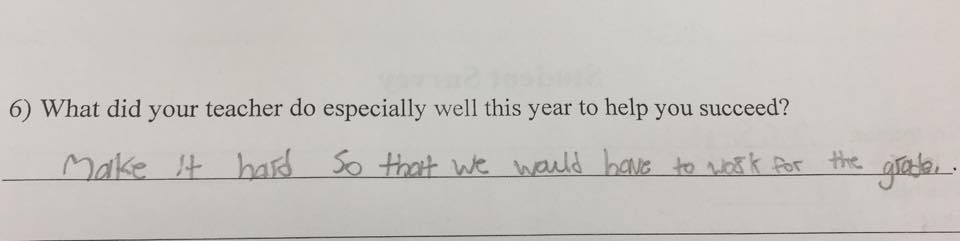
APTOPIX Atlanta Schools Cheating