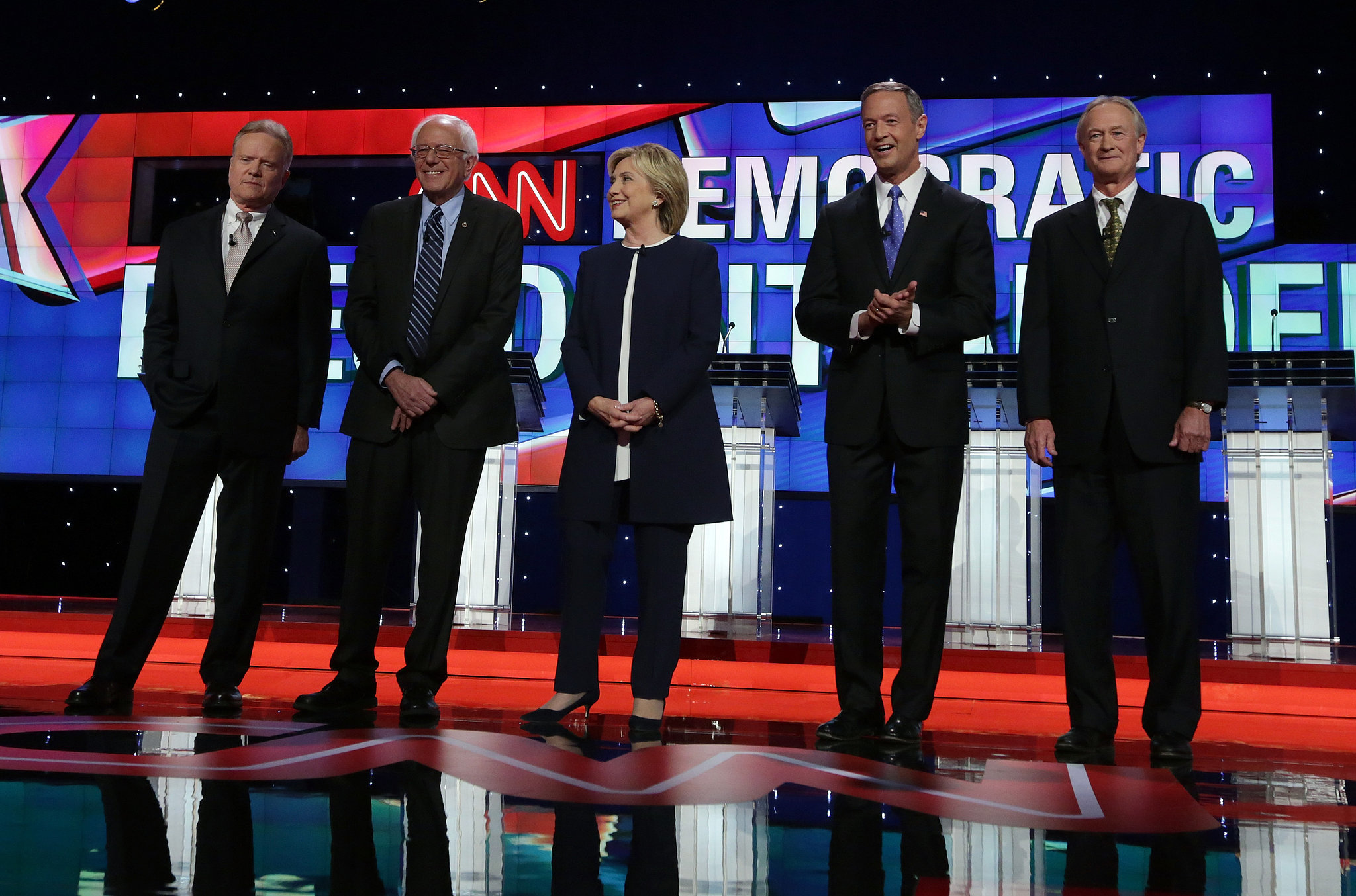
That’s how many questions CNN anchors asked presidential hopefuls about America’s public schools at the first Democratic Debate.
Imagine if Anderson Cooper and company had been silent on Climate Change. The candidates would have brought it up anyway. Bernie Sanders actually did talk about the threat to the environment when asked a question about national defense.
Imagine if moderators had no questions about gun violence. Candidates competed with each other to demonstrate which took a stronger stance against the National Rifle Association.
Imagine if no one asked about finance reform. On that stage each candidate tried to position his or herself as the new sheriff of Wall Street.
But when it comes to one of the most important issues of the day – our children’s struggling schools – the media apparently thought it was of no interest to the viewing public.
Admittedly both Hillary Clinton and Sanders briefly brought it up when asked about other things.
Clinton said we need universal pre-kindergarten and good schools. However, she neglected to say what those good schools would look like.
It’s almost like saying nothing at all. EVERYONE wants good schools – Even dunderheads like Chris Christie, Jeb Bush and Donald Trump! But their ideas of good schools differ greatly from that of most parents, teachers and students. McCharter schools for the poor and Cadillac campuses for the rich isn’t exactly what real progressives have in mind.
And universal pre-k? Great! But that’s kind of the flavor of the month. Who really disagrees that we should help toddlers prepare for school? It’s like asking, “Who wants ice cream?” in a room full of little kids on a hot day. EVERYONE wants ice cream – even the kids who are lactose intolerant!
Sanders took a second in a diatribe about social services to mention the need to fund schools. However, he didn’t say a thing about equity or if that funding would have strings attached. President Obama talked about funding schools, too, when he was running for president in 2008. Once he got into office those education dollars came at the cost of accepting untested and developmentally inappropriate Common Core State Standards. And equity meant closing poor schools to save them.
I wonder if CNN would have felt more pressure to ask even a single token education question if the largest national teachers unions hadn’t already endorsed Clinton. Both the American Federation of Teachers representing 1.5 million members and the National Education Association representing 3 million members have backed Clinton.
Well, leadership has. Member outreach, polling, even voting by the organizations largest representative boards has been almost entirely absent.
But now that teachers have been pigeonholed in Clinton’s camp, what’s the point of asking education questions? In the public eye educators have already chosen their candidate. Why would they need to hear Clinton’s thoughts on education policy? Why hear her opponents thoughts? Their minds are made up.
Meanwhile, the Obama administration continues to run roughshod over teachers concerns. For 7 years education professionals from all walks of life have complained about the administration’s failing school policies and its buffoonish education secretary Arne Duncan. But now that Duncan is leaving, the President replaces him with John King – ex-New York State Commissioner of Education who enraged parents so much he was run out of the state on a rail.
The media just doesn’t care about public education. Nine times out of ten if they even print a story about schools, it’s a puff piece spin doctoring a school reform policy that isn’t working, never has been working and is – in fact – making things much worse for our nation’s students. Otherwise it’s an expose of how teachers can’t make these horrendous policies work so its their fault and don’t even glance at the ballooning child poverty rate – that’s completely irrelevant to the issue of all these lazy teachers who can’t be fired because we’d have to prove they’re bad first.
And what of the candidates? Do they care about public education?
The Democrats say they do and then zip their lips. They might make positive noises about preschool or universities – especially when it comes to funding. But they have next to nothing to say about K-12 schools. When the issue comes up, they deflect to toddlers or the college campus.
Meanwhile Republicans can’t contain their glee about mentioning teachers during debates and stump speeches. They want prospective voters to know that conservative types like them want to punch teachers in the face. During the first Republican debate, at least half of the candidates in that crowded boasted how much they stood up to the teachers unions.
And so there you have it, folks. That’s what passes for a substantive Democratic debate of all the important issues of the day. Now voters can make an informed decision in the primaries. There will be a few more debates, but they’ll probably be no different than this one.
And if you actually care about public schools, if you have children in the system, or derive your livelihood from it, or even if you just don’t want to live in a society of uneducated dummies – you’d be better served using Tarot cards to determine where the Democrats stand on this issue.
YOU WILL ENDORSE HILLARY CLINTON IN THE 2016 PRESIDENTIAL PRIMARIES.
Your union has spoken.
Now please donate to the Political Action Committee (PAC).
The National Education Association (NEA) represents 3 million educators. It is the largest labor union in the country. However only about 180 people made the decision to back Clinton.
Thursday the 74 member PAC Council voted to endorse Clinton with 82% in favor, 18% against and some of the largest delegations – California and New Jersey – abstaining.
Check my math here. So 61 PAC votes plus 118 Directors plus one President Lily Eskelsen Garcia equals 180 in favor.
That’s about .00006% of the membership.
And we call that an endorsement.
But wait. It can’t really be that simple. All of these people are voted in by members. Surely they polled their constituencies to gauge how individuals wanted them to vote.
Nope.
To be fair, some NEA directors may have polled state union leaders.
Ronnie Ray James, NEA Director from South Carolina, wrote in to this blog saying he took a straw poll of the South Carolina Education Association (SCEA) board about an early endorsement. He said the vote was close but came out in favor of making the endorsement.
However, that’s a far cry from asking actual card carrying members of the rank and file! Moreover, it is unclear how widespread these straw polls were, if they polled board members about outright support for Clinton and if the leaders of state boards have the pulse of their constituents.
According to NEA by-laws, the organization need go no further to obtain input from individual members for a primary endorsement. Even these straw polls are a formality.
The 8,000 strong Representative Assembly (RA) did not get a say. This larger body representing state and local affiliates will get to vote on an endorsement in the general election when the field is narrowed down to only two major candidates.
But anything like a poll of individual members is apparently not desired by leadership – now or later.
It’s one thing to vote. It’s another thing to do it in the presence of one of the candidates!
This whole process has been a mockery of what labor is supposed to stand for.
Unions are supposed to be about solidarity. The word, itself, means joining together. But this move by NEA leadership has been nothing like that. It has been a top down decision imposed on membership.
It is ludicrous that leaders claim they are representing card carrying rank and file when they haven’t asked us what we think. Nor do they even seem to have the slightest interest in doing so.
Full disclosure: I am not a Clinton supporter. I lean towards Sanders. However, I could accept this decision if it had been conducted democratically – if it really was a reflection of the thoughts of my union brothers and sisters.
Instead, we’ve been treated like sheep. We’ve been herded, fenced in, hushed and placated.
The way I see it, there are only two ways to go from here: we can give up or we can fight back.
It is tempting to become despondent and stop participating in the union. Why bother with people who don’t care what I think? In fact, maybe all those fat cats fighting to destroy us are right. If the NEA won’t include me in something this important, why should I continue defending it? Why keep paying dues?
The problem is not unions. The problem is our leadership. We must fight to take it back.
We must replace those who would silence the rank and file. We must vote in new leaders who actually represent us and have an interest in our input.
We need leaders who will fight for us, not those who are satisfied with a mere seat at the table and an opportunity to enrich themselves at our expense.
This is hard. It’s much easier to just wave a white flag, go home and watch the football game.
A union is not made of leaders. It is made of members.
Despite vocal opposition from thousands of members of the largest union in the country, the NEA Political Action Committee (PAC) Council voted to endorse Hillary Clinton.
The council of 74 educators from the organization’s political arm voted Thursday. The NEA Board of Directors is expected to make a final decision on Saturday.
Many details of the vote, itself, are shrouded in secrecy and bad math.
Numerous sources in the NEA say the PAC council voted 82% in favor and 18% against. However, these figures are suspect. Two of the largest state delegations – California and New Jersey – abstained. The percentages being touted by PAC Council representatives do not seem to take that into account. The actual total should be somewhat closer.
When the Board of Directors votes later this week, at least 58% will be needed to give Clinton the organization’s endorsement.
However, the main body of representatives – the Representative Assembly (RA) – will be excluded from voting. The larger RA’s say is unnecessary according to NEA by-laws to give an endorsement in the primary election. However, the RA will get to vote on an endorsement in the general election when the field is narrowed to only two major candidates.
Any additional outreach to card carrying educators and other dues paying members is apparently not needed or desired.
Ohio and Massachusetts delegations voted against it, but full tallies of the roll call vote could not immediately be determined.
Those in-favor of the endorsement claim Clinton is the most electable candidate who supports positive education policies. However, even Garcia is reported to have admitted that Bernie Sanders has better education positions.
Clinton and Sanders are polling neck-and-neck in the first two Democratic primary states. A Clinton endorsement could give her a much needed edge over her political rival.
Leadership at the National Education Association (NEA) has been making troubling moves toward endorsing Clinton that could commit the organization to supporting the Democratic presidential hopeful with no regard for the wishes of its 3.2 million members.
An endorsement could come as early as Oct. 2-3 when President Lily Eskelsen Garcia is expected to propose a primary endorsement of Clinton at the NEA Board meeting, according to multiple NEA sources. Then the PAC council would vote. If approved, it would go to the board for a final decision.
However, since this is only an endorsement for the primary election, the matter would not need to go before the Representative Assembly (RA). In effect, the move could sidestep the voices of the RA’s 8,000 delegates representing state and local affiliates, student members, retired members, and other segments of the united education profession.
The decision would be made by a handful of leaders and the PAC council. Though there are thousands of PAC council votes, they are distributed by the amount of money raised by each state’s members. This means that little states like Delaware – where members donate greatly – have a larger vote relative to their membership than other states.
The voices of the great majority of members would be silenced.
Already leadership at the highest levels seems to be trying to consolidate Clinton support.
Last Wednesday NEA Directors were invited to an hour-long conference call with Clinton. Few directors were allowed to ask questions and only if those questions had been submitted in advance.
After Clinton left the call, only three state presidents had a moment to speak; all gave positive reflections on Clinton and how she supports teachers and public education.
Despite the fact that several Democrats have been courting the NEA’s endorsement, only Clinton was invited to this call.
Last summer, the NEA invited all presidential candidates to participate in the union’s endorsement process. Only Clinton, Martin O’Malley, and Bernie Sanders did so. Each made a video statement that was shown at the summer’s RA meeting and posted by many to their local groups. Though more candidates have entered the race since then, none have chosen to interview with the NEA.
Ironically, at the same RA meeting, the assembly voted specifically NOT to ignore rank and file membership before endorsing a Presidential candidate. New Business Item 79 states:
NEA, as an organization, will actively engage in conversation and outreach on the NEA endorsement process with all 2016 Presidential campaigns prior to the consideration of a primary recommendation.
It seems if the leadership goes through with the primary endorsement as outlined above, they may be violating NBI 79.
The move is doubly troubling because of the strong-armed manner in which the American Federation of Teachers (AFT) endorsed Clinton in July.
Though the AFT Executive Board voted to endorse Clinton, there is little evidence it did so after adequately gauging members opinions through claimed multiple surveys and telephone town halls. The move caused an uproar and claims the AFT endorsed too early and without rank and file support.
Despite politics at the national level of the NEA, some state affiliates have already made endorsements. For instance, Vermont NEA already endorsed Sanders, their state’s Senator.
“We want to let the whole country in on what we in Vermont have long known,” Vermont NEA president Martha Allen said in a statement. “Bernie’s core values are in line with ours: He is pro-family, pro-worker, pro-education and pro-labor and we believe the time has come for his vision to become a national reality.”
Alternatively, the New Hampshire NEA endorsed Clinton in September. Scott McGilvray, NEA-NH president, called Clinton a “tireless fighter” for students and teachers.
However, Sanders is gaining on Clinton in the polls in the first two primary states. A new Monmouth University poll of likely Democratic voters in New Hampshire gives Sanders the lead over Clinton by a 43-36 margin. Sanders also leads Clinton in Iowa by a 41-40 margin. This is a huge gain from July when Clinton was beating Sanders by 49-25 in that state.
A major endorsement from a union the size of the NEA at this time might give Clinton the boost she needs to solidify her front runner status.
Whatever happens, no matter who the NEA decides to endorse, if anyone, it should be someone leadership can demonstratively prove has the support of the majority of its members.
In education circles, it’s a buzzword meaning opposite things to opposite people. And determined in opposite ways.
Ask a representative of the standardized testing industry, and more than likely he’ll tell you accountability means making sure public schools actually teach students – especially the poor and minorities. And the only way to determine this is through repeated, rigid, standardized assessments. Let’s call that TEACHER ACCOUNTABILITY.
On the other hand, determining LAWMAKER ACCOUNTABILITY is easy. Just compare school budgets. Greater than and less than. You’ll find that none of our lawmakers provide equitable funding. Rich kids in wealthy districts get Cadillac funding while poor and minority kids in impoverished districts get bicycle funding. Strangely, this is never discussed.
Moreover, none of this relies on opinion. All it takes is empirical evidence to see the truth. Lawmakers are not accountable at all. Teachers are accountable for too much and judged by unscientific and untrustworthy methods.
Unfortunately, few politicians have fully figured this out yet. Even you, Bernie.
However, under President George W. Bush and throughout the Obama years, it’s become about punishing teachers and schools for low standardized test scores – TEACHER ACCOUNTABILITY.
And the champions of TEACHER ACCOUNTABILITY this summer have been primarily Democrats including liberal lions like Elizabeth Warren and Sanders.
That’s why a group of respected education professionals and union leaders (including myself) wrote an open letter to Sanders asking him to please explain, himself.
We aren’t exactly a hostile crowd. We like a bunch of things that Sanders represents in his presidential campaign. We want to support him, but we need to know why he voted to keep the worst aspects of the current law.
And Bernie answered! Or his staff did.
I’ll reproduce the entire letter we received from staffer Phil Fiermonte below this blog. But first I want to focus on Bernie’s specific reasons for voting in favor of the Murphy Amendment:
As you mentioned, Senator Murphy introduced an amendment on the Senate floor that would have required states to hold schools accountable for the academic performance of low-income, minority and disabled students. Senator Sanders voted for this amendment because he believes states must do more to protect every student’s right to a quality education, and that from a civil right’s perspective, the federal government has an important role to play in protecting low-income, minority and disabled children. As you pointed out, the mechanism this amendment would have used to identify struggling schools resembles the failed policies of No Child Left Behind. This was a significant concern to the Senator, and one that he shared with the sponsors of the amendment.
Senator Sanders cast his vote on this amendment to express his disapproval with aspects of the bill that were insisted upon by Chairman Alexander and Senate Republicans and that do not reflect the best interests of vulnerable populations, or a progressive view on the distribution of education resources. He has made clear to Chairman Alexander, Ranking Member Murray, and Senate Leadership that his vote was not an endorsement of the accountability mechanism included in the amendment, but rather as a statement of his intent that other measures must be put in place to protect low-income, minority and disabled students.
So Sanders voted for the Murphy Amendment for these reasons:
He was mad that there is nothing about LAWMAKER ACCOUNTABILITY in the ESEA.
He believes in TEACHER ACCOUNTABILITY – at least in part. He thinks the federal government needs to make sure teachers and schools are actually educating kids, BUT he doesn’t believe standardized tests are the best way of determining this.
However, I don’t see how voting for an amendment you don’t believe in is going to make a point about something entirely unrelated. How would voting for the Murphy Amendment get us LAWMAKER ACCOUNTABILITY? The Amendment had nothing to do with that. There are places for it in the ESEA but this amendment was focused almost entirely on TEACHER ACCOUNTABILITY.
Was Sanders trying to convince Republicans to add LAWMAKER ACCOUNTABILITY elsewhere in the bill by voting against them on TEACHER ACCOUNTABILITY here? That seems a stretch. Both parties appear to love TEACHER ACCOUNTABILITY, but during this ESEA process the Republicans have been more concerned with stripping the federal government of its power over education. It’s not that they don’t like TEACHER ACCOUNTABILITY, they just want to leave it up to the states.
Then we come to Sander’s position on TEACHER ACCOUNTABILITY. He’s certainly right that schools need to teach students. However, as a public school teacher, I find it ludicrous to think that there are any schools out there that don’t.
Are there really schools in our country that don’t even TRY to educate their students? Really!? Are there hospitals that don’t try to heal their patients? Are there defense attorneys who don’t try to defend their clients? Are their airlines that don’t even try to get passengers to their destinations?
It’s absurd. Certainly if there were such places, we should do something about them, but the fact that our education policies are obsessed with something that almost never happens is asinine. It’s like going to Ireland and spending the majority of your vacation budget looking for a leprechaun! (At least, this doesn’t happen in non-cyber, non-charter, not-for-profit traditional public schools. But I digress…)
Then we get to Bernie’s suggestion that he’s against using standardized tests to measure if schools are functioning properly. At least here he is justified. But how will voting for the exact thing you’re against get you what you want? It boggles the mind. I want Pizza, that’s why I’m voting for chicken. Huh!?
However, Sanders is responsible for an innovation in the ESEA along just these lines. He proposed a 7-state pilot program that would allow TEACHER ACCOUNTABILITY to be determined on more holistic methods than test scores. Schools could use multiple measures such as student portfolios, classroom projects, or other means to be determined by the states.
This could be a step forward. But even under the best of circumstances, it is limited to a maximum of 7 states. It’s not a long term solution. The majority of the country could still be stuck with test and punish.
So we’re left with some good news and bad news.
GOOD NEWS: Bernie actually took teachers open letter seriously enough to have a staffer answer it. That’s something. I’m sure there are plenty of presidential candidates who wouldn’t even do that much.
GOOD NEWS: Bernie has some thoughtful ideas on education. His pilot program holds – limited – promise. He understands that the measures usually prescribed to determine TEACHER ACCOUNTABILITY are bogus.
GOOD NEWS: Bernie acknowledges that LAWMAKER ACCOUNTABILITY is important and says he’d like to address it.
BAD NEWS: He doesn’t mind focusing on TEACHER ACCOUNTABILITY when there is very little need for it. Moreover, TEACHER ACCOUNTABILITY without LAWMAKER ACCOUNTABILITY is actually harmful. Imagine if NASCAR fired a driver because the Pit Crew didn’t gas up the car. If schools have inadequate money and resources, putting a gun to all the teachers heads isn’t going to help.
BAD NEWS: Some of his answers don’t make sense.
BAD NEWS: He isn’t addressing us personally. Will it take teachers storming his campaign speeches and swiping the microphone before he does more than limited reforms and pays us lip service? It’s one thing to say #BlackLivesMatter. It’s another to make sure our black and brown kids get an equitable education.
The following letter was sent to Arthur Goldstein, one of the teachers who signed the original open letter to Bernie Sanders:
Sen. Sanders views on the Every Child Achieves Act, standardized testing, and school accountability Rand Wilson Add to contacts 4:59 PM Keep this message at the top of your inbox To: Arthur Goldstein Cc: Philip Fiermonte, Cwa Cohen laborforbernie2016@gmail.com
Dear Brother Goldstein:
Senator Sanders has asked me to respond to your email, and share his views on the Every Child Achieves Act, standardized testing, and school accountability.
As you know, Senator Sanders has long opposed the blame-and-shame approach to school accountability embodied in No Child Left Behind. He voted against No Child Left Behind in 2001 because he believed then, as he does now, that the legislation’s narrow focus on standardized test scores ignores a broad range of factors that determine how well a school is meeting the needs of its students. Since the passage of this legislation, we have seen the devastating impact that high stakes standardized testing has had on schools all over the country. In the Senator’s home state of Vermont, nearly every school is identified as “failing,” and is threatened with increasingly proscriptive federally-determined interventions.
No Child Left Behind’s narrow focus on standardized test scores has tragically led to a significant culture shift in our nation’s schools. An obsession with testing and test preparation has taken over in countless school districts in America, and educators are being forced to dedicate hours of class time getting students ready for exams rather than teaching them new material, or strengthening essential skills and qualities like critical thinking, teamwork, and problem solving. And the worst thing is that students from low-income, urban school districts spend more time in test preparation than students from the suburbs. These hours and hours of test preparation have no educational value, and the fact that poor and minority students are disproportionately subjected to test prep at the expense of lesson time is a huge problem that must be addressed.
Last month, the senate passed the Every Child Achieves Act, which would fundamentally reform No Child Left Behind, and end its system of high stakes testing and draconian interventions. Senator Sanders supports this legislation, and believes it represents a very important step forward.
As a member of the Senate Committee on Health, Education, Labor and Pensions, the Senator had an opportunity to shape this legislation at every stage of its development. For example, he was one of the leading advocates on committee for the inclusion of a “multiple measure” accountability system that allowed states to include factors other than test scores when determining a school’s effectiveness.
In addition, he worked to provide states with significant flexibility when it comes to assessment. This legislation includes a provision written by Senator Sanders that would create a groundbreaking alternative assessment pilot program which would allow states to implement alternatives to standardized testing. If the legislation passes, these new assessments would eventually reduce the number of statewide tests children are forced to take, while providing educators with timely information on student performance.
However, this legislation is far from perfect, and there are several aspects of the Every Child Achieves Act that have caused the Senator great concern. For example, there is no requirement that states focus resources or attention on schools that are meeting the needs of middle class children, but not meeting the needs of minority, low-income and disabled children. In addition, the Senator is concerned that the bill does nothing to address resource equity, and was deeply disappointed when an amendment offered by Senators Kirk, Baldwin, Reed and Brown to address resource equity failed on the Senate floor.
As you mentioned, Senator Murphy introduced an amendment on the Senate floor that would have required states to hold schools accountable for the academic performance of low-income, minority and disabled students. Senator Sanders voted for this amendment because he believes states must do more to protect every student’s right to a quality education, and that from a civil right’s perspective, the federal government has an important role to play in protecting low-income, minority and disabled children. As you pointed out, the mechanism this amendment would have used to identify struggling schools resembles the failed policies of No Child Left Behind. This was a significant concern to the Senator, and one that he shared with the sponsors of the amendment.
Senator Sanders cast his vote on this amendment to express his disapproval with aspects of the bill that were insisted upon by Chairman Alexander and Senate Republicans and that do not reflect the best interests of vulnerable populations, or a progressive view on the distribution of education resources. He has made clear to Chairman Alexander, Ranking Member Murray, and Senate Leadership that his vote was not an endorsement of the accountability mechanism included in the amendment, but rather as a statement of his intent that other measures must be put in place to protect low-income, minority and disabled students.
As congressional leaders move toward the next step in consideration of this bill – negotiating differences with the House – Senator Sanders has urged the future leaders of the conference committee to include protections for low-income, minority and disabled students, and to do so in a way that addresses the needs of the whole child. We must ensure low-income, minority and disabled children have the same access to educational resources that their wealthy suburban peers have. In addition, we must ensure that struggling students have access to adequate supports including health, mental health and nutrition services and after school programs that help level the playing field.
For many years, educators across the country have been the loudest, strongest voices against the corporatization of our nation’s education system and for the increased funding and wraparound services that will make a difference for our children. This is a fight that Senator Sanders has been waging at the national level for 25 years, and one that he will continue to pursue.
Sincerely.
Phil Fiermonte
Bernie 2016
NOTE:This article also was published in the LA Progressive.




 gadflyonthewallblog