My Students Are Scared of Donald Trump


trump-800x430


“Are they gonna’ make us all leave?”


That was the question one of my 8th grade students asked today.


He sits in the front row – quiet, reserved, eyes usually pointed sullenly at his desk.


He doesn’t ask questions. Not publicly.


If he has something to say, he’ll ask me before or after class.


But there he was with his hand in the air and his eyes firmly fixed on mine.


“Tyree, are you afraid someone’s going to make you leave your country?”


He nodded and I saw several other black faces nodding throughout the room.


“Are you afraid someone’s going to send you… where… to Africa?”


“Yeah,” Tyree said for the group.


I teach Language Arts at an under-resourced school in Western Pennsylvania. I’m white and most of my students are black. Almost all of them are from poor families. Very few are Hispanic or Muslim.


We had been discussing the Holocaust in preparation to read “The Diary of Anne Frank.”


I often try to make connections with current events during this time, but today I didn’t have to do any connecting. My students did it for me.


“I don’t like Donald Trump,” Jacklyn said. “He’s racist.”


And Tyree spoke again – impatiently, nervously – “Who are you voting for, Mr. Singer?”


I paused. “I don’t think it would be appropriate for me to say,” I responded, “but I will say this…”


And I looked all of them in the face.


“Not. Donald. Trump.”


You could feel the sigh go through them like a physical thing.


They are actually scared. And something like it happened in every class today.


I mentioned Adolph Hitler and they came back with Donald Trump.


History had come alive. It was a boogeyman haunting the shadows. And the only thing that dispels shadows is light.


I had to reassure them. It wasn’t in my lesson plan. I had done no prior research for it, but this was the direction they were pulling me. I had had no intention of talking about Donald Trump, but we needed to go there.


We had a discussion comparing and contrasting the two men. They both wrote books, but “Mein Kampf” is very different than “The Art of the Deal.” Both were captivating speakers who promote violence, but Trump speaks at a third grade level. Both said hateful things against minorities, but only Hitler advocated eradicating people from the face of the Earth. Both proposed minorities be monitored by the government but Hitler focused mostly on Jews while Trump focuses mostly on Muslims.


The conversation went on.


In over a decade in the classroom, I’ve never had students so upset about politics. Sure they get angry when unarmed people of color are shot by the police. Sure they feel the pull of Baltimore and Ferguson. But never have they cared about who’s running for President. They won’t be able to vote, themselves, for five or more years.


But they wanted to talk public affairs. What was I to do? The purpose of history is to learn from it. We look to the past so we won’t repeat it. Yet that was a lesson I didn’t need to teach. They already knew it. That’s why they were bringing this up.


We talked political parties. We discussed how the Nazis were a political organization like the Democrats and the Republicans are today. We talked about how Hitler had been a house painter and Donald Trump was a reality TV star who inherited most of his money.


And we talked about racism.


Why people hate others. The definition of prejudice – how racism is one kind of prejudice but there are many others – hating people because of religion, because they’re disabled, because of their sexuality.


Jermaine said he was uncomfortable going to the bathroom in public in case someone gay walked in.


I asked if he thought a gay man would try to make a move on him while he was on the toilet. I asked if he’d ever make a move on someone while that person was on the toilet.


The class laughed.


Someone mentioned Chicago and how protesters had forced Trump to cancel his rally. Yes. An 8th grade student knew about that.


And then someone mentioned Bernie Sanders. Yes. They brought him up, too.


Some of my kids liked him because they said he wasn’t racist. Others thought he would legalize marijuana.


So I asked if anyone knew about the other candidates. And that’s where their news-savvy faded. Someone said something strange about Hillary Clinton that they heard she was against soil. I still don’t know what he meant.


Another child said he heard Tom Cruise was running. “TED Cruz,” I corrected. None had heard of John Kasich.


I explained how a primary election works. We talked about how Hitler was elected. We talked about the Reichstag vs. Congress.


“Didn’t we have concentration camps here in America?” someone asked. So we talked about Japanese internment camps and compared those to what you’d find in Europe.


At some point I lost track of all we talked about. But when the bell rang, the tension was gone.


They got up calmly and went to the door. Many of them made a point to cheerfully say goodbye or dap me up on their way. You always know middle school students love you when they do that.


Jason stopped by my desk on the way out and said, “My dad’s going to vote for Donald Trump.” He was blushing.


“He may have good reasons,” I said. “Maybe you should ask him about it.” He smiled and walked out.


Only one student was left.


“You, okay, Tyree?” I asked.


He was grinning. “You’d be a good history teacher, Mr. Singer,” he said.


I shook my head. “And you’re a good history student.”


I clapped him on the back, before writing him a pass to his next class.


My plans sat murdered on my desk.


But I had taught a much better lesson.


Nothing happens without cause.


We can understand it if we try.


Understanding is the key to prevention.


And we’re in this together.


NOTE: All student names have been changed to protect their anonymity.

.


Don’t Blame My Students For Society’s Ills

poverty LOCAL POVERTY GEE


As a public school teacher, I see many things – a multiplicity of the untold and obscure.

On a daily basis, I see the effects of rampant poverty, ignorance and child abuse. I see prejudice, racism and classism. I see sexism, homophobia and religious intolerance.

And hardly any of it comes from my students.

Despite what some people might say in the media, on Facebook or at the local watering hole, the kids are all right. It’s what we, the adults, are doing to them that’s messed up.

It’s always been in fashion for grown-ups to trash the next generation. At least since Hesiod bemoaned the loss of the Golden Age, we’ve been looking at the current crop of youngsters waiting in the wings to replace us and found them lacking. They just don’t have our drive and motivation. In my day, we had to work harder than they do. If only they’d apply themselves more.

It’s all untrue. In fact, today’s children have it harder than children of the ‘70s and ‘80s did when we were their age! Much harder!

For one thing, we didn’t have high stakes standardized tests hanging over our heads like the Sword of Damocles to the degree these youngsters do. Sure we took standardized assessments but not nearly as many nor did any of them mean as much. In Pennsylvania, the legislature is threatening to withhold my students’ diplomas if they don’t pass all of their Keystone Exams. No one blackmailed me with anything like that when I was a middle schooler. All I had to do was pass my classes. I worried about getting a high score on the SAT to get into college, but it didn’t affect whether I got to graduate. Nowadays, kids could ace every course for all 13-years of grade school (counting Kindergarten) and still conceivably only earn a certificate of attendance! Try using that for anything!

Moreover, my teachers back in the day didn’t rely on me so they could  continue being gainfully employed. The principal would evaluate them based on classroom observations from time-to-time to assess their effectiveness based on what he or she saw them doing. But if I was having a bad day during the assessment or if I just couldn’t grasp fractions or if I was feeling too depressed to concentrate – none of that would affect my teacher’s job rating. None of it would contribute to whether my teacher still had an income.

Think of how that changes the student-teacher relationship. Now kids as early as elementary school who love their teachers feel guilty on test day if they don’t understand how to answer some of the questions. Not only might their score and future academic success suffer, but their teacher might be hurt. That’s a lot of pressure for people who’ve just learned how to tie their shoes. They’re just kids! In many cases, the educator might be one of the only people they see all day who gives them a reassuring smile and listens to them. And now being unready to grasp high-level concepts that are being hurled at kids at increasingly younger ages may make them feel responsible for hurting the very people who have been there for them. It’s like putting a gun to a beloved adult’s head and saying, “Score well or your teacher gets it!” THAT’S not a good learning environment.

Finally, child poverty and segregation weren’t nearly as problematic as they are today. Sure when I went to school there were poor kids, but not nearly as many. Today more than half of all public school children live below the poverty line. Likewise, in my day public policy was to do away with segregation. Lawmakers were doing everything they could to make sure all my classes had increasing diversity. I met so many different kinds of people in my community school who I never would have known if I’d only talked with the kids on my street. But today our schools have reverted to the kind of separate but equal mentality that was supposed to be eradicated by Brown vs. Board of Education. Today we have schools for the rich and schools for the poor. We have schools for whites and schools for blacks. And the current obsession with charter schools and privatization has only exacerbated this situation. Efforts to increase school choice have merely resulted in more opportunities for white flight and fractured communities.

These are problems I didn’t face as a teenager. Yet so many adults describe this current generation as “entitled.” Entitled to what!? Less opportunity!? Entitled to paying more for college at higher interest for jobs that don’t exist!?

And don’t get me started on police shootings of young people. How anyone can blame an unarmed black kid for being shot or killed by law enforcement is beyond me.

Children today are different. Every few years their collective character changes.  Today’s kids love digital devices. They love things fast-paced, multi-tasked and self-referential. But they don’t expect anything they haven’t earned. They aren’t violent criminals. As a whole they aren’t spoiled or unfeeling or bratty. They’re just kids.

In fact, if I look around at my classes of 8th graders, I see a great many bright, creative and hard-working young people. I’m not kidding.

I teach the regular academic track Language Arts classes. I don’t teach the advanced students. My courses are filled with kids in the special education program, kids from various racial, cultural and religious backgrounds. Most of them come from impoverished families. Some live in foster homes. Some have probation officers, councilors or psychologists.

They don’t always turn in their homework. Sometimes they’re too sleepy to make it through class. Some don’t attend regularly. But I can honestly say that most of them are trying their best. How can I ask for more?

The same goes for their parents. It can be quite a challenge to get mom, dad, grandma, grandpa, brother, sister or other guardians on the phone. Parent-teacher conferences are very lonely in my room while the advanced teacher is mobbed. But I don’t generally blame the parents. In my experience, most moms and dads are doing the best they can for their kids. Many of my student’s have fathers and mothers working multiple jobs and are out of the home for the majority of the day. Many of my kids watch over their younger brothers and sisters after school, cooking meals, cleaning house and even putting themselves to bed.

I wish it wasn’t like that, but these are the fruits of our economy. When the recession hit, it took most of the well-paying jobs. What we got back was predominantly minimum wage work. Moreover, people of color have always had difficulty getting meaningful employment because of our government sanctioned racial caste system. Getting a home loan, getting an education, getting a job – all of these are harder to achieve if your skin is black or brown – the same hue as most of my students and their families.

So, yes, I wish things were different, but, no, I don’t blame my students. They’re trying their best. It’s not their fault our society doesn’t care about them. It’s not their fault that our nation’s laws – including its education policy – create a system where the odds are stacked against them.

As their teacher, it’s not my job to denigrate them. I’m here to lift them up. I offer a helping hand, not a pejorative finger.

And since many of the factors that most deeply affect education come from outside the school, I think my duty goes beyond the confines of the classroom. If I am to really help my students, I must be more than just an educator – I must be a class warrior.

So I will fight to my last breath. I will speak out at every opportunity. Because my students are not to blame for society’s ills. They are the victims of it.


NOTE: This article also was published in Wait What?, and the Badass Teachers Association Blog.


In Puerto Rico, Students Go On Strike to Stop Teacher Relocations

12050457_10153301043793152_183452142_o

Students streamed out of their classrooms chanting in unison in the mountainous Utuado region of Puerto Rico earlier this month.

They took over the halls and doorways of Luis Muñoz Rivera High School on Thursday, Sept. 10, locking their arms together to create a human chain.

They paralyzed their school, shut it down, and allowed no one in or out.

The reason? Not too much homework. Not lack of choice in the cafeteria. Not an unfair dress code.

These roughly 100 teenagers were protesting the loss of their teachers. And they vowed to occupy their own school until the government gave them back.

Six educators had been ordered to other schools, which would have ballooned classes at the Rivera School to 35-40 students per classroom.

Government officials claimed the high school had too few students to justify the cost. However, with more than 500 young people enrolled, the school has more than double the island average.

“These teachers provide education to almost 140 students,” said Sharymel Montalvo Vélez, a senior at the school. “Do you think this is not enough (to justify the) tuition?”

“Those teachers are excellent. I was their student. I learned with them. I’m grateful for it. Their teaching quality is amazing. I can prove that.”

The students including Vélez, 17, called an assembly to discuss the situation where they voted unanimously to take action. They blocked two gates and wrote a document demanding the Puerto Rican Department of Education revoke the decision to remove their teachers.

Later that day, Sonia González, a representative of the Secretary of Education, met with students and signed the document promising to keep the teachers at the Rivera School. Three parents and one student also signed.

11998478_10153281370523152_505102187_n

The affected teachers are Alex Natal, a 10th grade physical education instructor; Naixa Maldonado, an 11th grade Math educator; José Cruz, a 10th and 11th grade History teacher; María Medina, a 12th grade Physics instructor; Damaris Figueroa, an 11th grade Spanish educator; and an 11th grade English teacher.

Vélez said she’s surprised the government agreed to students’ demands. “ I was willing to keep the strike all the time necessary to solve our problem and get our teachers back,” she said.

“I experienced a large class size some years back, and it was hard on both teacher and students. It’s not that easy to make 30 students understand something and go explaining it chair by chair. Every student likes to show his/her ideas and in a large class there is not enough time for everyone.”

What happened in the Rivera School is not an isolated incident. All across the island, communities are fighting government mandates to relocate teachers, increase class size and shutter more schools.

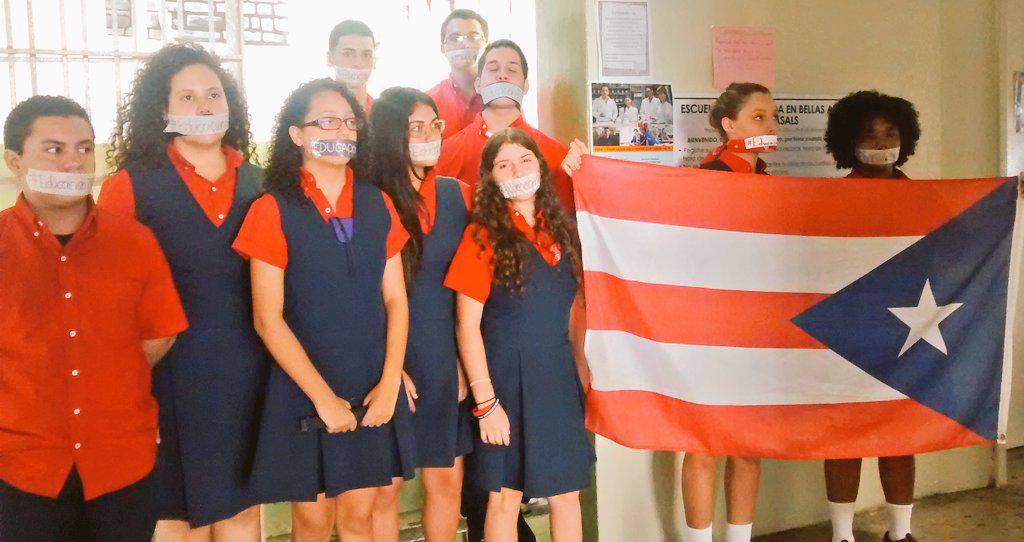
This Tuesday at Pablo Casals School, an arts institution in Bayamon along the north coast, students protested the government decision to relocate their theater teacher, Heyda Salaman.

About 100 students hung the Puerto Rican flag upside down and taped their mouths shut to represent the state of the government and the silence officials expect from the community.

Young people at the specialized arts school which offers visual arts, theater, music and dance as well as academic classes, protested with music and chants of “injustice!”

Just like in the case of the Rivera School, the government eventually relented and agreed to keep the teacher with her students.

The teachers union – the Federación de Maestros de Puerto Rico (FMPR) – has supported student protesters throughout the island.

“The Teachers Federation from Puerto Rico is proud of the actions these students performed,” said union president Mercedes Martinez about student actions at both facilities.

“Schools belong to our communities according to the law, so the communities have every right to fight for the school they deserve. No more cutting funds to create over-sized classrooms.”

Vélez echoes that statement.

“We have a good education and excellent teachers but the administration is failing their workers,” she said.

“The government is cutting rights and benefits to the teachers and employees and soon there will be no teachers. Maybe our schools get privatized and then only people with money will send their children to (public) school.”

11997060_10153278954588152_587899672_n

The Commonwealth government has closed 150 schools in the past 5 years in the U.S. Territory.

Officials warn the government may be out of money to pay its bills by as early as 2016. Over the next five years, it may have to close nearly 600 more schools – almost half of the remaining facilities!

The island is besieged by vulture capitalists encouraging damaging rewrites to the tax code while buying and selling Puerto Rican debt.

Hundreds of American private equity moguls and entrepreneurs are using the Commonwealth as a tax haven.

As a result, tax revenues to fund public goods like education are drying up while the super rich rake in profits.

The indigenous population has suffered at the hands of western conquerors since Columbus, but the newest fruit of Colonialism may be these corporate education reform policies.

Young people like Vélez aren’t revolutionaries. They look just like any ordinary teenage boys and girls wearing t-shirts and blue jeans, baseball caps turned backwards, backpacks slung across their shoulders.

But they have had enough. They aren’t going to accept the low expectations of the corporate world about what constitutes a fair education.

Viva Puerto Rico!


NOTE: This article also was quoted extensively on Diane Ravitch’s blog and published in full on the Badass Teachers Association blog.