Student Projects are Better Than Tests 


The class was silent. 


Students were hunched over their desks writing on paper, looking in books, consulting planners.  


I stood among them ready to help but surprised at the change that had overcome them.  


Maybe 10 minutes before I had heard groans, complaints and the kind of whining you only get from students at the end of the year.  


“Do we have to keep doing work!?” 


“Can’t we just watch a movie!?” 


“Ms. X- isn’t doing anything with her students!” 


And then I dropped the bomb on them.  


We had less than 3 weeks left in the school year. We had just finished our last text. In 8th grade that was “To Kill a Mockingbird” by Harper Lee. In 7th grade it was “Silent to the Bone” by E.L. Konigsburg.  


Now was the time for the infamous final project.  


Some kids asked me about it at the beginning of the year having heard about it from a brother or sister who had already graduated from my class. 


“Mr. Singer,” they’d say, “Is it true you give a 1,000 point project at the end of the year?” 


I’d laugh and ask who told them that, or if that sounded credible.  


“Do you really think I’d give a 1,000 point project!?” I’d say in my most incredulous voice, and they’d usually laugh along with me.  


But some of them still believed it.  


That was nearly 9 months ago. Yet it all came flooding back when I passed out the assignment sheet.  


In the world of education there are few truths more self-evident than this


Projects are better than tests. 


Just think about it for a minute. 


On the one hand you have a project – an extended group of related assignments demonstrating learning and culminating in a product of some sort – a paper, a poster, a movie, a presentation or some mix of these. 


On the other hand you have a test – a quick snapshot of skills taken out of context.  


Which do you think is the better assessment? 


Imagine a musician.  


You could have her answers questions about notation, rhythm and theory…. Or you could just have her play music.  


Which would best demonstrate that she can play? 


It’s the same with other subjects.  


Take a test on reading – or actually read.  


Take a test on writing – or actually write.  


Take a test on math – or actually….  


You get the picture.  


And so did my students.  


I place a huge emphasis on writing in my English Language Arts classes. In 8th grade, my students have already written at least a dozen single paragraph and two multi-paragraph essays. So they’re pretty familiar with the format. I try to get them to internalize it so that it’s almost second nature.  


So when the final project comes along, it’s really a culmination of everything we’ve done.  


In Harper Lee’s book, there is the symbol of the mockingbird: 


“Your father’s right,” she said. “Mockingbirds don’t do one thing but make music for us to enjoy. They don’t eat up people’s gardens, don’t nest in corncribs, they don’t do one thing but sing their hearts out for us. That’s why it’s a sin to kill a mockingbird.” 


We already discussed how several characters in the book could count as mockingbirds – Tom Robinson, Atticus Finch, Boo Radley, etc.  


So I have students write about mockingbirds in all of the texts we’ve read this year. That includes “The Outsiders” by S. E. Hinton, “The Diary of Anne Frank” and several short stories.  


In 7th grade, we’re at a slightly different place. 


At the end of the year, students have written nearly as many single paragraph essays but no multi-paragraph ones yet. I use the final project to introduce them to the concept and explain how it’s the culmination of what we’ve done before.  


Students write about characters that they like from all the stories we’ve read throughout the year. These would be characters from texts as diverse as the one by Konigsburg, “The Giver” by Lois Lowery, “A Christmas Carol” by Charles Dickens and several short stories.  


As projects go, it’s kind of narrow.  


In the past, I’ve had students make movies together interviewing various characters from their texts. I’ve had them design posters extolling various aspects of the Civil Rights movement. I’ve had them design graphics explaining the difference between internal and external conflict.  


But this is the end of the year – time to keep it simple.  


There’s actually a lot of research supporting this kind of assessment. 


Two separate studies were published by Lucas Education Research with Michigan State University (MSU), the University of Southern California (USC), and the University of Michigan. Researchers took either high school students or third graders and put them through a Project Based Learning (PBL) curriculum. 


The high school experiment conducted by MSU and USC involved 6,000 students in science and humanities from 114 schools about half of which were from low-income households. Students who were taught Advanced Placement (AP) U.S. Government and Politics and AP Environmental Science with a PBL approach outperformed their peers on AP exams by 8 percentage points in the first year and were more likely to earn a passing score of 3 or above, giving them a chance to receive college credit. In the second year, the gap widened to 10 percentage points. One key finding of the study, which included large urban school districts, was that the higher scores were seen among both students of color and those from lower-income households. 


The experiment with third-graders produced similar results. Students from a variety of backgrounds in PBL classrooms scored 8 percentage points higher than peers on a state science test. These results held regardless of a student’s reading level. 


In some ways, this should be obvious.  


When you put assessment in context it is more accurate. When you divorce it from its academic context (as you do with tests) it’s more abstract and less accurate. 


The problem is one of time and ease of execution. 


Put simply – tests are easy to give and grade. Projects are difficult.  


Even designing a good project can take lots of trial and error. Tests are often prepackaged and easy to design – you just have questions clustered around whatever skills you were hoping students would learn. 


It is very difficult for teachers to design entire courses with projects at every step of the way. Some might say it isn’t even desirable since such a course would probably not be able to cover as much material as traditional curriculum and it is generally preferable to use different modes of assessment in a single course. Let’s not forget that some students excel at tests and would suffer academically if the only kind of assessments were project based.  


My personal philosophy is one of moderation. Use projects when you can and when appropriate – but not always. And if you’re going to test, a teacher created assessment is orders of magnitude more valuable than a standardized one. 


And in terms of projects, the best is at the end. What better way to demonstrate the cumulative learning of a course than through a cumulative project?  


My students seem to agree. 


After the initial anxiety of such a hefty project, my kids in both grades settle down pretty quickly and get to work. I think they find the project comfortable because they’ve been exposed to almost every part of it before. This just brings it all together under one project.  


It’s the opposite of learned helplessness. Students already know they can do it. All they have to do is step up and get it done. 


That’s also why I make the project worth such a huge amount of points.  


I already double points for the last grading period. Doing that and having such a hefty final project sends the message to kids that they can’t slack off now. The work they do in the closing days of school will have an outsized impact on their grade. If kids care at all about that – and most still do in middle school – they’ll make the effort.  


It also helps fill the last few days and weeks with a focus on process. Nothing has to be memorized. Nothing is beyond anyone’s ability. We’re going to work together – each student and me – to make sure the final project gets done.  


Usually they accomplish it with flying colors.  


It’s something they often remember and pass on in legend to their younger siblings who bring it up in hushed tones when they enter my classroom for the first time. 


Like this post?  You might want to consider becoming a Patreon subscriber. This helps me continue to keep the blog going and get on with this difficult and challenging work.

Plus you get subscriber only extras!

Just CLICK HERE.

Patreon+Circle

I’ve also written a book, “Gadfly on the Wall: A Public School Teacher Speaks Out on Racism and Reform,” now available from Garn Press. Ten percent of the proceeds go to the Badass Teachers Association. Check it out!
 

I Teach Banned Books   


If you want people to do something, forbid them from doing it.  


As a middle school language arts teacher, that’s always worked for me.   


Many of my students are reluctant readers.  


If a text is longer than a Tweet or a YouTube description, most of them would rather skip it.  


And when it comes to books, many of them wouldn’t intentionally crack one open under any circumstances.  


Unless you tell them not to.   


Unless you point out a specific book on the shelf and say it’s off limits.   


Unless you open it up right in front of them before quickly snatching it away and saying, “Oops! I forgot! We can’t read that one!”  


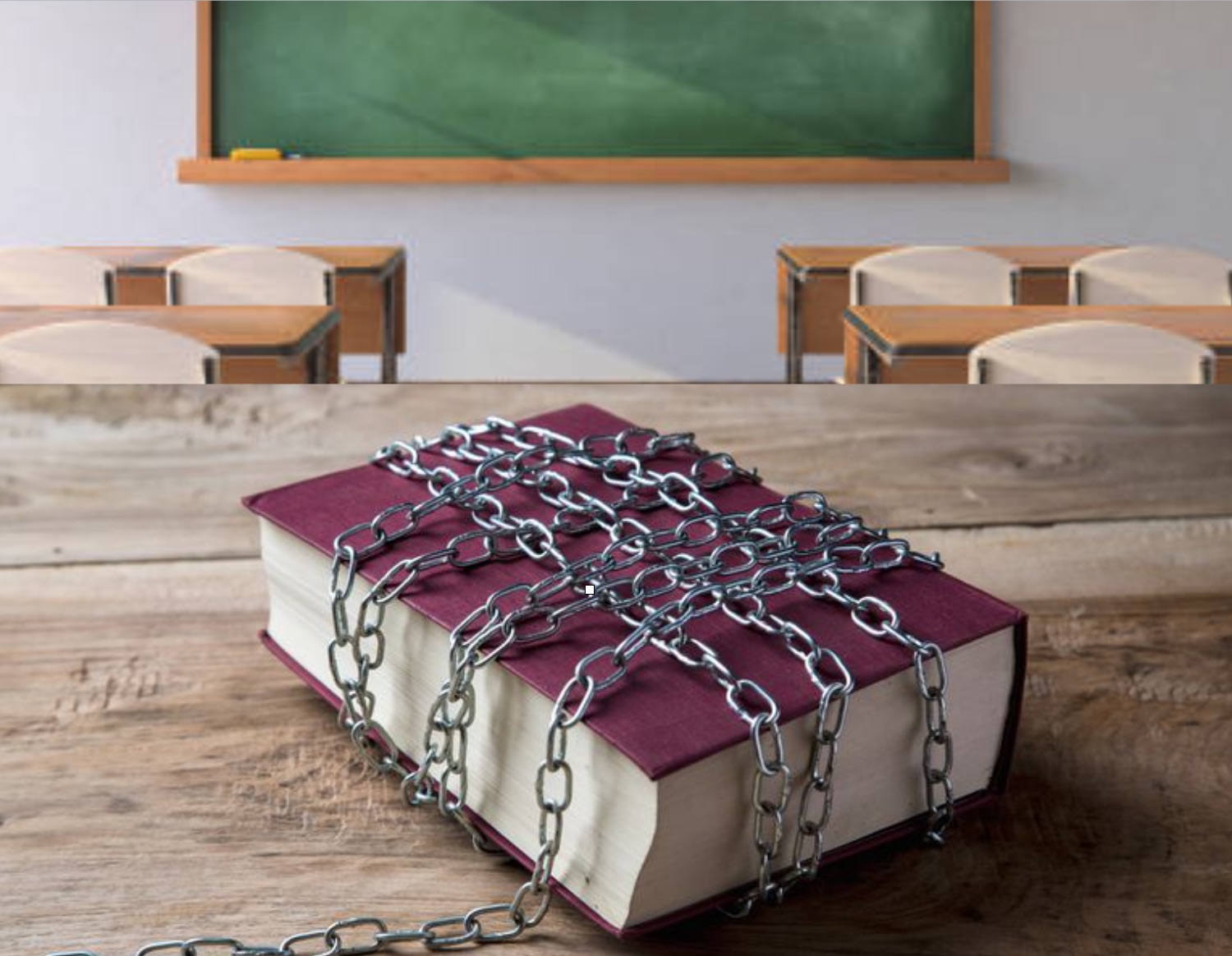
So most of my curriculum is made up of banned books.  


The Giver, Silent to the Bone, The Diary of Anne Frank, To Kill a Mockingbird – all forbidden in one place or another.   


Just not in my district.   


In fact, my school board has included each of these books on the approved reading list.


That doesn’t mean I have to use them.  


Language Arts teachers like me have a few different options at each grade level. And some of us actively avoid the more controversial texts to keep out of trouble.   


But not me.   


I go right for these taboo, prohibited, and oh so naughty books – for very good reasons


The Giver

  
Take “The Giver” by Lois Lowry.  


It’s almost the poster child for why we shouldn’t ban books in the first place. The story is set in a dystopian society where everyone is raised to be the same and people are discouraged from questioning things or having deep feelings.  


The book is most often challenged because parents don’t want their children to have to wrestle with its deep social criticism.  


When it first came under fire, Lowry responded thusly


”Submitting to censorship is to enter the seductive world of ‘The Giver’: the world where there are no bad words and no bad deeds. But it is also the world where choice has been taken away and reality distorted. And that is the most dangerous world of all.”  


However, not everyone is willing to let children think through these issues themselves – and what a bundle of issues Lowry presents! 


In the plot, she mentions sex, infanticide, suicide, starvation, and euthanasia.   


Nothing is graphic or developmentally inappropriate for middle schoolers, but the very idea of children thinking about S-E-X and challenging authority is enough to put it afoul of some censors.  


Which is exactly why my students love it.   


Too often teachers give students short passages taken from standardized tests where the only reason to read is to hunt for multiple choice answers. It’s dry, boring and meaningless to their everyday lives. 


That’s why they enjoy books like “The Giver” so much. This isn’t just for a grade. It’s reading something worth taking the time to consider, something that gets under their skin and makes them want to think.  


They’re at an age (12-14) when they’re starting to find their own place in society and struggling to understand adult issues like reproduction and romantic attachment. Making these topics explicit and being able to talk through them in the safety of the classroom can be liberating – and worth the effort to decode.   


That is – if you accept that children are little human beings who deserve the chance to consider these things aloud.  

Silent to the Bone

  
And speaking of adult issues, there’s the other comprehensive novel I teach in 7th grade – “Silent to the Bone” by E. L. Konigsburg.  


It’s a classic detective story where the characters try to discover why a young teen, Branwell, refuses to speak after his baby sister suffers a potentially life threatening injury.   


The plot grabs readers from the beginning and students find themselves really invested in unraveling the mystery. But to do so they come face-to-face with topics ranging from family, divorce, death, bigotry, sexuality and exploitation.   


It’s not about finding textual details to satisfy the number crunchers at Data Recognition Corp. or NCS Pearson Inc. It’s about getting textual to better understand what happened in the plot and why. 


Again the narrative is written for middle school readers but the concepts get them thinking and enthusiastic.  


As we come to the big reveal, I’ve had students turn to me with huge smiles saying they can’t believe we’re actually reading about this stuff in school.  


In an age where they usually communicate with emojis, I’m just glad that they’re reading. 


It can get uncomfortable, but by the end I definitely feel like I’ve reached them.

The Diary of Anne Frank


Speaking of uncomfortable, one of the hardest books I teach in 8th grade is “The Diary of Anne Frank.”


It’s not that the text is so difficult, but as a person of Jewish ancestry, I find it personally harrowing to relive this story every year.  


The plot centers on Anne, a historical Jewish girl in 1940s Amsterdam who with her family and others hid from the Nazis before eventually being captured and dying in a concentration camp. 


Like most teachers, I eschew the actual diary for the play version by Frances Goodrich and Albert Hackett.  


At first glance, it’s hard to imagine why this book would be banned. After all, it’s a true story of the Holocaust written by one of the people who lived it.   


However, there are an increasing number of people in this country these days who want to deny that the Holocaust even happened or claim that it was exaggerated. It’s hard to do that with a witness staring you in the face – even if that witness is just the book she left behind.  


Usually the text is challenged not on the basis of its plot so much as its sexual frankness. Not that there is much sex going on with people hiding above a factory in WWII. But the character of Anne is so real, she writes about everything including what it’s like to become a mature woman.   


For example, in Act II, scene 1, she mentions getting her period for the first time:  


“There is one great change, however. A change within myself. I read somewhere that girls of my age don’t feel quite certain of themselves. That they become quiet within and begin to think of the miracle that is taking place in their bodies. I think what is happening to me is so wonderful… not only what can be seen, but what is taking place inside. Each time it has happened I have the feeling that I have a sweet secret… and in spite of any pain, I long for that time when I shall feel that secret within me again.” 


My students often read over this passage without comment. I usually have to draw their attention to it and ask them what Anne is talking about before someone gets it.   


You might be surprised at how freeing this kind of discourse is. Menstruation is a natural part of life for nearly half the population, but it’s something we don’t often talk about.   


It’s not central to the story and Anne certainly goes into greater detail in her actual diary. However, even this little digression goes to further humanize her and make her relatable, especially to people like my students who are nearly the same age she was when she wrote it. 


She becomes so much more than a victim. She’s someone we know – inside and out.


To Kill a Mockingbird

 
The most challenged book I teach is “To Kill a Mockingbird” by Harper Lee.  


It tells the story of Atticus Finch, a white lawyer in the 1930s Alabama who defends Tom Robinson, a black man, of a crime he did not commit. The story is told from the point of view of the lawyer’s children who go from blissful naivety to uncomfortable understanding. 


In the past, people used to object most often to the book’s language since it makes liberal use of the N-word.  


It’s still an issue, and I make sure not to have myself or any of the students read these parts aloud. We only hear it on an audiobook as we follow along in the text. And even this only comes after we discuss how hurtful that word is. 


However, the language isn’t the book’s biggest sticking point today. It’s more often objected to these days on the basis of white saviorism. Critics complain that the narrative should be centered on Tom, the black man accused of the crime, and not Atticus, the defense attorney and his children.  


What makes this particularly troubling is the critics have a point. If the story is about racism, wouldn’t it be better to focus on the target of that racism?  


They suggest the book be replaced by more modern novels that center such a narrative appropriately – something like “The Hate U Give” by Angie Thomas (itself, a frequently challenged book). 


However, in the final analysis, I disagree.  


As good a book as Thomas’s is, it just isn’t as well-written or multifarious as Lee’s.  


Thomas reveals a lot about racism and the fight against it in today’s world, and her book is certainly worth reading. But it is a mistake to think that racism is only about people of color. White people are the cause of racism. White people have a responsibility to tear down the systems of white supremacy.

By the end of the book, my whole class – regardless of race – is devastated by what happens to Tom and furious at the injustice he experiences. To be honest, that might not happen to the same degree in a book that signals its message right from the beginning.  


“Mockingbird” starts quietly. It doesn’t even appear to have anything to do with racism at the beginning. We slowly get acclimated to this world, this time and place before prejudice creeps into view and surprises us. 


In my classroom, the book allows us to discuss so many intersectional issues – gender, economics, belief systems, etc. Plus it gives my students more cultural capital than other texts would. Having read “Mockingbird” allows them to understand more and talk to more people than other more modern books. 


If they haven’t already, when they go to the high school, they’ll read novels centered on blackness. Their education and discussion of this issue would be incomplete without them. But I don’t think we need to stop reading such a classic as “Mockingbird” that was, itself, part of the civil rights movement.  


In any case, the school board has not approved any similar texts at that grade level. If I put aside “Mockingbird,” it would mean not discussing the issue at all. I think that would be much worse. 


Conclusions

So this is how I teach. 


I know there are some adults out there who would rather my students not read these books.  


I know some grownups would rather my kids not think about these things and not come to their own conclusions.  


They’d rather children be seen and not heard – like furniture.  


But my students know it, too. And they’d rather be treated like actual human beings – even if that means… yuck… reading.

Now don’t get me wrong. I’d much rather decision makers put no restrictions on which books students can and cannot read. Even trash like Hitler’s “Mein Kampf” shouldn’t be forbidden. I make sure to tell my students that it’s readily available in the library but not recommended.  

Children should not be restricted to only some ideas. They will come into contact with all kinds as they grow older. They need the skill to sort through them and decide for themselves their value.  

In my experience the bigger threat isn’t prohibition, it’s indifference. 

 
As Ray Bradbury famously said, “You don’t have to burn books to destroy a culture. Just get people to stop reading them.” 


Focusing on banned books helps me keep reading real and relevant in my classroom.  


Like this post?  You might want to consider becoming a Patreon subscriber. This helps me continue to keep the blog going and get on with this difficult and challenging work.

Plus you get subscriber only extras!

Just CLICK HERE.

Patreon+Circle

I’ve also written a book, “Gadfly on the Wall: A Public School Teacher Speaks Out on Racism and Reform,” now available from Garn Press. Ten percent of the proceeds go to the Badass Teachers Association. Check it out!