
Waiting For a Teaching Assignment This Year is Like Anticipating a Death Sentence

Screen Shot 2020-07-20 at 8.38.17 AM

 
Going to the mailbox each time, my heart flutters.


I open the lid and see a stack of letters. My heart sinks.


Is today the day?


Has my teaching assignment finally arrived?


It’s not that I’m so anxious to find out what grade I’ll be teaching this year or whether I have lunch duty or have to monitor in-school suspension.


It’s whether I get to live or die.


And that’s no hyperbole.


As the summer whittles down, my district has yet to release its reopening plan. Meanwhile, no communication from administrators or school directors, no public meetings, nothing.


Meanwhile surrounding districts release plans that go against Center for Disease Control (CDC) guidelines in the name of expediency, politicians use the issue to demonize teachers and rally their base, and our unions pretend the only problem is a lack of funding.


The Sword of Damocles dangles over my head and the rope that keeps it in place looks more frayed with every pendulum swing.


For a person like me with at least two pre-existing conditions, an assignment in the school building during a global pandemic could be a death sentence.


Teaching has taken a huge toll on my body. I have heart disease and Crohn’s Disease. Not to mention that I’m certainly not getting any younger.


That’s at least twice the average risk of getting COVID-19 if my employer decides to assign me back in the building.


And it’s something my doctors made a point of mentioning.


From the middle of June to the middle of August, teachers like me try to take care of all our personal needs before the hectic classroom schedule begins.


That means renewing clearances, financial planning, medical visits, etc.


So when I went to a routine cardiologist appointment, I was somewhat taken aback as the doctor told me, “Remember, you can’t get sick.”


“I’m sorry? What?” I said.


He had just given me a clean bill of health.


“Remember, you can’t get sick. You simply cannot afford it,” he said.


Then he went on to complain about living in a country that put economics before science.


I heard much the same from my gastroenterologist.


They were both furious at how the pandemic is being handled but had no more advice on how I could protect myself.


“If they want you to go back to work, what else can you do?” one asked me.


Refuse?” I said.


I still don’t have a better answer.


It’s incredibly unfair that decision makers may force me to choose between my job and my life.


I love my job.


Teaching has been one of the most meaningful experiences I’ve ever had. Every day I get to help kids become the people they want to be. I get to introduce them to a world of reading where voices long past get to speak to each of them individually. I get to show them how to participate in a conversation that’s been raging for millennia.


It’s challenging and exhausting and difficult, but I know I’m making a difference.


I love every minute of it.


But I love breathing more.


I don’t want to be buried under a respirator as my lungs slowly fill with fluid.


I don’t want to die gasping for breath.


Not if I don’t have to.


“You might want to update your will,” a friend told me with a grin when I mentioned this to him.


But there’s really nothing to smile about here.


I feel like I’m about to be thrown to the wolves.


After 17 years in the classroom, years of helping kids learn how to read and write, years of listening to their needs and worries, years of helping them overcome their anxieties and fears, years of advice, counsel and friendship – is this all I’m worth to the community?


I chaperoned field trips with school directors and their children, I’ve taught board members kids and sat across from the adults at parent-teacher meetings regaling them with tales of mischief and academic triumphs. Will they now callously decide that I need to put my life at risk or else step down?


How many times did I joke and laugh with administrators, how many times did I try my best to do what they asked, how many times did I go above and beyond – and now have they no qualms about making my wife a widow and forcing my daughter to navigate the rest of her childhood without her daddy?


It doesn’t have to be this way.


A sane society wouldn’t reopen school buildings when Coronavirus cases are spiking. A rational country wouldn’t politicize safety precautions, undermine scientists and disparage facts. It would pay people to stay home, suspend rent payments, provide everyone with personal protective equipment (PPE) and universal healthcare.


And it’s not too late.


By the end of August, we can continue the distance learning initiatives we began in the spring.


To be honest, there were a truckload of problems in April and May. But at least we know what they are and can do better a second time around.

We can make sure all students have access to computers, devices and the Internet. We can make expectations clear and achievable and increase project based assignments. We can habituate participation, increase interactivity and offer multiple chances to do the work.


I’m not saying it would be perfect. On-line learning will never be as effective as in-person learning.


But any education attempted under the shadow of a pandemic will be less productive than under normal circumstances.


Even if we dispense with masks and social distancing in the classroom – which would be incredibly risky for all involved – children would be on edge, traumatized and frightened.


Distance learning is the safest way to go. Any academic shortfalls could be made up in subsequent years. But you have to survive first.


My life would certainly be at risk in the physical classroom. But so would every other staff member, children’s families and even the students, themselves.


The same people advocating for a full reopen of schools like to cite studies showing young people are immune or mostly asymptomatic. But kids were the first group to be quarantined.


As we have opened summer camps and daycare centers, an increasing number of children – especially those 10-19 – have gotten sick. And even the younger ones have been known to bring the virus home to their parents.


If my life has no value to you, what about your own? What about your child’s life?


Being a teacher kind of commits you to a sort of optimism.


To dedicate your life to young people, you have to believe the future can be better than the present and the past.


I let out a deep breath and went through the letters in my mailbox.


My assignment wasn’t there.


It may arrive tomorrow or the day after.


The uncertainty is hard, but it’s better than some certainties. I still have every hope that my community will not sacrifice my life.


But if it does, I will not go quietly.


I can’t be here for your kids, if I’m not here.


Like this post?  You might want to consider becoming a Patreon subscriber. This helps me continue to keep the blog going and get on with this difficult and challenging work.

Plus you get subscriber only extras!

Just CLICK HERE.

Patreon+Circle

I’ve also written a book, “Gadfly on the Wall: A Public School Teacher Speaks Out on Racism and Reform,” now available from Garn Press. Ten percent of the proceeds go to the Badass Teachers Association. Check it out!
book-4

Mask-to-Mask Instruction May Be More Problematic Than Distance Learning

Screen Shot 2020-07-11 at 5.40.35 AM

 
People talk about the upcoming school year as if we have a choice between in-person classes or distance learning.


We don’t.


The fact is there will be NO face-to-face learning this year.


Neither in our school buildings or on-line.


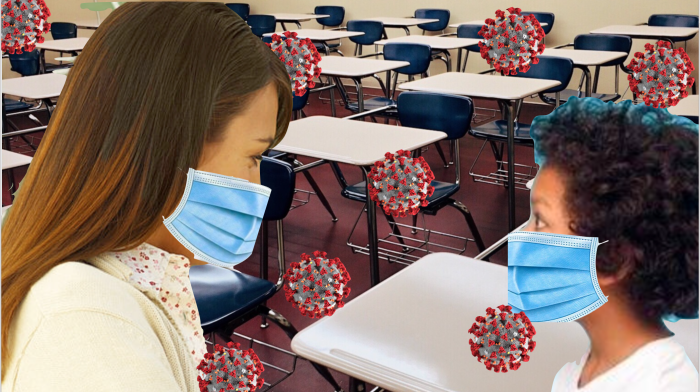
No matter which path we choose, we will be teaching behind a mask or behind a computer screen.


There is no middle ground here – nor should there be.


Even if schools try to execute some hybrid model where kids only attend classes in-person two or three days a week and go on-line for the remainder of the time, when they are in the school building everyone will be wearing masks.


And that’s as it should be.


When in a public place during a global pandemic like that of COVID-19, we need to wear face masks to reduce the spread of the disease.


But let’s not pretend this has no side effects.


Social distancing, limited mobility, plexiglass barriers, cleanliness protocols – all will have an impact on academics.


So if we reopen physical school buildings, we will not be returning to the kind of face-to-face instruction students enjoyed as recently as January and February.


It will be a completely new dynamic that may present as many difficulties – if not maybe more – than learning on-line.


That’s something people would do well to understand before deciding which course is best.


Mask-to-mask learning will not be face-to-face learning.


Social distancing may rob the physical classroom of almost all of its benefits over distance learning.


Again, I’m not suggesting we do without PPE or safety measures. But let’s be honest about how these measures will alter academics.

 
First, let’s look at masks.


Admit it. It is hard to be heard in a mask.


Imagine trying to get a message across to a classroom of middle school children with a piece of fabric hiding half of your face, obscuring your expressions and garbling your words.


I’m not saying it’s insurmountable, but it’s not indistinguishable from classroom teaching at the beginning of last school year, either.


It generates distance, just as it’s supposed to do. But teaching requires connection, understanding and relationship building.


Many of my students come into my class with trust issues. They’ve been let down by adults and authority figures. They aren’t about to put in their best work for just anyone. They have to know the teacher can be trusted and cares about them as individual people.


How are you supposed to generate trust when students can only see your eyes?


Moreover, masks are a permanent symbol of the danger we’re all in just being together. Every time we look at each other we’ll be reminded of risk, threat and our own vulnerability.


These do not make for good teaching. On Abraham Maslow’s Hierarchy of 
Needs, only physiological necessities like food and water take precedence. Without a sense of safety, it is difficult to impossible for students to achieve their full potentials.


Unfortunately, facial coverings aren’t the only problem. Consider physical proximity.


As a teacher, I rarely sit when students are in the room.


During a 40 minute class, I probably lap the space as many times going from desk to desk observing students progress, answering questions, reading work, making suggestions, etc. This will be much more difficult with the threat of Coronavirus in the room.


How can I closely observe my students from a minimum of 6 feet away?


I would suspect this will be even more profound with kids with special needs. Just because they’re in the classroom with the teacher does not mean the teacher will be able to serve them as well as under normal circumstances. This is bound to lead to increased frustration and acting out.


The most common diagnosis my middle school students have is ADHD. The most common adaptation I’m told to make to help them overcome this is to repeatedly prompt them back on task. And you don’t want to do this in a way that will draw attention to the issue. I often walk up to students and ask questions privately, or point to something on their papers.


This will not be easy when trying to avoid their physical space. Any verbal queues would be loud enough to be heard by the rest of the class.

 
Nor does this allow for students to work together on group projects. They can’t push their desks together and work on assignments cooperatively in the physical classroom. In fact, in the time of COVID, these kinds of projects may actually be better served on-line.


Finally, imagine the difficulty of getting children to comply with social distancing mandates.


If we can’t get adults to wear masks, how can we expect to get their kids to do it?


Moreover, children are mischievous. Some may try to purposefully cough on their classmates just to get a reaction. Others could intentionally take off their masks to annoy classmates. As every teacher knows, some kids will do anything for attention. Even negative attention.


In-person teaching could easily degenerate into a game of trying to get kids to obey the rules with little to no actual instruction going on.


Are administrators and school boards really prepared to suspend students for endangering their classmates? Are parents willing to accept such punishments?


And let’s not forget the elephant in the room.


What do we do when safety measures fail?


When a student gets sick, do we quarantine for two weeks all the other students who came into contact with him? When a teacher gets sick, who teaches her classes while she is in isolation? And do we keep her students home, too?


Before we can reopen schools to in-person instruction, there are a host of problems we have to solve.


We have to figure out how to get kids to and from school without crowding them together on buses. We have to arrange classes and move students safely from point A to point B within the building. We have to figure out how to safely feed them – since no one can wear a mask while they eat. We have to figure out how to adequately ventilate buildings that were in need of repair for decades prior to the crisis.


One has to wonder – is it worth it?


With so many challenges involved with reopening school buildings, might it not be better to just continue distance learning initiatives?


As we’ve seen, the push for in-person schooling isn’t justified by academic concerns.


Though under normal circumstances face-to-face learning is worlds better than on-line learning, that is not what we’ll be doing if we reopen schools this year.


In truth, the pressure to reopen schools during this crisis comes more from political and economic considerations than pedagogical ones.


Lawmakers and policymakers don’t want to put forward the funding necessary to reduce the risks. Teachers fear they’ll be laid off if they speak out against unsafe working conditions. Parents fear they won’t be able to return to their own jobs if they have to stay home to take care of their children.


These issues can all be solved by good government. Our lawmakers need to follow the lead of nearly every other country that has lowered infection rates. We need federal relief checks so people can pay their bills without having to risk their lives working through a pandemic. We need personal protective equipment (PPE), protection from evictions, and universal healthcare so that we can weather the storm.


It is not the job of schools and teachers to fix these problems. We can’t. We can only further enable bad leadership.


But putting aside political and economic issues, there is an obvious best course of action.


Under these circumstances, continuing distance learning is the best choice from the standpoint of both safety AND academics.


In any other year, having a teacher physically present in the classroom with a cohort of students is worlds better than Brady Bunch style ZOOM meetings or assignments posted on-line.


But this isn’t any other year. It’s 2020 and Coronavirus cases have topped 3 million in the United States. There were nearly 60,000 new cases just yesterday.


You don’t close schools when there are only thousands of cases and then reopen them when there are millions.


One thing to recommend on-line learning at the present time is that we know it can be done. We already tried it last school year. There were certainly major problems but we have a good idea what they are and can make changes to at least attempt to solve them.


We can do a better job ensuring all students have access to computers, devices and the Internet. We can make expectations clear and achievable and increase project based assignments. We can habituate participation, increase interactivity and offer multiple chances to do the work.


Don’t get me wrong. Distance learning will never be as effective as face-to-face instruction.


But we will not have face-to-face instruction this year. It will be mask-to-mask or screen-to-screen.


That cannot be emphasized enough.


None of the possible solutions does a perfect job overcoming the problems.


There are not enough adequate virus screenings to tell who has the disease. Nor can we screen those who have it and keep them quarantined from the rest. Nor do we have adequate PPE to reduce infection. Nor does any vaccine appear to be forthcoming.


With the exception of the last point, many other developed countries have done much better with these things and so are in a better position to reopen schools.


But we have to face facts. The United States is not in the same position. In fact, we’ve made wearing a mask a political statement instead of what it is – a public health concern.


Until we solve these issues, there will be no perfect solution for schools. We just have to choose the best of several imperfect options.


In my opinion, the only way forward is distance learning.


To do otherwise is like trying to figure out how to live in a burning building instead of putting out the fire.


The only sane option is to get to a relatively safe place first.


I hope we can do that for our children, families and communities.


I hope that the death cult of capitalism doesn’t require teachers to jump on the pyre of economic growth.


We all deserve better.


Like this post?  You might want to consider becoming a Patreon subscriber. This helps me continue to keep the blog going and get on with this difficult and challenging work.

Plus you get subscriber only extras!

Just CLICK HERE.

Patreon+Circle

I’ve also written a book, “Gadfly on the Wall: A Public School Teacher Speaks Out on Racism and Reform,” now available from Garn Press. Ten percent of the proceeds go to the Badass Teachers Association. Check it out!

1500x1000-garn-book-sale-2020-2