The Only Teaching Evaluation That Matters

Screen shot 2015-06-12 at 10.40.16 PM

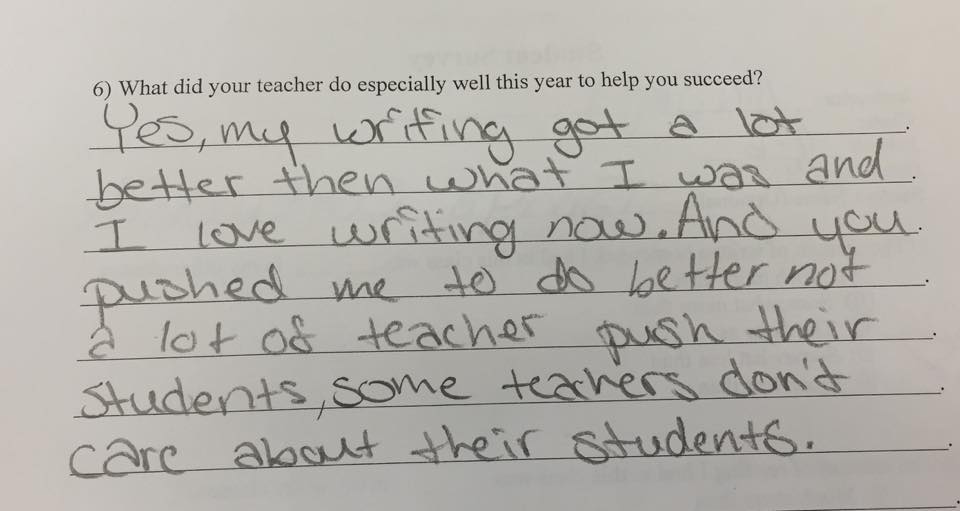
“Yes, my writing got a lot better than what I was, and I love writing now. And you pushed me to do better. Not a lot of teachers push their students, some teachers don’t care about their students.”
11280008_10153046535243860_104612156_n

One of my 8th graders wrote that to me on the last day of school.

I had asked her class to fill out an anonymous survey about my teaching. I said that all year I get to grade THEM, but this was their chance to grade ME.

I made sure to explain that they didn’t need to put their names on it. This would not be graded. Spelling and grammar didn’t count. The only thing I wanted was honesty.

I told them I wouldn’t personally collect the surveys. They should NOT hand them to me; they should put them in a pile on the desk by the door when they leave. I promised I wouldn’t even look at what they’d written until class was over. That way they could feel free to write whatever they wanted. If I did something bad or there was some way I could improve, I wanted them to tell me. If I did something exceptionally well, they should tell me that, too.

“Please help me become a better teacher,” I said.

As an 8th grade public school educator, I get evaluated a lot. I’ve spent countless hours gathering evidence that I’m “proficient” at my job.

I’ve had to endure formal observations, informal observations, H.E.A.T. observations, Student Learning Objectives (SLOs), written explanations of specific lessons with appeals to which Common Core standards I would be teaching – and there always seems to be a new one added to this list next year.

But I’ve been giving a version of this simple student survey to my classes on the last day of school for over a decade.

It’s not something I’m required to do. I don’t share the results with administration. The responses don’t go on file, increase my pay or get recorded in the newspaper. They don’t become part of the district’s ranking in the Business Times. No one is going to withhold funding from my district or close my building and convert it into a charter school based on these results. No one ever will be on television decrying the state of public education referencing these surveys. They are low stakes, class-based, teacher-centered and personal.

But I do this because I think it actually gives me useful information. I really want to know what my students think. That’s one of the things that truly drives my instruction. Not politically motivated standards monetarily incentivized and adopted before they were even completely written. Not standardized tests that measure little more than parental income. Not the latest fad handed down by the superintendent. Not a threat shouted at us through an email or at a faculty meeting.

No. I’m motivated by my kids in the classroom and the answer to the question, “Have I helped you learn?”

The survey is quite simple really. It’s two-sided.

On the front page are 5 multiple choice questions:

1) The amount of written homework I had in this class was                             in my other classes.

A) much more than
B) Somewhat more than
C) The same as
D) Somewhat less than
E) Much less than

2) The amount of reading I had in this class was                                in my other classes.

A) much more than
B) Somewhat more than
C) The same as
D) Somewhat less than
E) Much less than

3) The amount of studying I did for this class was                                 in my other classes.

A) much more than
B) Somewhat more than
C) The same as
D) Somewhat less than
E) Much less than

4) I received                                    instruction and comments on my written work.

A) much more than enough
B) Somewhat more than enough
C) Just enough
D) Somewhat less than enough
E) Much less than enough

5) In this class, I learned                                         in my other classes.

A) much more than
B) Somewhat more than
C) The same as
D) Somewhat less than
E) Much less than

When it comes to homework, students almost always say I give too much. The majority (68%) gave me an A or B.

I only require about an hour of extra-class work a week. I don’t think that’s too bad. However, many teachers give less or none. I go back and forth on the value of homework, myself, but I know that once my students get to 9th grade, they’ll have a tremendous load of it. I figure if I don’t prepare them for that, I’m doing them a disservice. So an avalanche of (one hour a week) homework it remains.

Likewise, kids often say I give a lot of reading. A language arts class should give a substantial amount of reading. So I’m glad most kids (69%) give me an A or B. I require my students to read one self-selected book a month. I don’t think that’s too burdensome. If the book is too tough or boring – hey! You picked it! Pick another one. I also provide them with 15 minutes per day to read in class.

Studying is not something I emphasize. But students are almost evenly divided whether I require too much, just enough or too little. I’m not big on having kids memorize something and then regurgitate that on a test. I’d rather spend time getting them to take good notes that they can use on the test. I’m a big fan of open notes or open book tests. But I hardly ever use the word “Test.” I give frequent short quizzes. I think tests (and even quizzes) are limited evaluation tools. I’d much rather assign a multi-day project. That tells me much more than a brief snapshot of what students were thinking at any one given point in time.

I do assign a lot of essays so I’m always anxious to know if I’ve given enough written feedback. The research seems to show that if you mark every error on an essay, you get diminishing returns. You discourage students. So instead I try to focus on a few trouble areas we’ve already discussed per essay. And students seem to appreciate it. Most of my kids (85%) gave me an A or B or C in this area.

Then comes the cumulative question. How much did you learn? I used to have my classes assign me a letter grade A-E. However, answers were all over the place. When I compared the results with surveys from students who had revealed their identities, I found that kids usually gave me the same grade they received in my class. A-students gave me As. C-students gave me Cs, and so on.

When I changed the question to “how much have you learned?” the results changed drastically. Most students (84%) gave me an A or B. Yes, that’s the result I’m aiming for, but I think it’s a more honest answer, too. It doesn’t focus on grades. It focuses on each child’s assessment of his or her own progress. That’s really what I want to know.

But this side of the survey still provides very limited answers. It is multiple choice, after all. It’s useful for a brief overview but not very deep.

The second side of my questionnaire only has two open-ended queries. Students can write as much or as little as they want to the following questions:

6) What did your teacher do especially well this year to help you succeed?

7) In what areas can your teacher improve his/her instruction?

To be honest, when looking at the surveys, I usually skip right to these questions. This is what I want to see – not a bunch of alphabet soup. I want to know what they really think.

What have I done well? Here are some answers from this year’s kids:

-He understood the learning abilities of certain students and helped them to the best of his ability.

11122062_10153046535213860_65835541_n

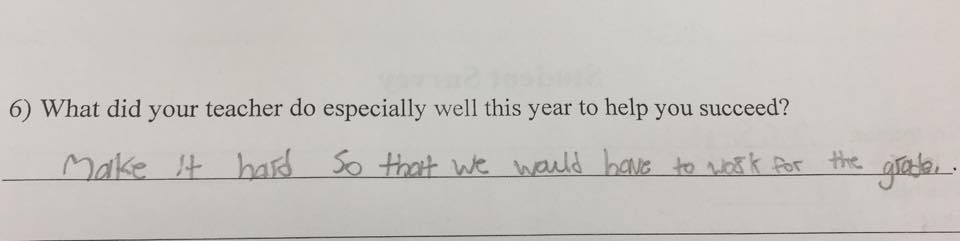
-You made it hard so that we would have to work for the grade.
11208874_10153046535223860_1052817053_n

-Before we could ask him for help, he asked us if we needed help. He’d help everyone, even the person who didn’t ask for it.

11310977_10153046535218860_807785160_n

-He was really good at explaining and pushed me to never give up. Therefore, Mr. Singer is one of my favorite teachers.

11329696_10153046535238860_1253356423_n

-Well, I didn’t like as much work as he was giving us, but then I understood he was trying to help us with our grades and trying to make our grades higher.

11348779_10153046535183860_857789294_n

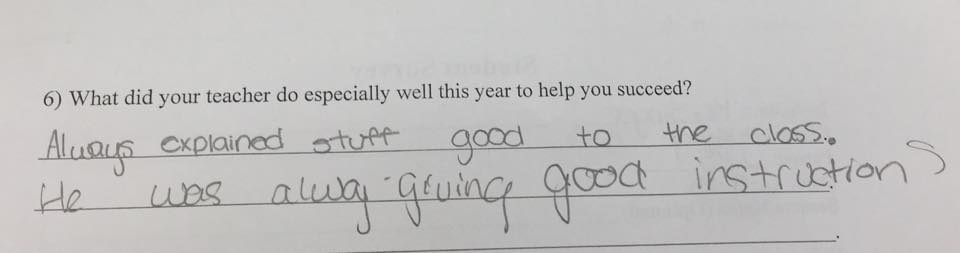
-Always explained stuff good in class. He was always giving good instructions.
11358887_10153046535198860_689871876_n

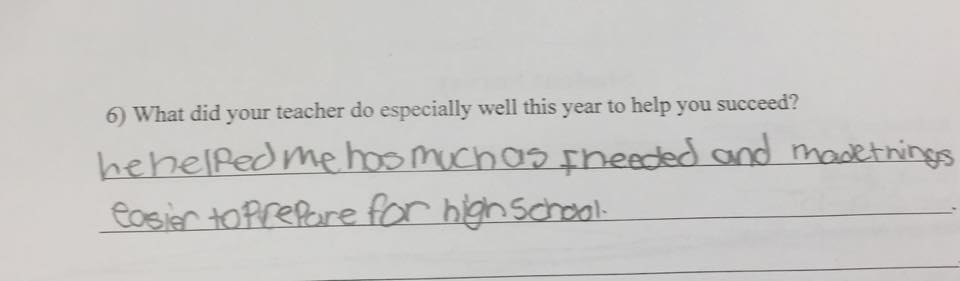
-He helped me as much as I needed and made things easier to prepare for high school.
11418417_10153046535203860_1321510136_n

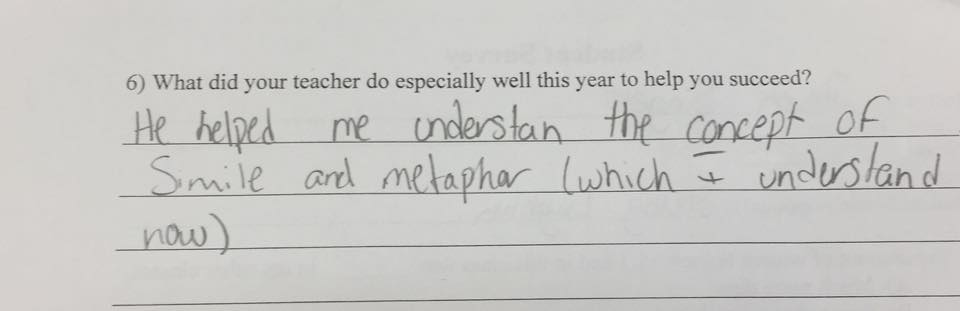
-He helped me understand the concept of simile and metaphor (which I understand now)
11420058_10153046535208860_229100346_n
-What my teacher especially helped me do to succeed is writing essays.

FullSizeRender

I was just floored by these responses. Talk about data I can use! But there was one answer that stood out above even these:

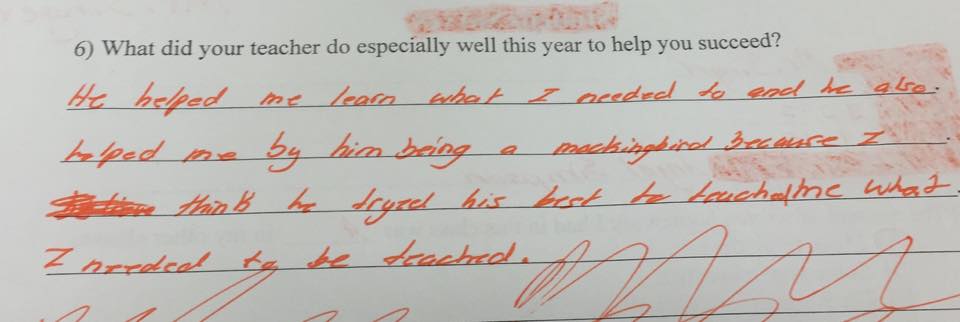
-He helped me learn what I needed to do and he helped me by being a mockingbird because I think he tried his best to teach me what I needed to be taught.
11280625_10153046535248860_1666870003_n

No, she wasn’t literally calling me a bird. She was relating me to our last novel – To Kill a Mockingbird. In the text, some characters are innocent victims. They try to help others but come under fire because of it. The author, Harper Lee, symbolizes them as “mockingbirds.” These include: Tom Robinson, the black man wrongly accused of rape; Atticus Finch, the lawyer standing up for a fair trial despite social criticism; Arthur “Boo” Radely, the recluse who saved lives at the expense of his privacy.

And here my sweet little student was including ME in this venerable list!

That choked me up a bit I can tell you.

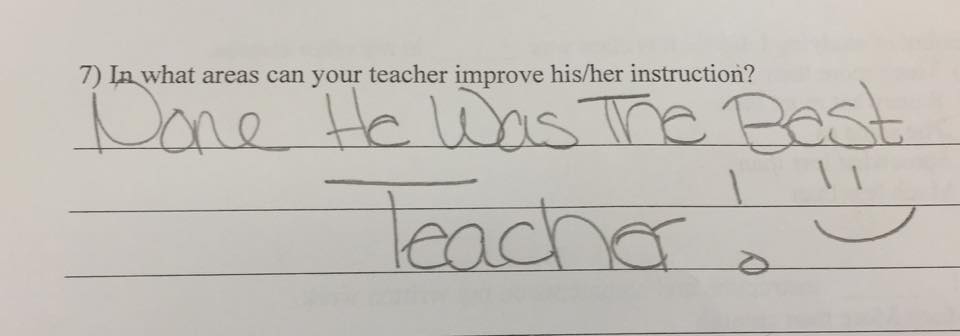
When it comes to areas for improvement, my students aren’t the most forthcoming. Answers include:

-I don’t think he needs to because he already does his best to teach us kids what we need to be taught and his instruction is easy to understand.

11418657_10153046535193860_238476660_n
-None. He was the best teacher! 🙂

11419982_10153046535228860_393598543_n

I appreciate the approbation but I wouldn’t mind constructive criticism. I do get complaints about the amount of homework and writing I assign. I also get requests for more free time.

I think if I wasn’t in the room when students took the survey, I might get more criticism. Ideally, I would leave the room for the last 15 minutes of the class, and kids could fill out their surveys. However, this is impractical. I don’t see how I could arrange it given the current climate, lack of subs and skeleton crew staff.

These surveys have given me much to think about over the summer. Maybe I should try to include more group work in next year’s class. Maybe I should revisit the homework situation.

But as June turns to July and then August, I know I’ll be thinking about all that happened this school year.

Some kids came in and out of shelters and juvenile detention. Some were present at a shooting at the local mall. Parents and I had to fight administration over valuing standardized test scores over classroom grades for student placement. The School board enacted a pointless student uniform policy. Students were demoralized and angry over national racial tensions involving Michael Brown, Eric Garner and the Baltimore uprising. Teachers had an active shooter drill for the first time as part of our professional development.

But most of all I’ll think about my students – well, no longer mine – off to the high school and bigger, better things.

For a brief moment I was an important part of their lives and they were an important part of mine. I’ll forget their names. (It’s like my mind is making space for the new ones I’ll have to learn.) But I’ll never forget their struggles and triumphs.

It’s easy to lose sight with all the privatizers and standardizers trying to dismantle our public schools. But even with all the political nonsense, selfishness and small-mindedness, teaching is the best job in the world.

Yes, it really is!

Every day I get a chance to positively impact dozens of lives!

I am truly blessed.

That’s what these surveys tell me.

And that’s why they’re the only evaluation that really matters.


NOTE: Here is a copy of the survey I use in class.

Student Survey

-This article also was published on the Badass Teachers Association blog.
Data Abuse – When Transient Kids Fall Through the Cracks of Crunched Numbers

Screen shot 2015-05-16 at 9.13.34 AM

I was teaching my classes.

I was grading assignments.

I was procrastinating.

I should have been working on my class rosters.

My principals wanted me to calculate percentages for every student I had taught that year and submit them to the state.

How long had each student been in my grade book? What percentage of the year was each learner in my class before they took their standardized tests?

If I didn’t accurately calculate this in the next few days, the class list generated by the computer would become final, and my evaluation would be affected.

But there I was standing before my students doing nothing of any real value – teaching.

I was instructing them in the mysteries of subject-verb agreement. We were designing posters about the Civil Rights movement. I was evaluating their work and making phone calls home.

You know – goofing off.

I must not have been the only one. Kids took a half-day and the district let us use in-service time to crunch our numbers.

Don’t get me wrong. We weren’t left to the wolves. Administrators were very helpful gathering data, researching exact dates for students entering the building and/or transferring schools. Just as required by the Commonwealth of Pennsylvania.

But it was in the heat of all this numerological chaos that I saw something in the numbers no one else seemed to be looking for.

Many of my students are transients. An alarming number of my kids haven’t been in my class the entire year. They either transferred in from another school, transferred out, or moved into my class from another one.

A few had moved from my academic level course to the honors level Language Arts class. Many more had transferred in from special education courses.

In total, these students make up 44% of my roster.

“Isn’t that significant?” I wondered.

I poked my head in to another teacher’s room.

“How many transient students are on your roster?” I asked.

She told me. I went around from room-to-room asking the same question and comparing the answers.

A trend emerged.

Most teachers who presided over lower level classes (like me) had about the same percentage of transients – approximately 40%. Teachers who taught the advanced levels had a much lower amount – 10% or below.

Doesn’t that mean something?

Imagine if you were giving someone simple instructions. Let’s say you were trying to tell someone how to make a peanut butter and jelly sandwich. But in the middle of your instruction, a student has to leave the room and go right next door where someone is already in the middle of trying to explain how to do the same thing.

Wouldn’t that affect how well a student learned?

If someone was trying to give me directions how to get somewhere under those circumstances, I’m willing to bet I’d get lost.

And this assumes the break between Teacher A and Teacher B is minimal, the instruction is disrupted at the same point and both teachers are even giving instruction on the exact same topics.

None of that is usually true.

I did some more digging. Across the entire building, 20% of our students left the district in the course of this school year. About 17% entered mid-year. So at least 37% of our students were transients. That’s 130 children.

The trend holds district wide. Some schools have more or less transients, but across the board 35% – 40% of our students pop in and out over the year.

Taking an even broader view, student mobility is a national problem. Certainly the percentage of student transience varies from district to district, but it is generally widespread.

Nationally, about 13 percent of students change schools four or more times between kindergarten and eighth grade, according to a 2010 Government Accountability Office analysis. One-third of fourth graders, 19 percent of eighth graders, and 10 percent of twelfth graders changed schools at least once over two years, according to the 1998 National Assessment of Educational Progress (NEAP).

And it gets worse if we look at it over a student’s entire elementary or secondary career. In fact, more students moved than remained in a single school, according to a national longitudinal study of eighth graders.

This problem is even more widespread among poor and minority students. The type of school is also a factor. Large, predominantly minority, urban school districts attract the most student mobility. In Chicago public schools, for instance, only about 47 percent of students remained in the same school over a four-year period. Fifteen percent of the schools lost at least 30 percent of their students in only one year.

And this has adverse affects on children both academically and psychologically.

Several studies at both the elementary and secondary levels conclude student mobility decreases test scores and increases the drop out rate.

A 1990s Baltimore study found, “each additional move” was associated with a .11 standard deviation in reading achievement. A similar 1990s Chicago study concluded that students with four or more moves had a .39 standard deviation. Highly mobile students were as much as four months behind their peers academically in fourth grade and as much as a full year behind by sixth grade, according to a 1993 Chicago study by David Kerbow.

It just makes sense. These students have to cope with starting over – fitting in to a new environment. They have to adjust to new peers and social requirements.

Moreover, transients have an increased likelihood of misbehaving and participating in violence. After all, it’s easier to act out in front of strangers.

What causes this problem? Most often it is due to parental job insecurity.

Parents can’t keep employment or jobs dry up resulting in the need to move on to greener pastures.

In my own district, one municipality we serve is mostly made up of low-cost housing, apartments and slums. It is a beacon  for mobility. Few people who haven’t lived here their whole lives put down roots. We’re just another stop on a long and winding road.

“We should be doing something about this,” I thought.

Our legislators should help promote job security. We should make it easier to afford quality housing. We should try to encourage new-comers to become part of the community instead of remain eternal outsiders.

At our schools, we need resources to help this population make the necessary adjustments. We should encourage them to participate in extra-curricular activities, provide counseling and wraparound services.

But we don’t do any of that.

Instead, we gather mountains of data.

We sort and sift, enter it into a computer and press “submit.”

And off it goes to the Pennsylvania Value Added Assessment System (PVAAS).

We don’t use it to help kids.

We use it to blame school teachers for things beyond their control.

Data has value but that doesn’t mean all data is valuable.

We need to know what we’re looking for, what it means and how to use it to make our world a better place.

Otherwise it’s just a waste of precious class time.

And an excuse to continue ignoring all the children who fall through the cracks.


NOTE: This article also was published on the LA School Report and the Badass Teachers Association blog.

Saturday Night Lame – Sucker Punching Teachers for a Laugh No One Made

Screen shot 2015-02-03 at 5.20.57 PM

Go ahead.

Make jokes about teachers.

Please.

But make them fair. No sucker punches.

And – goddammit – make them funny!

However, all we got on Saturday Night Live this week during the “Teacher Snow Day” segment were unconvincing lame low blows.

In the rap video parody, we see educators boasting of all the money they’re making for doing nothing, telling their students to “go to Hell,” having sex on school property, using meth they made in the science lab, and bragging that there’s nothing you can do about it because they have tenure so can’t be fired – all while students have the day off because of snow.

Are you freakin’ kidding me?

As a public school teacher of more than a decade, I wasn’t laughing. Nor was I alone. Ratings plummeted yet again from an already dismal viewership.

I hesitated writing this article at all because so few people saw the segment the first time, and I certainly don’t want to encourage anyone to go back and view this groan-fest.

But address it I must, because it’s part of a larger problem: the idea that teachers are fair game as a target for just about any dishonest criticism you can imagine.

And that’s the problem – dishonesty.

Jokes work best when they attack the powerful, not the powerless.

That’s the whole point of satire – to allow an attack on the dominant from below. When a mighty person attacks someone less powerful, that’s not satire and it’s not funny. It’s bullying.

We all remember teachers from school. When we were students, they were authority figures and – as such – fair targets of criticism.

But in a larger social context, teachers are one of the most vulnerable and disenfranchised groups in our society.

Educators are under constant onslaught from all sides.

Every problem of our public school system is heaped on top of them. No matter what’s wrong, it’s always their fault. And we’re quick to prove it by stacking the cards against them.

Just look at how we evaluate them. Our federal and state governments mandate we base teachers’ effectiveness substantially on their students’ standardized test scores. Statisticians call this approach “junk science” because it uses a test created to evaluate students as an assessment for something it was never meant to assess – their instructors. But that doesn’t stop the continued use of these value-added measures to “prove” how crappy teachers are at their jobs. And when educators gather together in a union to demand real proof of wrongdoing before they can be fired, they’re accused of insisting we give them a job for life.

Teachers don’t even have control over their own curriculum anymore. In many schools, educators can’t choose which books to use, which skills to teach or how to assess student learning. Often they’re even denied the choice of their own words since they’re forced to read from scripted lessons provided by multinational for-profit testing corporations.

Education policy doesn’t come from teachers. Do you think educators came up with Common Core? Of course not! That was a billionaire philanthropist’s pet project created with the help of think tanks and policy wonks. But teachers are expected to follow it regardless of their years of classroom experience that tell them it’s nonsense – at best – and developmentally inappropriate – at worst!

And if a teacher wants to speak up, the venues open to him are few and far between. Turn on any media program about education and you’ll see half a dozen talking heads offering their opinions but not one of them will be a teacher! Heck! Congress just held hearings on the federal law that governs K-12 schools (ESEA) and only let a handful of teachers testify.

Why?

Because if they don’t blame teachers, they’d have to face the facts of income inequality and child poverty.

More than half of all public school students are impoverished. Instead of providing extra resources to help those students, budgets have been slashed. Less tutoring. Less arts and music. Less extra curricular activities. Less social services. But instead larger class sizes! And we expect teachers to magically make our uncaring budgetary priorities work!

Yet, the “not ready for prime time” crew at SNL thought it was funny to target one of the only groups to stand up for these children.

You’d never see them make jokes at the expense of our troops, but teachers are soldiers on the front line of the war on poverty.

Yes! Soldiers!

When troubled teens denied the proper mental health services use our lax gun laws to take a semi-automatic with them in their book bags to school, it’s these same teachers who literally give their lives to save our children!

And these unsung heroes, these public punching bags, these scapegoats for all of society’s ills were your choice of target for feeble clowning?

I expect that from dark money fueled privatizers and corporate backed union busters. I don’t expect it from someone who’s supposed to help me get through another week with a few good laughs.

Snow day? You should have called it snow job because the only ones laughing were the Koch Brothers!

Sure, if you want to joke that teachers are too stuffy, fine! We deserve that criticism. As a whole, we are unhip, mostly white, sometimes pedantic and give too much homework.

But don’t you dare criticize us for being uncaring or lazy or criminal.

While you’re making jokes, our nations children are forced to go without – unless a teacher somehow manages to help.

That’s no joke, and the punchline may well be the future of this nation.

So while I’m out using my own money to buy supplies for my students…

While I’m staying hours late at school almost every day…

While I’m counseling a student with severe emotional problems…

While I’m doing my job, why don’t you do yours, SNL?

Make me laugh.


This article was also published in the LA Progressive.

Confession of a Standardized Test Proctor

A boy receiving a failing test score

Hello. My name is Steven.

HI, STEVEN!


And I’m a standardized test proctor.

(Clapping!)

I’ve been a proctor for over 10 years now. I used to be a teacher. Some days I still get to be one, but most of the time… I’m just a proctor.

(Clapping. Shouts of “YEAH!”)


I give my students standardized tests.

WOO-HOO!


And I make them do test prep.

(Cheers!)

But…

(Breaks down. Someone walks up behind him, claps him on the back and whispers in his ear. Encouraging noises from the crowd of people sitting in folding chairs around the room.)


Let me start with the box.

(Laughter)


The box came to my middle school classroom right before Christmas break. You know the one. Like a cinder block made of cardboard. 

A high school student brought it down from administration. She shook it like a huge maraca and asked, “Mr. Singer, where do you want it?”

For a second I had no idea what it was. Then I remembered – it was almost time again to take the GRADE Test. And I knew what it was – a box full of those black and green test booklets, Scantron sheets wrapped in plastic, a box of No. 2 pencils, a monitor’s booklet, scratch paper, student rosters and ID numbers… Everything I wanted for Christmas.

(Laughter)


So I put it on the shelf, went on teaching and forgot about it until December was over, until after the holiday break.

I didn’t want to even think about it.

But when I came back to school in January all rested and raring to go, I saw it there like some sinister Elf on the Shelf.

So I put it off for another week. No rush. I had until the end of the month to make my students take it.

I just…

I couldn’t have them come into my classroom and first thing take a standardized test. That would have been heartless. They didn’t come back to school to fill in bubbles. They wanted to do something interesting, something that they really cared about.

They wouldn’t admit it, but they wanted to learn Goddammit!

And I wanted to teach!

(Grumbling) TELL US ABOUT IT!


What?

TELL US ABOUT THE WEEK BEFORE YOU TESTED!


Okay. I…

It was great. We read S. E. Hinton’s The Outsiders. Or at least a few chapters of it. 

The kids couldn’t put it down. If there were only a few minutes left in class, they didn’t want to stop reading – they wanted to keep going. 

We wrote journal entries about what we might have done in the characters’ places, examined the use of slang and how it has evolved over time.

We participated in a Socratic Seminar discussion where we made connections between the novel and our own lives, explored gender issues, the role of socioeconomic status and race – it was higher level thinking all around. You know? The stuff they tells us we’re supposed to teach – the stuff all the research tells us helps learners grow.

But it didn’t last. The week ended. And I had to give the GRADE Test.

OOOH! (a few claps)

You know, it’s funny. Working in a poor school district like mine, you hear a lot about accountability. If administrators don’t enact this reform, or teachers don’t do that paperwork or students don’t score this high – they’ll close us down. But no one talks about holding politicians accountable for making sure we have the resources we need.

Case in point: when I came back from break, the fan in my room’s cooling system had broken down. I have no windows and the air wasn’t circulating. It was hot and muggy and miserable. Yes, in January with arctic temperatures outside!

I asked the grounds keeper and administrators to do something about it, but was told repeatedly “the part is on order.” Nothing happened.

The first week wasn’t too bad. We managed. But it wasn’t until the second week – when I gave out the test – that it went from annoying to miserable!

(He pauses, shaking his head.)

I don’t know. Maybe it wouldn’t be so bad if it was a different test, but the GRADE…

…. is such a waste of time!


(good natured laughter. Mumbling.)


They call it a reading diagnostic test because it’s supposed to diagnose the kids’ deficiencies in reading. But it doesn’t do that for a host of reasons – chief among them the fact that kids take the same exact test over-and-over again for at least three years!

That’s right! No variation! The same questions in the same order three times a year – year-after-year. Heck! This was the second time they were taking this same test just this year alone!

Sure there’s one alternative version we COULD give to mix things up, but administration rarely lets us do that. And even if we did, it wouldn’t help that much.

(Snickers!)


What’s worse, it isn’t even aligned with the high-stakes tests kids have to take in March and April!

Yeah! They stick a gun to our heads and say if your students don’t score well on the all-or-nothing, win-or-lose state tests, we’ll label you a “failure,” cut your funding or close you down.

So you’d think we’d practice – try to do look-alikes and get comfortable with the format and everything.

But the rehearsal we’re forced to do is the GRADE test! That’s like practicing a layup when you’re getting ready for the chess tournament!

The preparation doesn’t reflect what students will be asked to do when it comes to the make-or-break exams!

It wasn’t always like this.

We used to have kids take a diagnostic test called the 4SIGHT. It wasn’t perfect. Kids took it on computers, but there was an essay section they’d write on paper, too, that I was actually allowed to grade, myself!

I thought there were better uses of class time, but at least the 4SIGHT was actually a good dry run for the kind of high-stakes tests they were going to take later in the year. And sections they took on the computer gave you a score immediately. 

It was something you could look at as a rehearsal, as reducing test anxiety, as providing you data you could use to make decisions about the students.

(Laughter)


Yeah! As if you’d need it! Any teacher who knows his students so poorly that he needs standardized tests to tell their strengths and weaknesses is a pretty poor teacher.

The only reason we changed to the GRADE Test in the first place is because the district got a grant from the state. 

First, the governor and legislature slashed our budget, then they offered to give us back a small portion of it if we enacted certain reforms – one of which was to replace our somewhat helpful diagnostic test with a totally useless Pearson product.

(clapping. A few catcalls of “PEARSON! OOOH! OOOH!”)

Come to think of it – 4SIGHT was also made by Pearson.

(Laughter)


And the time it takes to give this thing! There are only four sections – Vocabulary, Sentence Completion, Listening Comprehension and Passage Comprehension. But it takes a minimum of two days – and I have double periods! That’s two 80-minute sections – actually more like three so I can give the make-ups!


(unhappy noise from crowd)


That’s right! If a student is absent, I have to somehow proctor the whole thing over again just for him. Administration says it’s too hard for them to pull students out of class and give the make-ups, themselves. So I’m forced to give busy work to students who completed the assessment so they have something to do while the stragglers catch up.

(grumbles)

So to review: today was day three of testing. Day six if you count the first time I proctored this darn thing. And three more days will be coming in May.

This is day seven of no air flow. Kids sitting at their desks like they’re half dead. Sad, bored looks on their faces, and I completely sympathize but I’m the one who’s forced to do this to them!

Every now and then one of them asks, “Why are we doing this, Mr. Singer? Will this affect my grade?” 

And I find the lies hard to get out. Because, no, it won’t affect your grade. There’s really no good reason you’re taking this, except that some of those books on the shelf you enjoy during sustained silent reading were bought with money we get for making you go through this nonsense.

I used to believe in standardized testing. I did!

When I first started teaching it made a certain kind of sense. We had the Pennsylvania System of School Assessment (PSSA) tests then. My 8th grade kids took one in Reading and one in Writing.

It was challenging but at least the expectations were clear. I knew exactly what kinds of things they would be tested on and what they were expected to do. 

There were reams of remediation material available, and I could have my pick of the best – the clearest and most engaging – as test prep materials go.

But then Pennsylvania adopted Common Core – or at least it adopted the look-a-like PA Core – and had to develop new tests! 

Today, high school students take a test called the Keystone and middle schoolers still take the PSSA. But they’re both just different versions of the PARCC test with a Pennsylvania-sounding name on it. We just pretend it’s something new and ground breaking.

That might be acceptable if the PARCC was a valid assessment. However, it’s notorious throughout the country for being designed to fail students – not fairly evaluate them. 

Moreover, the state Department of Education is extremely stingy with examples teachers can look at so we know what’s on the test. I doubt even they know what’s on it because they keep changing it from year-to-year.

So all of my remediation material is almost useless. I can’t even buy something new because it takes several years after a test is developed for the preparatory material to appear, and we’re still chasing a moving target!

And on top of all that – the state is forcing all schools to use the scores from these tests to evaluate teachers performance!

We use incomplete test prep and unaligned pretests to prepare for more tests that don’t fairly assess student learning – and then use these invalid scores to blame teachers and bemoan the state of education!

WHAT THE HELL!?

Yeah! So…

(Someone walks up behind him and whispers in his ear. Hands him something.)

I get this… chip?

(Cheers! He looks it over.)

One week. I’m a one week man!

(Clapping. People standing.)

I’ve accepted my lot for one week?

(Volume gets louder on applause.)

I’m a test proctor.

(Catcalls. ONE OF US! ONE OF US!)

I’m a test proctor!

(Insane yelling!)

I’M A PROCTOR! A PROCTOR! A TESTING PROCTOR!

(The crowd rushes to the stage and engulfs the speaker. More and more approach. They just keep coming – more than could possibly fit in this room. The clamor continues to gain in volume until its unclear whether its celebratory cheering or out of control insanity. One word is heard through it all until even it cannot be made out in any distinctness.)

PROCTOR!

(curtain.)


This article also appeared in the LA Progressive, Education Bloggers Network, Public School Shakedown and the Badass Teachers Association blog.

Dear Gov. Wolf – 10 Ways to Help Pennsylvania’s Schools

wolf-edu-infographic-blog-photo

Dear Gov. Tom Wolf:

It’s so nice to hear your name. Wolf. Wolf. Wolf.

I could write it all day. It’s so much better than Corbett.

As one of millions who voted for you, campaigned for you and even posted a yard sign for you – I want to offer my most cordial congratulations and welcome to office.

I know it may take a few weeks to get used to the new job. Heck! It could take a month just cleaning out all the skeletons left by your predecessor. It’s no coincidence that most of them are child sized.

Your forerunner treated public education like his own private piggy bank. He slashed education budgets with glee blaming it on federal stimulus dollars, Gov. Rendell or anyone but himself. Moreover, he trashed a newly created funding formula designed to ensure needy districts received adequate support. He stopped partially reimbursing poverty-stricken districts for the extra costs of having charter schools drain their coffers. And for a candidate who campaigned on limited government, he dramatically expanded the state role in education policy.

In short, it was a disaster. As a public school teacher, those were the four longest years of my life. I dearly hope we can expect better from you. One could easily make the case that you owe your position as governor to your stance against all these policies and the expectation that you would reverse course.

So let me offer some help. This is what I’d like to see you do as governor. I know it won’t be easy. I know you’ll probably have to compromise to work with a Republican legislature that enabled all these disasters to take place.

But you play a vital role – to set the agenda. And I fully expect you to do that for the children of Pennsylvania.

These are the top 10 ways to Help Pennsylvania’s schools:

1) Reverse Course in York

Talk about an American tragedy! York City Schools is a victim of your predecessor’s Draconian budget cuts. But instead of actually helping the district recover from years of underfunding, it was further hobbled by ideologues and profiteers.

First, Pennsylvania underfunds the already impoverished York Schools. Then when the district can’t cope with the lack of support, it’s labeled a “failure” and forced into a ridiculous recovery program. How does this make sense: tighten your belt, try a few targeted reforms and if that doesn’t work, give control of the district to a for-profit charter operator with a record of failure!?

And when the duly-elected school board has second thoughts, the state snatches control away from them and sends the school into receivership so this ridiculous privatization scheme can be instituted unmolested by Democracy!?

No. You need to listen to the taxpayers. Give control of the district back to the school board. Give the so-called Chief Recovery Officer his walking papers, throw his “Recovery Plan” into the trash and properly fund the district. No charters. Just common sense reform.

2) Return All Schools to Local Control

Public schools should be exactly that – public. Their actions should be governed by the community – not the state. Within certain Constitutionally mandated limits, the state has no business deciding what schools should be doing. The state’s main job is to ensure schools have what they need to function.

Yet Pennsylvania is running a handful of districts. Philadelphia Schools have been under control of the School Recovery Commission and appointed CEO for almost two decades with no improvement. Likewise, Duquesne and Chester Upland districts have struggled through receivership with nothing to show for it but misery and lack of services.

That’s why these schools were taken over in the first place. New leadership was never the problem. It was lack of funds.

Restore all Pennsylvania districts to the taxpayers and democratically elected school boards. Fund properly and stand back. Watch them flourish.

3) Increase the Education Budget

You campaigned on it. It’s time to do it. Bring funding back to pre-Corbett levels. In fact, increase it to reflect the increased costs of services. And bring back the charter school reimbursement.

A small increase will not be enough. Our schools have suffered through too much neglect. We need to lower class sizes and restore arts and music, extra-curricular activities, school nurses, librarians – everything we lost under your forerunner.

Critics will say this is throwing money at the problem. The rest of us call it an investment. We need to put more money toward educating children than locking up high school dropouts. We need to put all the strength and power of the Commonwealth into ensuring the next generation will have a better chance at succeeding than the current one.

That takes money. It takes taxes – especially on the wealthy and corporations that have had a tax holiday for the past four years. It’s time to pay up.

4) Institute a Fair Funding Formula

This is another of your campaign promises. Even your predecessor eventually came around to supporting it – after he trashed the one that had already been in place.

We need to make sure schools get the money they need to operate. This means the state has to provide more funding to cash-strapped schools than rich ones. After all, wealthy districts can rely more on local taxes. Poor districts cannot.

Start by re-instituting the funding formula the legislature created in 2008.

5) Halt Charter School Expansion

Speaking of money, it makes no sense to have two separate educational systems. It’s unnecessary and wasteful. We don’t need traditional public schools AND charters.

It’s all about performance. Traditional public schools often do much better or as well as charters – especially cyber charters.

So put a moratorium on new charter schools. Then make the ones we have transparent and accountable. You know? Like we already do for public schools!

No more holding board meetings in private, keeping budgets secret and discouraging difficult students from enrolling. Otherwise, the potential for malfeasance is huge – especially at those organized for-profit.

Direct the state Department of Education to investigate all existent charter schools to determine which are exemplary and which substandard. Close the bad, keep the good.

We simply can’t afford letting profiteers suckle on Pennsylvania’s school budgets.

6) Divest from Common Core. Return to PA Standards

Technically Pennsylvania never adopted Common Core State Standards. It just plagiarized them. We pretend our wonderful PA Core Standards are something new and innovative. They’re not. They’re just Common Core with Pennsylvania in the name.

What a waste of time and money! We don’t need the state telling districts what to do. There’s nothing wrong with benchmarks – suggested goals to which districts can aim. But unfunded mandates? No, thank you.

The Pennsylvania Standards that preceded PA Core were closer to the benchmark ideal. They were a guide – not a high-stakes mandated gun-to-your-head de facto curriculum.

Every teacher knows you don’t help children by simply changing the bar. But you do help textbook publishers by making them uniform. You create a market.

It’s time to do what’s best for children, not corporations. Throw out Common Core. Return to PA State Standards.

7) Cut Back on Standardized Testing

Everyone is sick of standardized tests. Teachers are sick of them. The kids and parents are sick of them. Even politicians are sick of them.

It’s time to do something about it.

Pennsylvania’s standardized test system is a joke. We took our own Pennsylvania System of School Assessments (PSSAs) – flawed as they were – and threw them away in favor of copying the horrific PARCC tests. The PSSAs weren’t exactly fair, nor did they accurately evaluate student learning. But at least they held reasonable goals.

The new state tests are so much like the PARCC, they expect students to be far above what is developmentally appropriate. Kids just aren’t ready for certain concepts until they’re older. These new tests ignore everything we know about how the growing mind works in favor of a scheme to fail more kids and sell more remedial textbooks.

We need to scrap these new tests and – in fact – dramatically reduce the number of standardized tests we give. In a perfect world, we’d give only one standardized test in high school and call it a day. Let kids in elementary and middle school learn their basic skills without the sword of Damocles hanging over their heads.

Moreover, don’t attach high-stakes to any test. That corrupts the score. Use it as a tool. It’s a way of checking the oil on a school’s educational engine. But you don’t throw a temper tantrum and blame the car when it’s low on oil. You add more oil. (See increase school funding.)

8) Abolish VAM Teacher Evaluations. Let Districts Design Their Own Evaluations.

When experts like those in the American Statistical Association are complaining that you’re using statistics incorrectly, you need to listen. Value-Added Measures are a horrible way to evaluate teachers. You simply can’t use student test scores to judge the effectiveness of teachers. It’s like measuring the size of the potholes on your work route to determine if you’re a good driver.

Moreover, the evaluation system now in place is a gothic, baroque mess. It’s cumbersome, takes way too much time from teachers and administrators and ultimately doesn’t provide a fair evaluation.

Let each school district come up with its own evaluation system. Yes, this probably means going back to relying on principals to actually observe their own teachers in their own ways.

Critics will complain this system is flawed because too many teachers get positive evaluations. So what? Most principals, parents and students are well satisfied with the quality of the teachers in their districts. Who are these corporate bureaucrats to tell them they’re wrong?

9) Appoint a Teacher as Secretary of Education

The state should have a limited role in setting education policy. You’d think your predecessor would agree seeing how he downsized the state Department of Education. But those employees he did keep – especially at the highest levels – had little to no education background.

In the rare case when an educator was hired, that background was almost completely in management positions – hardly any time in the classroom.

The Secretary of Education and the majority of staff running the Department of Education should be teachers – not CEOs, political advocacy nuts with an agenda – not even principals, superintendents, or academics. They should have real world experience doing the job recently. No more corporate shills. If you want the state to do what’s right for children, you need to employ their best advocates, people who know what’s needed and how to achieve it – teachers.

10) Kick Out TFA

Speaking of teachers – that’s who should be running our classrooms – Not lightly trained temps who have no intention of staying in the field.

It is a sad joke that our politicians have valued Teach for America recruits equally or more than educators. Teachers graduate from intensive education programs at our best colleges. TFA recruits go through a few weeks of training.

It is ridiculous and insulting to accept TFA as a substitute for well-trained staff – especially at our poorest schools. As governor, you should push for a moratorium on any new TFA recruits at our public schools. Every student matters. Every student deserves a real teacher.

In closing, thank you for your time. I hope you will consider enacting these reforms. You would be doing what’s truly in the best interests of the citizens, parents, teachers and children of the Commonwealth.

But be warned. We have had enough of politicians who come into office on a promise and a smile but don’t back it up with real action. We gave you our overwhelming support in the last election. Now it’s up to you to keep it.

Yours,

Steven Singer


This article appeared in its entirety on the Badass Teachers Association blog, and a shortened version was published in the York Daily Record. I also did a radio interview on the Rick Smith Show where I went over all 10 points. 

A Curriculum of Compassion

05_A1CP_t400

Rayvin was back.

I had been told to expect her today. She’d been on my class roster since the beginning of the year but this was the first time I had seen her in person.

Such sad eyes. Such a defeated look on such a young, beautiful face.

“Welcome back!” I said smiling and picking up her loose hand to give it a silly shake.

“I thought we might see you today!” I said ushering her to a choice seat in a front corner.

She said nothing.

Rayvin had been in my class last year when I taught 7th grade. She had disappeared about halfway through the year – sucked into a mire of horrific circumstances, homeless shelters and life experiences no one should have to endure.

Now that I was teaching 8th grade and she had come back to the district, she had been returned to me like a dead letter.

The poor thing slumped into the seat I had given her. But I wasn’t about to give up.

I gave her an assignment I knew she’d enjoy. I remembered she liked to read horror stories so I put a book under her nose and opened it to Edgar Allan Poe.

She obeyed with no comment. But I wasn’t about to give up.

As the class discussed the story, I offered her a chance to participate. After every question I’d ask, I let me eyes casually fall on her face to see if she was interested in commenting before giving someone else a chance. She met my gaze but said nothing.

When class was over, she crumpled her papers in her hand like a tube.

Just as she got up, I asked, “Would you like a folder?”

She stopped as if she had heard me for the first time.

“Yes,” she almost whispered.

“Would you like a three-ring binder?” I asked and reached under a desk to a pile of supplies I collected for just such occasions.

Her face lit up into a smile.

I don’t remember what she said after that. I gave her the binder and she left.

It was the best moment of my day. The best moment of my whole week.

I had gotten through to her. She knew that someone – SOMEONE – cared.

THAT’S why I teach.

We waste a lot of talk in academic circles on curriculum and standards and lesson plans. But in the classroom, most of the time it’s all empty words.

Teachers have to make lightning fast decisions in real time. They can’t refer to a workbook, their notes or government-sanctioned benchmarks.

They have to appraise the situation and act.

If a student is misbehaving, the teacher has to quickly make a judgement why it’s happening, who it’s affecting and what’s the best course to correct it before it spreads out of control.

If a student isn’t acting like his-or-herself, the teacher has to mentally take note of the situation, compare it to past knowledge of the child’s history and then decide how best to help the young person without bringing down undue attention.

If a student doesn’t understand something, the teacher has to find out where the misunderstanding comes from, explain away the troubled spot and then gauge to see if his action has solved the problem.

And all in the blink of an eye.

It’s one of the things I love about teaching. It’s also why not everyone can do it.

You have to not only live in the moment but persevere. You have to be there for all 20-or-30-something students as well as you can, as quickly as you can, at the same time.

It’s a rush, let me tell you.

It’s also draining and frustrating and painful.

But it’s so worth it.

You get to help people – people who really need it. Not at a remove. You get to stand in front of those in need and help them up – even if they don’t know they’re on the ground.

There is such joy in what I do.

I wouldn’t trade it for the world.

I’ll keep doing it even though my state and local government are determined to evaluate me to death with mountains of paperwork and statistics that would make even a statistician weep.

I’ll keep doing it even though my duly-elected school board publicly bad mouths their staff and refuses to even negotiate with us in person so we can afford to keep our own families.

I’ll keep doing it as long as I can.

One day I may not be able to do it anymore.

My health suffers. Time with my wife and daughter gets sacrificed.

But no matter what happens, I helped Billy express himself in writing. I made shy Kelcey feel safe enough to share her journal with the class. I showed Shaun that sometimes stories are about people just like him.

And I made Rayvin smile.

That’s so much more than enough!


NOTE: In an effort to preserve students’ anonymity, names and unimportant details may have been changed.

This article has been published in Public School Shakedown and the Badass Teachers Association blog.

Fight Corporate Education Reform and Meme It!

20-beach-sea-photography

Sometimes words alone aren’t enough.

Has this ever happened to you? You’re arguing with someone and just not able to get your point across. You know if you could just show them the picture in your brain, they’d understand what you meant with the force of a bullet. But lacking psychic abilities, you’re reduced to the efforts of your poor twisted, tangled tongue.

That’s where memes make all the difference.

A meme is “an idea, behavior, or style that spreads from person to person within a culture.” Though originally coined as a term to describe genes, the expression has expanded to encompass anything that can carry ideas from one mind to another with a mimicked theme.

I know that sounds daunting, but you’ve probably seen hundreds or thousands of memes already. At least half of the images on Facebook and Twitter are memes – Grumpy Cat, Condescending Wonka, One Does Not Simply, Conspiracy Keanu and enough facepalms to break your jaw.

As a meme-maker, myself, I’ve been surprised that some of my efforts have taken on lives of their own. By no means am I a master at the art, but a few of my 50 plus memes have been surfing the Internet on their own for a year or more. I’ll go on a nationwide education organization’s Facebook page and see my little meme staring back at me. “Hi, Daddy!”

I leave you with an experiment. Here is a collection of some of my favorite creations. I’ve limited myself here to memes on the subject of education. I’ve also organized them to some degree based on subtopics.

Please feel free to browse. If you see a meme that you like – that helps make your point about the errors of corporate education reform – you have my blessing to take it. Post it on your Facebook page, in a tweet, on Tumbler, whatever you please. Send my little message off again into the great sea of interconnected webs and communication nets. Maybe one day it’ll return to me.

Happy shopping!


STANDARDIZED TESTING
1
IMG_0975.JPG

2
IMG_2013.JPG

3
IMG_1262.JPG

4
IMG_1782.JPG

5
IMG_1903.JPG

BUDGETS
6
IMG_1764.JPG

7

IMG_2040.JPG

8
IMG_0559.JPG

COMMON CORE
9
IMG_1972.JPG

10
IMG_1295.JPG

11
IMG_1710.JPG

TENURE

12
IMG_1800.JPG

13
IMG_1696.JPG
14
IMG_1603.JPG

VALUE-ADDED MEASURES (VAM)

15
IMG_1489.JPG

16
IMG_1106.JPG

17
IMG_0476.JPG

CORPORATE EDUCATION REFORM

18
IMG_1817.JPG

19
IMG_1492.JPG

20
IMG_0901.JPG

ACCOUNTABILITY

21
IMG_2023.JPG

22
IMG_2101.JPG

23
IMG_1072.JPG

PENNSYLVANIA ISSUES
24
IMG_1793.JPG

25
IMG_1776.JPG

26
IMG_1222.JPG
27
IMG_0919.JPG
28
IMG_1420.JPG

MISCELLANEOUS

29
IMG_1927.JPG

30
IMG_1891.JPG

31
IMG_1950.JPG

32
IMG_1392.JPG

33
IMG_1446.JPG

34
IMG_1912.JPG

Franz Kafka and the Metamorphosis of Teacher Evaluations

kafka-drawing-251x300

One morning, when Mr. K woke from troubled dreams, he found himself transformed in his classroom into a horrible insect.


He lay on his segmented brown belly propped against his teachers desk. He had fallen asleep trying to grade English papers again.


His armor-like back ached and wiry thin antennae kept bobbing into view like stray hairs. If he lifted his head a little, he could see his many tiny legs waving about helplessly each holding a pen or pencil.


“What’s happened to me?” he thought.


It wasn’t a dream.


“Oh well.” he shrugged, “I have papers to grade,” and he began to attack the pile of high school essays on literary surrealism.


But before he could even finish the first one, the Commandant sauntered in. At least she liked to call herself that. She was really just a first year principal. Last year she had taught in a classroom right down the hall.


“Mr. K! What is this!?” she demanded.


“You used to call me Franz…”


He was shocked when he heard his own voice answering, it could hardly be recognized as the voice he had had before. As if from deep inside him, there was a painful and uncontrollable squeaking mixed in with it. Mr. K had wanted to give a full answer and explain everything, but before he could finish, the Commandant said, “You haven’t turned in your pre-observation report for your value-added evaluation.”


“Um, yes, I did. I emailed it to you yesterday.”


“You haven’t made references to Danielson’s framework or which Common Core State Standards you’ll be teaching to… How am I going to fairly evaluate your teaching if you don’t make explicit reference to pedagogues like Danielson… and Gates?”


“Half of my evaluation is supposed to come from observation. Couldn’t you just observe me? I told you what I was going to be teaching. Isn’t that enough? I have papers to grade.”


“Of course not, Mr. K! This is a teaching evaluation! Not a grading evaluation!”
 

“But my students worked all week on these papers. I need to make comments so they can revise them.”


“Do students get a chance to revise their essays on our state mandated standardized writing test?”


“Not really…”


“Then just give them an Advanced, Proficient, Basic or Below Basic and move on to the important work – your evaluation.”


“I thought teaching was the important work.”


“Certainly not. We’re in the evaluation business. We evaluate the students work on their standardized tests so we can tell how well their teachers are performing. That’s the other half of your evaluation, Mr. K – your students’ test scores.”


“But that doesn’t make sense. You can’t evaluate teachers based on a test made to evaluate students. That’s like judging the sturdiness of your shoes based on the sturdiness of your socks.”


“Sure we can! It’s a practice championed by US Secretary of Education Arne Duncan, himself!”


“But he has no education background. He’s just a CEO. And even he said schools could put the brakes on it for another year.”


“Time is money, Mr. K.”


“No it isn’t. Look. Most VAM studies have shown that teachers account for only about 1% to 14% of variability in test scores.”


“Come, come, Mr. K! You sell yourself short. Having an effective teacher is the most important factor in a child’s academic success!”


“Yes, having a good teacher is the most important factor IN THE SCHOOL BUILDING. But variation in test scores is attributable to factors outside of the teacher’s control such as student and family background, poverty, curriculum, resources, class size, motivation, attendance, health… Shall I go on?”


“Nonsense!”


“Really? You want to evaluate me based on test scores for students some of whom I may not even teach?”


“Yes.”


“I teach the lower level Language Arts students. I have more children with disabilities and English Language Learners so my students scores – even their progress – will be lower than their peers because they face greater learning challenges. That’s fair?”


“Maybe next year we’ll give you the gifted classes.”


“That’s worse! How can you judge me on progress when the gifted children have already reached an academic ceiling?”


“You’ve got nothing but excuses, Mr. K, and as they say at my old alma mater, Teach for America, ‘There are no shortcuts. There are no excuses.’”


“That’s rich coming from an organization that trains teachers in 5 weeks. Let me ask you a question, Ms. Commandant. Has VAM ever been shown to accurately evaluate teacher performance?”


“Uh. No, but…”


“Has its use ever been shown to increase student learning?”


“No, but…”


“Is it endorsed by the nation’s leading scholarly organizations like, say, The American Statistical Association?”


“No, I think the words ‘junk science’ were even thrown about…”


“And you think that you can determine whether I get to keep my job or not based on this deeply flawed methodology? Do you want to be sued for wrongful termination?”


“Sued!? Oh goodie! We get to hold a trial!”


“What?”


“All done. Let’s bring in the machine from the penal colony.”


“Wait, but… What did I do wrong?”


“You’ll see. The nature of your crime will be slowly carved into your back over a period of 12 hours.”


“Won’t that be excruciatingly painful?”


“Blame tenure. If it wasn’t for due process rights I wouldn’t even have to do that much.”


“Great. Didn’t you notice I’ve turned into a giant insect and have a thick layer of chitin across my shoulders?”


“Mr. K, I’m an administrator! I notice everything!”


And the moral of the story is… No one knows. Common Core requires us to read more nonfiction texts.


(rim shot)


FIN