
Down and Out and Lobbying for Public Education

 image

Let’s get one thing straight right from the start.

I’m no lobbyist.

I’m just a private citizen who’s sick of seeing his tax dollars swallowed up by big corporations under the guise of educational accountability.

I’m just a public school teacher who’s tired of his profession being demonized by policymakers and media talking heads alike.

And I’m just a father who’s worried that his daughter won’t get the same comprehensive public education he received as a child.

No one paid me. In fact, I bankrolled myself.

So like more than 300 members of the Badass Teachers Association (BATS), I came to Washington, D.C., to speak with my Congresspeople.

And what a day it was!

I met with Senators Pat Toomey (R-PA), Bob Casey (D-PA) and Corey Booker (D-NJ). I met with U.S. Reps Mike Doyle (D-PA) and Chris Smith (R-NJ).

Well, actually I met with their legislative aides.

None of the actual lawmakers made time to sit down with a flesh and blood teacher.

In one case, a legislator seemingly went out of his way to avoid me.

image

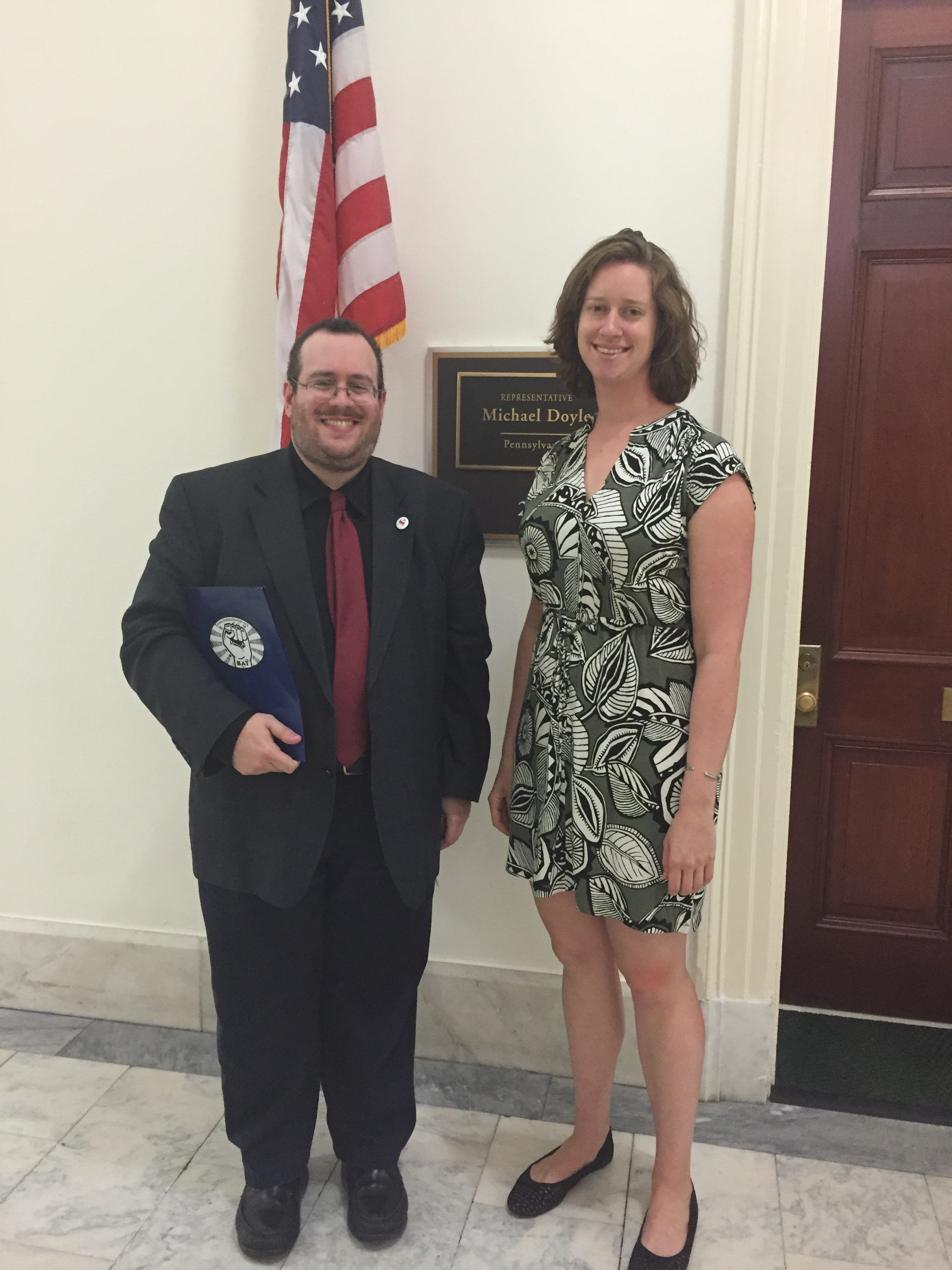
While sitting on the couch in Doyle’s office, he came out of a room to the left of me, asked his secretary for packing tape and then told her he was leaving for the day. It was 2:47 p.m. on Friday.

And they say teachers have easy hours!

I can’t say whether he was actively avoiding me. I made an appointment to see him, but it was never specified if I’d be meeting with him in person or if I’d be with his aide.

For all I know his staff never let him know I was a constituent sitting there on his couch in a suit and tie with a folder perched on my lap. But it didn’t feel good.

Maybe I should have said something. “Congressman Doyle! May I have a moment?”

But I frankly couldn’t believe this was happening. Moreover, he looks a lot different in a purple Hawaiian shirt than he does in all his press photos wearing a suit. I had to check his picture on my phone to make sure I was really seeing this correctly.

I was.

Still the meetings I had with these kids helping my legislators decide public policy were actually quite productive.

Without exception these youngsters were friendly, polite and knowledgeable. They seemed receptive to new ideas, were eager to hear my point of view, asked intelligent questions and were honest about where their bosses sometimes disagreed with me.

In Sen. Toomey’s office his assistants even asked if I was THAT Steven Singer.

“Who?” I said.

And they told me about a famous advertising campaign in eastern PA where a jeweler’s competitors are seen to complain “I HATE STEVEN SINGER.”

I laughed and told them it wasn’t me, but inside I wondered if that might explain the difficulty I had in some circumstances making these appointments. Maybe congressional staff thought I was pranking them. “Steven Singer wants an appointment!? Yeah! I’ll schedule it right after we see Mickey Mouse!”

image

I first met with Devorah Goldman, Toomey’s legislative correspondent on education and other issues. She’d only been on the job for about a year, but her qualifications included a degree in social work and she had worked in a public school resource center.

She was a very good listener. She heard me out as I spoke about a homeless student in my classes this year. She listened as I explained why Common Core is bad policy, why we need equitable school funding, an end to high stakes standardized tests, reigning in charter schools and voucher systems, and an end to judging teachers based on their students’ test scores.

Her boss isn’t exactly known as an education advocate. But she said he would agree with most of what I had said.

The main area of dispute would be charter schools. Toomey is in favor of expanding them so students can escape “failing schools.”

I explained that it was bad policy to try to save some students and let others fall behind. We need to make sure ALL our schools do an excellent job. Moreover, the Senator’s metric for determining which schools are failing is faulty at best.

I explained that traditional public schools often outperformed charter schools, which lack transparency and accountability and are wasting taxpayers dollars.

“We’ll just have to disagree on that point,” she said without explanation.

But she agreed to continue to take input from me and the BATS in the future.
image

At Doyle’s office, I eventually sat down with Hannah Malvin, a political science major who, at least, is from the Pittsburgh area – her boss’ legislative district.

She listened intently to my tales of education woe, even asking follow up questions. But she was surprised I supported the reauthorization of the Elementary and Secondary Education Act (ESEA).

Even the strongest supporters of the rewrite of the federal law that governs K-12 schools would admit it isn’t perfect. However, I would contend that the new version being cobbled together by the House and the Senate appears to be a slight improvement over what we have now – No Child Left Behind (NCLB).

Some educators think even this rewrite doesn’t go far enough to scale back standardized testing (and I sympathize but do not agree with that position). However, Malvin said Doyle had issues with it because it scaled back too much.

This was the issue I heard from Democrats all day. There isn’t enough accountability in the ESEA rewrite. How will we know which schools need extra help, they asked again-and-again.

I tried to explain that all they had to do was look at per-pupil spending. It’s no mystery which kids aren’t getting enough resources. It’s all right there on a ledger.

To her credit she heard me out and agreed to continue to dialogue with me on this subject in the future.

Next, I met up with some fellow teacher lobbyists from New Jersey and we dropped in unannounced on Booker’s office.

It’s not that we didn’t try to make an appointment. His staff never returned our calls and emails.

In fact, last week a fellow teacher not with us on Capitol Hill, Michele Miller,  even got into a scuffle with Booker on Twitter about elementary school funding. He told her to call his office and he would talk to her in detail.

To my knowledge, he never did. However, she was connected by phone to one of his aides. I’m told this is just modus operandi for Booker – strong talk in a public forum but shying away when the cameras aren’t rolling.

In any case, Booker’s senior education and health policy adviser Ashley Eden agreed to talk with us when we showed up to the office. Though her background isn’t in education, I can’t recall exactly what it is in. I do remember she has been doing this sort of legislative work for lawmakers for about 4 years – longer than any other aide we met.

She immediately made us feel welcome and found many areas of agreement. Bookers’ major point of contention – like fellow Democrat Doyle – was accountability.

How do we know which kids need help without giving them standardized tests?

Groan. But at least I had reinforcements: BATS Assistant Manager Melissa Tomlinson and retired NJ teacher extraordinaire Elizabeth DeMarco.

image

Perhaps the most telling moment of the entire conversation was when Eden said Booker just had to back standardized testing because every Civil Rights organization wanted it. She even criticized the New Jersey Education Association (NJEA) for not supporting black and brown students.

We stopped her right there. No. Every Civil Rights organization does NOT support testing. Journey for Justice – a coalition of 38 such organizations, in conjunction with 175 additional likeminded groups wrote to both the House and Senate asking to eliminate testing. Didn’t Sen. Booker see the letter?

Suddenly she remembered it.

She said she read it real quickly and didn’t like one sentence in it so she ignored it.

Which sentence?

Something about expecting poor and minority students to do badly on tests.

I explained that it has nothing to do with thinking these children can’t achieve at the same level as other children. It’s a matter of resources. If Sen. Booker was in a foot race against someone in a Monster Truck, I’d vote on the truck. Doesn’t mean Booker can’t run or that he might not even win. But the smart money is on Big Foot.

I joined the two ladies for their meeting with Smith as well.

His legislative assistant, Katherine Talalas, was perhaps the most knowledgeable aide with whom we talked. Her mother is a special education teacher, her brother is a paraprofessional working in a public school and she went to law school focusing on education issues.

She also took more written notes than any other assistant. With her nothing seemed canned. It was a real conversation about what her boss had done to help special education students and how he might continue to help in the future.

image

I was on my own again to meet with Sen. Casey’s aide, Jared Solomon.

This was one of the most fascinating and perplexing conversations I had all day.

He was warm, friendly, and had a depth of knowledge that was a bit more political than school-centered.

He agreed with almost everything I said. Casey supports 95% of the things that are important to me in education.

I could have smiled and walked away happy, but Solomon was so gregarious he kept talking. We shared our backgrounds.

He proudly admitted that he had been a Teach for America (TFA) recruit. He worked two years in a Baltimore public school and then left. He knew it wasn’t going to be his permanent job. He was emulating his parents who had joined the Peace Corps. He did TFA because he wanted the experience.

Then he moved to the administrative offices of Michelle Rhee’s Washington, D.C., Public Schools.

He only worked there two years – only one of which was under Rhee’s administration – but he respected what they had done. He said he disagreed with 80% of their policies and even quit because he was tired of being blamed for practices with which he didn’t agree. But, he added, the people in Rhee’s administration worked harder than anyone he knew, and he thought they really had the best interests of the kids at heart.

I’m tempted to chalk it up to the same feeling the incredible blogger Jennifer Berkshire (a.k.a. Edushyster) says she gets when she interviews many corporate school reformers. We may disagree with them, but they really do believe this stuff.

But something happened that doesn’t sit well with me. In an unguarded moment of a more than hour-long conversation, Solomon pulled the same stunt Eden did for Sen. Booker. He said all the Civil Rights groups were crying out for testing. But when I called him out on it, he immediately took it back. It was like he, too, knew this was untrue. It was a talking point, quickly to be conceded if called out and then move on to another argument.

I frankly don’t know what to make of it. The arguments are too similar among Democrats and Republicans to shrug off. Each is speaking from a party line script. That can’t just be a coincidence.

And why would Casey, a legislator who supposedly agrees with me 95% of the time on education, hire as his education expert someone who was actively involved in many of the practices that go directly against his beliefs? Why would someone like Solomon, who was part of the corporate education reform movement, really be on my side against these policies?

It’s befuddling to say the least.

Now that it’s all over, I’m so glad I did this.

Will this change the nation’s education policies? Probably not.

But I am only one of hundreds of people who climbed Capitol Hill in the last two days and met with more than 52 federal legislators to fight against the standardization and privatization of education.

And tomorrow we, BATS, will hold a Teachers Congress to further solidify our goals and decide where the great ship of real positive school change should go.

I am so looking forward to it.

But this teacher, soon-to-be BAT Congressman, needs to go to bed.

Here’s to a brilliant tomorrow for our children.


NOTE: This article also was published on the Badass Teachers Association blog.

In ESEA Debate, Education is Caught in the Middle Between the State and Fed

middle-dog-300

Watching Congress debate national education policy is a bit like going to a tennis match and finding a truck and tractor pull has erupted.

“Isn’t this supposed to be about how to make our schools better?” I want to scream.

“No!” someone yells from the stands. “This is about States’ Rights vs. the Fed. Go, States!”

Face palm.

The current brouhaha centers around the Elementary and Secondary Education Act (ESEA), the federal law that governs K-12 schools.

The present version, called No Child Left Behind (NCLB), is a thorough disaster. Thankfully Congress is trying to rewrite the legislation.

However, in doing so the emphasis has been less on making things better and more on deciding who gets to make decisions about schools.

Republican President George W. Bush greatly increased federal control with NCLB, something Democratic President Barack Obama has continued through his education policies.

These days, the GOP has done a 180 and is the champion of states rights to make their own education policies.

Given the Obama administration’s continued emphasis on standardized testing, punitive accountability systems and top down education standards, a move away from federalism seems completely justified.

But this is becoming the heart of the debate even at the expense of children, parents and teachers.

Take Opt Out.

NCLB allows parents to opt their children out of standardized testing, but school districts can be punished for it. If more than 5% of the students in a district don’t take the federally mandated tests for whatever reason (including parental opt out), the district’s Title I funding is put in jeopardy.

In many parts of the country, parents are refusing to subject their children to these tests anyway. They are voting with their feet. They are telling our lawmakers they do not want their children to take standardized tests so often – or in many cases – at all.

The good news is that BOTH of the two drafts of the ESEA allow for parental Opt Outs. However, who gets to decide if doing so will penalize your school?

The House version says that opting out will not hurt your district. Period. But the Senate version leaves the matter up to the states. State legislatures get to decide if withholding your child from standardized testing will have punitive consequences for your district.

This is absurd.

It’s not a matter of States’ Rights vs. the Fed. It’s a matter of parental rights.

As a parent, I should have final say over what my child does or does not have to do in school. There may be limits in extreme circumstances (i.e. vaccines) and in terms of content (i.e. science, history), but in general the rights of parents and children should trump all others.

Ironically the parents who shield their children the most from standardized testing are those who champion it for everyone else. Secretary of Education Arne Duncan is sending his children to a Chicago private school that does not use standardized tests. Likewise, Obama’s children attend a private school free from the influence of his education policies. Same with corporate education reform cheerleaders Governors Chris Christie and Rahm Emanuel.

So many cooks who refuse to eat their own cooking!

But to return to the ESEA, pundits are lauding the Senate Opt Out restriction as a selling point between the versions of the proposed law. The House version has a better Opt Out provision, so you can choose it.

However, it is also poisoned from the start because (unlike the Senate version) it includes a backdoor voucher provision. Called Title I Portability, the House bill essentially would suck up funding now given to impoverished districts and spit it back into the lap of richer ones. Poor kids need additional funding because they go to poor schools that have less money to spend educating them. If a poor child goes to a rich school, she doesn’t need additional funding – the school already spends more to educate her than a poor district ever could. But the issue is a bit of a nonstarter anyway because Obama already has promised to veto any bill containing it.

So the only option is the Senate version, and they just sunk a big turd in it.

But like any factory farm sausage, you often have to learn to accept a few unsavory morsels in with the meat. Even if the final bill includes this Senate provision, it will be an improvement over NCLB. Punishing schools for parental opt outs is the status quo. If even a few  states decide not to punish their schools because of parents choices, that will be a step in the right direction.

It’s just so frustrating to watch our myopic Congresspeople take such baby steps forward.

Why would anyone try to override parental concerns about testing?

Many legislators worry if all students aren’t tested, there will be no way to determine if school districts are properly educating students.

But that is exactly the point!

Standardized testing does not show how well a school is functioning! It only shows how many poor students go to the school. Rich kids score well; poor kids score badly. And academics? There are so many better means of assessing them than multiple choice exams graded on a curve!

If lawmakers really wanted to ensure all students were getting a quality education, they’d hold BOTH the state and federal governments accountable for equitably funding our schools. No more funding based on local wealth. No more poor kids getting less funding than rich kids. No more kids doing without because mommy and daddy have lousy paying jobs.

Parents, children and educators have been crying out to lawmakers about the injustice of using high stakes tests as means of punishing schools for the poverty of their students. THIS is what needs to change. THIS is the essential reform we’re crying out to be enacted!

But no one’s listening. All they care about is which team is winning – Team State or Team Fed.


NOTE: This article also was published on the Badass Teachers Association Blog and it was mentioned in the Washington Post.

Not My Daughter – One Dad’s Journey to Protect His Little Girl from Toxic Testing

FATHERS-AND-DAUGHTERS

I’ll admit it – I was scared.

I’m a nationally board certified teacher with a masters degree in education. I’ve taught public school for over a dozen years. But I’ve only been a daddy for half that time.

Would making this call get my little girl in trouble?

I didn’t want to rock the boat. I didn’t want my daughter to suffer because her old man is making a fuss. I didn’t want her teachers and principal giving her a hard time because of something I did.

But I couldn’t deny what I know.

Standardized testing is destroying public education. It’s stressing kids out by demanding they perform at levels they aren’t developmentally ready to reach. And its using these false measures of proficiency to “prove” how bad public schools are so they can be replaced by for-profit charters that will reduce the quality of kids’ educations to generate profits.

No. There was no doubt about it. I had to make this phone call.

I used my most professional voice on the line with the principal.

“Hi, Mr. Smith. This is Steven Singer. I’m Amy’s father. I know she’s just in kindergarten but it’s come to my attention she’s taking standardized tests, and I’d like to opt her out.”

Before my little girl started school, I hadn’t even realized there were standardized tests in kindergarten. She takes both the DIBELS and the GRADE test.

He seemed surprised, even a bit fearful, but he quickly suggested a meeting with me, my daughter’s teacher, the councilor and a few others to get it done.

It was my turn to be surprised. I had expected to be asked to review the tests before writing a formal letter citing my “religious” reason for refusal. But I guess things are different before students reach third grade. Without legislation mandating a formal process, we needed to meet and discuss like adults.

And a few weeks later, here I was waiting for that meeting to begin.

It wasn’t long before my daughter’s teacher arrived. We chatted briefly about a fire drill and how my sweetheart hadn’t been afraid. Then the councilor, principal and others came in and ushered us into the conference room.

Most of the space was taken up by a long rectangular table surrounded by black leather chairs on wheels. It looked like the kind of place where important decisions are made – a bit imposing really.

We sat down and Mr. Smith introduced me to the team and told them I had some concerns about standardized testing.

He paused letting me know it was my turn to speak. I took out my little notebook, swallowed and began.

“Let me start by saying I think the education my daughter is receiving here is top notch,” I said.

“Her teacher is fabulous, the support staff do a wonderful job, and I could not be happier with the services she’s receiving here.

“My ONLY concern is standardized tests. In general, I’m against them. I have no problem with teacher-created tests, just not the standardized ones.

“It’s come to my attention that my daughter takes the DIBELS and GRADE test. Is that correct?”

They nodded.

“As you know, I teach at the secondary level and proctor the GRADE test to my own students. I’m sure the version given to elementary children is somewhat different, but I know first hand how flawed this assessment is.

“Put simply, it’s not a good test. It doesn’t assess academic learning. It has no research behind it to prove its effectiveness and it’s a huge waste of time where kids could be learning.”

I paused to see them all nodding in agreement.

In many ways, the GRADE is your typical standardized test. Vocabulary, sentence completion, passage comprehension – fill-in-the-bubble nonsense.

Mr. Smith blushed in agreement. He admitted that he probably shouldn’t be so candid but the district probably wouldn’t give the GRADE test if it didn’t receive a Keystone to Opportunity Grant for doing so. When and if the grant runs out, the district probably would stop giving the test, he said.

It’s an old story – the same as at my own district. Two school systems serving high poverty populations bribed with extra money if they spend a large chunk of it on Pearson testing and remediation.

“As to the DIBELS,” I went on, “I had to really do some research. As something that’s only given at the elementary level, it’s not something I knew much about.

“However, after reading numerous scholarly articles on the subject, I decided it wasn’t good for my daughter either.”

When taking the DIBELS, the teacher meets with a student one-on-one while the child reads aloud and is timed with a stopwatch. Some of the words the child is asked to read make sense. Some are just nonsense words. The test is graded by how many words the child pronounces correctly in a given time period.

“My concern is that the test doesn’t assess comprehension,” I said. “It rewards someone who reads quickly but not someone who understands what she’s reading.

“Moreover, there is a political side to the test since it’s owned by Rupert Murdoch. Cut scores are being artificially raised to make it look like more students are failing and thus our schools aren’t doing a good job.

“Finally, focusing on pronunciation separate from comprehension narrows the curriculum and takes away time from proven strategies that actually would help my daughter become a better reader.”

I closed my notebook and looked around the table.

Silence.

I thought that maybe I hadn’t done enough research. I had been too quick and simple.

But the team quickly agreed with me. And when Mr. Smith saw that, I noticed his cheeks darkening.

He stuttered a few words before giving up. “I’ve never had a parent ask to opt out of the DIBELS before,” he said.

He said the DIBELS is a piece of the data teachers use to make academic decisions about their students. Without it, how would they know if their children could read, were hitting certain benchmarks?

“I know I teach secondary and that’s different than elementary,” I said, “but there is not a single standardized test that I give my kids that returns any useful information.

“I don’t need a test to tell me if my students can read. I don’t need a test to know if they can write or spell. I know just by interacting with them in the classroom.”

The fear was still in his eyes. He turned to my daughter’s teacher. “I don’t mean to put you on the spot here, but what do you think? Does the DIBELS provide you with useful information?” he asked.

The look on her face was priceless. It was like someone had finally asked her a question she had been waiting years to answer.

“No,” she said. “I don’t need the DIBELS to know if my kids can read.”

It was all down hill from there.

I agreed to revisit the situation if a problem arose but teacher recommendation will take the place of the DIBELS in the meantime.

Conversation quickly turned to hilarious anecdotes of my daughter’s school antics. What she said to get in trouble last week. How she tries to get adults to put on her coat when she’s perfectly capable of doing it herself.

I left the building feeling really good. This is the way it’s supposed to be.

Before we signed up my little girl for school, I had been nervous about her attending my home district. I wasn’t sure it was good enough for her. The papers said it was a failing school. I wanted so much to ensure my baby would have the best of everything – the best I could provide.

My district may not have the most up-to-date facilities. It may not have the smallest classes. But it has a team of dedicated educators and administrators who are committed to meeting the needs of their students.

Even Mr. Smith’s hesitancy is understandable. I don’t blame him one bit. He probably thinks DIBELS scores make an elementary principal like him look good. Kids starting from scratch only can go up. The scores can only improve.

Moreover, he sat down with me and heard me out. He may not have entirely agreed with me – in fact at times he looked at me like I had a third arm growing out of my forehead – but he respected my parental rights.

It wasn’t until then that I realized the power parents truly have. Mr. Smith might have refused a TEACHER who brought up all of the concerns I had. He’s their boss. He trusts his own judgment.

But I don’t work for him. In fact, he works for me. And – to his credit – he knows that.

I know everyone isn’t as lucky as me. Some people live in districts that aren’t as receptive. But if parents rose up en masse and spoke out against toxic testing, it would end tomorrow.

If regular everyday Dads and Moms stood up for their children and asked questions, there would be no more Race to the Top, Common Core or annual standardized testing.

Because while teachers have years of experience, knowledge and love – parents have the power.

Imagine if we all worked together! What a world we could build for our children!


NOTE: Small details may have been changed to protect the innocent.

ADDITIONAL NOTE: This article also was published in the Washington Post, Diane Ravich’s blog and the Badass Teachers Association blog.