Unwilling to Help Schools, PA Legislature Attacks Teachers

Screen shot 2016-05-13 at 10.48.35 PM
If you live in Pennsylvania, as I do, you must be shaking your head at the shenanigans of our state legislature.

Faced with a school funding crisis of their own making, lawmakers voted this week to make it easier to fire school teachers.

Monday the state Senate passed their version of an anti-seniority bill that was given the thumbs up by the House last summer.

Thankfully, Gov. Tom Wolf is expected to veto it.

As usual, lawmakers (or more accurately their surrogates at the American Legislative Exchange Council (ALEC) who actually wrote the bill) spent more time on branding the legislation than appealing to logic, sense or reason. The bill called HB 805 was given the euphemistic title “The Protecting Excellent Teachers Act.”

Yes, this is exactly how you protect excellent teachers – by making it easier to fire them.

Currently, if teachers are furloughed, those with least seniority go first. Under this new law, teachers would be let go based on their academic rating. Teachers can have one of four ratings: Distinguished, Proficient, Needs Improvement and Failing. Under the new legislation, teachers rated Failing would be furloughed first, followed by those under Needs Improvement, etc. Within those categories decisions would be made based on seniority.

It sounds great – if you know absolutely nothing about Pennsylvania public schools.

First off, in 2015 our rating system found 98.2% of state teachers to be in the highest two rating categories. So at best this bill is next to meaningless.

Second, like virtually all value added rating systems across the country, our rating system is pure bull crap. It’s a complicated measure of meaningless statistics, student test scores and mumbo jumbo that can be twisted one way or another depending on the whims of administrators, dumb luck and the phases of the moon.

A New York Supreme Court judge just ruled this week that the Empire state’s similar teacher rating system is “arbitrary” and “capricious.” But in Pennsylvania our legislators want to make it the axe that slices away teachers from the profession.

Third, the bill isn’t really about seniority at all. It’s about making it easier to fire teachers no matter how good they are at their jobs. Currently, state school districts are not allowed to furlough teachers based on lack of funds. This new legislation aims to remove that impediment.

It makes sense in a way. Pennsylvania lawmakers refuse to properly fund public schools so they have to make it easier to downsize. You’re welcome, taxpayers!

If this bill becomes law, school directors could fire whomever administrators want for whatever reason.

Admin: Mr. Smith, you’re fired.

Smith: Why?

Admin: Um. Financial reasons.

Smith: But I’m rated as Distinguished.

Admin: Not after we adjust the formula, mess with your class rosters and all around juke the stats to show you’re Failing.

Seniority is not perfect, but it avoids all these high jinks. It leaves no questions, nothing that can be easily altered. Either you have seniority or not. And if administrators have been doing their jobs by making sure good teachers stay and bad teachers are trained or let go, seniority correlates with good teaching. If you’ve been in the classroom for a long while, you’re probably a pretty descent teacher. Like anything else, practice makes perfect.

The public has to realize something about teaching at a public school. It is a deeply political job. You are subject to the whims of school directors, administrators, parents or anyone in the community with an axe to grind. You simply can’t do the job without some protections. How else can you fairly grade the school director’s child? How else can you exercise academic freedom to do what you think best if every decision is subject to committee?

This doesn’t mean teachers can’t be fired. They are fired every day. But administrators have to be able to make a valid case. They have to gather evidence to prove you deserve to be fired first.

It is highly ironic that Pennsylvania lawmakers are pursuing this legislation when they have done everything in their power to protect their own jobs first.

You want to talk seniority? Look to the legislature.

Incumbents are almost always re-elected. Why? Not because they do such a great job. They’ve made sure to gerrymander the state. Republicans reside in overwhelmingly Republican districts, Democrats in overwhelmingly Democratic ones.

This is no accident. A few years back, legislators redrew district borders to make sure they’d keep their jobs no matter how crappy they were at governance. It is deeply unfair and undemocratic. The majority of voters do not get a say. Instead, we cater to special interests and protect terrible legislators so they can pass crap like this bill without fear of repercussions during election season.

Do you think lawmakers would have refused to pass a state budget this year until 9 months after the deadline if they thought voters could actually hold them accountable? No way!

Do you think they’d withhold fair funding to the majority of public schools in the state if they thought the majority of voters had a say whether these knuckleheads stayed in power? Absolutely not!

And worst of all, even with Gov. Wolf’s promised veto, the crisis is far from over. When next year’s budget comes up for a vote in June and the Governor again asks for equitable funding for schools, legislators are bound to use HB 805 as a bargaining chip.

“You want some money for our kids’ schools? Then you’d better make it easier to fire teachers,” they’ll say.

Protect excellent teachers? Ha! They’re protecting terrible legislators.

We’ll never have good governance in this state again unless we find a way to redraw our gerrymandered districts. We need a voter referendum, a nonpartisan committee or – here’s a long shot – we need for extremist residents of these gerrymandered districts to revolt against the politicians hiding behind them.

Until then, we will be forever cursed with terrible lawmakers, execrable laws, under-resourced schools and a crumbling state.


Click HERE to find out how your representatives voted on HB 805.

The Only Teaching Evaluation That Matters

Screen shot 2015-06-12 at 10.40.16 PM

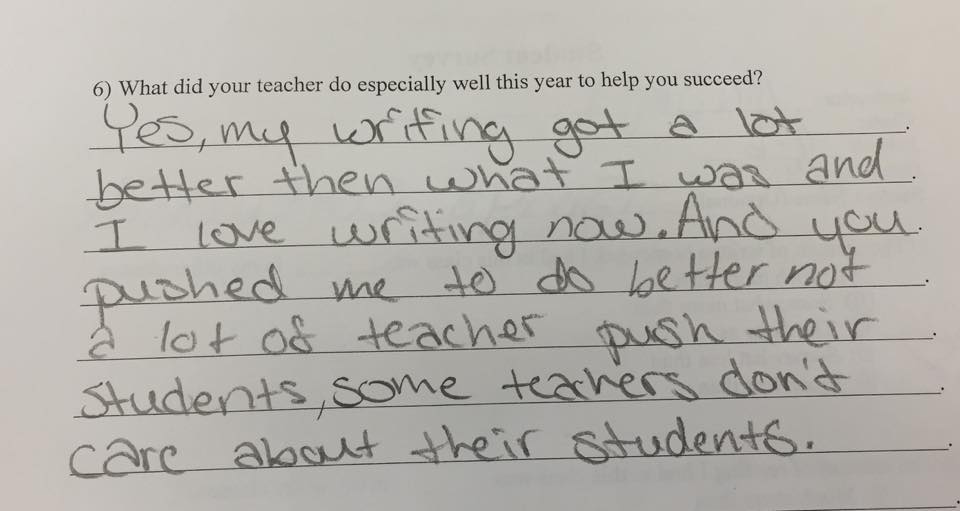
“Yes, my writing got a lot better than what I was, and I love writing now. And you pushed me to do better. Not a lot of teachers push their students, some teachers don’t care about their students.”

11280008_10153046535243860_104612156_n

One of my 8th graders wrote that to me on the last day of school.

I had asked her class to fill out an anonymous survey about my teaching. I said that all year I get to grade THEM, but this was their chance to grade ME.

I made sure to explain that they didn’t need to put their names on it. This would not be graded. Spelling and grammar didn’t count. The only thing I wanted was honesty.

I told them I wouldn’t personally collect the surveys. They should NOT hand them to me; they should put them in a pile on the desk by the door when they leave. I promised I wouldn’t even look at what they’d written until class was over. That way they could feel free to write whatever they wanted. If I did something bad or there was some way I could improve, I wanted them to tell me. If I did something exceptionally well, they should tell me that, too.

“Please help me become a better teacher,” I said.

As an 8th grade public school educator, I get evaluated a lot. I’ve spent countless hours gathering evidence that I’m “proficient” at my job.

I’ve had to endure formal observations, informal observations, H.E.A.T. observations, Student Learning Objectives (SLOs), written explanations of specific lessons with appeals to which Common Core standards I would be teaching – and there always seems to be a new one added to this list next year.

But I’ve been giving a version of this simple student survey to my classes on the last day of school for over a decade.

It’s not something I’m required to do. I don’t share the results with administration. The responses don’t go on file, increase my pay or get recorded in the newspaper. They don’t become part of the district’s ranking in the Business Times. No one is going to withhold funding from my district or close my building and convert it into a charter school based on these results. No one ever will be on television decrying the state of public education referencing these surveys. They are low stakes, class-based, teacher-centered and personal.

But I do this because I think it actually gives me useful information. I really want to know what my students think. That’s one of the things that truly drives my instruction. Not politically motivated standards monetarily incentivized and adopted before they were even completely written. Not standardized tests that measure little more than parental income. Not the latest fad handed down by the superintendent. Not a threat shouted at us through an email or at a faculty meeting.

No. I’m motivated by my kids in the classroom and the answer to the question, “Have I helped you learn?”

The survey is quite simple really. It’s two-sided.

On the front page are 5 multiple choice questions:

1) The amount of written homework I had in this class was                             in my other classes.

A) much more than
B) Somewhat more than
C) The same as
D) Somewhat less than
E) Much less than

2) The amount of reading I had in this class was                                in my other classes.

A) much more than
B) Somewhat more than
C) The same as
D) Somewhat less than
E) Much less than

3) The amount of studying I did for this class was                                 in my other classes.

A) much more than
B) Somewhat more than
C) The same as
D) Somewhat less than
E) Much less than

4) I received                                    instruction and comments on my written work.

A) much more than enough
B) Somewhat more than enough
C) Just enough
D) Somewhat less than enough
E) Much less than enough

5) In this class, I learned                                         in my other classes.

A) much more than
B) Somewhat more than
C) The same as
D) Somewhat less than
E) Much less than

When it comes to homework, students almost always say I give too much. The majority (68%) gave me an A or B.

I only require about an hour of extra-class work a week. I don’t think that’s too bad. However, many teachers give less or none. I go back and forth on the value of homework, myself, but I know that once my students get to 9th grade, they’ll have a tremendous load of it. I figure if I don’t prepare them for that, I’m doing them a disservice. So an avalanche of (one hour a week) homework it remains.

Likewise, kids often say I give a lot of reading. A language arts class should give a substantial amount of reading. So I’m glad most kids (69%) give me an A or B. I require my students to read one self-selected book a month. I don’t think that’s too burdensome. If the book is too tough or boring – hey! You picked it! Pick another one. I also provide them with 15 minutes per day to read in class.

Studying is not something I emphasize. But students are almost evenly divided whether I require too much, just enough or too little. I’m not big on having kids memorize something and then regurgitate that on a test. I’d rather spend time getting them to take good notes that they can use on the test. I’m a big fan of open notes or open book tests. But I hardly ever use the word “Test.” I give frequent short quizzes. I think tests (and even quizzes) are limited evaluation tools. I’d much rather assign a multi-day project. That tells me much more than a brief snapshot of what students were thinking at any one given point in time.

I do assign a lot of essays so I’m always anxious to know if I’ve given enough written feedback. The research seems to show that if you mark every error on an essay, you get diminishing returns. You discourage students. So instead I try to focus on a few trouble areas we’ve already discussed per essay. And students seem to appreciate it. Most of my kids (85%) gave me an A or B or C in this area.

Then comes the cumulative question. How much did you learn? I used to have my classes assign me a letter grade A-E. However, answers were all over the place. When I compared the results with surveys from students who had revealed their identities, I found that kids usually gave me the same grade they received in my class. A-students gave me As. C-students gave me Cs, and so on.

When I changed the question to “how much have you learned?” the results changed drastically. Most students (84%) gave me an A or B. Yes, that’s the result I’m aiming for, but I think it’s a more honest answer, too. It doesn’t focus on grades. It focuses on each child’s assessment of his or her own progress. That’s really what I want to know.

But this side of the survey still provides very limited answers. It is multiple choice, after all. It’s useful for a brief overview but not very deep.

The second side of my questionnaire only has two open-ended queries. Students can write as much or as little as they want to the following questions:

6) What did your teacher do especially well this year to help you succeed?

7) In what areas can your teacher improve his/her instruction?

To be honest, when looking at the surveys, I usually skip right to these questions. This is what I want to see – not a bunch of alphabet soup. I want to know what they really think.

What have I done well? Here are some answers from this year’s kids:

-He understood the learning abilities of certain students and helped them to the best of his ability.

11122062_10153046535213860_65835541_n

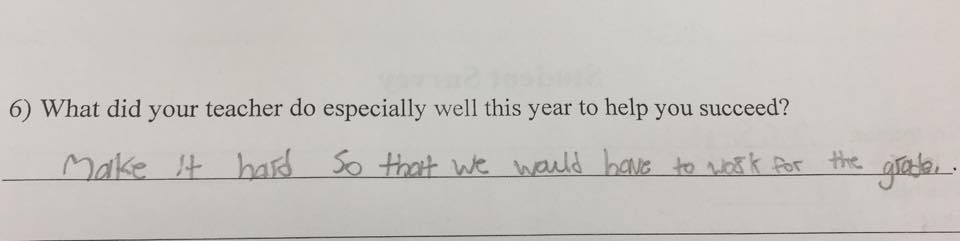
-You made it hard so that we would have to work for the grade.

11208874_10153046535223860_1052817053_n

-Before we could ask him for help, he asked us if we needed help. He’d help everyone, even the person who didn’t ask for it.

11310977_10153046535218860_807785160_n

-He was really good at explaining and pushed me to never give up. Therefore, Mr. Singer is one of my favorite teachers.

11329696_10153046535238860_1253356423_n

-Well, I didn’t like as much work as he was giving us, but then I understood he was trying to help us with our grades and trying to make our grades higher.

11348779_10153046535183860_857789294_n

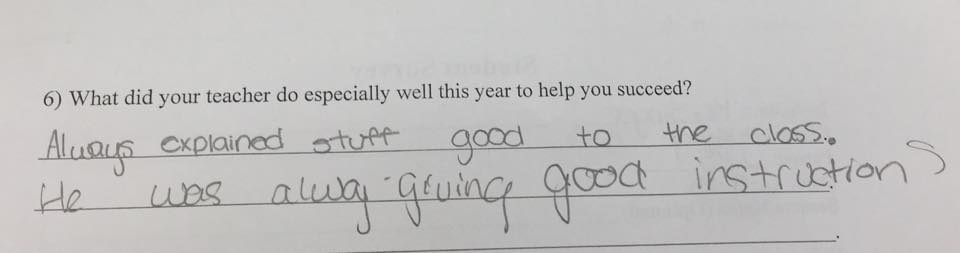
-Always explained stuff good in class. He was always giving good instructions.

11358887_10153046535198860_689871876_n

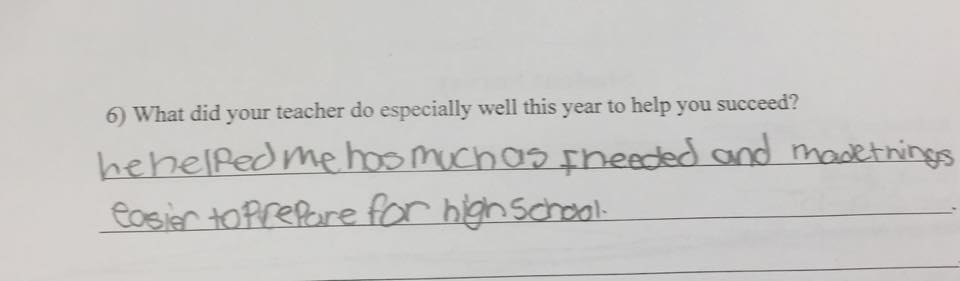
-He helped me as much as I needed and made things easier to prepare for high school.

11418417_10153046535203860_1321510136_n

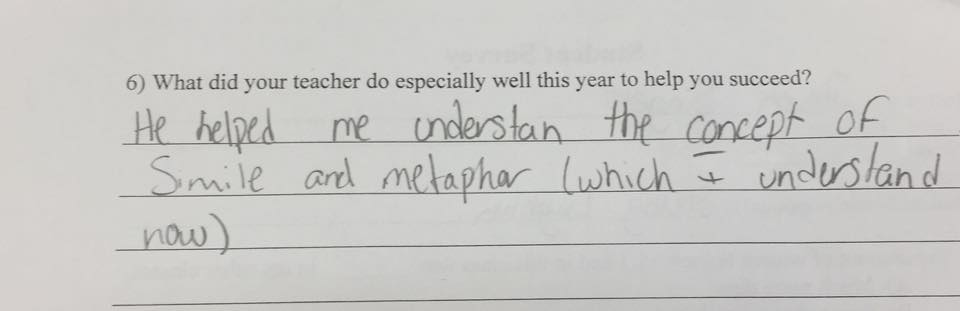
-He helped me understand the concept of simile and metaphor (which I understand now)

11420058_10153046535208860_229100346_n
-What my teacher especially helped me do to succeed is writing essays.

FullSizeRender

I was just floored by these responses. Talk about data I can use! But there was one answer that stood out above even these:

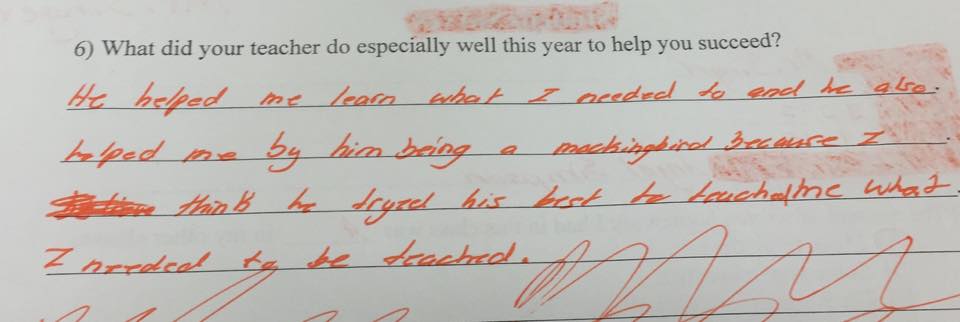
-He helped me learn what I needed to do and he helped me by being a mockingbird because I think he tried his best to teach me what I needed to be taught.

11280625_10153046535248860_1666870003_n

No, she wasn’t literally calling me a bird. She was relating me to our last novel – To Kill a Mockingbird. In the text, some characters are innocent victims. They try to help others but come under fire because of it. The author, Harper Lee, symbolizes them as “mockingbirds.” These include: Tom Robinson, the black man wrongly accused of rape; Atticus Finch, the lawyer standing up for a fair trial despite social criticism; Arthur “Boo” Radely, the recluse who saved lives at the expense of his privacy.

And here my sweet little student was including ME in this venerable list!

That choked me up a bit I can tell you.

When it comes to areas for improvement, my students aren’t the most forthcoming. Answers include:

-I don’t think he needs to because he already does his best to teach us kids what we need to be taught and his instruction is easy to understand.

11418657_10153046535193860_238476660_n
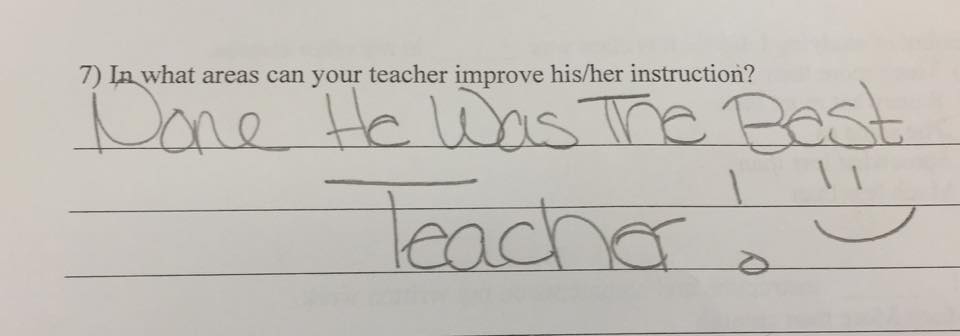
-None. He was the best teacher! 🙂

11419982_10153046535228860_393598543_n

I appreciate the approbation but I wouldn’t mind constructive criticism. I do get complaints about the amount of homework and writing I assign. I also get requests for more free time.

I think if I wasn’t in the room when students took the survey, I might get more criticism. Ideally, I would leave the room for the last 15 minutes of the class, and kids could fill out their surveys. However, this is impractical. I don’t see how I could arrange it given the current climate, lack of subs and skeleton crew staff.

These surveys have given me much to think about over the summer. Maybe I should try to include more group work in next year’s class. Maybe I should revisit the homework situation.

But as June turns to July and then August, I know I’ll be thinking about all that happened this school year.

Some kids came in and out of shelters and juvenile detention. Some were present at a shooting at the local mall. Parents and I had to fight administration over valuing standardized test scores over classroom grades for student placement. The School board enacted a pointless student uniform policy. Students were demoralized and angry over national racial tensions involving Michael Brown, Eric Garner and the Baltimore uprising. Teachers had an active shooter drill for the first time as part of our professional development.

But most of all I’ll think about my students – well, no longer mine – off to the high school and bigger, better things.

For a brief moment I was an important part of their lives and they were an important part of mine. I’ll forget their names. (It’s like my mind is making space for the new ones I’ll have to learn.) But I’ll never forget their struggles and triumphs.

It’s easy to lose sight with all the privatizers and standardizers trying to dismantle our public schools. But even with all the political nonsense, selfishness and small-mindedness, teaching is the best job in the world.

Yes, it really is!

Every day I get a chance to positively impact dozens of lives!

I am truly blessed.

That’s what these surveys tell me.

And that’s why they’re the only evaluation that really matters.


NOTE: Here is a copy of the survey I use in class.

Student Survey

-This article also was published on the Badass Teachers Association blog.