
You Can’t Be Anti-Opt Out and Pro-Democracy

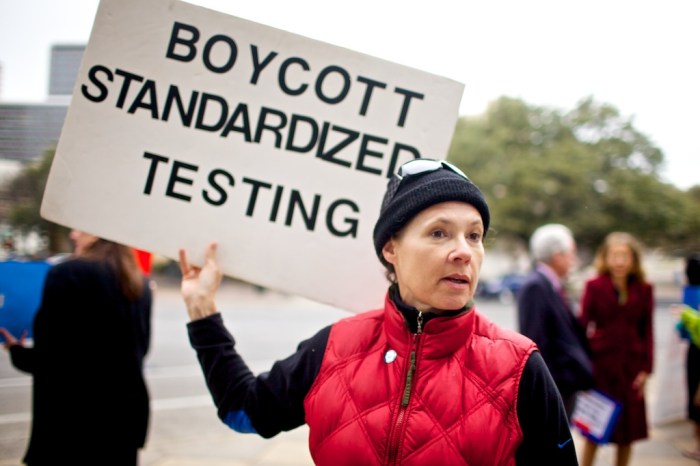
20130220-michels-edy-chamness-sign

Our lawmakers have a problem.

This summer they doubled down on one of the most anti-democratic mandates in the federal repertoire yet they claim they did so to protect states rights.

Here’s the problem.

Every year, hundreds of thousands of public school parents across the country opt their children out of standardized testing.

But Congress voted to keep mandating that 95% of students take the tests.

It all happened with the much celebrated bipartisan passage of the Every Student Succeeds Act (ESSA), the federal law that governs K-12 schools.

While lawmakers made changes here and there to let the states decide various education issues, they kept the mandate that students participate in annual testing.

They didn’t leave that to the states. Whether they were Republican or Democrat, almost all lawmakers thought it was just fine for the federal government to force our children to take standardized tests at least every year in 3-8th grades and once in high school.

If any school district, has more than 5% of students that don’t take the tests – for whatever reason – the federal government can deny that district funding.

Think about that for a moment.

Our lawmakers are supposedly acting in our interests. They’re our representatives. We’re their constituents. They get their power to pass laws because of our consent as the governed. Yet in this instance they chose to put their own judgement ahead of ours.

They could have made an exception for parents refusing the tests on behalf of their children. They just didn’t see the need to do so.

Why? Because they were worried about minority students.

It’s a laughable claim in so many ways.

It goes something like this – without standardized testing, we’ll have no way of knowing if public schools are educating students of color.

Let’s say for a moment that this were true. In that case, we can expect no parent of color would ever refuse standardized testing for his/her child.

First, this is demonstrably untrue. Black and brown parents may not be the most numerous in the opt out movement, but they do take part in it.

Second, in the majority of cases where white parents refuse testing, that would have no bearing on whether testing helps or hurts students of color. If the point is the data testing gives us on black kids, what white kids do on the test is irrelevant.

Third, even if opting out hurt students of color, one would assume that it is the parents prerogative whether they want to take part. If a black parent doesn’t want her black son to take a multiple choice exam, she should have the right to waive that exam and the responsibility would be on her head.

So there is absolutely no reason why lawmakers should have overstepped their bounds in this way and blocked all parents rights about what the schools do to their children.

It is a clear case of governmental overreach. And there are plenty of parents just waiting to bring it to the U.S. Supreme Court for the ultimate Constitutional test.

However, that probably won’t happen for the same reason it never happened through the 15 years of No Child Left Behind (NCLB) which also contained the annual testing rule.

The federal government has never withheld tax dollars based on students not taking standardized tests. officials at the U.S. Department of Education have made threats, but they have never devolved into action.

The bottom line is this: they know how Unconstitutional this mandate is, and they aren’t itching to have it tested in the highest court in the land.

It would open a whole can of worms about standardized testing. What is the federal government allowed to do and not allowed to do about education policy?

The ESSA is an attempt to reduce the federal role, but keeping the annual testing mandate was either a grievous mistake or the last vestiges of federal hubris.

But let’s return to the reasoning behind it – so-called civil rights fears.

Various groups including the NAACP asked for it to be included to protect minority students. Annual testing is the only way, they claimed, to make sure schools are teaching students of color.

It’s nonsense.

There are plenty of ways to determine if schools are meeting the needs of minority students – especially since most students of color go to segregated schools.

Even after Brown v. Board, we have schools that cater to black kids and schools that cater to white kids. We have schools for poor kids and rich kids.

It is obvious which schools get the most resources. Why isn’t that part of this “accountability” scheme? We can audit districts to see how much is spent per pupil on poor black kids vs rich white kids. We can determine which groups go to schools with larger class sizes, which groups have more access to tutoring and social services, which groups have expanded or narrowed curriculums, which groups have access to robust extra-curricular activities, which groups have the most highly trained and experienced teachers, etc.

In fact, THAT would tell us much more about how these two groups are being served by our public schools than standardized test scores. We’ve known for almost a century that these test scores are more highly correlated with parental income than academic knowledge. They’re culturally biased, subjectively scored and poorly put together. But they support a multibillion dollar industry. If we allow a back door for all that money to dry up, it will hurt lawmakers REAL constituents – big business.

So why were civil rights groups asking the testing mandate be kept in the bill? Because the testing industry is comprised of big donors.

Only a few months before passage of the ESSA, many of these same civil rights groups had signed declarations against standardized testing. Then suddenly they saw the light as their biggest donors threatened to drop out.

Make no mistake. Standardized testing doesn’t help poor minority children. It does them real harm. But the testing industry wrapped themselves up in this convenient excuse to give lawmakers a reason to stomp all over parental rights.

The conflict wasn’t between civil rights and parental rights. It was between parental rights and corporate rights. And our lawmakers sided with the corporations.

Let me be clear: legislators cannot be against opt out and in favor of individual rights.

The two are intimately connected.

Our schools have no business telling parents how to raise their kids. But our parents DO have a right to do the opposite. In fact, that’s how the system is supposed to work.

We, parents and citizens, control our schools – not you, our representatives. The principal can’t say you haven’t a right to opt out your kid. He’s just your representative. So is the teacher.

Everyone who works in the school is there to do what you want them to do for your child. Yes, they are well trained and have a world of knowledge and experience that we should draw on. And in most cases, they’re being forced to confront us by lawmakers who are tying their hands and directing them to do the dirty work.

We have common cause. We need to stand with our teachers and principals, our school boards and education professors. We need to stand together against lawmakers who think they know better.

In short, we don’t need lawmakers consent to opt out. They need our consent to stop us.

They get their power from us. They work for us.

And it’s time they get to work and rescind the annual testing mandate.

Blame the Victim – America’s Favorite Pastime

officer-ben-fields

I watched a little girl at school refuse to get out of her seat and get pounded by the police.

I watched a teenager in his car try to zoom away from a cop and get shot dead through the driver’s side window.

I watched all of these things and more from the safety of my cell phone. I wasn’t there in person, but I felt like I was.

And I am not alone.

It seems these two events were on everyone’s lips yesterday.

This is one of the fruits of self surveillance – the selfie, the dashcam, the youtube video. Events that would have been shrouded in the haze of he-said-she said are now public domain. The shadowy corners and back alleys are now just as flooded with spotlights as the most crowded theater on Broadway.

In some ways, that’s a really good thing. So many events that only a decade ago would have been hidden forever are now open to public view.

You’d think that would solve a lot of our society’s problems. No more secrets. No more lies. Just objective facts. THIS is what happened. No denying it. We’ll need context, but facts are facts. Now we can come together and decide with clarity what really happened, why it happened and who’s to blame.

However, things don’t always work out as you’d expect.

We can – in fact – agree on the facts but not necessarily on their meaning.

We all see the same images but we somehow don’t see the same things. The same light enters our eyes and forms the same images, but our brains process those images very differently.

We all see a little girl forcibly removed by an officer of the law. We all see a victim and a perpetrator. But which is which?

We all see a police officer exit his car, approach another vehicle which flees from him before he draws his gun and shoots. But who is to blame – the cop or the driver?

We come to different conclusions. And I think the reasons why depend on deep human truths about each of us.

Which side you take says something about you. It shows what kind of person you are, what you value, what assumptions you make about human nature.

When I watch that South Carolina police officer violently grab the little girl and throw her from the room, I focus on the child. Here is a 16-year-old black teen. She apparently was told to leave the room and refused to do so. She was wrong. But my heart won’t let me side against her.

Maybe she hit the officer. Maybe she was verbally abusive. It doesn’t matter. I don’t think a police officer – or any adult – should manhandle a child. If she had a gun, a knife or some weapon, that would be different. But she was just sitting peacefully in her seat. She probably deserved some sort of punishment for insubordination – but not one that would cause her physical harm. I’d be furious if someone treated my daughter that way. And so I am angry at this police officer and all the bystanders who took pains to ignore what was going on.

In a similar manner, when I watch another South Carolina officer approach 19-year-old Zachary Hammond’s car, I begin on the adult’s side. When the teen starts to drive away, I’m with the police officer. The teen is breaking the law. He should listen to the cop who is reasonably asking to question him. However, when the officer draws his gun, things get muddy for me. As the car drives away and the officer shoots into the window, I demand answers. All ambiguity disappears when I discover the teen was unarmed. He wasn’t pointing a gun at the officer. As you can clearly see, the car was not pointed at the cop. The adult was obviously in no danger.

The officer overstepped his bounds. Despite his claims of self defense, despite prosecutors siding with him, I cannot. It seems to me this 19-year-old boy out on a first date was victimized. Yes, he may have had drugs in his system. Yes, he may have possessed drugs with the intention of selling them. None of that justifies murder by a public servant who is charged with protecting and serving society. It may justify arrest, but it does not give the officer the right to be judge, jury and executioner. Imagine if death was the consequence for your own 19-year-old misdeeds! Far too high a price.

However, there are many who disagree. They side in both cases with the adult, with the police. And I see their point to an extent. Police have very difficult and dangerous jobs. They put their lives on the line to uphold laws that are sometimes ambiguous and of dubious value. But there needs to be limits to their authority.

What I find even more troubling is the dynamic between adults and children. Too often grown ups act as if they can do whatever they want to young people. They can touch, hit, belittle. And all in the name of discipline and order.

But maybe this says more about me than anything else. I care deeply about children. Not only am I a parent, I’m a public school teacher. I’ve devoted my life to helping young people get a good start in life. As such, I think violence against children is the most heinous thing anyone can do. It is despicable beyond words. Harming or killing an adult is bad. But do the same thing to a child and it is much worse.

This should be a shared value. It should be a tenet upon which our society is built. But instead too many of us blame the child or the parents. We’re presented with facts but lapse into assumptions about the child’s upbringing and the parents shortcomings. If the youngsters parents had done this or that, things would have been different. And – heck! – that may even be true! However, unlike our infinite surveillance of moments, the facts are not there. We have no record of mass parental neglect. We have just the opposite. In so many cases parents work multiple jobs to feed and clothe these children. They work night shifts. They take classes to improve themselves. So they can’t be present to the degree they’d like. But here we are passing the blame with nothing to support our assumptions but a feeling in our bellies. And we’re so deadly certain about it.

It’s sad really. We all can see the same events but remain unclear about the blame. We share the same senses and most of the same values. But our life experiences and prejudices make all the difference.

When an adult looks at these situations and sides against the child, I think it shows a terrible blindness. When some people look at the student roughed up in the classroom, they automatically side against her for a variety of reasons – race, gender, age, etc. among them. They have preconceptions about how black people act. Preconceptions about little girls. Preconceptions about poor children and their parents. And frankly it shows their moral judgment to be sick, diseased and untrustworthy.

Likewise, when some people see the teen gunned down in his car, they have preconceptions about the police and young people. Anyone on the other side of a police officer’s barrel is wrong simply by virtue of the direction in which he is pointing his gun, they might say. Police are defined as right. Suspects are defined as wrong. This is deeply troubling. It’s counterfactual. It’s untrue. Police are just humans, too. They can be wrong. They have been wrong. If we always assume they are correct in every situation, we are being morally lazy and willfully blind. We’re refusing to look at the facts and then judge accordingly. We stop at who is involved and not at what they did.

It’s so easy to blame the victim. It’s reassuring and safe. It means nothing is out of sorts with the world. Everything is just as it should be. Only this one person who was beaten by the police or shot dead – only that person is to blame. The social order remains intact and proper and good and justified.

It takes a kind of intellectual and moral honesty to look the world in the face and accept that which is uncomfortable but true. Sometimes those charged with protecting us actually do harm. Sometimes adults know less than children. Sometimes actions are racially motivated.

Because when we watch the world, the world looks back. We reveal ourselves. And sometimes we show the world exactly how ugly and depraved we can be as a nation.


NOTE: This article also was published on the Badass Teachers Association blog.