
Whistleblower Fights New York Officials to Enforce Their Own Child Safety Laws

Cole-Kathy-Steven
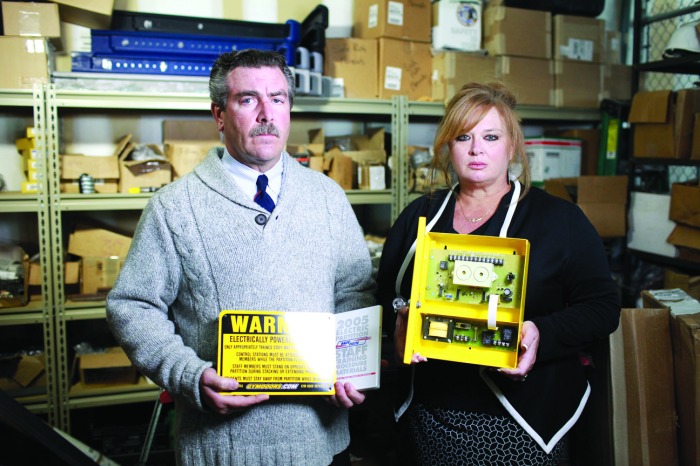
Stephen and Cathy Cole with their device for safe use of gym partitions. Photo: Long Island Business Times.


Are New York city and state officials doing enough to protect public school students?

Kathy Cole says no.

The co-owner of a gymnasium equipment company has been battling with city and state officials to comply with their own child safety laws for over a decade.

Her crusade stems from the crushing deaths of three students in New York and New Jersey over several years.

The problem is motorized partitions meant to close off sections of larger gymnasium spaces. Once set in motion, if safeguards aren’t put in place, and/or the devices aren’t properly monitored, they can shut on children causing fatal injuries.

In 1976 a boy in New Jersey was crushed and killed in the school gym electric partition. James Pesca, 12, was found lifeless, trapped between the cement gym wall and the partition.

In 1991, Deanna Moon met a similar end in her Long Island school. The nine-year-old got caught between the partition when she tried to slip through. Staff could not retract the wall off of Deanna’s neck so fire fighters had to use the jaws of life. It took 27 minutes to free her. Deanna’s mother was called to the scene but was restrained from coming inside and seeing what was happening. The elementary school student lingered in a coma and died nine days later from her injuries.

In 2001, twelve-year-old Rashad Richardson was looking for a teacher to give him a hall pass when he was crushed between a wall and a motorized room divider in his Ithaca, N.Y., school. The gym teacher had started the motorized door, defeated a spring-loaded safety switch, then walked away.

The first two incidents prompted the New York state legislature to require school staff be trained in the usage of these devices. However, it wasn’t until Rashad’s death that safety mechanisms were required to be installed in these partitions. New York is the only state with these provisions.

Since 2001 New York schools have been required to install Life Safety Detection Systems on these partitions to stop them from operating if a child is sensed in their path. Districts are also required to train staff in proper usage of these devices and to ensure staff observe the partitions until they are fully closed.

However, Cole, who owns Gym Door Repairs with her husband, Stephen, says many schools are not buying these mandated devices, correctly installing them or properly training staff. Her company invented and distributes these safety mechanisms.

When she brought this noncompliance to the attention of city and state education officials, she claims she was silenced.

“I was told not to bring it up publicly by high level education officials or I would be put out of business,” she says.

“I was told that compliance with the law was a financial decision and that if another child is killed their family will be compensated for their loss.”

The cost for implementation for these devices is about $37 million, most of which would be paid by New York State Building Aid. Cole’s safety mechanisms were installed in 5,000 facilities – the majority of state and city schools. But many still don’t have them.

Cole estimates there are hundreds of schools missing these devices. They were funded just not installed, she says. Still other schools have devices in place but they have fallen into disrepair and instead of being fixed are simply bypassed putting thousands of children at risk of death or injury.

“You can walk into any 10 New York City schools and 9 would have no training and no maintenance,” she says.

When Cole persisted in bringing these issues to various New York government officials, city and state public schools stopped using her company. The business, founded in 1976, specializes in safety inspection and preventative maintenance service, supplies and repairs to help keep school facilities in compliance with building and life safety codes.

“I was a vendor for over thirty years without incident until I reported this noncompliance,” she says.

“I was told they had had enough of my writing and complaining to the elected officials and that I was now considered a rat…That I would be out of business in New York State and that I had poked my nose where it did not belong.”

The battle has gone to federal court where Cole is suing for violation of her First Amendment rights to free speech.

Her suit implicates both Andrew Cuomo and John King. Cuomo was state Attorney General at the time and is now the state’s Governor. King was state Commissioner of Education and has risen to U.S. Secretary of Education.

The problem is one of accountability. In New York, the state Inspector General has no jurisdiction over the Department of Education. In fact, the Department of Education is the only branch of state government without an inspector general. So the Attorney General is responsible for both investigating and defending the Department of Education. When Cole first brought this issue up, that was Cuomo.

“It’s a conflict of interest,” she says. “There really is no where to go to report fraud and abuse at the highest levels. They investigate themselves.”

Cole condemns Cuomo in both his role as Attorney General and Governor for taking no action to fix the problem. She first brought the matter to his attention in early 2009 and has met with him several times since.

“He let the children of this state be intentionally  endangered and did nothing to protect them.”

King, too, was aware of the issue but did nothing as Commissioner of Education to help enforce the law protecting children, according to Cole.

“King has been there overseeing this,” she says. “He let this noncompliance continue.”

Cole has numerous suits in the courts alleging civil conspiracy, intellectual property theft and tortious interference with her business.

Since the first suit was filed, Cole has watched as long-standing contracts that had been awarded to her company were instead given to a competitor – Young Equipment Sales. As a result, her business has gone from 14 employees to two.

“My business has been devastated,” she says. “It’s disgraceful what’s been done. I’m not looking for sympathy, but I want justice.”

The financial loss to the Great River business owner caused her to further investigate state and city education practices. She implemented numerous Freedom of Information Act requests. In doing so, she discovered further startling school purchasing practices.

Many Long Island districts use cooperative bidding programs called the Board of Cooperative Educational Services (BOCES) to find competitive prices for school supplies. However, Cole found that using this system has resulted in paying much more for goods and services than necessary.

For instance, her data shows that districts using Nassau BOCES are paying $996 for a whiteboard available online for just $740. Also, a security card for charging laptop computers costs $1,910 through Eastern Suffolk BOCES, while it is listed online for just $1,560. Meanwhile, a 12-foot cafeteria table that you or I can buy online for $1,623.99 costs schools $2,275.99 through Nassau BOCES.

Cole’s findings are consistent with a 2012 state comptroller’s report on the cost-effectiveness of BOCES. The report audited four central New York BOCES and found that their costs for services were roughly 56 percent higher than costs for the exact same services being paid by districts not using the service. The availability of BOCES aid does not encourage BOCES to minimize costs or persuade schools to demand cheaper choices, the report concluded.

Eastern Suffolk BOCES responded to the allegations by releasing a statement saying in part, “At times, it may be possible to find a lower price for a product from an alternative source that does not meet the above criteria.” That criteria includes being able to “comply with all specifications, pay prevailing wages, be insured and be able to provide products and services to the large pool of participants in the Eastern Suffolk BOCES bidding program.”

And so it goes.

Meanwhile, Cole continues to fight this battle in the courts and is optimistic she’ll eventually receive justice for herself and the state’s children.

No young person should have to worry about being killed in school equipment and their parents shouldn’t have to worry about the state wasting their tax dollars.


Standardized Tests Every Day: the Competency Based Education Scam

rocketship-charter-schools

IN THE NOT TOO DISTANT FUTURE:

Welcome to class, children.

Please put your hands down, and sit at your assigned seat in the computer lab.

Yes, your cubicle partitions should be firmly in place. You will be penalized if your eyes wander into your neighbors testing… I mean learning area.

Now log on to your Pearson Competency Based Education (CBE) platform.

Johnny, are you reading a book? Put that away!

Are we all logged on? Good.

Now complete your latest learning module. Some of you are on module three, others on module ten. Yes, Dara, I know you’re still on module one. You’ll all be happy to know each module is fully aligned with Common Core State Standards. In fact, each module is named after a specific standard. Once you’ve mastered say Module One “Citing Textual Evidence to Determine Analysis” you will move on to the next module, say “Determining Theme or Central Idea for Analysis.”

Johnny, didn’t I tell you to put away that book? There is no reading in school. You’re to read the passages provided by the good people at Pearson. No, you won’t get a whole story. Most of the passages are non-fiction. But I think there is a fun passage about a pineapple coming up in your module today. Isn’t that nice?

Laquan, you haven’t put on your headphones and started your module yet? You’ve been on module three for the past week. How can you learn at your own rate if you never progress beyond module three?

What’s that? Your mother wrote me a note? Let me see that.

Huh. So she wants to know how come you never get beyond module three. You should be able to answer that question for her, yourself, Laquan. (At least you could get that one right.)

Laquan, tell your mother that you haven’t passed the proficiency standard yet. You’ve taken all the remediation available on the computer program, haven’t you? Yes, that fun game where you answered multiple choice questions and when you got one correct the spaceship blasts an asteroid. And then you took the daily assessment but you just haven’t received a passing score yet. But don’t worry. I’m sure if you continue to do the same thing again today… eventually… you’ll get it right. It’s how the state and federal government determine whether you’ve learned anything on a daily basis.

In ancient times, teachers like me used to make up our own assignments. We’d give you books to read… Johnny, have you started yet? …whole books, novels, literature. And then we’d hold class discussions, class projects, act out scenes, draw posters, relate the books to your lives, write essays. But now all that silliness is gone.

Thanks to the good people at the American Legislative Exchange Council (ALEC), the Gates Foundation, and the Foundation for Excellence in Education, The state and federal government have mandated a much more efficient way of determining student learning. Back in the day, they forced schools to give one big standardized test in Reading and Math every year. Teachers would have to scramble with test prep material to make sure all learners could pass the test, because if students didn’t get passing marks, the teacher was out on her butt.

We’ve done away with such silliness now. Thankfully the government got rid of yearly high stakes standardized testing. What we do now is called Competency Based Education. That’s what this program is called. It’s kind of like high stakes standardized testing every day. So much more efficient, so much more data to use to prove you know this set of basic skills written by the testing companies with hardly any input from non-experts like classroom teachers.

That’s how the district became composed of 100% charter schools. No more inefficient school boards made up of community members. Today our schools are run by corporate CEOs who are experts at finding ways to cut corners and increase profits for their shareholders. And, ugh, make you learn good.

Hm. I seem to be talking too much. No one’s paying me to impart any information. I’m just supposed to make sure you’re all hooked up to the program and making satisfactory daily progress. Otherwise, I’ll be out of a job again.

You laugh, but it’s hard to get minimum wage work like this. Since the U.S. Supreme Court made labor unions all but illegal and public schools instituted CBE programs, teachers like me could no longer demand such exorbitant salaries. Now I make an honest living. Speaking of which, I may have to get out of here a few minutes early today to make it to my shift at WalMart. I’m greeter today!

And if you work hard, someday you can be, too!


NOTE: This article also was published on the Badass Teachers Association Blog and quoted extensively on Diane Ravitch’s blog.


If School Computer Use Reduces Standardized Test Scores, Doesn’t That Prove the Tests are Inadequate?

ipad-kids

Melvin’s hand is up.

He’s a 13-year-old African American with too much energy and not enough self-control.

He’s often angry and out of his seat. He’s usually in trouble. But today he’s sitting forward in his chair with his hand raised high and a look on his face like he’ll explode if I don’t pick him right this second.

So I do.

“Mr. Singer! Can I show my imovie now!?”

This is a first. He hasn’t turned in a lick of homework all month.

“Wow! You’re really excited about this, aren’t you?” I say.

“Yeah,” he responds. “I was up all night finishing it.”

I start to doubt this, but he does look awfully tired underneath that urgent need to share.

Airdrop it to me from your ipad,” I say, “and I’ll put it up on the SMART Board.”

This takes a few minutes.

Let’s face it.

We live in a world of high technology.

Our cell phones have more computing power than the Apollo missions to the moon.

The best, high paying jobs opening up on the world stage require increasing levels of computer literacy.

Yet according to a new study, America’s students don’t succeed as well academically if they have access to computers at school.

How can this be?

How can exposure to new technologies cause a nation of young people to fail at a system supposedly designed to prepare them for the jobs of the future?

Doesn’t real world experience usually make you better prepared?

A future chef would be helped by more time in the kitchen.

A future doctor would be helped by more access to dissection.

But a future computer-user is hurt by more time at a computer!?

Something is very wrong here.

But according to a new study by the Organization for Economic Cooperation and Development (OECD), students who use computers more at school earn both lower reading and math scores on the Program for International Student Assessment (PISA).

The organization studied 15-year-olds across 31 nations and regions from 2012. The study just released in September even controlled for income and race.

Yet here in my classroom I see the exact opposite. Computer use increases my students test scores – on my teacher-created tests.

Melvin’s movie was ready. He had been tasked with explaining the differences between external and internal conflict. I pressed play.

High adrenaline music poured from the speakers. Pictures flashed across the screen of boxers and football players.

“This is external conflict,” came rushing forward followed by a brief definition. Then an image of Homer Simpson with an angel and devil on his shoulders. “This is internal conflict,” came zooming by our eyes.

The film might not win any Academy Awards, but it was pretty impressive work for 40 minutes of class time and however long Melvin decided to spend at home.

It’s the kind of thing my students never could have done before they each had ipads. And when they took my test, few of them got the questions wrong about conflict.

Yet according to the OECD, I was somehow hurting my students academically!?

Even in my high poverty district, students have always had access to technology. But the nature of that technology and how we use it has changed dramatically this school year.

I used to have eight computers in my classroom, but they were slowly becoming obsolete and inoperable. Some days they functioned best as extra illumination if we shut out the overhead light to show a movie.

Still, I tried to incorporate technology into my lessons. I used to have my students make their own Webpages, but reserving time in the computer lab became almost impossible. And even then, the district couldn’t afford to keep the devices in the lab updated enough to run anything but the most rudimentary software.

The one lab in the building that had new devices was reserved almost exclusively for a drill and kill test prep program we had received a state grant to operate. THIS was the apex of school technology – answering multiple choice look-a-like questions. It bored students to tears and didn’t even accomplish the stipulated goal of increasing standardized test scores. Yet we were blackmailed by the state government into initiating the program so we could gain additional funding to keep the school operational.

THIS is the kind of technology use you’ll find at most poor schools like mine. And it’s one of the reasons the authors of the OECD study came to their conclusion. It’s also one of the reasons why teachers like me have been skeptical of technological initiatives offered to impoverished districts.

However, the best use of technology is something quite different.

This year my district received a gift of ipads for all the students, and it’s changed everything. No longer do I have to beg and plead to get computer lab time for real high tech lessons. I don’t need it. The technology is already in the classroom in the palm of their hands.

But policymakers clutching their pearls because of this study have already began to make changes to international school curriculum. Schools in Asia have begun cutting back on student computer time. Should America follow suit?

Absolutely not.

The problem clearly is not computers. It’s the antiquated method we use to measure success.

Standardized testing has been around since 206 BC as an assessment for civil servants in ancient China. The same process spread to England in the 19th Century and then to the United States during WWI. Through all that time, the main process of rewarding rote learning through multiple choice questioning has remained the same.

But the world hasn’t. We’ve moved on a bit since the Han Dynasty. We no longer live in a medieval society of peasants and noblemen where the height of technology is an abacus. We live in an ever-changing interconnected global community where a simple search engine provides more information than could be stored in a thousand Libraries at Alexandria.

How can we possibly hope to rely on the same assessments as the ancients? Heck! Even as far back as 970 AD, standardized testing was criticized as being inadequate.

But a global multi-billion dollar industry relies on these primitive assessments. It’s the basis of an exceedingly lucrative business model.

So it shouldn’t be surprising that the same people who promise standardized testing and Common Core will best prepare students to be college and career ready are passing the blame.

They claim this report isn’t an indictment of their cash cow industry. It’s a warning against over-reliance on computers. And, yes, they’re right that technology is not a panacea. The mere presence of a computer won’t make a child smarter. Likewise, the mere presence of a book won’t make a person wiser. One must know how to use said computer and book.

But what I’m seeing in my classroom primarily is an opportunity – not a danger. Students like Melvin are more engaged and willing to take chances. They have greater freedom, intrinsic motivation and excitement about learning.

Many times when sharing Keynote presentations, after one or two, students ask to have their work back so they can improve them. That doesn’t happen with test prep.

They often elect to take ipad assignments to lunch and work on them between bites. That doesn’t happen with Pearson worksheets.

I’m not saying it’s easy. It’s up to me, my colleagues and administration to ensure technology is used to its full potential. Never should these devices be time fillers or babysitters. Nor can they ever replace the guidance of a thoughtful, creative educator to determine their best use. Teachers need to create and assign lessons that promote creativity and critical thinking skills.

Education professionals are constantly advised to individualize their lessons to meet the needs of diverse learners. Technology allows them a unique opportunity to do so. With district ipads I can talk to an English Language Learner in his own language. A struggling reader can have the device read test questions aloud. A student with poor motor control can type journal responses and have his writing be understood.

And these opportunities for enrichment don’t even need to be planned ahead of time. For instance, when discussing a short story about a character that was exceedingly proud, one of my students brought up the Seven Deadly Sins. She wasn’t exactly sure what they were or how exactly they related to pride, but one of her classmates quickly looked it up on her ipad. Then another found a medieval woodcarving to which someone else found a related manga text. The subsequent discussion was much deeper and relevant to these children’s lives than it would have been otherwise. And none of it was pre-packed, planned or standardized. It was individualized.

This is really no surprise. Administrators in charter or private schools aren’t asking themselves if they should close their computer labs and put their devices on ebay. They know the value technology can provide in the classroom, but they aren’t constrained by high stakes testing.

Even rich public schools don’t have to worry to the same degree because their students already score well on federally mandated assessments – after all, standardized tests are designed to favor children with wealthy parents over those from impoverished or minority backgrounds. It’s only in poor school districts where technology is either second hand or a charitable donation that administrators and school directors are being pressured to cut back.

As usual, best practices for the privileged become questionable when applied to the poor and minorities. You want technology? Prove it will boost your test scores!

It’s nonsense.

Think about it. Even the best use of computers won’t boost standardized scores. Computer skills aren’t on the tests.

Nor could these things ever be assessed effectively in this manner.

Yet such skills are exactly what education researchers tell us demonstrate the deepest levels of understanding and an ability to meet the demands of the best jobs of the future.

I wonder what Bill Gates thinks of this report. The Microsoft co-founder is also one of the biggest advocates for school standardization. If he had to pick between his two favorite children, which would he choose – laptops or Common Core tests? Maybe we needn’t wonder. His own children go to a private school with no standardization and a plethora of technology.

There comes a time when you have to admit the truth staring you in the face: standardized tests are poor measures of academic achievement. They are suitable only for turning our children into factory drones. They are for pawns, patsies and robots.

If we really want to prepare the next generation for the jobs of the future, we need to scrap high stakes testing. We need to invest in MORE technology, not less. We need to ensure technological lessons are being overseen by trained educators and the devices aren’t used as a babysitting tool. As such, we need to provide teachers with support and professional development so they can best take advantage of the technology they have.

America can prepare its children for the world’s high level management and administrative positions or we can prepare them to do only menial work that will soon by replaced by machines.

Computers do the former. Tests the latter.

Choose.


NOTE: This article also was published on the Badass Teachers Association blog.