Top 10 Education Blog Posts (By Me) You Should Be Reading Right Now!

computer-people-png-300x202

Chill the champagne, call the babysitter and get out those funky illuminated 2015 party glasses! It’s New Year’s!

What a year it’s been!

Good ol’ 2014 was a rough one in many ways. National news was bloodier and more violent than usual.

But in response, social activism was on the rise. People were taking to the streets to protest in numbers not seen since the Civil Rights movement. Corporate Education Reform was on the wane. National teachers unions were calling for the resignation of Arne Duncan, our U.S. Secretary of Education. Pennsylvania lost its worst governor in my lifetime – Tom Corbett. And they’re making a new Star Wars movie!

But perhaps most important of all, Gadflyonthewallblog was born!

I never thought I’d be a teacher-blogger. But here I am.

I used to just read the amazing work of people like Jessie Ramey, Peter Green, Jersey Jazzman, Anthony Cody, Diane Ravich and so many more.

They gave me ideas, made me want to speak out. I’d start posting things on Facebook. A status update here, a meme there. Until one day I starting writing something that was so long, I couldn’t fool myself anymore.

I had written a blog post. There was nothing for it, then, but to start a blog.

I promised myself if I took that step I would publish at least once a week as long as people were reading what I wrote.

At first, I’d get 50-100 page views. That quickly turned to 1,000 – 2,000 and then sometimes much more.

Now, more than 40,000 hits later, with 5,785 followers, I’m flattered beyond words that people seem to like what I’ve been writing. I hope I’m helping add to the conversation about education, social justice and anything else I write about.

To celebrate my half year as a blogger – I started all this in July – I’ve compiled a Top 10 List of my posts.

I hate to use data to rank my students, but I found it very helpful here in selecting which articles to include.

Like all data, it has its limitations. For instance, many of these articles were reblogged or published in many different venues – the Washington Post, LA Progressive, Diane Ravich’s blog, Public School Shakedown, the Badass Teachers Association blog, etc. Since I don’t have access to their statistics, I couldn’t include them in my calculations. As a result, a post may be lower on my list but it actually received more views overall if you include everywhere it was published. I suspect this is true in some cases but can’t prove it.

What I ended up with – in ascending order – are the most viewed posts on my blog site.

I hope you’ll find something interesting you haven’t read before or perhaps an old favorite to read again. Or maybe you can just share this list with a friend to let them know how totally super awesome my blog is!

Anyway, here we go – the Top 10 Posts of 2014 from Gadflyonthewallblog:


10) LIFE OR DEATH PROFESSIONAL DEVELOPMENT

Published: Aug. 2312184861-standard
Views: 1,022

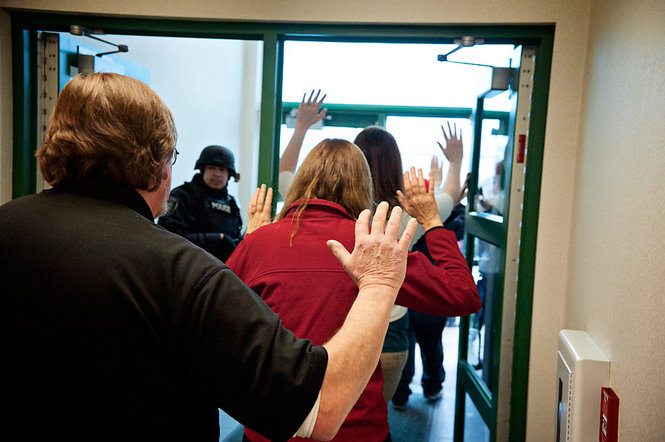
Description: Before the first day with students, my school had an active shooter drill. This is how it went down.

Fun Fact: This piece was chosen for a Freshly Pressed award by WordPress.com. It has the most likes (145) and the most comments (31) of any article I have published so far.


9) FIGHT CORPORATE EDUCATION REFORM AND MEME IT

Published: Oct. 19 20-beach-sea-photography
Views: 1,053

Description: Just a bunch of education memes I made – most of them before I started the blog.

Fun Fact: This was meant to be a toss off – somewhere for me to keep track of my memes. It was unexpectedly popular and many of these memes keep popping up in unexpected places to this day.


8) TOXIC TESTING MY KINDERGARTEN TOT – OR DADDY DON’T PLAY THAT

Published: Dec. 15  76754238

Views: 1,071

Description: It’s a surreal experience for a teacher to attend a parent-teacher night for the first time as a parent. From a daddy’s eyes, there’s no choice but to question the value of standardized testing in Kindergarten.

Fun Fact: This was so personal it was very hard to write. I didn’t think anyone would care. I was wrong. It’s been published widely beyond my blog.


7) TRACKING, TESTING AND THE MYTH OF MERITOCRACY

Published: Sept. 7  sad student
Views: 1,316

Description: When one of my students earned outstanding grades in my class last year but was denied a place in this year’s advanced class because of low standardized test scores, I took action.

Fun Fact: This piece really angered people on Facebook for the injustice this student faced. I received a plethora of comments and messages from others who had gone through similar situations.


6) A MOMENT OF SILENCE FOR MICHAEL BROWN

Published: Nov. 26  140824-michael-brown-4p_98a645e4e00131864161045b0edd09e7
Views: 2,052

Description: My students were so depressed by the Grand Jury decision not to hold a trial for the police officer who killed Michael Brown, I had to address it in class.

Fun Fact: I received more hate mail for this article than any other. It was widely published – even in the Washington Post. I had to stop reading the comments after a while. Many thanks to those who don’t want my head for doing this.


5) THE REAL AMERICAN EDUCATION CRISIS

Published: Aug. 3  Arne Duncan

Views: 2,131

Description: I got so sick of hearing corporate education reformers go on TV and talk about our failing schools. Yes, they’re failing because of education policies that don’t work that we refuse to replace.

Fun Fact: This was something of a slow burn. At first, it didn’t receive much attention, but I was surprised to see that views continue to trickle in daily.


4) MERRY CHRISTMAS. WE’RE STEALING YOUR SCHOOLS

Published: Dec. 27  feb5a53244c611e48eca12313d21419c

Views: 2,949

Description: My continuing coverage and outrage at the Commonwealth of Pennsylvania’s overreach to steal York City Schools away from taxpayers and give it to a failed charter school operator.

Fun Fact: My most recent post, widely published. I have been one of very few writers sounding the alarm for months. Finally, the nation seems to be paying attention.


3) THE BEST EVIDENCE AGAINST COMMON CORE

Published: Oct.4  Classroom-Management2
Views: 3,121

Description: Common Core is nonsense. To see that all you have to do is step in a classroom. Unfortunately that’s one thing the authors of CCSS have never done.

Fun Fact: I knew I had a winner from the second I posted this. It took off like a rocket. It has also been widely published and debated – one of the most popular pieces on the Badass Teachers Association blog. This is the only article I know of to inspire another blogger to write a complete piece attempting to debunk it.


2) CHECK YOUR WALLET – YOU TOO CAN BE AN EXPERT ON TEACHER TENURE

Published: Oct. 24  0714_wallet-open-money_485x340

Views: 6,070

Description: When Time Magazine promoted tech millionaires’ plan to improve education by attacking teachers, I exploded in fury. The result is this angry diatribe taking them to task point-by-point.

Fun Fact: Hugely, popular, widely published and almost universally praised by teachers and teachers groups. This lead to my involvement helping craft a response to the Time article published in the magazine along with my fellows at the Badass Teachers Association.


1) THE FINAL STRAW: CANCEL OUR LABOR CONTRACTS, WE CANCEL YOUR TESTS

Published: Oct. 11  the-straw-that-broke-the-ca1-300x273
Views: 10,910

Description: When Pennsylvania cancelled its contract with Philadelphia teachers, I saw the writing on the wall. If they can do that, teachers need to stop giving them the ammunition. They need to refuse to proctor the standardized tests being used to unjustly label our schools failures and justify the elimination of our collective bargaining rights.

Fun Fact: This is easily my most popular article yet. For a few weeks I was something of a folk hero. I saw my words memed by others and this piece appeared almost everywhere. Originally, I had debated publishing it at all thinking, “Who am I to tell teachers what they should do?” But my advice turned out to really hit a nerve. Teachers are dying to opt out of standardized testing. All it will take is one spark. One tiny spark.


Toxic Testing My Kindergarten Tot – or Daddy Don’t Play That

76754238

We were late.

At least it felt that way as my wife dragged me through elementary school hallways.

Racing past me were walls of multicolored palm print turkeys. Was it my imagination or did their googly eyes seem somewhat disapproving of my lateness and attire?

It’s my first parent-teacher night, I almost protested.

At least, it was my first as a parent and not as a teacher.

I was used to sitting on the other side of the table, notes organized in a neat little pile.


“Oh, you’re Jimmy’s father? So GLAAAD you could make it.”


But tonight I wasn’t Mr. Singer, teacher extraordinaire.

I was just a daddy. And Mommy was pulling my arm free from its socket trying to get us to the classroom on time.

There was just so much to see, frankly. I had never realized before how little of the school parents usually get to observe. At the district where I teach, I know my building like a second skin. But we don’t live where I work.

As parents, we’re invited into the auditorium, gymnasium, offices, and athletic fields. But we rarely get a peek at the inside of a classroom. You know? The place where our children spend most of their days!

“Oh my God! Is that her music lab? It looks amazing! Honey, take a look at all the instruments…”

But she just gave me the Eyes of Death. It was time to go.

We arrived at my daughter’s classroom exactly on time, thank you very much.

The teacher met us at the door wearing a Disney print dress beneath a wide smile. Hands shaken, greeting given, she immediately ushered us into seats.

They were miniature toddler seats – perfect for Kindergarten butts, a bit condensed for mine. But they held up heroically.

I already had met the teacher during an open house at the beginning of the year. She seemed an excellent educator and my little sweetheart loved her.

However, being in the parent’s seat listening to her presentation was both enlightening and bizarre.

It was surreal to sit there and listen to a report about this child’s academic life as if I had no idea what she was like. After all, I was her first teacher. I taught her to walk and use the potty. Even today she refuses to touch her homework unless I’m there to help.

Yes, she has homework almost every night. In Kindergarten, yes. After a full day in school, too.

When I was in her grade, my mother would usually walk me home at noon for a nice lunch and an afternoon of play. My daughter, on the other hand, eats in the cafeteria. For free! All the students get free lunches regardless of parental income. And then they return to class for a full afternoon of study.

She loves it, though. One of her favorite parts of the day is lunch. She might not tell me what story the teacher read to the class, but she’ll always tell me what she ate for lunch.

Spoiler: it’s usually chicken.

Anyway, her teacher was sitting across the table from us giving a full report on our daughter’s daily activities. It was mostly positive but being a teacher, myself, I could pick up on a few euphemisms.

“Oh! You’re daughter is very vocal!”

Translation: she won’t shut up.

“She is so independent!”

Read: defiant.

But I know my little girl. The teacher wasn’t telling me anything new.

I really enjoyed the personal stories. 

Apparently my little one sometimes uses her feminine whiles to get the boys to take out her pencil or open her book for her.

Little scamp!

I loved the story where my sweetheart darling child asked the teacher to take her home after school. Not home to my house, either. Home to the teacher’s house.

“Mommy and Daddy won’t mind,” she allegedly said.

We all had a good laugh about that one.

And then out came the standardized test scores.

That’s right. In Kindergarten!

I guess I should have expected it. Somewhere in my thick brain I knew standardized testing had trickled down all the way to Kindergarten. But it was so early in the year. I hadn’t expected it to happen yet. I had vague thoughts about opting her out of all that nonsense.

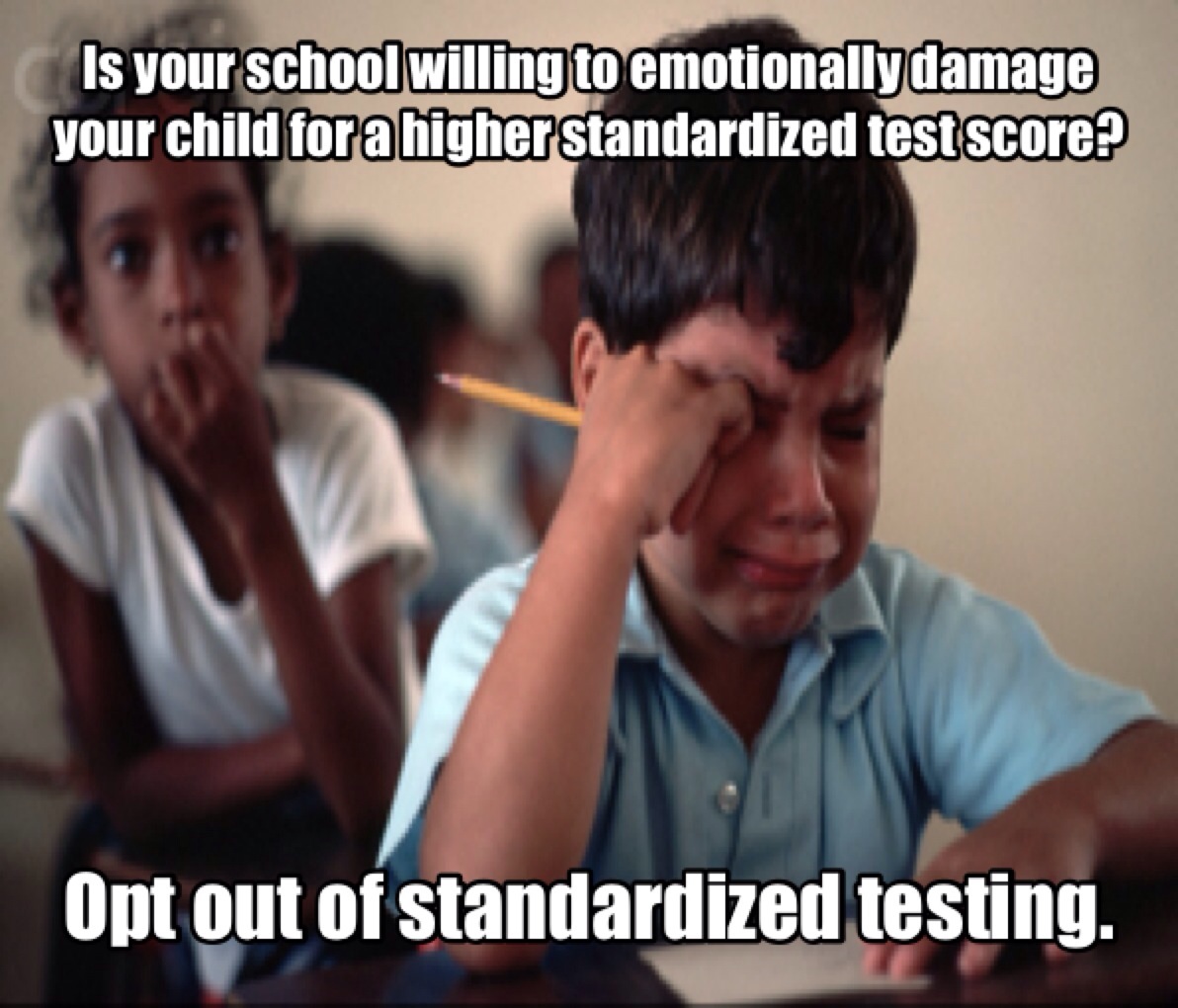
Many schools try to keep it a secret but your kids don’t have to participate in standardized testing. You can choose to opt them out under a religious exemption. All it takes usually is a visit to the principal and a request in writing.

But it was too late. My daughter’s scores were here already.

So I looked at them.

In my mind, my little girl is pretty advanced. After all, she’s literate. And, yes, I’m proud of that fact.

While most of her classmates are still fine-tuning the alphabet, my baby can already read a “Biscuit the Puppy” book from start to finish. And she can write, too. Just the other day she wrote me a note saying that she “LOVES DADDA.” The A’s looked a bit like H’s but I got the message.

However, when we looked at the test sheet, most of her scores were in the proficient range – a few advanced. The teacher said that unless my girl was reading chapter books at this age, she couldn’t score much above proficient.

That’s Common Core for you. They call it “rigor.” You’re at the head of the class and you’re only okay. This girl has had three years of preschool, we read with her everyday, practice writing, math, arts and crafts, etc. But the standardized test scores say, “Eh. You’re alright. Nothing special.”

It’s a good thing she’s too young to get these scores, herself. She’d be crushed.

Don’t mistake any of this for objectivity. I’m not a teacher here. I’m a daddy and daddy’s aren’t objective at all.

The teacher must have seen the look on my face. She conspiratorially let us in on her doubts about testing kids at this young age. She told us how she split up the testing period to fit the kids’ attention spans, and how it just sapped their energy and bored them, anyway.

I felt horrible. Here I am, Mr. Anti-Corporate Education Reform Blogger Guy, but my precious baby is losing time with blocks and “Clifford: the Big Red Dog” in favor of fill-in-the-bubble testing designed to make her prestigious achievements look small and mundane.

I should have known. While she was testing in her school, I was probably in my own classroom proctoring the middle school version of the same darn test. It’s one of many practice tests kids take before the real thing.

I wanted to ask the teacher to tell me more, to tell me if she supported opting my daughter out of future tests. But the look on her face didn’t invite further questions.

It’s a difficult situation. Most teachers hate the toxic testing regime. They know that multiple choice bubble tests are a terrible indicator of content knowledge – not to mention developmentally inappropriate for children my daughter’s age. But Wall Street hedge fund managers seeking to make a quick buck lobby politicians who put pressure on superintendents who order administrators to force teachers to do things under the guise of education that are really just about corporate profits. And if teachers in the workplace are too vocally against this scheme, they put a target on their backs.

I didn’t want to do that to my daughter’s teacher. I trust her. I know she’s a good teacher, I know my daughter loves her and I know where she’s coming from even without her vocalizing it.

Anyway, the meeting was quickly over. With a laugh and a smile, the teacher ushered us out the door so she could begin her next conference.

How many times have I been on that side of things – talking to parents about their kids? At least several hundred times. Almost definitely more.

But I left that meeting with a new sense of purpose.  I would opt my daughter out of her next standardized test. I would not allow the testing machine to feed on my precious child’s data.

I would listen to her teacher and my own misgivings.

Parent-teacher conferences were over. But it’s way past time to arrange a conference with the principal.

I grabbed my wife’s hand and pulled her after me.


This article has also been published on Public School Shakedown, LA Progressive and Badass Teachers Association blog.

Fight Corporate Education Reform and Meme It!

20-beach-sea-photography

Sometimes words alone aren’t enough.

Has this ever happened to you? You’re arguing with someone and just not able to get your point across. You know if you could just show them the picture in your brain, they’d understand what you meant with the force of a bullet. But lacking psychic abilities, you’re reduced to the efforts of your poor twisted, tangled tongue.

That’s where memes make all the difference.

A meme is “an idea, behavior, or style that spreads from person to person within a culture.” Though originally coined as a term to describe genes, the expression has expanded to encompass anything that can carry ideas from one mind to another with a mimicked theme.

I know that sounds daunting, but you’ve probably seen hundreds or thousands of memes already. At least half of the images on Facebook and Twitter are memes – Grumpy Cat, Condescending Wonka, One Does Not Simply, Conspiracy Keanu and enough facepalms to break your jaw.

As a meme-maker, myself, I’ve been surprised that some of my efforts have taken on lives of their own. By no means am I a master at the art, but a few of my 50 plus memes have been surfing the Internet on their own for a year or more. I’ll go on a nationwide education organization’s Facebook page and see my little meme staring back at me. “Hi, Daddy!”

I leave you with an experiment. Here is a collection of some of my favorite creations. I’ve limited myself here to memes on the subject of education. I’ve also organized them to some degree based on subtopics.

Please feel free to browse. If you see a meme that you like – that helps make your point about the errors of corporate education reform – you have my blessing to take it. Post it on your Facebook page, in a tweet, on Tumbler, whatever you please. Send my little message off again into the great sea of interconnected webs and communication nets. Maybe one day it’ll return to me.

Happy shopping!


STANDARDIZED TESTING
1
IMG_0975.JPG

2
IMG_2013.JPG

3
IMG_1262.JPG

4
IMG_1782.JPG

5
IMG_1903.JPG

BUDGETS
6
IMG_1764.JPG

7

IMG_2040.JPG

8
IMG_0559.JPG

COMMON CORE
9
IMG_1972.JPG

10
IMG_1295.JPG

11
IMG_1710.JPG

TENURE

12
IMG_1800.JPG

13
IMG_1696.JPG
14
IMG_1603.JPG

VALUE-ADDED MEASURES (VAM)

15
IMG_1489.JPG

16
IMG_1106.JPG

17
IMG_0476.JPG

CORPORATE EDUCATION REFORM

18
IMG_1817.JPG

19
IMG_1492.JPG

20
IMG_0901.JPG

ACCOUNTABILITY

21
IMG_2023.JPG

22
IMG_2101.JPG

23
IMG_1072.JPG

PENNSYLVANIA ISSUES
24
IMG_1793.JPG

25
IMG_1776.JPG

26
IMG_1222.JPG
27
IMG_0919.JPG
28
IMG_1420.JPG

MISCELLANEOUS

29
IMG_1927.JPG

30
IMG_1891.JPG

31
IMG_1950.JPG

32
IMG_1392.JPG

33
IMG_1446.JPG

34
IMG_1912.JPG

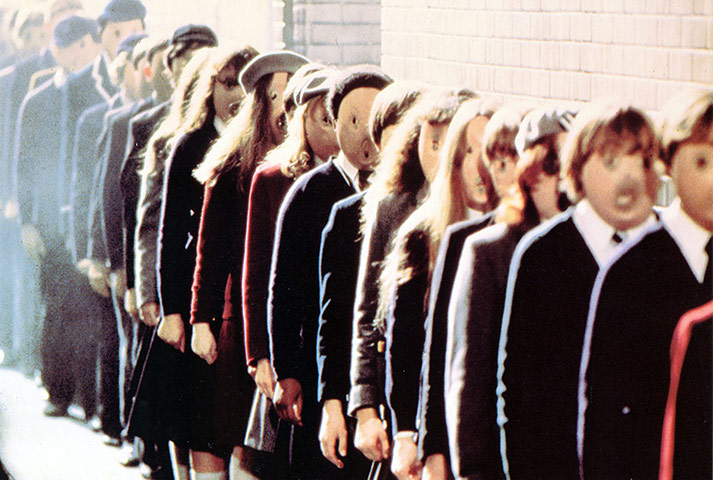
Standardized Dress – School Uniforms and Conformity as Social Norm

Pink-Floyd-The-Wall1982The-groups-musical-film-starred-Bob-Geldof-and-Bob-Hoskins

It was just a normal Monday. Two emotionally disturbed students chased each other into my classroom playing keep away with each others’ belongings.

I stopped them, reprimanded them and sent them to opposite corners of the room. Meanwhile the rest of the class hadn’t bothered to begin their warmup activity. I explained the assignment and got them back on track.

Finally, a girl sitting in the front row raised her hand and offered a solution to the problem on the board.

We were back in business and learning could continue.

At the end of class, an administrator stormed in. There was an urgent problem that needed solving immediately.

It wasn’t that the emotionally disturbed students were misplaced in the regular education setting. It wasn’t that the other students had needed redirection. It was the girl in the front row.

She was wearing a pink shirt!

When board members enact a school uniform policy – as was just accomplished at my district – they turn every educator in the building into the fashion police.

Individualized instruction, classroom management, content knowledge – all become secondary to the driving force of our schools: who isn’t conforming to the norm?

When did this become our educational philosophy? We should be doing just the opposite.

Schools should be engines of self-discovery and self-expression. In a world of stifling poverty and dangers from within and without, our schools should be places where kids can be themselves. We should be providing them safe places to learn who that is and what their relationship is to the rest of the world.

Instead, we standardize the curriculum with test prep and Common Core. We standardize their assessments with days of fill-in-the-bubble state-mandated testing and pretesting and post-testing.

To be fair, much of this is forced on us from the state and federal government. But now when your local school directors get an opportunity to make a rare decision about how to run their own community schools, they decide to standardize student dress!? They think having everyone look the same in drab colors and similar outfits is going to improve the situation!?

No! It simply continues the trend of turning our children into prisoners and turning our teachers into their wardens.

Case-in-point: my classroom is very cold. Even in summer the air conditioning blows out too much frigid air, and the maintenance department never seems able to adjust it properly.

I’ve almost given up complaining to administrators. After a few introductory attempts, I move on to things I can actually control.

In the past, I’ve simply told my students to bring a jacket. Most of them end up bringing a hoodie, but this year that’s against the dress code. They can wear a certain kind of plain sweatshirt or sweater, but they can’t wear one with a hood.

The result is a class of shivering children many of whom still try gamely to learn. I must admit, even standing there, myself, wearing a suit jacket, I go numb after a while.

So I took pity on my class and allowed them to discretely bring hoodies into class if that was all they had available. Almost immediately after the first student donned the verboten clothing, an administrator looked into my room and saw it. She pulled the student into the hall yelling and screaming that this was the second time the child had been seen wearing a hoodie, and disciplinary action would be taken.

The child turned to me with lost, helpless eyes before I spoke up and took the blame. He got off with a warning and shivered through the rest of my lesson.

Is this really the best use of our educational resources? We have real problems – such as dealing with the consequences of our “lowest responsible bidder” air conditioning service. But instead of tackling any of that, we’re pounding children into submission for a school uniform policy that doesn’t make any sense.

What lesson does it teach? Hoodies are evil? Wearing pink or – God help you! – navy blue will ruin your life!?

No. You must be the same as everyone else or you will be punished for being different.

This is what happens when school directors glance at the mountain of insurmountable problems they’ve volunteered to correct. But instead of solving any of them, they opt for a measure that solves nothing but looks good on paper – the newspaper, specifically.

A school uniform policy allows them to talk tough. We’re taking a strong stance against misbehavior by forcing student to dress the same way. We won’t put up with shenanigans at our school like gangs, violence and freedom of expression!

It’s ludicrous.

Do uniforms reduce violence and increase positive behaviors? There is no proof that they do. In every study that claims to prove the efficacy of uniforms for positive behaviors, districts made additional rule and administrative changes to the school environment at the same time. There is no way to isolate uniforms as the one factor among many that caused better behaviors.

What’s worse, there are long-standing, well respected studies that go further and conclude that uniforms are – at best – ineffective and – at worst – actually INCREASE negative behaviors.

Take this 1998 statistical study produced by the University of Notre Dame‘s Sociology Department that studied 10th grade students. Researchers showed that uniforms had no direct effect on “substance abuse, behavioral problems or attendance.” In fact, uniforms actually had a negative effect on student achievements for those students who previously considered themselves ‘pro-school’.

Researchers concluded:

“Student uniform use was not significantly correlated with any of the school commitment variables such as absenteeism, behavior, or substance use (drugs). In addition, students wearing uniforms did not appear to have any significantly different academic preparedness, proschool attitudes, or peer group structures with proschool attitudes than other students.”

What about academics? Supporters claim uniforms will boost academic achievement by removing distractions to learning.

It’s a curious claim to make.

Statistics show that mandatory school uniforms actually work AGAINST learning. States that require uniforms rank at the bottom for academic achievement. States without mandatory school uniforms rank at the top.

This is why school districts that adopt mandatory school uniforms often see a drop in property values. Mandatory uniforms are a hallmark of failing schools.

Consider what kinds of schools require uniforms. Hint: it’s not the rich suburban ones. It’s the poverty-stricken inner city ones. Specifically, 47% of high-poverty schools reported requiring school uniforms. While only 6% of low poverty schools did the same, according to the US Department of Education.

The National Center for Educational Statistics surveyed both primary and secondary school students from 1988 to 2004. Their conclusion: “Once I control for a number of factors, including race, sex and socioeconomic status… there is little evidence that school uniforms have an impact on student outcomes.”

In short, it’s time to stop reform for reform’s sake. We need to stop reaching for easy answers. Our children deserve better.

We need to give up this strange notion that in the land of the free, the home of the brave, the best ideal we can drum up for our schools is everyone marching in line, wearing the same clothing, thinking the same thoughts. That’s not the American dream. That’s the Communist one!

We’ve got to be okay with difference. In fact, we need to encourage it. Yes, there are limits, but they should be placed back as far as possible.

John Mason wrote, “You were born an original. Don’t die a copy.” Let’s not force our children into a mold.

Let’s guide them, nurture them to become independent thinkers who sometimes shock us with their originality.

Let our decisions today be worthy of the adults they may one day become.

Let them be free.

Tracking, Testing and the Myth of Meritocracy

sad student
Why do we track students?

Why do we separate them into remedial, academic and gifted classes?

Is it to make the teacher’s job easier? To reduce the learning gap between the lowest and highest functioning students? Or is it for some other reason?

These questions were on my mind this morning. I teach academic language arts classes at my school. I teach the students who don’t have the grades, test scores, behavior or motivation to be enrolled in the gifted classes.

When the Pennsylvania legislature slashed education funding at the insistence of Gov. Corbett, some of the first things we lost were remedial classes. So those students come to me now, too.

Perhaps that’s why it was a shock in the early morning hours when my principal dropped a bomb on me.

This morning she pressed a spreadsheet under my nose and told me she would not allow one of my best students from last year to move up to the gifted class this year.

I was gobsmacked.

This is a child who put forth the maximum effort almost every day. I couldn’t hand out a complicated week-long assignment without him completing it with a high degree of accuracy within an hour or two.

This is a boy whose hand was always raised, the correct answer almost bursting from his lips.

His grade was exceptional. I can count on one hand the number of students I’ve had in my entire teaching career who have ever earned a 100% in my class during a single semester. But he’s one of them. And even in the instances where he fell short, it was only by a few points.

If we were ever to allow a student to move on up, this is the one.

I told the principal all of this and she just pressed her finger deeper into the spreadsheet. Oh, he had the grades alright. He just didn’t have the standardized test scores.

Let’s pause here for a moment to take this in. The import of this decision goes way beyond one student in one school. It touches us all.

My principal had decided to place this child into a class based solely on his standardized test score. The administrator had weighed three days of testing versus 180 days of classroom excellence and come down on the side of the tests.

I couldn’t believe it. Countless studies have shown GPA is a better indicator of academic success than standardized test scores. That’s why more than 800 colleges no longer even require applicants to take the SAT. But before I could protest, my principal was off, holy spread sheet in hand.

I could barely breath. I had just seen my former student and his mother the night before at open house. Mom gushed about how proud she was of him. She had always been afraid to place him in the gifted classes because she wasn’t sure he could handle it emotionally. She didn’t want him to get bogged down with extra work and fall behind. But after his stellar performance in my class last year, she was finally willing to give him a chance.

The pride he felt was all over his face. He had worked hard and he knew now that he could do it. He wasn’t afraid anymore. He was ready for the next challenge.

What would this new decision do to him? My heart broke at the prospect of finding out.

What had happened to make his standardized test scores so low? He hadn’t bombed them, but he hadn’t quite passed them either.

This is the first time I’ve ever had such a discrepancy between classroom grades and test scores. Usually students who get a high grade in my class at least pass their standardized tests. I’ve had one of the best records in this regard in the district for years.

But last year’s exam was an anomaly. Pennsylvania is in the process of revising the PSSA tests – given to elementary and middle school students – to more closely resemble the Keystone exam – given to high school students.

Almost a quarter of last year’s PSSA questions were field tested (See: PSSA Reading Inquiry). They didn’t count toward the student’s score. They were questions test-makers were considering counting next year depending on how students did on them this year.

A test is only as good as its questions. A confusing question can really put a student off – especially if he has test anxiety.

Even if the problem is the question and not the student’s ability, having to face queries of variable quality while taking a high-stakes test can easily reduce a student’s faith in himself. Sure the field tested questions don’t count, but they can hurt a student’s chances of getting correct the ones that do.

Moreover, there were plenty of changes to the scored questions. Teachers lobbied the state Department of Education to provide us with examples of how the test was changing but were given very minimal information. We ended up giving our classes the same preparation we always do. We taught them how to identify synonyms and antonyms, theme, the elements of plot, etc. But students were inevitably less prepared about what kinds of questions to expect. Therefore, anxiety levels were heightened.

In addition, this is the first year my district has not trusted classroom teachers to proctor standardized tests to their own students. The state has been strongly cautioning schools from allowing teachers to give the tests to their own students since various cheating scandals have rocked the news.

In an effort to forestall teachers giving any help to students struggling on the tests, they make teachers give the tests to children with whom they do not already have a strong relationship. I guess the thinking is that we’d be more prone to help kids if we know and care about them.

Rapport matters. Students will work harder for a teacher they respect and admire – for someone they know cares about them as a person and not just as a name on a roster. Moreover, kids shut down for teachers with whom they don’t get along. Guess which kind of teacher proctored my star pupil’s test last year.

Finally, we come to grading. How are these standardized tests graded in the first place? Administrators like mine take these scores as an objective measure of student performance, but are they?

Grading tests in Pennsylvania is done by Data Recognition Corporation (DRC) – the same company that created and distributed the exams in the first place. Unlike most classroom grades, test scores are NOT determined on the percentage correct. For instance, getting 80% of the questions right does not mean you have a B or even necessarily a passing score. What constitutes passing isn’t even determined until after all the exams are scored.

DRC trusts the job of grading their tests to temporary workers who may or may not have a teaching certificate. The only prerequisite is holding some sort of college degree and agreeing to work for $13 to $14.25 an hour. Once all the tests have been graded, temps get together and decide which range of correct answers will constitute Advanced, Proficient, Basic and Below Basic that year.

So a student could get the exact same percentage of questions correct one year and get a Proficient and the next year get a Basic. That’s not an objective measure. These temps can decide to put the bar low or high based on whatever reason they want. How does that make this score an impartial measure of students academic abilities?

Yet this is the essential metric by which students like mine are to be judged.

Thus, the myth of meritocracy vanishes from our classrooms.

Let’s face it. The most accurate predictor of success on standardized tests is parental income. In general, rich kids do well and poor kids don’t.

Children who have the proper nutrition, get enough sleep, aren’t stressed out by the challenges of living in poverty – those children simply do better when a snapshot is taken of their academic performance.

Don’t believe me? Take the smartest person you want and starve them of healthy food, make sure they don’t get enough sleep, hold them back from instruction and make them worry about their personal safety before giving them a test. Then a month later give them adequate resources and have them take the same test. Want to bet which score will be higher?

Therefore, tracking students isn’t based on true academic ability, either. It only serves to stratify kids by socioeconomic status. The rich kids get the advanced classes and the poor ones get the academic.

It’s not a conscious decision, but in accepting standardized test scores as an objective measure when they clearly aren’t, we are in effect refusing to look behind the curtain. The limited mobility we do allow between advanced and academic classes is just to preserve the myth of meritocracy and “prove” it can be done.

So here we were. As the day wore on, I saw my student in the hall with the most crushed and defeated look on his face. He had been looking forward to moving up. He had worked so hard and achieved so much only to be told he wasn’t good enough.

I wanted to cry. I walked past the principal’s office determined to give her a piece of my mind but realized if I told her even a fraction of what I was really thinking, I’d have to be escorted from the building.

So I did the next best thing. I asked the student to see me after class, and then with him present I called his mother. I explained the situation and asked her what she thought.

She said she agreed with me and had been stewing about the situation all day. I told her I would help her fight the decision. I told her we would go all the way to the superintendent if needed.

She was very grateful and asked what she should do about standardized testing in the future. She said her son has always had intense test anxiety and would never do well on high-stakes tests.

I told her what I would tell any parent, what I tell every parent who just asks me: opt out. Students don’t have to take these high-stakes standardized tests.

Don’t let small-minded administrators use these deeply flawed assessments to judge your child and make life-changing decisions based on flawed data.

Don’t let the corporate education reform movement continue to mask class warfare as meritocracy.

Parents and teachers unite!

NOTE: In an effort to preserve my student’s anonymity, unimportant details may have been changed.

UPDATE: Mom called the school the next day, and the student was moved to the advanced class.

Burning Questions From Lee Schools Opt Out Reversal

burning-question-mark

There are two burning questions that come out of the Lee Schools Opt Out drama:


1) Why must our schools give standardized tests?

2) Who is in charge of our public schools?


To recap, the democratically-elected Board of Education for Lee Schools in Florida voted last week to opt out of all state standardized tests. Then fearing the consequences, the board voted again on Tuesday to reverse its original decision.


Why? A decision had been made due to a massive public outcry against standardized tests. Though it certainly wasn’t unanimous, the people had spoken. The voting public did not want this for their children. Why reverse the decision?


The only response we get from the superintendent, some school directors and other pro-testing advocates is that there are too many negative consequences for opting out. They fear the loss of state education funding and grant money. They fear students who haven’t taken state standardized tests will not be able to graduate. They fear that even if students do graduate, they won’t be able to get into good colleges or universities.


There is some truth to the worry about loss of funding. However, these other fears are baseless.


Opting out of standardized testing – whether individually or at the district level – cannot legally stop a senior from graduating. While rules vary from state to state, schools generally are required to allow senior projects and alternative assignments to count for whatever portion of their high school education is being displaced by opting out. At the very least, students can escape the endless multitude of state standardized testing given throughout elementary, middle and grade school and replace it with a single high school evaluation. A concordant score on SAT, ACT, PERT, or PSAT, can be used instead.


Moreover, this won’t hurt student’s chances of getting into college. Tests like the SAT originally were required by higher learning institutions as a way of predicting whether students would do well in college. However, studies continually show high school GPA is a better indicator of collegiate performance than standardized tests. As such, more than 800 colleges and universities no longer even require applicants to take the SAT.


What’s missing is any argument for the intrinsic value of the tests, themselves. Judging from the glaring absence of such arguments, one would be forgiven for concluding that standardized tests have no value in themselves. They only have value in what they can get you from the political system.


That, in itself, is very troubling. Why are we giving these tests in the first place? We have no pedagogical reason. In fact, much academic research has concluded that these tests at best serve no useful function and at worst actually cause harm. However, there is an entire cottage industry built around the manufacture, grading and preparation for these tests. Corporations are lobbying the state and federal government to continue this practice of increasing standardized testing.


So the reason our public schools are continually giving these tests is purely financial. People are making a pile of money off of it. Tax money. Your money.


Which brings us to the second question – who is in charge of our public schools?


On first glance, one would assume local school boards have this distinction. Voters decide who they want to represent them to run the public schools effectively. After all, school boards hire all the teachers, custodians, administrators and superintendent. They decide which extra-curricular activities to have and at what cost. They decide salary, bids for construction and repair of school buildings, etc. However, the role of the state and federal government has increased dramatically.


This is in large part due to budget crises at the state and federal level. While public schools are funded in part by local property taxes, a large portion of their budgets come from the state and federal government. This is especially true for districts that serve an impoverished population that cannot afford the same tax rates as more wealthy districts.


Meanwhile state and federal tax revenues are shrinking – partially due to a stagnant economy, but in large part because business taxes are continually forgiven, waived and incentivized. Public services like schools are left wanting. To garnish the shrinking pot of state and federal tax dollars, schools have had to sing for their supper.


Schools are told that if they want to continue operating, school directors must decide to enact certain education policies – chief among them are adopting Common Core State Standards and high stakes standardized testing.


So who’s really in charge here? Local school directors ostensibly have the right to make the decision but only with the gun of school funding held to their heads. Is that really a choice? Vote for standardized testing or we’ll take away your ability to operate?


It’s not much of a choice. I’d argue a forced choice is no choice at all. Therefore, even though it looks like we, the taxpayers and voters, are in control of our public schools, this is not the case. The major decisions affecting our children are made by bureaucrats at the state and federal level who have in turn sold their power to the testing industry.


You don’t have to be far left or far right to find that troubling. No matter where you fall on the political spectrum, you probably value democratic rule. And this is something we’ve lost in our public schools.


Our children are forced to sit through weeks of standardized testing for no benefit except it will needlessly impoverish taxpayers and increase the wealth of the testing industry.


But there is hope. While school directors like those in Lee County often find their hands tied by these political shenanagans, individual parents are not thus encumbered. They are free to make decisions about their own children based not on corporate profits but on what’s truly best for their kids. Parents can individually and in groups opt their children out of standardized testing.


Parents have the power. If enough of them utilize it, they’ll force their schools to confront the state and federal government huddled defensively around the testing industry. The government can’t withhold funding from everyone.


It just takes an act of civil disobedience. Do Mom and Dad have it in them?


You can find out more about opting out from the Web site for the National Center for Fair and Open Testing.