Judging the Judge: What Antonin Scalia’s Death Means to the People I Love

antonin-scalia-26

I am not sad Antonin Scalia is dead.

Wow! It feels so good to say that out loud!

Come on. Admit it. You probably feel the same way.

I know. I know. Everywhere you turn, people are going out of their way to talk about the ramifications of the 79-year-old Supreme Court Justice’s death without passing judgement on him.

“Let’s keep it classy,” they say.

Oh. Stop it.

In his 30 years on the bench, Scalia hurt an awful lot of people. And I mean real, live people – not ideological constructs, not hypotheticals – but moms, dads, husbands, wives, daughters, and sons.

The aggregate amount of misery in the world was drastically increased by his being in it. And now that he’s gone, much of that misery may be relieved.

So please curb any shock you may feel at my thesis. And spare me the false praise of a truly reprehensible human being.

He was against women controlling their own bodies, efforts to desegregate our schools, an individual’s right to love whomever they choose, refraining from executing mentally disabled or teenage prisoners. Heck! He was even against police reading suspects their Miranda Rights!

This was a person who said black people should go to “slower” colleges, homosexuality was the same as murder or bestiality, sex discrimination is constitutional, and maybe we have a right to all carry around rocket launchers in public.

If it is outrageous to feel relief at the death of this man, you may call me outrageous.

I’m not usually the kind of person who celebrates someone else’s death. Not even a famous person.

But you have to admit that the people we love are a lot better off without Scalia in the world.

It’s not like he kept all this to himself. He wasn’t some lone drunkard in the back of the bar mumbling sexist, racist views. He wasn’t your ancient uncle who you only see twice a year making people uncomfortable at the dinner table. He was a judge in the highest court in the land, and his demented and warped world view drove public policy impacting… well… everyone.

He was the deciding vote in several 5-4 decisions that – if they had gone differently – would have greatly benefited every person in this country.

You can thank him for the Presidency of George W. Bush and Citizens United. Let that sink in for a moment.

Imagine all the horrific blunders of the Bush Presidency – easily the worst administration in my lifetime. If the Supreme Court hadn’t given the highest office in the land to Dubya, arguably we wouldn’t have had the Irag War, the Great Recession, No Child Left Behind, the slow response to Hurricane Katrina – maybe even 9-11.

And if you hate what our elections have become, imagine if we didn’t have the Citizens United verdict. Campaign donations would have to be made in public with some limits on how much individuals and corporations can contribute.

How much better the world would have been without these terrible decisions!

I’m not saying Scalia wasn’t a good man in his personal life. I have no idea what he was like to the people he loved. For all I know he may have been a good friend, a loving husband, father and grandfather. He probably had people he cared about and who cared about him. And to those people I send my condolences.

However, he did great harm to just about everyone else. And for that I feel nothing but relief at his death.

Who am I to bask in such schadenfreude?

I am a father and public school teacher.

I have a seven-year-old daughter and several classes full of mostly impoverished and minority students.

And Scalia’s death is good for everyone I care about.

If he were still alive, there was so much more damage he could have done. Take the Friedrichs case, an important one for teachers like me.

The case is an attempt to strip teachers unions of the right to charge members for their services. If the court rules in favor of Friedrichs, it would overturn decades of established law against free riders. People would be allowed to be in a union, enjoy higher salary and benefits negotiated by that union, but not pay dues. It would be absurd. Yet with Scalia still on the bench, most court watchers seem to think we would have had another terrible 5-4 decision.

However, with Scalia’s death, the best anti-union forces would probably receive is a 4-4 decision – not enough to overturn established law. True the case has already been heard by the justices, but a ruling has not yet been handed down. According to the Supreme Court blog, even if Scalia had already written a ruling on this matter, it would be void. Any rulings he wrote that have not yet been made public don’t count.

So the most likely outcome now is that millions of people will continue to be protected from unfair labor practices. And you expect me not to have a big ‘ol smile on my face!?

So where do we go from here?

President Barack Obama will select who is to succeed Scalia. Numerous excellent choices have been floated. If Obama chooses any one of them, he would probably tilt the court fractionally to the left.

Before the body was even cold, Republicans vowed to block any nominee Obama makes until the next President is sworn in. Some are trying out the talking point that Supreme Court Justices have never been sworn in during an election year. But if that were true, we wouldn’t have Justice Anthony Kennedy who was confirmed during the last year of Reagan’s presidency.

Funny. The U.S. Constitution clearly states that the President has the right to nominate Supreme Court Justices with the advice of Congress. Yet so many of these right leaning partisans who considered themselves Constitutionalists last week suddenly find themselves against that revered document today.

I wonder how Scalia would have argued such a situation.

Not really. He was the one who taught the rest of his party how to twist the words of the founding fathers to mean whatever the far right favors this week.

Obama still has more than 300 days in office. If Republicans try to block his nomination until a new face tops the Executive, it would be the longest such obstruction in a century. Of sitting justices, the longest confirmation period was for Clarence Thomas who took 106 days to be approved by Congress.

And that brings us to the 2016 Presidential race.

Scalia’s death is likely to have a huge impact on whom becomes our next President.

If Republicans block Obama’s Supreme Court nominee, it would probably increase voter turnout. Whenever that happens, it favors Democrats since they have more registered members than the GOP.

Either way, Scalia’s death is probably beneficial to whomever the Democratic nominee will be. If either Hillary Clinton or Bernie Sanders get the nomination, supporters of the defeated candidate are more likely to support the reigning Democrat.

Even if voters don’t like the winner’s policies as much as their preferred candidate, they’re likely to support the nominee in order to continue tipping the Supreme Court to the left. After all, three additional justices are 70 or older. Stephen Breyer is 77, Anthony Kennedy is 79, and Ruth Bader Ginsburg is 82.

We have had a long haul these last 15 years. Much social progress has been stalled.

But now that Scalia is out of the picture, the future looks bright.

Maybe things really will turn out alright. Maybe we’ll actually have a chance to build that better world we’ve all been dreaming about.

Rest in Peace, Scalia. The nation can’t wait to move on without you.

What Antonin Scalia’s Death Means to the People I Love

antonin-scalia-26

I’m not sad Antonin Scalia is dead.

Wow! It feels so good to say that aloud!

Come on. Admit it. You feel exactly the same way.

I know. I know. Everywhere you turn, people are going out of their way to talk about the ramifications of the 79-year-old Supreme Court Justice’s death without passing judgement on him.

“Let’s keep it classy,” they say.

Oh. Stop it.

In his 30 years on the bench, Scalia hurt an awful lot of people. And I mean real, live people – not ideological constructs, not hypotheticals – but moms, dads, husbands, wives, daughters, and sons.

The aggregate amount of misery in the world was drastically increased by his being in it. And now that he’s gone, much of that misery may be relieved.

So spare me any shock at my thesis. Spare me the false praise of a truly reprehensible human being.

He was against women controlling their own bodies, efforts to desegregate our schools, an individual’s right to love whomever they choose, refraining from executing mentally disabled or teenage prisoners. Heck! He was even against police reading suspects their Miranda Rights!

This was a person who said black people should go to “slower” colleges, homosexuality was the same as murder or bestiality, sex discrimination is constitutional, and maybe we have a right to all carry around rocket launchers in public.

If it is outrageous to feel relief at the death of this man, you may call me outrageous.

I’m not usually the kind of person who celebrates someone else’s death. Not even a famous person.

But you have to admit that the people we love are a lot better off without Scalia in the world.

It’s not like he kept all this to himself. He wasn’t some lone drunkard in the back of the bar mumbling sexist, racist views. He wasn’t your ancient uncle who you only see twice a year making people uncomfortable at the dinner table. He was a judge in the highest court in the land, and his demented and warped world view drove public policy impacting… well… everyone.

He was the deciding vote in several 5-4 decisions that – if they had gone differently – would have greatly benefited every person in this country.

You can thank him for the Presidency of George W. Bush and Citizens United. Let that sink in for a moment.

Imagine all the horrific blunders of the Bush Presidency – easily the worst administration in my lifetime. If the Supreme Court hadn’t given the highest office in the land to Dubya, arguably we wouldn’t have had the Iraq War, the Great Recession, No Child Left Behind, the slow response to Hurricane Katrina – maybe even 9-11.

And if you hate what our elections have become, imagine if we didn’t have the Citizens United verdict. Campaign donations would have to be made in public with some limits on how much individuals and corporations can contribute.

How much better the world would have been without these terrible decisions!

I’m not saying Scalia wasn’t a good man in his personal life. I have no idea what he was like to the people he loved. For all I know he may have been a good friend, a loving husband, father and grandfather. He probably had people he cared about and who cared about him. And to those people I send my condolences.

However, he royally screwed just about everyone else. And for that I feel nothing but relief at his death. If only it had come sooner.

Who am I to bask in such schadenfreude?

I am a father and public school teacher.

I have a seven-year-old daughter and several classes full of mostly impoverished and minority students.

And Scalia’s death is good for everyone I care about.

If he were still alive, there was so much more damage he could have done. Take the Friedrichs case, an important one for teachers like me.

The case is an attempt to strip teachers unions of the right to charge members for their services. If the court rules in favor of Friedrichs, it would overturn decades of established law against free riders. People would be allowed to be in a union, enjoy higher salary and benefits negotiated by that union, but not pay dues. It would be absurd. Yet with Scalia still on the bench, most court watchers seem to think we would have had another terrible 5-4 decision.

However, with Scalia’s death, the best anti-union forces would probably receive is a 4-4 decision – not enough to overturn established law. True the case has already been heard by the justices, but a ruling has not yet been handed down. According to the Supreme Court blog, even if Scalia had already written a ruling on this matter, it would be void. Any rulings he wrote that have not yet been made public don’t count.

So the most likely outcome now is that millions of people will continue to be protected from unfair labor practices. And you expect me not to have a big ‘ol smile on my face!?

So where do we go from here?

President Barack Obama will select who is to succeed Scalia. Numerous excellent choices have been floated. If Obama chooses any one of them, he would probably tilt the court fractionally to the left.

Before the body was even cold, Republicans vowed to block any nominee Obama makes until the next President is sworn in. Some are trying out the talking point that Supreme Court Justices have never been sworn in during an election year. But if that were true, we wouldn’t have Justice Anthony Kennedy who was confirmed during the last year of Reagan’s presidency.

Funny. The U.S. Constitution clearly states that the President has the right to nominate Supreme Court Justices with the advice of Congress. Yet so many of these right leaning partisans who considered themselves Constitutionalists last week suddenly find themselves against that revered document today.

I wonder how Scalia would have argued such a situation.

Not really. He was the one who taught the rest of his party how to twist the words of the founding fathers to mean whatever the far right favors this week.

Obama still has more than 300 days in office. If Republicans try to block his nomination until a new face tops the Executive, it would be the longest such obstruction in a century. Of sitting justices, the longest confirmation period was for Clarence Thomas who took 106 days to be approved by Congress.

And that brings us to the 2016 Presidential race.

Scalia’s death is likely to have a huge impact on whom becomes our next President.

If Republicans block Obama’s Supreme Court nominee, it would probably increase voter turnout. Whenever that happens, it favors Democrats since they have more registered members than the GOP.

Either way, Scalia’s death is probably beneficial to whomever the Democratic nominee will be. If either Hillary Clinton or Bernie Sanders get the nomination, supporters of the defeated candidate are more likely to support the reigning Democrat.

Even if voters don’t like the winner’s policies as much as their preferred candidate, they’re likely to support the nominee in order to continue tipping the Supreme Court to the left. After all, three additional justices are 70 or older. Stephen Breyer is 77, Anthony Kennedy is 79, and Ruth Bader Ginsburg is 82.

We have had a long haul these last 15 years. Much social progress has been stalled.

But now that Scalia is out of the picture, the future looks bright.

Maybe things really will turn out alright. Maybe we’ll actually have a chance to build that better world we’ve all been dreaming about.

Rest in Peace, Scalia. The nation can’t wait to move on without you.
Beyoncé Upstaged by White Fragility at the Super Bowl

Pepsi Super Bowl 50 Halftime Show
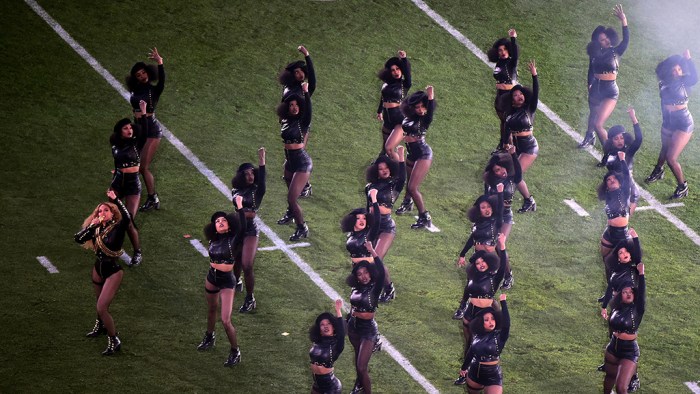
SANTA CLARA, CA – FEBRUARY 07: Beyonce performs during the Pepsi Super Bowl 50 Halftime Show at Levi’s Stadium on February 7, 2016 in Santa Clara, California. (Photo by Harry How/Getty Images)


Black women’s bodies are scary.


That’s the lesson we learned this Super Bowl Sunday.


When Beyoncé and 30 backup dancers performed a brief rendition of her new song, “Formation” during the halftime show, talking heads all over the country exploded.


Oh my God! Are those pro-black lyrics!? Are they making an allusion to the Black Panthers!? Was the music video to this song critical of overzealous police murdering black folks!?


Turn off the TV! This is too political for family entertainment!


When did we become so squeamish in this country? Can’t we all just sit back and enjoy seductive women gyrating in unison anymore?


I guess not. Not if they’re black.


Sleek female bodies in tight leather outfits displaying every curve of their anatomy – if their skin is black and their hair is Afro-ed and their fists are briefly in the air, it’s way too scary for white male libidos.


And that’s really the problem here.


Who was this performance supposed to be for? Fifty years of Super Bowl logic would suggest the target demographic was light skinned, heterosexual and possessing a penis. But these women had something to say – maybe. They had a message beyond “Look at me! I’m hot!”


How am I – as a red-blooded American male – supposed to commodify and objectify these women’s bodies if their brains are trying to convey a message that goes beyond mere consumerism?


That’s what the Super Bowl is, really. Some people say they watch it only for the commercials, but that’s all there is. It’s all a big advertisement for the American way of life.


Sit back, drink beer, eat pizza, watch an essentially meaningless contest and – whatever you do – don’t think about the way things really are. Don’t think about the problems we have and how we might fix them. Stay asleep. Watch the game and stay fast asleep.


And please don’t tell me this has nothing to do with race. If they were white girls with a message about world hunger, the outrage would be demonstrably more muted. If there’d be any outrage at all.


No. This was a direct assault on our tacit consent to be colorblind in all things. As a society we’ve silently agreed to refrain from mentioning anything about race in public.


Why are you even bringing up the fact that those dancers were black, someone is bound to ask.


My answer: because I have eyes.


Denying the pigment of their skin does no one any favors. And talking about it doesn’t denigrate them in any way. In fact, it acknowledges a key component of their being.


But Beyoncé’s performance didn’t let us forget her skin color. She made it important, and our white male society doesn’t want to admit it.

Or at least that’s what the 24-hour news cycle has made of it. Did Queen B really intend her routine to be taken as such a revolutionary display of black power? It’s hard to say.


In the actual performance, there is nothing much that is overtly political. Vaguely martial outfits? Dancing in an X-formation? A raised fist? Maybe.


The only somewhat rebellious moment occurred after they had already left the field. A few dancers held a sign offstage asking for justice for Mario Woods – a black San Francisco man gunned down by police. If you blinked, you missed it.


But the same cannot be said of the recently released music video for the song. It contains many images of black oppression from police brutality to the slow response to Hurricane Katrina. However, if you never saw the video, would you make that connection?


I didn’t. It went right over my head.


To be fair, I’d had a few.


It wasn’t until the next day that I read about the media’s hyperventilating all over it. Viewers had to actively search out the video to find any revolutionary content. Maybe that was Bey’s intent. Maybe not.


Either way, I find it hard to believe that most people’s immediate reaction was the same as that of the pundits.


At first, it was only a vocal minority that made a big deal about it. Then it snowballed into the center of our public discourse. I’m not sure why it’s gained such purchase. Maybe it’s because the halftime show always elicits strong emotions. Maybe it’s because it’s an election year. But without a doubt, a lot of folks’ white fragility is showing.


People of color are often stereotyped as having a thin skin about these issues. If black or brown folks bring it up, they’re criticized as “playing the race card.” But this situation shows how reactionary we, white people, really are.


No one decried Coldplay for starting the show with “Viva la Vida” – a song featuring the lyric, “When I Ruled the World.” People of color aren’t theorizing that the song by the whiter-than-white Chris Martin is really a Caucasian lament about the loss of white power.


“I used to rule the world

Seas would rise when I gave the word

Now in the morning I sleep alone

Sweep the streets I used to own”


Why? Because it would be just as ridiculous! Black folks have more important things to worry about – like the very things that white people are mad at Beyoncé for bringing up!

Taking Back Your Name – The Pros and Cons of Political Correctness

introduction


“What I think the political correctness debate is really about is the power to be able to define. The definers want the power to name. And the defined are now taking that power away from them.”
Toni Morrison

“Never trust anyone who says they do not see color. This means to them, you are invisible.”
Nayhyirah Waheed


Call me Steve.

Not Steven. Not Stephen. Certainly not Steveareno.

It’s a preference. My preference. My choice. And if people want to be in my good graces, they’ll comply with my wishes.

There’s nothing strange or unreasonable about this. We do it all the time – usually when we’re being introduced to someone.

“Hi. I’m Steve.”

“Nice to meet you, Steve. I’m Elisha.”

“Elisha? What a beautiful name!”

“Thank you, Steven.”

“Please. Call me Steve.”

Is there anything wrong with that? Does that stifle conversation? Does it stop people from talking freely to each other?

No. Certainly some names are hard to pronounce or – in my case – remember. But overcoming those hurdles is just common decency. It’s not too much to ask – especially if you’re going to be dealing with this person for an extended length of time.

The idea that allowing people to define themselves somehow shuts down conversation is rather strange. But it’s the essence of opposition to political correctness.

“Political correctness is tyranny with manners,” said conservative icon Charlton Heston.

I wonder if he would have felt the same if we’d called him Charlie Hessywessytone.

A more fleshed out criticism comes from President George H. W. Bush who said, “The notion of political correctness declares certain topics, certain expressions, even certain gestures off-limits. What began as a crusade for civility has soured into a cause of conflict and even censorship.”

Is that true? Is political correctness really censorship? That’s the conflation made by many conservatives and even some liberals. After all, popular Left-wing comedian Bill Maher sarcastically calls his HBO show “Politically Incorrect,” and he often rails against the practice.

There’s a kernel of truth to it. We are asked to change the way we speak. We’re asked to self-censor, but we already do this frequently without wailing against a loss of free speech.

Human beings are subject to various impulses, but as adults, we learn which ones we can act on and which we shouldn’t. I may think it would be hilarious to run into a crowded movie theater and yell, “FIRE!” However, I know that doing so – while possibly funny to a certain kind of person – would result in injuries and trauma as moviegoers stampede out of the theater. So I don’t do it. Is that censorship? Maybe. But it’s censorship with a small c.

The Hestons, Bushes and Mahers of the world seem to think political correctness is more like Capital C Censorship. But this is demonstrably false.

That kind of Censorship is the act of officials, possibly agents of the government, a corporation or some other formal bureaucracy. But political correctness has nothing to do with officials. There are no censors. There are only people who ask to be named a certain way.

A censor looks at a news report of military operations in Iraq and deletes material that would give away the army’s location. Political correctness is nothing like that. It involves someone asking others to refer to themselves THIS WAY and not THAT WAY.

The penalties for violating Censorship are official. Ask Chelsea Manning who is serving a 35-year prison sentence for doing just that. The penalties for violating political correctness are social. You may be criticized, condemned or disliked.

If you criticize Manning for releasing classified documents to Wikileaks, you’re not violating political correctness. That’s your opinion, and you’re entitled to it. However, Manning is a trans woman who is going through hormone replacement therapy. If you refer to her as “him” you are violating political correctness. You’re naming her in a way that violates her wishes. The penalty is not a prison sentence. It’s a sour look.

So political correctness is not Censorship. In some ways, the confusion comes from the term “political correctness,” itself.

Though its origins are hard to pin down, it appears to have been coined by the Soviets to mean judging “the degree of compatibility of one’s ideas or political analysis with the official party line in Moscow.” At least that’s what the International Encyclopedia of Social Studies says.

The term came to prominence in the United States in conservative writer Dinesh D’Souza’s book “Illiberal Education.” He disparaged affirmative action as a kind of political correctness that gave preference to (what he saw as) unqualified minority students over whites in college admissions.

So the first mention of the term in the USA was simply to disparage liberal political policies. It was a ham-handed way of comparing the Left with the Soviets. Yet somehow this term has become the handle by which we know simple civility. It’s kind of hard to feel positively about a concept that begins with a mountain of unearned negative connotations.

Conservatives know the power of getting to name something. It’s their go-to propaganda tactic and lets them control much of the debate. For instance, that’s why the Right loves to call Social Security an “entitlement.” There’s truth to it because you’re entitled to getting back the money you pay in, but it’s full of unearned negative connotations as if these people were somehow demanding things they don’t deserve.

In essence, political correctness shouldn’t be political at all. It’s just kindness. It’s just being a decent human being. Don’t purposefully call someone by a name they wouldn’t appreciate. Respect a person’s ownership of their own identity.

And for some people that’s hard to do. Their conceptions of things like gender, sexuality, race and religion are extremely rigid. The only way to be a man is THIS WAY. The only way to be spiritual is THAT WAY. But if they give voice to these ideas in the public square – especially in the presence of people who think differently – they will be frowned upon.

But is this really so dissimilar to the crowded movie theater? Refusing to acknowledge someone else’s identity is harmful to that person. It tramples the soul similarly to the way their body would be trampled in a stampeded exit. So you shouldn’t do it.

The result is an apparently much more tolerant society. It’s no longer okay to use racial, cultural, gender and sexual stereotypes in public. You’re forced to give other people consideration – or else face the consequences of being disliked. And on the surface, that’s a much more inviting world to live in.

However, there is a glaring problem. In some ways, this has made public discourse more antiseptic. People don’t always say what they mean in the public square. It’s not that they’ve changed the way they think about the world. They’ve just learned to keep it to themselves until they’re around like-minded individuals. They reserve their racist, classist, sexist language for use behind closed doors.

This is why when I’m at a party peopled exclusively by white folks, some partygoers may let racial epithets slip out. And we all laugh nervously to be polite. Or maybe it’s more than politeness. Maybe for some it’s to relieve the tension of such refreshing candor like taking off a girdle. Fwew! Here, at least, I can say what I really think without having to worry about people looking down on me for it!

Since such reactions occur mostly in homogeneous groups, it makes the world look much more enlightened than it really is. Pundits and policymakers look around and cheer the end of these social ills when they haven’t ended at all. They’ve merely gone underground.

And so we have an epidemic of colorblind white people who can’t see racism because of the gains of political correctness. Somehow they forget those unguarded moments. Somehow they haven’t the courage to examine their own souls. Or perhaps they don’t care.

And so we have the conundrum: which is better – to live in a world where all individuals have the right to name themselves or to live in a world where our most basic prejudices are on display for all to see?

Personally, I pick political correctness, and here’s why.

Words are important. We think in words. We use them to put together our thoughts. If we continue to respect individuals’ names in word, eventually we’ll begin to do so in thought and deed.

This isn’t mind control. It’s habit. It’s recognizing an ideal and working toward it. As Aristotle taught, the way to become a good person is to act like one. Eventually, your preferences will catch up with your habits.

I think that’s what’s happening today. Look at the children. They’re so much less prejudiced and racist than we, adults. This is because they’ve learned political correctness first. They didn’t have to unlearn some archaic white-cisgender-centrism. This is normal to them, and I think that’s a good thing.

Obviously some people will balk at this idea. They will look at this ideal as reprehensible. They want to return to a world where women were little more than property, a world where black people knew their place, where sexual identity was as simple as A or B.

But I think most of us recognize that this is not a world where we’d want to live. Modern society can be scary and confusing but trying to respect everyone as a person isn’t a bad thing. It’s consideration, concern, warmth.

Perhaps the best way to love your fellow humans is to call them by their proper names.

Prejudice of Poverty: Why Americans Hate the Poor and Worship the Rich

2children


Take a breath.

Take a deep breath. Let your lungs expand. Let the air collect inside you.

Hold it.

Now exhale slowly. Feels good doesn’t it? You’d never realize there are hundreds of contaminates floating invisible in that air. Dirt, germs, pollution – all entering your body unnoticed but stopped by your immune system.

If only we had such a natural defense against prejudice. Racism, classism, xenophobia, sexism, homophobia – we take all that in with every breath, too.

It may not seem like it, but all these value judgments are inherent in American culture. They’re as much a part of life in the United States as the flag, football and apple pie. And to a greater or lesser extent, you have subconsciously accepted them to help construct your ideas of normality.

What does it mean to be a man? What does it mean to be a woman? How should black people be treated? To whom is it appropriate to be sexually attracted? What makes a person poor and why? All of these questions and so many more have been answered one way or another for us by the dominant culture. Not everyone accepts this perceived wisdom, but most of us have swallowed these solutions whole without thought, logic or criticism – and we don’t even know it’s happened.

Take our preconceptions about wealth and poverty.

Well paying jobs are drying up. Minimum wage work is becoming more common. Salaries are shrinking while productivity is increasing. Meanwhile the cost of living continues to rise as does the cost of getting an education.

Yet we still cling to the belief that all rich people deserve their wealth and all poor people deserve their poverty.

When we hear about someone on Welfare or food stamps, we sneer. The average conception is that this person is probably faking it. He or she could have earned enough to avoid public assistance, but he or she isn’t trying hard enough.

Moreover, we KNOW with a certainty that goes beyond mere empiricism that many of the poor still manage to buy the newest sneakers, have flat screen TVs and eat nothing but Porterhouse steaks.

You can hear this kind of story uttered with perfect certainty from the mouths of white, middle class people everywhere. They don’t mind helping people who are really in need, they say, but most poor folks are gaming the system.

Never once do they stop to consider that this story about impoverished individuals living better than middle class Americans is, itself, one of the most pervasive myths in our society. We know it the same way we know all Polish people are dumb, all Asians are smart and all Black people love fried chicken and watermelon.

However, none of this “knowledge” is supported by the facts. Look at the Supplemental Nutrition Assistance Program (SNAP). According to the New York Times:

Allegations of fraud, including an informal economy in which food stamps are turned into cash or used to buy liquor, gasoline or other items besides food have been used to argue that the program is out of control. In fact, the black market accounts for just over 1 percent of the total food stamp program, which is far less than fraud in other government programs like Medicare and Medicaid.

If you include erroneous payments because of mistakes on applications, overall loss to the food stamp program comes to 4%, according to the Department of Agriculture. Compare that to the 10% lost to Medicare and Medicaid – programs no one is calling to be cut or eliminated.

But figures like these don’t convince the average American. We’re so certain that all or most poor people are just lazy parasites. Everyone “knows” some low-income person they deem to be living too high for their circumstances.

And, yes, sometimes you do see an impoverished individual not wearing rags. Sometimes you do peek into an indigent person’s hovel and see new electronics or game systems.

How does this happen?

Debt.

Credit card companies are waiting in the shadows to extend a line of credit to just about anybody. It’s a safe bet for these businesses. If they give you money today, they can charge exorbitant rates of interest – even more so with the highest risk clientele. But there isn’t much risk to these corporations these days when almost anyone can take a job as a state constable or bail recovery agent to hunt down debtors and bring them to economic justice.

When you see a destitute child with new sneakers, his parents probably bought them with plastic. When you see an X-Box in a needy person’s house, chances are that wasn’t paid for in cash. They used the charge plate and will end up paying for that game system many times what it’s worth.

It’s a problem not limited to the poor. Even middle class folks are drowning up to their eyeballs in debt. As wages have decreased, people have used their credit cards to keep a standard of living they expect. But they’re paying for it with huge portions of their paychecks going to these credit card companies. Yet even though we all do this, middle class folks look down their noses at people lower down the economic ladder for doing the same thing.

In fact, they refuse to even see that obvious truth. Instead they cling to the lie that poor folks are social parasites. We even begrudge them food. Those are my tax dollars going to pay for that penurious person’s free ride, they say.

Unfortunately, we don’t stop to consider how much of our taxes are actually going to help the less fortunate.

Let’s say you make $50,000 a year. That means, you pay $36 toward food stamps. That’s ten cents a day – the same amount many charities ask to help feed starving children in Africa.

If you add all safety net programs, the cost only goes up an additional $6 a year. That doesn’t seem like a huge chunk of my taxes. Honestly, do you begrudge needy people less than the price of a meal for a family of four at Bennigan’s?

By and large, your tax bill isn’t going to the poverty-stricken. It’s going to the wealthy. Over the course of a year, you pay $6,000 for corporate welfare.

You read that right. Six K. Six grand. Six thou. Those are your tax dollars at work, too. And it’s a much larger burden on your bank account than the $42 you shell out for the poor.

What do you get for that $6,000 outlay? It includes at least $870 to direct subsidies and grants for corporations. An additional $870 goes to offset corporate taxes. Another $1,231 goes to plug holes in the federal budget from revenue lost to corporate tax havens. Oh! And don’t forget a sizable chunk for subsidies to Big Oil companies that are polluting our skies and fueling climate change and global warming.

Most of your money isn’t going to feed hungry children. It’s going to recoup losses for giant transnational corporations like Apple and GE that hide their money overseas to boost profits and avoid paying taxes for things we all need like schools, police and fire departments.

This money subsidizes giant multi-national corporations that are already making billions and billions of dollars in profit each year. In the past decade alone, corporations have doubled their profits – all while reducing their American workforces and sending jobs overseas. Yet we only complain about poor folks using food stamps and buying new sneakers on credit.

Why is that? Why does it only bother us when poor people get help and not when huge corporations do?

Part of it is the media. We’ve been convinced that big business deserves its money and poor people don’t. Another part of it is that these facts often go underreported. Movies and TV shows love portraying the parasite poor person but rarely portray the corporate leech. Outside of “It’s a Wonderful Life” and “A Christmas Carol,” the wealthy are usually portrayed in the most positive light possible and not as addicts hoarding cash they don’t need to compete with each other in a childish game of one-upmanship.

Finally, there is the racial and sexual element. By and large, corporations are run by white males. The poor are mostly black, brown and though women make up a slightly higher percentage than men, it is often conceptualized as uniquely female. Take the term Welfare Queen. Why is there no Welfare King? How telling that our conception only allows for one gender in this role!

The reality is much different. The true Welfare Queens are Big Businesses. They make unprecedented profits and avoid paying taxes on them. They have tons of cash on hand but never can seem to get enough. And if we increased the corporate tax rate to what it was in the 1950s when the Unite States was more prosperous than it has ever been, these same corporations would still be Filthy. Stinking. Rich.

So the next time you hear someone blaming the poor for gobbling up your taxes, remember the facts. First, it’s simply not true. There is no widespread fraud by the poor. They are not gaming the system. They are not putting an undue burden on the middle class. However, big business IS – in fact – cheating you out of income. Business people are getting fabulously wealthy on your dime – and even if we stopped subsidizing them, they’d still be fabulously wealthy!

Finally, don’t ignore the racial component. Would middle class Caucasians still complain so vehemently about the poor if they weren’t mostly talking about Black people, Latinos and women? I doubt it.

We may breath in these prejudices but we’re not helpless. It’s up to all of us to dispel these myths, not to let them stand, to confront them every time they come up. And, yes, I mean EVERY. TIME.

The only immune system we have as a society is education, knowledge, wisdom. And once you know the truth, don’t let anyone get away with this kind of racist, classist bullshit.


NOTE: This article also was published in the LA Progressive and on the Badass Teachers Association blog.


You Can’t Solve Prejudice With a Cookie-Cutter: Celebrate Diversity

057 soft chocolate chip cookies for blog

If America was a cookie, it would probably be chocolate chip.

Sure it’s mostly dough, but the chips are what give it flavor!

I mean, come on! Who wants a plain sugar cookie!? Yuck!

Maybe that’s what they meant all those years ago when they described us as a melting pot. All these different races and nationalities blending together to form a delicious whole.

However, some flavors just don’t mix – or at very least are slow to come together.

In fact, since the very beginning, much of America has been obsessed with ensuring we DON’T mix! Chips and dough can’t melt together! We must preserve the purity of the batter. In fact, let’s send those chips back to Belgium!

But times have changed. We’ve tried to legislate our way to equality. Voting Rights Acts. Anti-Segregation Acts. Non-Discrimination Laws. But the legal system is far from perfect, and it can only do so much. If we’re really going to become one big tasty treat, we’ve got to do something about it – each and every one of us.

So how do we all come together? What should be our goal?

For some people, the answer is silence. We shouldn’t talk about this stuff at all.

There’s very little scientific justification for categorizing ourselves into different races, anyway. Just button your lip and it will all go away.

To which I say, yeah, many things such as race, nationality, even sexuality are to a large extent man-made. They’re the product of culture and society, but that doesn’t make them unreal. They’re totems, archetypes, symbols we use to navigate the social universe. If you think a social constraint is unreal, try violating it.

Moreover, ignoring inequality won’t solve it. That only ensures that the status quo continues to reproduce itself.

In short, if we don’t talk about prejudice, we’ll never get over it. Our biases will never go away.

Other folks – many with the best of intentions – think not that our differences are unreal, but that we should ignore them. Don’t talk about us and them. It’s all just us.

No more twitter campaigns proclaiming #AllChipsMatter. We should instead join hands and proclaim #AllIngredientsMatter.

And I do see your point. We are all important regardless of race, nationality, gender, religion, sexual orientation, etc. But is this really the best way to come together as a nation? If all of us taste the same, we’ll certainly be one – one bland and lousy confection sitting in the bakery that no one in their right mind would really want to eat.

Homogenization has its strengths. Look at white folks. We used to be very different. Czech, Slovak, German, Russian, etc. Now we’re one indistinguishable whole. Sometimes we venture outside of that label for a few hours to celebrate some ethnic festival, but most of the time we’re just white, White, WHITE. Having a beer and a Wiener Schnitzel during Oktoberfest doesn’t change how you usually identify and how you are identified in the world.

But something has been lost here. You can only be blind to the differences in people if you wipe away the rough edges. People become less distinct, more similar. That’s not the best way to be.

There’s another way.

Instead of ignoring the differences between people, we should embrace them. Don’t hide your nationality, your race, etc. Celebrate them!

I am the proud product of this culture! I am the son or daughter of this type of person! I love this! I believe that! I am not just anyone – I am ME!

There is a danger when anyone suggests conformity as a way to fight racism, sexism or any form of prejudice. It puts the responsibility on those who are different. If you don’t want to be discriminated against, YOU need to conform.

I think this is wrong. You have the right to be yourself. Instead it is the responsibility of those who would discriminate to STOP.

If you’re racist, YOU need to stop.

If you’re sexist, YOU need to stop.

If you’re homophobic, YOU need to stop.

And so on.

This isn’t as easy as it sounds. You can’t just walk it off. Prejudice is the result of years of enculturation, socialization and bigotry. It takes time. It takes a loving heart. But most of all it takes two very important things that few people in America have truly achieved:

1) Willingness to try.

2) Acknowledging that there is a problem in the first place.

That’s where we are today.

Very few people exist in the United States without some prejudice. People feel uncomfortable around those unlike themselves. We have preconceptions about how certain people will act. We think we know better how other people should live their lives.

These are all prejudices. And what’s worse, many of them are actually unconscious. I didn’t even recognize that I got nervous around black people – and now that I do, I don’t want to feel that way. I know it’s not justified, but I still can’t help the feeling!

So there is much to be done here in the USA to make us the best we could be. And it is our job to do that work.

Because the cookie of America has lots of cracks in it and more than a few nuts.