Our Martyred Brothers: What 43 Missing Mexican Student Teachers Share with US Educators Fighting Factory School Reform

A-young-woman-takes-part-in-a-demonstration-demanding-information-on-the-whereabouts-of-the-43-missing-students-in-Mexico-City-on-Nov.-5-2014-AFP-800x430

Death is the ultimate exclamation point.

We walk through life blissfully unaware until someone dies.

Such is the case for 43 someones in Mexico. These rural first-year teaching students were kidnapped on Sept. 26 by police and allegedly handed over to a drug cartel who tortured and killed them.

Why such violence against a group of young men from one of the poorest states in the country who had dedicated their lives to care for the needs of Mexican children?

They opposed the country’s education reform policy.

That’s right. They were just like us.

Just like the 53,000 members of the Badass Teachers Association or the 99,000 people who follow Diane Ravich on Twitter or all the parents who stand in the back of a school board meeting holding a sign against toxic testing.

They had come from rural Ayotzinapa to the city of Iguala to peacefully protest but were fired on by police. Six died on the scene and 43 more were taken into custody and are presumed dead. Students who survived the attack but escaped capture said army personnel were in the area and aware of what was happening, yet did nothing to stop the massacre.

Mexican school reform is apparently a bloody business. But reading the background of this tragedy is like looking in a mirror.

In February 2013, Mexican President Enrique Peña Nieto signed an education reform bill with the support of the three main political parties. The bill reads like it was plagiarized from the United States federal Race To The Top program. In fact, it’s much worse.

It includes hiring and promotion based solely on “merit,” new allegedly more rigorous educational standards, and reappraisal of teachers deserving tenure. Local control of public education is almost completely negated in favor of a new federal National Institute for Education Evaluation.

Like it’s American counterpart, it ignores the realities of poverty in favor of vilifying teachers.

Millions of Mexican school children suffer from a dismal lack of funding and infrastructure. Many schools lack floors, bathrooms, Internet, or even telephone access, and in rural areas roads to schools often are non-existent.

At least a third of schools face severe infrastructure problems, according to an April 2014 census report on pre- through middle schools. A total of 41% lack sewage systems and 31% have no drinkable water. Fixing the problem would cost at least $4 billion.

Just like in the United States, the Mexican reform agenda was created and pushed through by big business. In this case, the right-wing business group “Mexicans First” is hoping to undo much of the liberal reforms associated with the Mexican Revolution. The goal is to subordinate education to the profit needs of big business.

The strategy includes singling out and slandering educators in the mass media for the supposed failures of public education. As in the US, the position of the teachers unions has been not to reject the reactionary plan, but to demand that they be included as partners.

Public outcry against the massacre has been massive. Students have called for a general strike on Nov. 20. On Saturday, Nov. 8, demonstrators set fire to the door of Mexico City’s ceremonial presidential palace. Protestors chanted “it was the state” and called for the resignation of President Nieto and the Attorney General.

The most popular rallying cry seems to be “Ya Me Cansé.” It means: “Enough. I’m tired” or “I’m already tired.”

Would it take similar bloodshed for the American public finally to be fed up with our own factory schools movement?

Our own government pushes these same counter-reforms.

Just like in Mexico, US privatizers drool all over the prospect of de-professionalizing teaching, and raking in education funding as profits. The only difference is we haven’t started murdering protestors yet.

I’ll admit it’s a big difference, and I’m thankful for it. Otherwise, my body would have been tossed on the rubbish heap long ago.

But after investigating this tragedy, I can no longer look at our own self-proclaimed reformers the same way. They look like Mexican gangsters.

There is very little to distinguish them from the corrupt Mexican government and its drug cartels. If you put Bill Gates, Barrack Obama, Arne Duncan, Michelle Rhee and Campbell Brown in a room with their Mexican counterparts, there is much they’d agree on.

Common Core State Standards? YES!

Merit Pay? YES!

Abolishing teacher tenure? YES!

Murdering dissidents?

No?

I hope so.

But before we let them off the hook, it’s best to look at the blood on their hands.

Oh, yes, they are dripping with blood.

Our American government is complicit in this tragedy because of our never wavering faith in the drug war that feeds it – American demand, Mexican supply, American guns, Mexican bloodbath.

As we ponder how far our own politicians and corporate leaders are willing to go to ensure their agenda, let us pause to remember our brothers who died in Mexico.

They were someone’s sons. They had been born, loved, cherished and wanted to make a difference.

They didn’t want to be martyrs. They wanted to be teachers.

Sometimes that means the same thing.

Ya Me Cansé!

Ya Me Cansé!

Ya Me Cansé!

YA ME CANSE!

mexico-missing-students


This article has also been published on the Badass Teachers Association blog.

American Public Schools Could Defeat Racism by Confronting Our Dark Past

x_2163_801502570_0_0_2044_300

We’re a country of dreamers.

High ideals of democracy, fair play, and freedom are nothing more than our nighttime reveries forced into the light of day.

We look about us at a world of what could be and believe with our whole hearts that it will be so.

But we’re such good dreamers that we often don’t see the reality in front of us. We walk through the day with half closed eyes and never see the shadow and dirt in which we live. Our bodies lay in the mud while our heads are forever in the clouds.

That’s our problem. If you don’t also recognize what is, your dream will never be more than that – a mirage.

And so our greatest strength is also our greatest weakness. The American dream has become the American delusion.

Nowhere is this more apparent than with race.

So many of us – mostly Caucasians – don’t even think it’s an issue anymore.

“Hate crimes are a thing of the past,” says the police departments blaming Black teens for getting in the way of officers’ bullets.

“Everyone’s treated equally,” says a court system that disproportionately locks away people of color for the same crimes it practices leniency on for Whites.

“Racism is over,” says the US Supreme Court as it strips away much of the teeth of the Voting Rights Act.

“There’s nothing wrong with naming your sports team after a racial epithet,” says the Washington football franchise as it sues Native Americans with the temerity to be offended.

These are not issues of mere prejudice. This is out-and-out institutionalized racism.

Howard Prof. Denisha Jones explains the difference between the two:

“Using derogatory terms about a person’s race, attributing negative behaviors to a person because of their race, and treating someone poorly because of their race, are all examples of prejudice. Anyone can be prejudiced towards another person based on race. Black people can harbor racial prejudice towards White people. Latino people can harbor racial prejudice towards Black people. White people can exhibit racial prejudice toward people of color.

Now racism is more than just racial prejudice. To understand the difference you can define racism as prejudice + power. See racism is a system that confers advantages on one group while systematically disadvantaging another group (for every advantage there is disadvantage). In America, racism is a system of White supremacy that advantages White people over people of color.”

This is an issue that Americans, frankly, don’t want to deal with – in fact, most of us refuse to see it at all.

We’re finally a color blind society, I suppose.

No, we don’t treat people of color equally because we can’t see any reason to discriminate against them.

We treat them unequally because we refuse to acknowledge how our privileged actions and power affect them.

This willful blindness is so pervasive we don’t even see it under the most extreme circumstances – brutality and genocide.

Compare our attitude with that of the country most associated in the American mind with mass murder of ethnic groups – Germany.

Deutschland, or the Federal Republic of Germany, has a history of civil rights abuses and factory murder.

During WWII, Germany committed some of the worst atrocities against humankind in a century know for atrocity. As Hitler and the Nazi regime conquered much of Europe, his government was responsible for the systematic extermination of 6 million Jewish people and 5 million non-Jewish people. Taken together, we call this dark period the Holocaust.

We all know that. But, the United States has a similar history of racism and murder.

In the 18th and 19th centuries, the US allowed legal chattel slavery of human beings stolen from Africa. These people were taken from their homes and families and sold into generational servitude. Of the 12 million enslaved people brought from Africa to the Americas, only about 600,000 were taken to the 13 Colonies and (later) the United States. The great majority of slaves were taken to sugar colonies in the Caribbean and Brazil where they were often worked to death and had to be replenished with new arrivals. Life expectancy was higher in the US and slaves often reproduced their numbers. By 1860, there were 4 million slaves in the country.

Treatment, however, was severe. Beatings and rapes were commonplace. Punishments often included whipping, shackling, hanging, burning, mutilation, branding, and imprisonment. It was most often meted out in response to disobedience or perceived infractions, but sometimes abuse was carried out simply to re-assert the dominance of the master or overseer over the slave. Most captive laborers weren’t allowed literacy or to congregate in large groups – except for church services – for fear these things would inspire thoughts of rebellion or escape. The economic prosperity of a large section of our country was built upon the blooded and beaten backs of these people.

But that’s not all.

Furthermore, the United States and its precursor British government practiced outright genocide against Native American peoples living here before the arrival of European settlers. The extent of this brutality is hard to calculate. Estimates of the pre-Columbian population for what today constitutes the U.S. vary significantly. More recent efforts put the number at approximately 18 million. As of 2010, only 5.2 million US citizens claim Native American ancestry. Of that, 2.9 million claim to be descended solely from indigenous peoples, while 2.3 million claim some combined heritage.

Arguments explaining this drastic plunge in population are numerous and heated. Certainly Native Americans weren’t able to cope with European diseases such as Smallpox. To what extent this was exacerbated by purposeful attempts to murder First Peoples with primitive biological warfare (“gifting” them smallpox infected blankets, etc.) is hard to determine. But since 1830, the national policy turned from assimilation to outright displacement. The Indian Removal Act authorized the government to forcibly deport tribes west of the Mississippi. But as Europeans encroached even further, this resulted in the genocide or near-genocide of many tribes, with brutal, forced marches including the infamous Trail of Tears, which alone caused 4,000 casualties.

Over time, the United States forced indigenous peoples into smaller plots of land until they were on reservations where they were coerced to change their hunter-gatherer life-style to a more agrarian culture which neither they nor the lands they were forced to live on were suited. Mass starvation was common. It wasn’t even until 1924 that all Native Americans were even granted US citizenship.

The point is this – no matter how much the depopulation of Native Americans can be attributed to natural causes, there was certainly a large factor of purposeful, government-sanctioned racism, and murder involved.

The bottom line? Both Germany and the United States have a history of brutality and genocide. It is not important to determine which atrocity is worse – American Slavery, Native American Genocide or the Holocaust. That’s irrelevant. Murder is murder. Genocide is genocide.

The crux of the matter is that both countries have a dark history of aggression and inhumanity to face. But each chose a much different path to do so.

In Germany, there is a policy of education and acceptance. They don’t hide from their past. They teach it.

The Holocaust is a mandatory, binding subject in all schools.

Students begin studying the Nazi persecution of the Jews between ages 12 and 15. At that point all students study the history of the 20th century – in general – and National Socialism – in particular. The Holocaust is a central topic of this instruction. So much so that students who who pass the Abitur exam (prerequisite for university) take it up again at age 18.

German-sanctioned genocide pervades the entire curriculum – not just history and civics, where it is central. It is also frequently taught in classes on German literature, religion, ethics, biology, art and music. It’s not uncommon for science classes to disprove racist theories, art classes to study works produced by Holocaust survivors, etc. Students engage in long-term educational projects that often focus on these issues, as well.

Finally, students continue to learn about the Holocaust outside the classroom. Numerous class trips are scheduled to the nearly 100 memorial museums every year. Dachau, Bergen-Belsen, Buchenwald, and Sachsenhausen have several hundred thousand visitors – most of whom participate in guided tours for students and teachers.

But that’s Germany.

Q: How does the United States deal with its dark past?

A: Haphazardly.

In the USA, there is no such systematic educational approach to either American Slavery or Native American Genocide. While neither subject is completely ignored, there is no national push to ensure anything but a superficial knowledge of these events.

American school children know that we used to have slaves; they may even know that we didn’t treat the Native Americans so nicely. But they don’t know nearly the scope and fallout of these events.

Slavery is one thing. The Civil Rights movement is another. They may have some vague connection, but little is taught about the generations of nationally-endorsed racist laws that kept African Americans from voting or exercising the same freedoms available to White people. And after the Civil Rights movement!? It must have been all good, because there’s little else you’ll learn about it in most schools.

Likewise, students learn there used to be a whole civilization of Native Americans before Columbus arrived. They might learn a bit about a few of the skirmishes and disagreements between the US government and the indigenous peoples. But genocide!? That concept is usually reserved for WWII and European history when it could equally be applied to events at home.

You’d think the Common Core State Standards – our ill-conceived de facto national norms – would have solved this problem. However, they are exceedingly general when it comes to social studies and history. Criterion focus on “conflict and cooperation,” “evaluating patterns of change” and “interpreting historical events.” No emphasis is placed on particular historical occurrences.

It’s ironic that when it comes to skills such as Language Arts, the standards are – in fact – too specific. They prescribe things like close reading, an emphasis on nonfiction texts, comprehension without context, and the New Criticism literary point of view of the 1940s. But when it comes to fact-based pursuits like Social Studies, the standards are as watered down as weak tea. How else could they pass political muster for all concerned?

None of this stops individual teachers, schools or states from being comprehensive and specific. In fact, some states such as Virginia have their own state standards that emphasize local history and norms. For instance, one Virginia benchmark prescribes studying “the effects of segregation and ‘Jim Crow’ on life in Virginia for Whites, African Americans, and American Indians.” That’s a far cry from “evaluating patterns of change!”

Let me be clear. I am not advocating a rigid national curriculum. But I am in favor of a national desire to have some specific social studies standards at some level. Those standards should definitely be fleshed out by states and school districts, but the national emphasis should be on confronting our past, not ignoring it. Otherwise, our students will continue to be left with a vague idea of these events and their importance.

So I’d like to make a suggestion.

If the United States is serious about its ideals – if we really want to achieve our dreams of freedom and equal opportunity – we need to be more like Germany.

We need a comprehensive educational program that teaches our history – all of our history – even the nasty parts.

We need to emphasize American Slavery and Native American Genocide the same way Germany emphasizes the Holocaust.

Starting in middle school, students should learn about the events leading up to both tragedies.

Lessons should be plentiful and multidisciplinary. It shouldn’t be something that’s only the prerogative of the social studies classes. Literature courses should teach texts such as Beloved, Native Son and Bury My Heart at Wounded Knee in this context. Biology classes should do experiments to discredit racist theories of eugenics. Music and art classes should examine the rich heritage produced by these two peoples.

Schools should institute field trips to former slave markets, plantations, reservations, battle sites and massacres. This, in turn, would necessitate turning some of the historical sites into museums of equal quality to those explicating the Holocaust in Europe. No more fond reminiscences on life in the Antebellum South. They would show in stark detail what it meant to be a slave, how these people were housed, worked, penalized, etc. Battle grounds, in so much as they exist, wouldn’t just be about numbers killed and instruments of war, but instead show in detail the inhumanity practiced by our forebears.

The point is not to rub our children’s noses in the brutalities of the past. The truth of history should be inescapable, yes, but we must also teach the value of tolerance and acceptance of those different than us. To do this, we need a comprehensive program of ethnic studies. We need to teach the stories, histories, struggles and triumphs of people of color on their own terms.

For this to have any lasting effect, it is essential that such courses occur at all of our schools – not just those made up of mostly minority students. Our children need to know that it’s okay to be who they are. There’s nothing wrong with being non-White just as there’s nothing particularly special about being Caucasian. We’re all people. We all deserve respect, acceptance and love.

Isn’t that really one of our most cherished ideals?

We hold these truths to be self evident – that all men are created equal.

They are endowed with certain unalienable rights.

That among these are life, liberty, and the pursuit of happiness.

If our actions matched our words, maybe then we’d finally realize the American Dream.


NOTE: A shorter version of this article appeared in the LA Progressive.

My heartfelt THANK YOU to the following people without whom I could not have written this piece: Dr. Mark Naison (Fordham Univeristy), Dr. Yohuru Williams (Fairfield University), Dr. Denisha Jones (Howard University) and Traci Churilla. Any faults are my own.


A Curriculum of Compassion

05_A1CP_t400

Rayvin was back.

I had been told to expect her today. She’d been on my class roster since the beginning of the year but this was the first time I had seen her in person.

Such sad eyes. Such a defeated look on such a young, beautiful face.

“Welcome back!” I said smiling and picking up her loose hand to give it a silly shake.

“I thought we might see you today!” I said ushering her to a choice seat in a front corner.

She said nothing.

Rayvin had been in my class last year when I taught 7th grade. She had disappeared about halfway through the year – sucked into a mire of horrific circumstances, homeless shelters and life experiences no one should have to endure.

Now that I was teaching 8th grade and she had come back to the district, she had been returned to me like a dead letter.

The poor thing slumped into the seat I had given her. But I wasn’t about to give up.

I gave her an assignment I knew she’d enjoy. I remembered she liked to read horror stories so I put a book under her nose and opened it to Edgar Allan Poe.

She obeyed with no comment. But I wasn’t about to give up.

As the class discussed the story, I offered her a chance to participate. After every question I’d ask, I let me eyes casually fall on her face to see if she was interested in commenting before giving someone else a chance. She met my gaze but said nothing.

When class was over, she crumpled her papers in her hand like a tube.

Just as she got up, I asked, “Would you like a folder?”

She stopped as if she had heard me for the first time.

“Yes,” she almost whispered.

“Would you like a three-ring binder?” I asked and reached under a desk to a pile of supplies I collected for just such occasions.

Her face lit up into a smile.

I don’t remember what she said after that. I gave her the binder and she left.

It was the best moment of my day. The best moment of my whole week.

I had gotten through to her. She knew that someone – SOMEONE – cared.

THAT’S why I teach.

We waste a lot of talk in academic circles on curriculum and standards and lesson plans. But in the classroom, most of the time it’s all empty words.

Teachers have to make lightning fast decisions in real time. They can’t refer to a workbook, their notes or government-sanctioned benchmarks.

They have to appraise the situation and act.

If a student is misbehaving, the teacher has to quickly make a judgement why it’s happening, who it’s affecting and what’s the best course to correct it before it spreads out of control.

If a student isn’t acting like his-or-herself, the teacher has to mentally take note of the situation, compare it to past knowledge of the child’s history and then decide how best to help the young person without bringing down undue attention.

If a student doesn’t understand something, the teacher has to find out where the misunderstanding comes from, explain away the troubled spot and then gauge to see if his action has solved the problem.

And all in the blink of an eye.

It’s one of the things I love about teaching. It’s also why not everyone can do it.

You have to not only live in the moment but persevere. You have to be there for all 20-or-30-something students as well as you can, as quickly as you can, at the same time.

It’s a rush, let me tell you.

It’s also draining and frustrating and painful.

But it’s so worth it.

You get to help people – people who really need it. Not at a remove. You get to stand in front of those in need and help them up – even if they don’t know they’re on the ground.

There is such joy in what I do.

I wouldn’t trade it for the world.

I’ll keep doing it even though my state and local government are determined to evaluate me to death with mountains of paperwork and statistics that would make even a statistician weep.

I’ll keep doing it even though my duly-elected school board publicly bad mouths their staff and refuses to even negotiate with us in person so we can afford to keep our own families.

I’ll keep doing it as long as I can.

One day I may not be able to do it anymore.

My health suffers. Time with my wife and daughter gets sacrificed.

But no matter what happens, I helped Billy express himself in writing. I made shy Kelcey feel safe enough to share her journal with the class. I showed Shaun that sometimes stories are about people just like him.

And I made Rayvin smile.

That’s so much more than enough!


NOTE: In an effort to preserve students’ anonymity, names and unimportant details may have been changed.

This article has been published in Public School Shakedown and the Badass Teachers Association blog.

Forget Corporations… Unions Really ARE People

Labor-Unions

One word.

That’s all it takes to make some folks explode with anger.

One PARTICULAR word.

Not the F-word.

Or the C-word.

Or the even the N-word.

It’s the U-word. UNIONS!

Say that word, especially in a positive light, and heads burst like rotten pumpkins holding freshly lit firecrackers!

Eyes narrow, nostrils flare, a vein pops out on a forehead – and then a diatribe comes pouring out of your interlocutor’s mouth like the deep-seated, half-digested bile it is.

I just don’t get it.

Unions are people, after all.

Mitt Romney may have earned himself a place in the Presidential Candidate Hall of Shame for saying the same of corporations. But where he was wrong about the company, firm or business – it’s more truthful to speak this way of labor unions. Or any Democratic institution, for that matter.

No, I don’t mean that unions are individual entities that have lives of their own and deserve civil rights. But the people who make up those unions do.

That’s the whole point. Unions are made up of people. Their whole purpose is to fight for the rights of the individuals in them.

Corporations, on the other hand, have people who work for them, yes, but their raison d’etre is to earn profits for the board of directors or shareholders only.

While both work for the good of their members, unions work for ALL of their members. Corporations only work for the good of a limited selection of those connected with them – the owners.

At least that’s how it’s supposed to work. There are unions that work well and those that don’t. But the concept of a labor union – all the workers at a place of business gathering together to equal the power of the owners – is a good one.

Critics, however, see everything about unions as wrong.

They accuse unions of (1) stifling flexibility and creativity in the workplace. They say unions are (2) Communist, (3) politically allied to the Democrats and (4) increase costs. Among other things.

Let’s examine these claims:

1) Unions stifle flexibility and creativity:

Naysayers act as if unions impose rules on the helpless bosses. This is untrue. There is nothing in any union contract that was not agreed on by both parties. Sometimes it’s quite difficult to reach agreement. Often compromises are made on both sides. But each party has an equal say in what goes into the agreement.

As a result, sometimes the contract gets in the way of an easy fix to a problem. But is that really surprising for a document born of compromise? Neither party gets exactly what it wants. They meet in the middle. Sure, it would be much more flexible for the owners to make all the decisions. Likewise, it would be more flexible if the workers got to make all the decisions, too. But would either really lead to the best working environment?

Take break periods. If it were up to most managers, workers wouldn’t get any time to recoup from the constant demands of the job. They’d have to keep going with no respite until quitting time – maybe with a brief working lunch.

So union contracts often require breaks in the day. Not as much as workers would like and not as few as the bosses would prefer, either. To achieve this, you lose some flexibility.

For instance, if the contract says workers get two 15-minute breaks, you can’t combine them into one 30-minute breather. This makes it difficult if you’re needed at your post but have to stop suddenly to punch out. Otherwise, you won’t have time for both breaks.

It would seem to make more sense to keep working now and take a longer respite later. However, that is not what management and labor agreed to do.

It’s a compromise to benefit both parties. Workers are assured of having breaks in their day while management is assured that labor can’t take advantage of the situation by manipulating the clock to get a prolonged period off. If it becomes a problem, both parties can revisit it and make changes during the next contract negotiations. It may be difficult to change deeply embedded practices, but it can be done.

It doesn’t stop anyone from being creative. It just means you have to work within certain guidelines – and doing that may actually require innovation!

2) Unions are Communist

This is patently false. In fact, there are few more democratic institutions than labor unions.

All decisions are made by majority rule. Members vote on who serves as officers, who will have a seat on the negotiation committee, whether to accept a contract, when and if to go on strike, etc. That doesn’t sound like Soviet Russia! It sounds like Independence Hall in Philadelphia!

The only difference is it attempts to equalize power between the workers and the boss. It never actually achieves this ideal, but it does increase the say of the working stiff over the fat cats of the world.

That is not communism. It’s a respect for people’s individual rights.

Think about it. You don’t lose your human rights the moment you take a job. Why should the owners get free reign over their employees? Likewise, owners don’t lose all their power just because they need other human beings to make the goods and/or services they provide. Labor shouldn’t get to dictate everything either. It’s a give-and-take. When working well, it brings out the best in everyone.

Let’s be clear. THIS is what critics are really railing against. They’d rather preserve the owner’s power. The idea that the elites have to listen at all to menial workers just rubs them the wrong way. They’d rather be the ones making all the decisions – just like Pol Pot, Mao Zedong or Kim Jong-il. Come to think of it, the non-union workplace is more like Stalingrad than the union one.

Without unions, workers are at the mercy of their employers. Not exactly a red, white and blue proposition!

3) Unions are politically allied to the Democratic Party

How I wish this were true!

It would be great if one political party stood up for the rights of the working man! Unfortunately neither donkey nor pachyderm is exactly itching for the job.

Historically, the Democrats have done more to increase unions’ power than the Republicans. But that’s a pretty old and dusty history book you’re reading.

In the past 40 years, both parties have gleefully striped away union protections and rights. The only difference is that some Democratic politicians concede the right of unions to actually exist. Many Republicans act as if they would abolish the institution at the first opportunity.

Rank and file union members vote based on the platforms of the candidates involved. If there were a Republican candidate running on pro-union policies, union members would probably vote for him. That’s just called Democracy.

If a party wants the union vote, just give workers a reason to vote for your candidates.

4) Unions raise costs

Yes, and no.

In the short term, they do. But in the long run, unions may actually increase profits thereby paying for any increased initial investment.

When your business has a labor union, you have to pay higher wages. You have to have more safety regulations so less people get hurt on the job. You pay more for healthcare and pension plans. You have to cover more paid leaves and vacation times.

This is true. But it’s not a liability. It’s an advantage.

When you treat workers well, the quality of their labor increases. It just makes sense. If people are happy at the job, they’re going to do it better than those who hate it. This increases the quality of your product and, thus, sales. So you may have to pay more money upfront, but it gets offset by profits. Does the increase justify the cost? That depends.

Every business needs customers. Without money, consumers can’t buy the goods and/or services you provide. So when you pay a higher salary, you’re creating a potential market.

Consider this. When workers have more money, that’s cash that goes right back into the economy. They have money to buy stuff, maybe even the stuff you’re selling. That’s why Henry Ford famously made sure to increase wages at his auto factories – so that his employees could afford to buy the very cars they were making!

But what about non-union workers? Is it fair that union labor gets all this while everyone else is left wanting?

The short answer – yes.

If you’re jealous of the benefits of being in a union, join one. Don’t tear down someone else. Don’t be a resentful child popping another kid’s balloon because Mommy didn’t buy you one. Go get yours. Unionized labor will welcome you with open arms.

Petulant envy is exactly the attitude the bosses want you to take. You can always tell a news source is bought-and-paid-for when you hear some talking head spouting such petty, childish nonsense.

But leaving aside those who’d rather bring you down than boost themselves up, there’s an even more important reason to support unions. Membership actually benefits all – even non-unionized labor!

It’s called the free market. When unions boost salary and fringe benefits at one business, others have to do the same to compete. If your business doesn’t pay the same high salaries, it will lose the best employees to businesses that do. That’s simple economics.

None of this is seriously in contention. These are proven historical facts. Naysayers really just don’t want to pay a fair wage. They’d rather pay as little as possible and thus bring down salaries and benefits across the board.

In fact, as unions have decreased, that’s exactly what’s happened!

It’s a matter of point of view. Should we aim for a shared prosperity in this country or a limited one? Should we aspire to be a nation that’s best for all or only for some? I know my answer.

What about the global marketplace? Don’t unions make it harder for the US to compete with foreign markets, especially those in the third world?

Again, the answer is both yes and no.

Sure, it costs more to treat labor as human beings than as indentured servants. When you pay a living wage, your costs will be more and your profits initially lower than a company that keeps its workers in dormitories and has suicide nets outside the windows. But do we really want to compete with that? Is that the kind of America you want to live in? Does your morality really allow you to make money off of the misery of your employees?

Heck! Why pay workers at all? Slavery has a much better return on investment. The owners can keep people alive as cheaply as possible and then just work them to death. Profits would soar!

Assuming, of course, there’s anyone left to buy! That’s a pretty big problem. Right now, the third world is only able to continue these practices because it has a willing market here in the US. Without us buying these cheap products, they wouldn’t have customers and, thus, couldn’t continue.

Instead of slobbering all over ourselves in covetousness at their inhumane business practices, we should be putting political pressure on these third world companies to reform! We should boycott their products.

The irony, of course, is that many of the most egregious crimes committed against third world peoples are perpetrated by US companies who’ve outsourced their labor. We are selling short our own workers by preferring brown and black people in foreign lands whom we can more easily exploit.

If Americans had higher wages, they could more easily disengage from these abuses! If US consumers had higher salaries, they’d be more choosey about what they buy – they’d spend more freely on high quality goods – like the kind made by a unionized workforce.

In short, we need to stop shaming hard-working people from using their collective power to improve their lives. There’s nothing wrong with demanding fair treatment. Human beings deserve to be treated humanely.

And that’s exactly what unions are. Human beings.

They are engineers, nurses, auto-workers, letter-carriers and food service employees.

They are your teachers, police and fire fighters.

They are fathers, mothers, sisters, brothers, sons and daughters.

They’re just people.

Not a dirty word.


This article has also been published on the Badass Teachers Association blog.

Check Your Wallet! You Too Can Be An Expert on Teacher Tenure!

0714_wallet-open-money_485x340

It is IMPOSSIBLE to fire a bad teacher.

Unless of course you document how that teacher is bad.

You know? Due process. Rights. All that liberal bullshit.

Thank goodness we have tech millionaires to stand up for the rights of totalitarians everywhere!

A slew of Microsoft wannabes is taking up the mantle of the bored rich to once again attack teacher tenure.

They claim it’s almost impossible to fire bad teachers because of worker’s rights.

You know who actually is impossible to fire!? Self-appointed policy experts!

No one hired them to govern our public schools. In fact, they have zero background in education. But they have oodles of cash and insufferable ennui. Somehow that makes them experts!

I wonder why no one wants to hear my pet theories on how we should organize computer systems and pay programmers. Somehow the change in my pocket doesn’t qualify me to make policy at IBM, Apple or Microsoft. Strange!

But that doesn’t stop millionaires and billionaires with nothing better to do than try to increase their already skyrocketing profits.

It’s disgusting. They’re nothing but wealth addicts looking for a new score by stealing whatever crumbs have fallen to the floor that the rest of us need just to survive.

Time Magazine, which decided to put this non-story on the cover for Nov. 3, should be ashamed. But something tells me the editors could care less about things like facts, truth, integrity…

These are the same folks, after all, who propelled Michelle Rhee to fame on their infamous cover with the then-DC-schools chief holding a broom to sweep out all the bad teachers. Oh! That worked out so well! Cheating scandals, anyone!?

But instead of any apology or retraction for their faulty journalism, one can imagine the following conversation at Time’s last editorial meeting:

Editor 1: I’ve got a great idea for the cover! How about a bunch of know-nothing idle rich talking out of their asses!?

Editor 2: Brilliant!

I know I’m just a teacher and I don’t have millions in the bank, a bulging wallet or even a platinum credit card – but let me try to draw on my poor more-than-a-decade of experience in the classroom to explain.

1) Tenure does not mean a job for life. It just means you have to follow due process before firing a teacher. Many other jobs have similar due process rights for their workers that they don’t call tenure. Unfortunately that leads to the belief that teacher tenure is special or unique. It isn’t.

2) Teachers are Evaluated Based on Student Test Scores. This is ridiculously inaccurate and unfair. Standardized tests do NOT effectively measure student learning. They measure family income. So teachers who have richer students have generally more favorable evaluations than those who teach the poorest and most difficult children. Value-Added Measures, as these are often called, have been labeled junk science by national statistical organizations. They violate a basic principle of the field that you cannot use a test designed to evaluate one factor as a way to evaluate an entirely different factor. Removing due process would make the teachers who serve the most at-risk students, themselves, unfairly at risk of losing their jobs.

3) Firing the “least effective” teachers doesn’t improve education.
I know this goes against common sense, but facts are facts. If you fire someone, you have to find a replacement. Ideally, you want a replacement who will do a better job than the person being removed. However, this is incredibly difficult and expensive. Half of teachers who enter the field leave in 5 years. It’s a tough job that many people just can’t handle. Moreover, it takes a long time to get good at it. A much more cost-effective approach is providing high-quality professional development. You can’t fire yourself to the top. Yes, if a teacher has no interest and doesn’t improve after multiple attempts to help, then it may be best for that person to seek employment elsewhere. But it’s not step 1!

4) Tenure Protects the Most Experienced Teachers. Without it, veteran teachers could not compete with new hires who enter the field at a lower salary. In the long run, it costs less to keep and train veteran teachers than hire new ones. But administrators and school directors often only see short-term gain. Without due process, veterans would be in danger of unfair firing to increase the short-term bottom line. This would reduce the quality of education kids receive because they’d be denied a wealth of experience and talent. Moreover, who would enter a field that only values new hires? There’s no future in such a job and it would just be a repository for a series of temps with no other choice than to teach for a few years before moving on. Teach for America, anyone?

5) Tenure Allows Teachers to Innovate. With due process, teachers can more easily make decisions based on what’s best for their students and not what’s politically acceptable. They don’t have to give the school board director’s son an A just because of his patronage. Kids actually have to earn their grades. And if a student doesn’t like a teacher, he can’t destroy the adult’s career by making a baseless accusation.

But to know any of this, one would have to possess some actual information about the field. That takes experience, not big money.

For some reason, the same people who are investing heavily in privatization just can’t see it. The people who champion for-profit charter schools, toxic testing and Common Core can’t wrap their heads around the concept. All they see are dollar signs of public money meant to pay for the public good being diverted into their private bank accounts.

Human suffering? Educational outcomes? Struggling students?

Who gives a shit?

Teachers do. That’s why they’re trying so hard to get rid of us.


This article was also published on Diane Ravich’s blog and the Badass Teachers Association blog.

As a member of the Badass Teachers Association, I subsequently helped craft a response that was published in Time Magazine.

Fight Corporate Education Reform and Meme It!

20-beach-sea-photography

Sometimes words alone aren’t enough.

Has this ever happened to you? You’re arguing with someone and just not able to get your point across. You know if you could just show them the picture in your brain, they’d understand what you meant with the force of a bullet. But lacking psychic abilities, you’re reduced to the efforts of your poor twisted, tangled tongue.

That’s where memes make all the difference.

A meme is “an idea, behavior, or style that spreads from person to person within a culture.” Though originally coined as a term to describe genes, the expression has expanded to encompass anything that can carry ideas from one mind to another with a mimicked theme.

I know that sounds daunting, but you’ve probably seen hundreds or thousands of memes already. At least half of the images on Facebook and Twitter are memes – Grumpy Cat, Condescending Wonka, One Does Not Simply, Conspiracy Keanu and enough facepalms to break your jaw.

As a meme-maker, myself, I’ve been surprised that some of my efforts have taken on lives of their own. By no means am I a master at the art, but a few of my 50 plus memes have been surfing the Internet on their own for a year or more. I’ll go on a nationwide education organization’s Facebook page and see my little meme staring back at me. “Hi, Daddy!”

I leave you with an experiment. Here is a collection of some of my favorite creations. I’ve limited myself here to memes on the subject of education. I’ve also organized them to some degree based on subtopics.
Please feel free to browse. If you see a meme that you like – that helps make your point about the errors of corporate education reform – you have my blessing to take it. Post it on your Facebook page, in a tweet, on Tumbler, whatever you please. Send my little message off again into the great sea of interconnected webs and communication nets. Maybe one day it’ll return to me.

Happy shopping!


STANDARDIZED TESTING
1
IMG_0975.JPG

2
IMG_2013.JPG

3
IMG_1262.JPG

4
IMG_1782.JPG

5
IMG_1903.JPG

BUDGETS
6
IMG_1764.JPG

7

IMG_2040.JPG

8
IMG_0559.JPG

COMMON CORE
9
IMG_1972.JPG

10
IMG_1295.JPG

11
IMG_1710.JPG

TENURE

12
IMG_1800.JPG

13
IMG_1696.JPG
14
IMG_1603.JPG

VALUE-ADDED MEASURES (VAM)

15
IMG_1489.JPG

16
IMG_1106.JPG

17
IMG_0476.JPG

CORPORATE EDUCATION REFORM

18
IMG_1817.JPG

19
IMG_1492.JPG

20
IMG_0901.JPG

ACCOUNTABILITY

21
IMG_2023.JPG

22
IMG_2101.JPG

23
IMG_1072.JPG

PENNSYLVANIA ISSUES
24
IMG_1793.JPG

25
IMG_1776.JPG

26
IMG_1222.JPG
27
IMG_0919.JPG
28
IMG_1420.JPG

MISCELLANEOUS

29
IMG_1927.JPG

30
IMG_1891.JPG

31
IMG_1950.JPG

32
IMG_1392.JPG

33
IMG_1446.JPG

34
IMG_1912.JPG

The Monsters on Main Street – The Worst of Pennsylvania’s Political Freak Show


monster pic

Monsters are coming to your door.

You hear them shambling outside, dragging themselves up your front stoop and ringing the bell.

Unaware, you open the door and choke back a scream of disgust at their grotesque faces – enormous elongated smiles under sad clown eyes.

They aren’t wearing Halloween masks. They aren’t trick-or-treaters. They’re a gaggle of local GOP politicians aching to press the flesh!

Aaaaaaaaaaah!

Sorry, but the idea of these morally bankrupt, mentally challenged, scientifically illiterate Republican lawmakers at the threshold of my own home is enough to make me scream in terror.

But that’s where they’re headed – accompanied by campaign organizers and volunteers – armed with clipboards full of apologies or (more likely) attacks on their political opponents.

It’s almost funny that they even remember us, voters. The whole year long they act as if they have no constituents other than corporate lobbyists and the party line.

Slash funding for public schools? Oh yeah!

Healthcare for women? Not on my dime!

Environmental protections? Drill, Baby, drill!

Voter protections? Naah! Voter Obstructions!

But when election time rolls around, the rhetoric gets muted, and the false smile is duct taped in place. Disgusting!

And what’s worse – they know we’re repulsed. They’re actually overjoyed by it! That’s exactly the effect they’re going for!

It’s a calculated gamble. Instead of filling us with a burning desire to vote for them, they figure their chances for re-election are even better if we don’t show up at all.

An empty polling station is a vote for the status quo.

It’s the same in my home state of Pennsylvania as it is across the country.

Let me tell you; Democracy takes a strong stomach.

In that spirit of intestinal fortitude, I present to you a menagerie of monsters.

Look closely at these twisted public figures all suddenly begging for your vote. Watch as they rage and foam expelling rapacious quantities of gas and bluster – all safely locked behind thick glass for your protection. Of course!

I present for your entertainment and edification “Pennsylvania’s Worst Political Monstrosities: Rancid Republicans on Parade!”


Rick Saccone

hqdefault

In God we trust. For Rick Saccone, that’s not just the national motto – it’s his signature piece of legislation.

The Tea Party Republican authored a bill to force all public schools in the state to paint those words on the front of their buildings. The bill was eventually watered down to merely allow schools to break the Separation of Church and State and not force compliance.

But it didn’t matter. Saccone was trying to make a point.

“Don’t trust the gub’ment,” his smirking face seemed to say. “Put your trust in a higher power.”

As if to prove his point, in 4 years as a lawmaker he slashed almost $1 billion in funding for school children, kicked out supports for the sick and elderly and basically stomped on the poor and needy across the Commonwealth.

I’m no Biblical scholar, but I don’t think the core message of religion is to screw everyone over just to see if The Divine will step in.

Maybe if Saccone spent more time worrying about meeting the needs of the kids in those school buildings instead of just on what’s painted outside them, he wouldn’t have to rely on miracles to do his neglected job!

If that makes you want to vomit, Rick’s got you there, too. His second biggest legislation authorized a state day of fasting. So dry heave away!

The rest of the time, he just let Gov. Tom Corbett and the GOP do his thinking for him. In fact, he voted for Corbett’s initiatives 95% of the time giving him the nickname of Corbett’s “Mini-me.”

His Democratic challenger in the 39th Legislative District is Lisa Stout-Bashioum. You may have seen signs for her candidacy throughout southern Allegheny and northern Washington Counties if they haven’t been mysteriously torn down yet. Strangely, none of Saccone’s signs seem effected. Weird!

Will residents finally give Saccone his walking papers or are they resigned to more toadying and Biblical legislation?

Considering that Saccone only won re-election last time by 114 votes (less than .5% of the total voting in his district), it wouldn’t exactly take a tidal wave to wash him out to sea.

Here’s hoping that his constituents are as fed up with him as the rest of us are. Yuck!

 Daryl Metcalfe

Daryl-Metcalfe

Bigot. Xenophobe. Idiot.

State Representative Daryl Metcalfe is all that and more!

Remember our controversial Voter ID law that tried unsuccessfully to disenfranchise minorities, seniors and college students? As chairman of the powerful House State Government Committee, Metcalfe sponsored the darn thing.

It doesn’t matter that the law was eventually struck down by the courts as unconstitutional. It doesn’t matter that millions were wasted implementing this farce. The eight-term Republican put the blame where he thinks it belongs – on the people of Pennsylvania. He said, “…this judicial activist decision is skewed in favor of the lazy who refuse to exercise the necessary work ethic to meet the commonsense requirements to obtain an acceptable photo ID.”

But let’s not forget Metcalfe’s homophobia. There’s something about gay marriage that just gets him all hot and bothered. Since a federal court struck down Pennsylvania’s ban on same-sex marriage, Metcalfe can be seen most weekends on his hands and knees pleading with the governor to appeal the decision. The economy’s tanking. Our environment is being poisoned by frackers. Our schools struggle to function on crumbs. But Metcalfe is working on what’s really important – blocking gay people’s right to equal treatment!

This issue is so important to Metcalfe, he wouldn’t even allow anyone else to voice a dissenting opinion. When State Rep. Brian Sims, the first openly gay lawmaker in Harrisburg, tried to speak on the house floor in support of the U.S. Supreme Court’s decision to strike down the Defense of Marriage Act, Metcalfe denied Sims the right to speak. He said Sims’ intended remarks were “in open rebellion against God’s law.” It’s so nice we have such an expert in the house chamber!

One could go on recounting Metcalfe’s backward world view for days (a personal favorite of mine is when he opposed immigration reform as an “illegal alien invasion”) but to make matters worse – he’s also dumb as a brick.

One of his first pieces of legislation in 2001 was to introduce a resolution asking the federal government to fund and deploy a national defense missile system. Daryl, why would state lawmakers debate what the federal government should or should not be doing? The state can’t send soldiers into battle. It can’t declare war on a foreign power. Heck! It can’t even change the color the army paints its tanks. Why would it be in charge of missile defense?

Oh well. Calmer heads prevailed. Republicans passed the measure anyway!

Residents of the 12th Legislative District may have had their fill of these shenanigans. In May, Metcalfe almost lost a write-in campaign to Republican challenger Gordon Marburger. Metcalfe got 54% of the vote vs. 45% for Marburger – an impressive total for a write-in candidate.

Perhaps Democratic challenger Lisa Zucco will finally be able to unseat this blowhard. Residents of this gerrymandered Republican-leaning district will have to decide which they hate more – Democrats or being the laughing stock of the Commonwealth!


Gov. Tom Corbett

corbett-638x426

Speaking of sick jokes, there’s Tom Corbett – the chief executive of Keystone A-holes.

Wow! One has to wonder how such an incompetent public servant could ever be elected to a post as high as Governor of a populous state like Pennsylvania! It’s almost like electing Gomer Pyle, Screech or… George W. Bush!

In his 4 long, miserable years in office, Corbett has done more damage to the Commonwealth than an invading army. Let’s revisit some of his biggest catastrophic blunders:

Colossal Education Cuts – Larger class sizes in 70% of public schools, 19 districts completely eliminating full-day kindergarten, 56% of schools cutting full-time librarians, cuts to the arts, music and extracurricular activities, not to mention 27,000 teachers out of work.

This kind of catastrophic elimination of services doesn’t just happen – no matter how much Corbett tries to convince voters otherwise.

Corbett presided over the deepest education cuts in the state’s history. Originally, he wanted to slash more than $1.1 billion in school funding.

The Republican-led legislature eventually balked at such a huge sum and instead slashed only $860 million. With little change, these cuts have continued with every budget since, compounding the damage every year. So after three disastrous budgets, our school system is actually down approximately $2.5 billion!

But Corbett isn’t just against little kids getting an education. Like a villain in a slasher movie, he’s also after the frat boys and sorority girls at your local community college. He wanted to cut funding for state-owned and -related colleges by 50% in his first budget; but he settled for a mere 18% chop. Higher education has been flat-funded ever since. That’s why tuition has gone up 7.5%, technology fees have skyrocketed by 50%, not to mention other costs.

What about taxes? Corbett’s biggest campaign promise has always been not raising them. However, when you cut necessary services, the cost usually gets passed on someplace else. For instance, local taxes have increased at 75% of public schools statewide. At the Commonwealth’s colleges, higher tuition and costs were just passed on to the students. So technically Corbett’s right to claim he didn’t raise state taxes. He just made you pay for it elsewhere!

Voter Identification Law – It takes a person with a special depth of stupidity to ignore his own officials time and again. Well, Corbett has the right stuff! His administration officials told him the elderly would be disproportionately affected by the voter identification law (not to mention minorities, women, the poor, etc.) But with the 2012 presidential election coming up, Corbett did it anyway. Anything to get rid of that Bla… I mean “Kenyan Communist” Obama.

The courts, however, were unconvinced since the state couldn’t prove a single instance of voter fraud. If Tommy had had his way, more than 100,000 Pennsylvanians might have been disenfranchised. It remains to be seen if they’ll turn out in November to “thank” him at the polls.

Rejected Medicaid Expansion
Healthcare? You don’t need no stinking healthcare! Until recently Corbett held out on the Republican hissy fit against Obamacare longer than most other far right governors.

He just refused to accept the Medicaid Expansion, an estimated $17 billion in federal funds, leaving Pennsylvanians high and dry, while every bordering state took the free money.

Not only was this decision once again against the recommendations of his aides, it put Corbett to the far right of even Republican governors like John Kasich of Ohio and Chris Christie of New Jersey, who agreed to accept federal dollars for the expansion of Medicaid in their states. Facing dismal re-election polls, Corbett finally caved somewhat and accepted the funds only if he could provide the stingiest benefits in the country. Well, he has to live with himself somehow!

Mandatory Ultrasounds
– There’s something hilarious about a politician who screws over school kids but is so concerned about unborn fetuses. Corbett proudly supported his party’s version of Shariah Law called misleadingly the “Women’s Right to Know” Act. It would require doctors to perform an ultrasound on a patient, offer her two personalized copies of the image and play and describe fetal heartbeat in detail before she can have an abortion. Maybe they should have called it “Women’s Right to be Forced to Know.” Anyway, Corbett made the off-color remark that if a woman feels the measure goes too far “you just have to close your eyes.”

After outraged calls from doctors, the legislature decided to abort any further debate on the measure.

XXX

There are so many more catastrophic blunders. Everything from sinking the state’s job creation record from 6th to 47th in the country, the fiscally unsound lottery privatization, ethical fiascos, selling off government positions to his gas company campaign contributors… Oh, Tom, you are such a piece of sh… work.

Corbett is running against York businessman Tom Wolf who is killing the incumbent in the polls. I guess running on the exact opposite of Corbett’s policies is somehow popular. Who knew? Certainly not Corbett!

But “expected voters” and the real thing aren’t always the same. Will Pennsylvania rise up as one to swat this Republican insect from our collective posterior? I sure hope so.


And there you have it, Ladies and Gentlemen! The Monsters of Pennsylvania!

I hope it wasn’t too distressing for the kiddees to see. Just remember these creatures have no power unless you give it to them.

Even in our post-Citizens United age where corporations apparently are people, only YOU have the right to vote.

These slurping, burping, hideous fiends tried to take that away! With flag pins hypocritically shinning on their lapels, they actually tried to stop people from casting a ballot.

And even though they lost, they’re betting that you don’t care. You’d rather shut your eyes tight and wait for them to shamble on by.

If horror movies have taught us anything, it’s this: the person who refuses to hide in the woodshed, the person who stands and fights is the one who makes it out alive.

So wrap your ballot in a clove of garlic, spritz a little holy water on it and shove it down these critters throats.

The secret about any monster is that it’s actually afraid of you!

The Final Straw: Cancel Our Labor Contracts, We Cancel Your Tests

the-straw-that-broke-the-ca1-300x273

You can’t do that.

All the fear, frustration and mounting rage of public school teachers amounts to that short declarative sentence.

You can’t take away our autonomy in the classroom.

You can’t take away our input into academic decisions.

You can’t take away our job protections and collective bargaining rights.

You can’t do that.

But the state and federal government has repeatedly replied in the affirmative – oh, yes, we can.

For at least two decades, federal and state education policy has been a sometimes slow and incremental chipping away at teachers’ power and authority – or at others a blitzkrieg wiping away decades of long-standing best practices.

The latest and greatest of these has been in Philadelphia, Pennsylvania.

Earlier this week, the state-led School Reform Commission simply refused to continue bargaining with teachers over a new labor agreement. Instead, members unilaterally cancelled Philadelphia teachers contract and dictated their own terms – take them or get out.

The move was made at a meeting called with minimal notice to hide the action from the public. Moreover, the legality of the decision is deeply in doubt. The courts will have to decide if the SRC even has the legal authority to bypass negotiations and impose terms.

One doesn’t have to live or work in the City of Brotherly Love to feel the sting of the state SRC. For many educators across the nation this may be the last straw.

For a long time now, we have watched in stunned silence as all the problems of society are heaped at our feet.

Nearly half of all public school children in the United States live in abject poverty. This is not our fault. We did not pass the laws that allowed this to happen.

We did not crash the economy and then allow the guilty parties to get away Scott free – in most cases to continue the same risky financial practices all over again.

We did not cut funding to programs designed to help the poor – public assistance, childcare, counseling , job placement, etc.

We did not slash state and federal taxes for the wealthiest Americans, corporations and big businesses resulting in less public money to do the jobs we give the government.

We didn’t even get to provide more than the most minimal input into the dominant education policies of the land. School Choice, No Child Left Behind, Common Core, Race to the Top – those were written and enacted by bureaucrats, politicians and billionaire philanthropists.

But somehow we’re to blame.

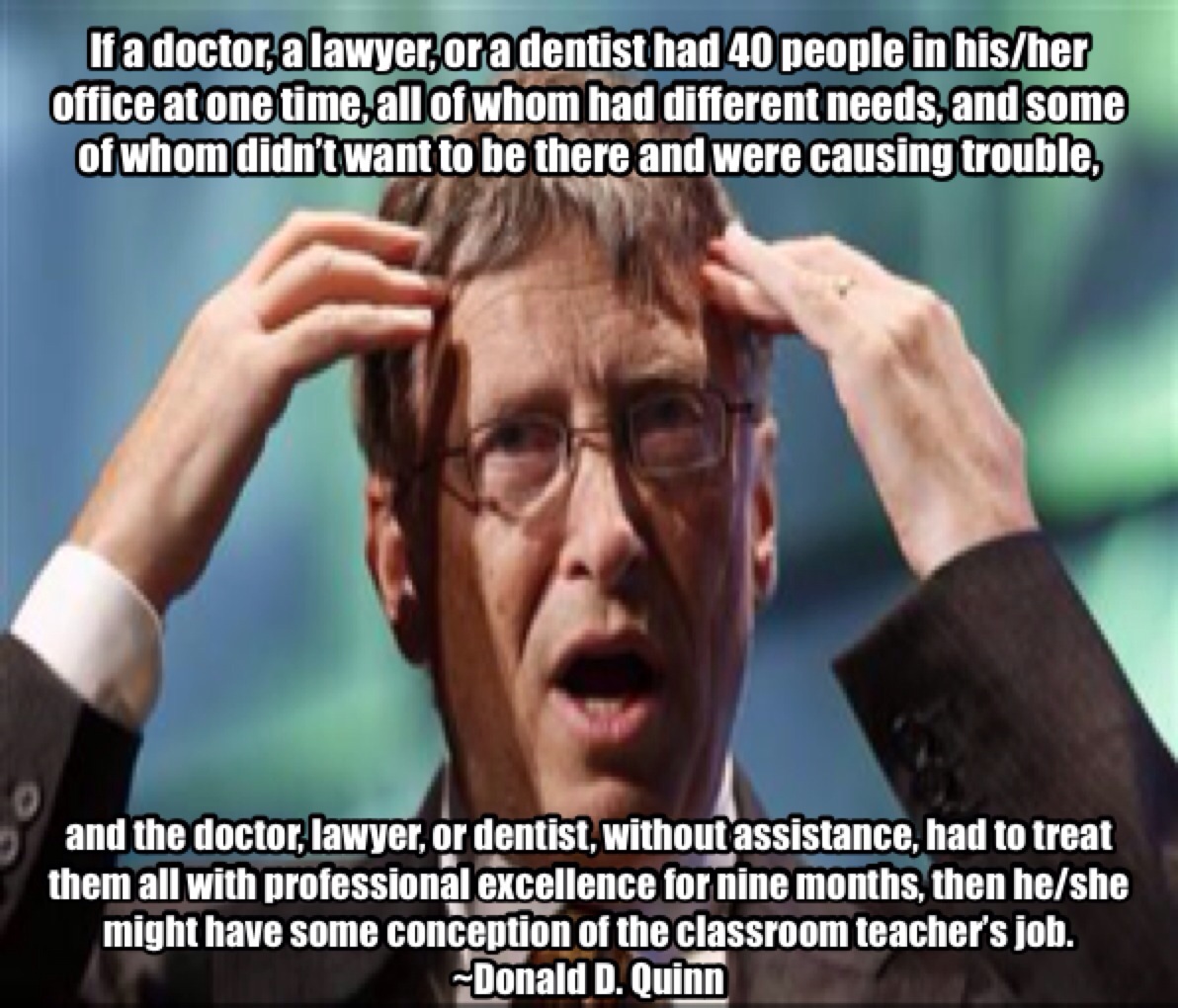
Teachers dedicate their lives to fight the ignorance and poverty of the next generation and are found guilty of the very problem they came to help alleviate. It’s like blaming a doctor when a patient gets sick, blaming a lawyer because his client committed a crime or blaming a firefighter because an arsonist threw a match.

The Philadelphia decision makes clear the paranoid conspiracy theories about school privatization are neither paranoid nor mere theories. We see them enacted in our local newspapers and media in the full light of day.

Step 1: Poor schools lose state and federal funding.

Step 2: Schools can’t cope with the loss, further reduce services, quality of education suffers.

Step 3: Blame teachers, privatize, cancel union contracts, reduce quality of education further.

Ask yourself this: why does this only happen at poor schools?

You never see a rich school dissolve its contract with its teachers. You never see a rich school declare it will become a charter to increase educational outcomes.

Why is that? Is it because rich schools are so poorly managed they can’t see the benefits of these excellent strategies – or is it because no one cares about the poor?

Poverty has been the driving factor behind the Philadelphia Schools tragedy for decades.  Approximately 70% of district students are at or near the poverty line.

To meet this need, the state has bravely chipped away at its share of public school funding. In 1975, Pennsylvania provided 55% of school funding statewide; in 2014 it provides only 36%. Nationally, Pennsylvania is 45th out of 50 for lowest state funding for public education.

Such chronic neglect by the state left poorer Philadelphia neighborhoods unable to make up the difference financially. In 1998, exasperated school administrators threatened to close the district unless the state paid its fair share.

The matter went to the courts with the district suing the state for not providing “thorough and efficient” funding and discriminating against the district’s largely non-White population. After a long series of negotiations, in 2001 lawmakers quickly created contentious legislation to take over management of the district.

Since the schools were in distress (read: poor), the state decided it could do the following: put the district under the control of a School Reform Commission; hire a CEO; enable the CEO to hire non-certified staff, reassign or fire staff; allow the commission to hire for-profit firms to manage some schools; convert others to charters; and move around district resources.

And now after 13 years of state management with little to no improvement, the problem is once again the teachers. It’s not mismanagement by the SRC. It’s not the chronic underfunding. It’s not crippling, generational poverty. It’s these greedy people who volunteer to work with the children most in need.

We could try increasing services for those students. We could give management of the district back to the people who care most: the citizens of Philadelphia. We could increase the districts portion of the budget so students could get more arts and humanities, tutoring, wraparound services, etc. That might actually improve the educational quality those children receive.

Nah! It’s the teachers! Let’s rip up their labor contract!

Take my word for it. Educators have had it.

There will come a time – that time may have come already – when teachers refuse to be the scapegoats for poor policies made by poor decision-makers to fleece and rob the poor.

It all comes down to standardized tests. Bureaucrats don’t know how to measure educational achievements without them. After all, they’re not, themselves, educators. That’s why every major educational “reform” of recent years requires more-and-more of these fill-in-the-bubble falsely objective, poorly written and cheaply graded tests.

In fact, standardized test scores are used to determine whether a school is “failing” or not. It was, after all, one of the chief justifications used for the state takeover of Philly schools.

However, educators know the emperor has no clothes. We know the best predictor of high test scores is a student’s parental income. Rich kids score well, poor kids score badly. Standardized tests don’t measure knowledge. They measure economics.

That’s why parents across the nation are increasingly refusing to let their children take them. It’s why colleges are increasingly lifting the requirement that applicants even take the SAT.

Teachers, too, have begun refusing to administer the tests. However, this is risky because in doing so they are in jeopardy of being fired for insubordination.

But times are changing. The two biggest teachers unions in the country recently came out in favor of protecting educators who take this principled stance.

Alice O’Brien, head of the NEA Office of the General Counsel:

“NEA supports parents who chose to exercise their legal right to opt their children out of standardized tests. When educators determine that a standardized test serves no legitimate educational purpose, and stand in solidarity with their local and state association to call for an end to the administration of that test in their schools, NEA will support those educators just as it did in the case of the teachers who protested the administration of the MAP test at Garfield High School.”

AFT President Randi Weingarten:

“We supported teachers at Garfield High School in Seattle when they refused to give redundant tests. We supported early childhood teachers in New York when they shined the light on how abusive it is to give bubble tests to 5-year-olds. On the testing madness that’s sapping the joy from our classrooms, teachers are the canaries in the coal mines, and we support their advocacy. Ultimately, though, it’s up to parents to make the decision whether to opt out.”

It follows then that educators should refuse to administer standardized tests across the country – especially at poor schools.

What do we have to lose? The state already is using these deeply flawed scores to label our districts a failure, take us over and then do with us as they please.

Refuse to give them the tools to make that determination. Refuse to give the tests. How else will they decide if a school is succeeding or failing? They can’t come out and blame the lack of funding. That would place the blame where it belongs – on the same politicians, bureaucrats and billionaire philanthropists who pushed for these factory school reforms in the first place.

This would have happened much sooner if not for fear teachers would lose their jobs. The Philadelphia decision shows that this may be inevitable. The state is committed to giving us the option of working under sweatshop conditions or finding employment elsewhere. By unanimously dissolving the union contract for teachers working in the 8th largest district in the country, they have removed the last obstacle to massive resistance.

Teachers want to opt out. They’ve been chomping at the bit to do this for years. We know how destructive this is to our students. But we’ve tried to compromise – I’ll do a little test prep here and try to balance it with a real lesson the next day. Testing is an unfortunate part of life and I’m helping my students by teaching them to jump through these useless hoops.

But now we no longer need to engage in these half measures. In fact, continuing as before would go against our interests.

Any Title 1 district – any school that serves a largely impoverished population – would be best served now if teachers refused to give the powers that be the tools needed to demoralize kids, degrade teachers and dissolve their work contracts. And as the poorer districts go, more affluent schools should follow suit to reclaim the ability to do what’s best for their students. The standardized testing machine would ground to a halt offering an opportunity for real school reform. The only option left would be real, substantial work to relieve the poverty holding back our nation’s school children.

In short, teachers need to engage in a mass refusal to administer standardized tests.

“But you can’t do that,” say the politicians, bureaucrats and billionaire philanthropists.

Oh, yes, we can.


This article was published on Diane Ravich’s blog and the Badass Teachers Association blog.

The Best Evidence Against Common Core

Classroom-Management2

There were hands in the air. Lots of them.

It wasn’t just the same one or two I was used to seeing, either. It was almost all of them.

My classroom of 8th grade Language Arts students had something to say, and they could barely contain it.

We sat together in a circle, the desks piled in the center and forgotten. We peered across that distance at each other’s faces and waited for someone to be called on.

It wasn’t me who did it.

The student who had just spoken picked a girl across the room from him. A smile cracked her face wide open as she began to speak.

This wasn’t the norm in my room. At least not yet.

We had only been together a few weeks. In that short time, this group of children from impoverished families – many of whom had criminal records, behavior contracts and folders full of write up slips in the office – had really been putting me through my paces.

If you left them in a room alone, there would probably be a fist fight in 5 minutes. If you peeked at their IEPS, you’d see a host of pharmaceuticals needed just to get them through the day. And if you only looked at their standardized test scores, you’d assume they’d need help to tie their own shoes.

But here they were sitting comfortably, discussing societal racism, gender roles, and how we treat the disabled.

If you closed your eyes and just listened, you’d think it was a class of college freshmen.

That’s what a Socratic Seminar does to a class full of troubled teens.

For the uninitiated, Elfie Israel succinctly defines Socratic Seminars as follows:

The Socratic Seminar is a formal discussion, based on a text, in which the leader asks open-ended questions.  Within the context of the discussion, students listen closely to the comments of others, thinking critically for themselves, and articulate their own thoughts and their responses to the thoughts of others.  They learn to work cooperatively and to question intelligently and civilly. (89)1

Socratic Seminars acknowledge the highly social nature of learning and align with the work of John Dewey, Lev Vygotsky, Jean Piaget, and Paulo Friere.

In short, it’s the kind of thing teachers used to do all the time before No Child Left Behind, Common Core and Race to the Top replaced it with something more rigorous – test prep.

The text we were discussing was “Raymond’s Run” by Toni Cade Bambera. The story centers around Squeaky, an African American girl tasked with looking after her mentally challenged brother, Raymond. At first this is just a chore assigned by her parents. Her real goal is to defeat all comers in various track and field events. However, by the end of the story, she discovers that helping others is its own reward.

But hush. Destiny is speaking.

“Squeaky is kind of a Tomboy,” she read from the question sheet I provided. “Should girls do girly things like being ‘flowers or fairies or strawberries’ or should they be allowed to do more masculine things like play sports? Why or why not?”

“Girls should be allowed to do whatever they want,” she answered. “If they want to play sports or do things that we usually think of as boy things, no one should stop them.”

“In fact,” she went on, “boys should be able to do girl things if they want, too. It’s just like in the story when Squeaky says girls can’t be real friends with other girls because they’re too busy being something other people expect them to be. If people were allowed to be themselves, there’d be less fights.”

Destiny was a girl who only last week sullenly sat with her head down refusing to answer any of my classroom questions with a suck of the teeth. Now she sounded like Gloria Steinem.

And she wasn’t alone. She chose Pablo to continue answering the question about gender roles. He brought up how people in our school treat gay kids.

Pablo said it made him sad that other boys were afraid to be seen hanging around with some kids because they thought their friends would call them gay. “Two girls can hug and hold hands and no one says anything, but if boys did that – they’re gay.”

This from a child who is often absent from school and still had the remains of a black eye that the guidance councilor would only explain by saying the school was aware of it.

Serina took the floor next and had to actually calm herself down before speaking. She told us about her brother, who is gay, and how it makes her cry when people make fun of him. In fact, there may have been a tear or two she calmly rubbed out of her eye with her palm.

At this point – had he been there – David Coleman would put a halt to our discussion.

The co-author of the Common Core famously said, “People don’t really give a shit about what you feel or think.

So shut up, kids. No one cares what you have to say.

Drawing from his deep zero years of training in the field of education, Coleman said:

Do you know the two most popular forms of writing in the American high school today?…It is either the exposition of a personal opinion or the presentation of a personal matter. The only problem, forgive me for saying this so bluntly, the only problem with these two forms of writing is as you grow up in this world you realize people don’t really give a shit about what you feel or think. What they instead care about is can you make an argument with evidence, is there something verifiable behind what you’re saying or what you think or feel that you can demonstrate to me. It is a rare working environment that someone says, “Johnson, I need a market analysis by Friday but before that I need a compelling account of your childhood.”

This attitude is reflected in the standards Coleman helped write and Bill Gates coerced state and federal governments to force on our public schools.

It’s embodied in an emphasis on close reading – going over a text multiple times to squeeze every drop of intention from the author. It’s a fine way of understanding what the author may have meant. It’s not a fine way of teaching or even understanding the full scope of a literary text.

To be honest, this isn’t exactly cutting edge stuff. It comes from the New Criticism of literary theory of the 1940s. Most schools of education replaced this outdated orthodoxy with Reader-Response theory thirty or forty years ago. Reader-Response sees the author as merely one of many factors making meaning in a text. Of equal importance is the world in which the author lived and the particular point of view of the reader.

Think about it. To Kill a Mockingbird is a very different book written during the Civil Rights Movement than had it been written in the 1990s. It’s important to know that many of the characters are based on real people in the author’s life. It’s important to know about the violence and civil unrest that came to a head at the time of the book’s publication. Moreover, an inner city African American boy has a different experience reading it than a privileged white suburbanite.

Reader-Response criticism opens up the act of reading and allows for classroom activities like the Socratic Seminar. But Coleman wouldn’t know anything about that. He was an English Literature major, and when given the chance to write education standards, he paid no attention to what was most pedagogically significant. He simply favored his pet literary theory over those of more modern thinkers.

But if Coleman and the architects of Common Core could be in my classroom, they might see the error of their ways.

Allowing students ownership of the text – allowing them to take their proper place as part of a complex relationship between the text, author and the world – is so much more engaging an experience than just being an authorial archeologist.

When we insist on strict adherence to the author’s message – and only that – we create a false objectivity. Language Arts is a subject that is at most times open to interpretation. But Coleman makes it a guessing game to get the “right answer.”

Literature is not math. We shouldn’t try to turn it into something it isn’t.

This is why at the beginning of the year, my students take my innocent questions about the meaning of a text as an affront. They see me as just another adult trying to trick them. They assume I’m trying to get them to guess what I’m thinking – about what the author was thinking. There has to be only one true answer, they suppose, and if they haven’t been good at guessing it in the past, why try now?

It takes a while, but through lessons like the Socratic Seminar, I try to broaden their horizons, to show them that they have a vital place in this dynamic. Without a reader, a text is nothing but words on paper. Without a larger societal context, those words lack their full meaning.

Moreover, not all texts are created equal. By this I don’t mean that some aren’t rigorous enough. I mean that literary texts are richer and deeper if they come from a multitude of cultural points of view.

We used to know this. Schools used to encourage students to read works by the full spectrum of Americans – African Americans, Latino-Americans, Asian Americans, Jewish Americans, Muslim Americans, etc. Now we shove all that under the carpet in favor of “rigorous” works by the same safe vanilla European Caucasian males.

Common Core doesn’t stop schools from using multicultural texts, but it doesn’t value them, either. There is no standard about the importance of reading diverse authors. In fact, the only diversity I see valued is that students should view diverse kinds of media!

Great! Read an essay, watch a video, play a song. But what about being exposed to diverse cultures and points of view?

Oh! I almost forgot. Coleman says no one gives a shit about that stuff.

My students do. When they read a work by an African American woman like Toni Cade Bambera, they can see themselves in her work. I’ve taught an awful lot of Squeakies in my years as a teacher. (I’ve even taught a few David Colemans.)

When you can open a book and see yourself looking back, what a motivation to read! But how unfair that we only value providing this experience for the white kids!

If we had truly high standards, we’d recognize this. We wouldn’t ignore the value of multiculturalism. We wouldn’t dumb down Language Arts to a simplistic and anachronistic formula designed to fail and humiliate.

Coleman and the Common Core designers would know that if they had ever led a classroom of students. But hardly any of them are educators. They’re bureaucrats, politicians and millionaire philanthropists.

They’re missing the true picture.

Because the best evidence against Common Core is denied them.

Because the best evidence against Common Core is in the classroom.


NOTES:

1 – Israel, Elfie.  “Examining Multiple Perspectives in Literature.”  In Inquiry and the Literary Text: Constructing Discussions n the English Classroom.  James Holden and John S. Schmit, eds.  Urbana, IL: NCTE, 2002.

-For more information about Socratic Seminars, professional development and even ideas about how to extoll their Common Core benefits (lesson plans, people!) please visit Socratic Seminars International.

This article was also published on Diane Ravich’s blog and the Badass Teachers Association blog.

When All Else Fails, Cash In: Charter Schools as Miracle Cure

Cloud Dollar Sign web*304

Do you believe in miracles?

If you live in York, Pennsylvania – you’d better.

Still hurting from $1 billion in statewide education cuts, York City School directors are considering giving their entire district over to a failing charter operator. This would make it the first all charter district in PA.

It’s the kind of decision that no rational individual would normally even entertain. My school doesn’t have enough funding so I should give it to a company to run for-profit!?

Oh! That ALWAYS works!

Such a boneheaded idea could only be proposed by a government bureaucrat. Enter David Meckley, the district’s state-appointed chief recovery officer.

Tasked with guiding the district’s financial recovery, Meckley developed a plan that leads to charter conversion if monetary and academic goals are not met.

Let me get this straight.

Back in 2012, Gov. Corbett cut $8.4 million – over 15% – from York’s budget. To cope, the district cuts the arts, student services, increased class sizes, etc. And now we’re calling the school a “failure” simply because it couldn’t survive the funding cuts deemed necessary by the state.

Reminds me of a bully shouting, “Why are you hitting yourself!?” as he slaps a little kid in the face with the child’s own hands!

So, to review, the same people who hobbled the district in the first place by slashing its funding are responsible for fixing the problem they created. And their solution is to give up. Give the schools to someone else to run.

Q: What was the straw that broke the camels back? What was the final factor that convinced Meckley it’s charter time?

A: School directors can’t agree to a new teachers contract.

Of course! Those greedy teachers asking for a fair wage for a fair day’s work! How dare they!? Don’t they know the district is suffering from a manufactured crisis!?

Do doctor’s ask to be paid for working in poor neighborhoods? Do lawyers work exclusively pro bono to defend poor clients?

Of course not! They’ve got to earn a living! They’re freakin’ professionals after all! Not like these.. yuck! …teachers!

Okay, so the public sector can’t miraculously get blood from a stone. How will a for-profit company be able to succeed where democratically-elected school directors have failed?

The short answer: charters can fire the entire staff and rehire teachers at a lower rate. Yep. Cheap labor! That’s bound to increase the quality of kids’ educations!

Everyone knows the lower the salary, the better the service. That’s why NFL players are all on food stamps. It’s why the most luxurious hotels charge the least for a room! Want a good, Michelin star meal? Welcome to McDonalds, my foodie friends!

For Meckley there’s really only one question to consider. “What’s best for our kids?” he asked at a recent board meeting.

It’s hilarious he can even say that with a straight face! How could reducing teachers’ salaries be best for kids!? That means the most talented and experienced educators will leave for greener pastures. The kids will be left with only the most substandard teachers who have no choice but to accept whatever crumbs charter operators deign to throw their way.

Imagine that happening at a rich school. Imagine that happening at the (private) schools where President Obama or Bill Gates send their kids.

Ha! They demand the best for their children – as they should. But when it comes to your kids and mine – let them eat cake!

Let’s get something straight: most charter schools are not about academic excellence. They’re about high profit margins. Period.

Politicians and corporate school reformers rhapsodize about the power of the free market to cure all the ills of our school system. But from a market point of view, it makes sense to provide the most substandard product possible that parents will still allow their children to endure. The less money spent on the actual job of educating children, the more money to boost the bottom line.

Don’t believe me? Check out the two charter companies vying for a chance to take over York Schools: Charter Schools USA and Mosaica Education.

Charter Schools USA

“Floridian of the Year!” That’s what Florida Trend business magazine calls CEO of Charter USA Jonathan Hage. The rest of us would just call him a douchebag.

Hage probably considers himself some kind of pirate or profiteer. In fact, he brazenly advertises where he gets his precious booty by naming his yacht “Fishin’ 4 Schools.” That’s clever! Morally repugnant, sure! But clever!

To pay for it, he found a new revenue stream that’s just this side of legal. Charter Schools USA is the largest seller of charter school debt in the country. “It will sell $100 million worth of bonds this year, Hage says. … The bonds come with tax-exempt status because they are technically held by the nonprofit founding boards that oversee the schools.” Over a three-year period, the company made closer to $200 million.

So York Schools are considering bettering their financial predicament by giving their district to a company engaging in the same kinds of risky monetary practices that crashed our economy not even a decade ago. Run up debt, then sell it to others tax free! That’s not exactly a prescription for sound fiscal management.

Mosaica Education

This company has a string of scandals that go back decades. Let’s just look at some of the most recent.

  • In 2006, Mosaica was forced to end its contract to run Lafayette Academy Charter School in New Orleans, Louisiana, because it failed to align its curriculum to state standards, provide after-school programs for students below grade level and organize transportation to and from the school. The charter even ended up paying Mosaica $100,000 for early termination of the contract!
  • In 2009, Mosaica-run Howard Road Academy leaked a copy of the DC-CAS standardized test to two teachers, who then distributed copies of the test to their students prior to exam day. One administrator and two teachers were fired.
  • In 2012, Mosaica botched a situation similar to the one they may enter in York, PA. The company was contracted to manage a public school that had just been turned into a charter district in Muskegon Heights, Michigan. Prior to contracting with Mosaica, the emergency manager of the struggling district, Donald Weatherspoon, had fired the entire staff. Mosaica had “three months to hire and train staff members, including those rehired from the old district, bring neglected facilities up to code, and persuade parents to keep their children enrolled.” The school’s first principal quit within the first month and, within 3 months, a quarter of the teachers hired by Mosaica in the summer had left the district. According to Education Week, “the largest single proportion [of teachers who left the district]—28 percent—cited the charter district’s lack of participation in Michigan’s public school employee retirement plan as the reason [for leaving].” Helluva job!
  • As of 2013, Mosaica did such great work running Atlanta Preparatory Academy, the charter ranked in the bottom 20% of schools in Georgia. Atlanta Public Schools recommended that the state not renew the school’s charter. They were also concerned that the charter school’s board lacked sufficient independence because it owed $801,384 to Mosaica!

Read closely, York taxpayers. These are the people you’re being asked to invite to manage your school district! It just makes sense. Foxes make such excellent hen house guards!

Perhaps more disturbing, though, is the Tom Wolf connection.

The Democratic challenger to Gov. Corbett in the November election is a York resident and knows all parties involved too darn well.

Wolf eventually (reluctantly?) came out against turning York into a charter district but was too cozy with those involved, even calling Meckley, “my good friend.

Moreover, Wolf’s chief financial officer for his business and his campaign treasurer, Michael Newsome, served on the work group that recommended converting York to an all charter district. But don’t worry. Wolf says he disagrees with this trusted advisor, as well.

If you really disagree so much, Tom, why have you surrounded yourself with privatizers and profiteers!?

The Democrat seems poised to an easy victory over a certainly more radical Corbett, but let’s hope we don’t have another Wolf in Progressive clothing!

In any case, charterization is a terrible idea.

Turning public schools into charter schools will not solve any problems. It will only make them worse. There is no proof that charters as a whole are any better than public schools. In fact, as we’ve seen, there is plenty evidence to show that charters are much worse.

Yet despite this dismal track record, when public schools struggle, politicians and corporate school reformers keep suggesting charters are the only answer.

We need to look at the source of the problem. Our schools are being starved of funding through the reduction of tax revenue. When the state and federal government refuse to make the richest pay their fair share of taxes, the burden of funding our schools falls to the local taxpayer. In rich districts, this is fine. They can just raise taxes. However in poorer districts like York, this is unsustainable. Putting aside the issue of fairness, it’s impossible to raise local taxes where there is no tax base capable of supporting it.

In any sane country, the shortfall would be taken up by the state and federal government. Education is a right, after all, not a privilege. All schools should have adequate, equitable and sustainable school funding – not just the rich ones.

One wonders if this situation would be allowed to continue if there weren’t people making a mint off the suffering of our school children.

Do what’s best for our kids? Certainly. But it isn’t a charter school miracle.

Enough cashing in on our kids educations. As a nation, we need to grow up, put on our big boy pants and pay for shit. You want to live in a country that leads the world in innovation, industry, freedom and happiness? You want to live in a country that educates it’s children – all it’s children?

Then it’s time we force the rich to reach for their wallets and stop blaming us for being robbed by the policies they’ve bought and sold.

Class Warfare begins in the classroom.


As a result of this article, I was invited on the Rick Smith Show for an interview.