The Only Teaching Evaluation That Matters

Screen shot 2015-06-12 at 10.40.16 PM

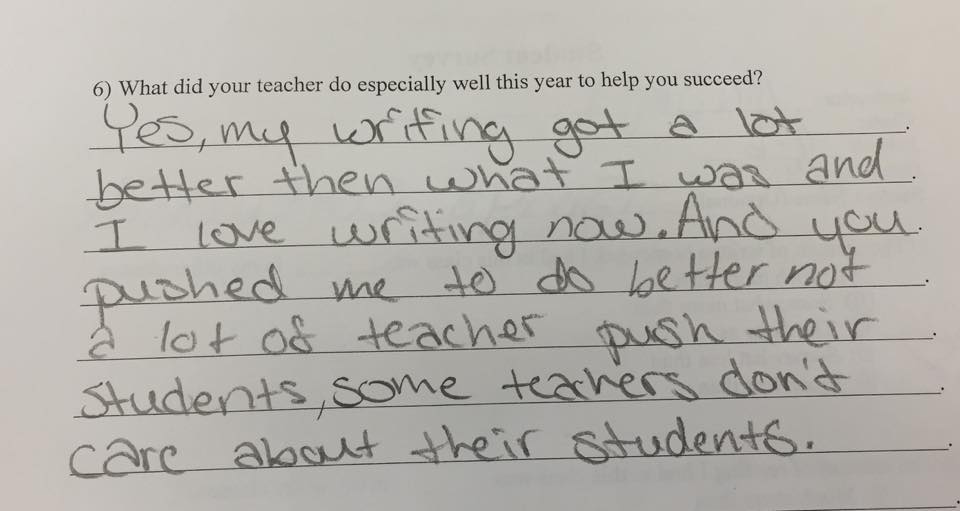
“Yes, my writing got a lot better than what I was, and I love writing now. And you pushed me to do better. Not a lot of teachers push their students, some teachers don’t care about their students.”
11280008_10153046535243860_104612156_n

One of my 8th graders wrote that to me on the last day of school.

I had asked her class to fill out an anonymous survey about my teaching. I said that all year I get to grade THEM, but this was their chance to grade ME.

I made sure to explain that they didn’t need to put their names on it. This would not be graded. Spelling and grammar didn’t count. The only thing I wanted was honesty.

I told them I wouldn’t personally collect the surveys. They should NOT hand them to me; they should put them in a pile on the desk by the door when they leave. I promised I wouldn’t even look at what they’d written until class was over. That way they could feel free to write whatever they wanted. If I did something bad or there was some way I could improve, I wanted them to tell me. If I did something exceptionally well, they should tell me that, too.

“Please help me become a better teacher,” I said.

As an 8th grade public school educator, I get evaluated a lot. I’ve spent countless hours gathering evidence that I’m “proficient” at my job.

I’ve had to endure formal observations, informal observations, H.E.A.T. observations, Student Learning Objectives (SLOs), written explanations of specific lessons with appeals to which Common Core standards I would be teaching – and there always seems to be a new one added to this list next year.

But I’ve been giving a version of this simple student survey to my classes on the last day of school for over a decade.

It’s not something I’m required to do. I don’t share the results with administration. The responses don’t go on file, increase my pay or get recorded in the newspaper. They don’t become part of the district’s ranking in the Business Times. No one is going to withhold funding from my district or close my building and convert it into a charter school based on these results. No one ever will be on television decrying the state of public education referencing these surveys. They are low stakes, class-based, teacher-centered and personal.

But I do this because I think it actually gives me useful information. I really want to know what my students think. That’s one of the things that truly drives my instruction. Not politically motivated standards monetarily incentivized and adopted before they were even completely written. Not standardized tests that measure little more than parental income. Not the latest fad handed down by the superintendent. Not a threat shouted at us through an email or at a faculty meeting.

No. I’m motivated by my kids in the classroom and the answer to the question, “Have I helped you learn?”

The survey is quite simple really. It’s two-sided.

On the front page are 5 multiple choice questions:

1) The amount of written homework I had in this class was                             in my other classes.

A) much more than
B) Somewhat more than
C) The same as
D) Somewhat less than
E) Much less than

2) The amount of reading I had in this class was                                in my other classes.

A) much more than
B) Somewhat more than
C) The same as
D) Somewhat less than
E) Much less than

3) The amount of studying I did for this class was                                 in my other classes.

A) much more than
B) Somewhat more than
C) The same as
D) Somewhat less than
E) Much less than

4) I received                                    instruction and comments on my written work.

A) much more than enough
B) Somewhat more than enough
C) Just enough
D) Somewhat less than enough
E) Much less than enough

5) In this class, I learned                                         in my other classes.

A) much more than
B) Somewhat more than
C) The same as
D) Somewhat less than
E) Much less than

When it comes to homework, students almost always say I give too much. The majority (68%) gave me an A or B.

I only require about an hour of extra-class work a week. I don’t think that’s too bad. However, many teachers give less or none. I go back and forth on the value of homework, myself, but I know that once my students get to 9th grade, they’ll have a tremendous load of it. I figure if I don’t prepare them for that, I’m doing them a disservice. So an avalanche of (one hour a week) homework it remains.

Likewise, kids often say I give a lot of reading. A language arts class should give a substantial amount of reading. So I’m glad most kids (69%) give me an A or B. I require my students to read one self-selected book a month. I don’t think that’s too burdensome. If the book is too tough or boring – hey! You picked it! Pick another one. I also provide them with 15 minutes per day to read in class.

Studying is not something I emphasize. But students are almost evenly divided whether I require too much, just enough or too little. I’m not big on having kids memorize something and then regurgitate that on a test. I’d rather spend time getting them to take good notes that they can use on the test. I’m a big fan of open notes or open book tests. But I hardly ever use the word “Test.” I give frequent short quizzes. I think tests (and even quizzes) are limited evaluation tools. I’d much rather assign a multi-day project. That tells me much more than a brief snapshot of what students were thinking at any one given point in time.

I do assign a lot of essays so I’m always anxious to know if I’ve given enough written feedback. The research seems to show that if you mark every error on an essay, you get diminishing returns. You discourage students. So instead I try to focus on a few trouble areas we’ve already discussed per essay. And students seem to appreciate it. Most of my kids (85%) gave me an A or B or C in this area.

Then comes the cumulative question. How much did you learn? I used to have my classes assign me a letter grade A-E. However, answers were all over the place. When I compared the results with surveys from students who had revealed their identities, I found that kids usually gave me the same grade they received in my class. A-students gave me As. C-students gave me Cs, and so on.

When I changed the question to “how much have you learned?” the results changed drastically. Most students (84%) gave me an A or B. Yes, that’s the result I’m aiming for, but I think it’s a more honest answer, too. It doesn’t focus on grades. It focuses on each child’s assessment of his or her own progress. That’s really what I want to know.

But this side of the survey still provides very limited answers. It is multiple choice, after all. It’s useful for a brief overview but not very deep.

The second side of my questionnaire only has two open-ended queries. Students can write as much or as little as they want to the following questions:

6) What did your teacher do especially well this year to help you succeed?

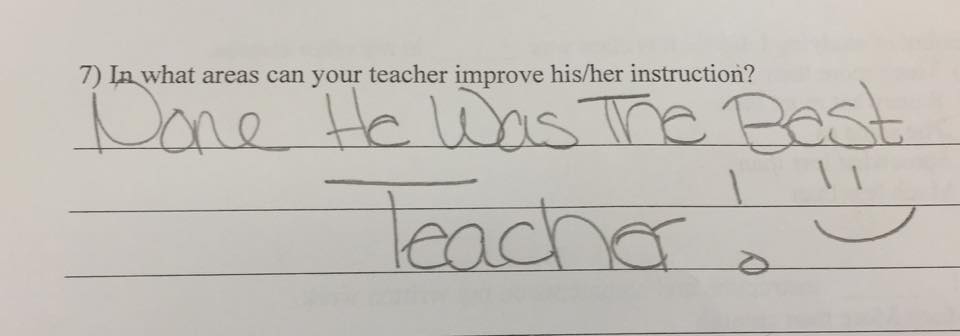
7) In what areas can your teacher improve his/her instruction?

To be honest, when looking at the surveys, I usually skip right to these questions. This is what I want to see – not a bunch of alphabet soup. I want to know what they really think.

What have I done well? Here are some answers from this year’s kids:

-He understood the learning abilities of certain students and helped them to the best of his ability.

11122062_10153046535213860_65835541_n

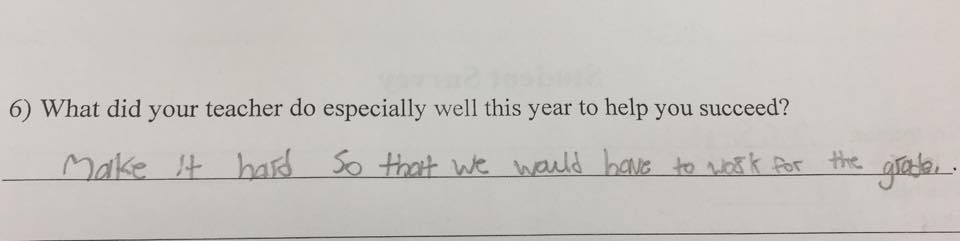
-You made it hard so that we would have to work for the grade.
11208874_10153046535223860_1052817053_n

-Before we could ask him for help, he asked us if we needed help. He’d help everyone, even the person who didn’t ask for it.

11310977_10153046535218860_807785160_n

-He was really good at explaining and pushed me to never give up. Therefore, Mr. Singer is one of my favorite teachers.

11329696_10153046535238860_1253356423_n

-Well, I didn’t like as much work as he was giving us, but then I understood he was trying to help us with our grades and trying to make our grades higher.

11348779_10153046535183860_857789294_n

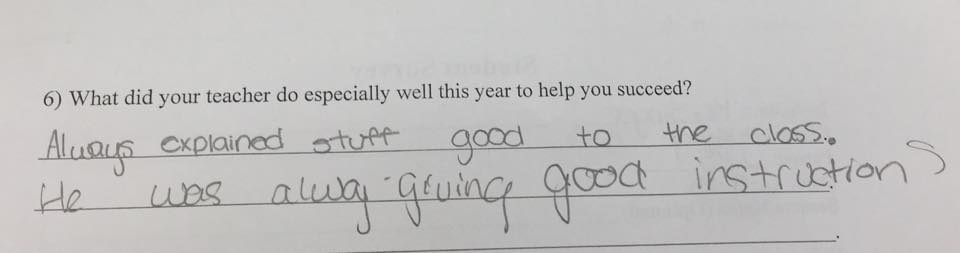
-Always explained stuff good in class. He was always giving good instructions.
11358887_10153046535198860_689871876_n

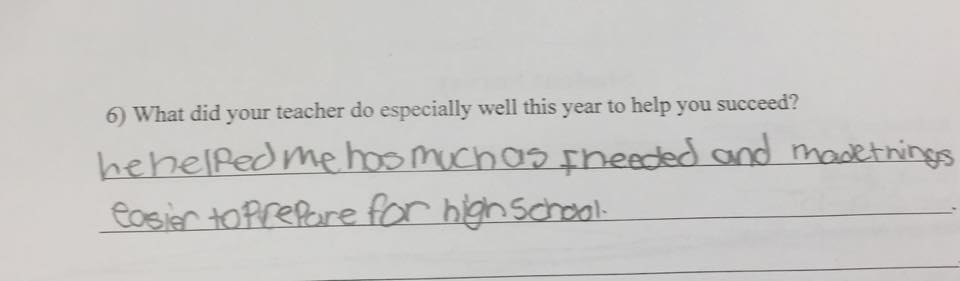
-He helped me as much as I needed and made things easier to prepare for high school.
11418417_10153046535203860_1321510136_n

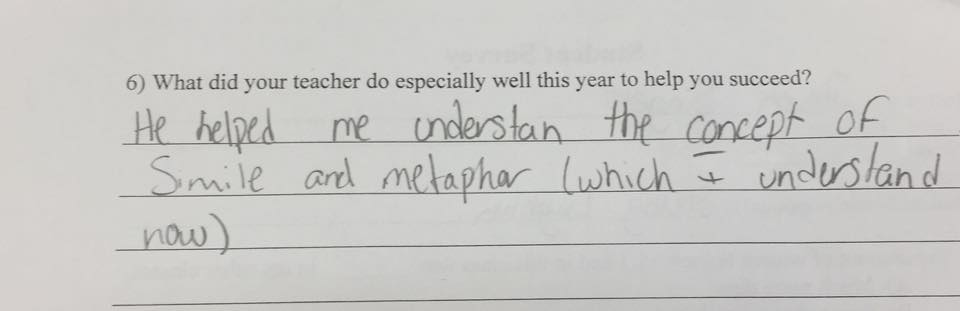
-He helped me understand the concept of simile and metaphor (which I understand now)
11420058_10153046535208860_229100346_n
-What my teacher especially helped me do to succeed is writing essays.

FullSizeRender

I was just floored by these responses. Talk about data I can use! But there was one answer that stood out above even these:

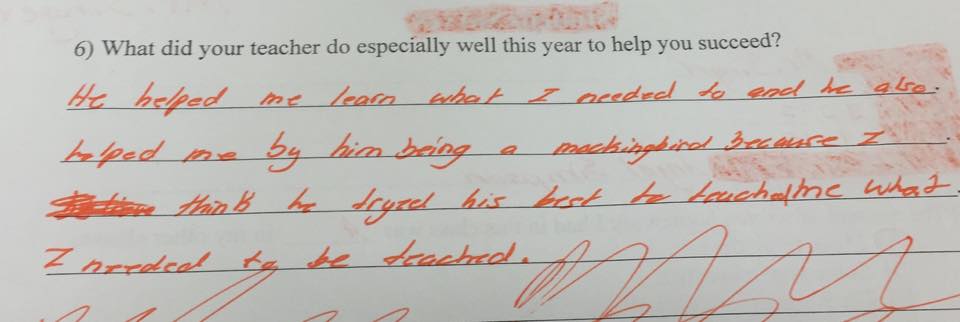
-He helped me learn what I needed to do and he helped me by being a mockingbird because I think he tried his best to teach me what I needed to be taught.
11280625_10153046535248860_1666870003_n

No, she wasn’t literally calling me a bird. She was relating me to our last novel – To Kill a Mockingbird. In the text, some characters are innocent victims. They try to help others but come under fire because of it. The author, Harper Lee, symbolizes them as “mockingbirds.” These include: Tom Robinson, the black man wrongly accused of rape; Atticus Finch, the lawyer standing up for a fair trial despite social criticism; Arthur “Boo” Radely, the recluse who saved lives at the expense of his privacy.

And here my sweet little student was including ME in this venerable list!

That choked me up a bit I can tell you.

When it comes to areas for improvement, my students aren’t the most forthcoming. Answers include:

-I don’t think he needs to because he already does his best to teach us kids what we need to be taught and his instruction is easy to understand.

11418657_10153046535193860_238476660_n
-None. He was the best teacher! 🙂

11419982_10153046535228860_393598543_n

I appreciate the approbation but I wouldn’t mind constructive criticism. I do get complaints about the amount of homework and writing I assign. I also get requests for more free time.

I think if I wasn’t in the room when students took the survey, I might get more criticism. Ideally, I would leave the room for the last 15 minutes of the class, and kids could fill out their surveys. However, this is impractical. I don’t see how I could arrange it given the current climate, lack of subs and skeleton crew staff.

These surveys have given me much to think about over the summer. Maybe I should try to include more group work in next year’s class. Maybe I should revisit the homework situation.

But as June turns to July and then August, I know I’ll be thinking about all that happened this school year.

Some kids came in and out of shelters and juvenile detention. Some were present at a shooting at the local mall. Parents and I had to fight administration over valuing standardized test scores over classroom grades for student placement. The School board enacted a pointless student uniform policy. Students were demoralized and angry over national racial tensions involving Michael Brown, Eric Garner and the Baltimore uprising. Teachers had an active shooter drill for the first time as part of our professional development.

But most of all I’ll think about my students – well, no longer mine – off to the high school and bigger, better things.

For a brief moment I was an important part of their lives and they were an important part of mine. I’ll forget their names. (It’s like my mind is making space for the new ones I’ll have to learn.) But I’ll never forget their struggles and triumphs.

It’s easy to lose sight with all the privatizers and standardizers trying to dismantle our public schools. But even with all the political nonsense, selfishness and small-mindedness, teaching is the best job in the world.

Yes, it really is!

Every day I get a chance to positively impact dozens of lives!

I am truly blessed.

That’s what these surveys tell me.

And that’s why they’re the only evaluation that really matters.


NOTE: Here is a copy of the survey I use in class.

Student Survey

-This article also was published on the Badass Teachers Association blog.
It’s Not Nothing: Why I Support the ‘Every Child Achieves Act’

not-perfect1

No more federal intervention.

No more reducing schools to a number.

That’s the promise of the Every Child Achieves Act (ECAA).

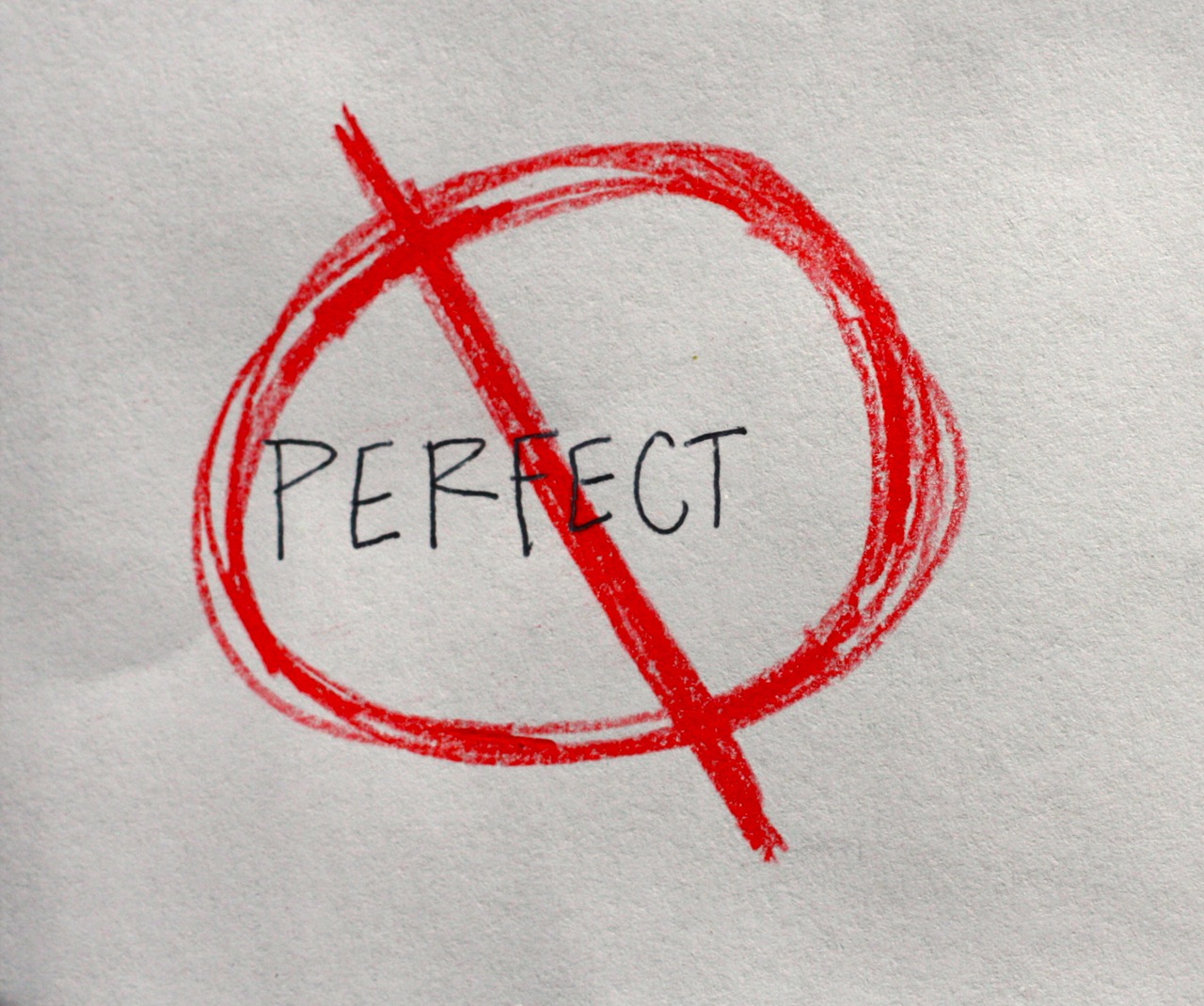
Sure, it’s not perfect. But this Senate proposed rewrite of the Elementary and Secondary Education Act (ESEA) could do a lot of good – even if it includes some bad.

Imagine it.

States would be in control of their own public schools. The U.S. Department of Education and its appointed Secretary would lose much of their power to impose unfunded federal mandates.

For example, the federal government could no longer force states to tie teacher evaluations to student test scores. It could no longer force states to adopt Common Core or Common Core look-a-like standards. It could no longer label high poverty schools “Failing” and then demand they be closed.

That’s not nothing.

But to realize these goals, we may have to compromise.

This federal law (currently known as No Child Left Behind) governs K-12 public schools. It has to be reauthorized.

We tried in 2007, but no one could agree. So the Obama administration took over – offering states a waiver from the worst consequences of the current disastrous law if they just doubled down on those same failing policies.

The result? Seven years of continued educational failure. Policies to privatize, punish the poor and enrich profiteers.

And now we have another chance to reauthorize the law!

We can change course! We can right the ship! We can get our heads out of our collective asses and actually do what’s right for our children!

But this is politics. It’s never that simple.

We have a divided Congress. We have a President who never met a corporate school reform scheme he didn’t like.

But we also have a citizenry who is fed up with all the bullshit. People are demanding change.

We have a real opportunity. If we can seal the deal, a generation of children will be the better for it. If not, the current calamitous law will stay in place for at least 7 more years.

That’s just unacceptable.

The biggest flaw in this proposed act is that it keeps annual testing in place. If approved in its current form, public schools would still have to give standardized tests to children in grades 3-8 and once in high school.

If you’re like me, you just threw up in your mouth a little bit.

However, supporting ECAA doesn’t have to mean supporting testing. There is an amendment proposed by Senator Jon Tester (D-Montana) that would replace annual testing with assessments only once at the elementary, middle and high school levels.

Yes. It’s not enough. We really should have zero standardized tests in our schools. If we have to accept Grade Span Testing – as Tester’s proposal is called – it should be done by a random sample. Don’t test all kids. Just test some small group and extrapolate their scores to the whole.

But Tester’s amendment is not nothing.

Even if it weren’t approved – even if all schools are mandated to continue annual testing as is – the ECAA requires no minimum length for those tests.

How many questions do we need to have on our exams? How many sections? Right now, most states have three sections in both Reading and Math of around 30-40 questions each.

If I’m reading this correctly, it’s conceivable that states that disagree with standardized testing could give assessments of only one section with only one question.

Talk about opting out!

That’s not nothing.

Moreover, the proposed law does not require states to continue evaluating teachers based on student test scores. States are free to stop using the same junk science evaluations currently championed by U.S. Secretary of Education Arne Duncan or not. It’s totally up to the states.

That’s not nothing.

If the proposed act were passed, Common Core State Standards (CCSS) would lose much of their backing.

We all know the sad story of how these supposedly “state” standards were pushed on states from the federal government. We know how states were bribed with federal money to enact these standards before many of them had even finished being written. We know how the U.S. Department of Education has required states to either adopt CCSS or come up with their own academic standards. Moreover, any state that decides to go its own way and write its own standards must then have these standards approved by the federal government, thereby ensuring that regardless of the name you slap on them, they are usually Common Core lite.

However, the ACAA removes the requirement that state standards need federal approval. Therefore, it allows states to actually lead their own quest for real, consequential standards. They no longer have to follow in the footsteps of CCSS. They can set their own agenda.

That’s not nothing.

The proposed act also improves the situation for at risk students. It would establish appropriate class size, specifically in low-income areas. It would give clear/expanded rights to homeless children so they could continue attending their original schools. It would allow English Language Learners to appropriately remain in their classes longer. It would continue Head Start and Early Start programs. It would provide adequate support for gifted and talented students. It would add early intervention services and support early childhood programs.

That’s not nothing.

But the ACAA isn’t the only version of the rewrite being considered. The House has it’s own version called HR 5 or the Student Success Act (SSA).

The biggest difference between the two is Title I Portability – the House version allows it, the Senate one does not.

Currently Title I funds are allocated by the federal government to states each year based on the numbers of children living in poverty in each district. The goal is to provide billions of dollars to poor schools to help them meet students’ needs often left neglected because of lack of local tax revenue.

Title I portability found in the SSA would mandate this money follow the students instead of going to districts. That would be a budgetary and economic nightmare. It would decrease money going to poor schools and increase funds going to rich districts. It would pave the way for nefarious and misnamed “school choice” measures.

That’s why the Senate ECAA is better. It doesn’t allow this wrongheaded scheme.

That’s not nothing.

But – I know – you’re still pinning for that one pristine act that would right all the wrongs of the current law.

Me, too.

In dreams, we can get everything we want.

In waking life, we sometimes have to compromise and accept less.

But at least here you get SOMETHING!

Quite a lot actually.

And as we support the general outline of the ACAA, we can push to make it better by adopting the Tester Amendment and other improvements that may come along the way.

We have to be realistic. A perfect law probably wouldn’t get through Congress. Our lawmakers just wouldn’t vote for it. They couldn’t agree.

We’d be where we were in 2007.

And that would mean more of the status quo.

I can accept the problems with the ACAA, but I cannot accept that.


Please consider joining the Badass Teachers Association in writing your Congresspeople to approve the ACAA with the Tester Amendment.

NOTE: This article also has appeared in the La Progressive, the Badass Teachers Association Blog and was written about on Diane Ravich’s blog.

A Lesson in Resistance – The Baltimore Uprising Comes to my Classroom

Black_Lives_Matter


There was anger in the air.

You could almost taste it.

The children filing into the classroom were mumbling to each other, gesticulating violently, pointing fingers.

And out of all that jumbled noise – like a TV showing a scrambled channel – only one word came through clearly.

Baltimore.

The bell rang its muffled cry – just another dissonant note lost in the chatter.

I held up my hands and began to quiet them.

But then stopped.

Exercises about vocabulary, analogies, sentence construction and figurative language waited patiently on the board. They’d have to wait until tomorrow.

There was something going on here more than just teenage drama. My middle school kids were shaken and upset. As a white teacher who presides over classes of mostly minority students, I shouldn’t have been surprised that the events in Baltimore would weigh heavily on their minds. They were on mine, too.

So I quieted my 8th graders with a question: “Are you talking about Baltimore?”

A collective shout of various disconnected assents.

“Who can tell me what’s happening there?” I asked.

They quieted and raised their hands.

We were back in school again.

They told me what they knew, which was surprisingly little. They knew people of color were rioting in Baltimore. They thought a black man had been shot.

I said, “He wasn’t shot. Does anyone know his name?”

No one did.

“Has anyone heard of Freddie Gray?” I asked.

None of them had. So I told them.

I told them that Gray was a 26-year-old black man in Baltimore who died under mysterious circumstances while in police custody. I told them he was arrested because he met an officer’s eye, got scared and ran. The police arrested him and found a knife on him.

I told them there was a cell phone video of Gray being arrested. He was being dragged to the police car screaming in pain. After about 30-45 minutes he was taken to the hospital. His spine was 80% severed from his neck. He had a bruised larynx and broken vertebrae. He eventually died from his injuries.

They wanted to see the video. At first I refused because I clung to some optimistic hope we might get back to my lesson plans. But one look at their eager faces and I gave in.

I have never heard them so silent. Never. They watched the video and an accompanying news report as if they were the about life and death. I guess they were.

Then we went around the room discussing what we’d seen and what it meant.

More than anything, I just let my kids talk.

You’d be amazed at what they had to say. Some highlights:

  • It’s really hard to be a black person in America. Black people – especially boys – are being murdered by the police. They assume if you’re sagging your pants, you have a gun on you.


  • White people can put their hair in cornrows and dress “ghetto” but when they change their hair back and put on different clothes, they’re still white. I can’t change my face. The police still look at me like I’m an animal and a criminal.


  • Lot of boys I know sell drugs so they can support their mommas. It’s not for them. They want their mommas to have it easier. They do it out of respect for all their mommas have sacrificed to bring them up and feed them.


  • There’s no such thing as race. It’s just a color. We’re all the same.


When it came to the riots, the class was sharply divided – and not on racial lines.

Some kids said that people rioting in Baltimore are being “trashy” and “ghetto.” They’re making black people look bad. “How does stealing the new Jordan’s help Freddie Gray?”

Others thought the violence was completely justified.

In fact, some of my girls were so angry they wanted to go to Baltimore and join the tumult. They were so mad, they wanted to ditch school and riot right here in Pennsylvania.

“This didn’t start with riots,” I told them. “It started with protests. Can someone tell me the difference?”

They calmed again and tried to answer the question.

We started to define both terms. We decide that a riot was chaos, unorganized and had no purpose. A protest was just the opposite – organized and purposeful.

The anger resurfaced.

“I don’t care, Mr. Singer!” a big girl in the back shouted. “They always be out to get us, and when it goes to court no one does nothing!”

I pointed in her direction and nodded. We talked about it. Many felt the same way. If you can’t trust the police and the courts, who can you trust?

I moved forward into the middle of the room.

Dr. Martin Luther King said, ‘The arc of the moral universe is long, but it bends toward justice.’ Does anyone know what that means?”

We decoded it. We decided it meant that it might take a long time, but justice usually wins in the end.

I nodded. 

I asked them if Dr. King ever rioted. They said no. I asked them if Dr. King ever protested. They smiled and said yes.

We talked about the Civil Rights movement. We talked about how organized, peaceful protests won us many of the rights we have today. We talked about Mahatma Gandhi and how passive resistance won the country of India.

And then the talk changed.

No more talk of riots.

We talked about protests – what they looked like today and how they worked.

“I’m going to go down Main Street and protest this Sunday,” another girl said with tears in her eyes. “I have the right to think my thoughts and no one can stop me thinking them.”

Others mumbled agreement and said they’d go with her.

I asked her what she’d do – just march back and forth. She didn’t know. I told her about die-ins – how people would just drop to the ground and stay there to represent the people being murdered.

The class took it from there. They planned to do a die-in. They’d do it at the exact time Freddie Gray died. They’d bring signs that said “Black Lives Matter.”

I asked the girl who originated the idea if she went to church. She said she did. I told her she might want to tell them what she was planning. She should tell her parents. Maybe they’d join her.

She beamed. Her grandfather is a retired police officer and she thought he’d come along. She said she’d talk with her pastor Saturday.

All this in the space of 45 minutes. 

By the time the bell rang again, they were literally marching and singing “Protest!” as they walked off to lunch.

We never got to the planned lesson, but I’m not sure that matters.

Did I overstep my bounds as teacher?

I don’t think so. Something had to be done. These kids were hot. They wanted to tear something apart. But after our discussion they had an outlet, a plan.

Will they go through with it? I don’t know.

Frankly, that wasn’t the point. In the classroom, I’m not an organizer. I’m a teacher.

I’ve lost too many kids to the streets. Drugs, violence, neglect, juvenile detention.

“Promise me something,” I said in the middle of our discussion.

“Mr. Singer, it looks like your going to start crying,” one of them said awed and frightened.

“Please. Whatever you do, be safe,” I said.

“If a cop asks you to do something, you do it. Don’t run. Don’t yell and scream.”

“But, Mr. Singer!”

“Honey,” I interrupted, “I’m not saying to give up fighting for your rights. But you have to live long enough to tell your story. Freddie Gray isn’t around to have his day in court. Neither is Trayvon, Michael or Eric. You know what I mean?”

They nodded.

Teachers can’t make anyone to do anything.

The only thing they can do is get you to think.

I did that. I just hope it’s enough.


NOTE: This article also was published on Commondreams.org, ConversationED, the Badass Teachers Association blog and I talked about it at length during an interview on the Rick Smith Show.


WANTED: Progressive Candidate With the Guts to Stand Up For Public Education

weird-help-wanted-9

Wanted:

Progressive presidential candidate.

MUST SUPPORT PUBLIC EDUCATION.

No. Not just the words. Not as a soundbite. Must actually support policies that help public schools – not tear them apart and sell them away piece-by-piece while you smile and brag about how much you support education.

This means you must:

1) Repudiate and Vow to Repeal Common Core State Standards

-Must know how they were created by unqualified partisans with little input from real educators.

-Cash strapped states were coerced into accepting them – in many cases even before they were done being written – as a condition for increased funding.

-They have never been proven to help kids learn and are in fact a massive social experiment at taxpayers’ expense and students’ peril.

-They are a huge payday for the testing and test prep industry who provide the new standardized assessments and new textbooks necessary for their implementation.

-They are developmentally inappropriate, demanding all students to learn at the same rate and at a time frame that is inconsistent with the way children cognitively develop.

2) End Annual Standardized Testing

-Must promise to end policies forcing public schools to give standardized tests in reading and math to all students in grades 3-8 and once in high school. Ideally, standardized tests should be completely eliminated.

-Must understand that standardized tests are poor assessments that have never been proven to measure academic achievement. However, they do an excellent job of demonstrating a student’s parental income – rich kids do well, poor kids less so.

-Must realize these tests are nothing but a money-maker for private industry and are used as an excuse to close under-funded schools predominantly serving children of color.

MUST REPUDIATE THE MEDIA NARRATIVE OF FAILING SCHOOLS, which is not supported by facts and merely the propaganda of an industry feeding off of our public taxes and children’s misery.

3) Stop the Expansion of Charter Schools

-Must understand how for-profit charters siphon away public money for use as private profits. Charters reduce services for children to increase the bottom line.

-Must vow to protect funding meant for traditional public schools that is lost when charters open in the district.

-Must know that no research has ever shown charters to be better than public schools, and many studies have shown them to be drastically worse.

-Must appreciate the lack of transparency charters are afforded feeds the growing plague of national charter financial scandals.

4) Work to Stop School Segregation

-Our public schools are more segregated now than they were before Brown vs. Board of Education 60 years ago. This is intolerable and makes it easy to disenfranchise students of color.

-Must not only recognize this, but have a plan to solve the problem.

5) Promise to Increase Public School Funding – Especially to the Poorest Districts

-Must understand that nationwide, rich schools spend on average 15.6% more than high poverty schools. Being born poor should not mean you get a worse education. In fact, impoverished students have greater needs than wealthy ones. It costs MORE to educate them.

-Must champion an effective plan to address funding inequalities with an emphasis an equity.

6) Have a Plan to Address Child Poverty

-Must understand that more than half of public school students live below the poverty line.

-Must have an effective plan to help children, parents and families rise out of poverty.

7) Allow Teachers Autonomy and Recognize Them as Professionals

-Must support letting teachers run their own classrooms, champion teacher-created tests over standardized ones – in short, LET TEACHERS TEACH.

-Must vow to eliminate any so-called teacher accountability programs that evaluate educators based on student test scores. Let teachers be evaluated by their own administrators based on classroom observations.

8) Stop Supporting Teach For America

-Must admit six weeks training for college graduates without education degrees is not good preparation to become classroom teachers. All students deserve a teacher with a 4-year degree specializing in education.

-Must condemn valuing TFA recruits who have only promised to be in the classroom for two years over teachers who have devoted their whole lives to their students.

9) Repudiate Any So-called School Choice or Voucher Programs

-Must understand that these policies are often backdoor support for the unconstitutional practice of spending public money on religious or parochial schools.

-Must recognize these policies are another attempt by private industry to convert public taxes into profits. Private schools are not subject to the same regulations as public entities and as such can freely use tax money in more nefarious ways.

-Must acknowledge that school choice is a sham – sending children to schools without public school boards paradoxically reduces the choice parents have over how the school is run.

-Public schools must remain public. Policies allowing for choice among schools – if done fairly – would increase the cost of public education exponentially. It is a much more efficient policy and less open to fraud if we instead ensure every student has a quality education. We need one excellent education system – not multiple ones.

10) Support the Right of Workers to Unionize

-Must support policies to make it easier for private citizens to exercise their collective bargaining rights. Period.


I would be willing to vote for any candidate who met all of these requirements regardless of race, gender, sexual orientation, background or party affiliation.

That’s right. This job need not be filled by a Democrat. Any party will do. I am sick of being offered false progressives under a Democratic banner.

And Hillary Clinton coming right out of the gate praising Common Core may have been the last straw.

Why vote for her over Jeb Bush when they support THE SAME THING!?

No. I will not vote Democrat just because. Never, never again.

If they want my vote, they will have to meet my job application. I will vote to hire the best candidate. Whoever that is.

And I bet I’m not alone.

The education vote is no longer a gimme for the Democrats.

Progressive education candidates? Are you out there?


NOTE: This article was additionally published on the Badass Teachers Association blog.

It’s a Badass Film Festival! Closeup on Corporate School Reform!

11025643_1787964744761514_7757764095588311307_n

I blog.

I write.

I look at the devastation, the hopes and promise of our public school system, and I report it to the world.

It seems a futile pursuit some days. Does anyone actually read this stuff? Or am I just talking to myself?

The hit counter tells me that, yes, indeed, there are people out there clicking on my humble little gadflyonthewallblog. Comments appear under my Facebook posts. My tweets get retweeted. Followers and friends multiply.

But I wonder sometimes about all the sets of eyes that see a block of text under my name and just keep on scrolling.

Would the minds connected to those eyes have understood? Would they have been spurred to action? Might they have been just the people we need to turn the tide and take back our education system?

And I answer: maybe.

So today’s entry is an attempt to get those roving, impatient orbs to stop, look and see.

Because today I bring not just words but pictures. Movies, in fact.

But first some background.

This whole enterprise began by accident. My school district received a $360,000 donation from Apple and Bill Campbell so every student could have an iPad for use in class.

The program will be rolled out next year, but teachers have already been given devices and some minimal training.

We were encouraged to play around with the devices to find applications for our students next year. One such app we were told to explore was iMovie.

I made a brief preview trailer for S.E. Hinton’s “The Outsiders” – one of the novels my students read. I thought it might make a good lesson on theme for next year’s kids.

However, in doing the assignment, I wondered what it might look like if I made a similar short movie about corporate education reform. After all, I spend a lot of my off hours writing about it. Why not try another medium?

Let me be clear. I did NOT use school equipment. I have my own personal iPad at home. It’s not nearly as nice as the ones the students will be using. In fact, I had to pay for a few upgrades to get it up to similar specs.

But once I did, it was a simple matter to make the “OPT OUT OF STANDARDIZED TESTING” movie you see here:

The newest version of the program provides several short preview templates in various movie genres. All you have to do is insert pictures or video and change the text to suit your purposes. In some cases, I had to extend the templates so they’d fit the topic I was tackling.

I was kind of tickled by the result so I shared it with my fellows at the Badass Teachers Association. I serve on the Leadership Team. And in a moment of whimsy I had designated my film a production of “Badass Films.”

They seemed really taken with it. They loved the idea of having our own film studio – even if it was just a hand-held Apple device.

With the power of an organization representing more than 54,000 people, they promoted my first little film on their YouTube channel. They pushed it out on twitter and facebook. Even Education Historian Diane Ravich gave it a push and a very kind review.

They asked me to make more. I did.

My fellow BATS helped me decide on topics, made suggestions for revisions, helped provide photos and even made a kick ass mock movie poster for each film!

And every day they’d send out into the ether a reminder that Badass Films is coming soon!

I hope you enjoy them.

Without further ado, here are the remaining 12 Badass Films:


COMMON CORE

On YouTube


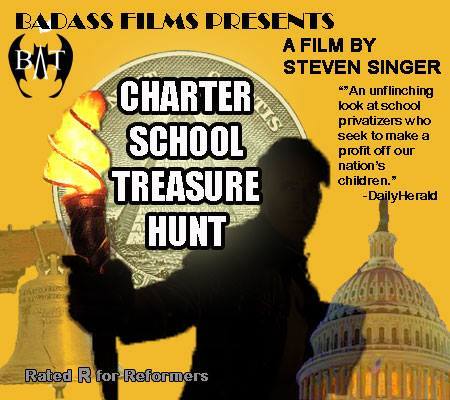
CHARTER SCHOOL TREASURE HUNT

On YouTube


V.A.M. SHAM

On YouTube


SCHOOL TO PRISON PIPELINE

On YouTube


SOCIAL JUSTICE

On YouTube


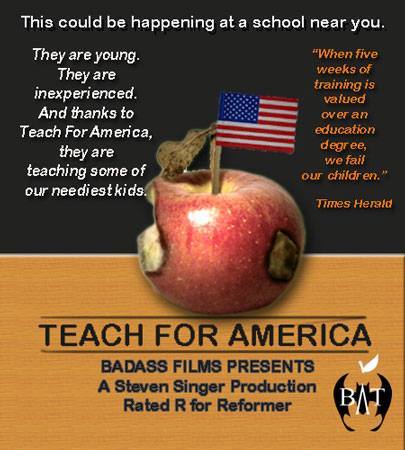
TEACH FOR AMERICA

On YouTube


TEACHERS UNIONS

On YouTube


TEACHER TENURE

On YouTube


PENSION THEFT

On YouTube


SCHOOL “CHOICE”?

On YouTube


BADASS TEACHERS ASSOCIATION

On YouTube


G.E.R.M. – Global Education Reform Movement

On YouTube


So there you have it. Badass Films.

I’m hoping these short videos can serve as a primer for our fight against the standardization and privatization movement.

People who wouldn’t sit to read an entire blog entry might stop long enough to watch a less than 2 minute film. And – hey – videos are like potato chips – you can’t stop at just one!

Some might criticize this project as being shallow. How can you really explain a topic like the School to Prison Pipeline or even Common Core in such a short span?

Well, you can’t. But these are meant to be attention-getters. I only hope they’ll spark interest. There are so many sources for more information – many of them previous articles published on this very blog!

I’d love to hear your thoughts. How did I do? Are these films successful? Will they help the fight against factory schools?

Feel free to leave a comment and certainly to share this blog or any of the individual videos.

Special thanks to all the BATS who helped bring this project to completion. You earn the name “Badass” every day!

As for me? I will continue to write.

To blog.

And – when possible – make movies.


This article was also published on the Badass Teachers Association blog.
Coming Soon – Badass Films!

11025643_1787964744761514_7757764095588311307_n

Quick! Somebody microwave Bill Gates a bag of popcorn!

Fluff up Arne Duncan’s favorite pillow!

Get Chris Christie some Sour Patch Kids!

A lot of Sour Patch Kids!

Because the show is about to begin!

Coming Friday, March 6, I’ll be launching Badass Films.

This new venture is a division of the Badass Teachers Association (BATs). Your humble blogger is a member of the leadership team.

I’ve made 12 very short films about corporate school reform and the grassroots movement that fights against it.

They’re nothing fancy – just something I whipped up with imovie. But I hope they’ll help spread the message and get people up to speed on the damage being done to our school system by standardization and privatization. I also hope to shine a light on some of the amazing people out there – parents, teachers, students, and people of conscience – who are fighting against factory schools with all their might.

I already released this film called “Opt Out of Standardized testing:

Friday I’ll release the remaining 11.

Here are the working titles and a few mock movie posters made by our incredible BAT Meme Team:

COMMON CORE

11025657_10203268816873981_1262629182399128973_n

(Meme by Lisa Smith)

CHARTER SCHOOL TREASURE HUNT

11018333_1787967094761279_1927574463641915875_n

(Meme by Deb Escobar)

V.A.M. SHAM

10407708_1787964788094843_6197962986326075342_n

(Meme by Lisa Smith)

SCHOOL TO PRISON PIPELINE

11041805_1787967058094616_9048113339296113831_n

(Meme by Lisa Smith)

SOCIAL JUSTICE

11021256_10203265686555725_803665120896316326_n

(Meme by Lisa Smith)

TEACH FOR AMERICA

13153_1787964821428173_6920343151965987041_n

(Meme by Deb Escobar)

TEACHERS UNIONS

11038394_1004294866247425_5874150282235233581_n

(Meme by Deb Escobar)

TEACHER TENURE

11024651_1787967144761274_6689401375953386379_n

(Meme by Deb Escobar)

PENSION THEFT

11021097_1004792002864378_1669790349007334121_n

(Meme by Deb Escobar)

SCHOOL “CHOICE!?”

11050259_1787967254761263_453569343639332923_n

(Meme by Lisa Smith)

BADASS TEACHERS ASSOCIATION

11025643_1787964744761514_7757764095588311307_n

(Meme by Lisa Smith)

I hope you’re as excited as I am! I always wanted to be in the movies! Move over, Orson Welles! Here comes a BAT with an ipad!

See you Friday at the movies! ^O^


This article also was published on the Badass Teachers Association blog.

Montel Williams is a True Public Schools Advocate

fcb9ca89141ab8aa52049d9d7dd90bf1

Montel Williams did something truly amazing yesterday.

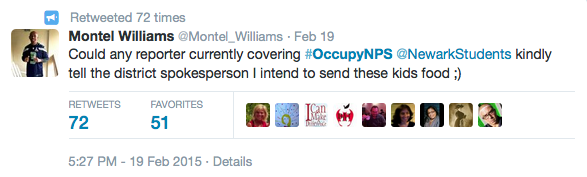
When he heard the Newark Student Union was having difficulty getting food during their sit-in at Cami Anderson’s office, he volunteered to personally send them something to eat!

He tweeted, “Could any reporter currently covering #OccupyNPS @NewarkStudents kindly tell the district spokesperson I intend to send these kids food ;)”

Screen shot 2015-02-20 at 8.38.12 PM

That takes guts. He wasn’t just offering his opinion. He was threatening to get involved.

It’s that kind of integrity that’s behind his #StandUpForPublicSchools campaign. Here we have a national celebrity, known as a groundbreaking talk show host who could just sit back and enjoy life. But instead he uses his notoriety to help public school teachers!

That might not sound like much to some, but our public schools are under attack. You’d be hard pressed to find anyone in the public eye to say something nice about our school system. Our national debate about education is curiously absent teachers. Yet here comes Montel who not only praises our work but starts a campaign to advocate for us and our students! Heck! Another one of his hashtags is #LetTeachersTeach!

Finally we have a prominent figure with the courage to take the public stage and not call for more school closures. He calls for support!

Last night he even went on Fox Business to talk with former MTV VJ Kennedy who famously said “There really shouldn’t be public schools.” And he boldly told her the truth: public schools need our advocacy!

As teachers, it brings tears to our eyes to finally see someone have our backs. He’s taking some heat on twitter for it, too. But, Montel, just know we will always be there to back you up.

You are truly badass! Much love and appreciation from all of us at the Badass Teachers Association!