No Pineapple left Behind – the Consolation of Satire and Video Games

altersplash3

Q: What’s the difference between a pineapple and a human child?

A: Pineapples are more profitable.

Let’s face it – kids have.. yuck … needs! Maslow even came up with a hierarchy of needs that must be met before you can get the little tykes to do anything. Physical well-being, safety, emotional… Argh! It’s just so much work!

Pineapples, however, are money-makers from the get go.

Chop them up, and you’ve got a tropical fruit salad.

Juice them, and you can make about a hundred different premium cocktails.

Heck! Just plop one in a hat and you’ve got an island-themed mascot!

But kids!? You can’t even get them to take a lucrative standardized test without… bleugh … educating them first.

Imagine if you could make pineapples take tests and get grades instead. Schooling would be like a gardening contest. Who has the best recipe for success? There would be no intangibles like the effects of poverty, home-life, special needs. It would all be neat, measurable and objective.

Yes, sir. Pineapples would be great for business – especially if your business is education.

That’s the premise of Subaltern Games current project No Pineapple Left Behind.

The satirical fantasy video game is the brainchild of former teacher, Seth Alter.

Alter taught at a Boston middle school before giving up the classroom for the programmer’s chair. According to his blog, he “became fed up with the callous administration” and decided he could teach more effectively through video games.

His first game, Neocolonialism, was inspired by world history and economics. The goal is to extract as much wealth as possible from the world through any means necessary. While many video games invite the player to engage in senseless violence, Neocolonialism inevitably forces players to consider the consequences of their actions. In fact, the game’s tagline is “Ruin Everything.”

The project was completed through a $10K Kickstarter campaign in January 2013 and released in November of the same year.

Now Alter and his 4-person team are writing No Pineapple Left Behind (NPLB) – a game he calls his “response to his old teaching job.”

While still in the early stages, the company has provided some video of what the game may look like when completed:

A Kickstarter campaign is anticipated to help the company finish this ambitious project.

Even in its early stages, NPLB confronts us with a host of essential questions about education:

1) WHO ARE PUBLIC SCHOOLS DESIGNED FOR – CHILDREN OR WIDGETS?

2) WHAT IS THE PURPOSE OF OUR SCHOOLS – EDUCATING KIDS OR MAKING MONEY?

Examine the state and federal education policies of the last dozen years and you’ll be forgiven for thinking we’re servicing widgets.

Federal programs like No Child Left Behind and Race to the Top increase high-stakes standardized testing to absurd lengths. Public schools are repeatedly defunded at the state and federal level, forcing them to rely on local taxes to survive. This is fine for affluent districts that can just raise property taxes, but it is unsustainable for the 99%.

To make up the difference, poorer schools are forced to compete for the remaining funds by enacting reforms that don’t benefit children but enrich the special interests that lobbied for them. Test companies like Pearson rake in the cash creating and scoring the tests on the one hand, and then earn even more profit providing the inevitable remedial test prep materials districts are forced to buy on the other.

Microsoft billionaire Bill Gates poses as a disinterested philanthropist funding Common Core, but then increases his company’s market share by providing the computers and technology necessary to take the standardized tests required by Common Core.

Moreover, for-profit companies entice away students to charter schools in order to garnish their per student funding. Then just before it comes time to take their standardized tests and thus be judged as effective or not based on these scores, charters boot the lowest achievers back to the public schools. The money, however, they keep. And they get to boast of how well they teach kids since the only ones left are the cream of the crop!

Children then become little more than a means to school funding. Schools are forced to use children to earn money for the district to remain open.

But schools are supposed to be places where funding is used to educate kids – not places where kids are used to earn funding.

3) IS COMPETITION THE BEST MOTIVE FOR A PUBLIC SERVICE?

No. Emphatically not. When you have competition, you by necessity have winners and losers. The goal of public schooling is to educate EVERYONE. Didn’t we call this nonsense No Child Left Behind? How can it be about doing that, if the goal is to see who wins the Race to the Top? In a race, the objective is to leave everyone else behind!

4) WHAT IS THE ROLE OF THE CLASSROOM TEACHER – GUIDE OR SORCERER?

In the early draft of NPLB, teachers will cast spells on their pineapple classes to get them to learn. This works well, apparently, for fruit. However, if classes are left unattended, the pineapples will turn back into children who are much harder to educate in this manner.

Go to any school of education in any university in the country and you’ll learn this simple fact: Education is not something someone does to you. No one can put a finger to your head and make you learn. There are no mystical words to engender wholesale epiphanies. Learning is a complex process that requires a relationship between the teacher and student. It happens gradually over time. There is no magic here.

However, our national education policy acts as if all children go to Hogwarts. Teachers are evaluated on how much their students learn. That’s only looking at one part of this complex relationship. What about the children? Aren’t they part of this equation, too?

Moreover, the metric administrators are being forced to use to determine if this learning has actually taken place is… standardized test scores! These are tests graded by temps who may or may not have an education degree working for corporations that make more money if more kids fail the tests! That’s a classic case of conflict of interests.

So we have a faulty evaluation method that is using faulty data to come up with faulty conclusions that will determine whether a teacher gets to keep his job or not. The ONLY way that works is through magic!

And so we’re left with the consolation of satire and video games. Will No Pineapple Left Behind be a big hit on the market? It’s still to early to tell.

However, the concept shows tremendous promise.

Perhaps players will recognize their own schools in the game.

Perhaps policy-makers will become embarrassed and discredited as the objects of virtual ridicule.

Perhaps encountering such everyday absurdism in video game form will serve as a wakeup call to the slumbering masses.

Otherwise, it may be game over for American Education.

UPDATE: No Pineapple Left Behind is now on Kickstarter looking to raise $35,000 to finish the project. New pictures, promos and information is available on the site.
Standardized Dress – School Uniforms and Conformity as Social Norm

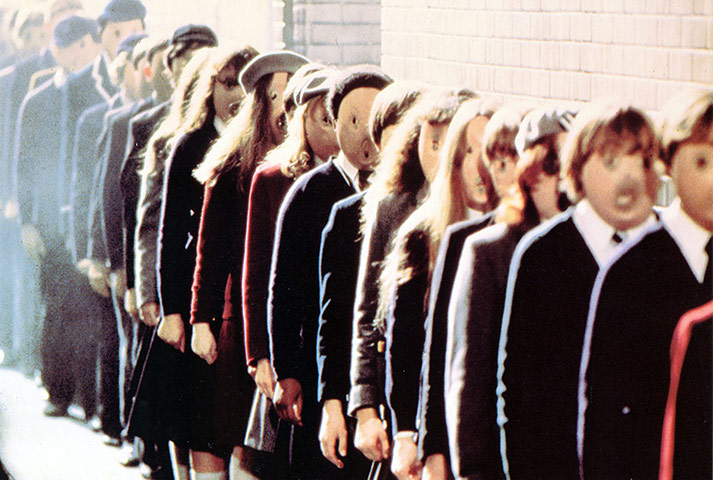
Pink-Floyd-The-Wall1982The-groups-musical-film-starred-Bob-Geldof-and-Bob-Hoskins

It was just a normal Monday. Two emotionally disturbed students chased each other into my classroom playing keep away with each others’ belongings.

I stopped them, reprimanded them and sent them to opposite corners of the room. Meanwhile the rest of the class hadn’t bothered to begin their warmup activity. I explained the assignment and got them back on track.

Finally, a girl sitting in the front row raised her hand and offered a solution to the problem on the board.

We were back in business and learning could continue.

At the end of class, an administrator stormed in. There was an urgent problem that needed solving immediately.

It wasn’t that the emotionally disturbed students were misplaced in the regular education setting. It wasn’t that the other students had needed redirection. It was the girl in the front row.

She was wearing a pink shirt!

When board members enact a school uniform policy – as was just accomplished at my district – they turn every educator in the building into the fashion police.

Individualized instruction, classroom management, content knowledge – all become secondary to the driving force of our schools: who isn’t conforming to the norm?

When did this become our educational philosophy? We should be doing just the opposite.

Schools should be engines of self-discovery and self-expression. In a world of stifling poverty and dangers from within and without, our schools should be places where kids can be themselves. We should be providing them safe places to learn who that is and what their relationship is to the rest of the world.

Instead, we standardize the curriculum with test prep and Common Core. We standardize their assessments with days of fill-in-the-bubble state-mandated testing and pretesting and post-testing.

To be fair, much of this is forced on us from the state and federal government. But now when your local school directors get an opportunity to make a rare decision about how to run their own community schools, they decide to standardize student dress!? They think having everyone look the same in drab colors and similar outfits is going to improve the situation!?

No! It simply continues the trend of turning our children into prisoners and turning our teachers into their wardens.

Case-in-point: my classroom is very cold. Even in summer the air conditioning blows out too much frigid air, and the maintenance department never seems able to adjust it properly.

I’ve almost given up complaining to administrators. After a few introductory attempts, I move on to things I can actually control.

In the past, I’ve simply told my students to bring a jacket. Most of them end up bringing a hoodie, but this year that’s against the dress code. They can wear a certain kind of plain sweatshirt or sweater, but they can’t wear one with a hood.

The result is a class of shivering children many of whom still try gamely to learn. I must admit, even standing there, myself, wearing a suit jacket, I go numb after a while.

So I took pity on my class and allowed them to discretely bring hoodies into class if that was all they had available. Almost immediately after the first student donned the verboten clothing, an administrator looked into my room and saw it. She pulled the student into the hall yelling and screaming that this was the second time the child had been seen wearing a hoodie, and disciplinary action would be taken.

The child turned to me with lost, helpless eyes before I spoke up and took the blame. He got off with a warning and shivered through the rest of my lesson.

Is this really the best use of our educational resources? We have real problems – such as dealing with the consequences of our “lowest responsible bidder” air conditioning service. But instead of tackling any of that, we’re pounding children into submission for a school uniform policy that doesn’t make any sense.

What lesson does it teach? Hoodies are evil? Wearing pink or – God help you! – navy blue will ruin your life!?

No. You must be the same as everyone else or you will be punished for being different.

This is what happens when school directors glance at the mountain of insurmountable problems they’ve volunteered to correct. But instead of solving any of them, they opt for a measure that solves nothing but looks good on paper – the newspaper, specifically.

A school uniform policy allows them to talk tough. We’re taking a strong stance against misbehavior by forcing student to dress the same way. We won’t put up with shenanigans at our school like gangs, violence and freedom of expression!

It’s ludicrous.

Do uniforms reduce violence and increase positive behaviors? There is no proof that they do. In every study that claims to prove the efficacy of uniforms for positive behaviors, districts made additional rule and administrative changes to the school environment at the same time. There is no way to isolate uniforms as the one factor among many that caused better behaviors.

What’s worse, there are long-standing, well respected studies that go further and conclude that uniforms are – at best – ineffective and – at worst – actually INCREASE negative behaviors.

Take this 1998 statistical study produced by the University of Notre Dame‘s Sociology Department that studied 10th grade students. Researchers showed that uniforms had no direct effect on “substance abuse, behavioral problems or attendance.” In fact, uniforms actually had a negative effect on student achievements for those students who previously considered themselves ‘pro-school’.

Researchers concluded:

“Student uniform use was not significantly correlated with any of the school commitment variables such as absenteeism, behavior, or substance use (drugs). In addition, students wearing uniforms did not appear to have any significantly different academic preparedness, proschool attitudes, or peer group structures with proschool attitudes than other students.”

What about academics? Supporters claim uniforms will boost academic achievement by removing distractions to learning.

It’s a curious claim to make.

Statistics show that mandatory school uniforms actually work AGAINST learning. States that require uniforms rank at the bottom for academic achievement. States without mandatory school uniforms rank at the top.

This is why school districts that adopt mandatory school uniforms often see a drop in property values. Mandatory uniforms are a hallmark of failing schools.

Consider what kinds of schools require uniforms. Hint: it’s not the rich suburban ones. It’s the poverty-stricken inner city ones. Specifically, 47% of high-poverty schools reported requiring school uniforms. While only 6% of low poverty schools did the same, according to the US Department of Education.

The National Center for Educational Statistics surveyed both primary and secondary school students from 1988 to 2004. Their conclusion: “Once I control for a number of factors, including race, sex and socioeconomic status… there is little evidence that school uniforms have an impact on student outcomes.”

In short, it’s time to stop reform for reform’s sake. We need to stop reaching for easy answers. Our children deserve better.

We need to give up this strange notion that in the land of the free, the home of the brave, the best ideal we can drum up for our schools is everyone marching in line, wearing the same clothing, thinking the same thoughts. That’s not the American dream. That’s the Communist one!

We’ve got to be okay with difference. In fact, we need to encourage it. Yes, there are limits, but they should be placed back as far as possible.

John Mason wrote, “You were born an original. Don’t die a copy.” Let’s not force our children into a mold.

Let’s guide them, nurture them to become independent thinkers who sometimes shock us with their originality.

Let our decisions today be worthy of the adults they may one day become.

Let them be free.

Tracking, Testing and the Myth of Meritocracy

sad student
Why do we track students?

Why do we separate them into remedial, academic and gifted classes?

Is it to make the teacher’s job easier? To reduce the learning gap between the lowest and highest functioning students? Or is it for some other reason?

These questions were on my mind this morning. I teach academic language arts classes at my school. I teach the students who don’t have the grades, test scores, behavior or motivation to be enrolled in the gifted classes.

When the Pennsylvania legislature slashed education funding at the insistence of Gov. Corbett, some of the first things we lost were remedial classes. So those students come to me now, too.

Perhaps that’s why it was a shock in the early morning hours when my principal dropped a bomb on me.

This morning she pressed a spreadsheet under my nose and told me she would not allow one of my best students from last year to move up to the gifted class this year.

I was gobsmacked.

This is a child who put forth the maximum effort almost every day. I couldn’t hand out a complicated week-long assignment without him completing it with a high degree of accuracy within an hour or two.

This is a boy whose hand was always raised, the correct answer almost bursting from his lips.

His grade was exceptional. I can count on one hand the number of students I’ve had in my entire teaching career who have ever earned a 100% in my class during a single semester. But he’s one of them. And even in the instances where he fell short, it was only by a few points.

If we were ever to allow a student to move on up, this is the one.

I told the principal all of this and she just pressed her finger deeper into the spreadsheet. Oh, he had the grades alright. He just didn’t have the standardized test scores.

Let’s pause here for a moment to take this in. The import of this decision goes way beyond one student in one school. It touches us all.

My principal had decided to place this child into a class based solely on his standardized test score. The administrator had weighed three days of testing versus 180 days of classroom excellence and come down on the side of the tests.

I couldn’t believe it. Countless studies have shown GPA is a better indicator of academic success than standardized test scores. That’s why more than 800 colleges no longer even require applicants to take the SAT. But before I could protest, my principal was off, holy spread sheet in hand.

I could barely breath. I had just seen my former student and his mother the night before at open house. Mom gushed about how proud she was of him. She had always been afraid to place him in the gifted classes because she wasn’t sure he could handle it emotionally. She didn’t want him to get bogged down with extra work and fall behind. But after his stellar performance in my class last year, she was finally willing to give him a chance.

The pride he felt was all over his face. He had worked hard and he knew now that he could do it. He wasn’t afraid anymore. He was ready for the next challenge.

What would this new decision do to him? My heart broke at the prospect of finding out.

What had happened to make his standardized test scores so low? He hadn’t bombed them, but he hadn’t quite passed them either.

This is the first time I’ve ever had such a discrepancy between classroom grades and test scores. Usually students who get a high grade in my class at least pass their standardized tests. I’ve had one of the best records in this regard in the district for years.

But last year’s exam was an anomaly. Pennsylvania is in the process of revising the PSSA tests – given to elementary and middle school students – to more closely resemble the Keystone exam – given to high school students.

Almost a quarter of last year’s PSSA questions were field tested (See: PSSA Reading Inquiry). They didn’t count toward the student’s score. They were questions test-makers were considering counting next year depending on how students did on them this year.

A test is only as good as its questions. A confusing question can really put a student off – especially if he has test anxiety.

Even if the problem is the question and not the student’s ability, having to face queries of variable quality while taking a high-stakes test can easily reduce a student’s faith in himself. Sure the field tested questions don’t count, but they can hurt a student’s chances of getting correct the ones that do.

Moreover, there were plenty of changes to the scored questions. Teachers lobbied the state Department of Education to provide us with examples of how the test was changing but were given very minimal information. We ended up giving our classes the same preparation we always do. We taught them how to identify synonyms and antonyms, theme, the elements of plot, etc. But students were inevitably less prepared about what kinds of questions to expect. Therefore, anxiety levels were heightened.

In addition, this is the first year my district has not trusted classroom teachers to proctor standardized tests to their own students. The state has been strongly cautioning schools from allowing teachers to give the tests to their own students since various cheating scandals have rocked the news.

In an effort to forestall teachers giving any help to students struggling on the tests, they make teachers give the tests to children with whom they do not already have a strong relationship. I guess the thinking is that we’d be more prone to help kids if we know and care about them.

Rapport matters. Students will work harder for a teacher they respect and admire – for someone they know cares about them as a person and not just as a name on a roster. Moreover, kids shut down for teachers with whom they don’t get along. Guess which kind of teacher proctored my star pupil’s test last year.

Finally, we come to grading. How are these standardized tests graded in the first place? Administrators like mine take these scores as an objective measure of student performance, but are they?

Grading tests in Pennsylvania is done by Data Recognition Corporation (DRC) – the same company that created and distributed the exams in the first place. Unlike most classroom grades, test scores are NOT determined on the percentage correct. For instance, getting 80% of the questions right does not mean you have a B or even necessarily a passing score. What constitutes passing isn’t even determined until after all the exams are scored.

DRC trusts the job of grading their tests to temporary workers who may or may not have a teaching certificate. The only prerequisite is holding some sort of college degree and agreeing to work for $13 to $14.25 an hour. Once all the tests have been graded, temps get together and decide which range of correct answers will constitute Advanced, Proficient, Basic and Below Basic that year.

So a student could get the exact same percentage of questions correct one year and get a Proficient and the next year get a Basic. That’s not an objective measure. These temps can decide to put the bar low or high based on whatever reason they want. How does that make this score an impartial measure of students academic abilities?

Yet this is the essential metric by which students like mine are to be judged.

Thus, the myth of meritocracy vanishes from our classrooms.

Let’s face it. The most accurate predictor of success on standardized tests is parental income. In general, rich kids do well and poor kids don’t.

Children who have the proper nutrition, get enough sleep, aren’t stressed out by the challenges of living in poverty – those children simply do better when a snapshot is taken of their academic performance.

Don’t believe me? Take the smartest person you want and starve them of healthy food, make sure they don’t get enough sleep, hold them back from instruction and make them worry about their personal safety before giving them a test. Then a month later give them adequate resources and have them take the same test. Want to bet which score will be higher?

Therefore, tracking students isn’t based on true academic ability, either. It only serves to stratify kids by socioeconomic status. The rich kids get the advanced classes and the poor ones get the academic.

It’s not a conscious decision, but in accepting standardized test scores as an objective measure when they clearly aren’t, we are in effect refusing to look behind the curtain. The limited mobility we do allow between advanced and academic classes is just to preserve the myth of meritocracy and “prove” it can be done.

So here we were. As the day wore on, I saw my student in the hall with the most crushed and defeated look on his face. He had been looking forward to moving up. He had worked so hard and achieved so much only to be told he wasn’t good enough.

I wanted to cry. I walked past the principal’s office determined to give her a piece of my mind but realized if I told her even a fraction of what I was really thinking, I’d have to be escorted from the building.

So I did the next best thing. I asked the student to see me after class, and then with him present I called his mother. I explained the situation and asked her what she thought.

She said she agreed with me and had been stewing about the situation all day. I told her I would help her fight the decision. I told her we would go all the way to the superintendent if needed.

She was very grateful and asked what she should do about standardized testing in the future. She said her son has always had intense test anxiety and would never do well on high-stakes tests.

I told her what I would tell any parent, what I tell every parent who just asks me: opt out. Students don’t have to take these high-stakes standardized tests.

Don’t let small-minded administrators use these deeply flawed assessments to judge your child and make life-changing decisions based on flawed data.

Don’t let the corporate education reform movement continue to mask class warfare as meritocracy.

Parents and teachers unite!

NOTE: In an effort to preserve my student’s anonymity, unimportant details may have been changed.

UPDATE: Mom called the school the next day, and the student was moved to the advanced class.

Burning Questions From Lee Schools Opt Out Reversal

burning-question-mark

There are two burning questions that come out of the Lee Schools Opt Out drama:


1) Why must our schools give standardized tests?

2) Who is in charge of our public schools?


To recap, the democratically-elected Board of Education for Lee Schools in Florida voted last week to opt out of all state standardized tests. Then fearing the consequences, the board voted again on Tuesday to reverse its original decision.


Why? A decision had been made due to a massive public outcry against standardized tests. Though it certainly wasn’t unanimous, the people had spoken. The voting public did not want this for their children. Why reverse the decision?


The only response we get from the superintendent, some school directors and other pro-testing advocates is that there are too many negative consequences for opting out. They fear the loss of state education funding and grant money. They fear students who haven’t taken state standardized tests will not be able to graduate. They fear that even if students do graduate, they won’t be able to get into good colleges or universities.


There is some truth to the worry about loss of funding. However, these other fears are baseless.


Opting out of standardized testing – whether individually or at the district level – cannot legally stop a senior from graduating. While rules vary from state to state, schools generally are required to allow senior projects and alternative assignments to count for whatever portion of their high school education is being displaced by opting out. At the very least, students can escape the endless multitude of state standardized testing given throughout elementary, middle and grade school and replace it with a single high school evaluation. A concordant score on SAT, ACT, PERT, or PSAT, can be used instead.


Moreover, this won’t hurt student’s chances of getting into college. Tests like the SAT originally were required by higher learning institutions as a way of predicting whether students would do well in college. However, studies continually show high school GPA is a better indicator of collegiate performance than standardized tests. As such, more than 800 colleges and universities no longer even require applicants to take the SAT.


What’s missing is any argument for the intrinsic value of the tests, themselves. Judging from the glaring absence of such arguments, one would be forgiven for concluding that standardized tests have no value in themselves. They only have value in what they can get you from the political system.


That, in itself, is very troubling. Why are we giving these tests in the first place? We have no pedagogical reason. In fact, much academic research has concluded that these tests at best serve no useful function and at worst actually cause harm. However, there is an entire cottage industry built around the manufacture, grading and preparation for these tests. Corporations are lobbying the state and federal government to continue this practice of increasing standardized testing.


So the reason our public schools are continually giving these tests is purely financial. People are making a pile of money off of it. Tax money. Your money.


Which brings us to the second question – who is in charge of our public schools?


On first glance, one would assume local school boards have this distinction. Voters decide who they want to represent them to run the public schools effectively. After all, school boards hire all the teachers, custodians, administrators and superintendent. They decide which extra-curricular activities to have and at what cost. They decide salary, bids for construction and repair of school buildings, etc. However, the role of the state and federal government has increased dramatically.


This is in large part due to budget crises at the state and federal level. While public schools are funded in part by local property taxes, a large portion of their budgets come from the state and federal government. This is especially true for districts that serve an impoverished population that cannot afford the same tax rates as more wealthy districts.


Meanwhile state and federal tax revenues are shrinking – partially due to a stagnant economy, but in large part because business taxes are continually forgiven, waived and incentivized. Public services like schools are left wanting. To garnish the shrinking pot of state and federal tax dollars, schools have had to sing for their supper.


Schools are told that if they want to continue operating, school directors must decide to enact certain education policies – chief among them are adopting Common Core State Standards and high stakes standardized testing.


So who’s really in charge here? Local school directors ostensibly have the right to make the decision but only with the gun of school funding held to their heads. Is that really a choice? Vote for standardized testing or we’ll take away your ability to operate?


It’s not much of a choice. I’d argue a forced choice is no choice at all. Therefore, even though it looks like we, the taxpayers and voters, are in control of our public schools, this is not the case. The major decisions affecting our children are made by bureaucrats at the state and federal level who have in turn sold their power to the testing industry.


You don’t have to be far left or far right to find that troubling. No matter where you fall on the political spectrum, you probably value democratic rule. And this is something we’ve lost in our public schools.


Our children are forced to sit through weeks of standardized testing for no benefit except it will needlessly impoverish taxpayers and increase the wealth of the testing industry.


But there is hope. While school directors like those in Lee County often find their hands tied by these political shenanagans, individual parents are not thus encumbered. They are free to make decisions about their own children based not on corporate profits but on what’s truly best for their kids. Parents can individually and in groups opt their children out of standardized testing.


Parents have the power. If enough of them utilize it, they’ll force their schools to confront the state and federal government huddled defensively around the testing industry. The government can’t withhold funding from everyone.


It just takes an act of civil disobedience. Do Mom and Dad have it in them?


You can find out more about opting out from the Web site for the National Center for Fair and Open Testing.


Franz Kafka and the Metamorphosis of Teacher Evaluations

kafka-drawing-251x300

One morning, when Mr. K woke from troubled dreams, he found himself transformed in his classroom into a horrible insect.


He lay on his segmented brown belly propped against his teachers desk. He had fallen asleep trying to grade English papers again.


His armor-like back ached and wiry thin antennae kept bobbing into view like stray hairs. If he lifted his head a little, he could see his many tiny legs waving about helplessly each holding a pen or pencil.


“What’s happened to me?” he thought.


It wasn’t a dream.


“Oh well.” he shrugged, “I have papers to grade,” and he began to attack the pile of high school essays on literary surrealism.


But before he could even finish the first one, the Commandant sauntered in. At least she liked to call herself that. She was really just a first year principal. Last year she had taught in a classroom right down the hall.


“Mr. K! What is this!?” she demanded.


“You used to call me Franz…”


He was shocked when he heard his own voice answering, it could hardly be recognized as the voice he had had before. As if from deep inside him, there was a painful and uncontrollable squeaking mixed in with it. Mr. K had wanted to give a full answer and explain everything, but before he could finish, the Commandant said, “You haven’t turned in your pre-observation report for your value-added evaluation.”


“Um, yes, I did. I emailed it to you yesterday.”


“You haven’t made references to Danielson’s framework or which Common Core State Standards you’ll be teaching to… How am I going to fairly evaluate your teaching if you don’t make explicit reference to pedagogues like Danielson… and Gates?”


“Half of my evaluation is supposed to come from observation. Couldn’t you just observe me? I told you what I was going to be teaching. Isn’t that enough? I have papers to grade.”


“Of course not, Mr. K! This is a teaching evaluation! Not a grading evaluation!”


“But my students worked all week on these papers. I need to make comments so they can revise them.”


“Do students get a chance to revise their essays on our state mandated standardized writing test?”


“Not really…”


“Then just give them an Advanced, Proficient, Basic or Below Basic and move on to the important work – your evaluation.”


“I thought teaching was the important work.”


“Certainly not. We’re in the evaluation business. We evaluate the students work on their standardized tests so we can tell how well their teachers are performing. That’s the other half of your evaluation, Mr. K – your students’ test scores.”


“But that doesn’t make sense. You can’t evaluate teachers based on a test made to evaluate students. That’s like judging the sturdiness of your shoes based on the sturdiness of your socks.”


“Sure we can! It’s a practice championed by US Secretary of Education Arne Duncan, himself!”


“But he has no education background. He’s just a CEO. And even he said schools could put the brakes on it for another year.”


“Time is money, Mr. K.”


“No it isn’t. Look. Most VAM studies have shown that teachers account for only about 1% to 14% of variability in test scores.”


“Come, come, Mr. K! You sell yourself short. Having an effective teacher is the most important factor in a child’s academic success!”


“Yes, having a good teacher is the most important factor IN THE SCHOOL BUILDING. But variation in test scores is attributable to factors outside of the teacher’s control such as student and family background, poverty, curriculum, resources, class size, motivation, attendance, health… Shall I go on?”


“Nonsense!”


“Really? You want to evaluate me based on test scores for students some of whom I may not even teach?”


“Yes.”


“I teach the lower level Language Arts students. I have more children with disabilities and English Language Learners so my students scores – even their progress – will be lower than their peers because they face greater learning challenges. That’s fair?”


“Maybe next year we’ll give you the gifted classes.”


“That’s worse! How can you judge me on progress when the gifted children have already reached an academic ceiling?”


“You’ve got nothing but excuses, Mr. K, and as they say at my old alma mater, Teach for America, ‘There are no shortcuts. There are no excuses.’”


“That’s rich coming from an organization that trains teachers in 5 weeks. Let me ask you a question, Ms. Commandant. Has VAM ever been shown to accurately evaluate teacher performance?”


“Uh. No, but…”


“Has its use ever been shown to increase student learning?”


“No, but…”


“Is it endorsed by the nation’s leading scholarly organizations like, say, The American Statistical Association?”


“No, I think the words ‘junk science’ were even thrown about…”


“And you think that you can determine whether I get to keep my job or not based on this deeply flawed methodology? Do you want to be sued for wrongful termination?”


“Sued!? Oh goodie! We get to hold a trial!”


“What?”


“All done. Let’s bring in the machine from the penal colony.”


“Wait, but… What did I do wrong?”


“You’ll see. The nature of your crime will be slowly carved into your back over a period of 12 hours.”


“Won’t that be excruciatingly painful?”


“Blame tenure. If it wasn’t for due process rights I wouldn’t even have to do that much.”


“Great. Didn’t you notice I’ve turned into a giant insect and have a thick layer of chitin across my shoulders?”


“Mr. K, I’m an administrator! I notice everything!”


And the moral of the story is… No one knows. Common Core requires us to read more nonfiction texts.


(rim shot)


FIN

Life or Death Professional Development

12184861-standard

You know what’s funny about school shootings?

It’s the only time the public still universally loves teachers.

We don’t trust them with collective bargaining rights. We don’t think they deserve a decent salary. Heck! We don’t even trust their judgement to design their own teaching standards, lead their own classrooms or be evaluated by their own principals!

But when armed assailants show up at school, then we think teachers are just great.

When angry teens arrive rifles strapped to their trench-coated backs, carrying duffel bags full of ammunition – then teachers are heroes.

I guess you can’t standardize your way past a bullet.

My school district had an outstanding training today. Administration brought in current and retired FBI agents, local law enforcement and EMTs to practice active shooter drills with the teachers.

We spent the morning learning about common factors between various school shootings, what to look for to stop the violence before it even begins and what strategies we should consider if we’re ever in such a situation.

This may sound a bit vague but the trainers asked us specifically not to give away the details. They fear if too much of this becomes common knowledge, mass shooters will better be able to prepare for their killings. So in deference to law enforcement, I’m not going to get into any specifics that might help a shooter increase his body count.

The afternoon was taken up with various scenarios. We were split into groups and given roles to play as a law enforcement officer took on the role of a school shooter.

The officer had a gun filled with blanks. We were given the opportunity to hear what it sounds like to have a gun go off in our building at various distances. It certainly wasn’t what I expected but gave us an excellent point of reference in case the real thing ever happened.

Probably the most frightening scenarios were in our own classrooms. I was sent to the room where I teach with a group of teachers who would play the role of students. Then we practiced locking down.

When the announcement was made, I locked my door, had the “students” turn over the desks for cover and turned off the light. One of the “students” was an army veteran so he tied his leather belt to the doorknob making it harder to open.

We heard the shooter walking the halls, screaming at others, even knocking on our door and trying unsuccessfully to get inside.

However, in the very next room, he broke in causing real damage to the door. He made the teachers kneel on the ground and asked them if they had children, if they wanted to live before shooting them with blanks.

When it was over, their faces were bloodless and scared.

During another scenario, I was only able to save one student in my room before the shooter arrived. I looked right at the shooter before slamming my door shut. There was just no time to do more.

The two of us hid along the wall with the lights out. We even tried our army friend’s belt trick but it did no good. The shooter broke through the door breaking the belt. I had my chair raised above my head and brought it down gently on his gun arm as he entered the room.

He turned to me and said “that was a good idea,” before shooting me. In my defense, had this been real and not practice, I would have brought the chair down with much more force. But dead I remained until police swept the room and the scenario ended.

A friend of mine in another room said the shooter entered her classroom and asked, “Who’s the teacher!?” My friend rose from the floor and said it was her. He took her outside of the room at gun point, turned her around and told her to run. She said she tried to follow his directions but her legs barely obeyed her. She doesn’t remember if he shot her.

Others froze in the halls against lockers or on the floor becoming easy targets as the shooter approached.

At one point he yelled, “Where’s the principal!?” Another friend calmly gave him directions how to get to the office. “Just go out these doors, make a left…” But by then the principal had already run from the building. She admitted to feeling horrible after she was safe.

We did a few other scenarios where the shooter approached us in areas where there was much less cover and you had to decide immediately what to do, where to go. It became something of a mad dash. One of the teachers even fell and broke her nose. She was treated on the scene by EMTs and taken to the hospital.

All-in-all, it was a thoughtful and fascinating training. It’s unfortunate we need to take the time away from academic concerns, but it is necessary. Our trainers called it “fear inoculation.” They said it would help us be less frightened, more able to act if the real thing ever were to happen.

The irony is that our public schools ARE safe – safer even than our homes. You have a better chance of being struck by lightening than you do being involved in a mass shooting. But these things do happen and it’s best to be prepared.

It certainly brought home the experience for me. I know what I’d do. I’d protect my students with my last breath. I think most teachers would. It’s who we are.

We don’t get into teaching for the salary or tenure. We certainly don’t do it for the standardization, dwindling autonomy, and fading professional regard.

We do it for the children.


I was honored to have this article featured on Freshly Pressed.

Perfect Strangers: Racial Injustice as a Symptom of Continuing School Segregation

Teenager-Sad-Depressed_t580

I remember faces.


Names fade over time, but after more than a decade of teaching in impoverished Western Pennsylvania schools, I still remember all my students’ faces. I remember the smiles, the mischievous looks, the winks, the fronting, the brows knit in concentration and the rare honest smiles when they surprised themselves that they really can do the impossible.


Most of those faces are brown though mine is white.


Does that matter? Sometimes I lie to myself and say it doesn’t. We’re all just people, after all. Sure we have different stories, different cultures. What does it matter how much melanin we have in our skins?


But it does matter.


All those brown-skinned faces walking in-and-out of my life everyday are in real danger. I’ve seen their pictures in the newspaper – gunned down, wounded by a stray bullet, sometimes even pulling the trigger. These aren’t strangers. They were my students. They came to my class almost every day and sat right there in those desks. I may still have their writing journals locked away in a drawer and I can read about what they wanted from life. I can read my pen-marked critiques on their papers – a beautiful image here, bad spelling and grammar there, did that really happen to you, excellent creativity…


And in a week there will be a whole new group. They’ll take those same seats and look up to me with the fear of the future shinning in their eyes. As time goes on, it’ll get easier to hide, but on that first day it will be piercing like a knife. It’ll be my job to calm them, to let them know it’ll be alright – at least for a while.


I love my students, but I don’t know what they go through. Even when they tell me. The only gun I ever saw as a child was a BB gun. The only dead body I saw was on TV or in the movies. The police never followed me through a department store. I never knew what it was like to go hungry, to wonder who my father is, to wonder when he’s coming back from prison, to wonder what he did to end up there so far away from me.


Michael Brown, Trayvon Martin – they could have been my students. Eric Garner could have been any of their fathers. And they were murdered – each and all – for no reason except they had brown faces. Meanwhile, white lips strained, white cheeks filled with blood and white foreheads creased with furrows as they killed these boys and men. But it didn’t matter. The White World – my world – would let their murderers go. They had only shut the eyes on black faces. A misdemeanor at most.


It’s a shock to me, but not to my students. It just reaffirms the fear I’ve seen in their eyes. And no matter what I do, I will always be a part of that White World where they can be gunned down for nothing. Will I rise my voice in protest once their bodies lie cold in the ground? Is that what I’m doing now? Does it matter?


In the adult world, black and white keep so apart, so distinct. We live in different areas of the city, work at different jobs, go to different entertainments. Separation breeds fear. Maybe if we knew each other better, maybe if we saw each other every day, maybe it would make a difference.


It used to be the job of the public schools to introduce us to each other. We used to go to class together side-by-side. Many of us even ate lunch together, played sports together, even got in trouble together.


Maybe it wasn’t such a big deal but it taught us something important: we couldn’t know what it was like to BE each other – you have to live a life to really know what that’s like – but at least we knew the other person was human, too.


Among all the educational “advances” of increased standardized testing, ipads and data walls, we’ve lost one of the most important lessons we could teach each other: each other.


Some schools – not all schools – still teach that. Certain schools that are given the most oversight, squeezed financially and bad mouthed in the press – the kind that serve impoverished populations. They’re the only kind that still mix. My kind.


But our educational policy of the past few decades has been to segregate public schools of all stripes – encouraging charter schools and private schools and taking the remaining public schools and making sure they serve mostly one race or another.


Charter schools have always been about segregation. They were invented in The South after Brown v. Board of Education as a means to facilitate white flight. Now these mostly for-profit ventures are set up in impoverished neighborhoods to suck out the black kids and bleach the public schools a more respectable color. Or sometimes they do just the opposite – enticing away the white kids. Remember charters can accept whoever they want. They don’t have to take everyone. The bottom line is profit.


School vouchers are just the same. What’s a school voucher but a free ticket to get away from all those brown faces? Marketers claim they want to help the black kids go to private schools, yet those same vouchers never provide enough money to completely cover tuition. They end up being a boast for more affluent white kids to get away from all those stifling black faces.


For those left behind in public schools, we have Common Core. It’s job is to feed the School-to-Prison Pipeline by sucking the life out of education. For instance, imagine being told to constantly read every text three times looking for different things each time. A poem – three times. A short story – three times. A nonfiction piece – three times. That will kill any love of reading for sure – especially if you didn’t have much to begin with! Policymakers like Bill Gates decry low graduation rates but then make huge dividends from the for-profit prisons that sweep up these same dropouts.


For a country that prides itself on being a melting pot, we certainly work hard to keep the various ingredients separate. I wonder if changing our education policies would make a difference. After all, it’s harder to fear the known. It’s harder to kill someone when you see them as a person. It’s harder to ignore the injustices of lost opportunity, unfair funding, senseless murder.


I live my professional life among brown faces. Most days I give my time, my strength, my thoughts to helping them, loving them. I don’t want to keep losing them. I want to be able to do more than just dim the fear in their eyes. I want to do more than just give them platitudes. I want more than to dry their tears after the violence is done. I want to stop if from happening in the first place.


Please help. Fight segregating education policies. Or else be haunted by the faces of all colors we fail.

Reformers Standardize – Teachers Individualize

head in book
If you turn on the TV these days, you’re bound to come across a news program talking about education reform. You’ll see at least five talking heads – not one of whom is an actual school teacher.


And no one thinks there’s anything wrong with that.


You’ll find actors, sports stars, politicians, hedge fund managers, vulture capitalists, economists… anyone but a living, breathing educator. If you’re lucky, you might find someone like Michelle Rhee who taught for about three years before becoming a professional education reformer and then was embroiled in various cheating scandals.


Would we find this acceptable if it were in other fields? I wonder if a panel on medical reform held without a single doctor would have the same gravitas. Maybe a discussion on safe ways to fly an airplane without any airplane pilots would be well received. ‘Laws Without Lawyers’ would sure be an informative talk! Heck! We even hire ex-athletes and coaches to go on ESPN and talk about the games they, themselves, played and/or coached!


Only in the field of education do we find The Professional completely superfluous. Much has been made of the public’s disregard for teachers: the idea that since you’ve graduated high school, you know what it means to be a teacher. You don’t.


You don’t get a teaching certification digging around in a Crackerjack box. People earn genuine college degrees in this – many of them get masters and doctorates. Those degrees even require you to go out and do some actual teaching! Let me assure you, none of it entails reminiscing about your old high school days and all the teachers who were mean to you.


So why does the public love reformers but hate teachers so much? I think it’s because we let them define the debate and frame the narrative.


“He who frames the question wins the debate,” goes the old saying. Though erroneously attributed to Randall Terry (There is no evidence he was the first to use it), it’s true.


We’ve let the Michelle Rhee’s of the world do exactly this. To see how, ask yourself the following question: What do we call THEM?


The answer: Education reformers. Some of us try to put a disparaging “Corporate” at the front, but by then the damage is done.


They’re the “reformers,” and what do we call those who oppose them? We don’t even really have a name. Nothing except “TEACHERS!” said with a sneer! Or maybe they’ll try to stick in “UNIONS!” with that same sarcasm! Even if you don’t belong to a union, even if you aren’t a teacher, they’ll try to tie you to those pejorative terms: “You’re in the pay of the teacher’s unions!” Heaven help us!


In the court of public opinion, the facts don’t matter. This is where we’ve lost. It doesn’t matter that the state and federal government has been trying out the pet projects of these “reformers” for at least a dozen years and none of their promises have come true. No Child Left Behind, Race to the Top, Common Core, high-stakes testing, charter schools, vouchers – it’s all the same snake oil they keep selling the public again-and-again…  AND PEOPLE KEEP BUYING IT!


But what choice do they have? These are the “reformers.” If I’m against them, what am I? An obstructionist? Am I in favor of the status quo? Do I just want to keep things the way they are?


Of course not! But we’re stuck without a name to call ourselves and, to be honest, a more accurate (but polite) term to call them.


Let me offer a solution.


We’ve seen that the reformers really aren’t reformers at all. They’re “STANDARDIZERS.” Isn’t that, after all, the goal of all their botched and bungled education efforts?


Our national and state education policies push for students and teachers to be evaluated on standardized tests. Teachers must use common standards from which to design their lessons. Many times, teachers are required to read their lessons right from a standardized script. It’s all about making students and teachers march in line to the ca-ching of the cash register as public money flows into privateers’ pockets. (Who do you think pays for all those tests and test prep? You do, Mr. and Mrs. Taxpayer!)


Even the debate on teacher tenure is about standardization. The shadowy AstroTurf organizations financing these attacks want teachers to shut up and get in line. No more due process so they can fire whoever they want, whenever they want. No more talking out against these failed reforms. No more push back. Just read from the script, do your test prep, proctor your standardized tests and when you’ve either quit or your salary is too expensive, it’s time for you to go into another field.


STANDARDIZERS want our public schools to look like the educational equivalent of Walmart or McDonalds. On any given day, walk into an 8th grade class in a school in Brooklyn and walk into one in Kansas City or Los Angeles or anywhere in the country and you’ll see the same lesson being taught the same way by your easily replaceable and inexperienced teacher.


Many of us oppose this goal. We think this isn’t the best way to educate our children. But what do you call us? What term best characterizes our educational outlook and goals not just by contrast to what STANDARDIZERS do but also positively describes what we think a good educational system should look like?


I’d suggest “INDIVIDUALIZERS.” After all, that’s what good teachers do. We individualize children’s education.


We construct our lessons so that they address the various learning styles of our students. We let students make choices and hold them responsible for those choices. We talk to parents and psychologists and make decisions based on our students needs. We thoroughly read our students IEPs and abide by them (instead of just ignoring them like the STANDARDIZERS do). We meet kids where they are and help them progress from there. We don’t start at some arbitrary standard. We don’t tell them facts are all that matter. We cherish their opinions and help them make stronger arguments based on facts.


This includes school funding. STANDARDIZERS say they want every school to get equal funding! That sounds great – equality – but what we need is equity. Poorer schools require more funding than those that serve a wealthier population. Impoverished students need extra tutoring, child care, basic health programs and other wraparound services for the things that – for whatever reason – don’t get provided at home. And there are an awful lot of kids in need. A majority of all public school students in one third of America’s states now come from low-income families. Poor kids just cost more to educate.


The rest of the industrialized world knows this and funds schools accordingly. We’re one of the few countries that willfully refuses to do it. It’s like the racist who claims he “can’t see color.” STANDARDIZERS won’t see poverty. They also won’t see that many of these impoverished children are minorities, either.


A sure way to tell if you’re talking to a STANDARDIZER is if he says that we need to stop wasting money on schools that don’t work and start investing in ones that do. It just means he thinks rich kids deserve more money than poor kids. You don’t think STANDARDIZERS want all this mechanized horror for their own kids, do you?


Despite what they say, STANDARDIZERS know standardization isn’t what’s really best for children. You can tell by where they send their own kids – private and parochial schools that don’t have to abide by their own standardized policies! (Wow! Isn’t that a shock!?)


This robotic utopia isn’t for their own children. If you walk into a rich school – probably a charter, parochial or private school – you won’t see standardization. If they want public schools to be Mickey Dees, they want their kids schools to be a celebrity chef’s burger bistro selling made-to-order patties of Kobe beef topped with Foie Gras! And there’s nothing wrong with that, BUT it’s awfully telling that what they want for their own children is too good for yours and mine.


So to review, Corporate Education Reform is all about standardization. Those who oppose it are in favor of individualization.


Or to put it in a soundbite: Reformers Standardize – Teachers Individualize.


I think if we start talking about it like this, we may see a change. Every time a STANDARDIZER tries to frame it their way, correct them. Don’t let anyone characterize the status quo as “reform” without correcting them that it’s actually about standardization. We need individualization.


It will take time, and we need to continue making the arguments we’re already making about why this is true. But eventually things might change.


One day in the not-so-distant future, you might turn on a TV news program about education reform and hear from – GASP! – a teacher!


NOTE: Many Individualizers self-identify with activist groups to oppose the work of standardization. For example, some call themselves BATS or Badass Teachers since they belong to the Badass Teachers Association. (I know I do!) And there’s nothing wrong with that. However, I think we need a close synonym, a broader blanket term for the entire aggregate of people who oppose standardization. Not everyone will want to be called a Badass Teacher. But we can all be Individualizers. And, moreover, the use of that term in contrast to “standardizer” helps us frame the narrative in a more truthful way than that currently being popularized.

Shhhh! Who’s Silencing the Debate on Real Education Reform?

shush-quiet-carousel

“Well, I, I mean, they’re trying to silence the debate that’s a really important debate that we should be having in this country.”
-Campbell Brown on The Colbert Report, July 31, 2014


Yes, Campbell Brown. You’re absolutely right. Someone is trying to silence an important debate we’re trying to have about public education. But who?


The former CNN anchorwoman thinks teachers are to blame. She made the above comment as part of her publicity tour to promote her New York lawsuit attacking teacher tenure. Colbert had asked her why her appearance on his show moved people to protest outside his studio.


Her answer above was that the protestors were silencing debate – she was in effect demonizing those who disagree with her, many of whom are teachers. It was a cheap propaganda move that somehow manages to be both grossly incorrect and – from another vantage point – absolutely factual.


On the face of it, protestors aren’t silencing debate – they’re just taking part in it. A debate with only one side is not a debate; it’s a monologue.


Parents, students and teachers standing politely on the sidewalk holding handmade sign aren’t silencing anyone. Strongly worded tweets with clever hashtags aren’t silencing anyone. They just don’t agree with Brown.


But no worries. The ex-TV-personality is using her well-financed megaphone to shout over all these little people just fine. The secret donors (she still won’t say who they are) funding Brown are getting their message across like a thunderclap. The money being pumped into the few remaining media giants to discredit public servants rights is still making it to the right palms and greasing them nicely. As a result, talking heads across the nation from Joe Scarborough (who doesn’t know any better) to Whoopie Goldberg (who really should) go on TV to tell the traditionally Conservative bedtime story of a rampant horde of bad teachers who allegedly can’t be fired because of tenure. Ooooh! Scary!


This is so clearly nonsense it staggers the mind that it even needs debunking. But we might as well address the three most glaring falsehoods.


First, Brown and company are fighting a straw man. No one wants bad teachers to keep their jobs. Teachers don’t want it. Unions don’t want it. No one wants it.


Second, tenured teachers do not have a job for life. In fact, teacher tenure only means due process. It just means a teacher can’t be fired without administrators providing a good reason to do so. Therefore, if there are countless multitudes of bad teachers infesting our schools, administrators don’t need Brown and company to do a thing. Administrators can fire every bad teacher in America TODAY if they just gather the evidence and make a case.


Finally, we must ask ourselves how many bad teachers are out there? Are their armies of educators not doing their jobs resulting in poor academic outcomes for our children? The answer is unequivocally NO. Even the anti-tenure crowd admit there are very few bad teachers working in our public schools. That’s one of the things that makes this so absurd!


The Vergara v. California decision, which emboldened people like Brown to attack teacher tenure elsewhere, makes this plain. The case, which found teacher tenure to violate students rights, hinged on this fact. How many bad teachers are there in California? The prosecution’s chief witness, Arizona State Education Prof. David Berliner, put the number at 1-3% – a statistic that he later admitted was a “guesstimate.” (Look for this verdict to be overturned soon.)


But let’s do like the judge and accept this statistic for a moment. If only 1-3% of a student’s teachers aren’t doing a good job, how can that possibly result in that child doing badly through all his years in school? If true, this would mean on average some students have at most one bad teacher during their entire academic careers while others have none. One bad teacher is enough to make you a bad student? Forever? Even before you had that teacher? This doesn’t exactly pass the smell test.


So even by the less than rigorous standards set by the anti-tenure crowd, bad teachers are like four leaf clovers. They exist but you’d have to look for a long time to find one. Yet we’re spending all this time and money to eradicate mythical bad teachers while doing absolutely nothing to help the true majority of teachers who execute their jobs with passion and diligence.


Therefore, Brown is wrong. Protesting anti-tenure efforts does NOT silence debate. However, she’s also correct. A debate IS being silenced – the debate over corporate education reform. And it’s Brown and company who are doing it.


Teachers have had enough of decades of top down, corporate education policies failing miserably and then being resurrected from the dead, given a new name and failing again – all the time with no evidence they’ll work the second, third or fourth time. No Child Left Behind, Race to the Top, Common Core, school vouchers, charter schools – it’s all the same Kool-Aid just in different flavors.


The biggest resistance to these policies has come mainly from teachers. Yes, parents, administrators and policy-minded individuals have joined this fight, too, but it’s teachers who have been most visible making the argument against these policies.


And the resistance is only getting stronger. Just this summer the largest teachers union in the country, the National Education Association, voted for U.S. Secretary of Education Arne Duncan to resign. The reason? His support and proliferation of these same proven destructive policies. Similarly, the second largest teachers union, the American Federation of Teachers, cheekily voted to put Duncan on an improvement plan. Either he changes his ways and supports real reform efforts or else he should step down.


How interesting that when grassroots teachers groups are clamoring for a change in our failed education policies, shadowy AstroTurf organizations appear from nowhere to attack teacher’s rights! Moreover, the rights they’re attacking are the ones that allow teachers to take such a stand in the first place!


Without due process rights, teachers would not be able to speak out against the horrendous injustices being done to students in their classrooms without fear of being fired in retaliation. Without tenure, school districts do not need to provide a teacher with notice, summary of charges, or a hearing before summarily kicking them out the door. So if untenured teachers speak out, administrators and school boards can fire them at will. Teachers are witnesses to the abuses of our current educational policy – should we make them mute, as well?


Unlike policymakers, teachers see the results of these top-down directives every day. Teachers see their students ground down under the pressure of months of administration-mandated test prep. Teachers see the weeks of class time wasted as students take the tests. Though explicitly told not to read the questions students are being asked and even threatened with legal action if they divulge the content of the tests, teachers see how badly worded and inappropriate the questions are.


Teachers see the love of reading dim from their students eyes as Common Core initiatives imply that the only reason to open a book is to score well on a test. They see the increased emphasis on facts and figures and any connection to the students lives, to forming valid opinions, to real critical thinking being dismissed as – of all things – not rigorous enough!


Without tenure, we lose the most vocal critics of the very policies that are holding our public schools back and stopping our children from succeeding. Apologists like Michelle Rhee, Duncan and Brown will tell you our schools are failing because of bad teachers. But if you listen to the professionals in the room where these policies are being enacted, you’ll hear the real story: it is corporate education reform that is failing our schools.


It makes one wonder again about those anonymous donors of Campbell Brown. Could they be the same people pushing for these destructive policies? Almost definitely.


The Board of Directors for her organization prosecuting this case, Partnership for Educational Justice, reads like a who’s who of vulture capitalists and corporate education reformers. Her own husband, Dan Senor, sits on the board of Rhee’s poisonous Students First.


We have here the worst conflict of interest imaginable. Corporate education reformers are funding an attack on their biggest critics – teachers – in order to silence them.


Campbell Brown may play the victim crying that the debate on teacher tenure is being silenced. But the truth is that she’s part of a well-financed effort to silence the resistance to their destructive and noxious education policies.

The Real American Education Crisis

Arne Duncan

“There’s a crisis in education…”

“Our schools are in crisis…”

“Schools are failing…”

“We’re failing our kids…”

You hear some variation of the above almost every time the subject turns to American education – especially the public schools. It’s usually the first thing out of a corporate education reformer’s mouth before he/she unveils the disruptive, top-down, data-driven solution that will save us all. Davis Guggenheim made a famous corporate reform propaganda film claiming we were all “Waiting for Superman” to come save education. Well, if we’re waiting for superman, the above phrase and its variations are his theme music.

However, when we hear these words, the gut level reaction is to deny them. “What? Our schools are failing? Of course not!”

And then we look like deluded pollyannas trying to hide our heads in the sand from an obvious problem. Our schools are failing. It MUST be true. I heard Wolf Blitzer say it on CNN. The US Secretary of Education says it. The President even says it!

So I’d like to make a suggestion the next time you hear someone say this ubiquitous phrase. Agree with him.

Say, “Yes. Our schools are failing. Our state and federal education policy has failed them.”
Say, “We’ve spent billions of dollars on No Child Left Behind and Race to the Top and none of it has helped kids learn any better!”

Say, “We’ve been trying high-stakes standardized testing, test prep and teacher accountability programs for at least the last dozen years with the sole goal of bringing up student test scores. It hasn’t worked.”

Give them the old saw that “Insanity is repeating the same mistakes and expecting different results.” Tell them this is exactly what we’re doing in our school system. Common Core, value-added measures, school vouchers, charter schools – it’s all the same failed educational scheme that just doesn’t work.

They may want proof. Turn their attention to International PISA scores. (They’ll love that! Data! Drooool!)

We know that students from wealthy districts earn some of the best test scores in the world. It’s the kids entrenched in poverty that don’t do so well. AND (This will probably be news to your corporate education reformer interlocutor) a majority of all public school students in one third of America’s states now come from low-income families.

Social science research over the last several decades has shown that two thirds of student achievement is a product of out-of-school factors — and among the most powerful of those is economic status. That’s not exactly shocking: Kids exposed to destitution and all that comes with it have enough trouble just surviving, much less succeeding in school.

Then you can turn to real reform tactics – things that might actually help kids learn!
Things like increasing public money to fund extra tutoring, child care, basic health programs and other wraparound services at low-income schools.

Talk about equity (They’ll love that! They try to sell their snake oil as a cure for our Civil Rights abuses. Hit them with a real one!) Tell them high-poverty schools must finally receive the same amount of funding as schools in wealthy neighborhoods. Tell them we actually should do like the rest of those high achieving PISA nations and give high-poverty districts MORE funds than rich districts because combating poverty is expensive.

Tell them we need to help impoverished students’ parents – we need to expand the social safety net, raise the minimum wage, provide funding for daycare, single-payer healthcare, introduce a real jobs bill to get people back to work.

And if they shy away from poverty (Because they will! They don’t really want to solve society’s ills!) tell them how we need to change the antiquated school system, itself.

Yes, antiquated. Our public schools are still organized as if they were preparing kids to work in a factory. The industrial revolution has been over for some time now. Those mill jobs mostly have been shipped overseas and they aren’t coming back. Our schools need to educate kids for the jobs of the future – science and technology jobs, for instance.

How do you do that? You do exactly the opposite of what the corporate education reformers propose. When they say “standardize,” we should say “individualize.” It’s a head scratcher in the teaching profession these days that educators are told to individualize their lessons but standardize their tests.

We can change the paradigm by allowing students to have more of a say in their own educations as they get older. For instance, instead of arbitrarily forcing teachers to make their students read a certain percentage of nonfiction texts (i.e. Common Core), let the students pick a certain percentage of the texts they read based on… gulp… personal interest.

Let children follow their hearts. Teach them to be media savvy and computer literate, but don’t give them any answers. Help them find the answers.

That’s what a 21st Century education should look like, not children sitting all in a row filling in bubbles on a standardized test.

I offer this bit of advice not because I think we’ll convince the reformers. Let’s face it. They’re in the pockets of the rich and powerful who are making billions off of the poison these shills are selling. However, if we challenge this basic assumption, if we change the narrative, we may begin to convince the voting pubic.

To be fair, I think this has already begun. The tolerance for these top-down reform methods has started to wane. If we can shut down their schemes before they’ve even begun, we may have a chance of increasing erosion to their policies acceptance.

And then the crisis in education may actually find a solution.