
In Puerto Rico, Students Go On Strike to Stop Teacher Relocations

12050457_10153301043793152_183452142_o

Students streamed out of their classrooms chanting in unison in the mountainous Utuado region of Puerto Rico earlier this month.

They took over the halls and doorways of Luis Muñoz Rivera High School on Thursday, Sept. 10, locking their arms together to create a human chain.

They paralyzed their school, shut it down, and allowed no one in or out.

The reason? Not too much homework. Not lack of choice in the cafeteria. Not an unfair dress code.

These roughly 100 teenagers were protesting the loss of their teachers. And they vowed to occupy their own school until the government gave them back.

Six educators had been ordered to other schools, which would have ballooned classes at the Rivera School to 35-40 students per classroom.

Government officials claimed the high school had too few students to justify the cost. However, with more than 500 young people enrolled, the school has more than double the island average.

“These teachers provide education to almost 140 students,” said Sharymel Montalvo Vélez, a senior at the school. “Do you think this is not enough (to justify the) tuition?”

“Those teachers are excellent. I was their student. I learned with them. I’m grateful for it. Their teaching quality is amazing. I can prove that.”

The students including Vélez, 17, called an assembly to discuss the situation where they voted unanimously to take action. They blocked two gates and wrote a document demanding the Puerto Rican Department of Education revoke the decision to remove their teachers.

Later that day, Sonia González, a representative of the Secretary of Education, met with students and signed the document promising to keep the teachers at the Rivera School. Three parents and one student also signed.

11998478_10153281370523152_505102187_n

The affected teachers are Alex Natal, a 10th grade physical education instructor; Naixa Maldonado, an 11th grade Math educator; José Cruz, a 10th and 11th grade History teacher; María Medina, a 12th grade Physics instructor; Damaris Figueroa, an 11th grade Spanish educator; and an 11th grade English teacher.

Vélez said she’s surprised the government agreed to students’ demands. “ I was willing to keep the strike all the time necessary to solve our problem and get our teachers back,” she said.

“I experienced a large class size some years back, and it was hard on both teacher and students. It’s not that easy to make 30 students understand something and go explaining it chair by chair. Every student likes to show his/her ideas and in a large class there is not enough time for everyone.”

What happened in the Rivera School is not an isolated incident. All across the island, communities are fighting government mandates to relocate teachers, increase class size and shutter more schools.

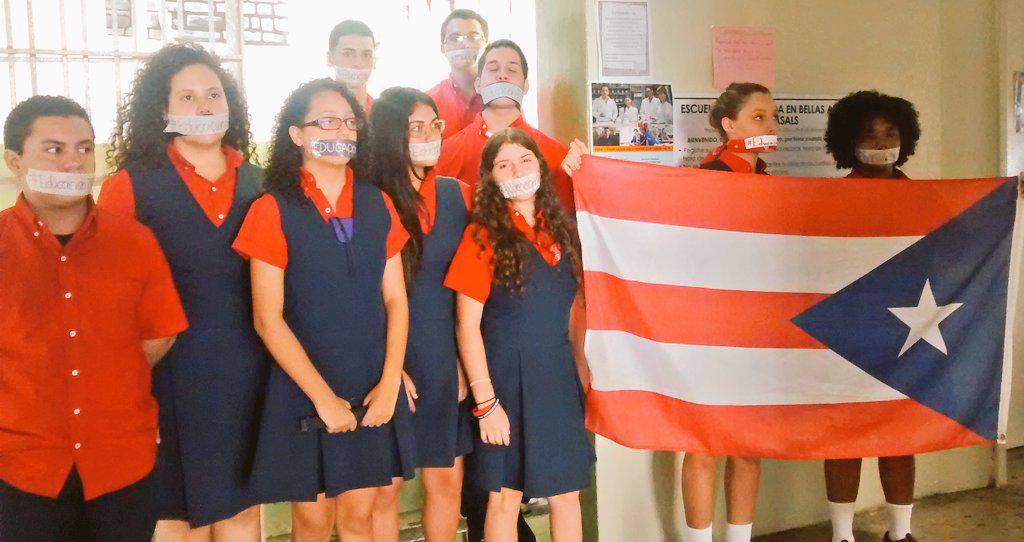
This Tuesday at Pablo Casals School, an arts institution in Bayamon along the north coast, students protested the government decision to relocate their theater teacher, Heyda Salaman.

About 100 students hung the Puerto Rican flag upside down and taped their mouths shut to represent the state of the government and the silence officials expect from the community.

Young people at the specialized arts school which offers visual arts, theater, music and dance as well as academic classes, protested with music and chants of “injustice!”

https://www.youtube.com/watch?v=pITIkdiHoMQ&feature=youtu.be

Just like in the case of the Rivera School, the government eventually relented and agreed to keep the teacher with her students.

The teachers union – the Federación de Maestros de Puerto Rico (FMPR) – has supported student protesters throughout the island.

“The Teachers Federation from Puerto Rico is proud of the actions these students performed,” said union president Mercedes Martinez about student actions at both facilities.

“Schools belong to our communities according to the law, so the communities have every right to fight for the school they deserve. No more cutting funds to create over-sized classrooms.”

Vélez echoes that statement.

“We have a good education and excellent teachers but the administration is failing their workers,” she said.

“The government is cutting rights and benefits to the teachers and employees and soon there will be no teachers. Maybe our schools get privatized and then only people with money will send their children to (public) school.”

11997060_10153278954588152_587899672_n

The Commonwealth government has closed 150 schools in the past 5 years in the U.S. Territory.

Officials warn the government may be out of money to pay its bills by as early as 2016. Over the next five years, it may have to close nearly 600 more schools – almost half of the remaining facilities!

The island is besieged by vulture capitalists encouraging damaging rewrites to the tax code while buying and selling Puerto Rican debt.

Hundreds of American private equity moguls and entrepreneurs are using the Commonwealth as a tax haven.

As a result, tax revenues to fund public goods like education are drying up while the super rich rake in profits.

The indigenous population has suffered at the hands of western conquerors since Columbus, but the newest fruit of Colonialism may be these corporate education reform policies.

Young people like Vélez aren’t revolutionaries. They look just like any ordinary teenage boys and girls wearing t-shirts and blue jeans, baseball caps turned backwards, backpacks slung across their shoulders.

But they have had enough. They aren’t going to accept the low expectations of the corporate world about what constitutes a fair education.

Viva Puerto Rico!


NOTE: This article also was quoted extensively on Diane Ravitch’s blog and published in full on the Badass Teachers Association blog.
Parents and Children Occupy Puerto Rican School Refusing to Let Corporate Vultures Raid Its Contents

Screen shot 2015-08-22 at 9.09.36 AM

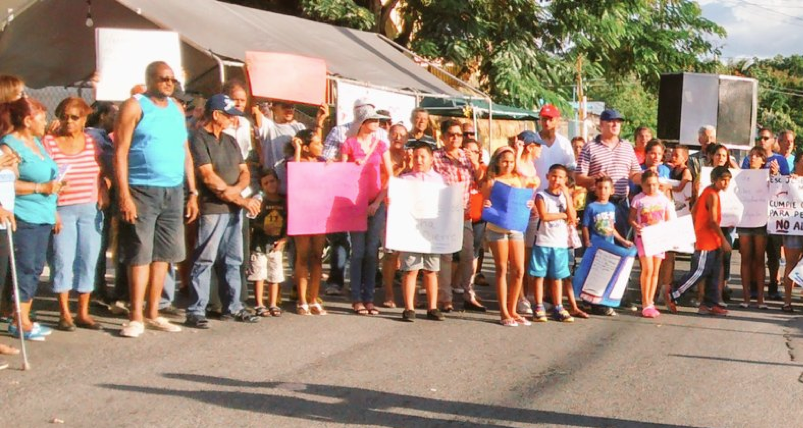
For more than 80 days, about 35 parents and children have been camping out in front of their neighborhood school in the U.S. Territory of Puerto Rico.

The Commonwealth government closed the Jose Melendez de Manati school along with more than 150 others over the last 5 years.

But the community is refusing to let them loot it.

They hope to force lawmakers to reopen the facility.

Department of Education officials have been repeatedly turned away by protesters holding placards with slogans like “This is my school and I want to defend it,” and “There is no triumph without struggle, there is no struggle without sacrifice!”

Officials haven’t even been able to shut off the water or electricity or even set foot inside the building.

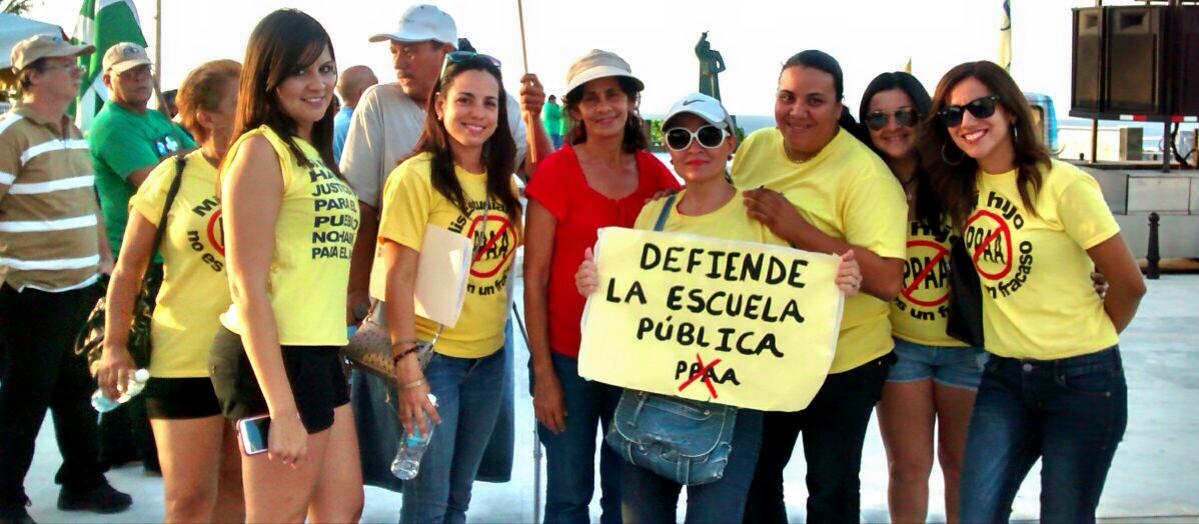
The teachers union – the Federación de Maestros de Puerto Rico (FMPR) – has called for a mass demonstration of parents, students and teachers on Sunday, Aug. 23. Protesters in the capital of San Juan will begin a march at 1 p.m. from Plaza Colón to La Fortaleza (the Governor’s residence).

11212175_538567642948296_6542092169551987830_o

The schools being closed are all in low income areas, said union president Mercedes Martinez. “This is detrimental to education, because the necessities of the community, the investment in infrastructure in recent years, the technology, have not been taken into consideration, and neither the parents nor the teachers have been consulted.”

The Jose Melendez de Manati school, for instance, served students 92% of whom live in poverty.

Now that the building has been closed, parents say they can’t afford the cost to transport their children to a new school miles away. And those schools that remain open have been forced to make drastic cuts to remain functional. Class sizes have ballooned to 35 students or more. Amenities like arts, music, health and physical education have typically been slashed.

Why?

The island territory is besieged by vulture capitalists encouraging damaging rewrites to the tax code while buying and selling Puerto Rican debt.

Hundreds of American private equity moguls and entrepreneurs are using the Commonwealth as a tax haven.

Since 2012, U.S. citizens who live on the island for at least 183 days a year pay minimal or no taxes, and unlike those living in Singapore or Bermuda, they get to keep their U.S. passports. After all, they’re still living in the territorial U.S. These individuals pay no local or federal capital gains taxes and no local taxes on dividend interest for 20 years. Even someone working for a mainland company who resides on the island is exempt from paying U.S. federal taxes on his salary.

puerto_rico_teachers_strike.jpg_1718483346

Big corporations are taking advantage of the situation, too.

Worldwide, American companies keep 60 percent of their cash overseas and untaxed. That’s about $1.7 trillion annually.

Microsoft, for instance, routes its domestic operations through Puerto Rican holdings to reduce taxes on its profits to 1.02 percent – a huge savings from the U.S. corporate tax rate of 35 percent! Over three years, Microsoft saved $4.5 billion in taxes on goods sold in the U.S. alone. That’s a savings of $4 million a day!

Meanwhile, these corporate tax savings equal much less revenue for government entities – both inside and outside of Puerto Rico – to use for public goods such as schooling.

Public schools get their funding from tax revenues. Less tax money means less money to pay for children’s educations. As the Puerto Rican government borrowed in an attempt to shore up budget deficits, the economy tanked.

But have no fear! In swooped Hedge Funds to buy up that debt and sell it for a profit.

When this still wasn’t enough to prop up a system suffering from years of neglect, the Hedge Fund managers demanded more school closures, firing more teachers, etc.

Of course, this is only one interpretation of events.

If you ask Wall Street moguls, they’ll blame the situation on declining student enrollment. And they have a point.

Some 450,000 people have left the island in the last decade as the economy suffered an 8-year depression.

There were 423,000 students in the Puerto Rican school system in 2013. That’s expected to drop to 317,000 by 2020.

But is this the cause of the island’s problems or a symptom?

Unfortunately, things look to get much worse before they’ll get any better.

The government warns it may be out of money to pay its bills by as early as 2016. Over the next five years, it may have to close nearly 600 more schools – almost half of the remaining facilities!

Right on cue, Senate President Eduardo Bhatia is proposing corporate education reform methods to justify these draconian measures. This includes privatizing the school system, tying teacher evaluations to standardized test scores and increasing test-based accountability.

“Our interest is to promote transparency and flow of data through the implementation of a standardized measurement and accountability system for all agencies,” Bhatia said, adding that the methodology has been successful in such cities as Chicago.

Despite such overwhelming opposition, protesters are taking the fight to the capitol. “Tax the Rich!” is a popular slogan on signs for Sunday’s march.

11029506_1679179132316825_4270916741405376334_n

“It’s unacceptable that the rich and powerful that created our crisis are the ones asking the working class for more sacrifices,” said Martinez.

“The foreign companies that pay no taxes or a less amount to evade paying their due in contributions – impose a tax on them now!”

This is just a beginning, she adds. Stronger actions will be coming.

In the meantime, those brave parents and children still refuse to give up their shuttered school.

They dream of a day when that empty building once again rings with the laughter of students and the instruction of teachers.

In a country being used by the wealthy to increase their already swollen bank statements, is that really so much to ask?


You can show your solidarity with these Puerto Rican protestors by spreading the word through social media. Post a picture of yourself with a sign saying you’re with them in their fight. Tweet the Commonwealth Secretary of Education @Rafaelroman6. Use the hashtags #EducacionEnPR #SOSdocente.

NOTE: This article was mentioned on Diane Ravich’s blog and was also published on CommonDreams.org and the Badass Teachers Association blog.