
Racism is Just One of Two Things Shown in Alton Sterling Killing

-1dd3afa605e6bc1d

Americans are notoriously bad at holding two thoughts in our heads at the same time.

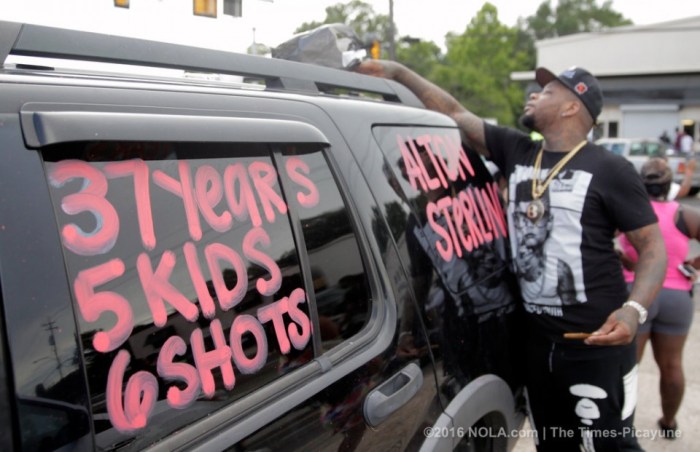
We look at the police shooting of Alton Sterling and can’t decide whether it was racist or if the 37-year-old black man just had it coming.

But we’re missing the point. Sometimes twice.

Baton Rouge Police shot and killed the father of five on July 5th.

The 37-year-old man was killed outside a convenience store in Louisiana because police allegedly got a tip someone was selling CDs and was armed. In the resulting scuffle, Sterling was shot and killed.

If the whole thing weren’t caught on a cell phone video, it probably wouldn’t be more than a sad headline. Just another black dude killed by police.

But the resulting attention has made his name a hashtag and his death a source of outrage – for good reason.

On the video, police tackle Sterling to the ground before gunshots are heard.

One of the officers shouts “gun” before shooting, but store owner Abdullah Mulfahi told the media that Sterling’s hand was not near any weapon and the alleged gun later recovered from his pocket was not visible.

People watch the video (or not) and immediately take sides.

Who is to blame – the police or Sterling?

Was the black man armed? Maybe – though Louisiana is an open carry state so he would be within his rights to do so.

What should he have done when confronted by police? What actions of his might have resulted in police not shooting him dead?

Did he have a record? Is that even relevant since police had no access to that information at the time?

Typically people come to conclusions based on their convictions and not based on the evidence. If you think black people are being victimized by police, then you’re probably on Sterling’s side. If you think black people are naturally violent and police rarely do any wrong, you’re probably on the side of law enforcement.

But what both sides are ignoring is a sense of context.

This was the 15th American killed by police so far in July alone.

Not the 15th black person. The 15th person. Period.

There’s some dispute over exactly how many people have been killed by police so far this year, but the number is surprisingly high. You’d think that would be something the federal government would keep track of, but no. The FBI’s Uniform Crime Reporting Program tabulates every criminal statistic imaginable – except homicide by law enforcement. Alarmingly, it leaves this to the private sector – almost as if it had something to hide.

Much of this is done by the news media, both in and out of the country. The Washington Post puts the number of Americans killed by police this year at 505 people. The Guardian puts it at 560. An open sourced database called Killed by Police puts the number at 580.

Any way you look at it, no matter which tally you go with, 2016 is turning out to be one of the deadliest years for police shootings since people have been counting.

It’s a problem for everyone. Police should not be killing such high numbers of civilians. In fact, in other countries, they don’t. Police kill more people in the U.S. in days than they do in other countries in years.

For instance, U.S. police killed 59 people in 24 days last year. In England and Wales, 55 people were killed by police in 24 YEARS!

And the numbers aren’t that high solely because the United States has a larger population. The entire nation of Canada has about as many people as the entire state of California, yet Canadian police killed 25 people last year to 72 by California law enforcement.

That may be due in part to a lack of accountability.

Despite such high body counts in this country, not a single police officer has served jail time for it in the last few years. Several officers went to trial in 2016, but none were convicted, according to the Wall Street Journal.

Last year had the highest number of officers being charged for shooting civilians in a decade. That number? 12. And none of them – not one – was convicted of murder or manslaughter.

We have a real problem here. American police kill far too many people.

However, this doesn’t mean that racism isn’t a motive in many of these police shootings. In fact, the numbers back that up.

Though more white people are killed by law enforcement in this country, it is black people who are killed at a disproportionately high rate. They only make up 13.2% of the population, yet they are twice as likely to be killed by police as whites. Nearly a quarter of all police homicides this year resulted in dead black folks.

What’s going on here?

First, we live in a police state. Officers often kill suspects with impunity and face little to no consequences. Not all police, certainly, but far too many.

Second, black folks are killed more regularly by police than whites. In fact, if all things were equal, you’d expect MORE white people to be killed than already are. Whites make up 77.7% of the population, yet they account for only half of the victims of police shootings.

This isn’t because black people are so much more violent than whites. According to the Center on Disease Control’s annual Youth Risk Behavior Survey, they engage in violent behavior at similar rates to whites.

For instance, they carry a weapon (whites 17.9% to African Americans 15.2%) and carry guns (whites 5.5% to African Americans 6.5%) at about the same rates. However, blacks are twice as likely to be arrested for weapons possession.

The same holds for assaults. African Americans report being in physical fights at similar rates (36.5% versus 32.5% for whites) but are three times more likely to be arrested for aggravated assault.

It should come as no surprise then that black people are more likely to be killed by police. This holds with everything else we know. When it comes to the criminal justice system, black people are penalized more often and that includes being shot and killed by law enforcement.

Why? Because they’re black. Because of societal attitudes, fears, phobias and prejudices.

For many of us, when we see Sterling’s last moments enacted on that cell phone video, we’re confronted with that fact. We put ourselves in his position. What could he have done differently? Whether he was guilty of a crime or not, what action on his part would have assured that he got out of this situation alive?

Eric Garner was choked to death by police while repeatedly saying, “I can’t breathe!” Tamir Rice was shot by police in two seconds. What exactly could a black person do to avoid being shot if law enforcement already perceives him or her to be a threat?

These are important questions. But they aren’t the only ones.

America has a problem with police violence. In fact, it has two problems. And we can’t solve one without solving the other.

We have to come to terms with this. It is not a case of racism or a police state. It is a case of BOTH.
Florida Shooter’s Strongest Ally Was The American Gun Lobby

os-orlando-shooting-pulse-nightclub

“America is absolutely awash with easily obtainable firearms. You can go down to a gun show at the local convention center and come away with a fully automatic assault rifle, without a background check, and most likely without having to show an identification card. So what are you waiting for?”

-American-born al-Qaeda spokesmen Adam Yahiye Gadahn


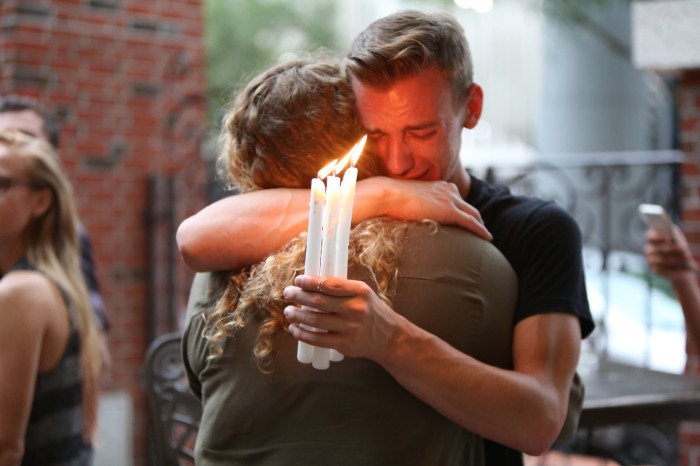
Omar Mateen considered himself a terrorist.


He wanted to make that clear to posterity before ending a shooting rampage he initiated in Florida yesterday that left 50 dead and dozens more injured – the worst mass shooting in U.S. history (so far).


During the carnage at an Orlando gay nightclub, he allegedly called 911 to pledge his allegiance to ISIS. He just wanted us to know that.


Now that the shooter’s gone, just as he would have wished, pundits are making a lot of this phone call. Though his family claims he wasn’t particularly religious, media talking heads are seizing upon this one action by an unhinged young man in order to denigrate all American Muslims.


ISIS is a militant organization. Islam is a religion.


By contrast, the KKK is a militant organization. Christianity is a religion.


But never mind that. In Mateen’s case, an entire religion is somehow responsible for the actions of one man. If he had been a white Christian – as most mass shooters are – we probably wouldn’t be seizing on his race or creed. But even though Mateen was born in this country, his family is from Afghanistan, his skin is brown, he was one of THEM.


However, there is no evidence that anyone in the Islamic community helped Mateen conduct his reign of terror. He allegedly saw two men kissing several months earlier, became enraged and planned accordingly.


But we can pinpoint one American institution that gave the self-proclaimed terrorist much aide and comfort in his scheme – the American gun lobby.


In fact, firearm powerbrokers are helping terrorists kill civilians all over the country.


No. I don’t meant to say they are working hand-in-hand with international terrorist organizations like al-Qaeda and ISIS.


But they might as well be.


Our lax gun laws are the direct result of the lobbying efforts of the National Rifle Association (NRA) and other organizations closely associated with the gun industry. Those laws are being exploited by individuals like Mateen bent on murdering as many American civilians as possible.


Before Mateen opened fire, he had been on a terrorist watch list. In fact, the FBI had monitored his past activities.


You might think someone like that would not have been permitted to buy a gun in the first place. But you’d be wrong.


Just six months ago, the U.S. Senate had considered a law to restrict suspected terrorists from buying firearms and explosives, but it was defeated largely by Republican lawmakers accepting huge campaign contributions from the gun industry.


Mateen might have found it much more difficult to carry out this terrorist attack without the help he received from the NRA and so-called conservative lawmakers.


But don’t take my word for it.


Gadahn (quoted above) was killed in a drone strike in 2015, but he was not the only terrorist praising the efforts of the American gun lobby.


A six-page recruiting pamphlet found in terrorist safe houses in Kabul, Afghanistan, called “How Can I Train Myself for Jihad” instructs would-be terrorists “on the advantages the United States offers for firearms training and advises readers on how to exploit them.”


Maybe that’s why a measure like that recently defeated in the Senate to stop suspected terrorists from accessing guns was strongly supported by the George W. Bush administration.


It’s strange. Bush pushed the PATRIOT Act as an invaluable tool to keep America safe from terrorism despite the concerns that it trampled civil liberties. If lawmakers on both sides of the aisle are willing to weaken the 4th amendment’s provisions against unreasonable search and seizures in order to stop terrorism, then why do they oppose much more reasonable restrictions on the 2nd? What makes the right to bear arms so much more important than other privileges enumerated in the Bill of Rights?


In truth, it’s not a philosophical debate. It’s an economic one.


There is simply too much money being made by gun manufacturers – and thus being funneled into political campaigns – to allow for sane firearm policy.


Take the AR-15, one of two firearms used by Mateen yesterday. The same semi-automatic model he used was illegally modified and used to kill 14 and wound 21 in the San Bernardino shootings in late 2015. In 2012, it was also used in the murder of 20 children and six adults at Sandy Hook elementary school in Newtown, Connecticut.


It’s the most popular rifle in the country, and the weapon of choice for mass shooters.


As such, there have been calls to reinstitute the federal assault weapons ban from 1994 – 2004. Some claim that the ban was ineffective, allowing too many loopholes. Others say despite weaknesses it resulted in less people being killed by these types of weapons during the time of the ban.


Though several attempts have been made to reinstitute the ban, it has been stalled by the gun industry largely because of wordplay and minutiae.


They claim the term “assault weapons” is inaccurate at best and propaganda at worst. (Never mind that it was coined by the gun manufacturers, themselves, to increase sales.)

 
Rifles designated as “assault weapons” are not easily distinguishable from other kinds of rifles, they say, so banning them would lead to a slippery slope of banning all guns.


The most basic difference is the firearm’s ability to expel multiple rounds quickly. Because of this, the rifles included under assault weapons bans are usually semiautomatic – a new round is automatically reloaded into the chamber but is not fired until the trigger is squeezed again. The weapons also have detachable magazines, allowing them to fire 10, 20, 30 rounds or more without the need to reload.


However, bans often include “military style” rifles that are not necessarily semiautomatic. Gun advocates claim these rifles are similar to firearms excluded from bans except for cosmetic features to make them appear more militaristic.


Those could include features like a pistol grip, designed to allow a weapon to be fired from the hip; a collapsible or folding stock, which allows the weapon to be shortened and concealed; a flash suppressor, which keeps the shooter from being blinded by muzzle flashes; a muzzle brake, which helps decrease recoil; and a threaded barrel, which can accept a silencer or a suppressor. Bayonet lugs or grenade launchers are also sometimes included.


But are these features truly just cosmetic? Or do they actually make these rifles much more dangerous? No one needs a grenade launcher to hunt for game or protect their home.


When people call for gun regulations, they aren’t necessarily calling for a ban on all guns.


People want a degree of safety in public spaces. They don’t want to be cut down by one or two gunmen causing exponential carnage in seconds.


That seems a reasonable expectation.


Gun industry surrogates claim safety is best assured if everyone is packing heat – an endless stalemate.


In point of fact, there was an armed police officer working security yesterday at the gay club when Mateen sprayed the crowd with bullets. Though he traded fire with Mateen, he was unable to stop the carnage.


It’s absurd. The people who initiate mass shootings rarely survive them. They don’t care about being killed. They only care about spreading death and terror.


Moreover, adding more guns to public spaces only increases the chances of more shootings, many of which would probably be accidental.


The rest of the world has figured this out. There really is no argument to be made here. Polls show that most of the public wants some kind of gun control.


But it won’t happen so long as the gun industry is allowed to buy our lawmakers.


It won’t happen so long as we allow gun industry trolls to drown out all reasonable discussion with their circular zombie arguments.


Mateen couldn’t stand the sight of two men publically expressing their love for each other.


The gun lobby can’t stand the idea of reduced profits.


And together those two aims make up the twin pillars sheltering American terrorists everywhere.

The Worst Sort of Violence Against Children

school_and_TBI_iStock_000007171993XSmall

She was smiling and laughing, but her eyes were terrified.

Sitting in class among her fellow middle school students, her words were all bravado. But her gestures were wild and frightened. Tears were close.

So as the morning bell rang and the conversation continued unabated, I held myself in check. I stopped the loud rebuke forming in my teacher’s throat and just listened.

“You know that shooting at Monroeville Mall Saturday night, Mr. Singer? I was there!”

I swallowed. “My gosh, Paulette. Are you okay?”

She acts street smart and unbreakable, but I can still see the little girl in her. She’s only 13.

She slowed down and told us what happened; a story framed as bragging but really a desperate plea for safety and love.

She went to the mall with her mother. When they separated so she could go to the restroom, the gunfire began. She ran out and Mom was gone. She was ushered into a nearby store where the customers were kept in lockdown. She stayed there until the police cleared the mall, and it was safe to find her mother and go home.

A 17-year-old boy had gunned down three people. One was his target. The others were bystanders – parents who had gotten in the way. Now they were all in the hospital, two in critical condition.

And my student – my beautiful, precious, pain-in-the-butt, braggadocious, darling little child – was stuck in the mix.

I could imagine how scared she must have been separated from her mother, hiding with strangers as police swept the shops, food court and children’s play center.

Here she was telling the class her story and getting more upset with each word.

I gave her a meaningful look and told her we’d talk more later. Then I began class.

But I kept my eye on her. Was that relief I saw as the talk turned from bullets and bloodshed to similes and metaphors? Did the flush leave her cheeks as we crafted multi-paragraph theses? I hope so.

I think I know her pretty well by now. She’s been mine for two years – in both 7th and 8th grades. I even taught her older brother when he was in middle school.

I know she’s rarely going to do her homework – and if she does, it will be finished in the last 20 minutes. I know she’d rather be out playing volleyball or cheerleading than in school writing or reading. I know when she’s secure and when she’s scared.

And I know that today’s lesson will be a breeze for her. So why not put her in her comfort zone, show her things haven’t changed, she’s still the same person, she can still do this – nothing is different?

At least, that was the plan.

As any experienced public school teacher knows, you have to satisfy a person’s basic needs before you have any chance at teaching them something new. Psychologist Abraham Maslow’s Hierarchy of Needs is always at the back of mind.

Students must have their physical needs met first – be fed, have a full night’s rest, etc. Then they have to feel safe, loved, and esteemed before they can reach their potentials.

But meeting these needs is a daily challenge. Our students come to us with a wealth of traumas and we’re given a poverty of resources to deal with them.

How many times have I given a child breakfast or bought a lunch? How many kids were given second-hand clothes or books? How many hours have I spent before or after school just listening to a tearful child pour out his heart?

Let me be clear. I don’t mind.

Not one bit.

It’s one of the reasons I became a teacher. I WANT to be there for these kids. I want to be someone they can come to when they need help. It’s important to me.

But what I do mind is doing this alone. And then being blamed for not healing all the years of accumulated hurt.

Because that’s exactly what’s expected of teachers these days. Fix this insurmountable problem with few tools and if you can’t, it’s your fault.

I didn’t shoot up the mall. I didn’t pass the laws that make it so easy for kids to get a hold of a gun. I didn’t pass the laws that allow such rampant income inequality and the perpetuation of crippling poverty that more than half of our nation’s public school children live with every day. And I sure didn’t slash public school budgets while wealthy corporations got a tax holiday.

But when society’s evils are visited on our innocent children, I’m expected to handle it alone. And if I can’t solve it all by myself, I should be fired.

That is where I take umbrage.

The issue is violence but not all of it comes at the end of a gun.

Keeping public schools defunded and dysfunctional is also a form of violence. Promoting privatization and competition when kids really just need resources is also cruelty. Pretending that standardized curriculum and tests are a Civil Right is also savagery.

It’s called class warfare. Its most prominent victims are children. Its most active soldiers are teachers. And we’re on the front lines every day.

When the bell rang to end class, Paulette stopped by my desk.

I looked up at her ready to give whatever support I could. It was my lunch break, but I was willing to skip it and just talk. I’d get the guidance counselor. I’d call home. Whatever she needed.

But none of it was necessary.

“Are you okay?” I asked.

“Yeah.” She gave me a big smile and a deep breath.

I returned it.

Today would be alright. Tomorrow? We’ll meet that together.

But we sure could use some help.


NOTE: Names and other minor details may have been changed to preserve anonymity.

This Article was also published in The Progressive, Portside Navigator, Common Dreams, Public School Shakedown and the Badass Teachers Association blog.