Hundreds Gather in Puerto Rico on Martin Luther King Day Demanding Arts Education

12576302_10153529451238152_1250187250_n

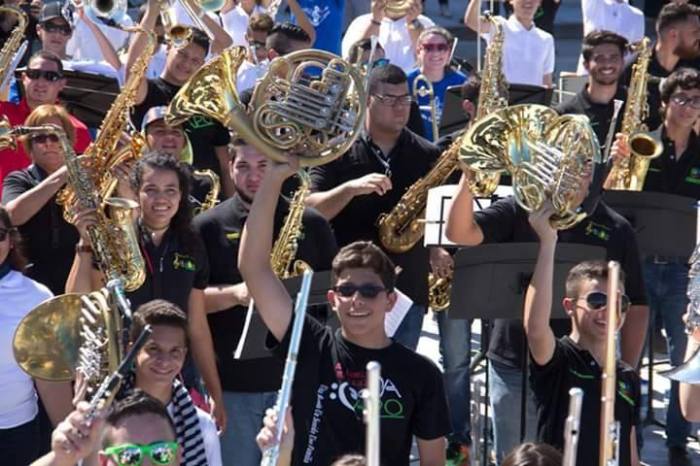
They came with trumpets, tubas, bongos and acoustic guitars.

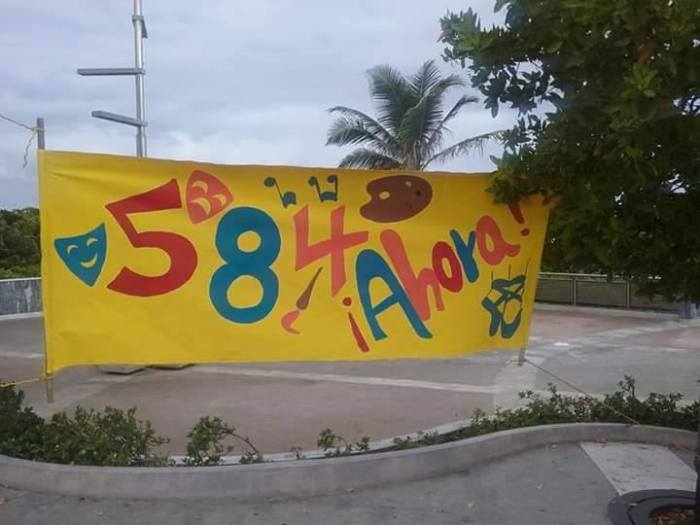
They came with brightly colored banners and freshly painted posters.

They came armed with songs, dances and slogans.

More than 500 teachers, students and college professors marched to the Puerto Rican capital of San Juan to demand the island government bring back public school arts classes.

The group of activists calling itself Let’s Save the Arts has been fighting against the narrowing of curriculum for the last three years.

At that time, the island Department of Education changed the length of class periods at all public schools in the U.S. territory.

Students used to have seven class periods of 50 minutes each. Now students have six class periods of 60 minutes each. In effect, officials eliminated one class.

Students still receive Spanish, Math, Science, Social Studies, and English instruction. However, now they have to choose between Physical Education or Arts where they used to be able to do both.

Secretary of Education Rafael Román approved the measure to save money. More than 3,000 half time teaching positions were lost.

12606925_10153529451103152_557288241_n

“It was an austerity measure,” says Mercedes Martinez, president of the Federación de Maestros de Puerto Rico (FMPR) – the  teachers union.

“They’re saying these teachers are not needed.”

Senator Rossana Lopez has proposed a solution. She introduced Bill 584 – legislation that would require all Commonwealth schools to include arts courses as a graduation requirement.

Arts teachers across the island formed the collective group to help pass the measure.

“Having a holistic  education is a right and not a privilege,” said Carlos Vélez, an art teacher from Ángel Sandín Martinez Middle School in the Vega Baja region.

“The study of the arts benefits all students – especially those living under poverty that can’t pay for art courses elsewhere.”

The teachers union issued a strong statement of support.
12596229_10153529493163152_1705645538_n

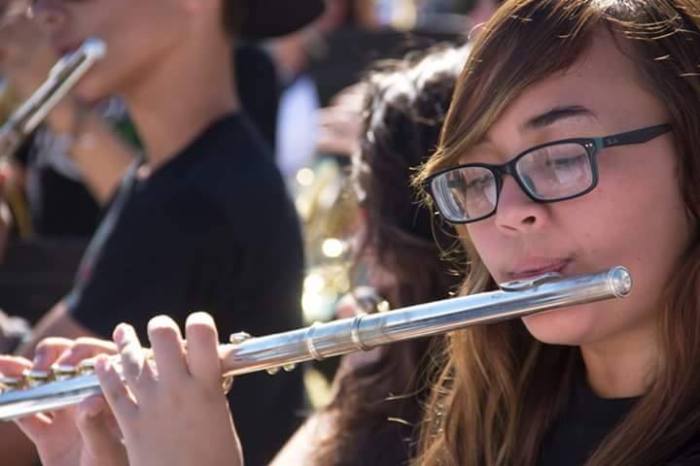
“Students were off school Monday,” Martinez says. “In symbolism to MLK’s holiday celebration, they protested the best way they know: performing.”

During those performances, Román, the architect of the plan to eliminate the arts, changed his tune. While at the rally, he said he supports the bill.

However, the Secretary of Education could make most of these changes, himself, without legislative action. He could return the alignment of class periods to their previous configuration tomorrow.

“We’re waiting for him to put words into action,” Martinez says.
12606903_10153529451063152_1511355704_n

Meanwhile, supporters hope Bill 584 will pass before this Congressional session ends in June.

Corporate education reform measures like this one limiting arts classes are a consequence  of financial woes imported from the mainland. Puerto Rico is besieged by vulture capitalists encouraging damaging rewrites to the tax code while buying and selling the territory’s debt.

Hundreds of American private equity moguls and entrepreneurs are using the Commonwealth as a tax haven.

As a result, tax revenues to fund public goods like education are drying up while the super rich rake in profits.

Officials warn the government may be out of money to pay its bills this year. Over the next five years, it may have to close nearly 600 more schools – almost half of the remaining facilities!

Of the 135 schools closed in just the last two years,  Román had originally proposed shuttering 200. The remaining 65 were only kept alive because communities occupied the buildings and refused to let the government step in.

The people of Puerto Rico aren’t letting their government defund and defraud their public schools without a fight. Monday’s musical and artistic protest was just another note in the battle hymn of the people.

12575817_10153529451308152_75105760_n

702853_10153529492758152_589523556_n

Putting the Arts Back in Language Arts – One Journal at a Time

d3493c8db7e1e4b423ce6b5e87f14eb6

This is the fifth in a series of blog posts focused on the value of art in our lives, and the role art can play in resisting the test and punish model of education.  See the intro and links to other posts in the series here.


Sometimes in public school you’ve just got to cut the crap.

No testing. No close reading. No multiple choice nonsense.

Get back to basics – pass out notebooks, crack them open and students just write.

Not an essay. Not a formal narrative. Not an official document. Just pick up a pencil and see where your imagination takes you.

You’d be surprised the places you’ll go.

You might invent a new superhero and describe her adventures in a marshmallow wonderland. You might create a television show about strangers trapped in an elevator. You might imagine what life would be like if you were no bigger than a flea.

Or you might write about things closer to home. You might describe what it’s like to have to take care of your three younger brothers and sisters after school until just before bedtime when your mom comes back from her third minimum wage job. You might chronicle the dangers of walking home after dismissal where drug dealers rule certain corners and gangs patrol the alleys. You might report on where you got those black and blue marks on your arms, your shoulders, places no one can see when you’re fully clothed.

My class is not for the academic all stars. It’s for children from impoverished families, kids with mostly black and brown skin and test scores that threaten to close their school and put me out of work.

So all these topics and more are fair game. You can write about pretty much whatever you want. I might give you something to get you started. I might ask you a question to get you thinking, or try to challenge you to write about something you’ve never thought about or to avoid certain words or phrases that are just too darn obvious. I might ask your opinion of something in the news or what you think about the school dress code or get your thoughts about how things could improve.

Because I actually care what you think.

Strange, I know.

At times like these, I’m not asking you to dig through a nonfiction text or try to interpret a famous literary icon’s grasp of figurative language. It’s not the author’s opinion that matters – it’s yours – because you are the author. Yes, YOU.

You matter. Your thoughts matter. Your feelings. YOU MATTER!

And sometimes students raise their hands and ask me to read what they’ve written. And sometimes – more often than not – the first thing they say is, “It’s no good.” “I don’t like it.” “I did bad on this.”

So I stop reading, I look them right in the eyes and ask them who wrote it.

“Me?” they say.

And I respond, “Then I’m sure it’s excellent.” And it usually is.

My 8th grade students have been ground down so low under the weight of a society that could care less about their well being that they’ve begun to internalize it. They think their thoughts and feelings are worthless. No one cares about what they think.

But I do.

So I offer them a chance to share what they’ve written. I don’t demand. I don’t force anyone to read anything. I know that some things that spill out on the page aren’t for sharing. But I want them to know that I value what they’ve just put down and that I think it’s worth taking the class time to let others hear it, too.

“Mr. Singer, I wrote five pages,” Jaquae tells me this afternoon. “That’s too long to share.”

“I disagree,” I say. “If you think it’s worth our time, you should read it. You deserve our attention.”

So he reads, blows out a cleansing breath and smiles.

In the process, we all become ennobled. We become more. We become a community. We get a peak at our common humanity.

It’s so easy to look at others as mere adversaries. Even our national education policy sees things in terms of a competition, a race. We set children against each other for points, for grades, for attention, just to feel valuable. You’re a Proficient. You’re a Basic. You’re a Below Basic. And somewhere along the way they lose the sense that they’re all valuable because they’re all human beings with thoughts, feelings and experiences that no one else has ever gone through before – but with which everyone can relate.

So I write, too. Every time I set my students a journal, I put pen to paper, as well.

At the beginning of the year, I share what I wrote to show them that it’s okay. At the middle of the year I ask them if they want me to share. And at the end of the year I remain silent unless they ask me to do otherwise.

Because these class moments aren’t about me. They’re about them. I’m willing to be as much a part of their creative space as they want, but it’s a choice, not a dictate.

In my class I will make you learn, but I don’t control what you learn or how you feel about it.

I extend my students this respect because I know that what we’re really doing isn’t some meaningless exercise. We’re creating art.

Not just scribbles on a page. Not something done just to please the teacher. This is an excavation of the soul. We dive into the depths of ourselves and come back all the better for it.

That’s why my students journal almost every day.

That’s why we put mechanics and spelling and grammar aside for a few moments and just write what we need to say.

Because Language Arts, after all, is an Art. It says that right in the title.

My students are artists. I am their muse. I hold a mirror up to their fractured and beaten spirits to show them the grandeur of what resides inside them.

And hopefully they come away inspired.

Because they are wonders. They are joyous. They are little pieces of my heart.


NOTE: This article was also published in Living in Dialogue, the Badass Teachers Association Blog and mentioned on Diane Ravitch’s blog.