White Fragility Frames the Media Narrative of the Million Man March Forward

12139070_1233888909971346_1493116541_n

White people will go a long way to avoid talking about racism.

Not only does it seem invisible to most melanin deficient folks like myself, but we refuse to acknowledge it when someone tries to bring it to our attention.

That’s not racism. There is no racism. Stop stirring up trouble.

Unless someone is wearing a white sheet and burning a cross on a black person’s lawn, most Caucasians close their eyes, stick their fingers in their ears and stay willfully blind.

Sociologists call this White Fragility, and it was on full display in the media response to the Million Man March Forward on Saturday.

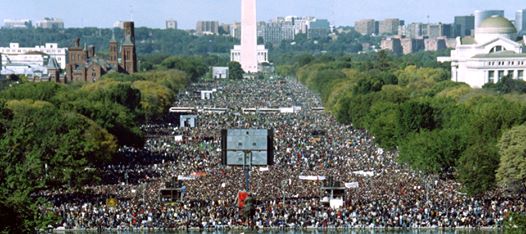
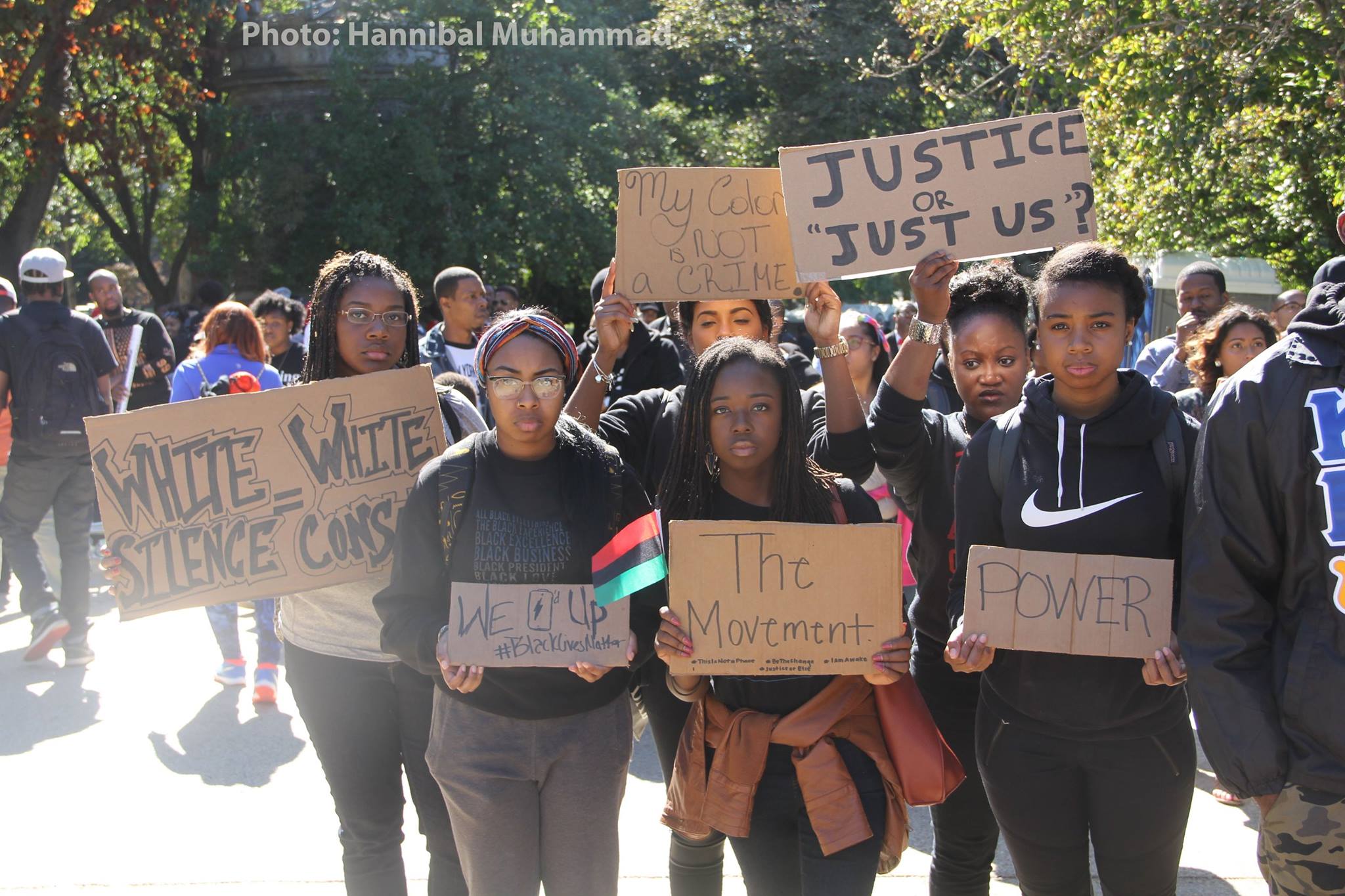
Thousands of African Americans and a smattering of people of other races and ethnicities gathered in the National Mall in Washington, D.C., to demand “Justice or Else” and commemorate the 20th anniversary of the original Million Man March.

Like during that 1995 gathering, today’s media was quick to frame the narrative in a way that silenced legitimate black concerns while benefiting White America.

First, most media outlets refused to cover the event at all. I guess to them there was nothing newsworthy going on. Just tens of thousands of black folks gathering in the nation’s capital. No saggy pants. No guns. Nothing to see here.

When the mainstream news covered it at all, it was to minimized its importance. Short articles basically saying – Here were some black people. Remember that time they did this before? In other news…

I remember the first march back in the 90s. I wasn’t there, but I remember how white folks talked about it. At first there was a genuine fear – black people with a united purpose coming together to better their social standing!? But we quickly found a way to negate everything they were doing.

How? Math.

Har! Har! Look at all those black folks gathered in front of the Capital steps. They held a Million Man March and didn’t even get a million men!

And therefore by the logic of white fragility we can ignore everything they did and said.

Institutionalized racism? Sorry not a million people!

Racial prejudice in hiring and firing employees? Not a million. Can’t hear you!

Police brutality? Come back when you’ve got more people!
12087324_1675832909318901_8512279402781528158_o

Of course it’s still a major point of contention exactly how many bodies showed up that first time. Estimates of the original rally put between 400,000 to 2 million folks on the scene. Unsurprisingly white people almost always go with the smaller number. I guess they don’t think black people can count that high.

But what if the lower estimation is true? Is there some racial math that bestows relevance on a moral crusade based only on sheer numbers? Is it okay to deny a handful of people their rights, a thousand or even a hundred thousand – but somehow a million is the tipping point where I have to say “No more”?

Even if only hundreds of thousands of people showed up, that’s something. Quite a lot, really. Doesn’t that demonstrate an attempt at racial unity, at addressing a shared list of problems? After all, how many people need to attend for White America to take them seriously?

This weekend journalists were careful not to make estimates of the number of attendees at the March Forward. But they’d subtly state that it was less well attended than the previous rally which – given the pictures I’ve seen of both events and the above mentioned disparity – seems somewhat hard to corroborate.

Still the media didn’t stop there. They found other ways to invalidate the event.

For instance, who is leading these marches? The Nation of Islam? Louis Farrakhan? Oh my! White people don’t approve of that! Therefore the whole gathering is unjustified. Poof!

Funny how that works. Black leaders must be perfect. White leaders? Not so much. George W. Bush was a C-student. Bill Clinton had extramarital affairs. Both men served as two-term presidents, and somehow the Republicans and Democrats go on.

Finally there was the rhetoric. This rally was subtitled “Justice or Else.”

That just won’t do. Angry black people demanding justice? No, white people simply will not respond to that kind of tone. If only they had been more polite about it, we might listen, but “Justice or else”!? Nope.

Any rational human being should be able to comprehend why black folks are demanding justice; They aren’t getting much of it from our courts. Unarmed black people are increasingly being murdered by the police and white citizens which prompts the debate of whether a crime has even been committed – a debate in which the answer is often, “No.”

The Black Lives Matter movement has grown because of just such concerns and the group was even represented at the rally.

But white folks – in the guise of analysis – ask what that phrase means “justice or else.” Are black people threatening to attack white people if they don’t get justice? What justice is there beyond a court of law? Do they really expect us to change our laws and hold our courts accountable?

No. Nothing to see here, folks. This throng of humanity peacefully assembling clearly has no valid points to make. Turn the cameras off. Let’s go home.

But had these thousands suddenly thrown bottles, overturned cars or started fires, the spot light would have been turned on full force.

“Another black riot,” newscasters would have proclaimed with glee. CNN would have devoted 24-hour news coverage. Expensive graphics would show the exact extent of the damage between interviews with scared white folks wondering why black people were allowed to misbehave so!

But a peaceful rally of African Americans coming together to share their pain, commemorate their history of struggle and commit to solutions?

Who cares about that? It doesn’t fit the media narrative. It doesn’t help white people ignore their black brothers and sisters problems. It doesn’t help our system of white supremacy remain invisible.

As a representative of the white race, may I make a suggestion? Could we possibly consider listening to what these people have to say? And before rejecting it out of hand, might we look at it objectively and even find a valid point or two? Could we then try to offer our black brothers and sisters a hand?

But the answer is always the same from white folks. Excuse after excuse to ignore, reject, repulse and keep our fragile white eyes firmly shut.

12105954_10106301025970309_961760835270051441_n


NOTE: This article also was published in the LA Progressive and on the Badass Teachers Association blog.


White People Need to Stop Snickering at Black Names

baby-and-parents

As a public school teacher, few things give me as much anxiety as getting my student rosters for the first time.

I look over the list of names for my incoming children and cringe.

How do I pronounce that?

Every year it never fails – there’s always at least four or five names I’ve never seen before – or at least never spelled quite like THAT!

As a white teacher in a district with a majority of black students but very few black teachers, there’s not really many people to turn to for guidance.

And if I don’t figure it out soon, I’ll be making a pretty terrible first impression. No one likes to have their name butchered, especially children, especially if an adult is doing it, especially if that adult is white.

The only solution I’ve found is to soldier on with the first day’s attendance and just try my best:

Me: Shah-NEE-Qwa?

Child: Shah-NAY-Qwa.

Me: JAY-Marcus?

Child: JAH-Marcus.

It’s uncomfortable, but I get through it and eventually learn.

However, one thing I’ve stopped doing is going to other white people for help. That’s a recipe for disaster.

It almost always turns into an exercise in subtle racism and white supremacy. No matter who the person is, no matter how kind, caring or empathetic, the reaction to unique black names is most often derision.

White people snicker and use the situation as the impetus for telling stories about other black names that they thought were even more outrageous.

It’s not that we’re trying to be hateful. I don’t think we even recognize it as racist, but it is.

We use the situation as an opportunity for bonding. THOSE people who are not like you and me – THEY name their children things like THIS! Not like you and me who name our children more respectably.

Make no mistake. This is racist behavior. We are emphasizing the otherness of an entire group of people to put ourselves over and above them.

It’s bigoted, discriminatory, prejudicial and just plain dumb.

What’s wrong with black names anyway? What about them is so unacceptable?

We act as if only European and Anglicized names are reasonable. But I don’t have to go far down my rosters to find white kids with names like Braelyn, Declyn, Jaydon, Jaxon, Gunner or Hunter. I’ve never heard white folks yucking it up over those names.

I can’t imagine why white people even expect people of color to have the same sorts of names as we do. When you pick the label by which your child will be known, you often resort to a shared cultural history. My great-great-grandfather was David, so I’ll honor his memory by calling my firstborn son the same. Jennifer is a name that’s been in my family for generations so I’ll reconnect with that history by calling my daughter by the same name.

Few black people in America share this same culture with white people. If a black man’s great-great-grandfather’s name was David, that might not be the name he was born with – it may have been chosen for him – forced upon him – by his slave master. It should be obvious why African Americans may be uncomfortable reconnecting with that history.

Many modern black names are, in fact, an attempt to reconnect with the history that was stolen from them. Names like Ashanti, Imani and Kenya have African origins. Others are religious. Names like Aaliyah, Tanisha and Aisha are traditionally Muslim. Some come from other languages such as Monique, Chantal, and Andre come from French. I can’t understand why any of that is seen as worthy of ridicule.

Still other names don’t attempt to reconnect with a lost past – they try to forge ahead and create a new future. The creativity and invention of black names is seldom recognized by White America. We pretend that creating names anew shows a lack of imagination when in reality, it shows just the opposite!

Creating something new can be as simple as taking an Anglicized name and spelling it in inventive ways. Punctuation marks also can be utilized in unusual positions to add even more distinctiveness such as in the names Mo’nique and D’Andre.

At other times, they follow a cultural pattern to signify as uniquely African American using prefixes such as La/Le, Da/De, Ra/Re, or Ja/Je and suffixes such as -ique/iqua, -isha, and -aun/-awn.

And for the ultimate in creativity, try mixing and matching various influences and techniques. For instance, LaKeisha has elements from both French and African roots. Other names like LaTanisha, DeShawn, JaMarcus, DeAndre, and Shaniqua were created in the same way.

This is something all cultures do. They evolve to meet the needs of people in a given time and place. Yet when it comes to people of color, we, white folks, whoop and guffaw at it. Heck! When we can’t find black names far enough out of our mainstream, we even make them up!

Don’t believe me? Have you heard of La-a? The story goes that a black girl was given that name and a white person asked how it was pronounced. The black woman said her name was La-DASH-ah. This is often followed by a punchline of black vernacular.

Har! Har! Har!

But it’s not even true! According to Snopes, this is a made up story. It’s the American version of a Polish joke and demonstrates how far white people will go to laugh at black culture.

The great comedy duo Key and Peele tried to call attention to this in their outstanding substitute teacher sketches. In a series of short routines, an almost exclusively white classroom gets a black substitute teacher from the inner city schools. Mr. Garvey is expecting black names, so he pronounces the students’ middle class white names as if they were African American.

Almost everyone loves this sketch. It gets universal laughs, but wait until it’s over. Too many white folks try to continue the giggles by then talking about crazy black names they’ve encountered. But that’s not at all the point Key and Peel were trying to make! They were trying to show how cultural context shapes our expectations of proper names. Mr. Garvey is worthy of our laughter because his expectations are out-of-sync with his surroundings. When we expect all African Americans to have European or Anglicized names, we’re just as out of touch as Mr. Garvey. But like Dave Chapelle’s comedy, sometimes the person laughing the loudest is getting something the comedian didn’t intend at all.

Maybe it wouldn’t be so bad if black names just generated snickers. However, white culture actually selects against people with black sounding names.

Countless studies have shown how much more difficult it is for someone with a black sounding name to get a job, a loan or an apartment than it is for someone with a white sounding name. It’s one of the most obvious features of white supremacy. You may not like black names, personally, but do these people deserve to suffer for embracing their own culture?

Moreover, having a European or Anglicized name is no guarantee of fair treatment. It certainly didn’t help Michael Brown or Freddie Gray.

If we’re really going to treat people equitably, an easy place to begin is with black names. White people, stop the laughter and giggles. I used to do it, myself, until I thought about it. Yes, I’m guilty of the same thing. But I stopped. You can, too.

It’s not the biggest thing in the world. It’s not even the most pressing thing. It’s not a matter of guilt. It’s a matter of fairness.

Because when the final role is taken of all America’s racists and bigots, do you really want your name to be on it?


NOTE: This article also was published on Everyday Feminism and the Badass Teachers Association blog.

Why You Should Thank Harper Lee for Tearing Down Your Childhood Hero

Screen shot 2015-08-27 at 10.47.03 PM

It’s been more than 50 years since Harper Lee published her Pulitzer Prize winning novel “To Kill a Mockingbird.”

In that time, a lot has changed and nothing has changed.

Our schools are still highly segregated and unequal – but we justify that with standardized test scores. Our prisons are still disproportionately filled with black and brown people – but we justify that with the War on Drugs. Racial minorities are still gunned down in the street while their killers get off scot-free – but we justify that with a dysfunctional justice system.

Yes, we have our first black president but most people of color still live under the shadow of white privilege and a government sanctioned caste system.

Now comes “Go Set a Watchman” a book Lee wrote before “Mockingbird” but that works best as a sequel.

Does it matter? Is it still relevant?

I’d say yes.  After all, the original was written as people across the nation were struggling to overthrow the old racist system. And today many of their grandchildren and great-grandchildren are still engaged in that same struggle.

In a world where the majority cling desperately to colorblindness, it’s refreshing to read a book that proclaims black lives matter – even if it was written in the 1950s.

The most striking thing about the new novel is its portrayal of Atticus Finch. In “Mockingbird” he’s described as the quintessential hero – a white lawyer putting himself at great personal risk in a doomed attempt to defend an innocent black man. In “Watchman” Atticus is… well… a bit of a racist.

He’s 20 years older, has joined a neighborhood committee dedicated to keeping the races separate and we learn that at one time he had even been a member of the Ku Klux Klan.

How can we reconcile THIS Atticus with the one we remember from our childhoods? Is it even worth trying? Is the book worth reading?

Let’s start with the book’s literary value. Questions abound about its publication. Lee, 88, lives in a nursing home and is reportedly in ill health. After all this time, did she really want this book out there now or is that the result of overzealous publishers who know any book with her name on it will be a best seller? Moreover, her sister, Alice, served as a protector of Harper’s legacy but almost as soon as she died, the book was slated for publication.

And when you actually crack it open, it’s clear that certain passages are almost identical to others in “Mockingbird.” You can see how the one book lead to the other. Moreover, there are places that could use expansion and others that could use a bit of editing.

However, despite its shortcomings, from the first page to the last “Watchman” is like returning home to Maycomb County.

In the first chapter, we share a 20-something Jean Louise’s excitement on the train from New York south to visit her family, because we want to see these people again, too. Unlike a simple rereading of the classic “Mockingbird,” this time the characters have grown, changed and act in unexpected ways. Like our protagonist, though, we’re in for many a rude awakening.

Scout’s brother, Jem, is dead, and his absence is felt throughout most of the book. At first, I was angry about this. I thought it was simply bad writing, trying to artificially limit the characters. But then I realized Lee had already set up Jem’s demise back in “Mockingbird.” After all, their mother died around the same age from a heart attack – a congenital defect on her side of the family.

Jem’s absence is irksome because it’s real. Too many times in life people who mean so much to us just disappear leaving a hole never to be filled again.

Likewise, Dill is hardly to be seen. However, this shouldn’t be surprising. Both books are semi-autobiographical and his character is modeled after Harper’s childhood friend – Truman Capote. In the novel just as in life, our heroine, Scout/Harper, and Dill/Truman grew apart.

In his place we get Hank – a character never mentioned in “Mockingbird” but who apparently was around – somewhere. He serves as Scout’s boyfriend. Though he’s drawn a bit vaguely, through him we get to see the kind of woman Jean Louise has grown into.

The Scout of “Watchman” is different than her 6-8-year-old self, too. But it’s easy to see how the little girl of the previous book could become the intelligent but restless woman in this text.

Calpurnia is much changed. She no longer works for the family. In fact, she seems to have enclosed herself in the Quarter – the part of town where only the black people live.

With the U.S. Supreme Court ruling in Brown vs. Board of Education,  Maycomb’s black folks seem much less inclined to smile and nod and serve every passing whim of white people. They have an inkling that maybe things could be different, that maybe they’re entitled to equal rights, after all. And these new possibilities come between Jean Louise and the woman who raised her more than any other.

Calpurnia is the one who explained to her what it means to be a woman. She explained everything from menstruation to sexual intercourse. Yet these new possibilities in social justice make it impossible for the two women to have a proper homecoming.

I wonder: would Jean Louise really not begrudge Calpurnia all the rights and privileges she so easily expects as her own right? It’s hard to say but still very sad.

On the other hand, Aunt Alexandra hasn’t changed much. She’s still disapproving, tyrannical yet emotional. Likewise, Uncle Jack is much the same. He’s grown more eccentric but it’s easy to recognize the friendly doctor who bandaged Scout’s hand after she punched her cousin for calling her father a racial epithet in “Mockingbird.” And neither does Atticus seem drastically different at first. He’s older and suffers from terrible arthritis. But at first glance he’s the same caring, wise paternal figure of our remembrances.

For about 100 pages the book is a mostly meandering return to a world we never thought we’d see again. Then everything changes with the bombshell of Atticus’ recent pro-segregation activities.

How can it be possible? Can this really be Atticus Finch? Or is this just bad writing?

We know the character is based on Harper’s own father, Amasa Lee. Is this really more of a portrait of the real man than the fictional one?

It’s hard to say. But as we read on it becomes clear that, yes, this is still the Atticus we remember. But we didn’t know him as well as we thought.

(WARNING: Limited spoilers ahead.)

The heart of the novel is when Jean Louise confronts her father about his seemingly new attitude. In typical Atticus style, he argues with her almost like he was defending himself in court. Some of his defense makes a weird kind of sense. He says he briefly joined the Klan just to see who was behind those hoods. He wanted to know whom he was dealing with. Moreover, his participation in this segregation society was to serve as a moderating influence. He wanted to make sure they didn’t get up to too much trouble.

But this is only half an answer. As he continues, it becomes clear that Atticus actually does believe some of the racist rhetoric of his times. He really doesn’t want black people and white people to be put on an equal footing. He justifies this by saying black people aren’t ready yet. They haven’t been prepared for the rights and privileges of white folks. Maybe some day they will be, but not today.

It’s a disgusting and patronizing argument – infantilizing an entire people. And hearing this out of Atticus mouth – it’s like seeing a spider crawl across a gorgeous face.

Similarly creepy is his appeal to state’s rights – an argument we still hear today from our Tea Party friends. Perhaps it WAS Southern white people’s responsibility to raise up the people of color in their midst – but if they weren’t going to do it, it was past time that someone did!

Scout doesn’t let her father get away with any of this. She does her best to verbally destroy him and run away forever.

But before she can escape, she runs into her Uncle Jack. What he does is equal parts rationality and sexism. I can’t imagine any modern author resolving the story this way. Perhaps that’s for the best. In some ways, Uncle Jack’s actions are more disturbing than Atticus’ opinions.

In the end, Scout learns to accept her father for who he is. Yes, he is dead wrong about black people, but most of the time he’s still the same loving Atticus. It’s a good point. How many people do you love who believe reprehensible things? Probably a lot. That doesn’t mean you stop loving them.

I’d say that’s the central point of the novel. Each of us is responsible for creating our own conscience. We can’t rely on any value system that comes to us prepackaged. We have to examine every facet of our worlds and decide what it is we truly believe. And in doing so we’ll probably reach divergent opinions.

The only way Lee could do that was by showing us the heroic Atticus as nothing but a flesh and blood human being, full of the same frailties and mistaken thinking.

In the end, Scout’s thoughts seem more modern than anyone else’s in the book, more in line with our own views about social justice. But her conclusion only goes so far. We’re still left with questions. How do we reach loved ones who disagree with us? How can we tell if our own ethical intuitions are correct? How can white folks best help people of color secure their rightful place in society?

None of these have answers, but Lee is still asking the right questions. More than 50 years later, we’re still searching for solutions.

I am Racist and (If You’re White) You Probably Are, Too

Screen shot 2015-06-02 at 1.42.34 PM

I am a white man.

I am racist.

But that’s kind of redundant.

It’s like saying, “I am a fish, and I am soaking wet.

In some ways, I can’t help it. I don’t even notice it. I live my life immersed in a world of white privilege that most of the time I frankly can’t even see.

That doesn’t excuse me. It doesn’t mean I should just shrug and say, “What are you gonna’ do?”

But it does mean that the first step in removing that racism – in undoing the systematic subjugation of people of color – is recognizing my own culpability in that system.

It’s like being an alcoholic. The first step is admitting the truth.

I know I’ve pissed off a lot of people with what I’ve just written. This article isn’t about gaining new friends. But I’m sure I’ll have a lot of death threats to delete from the comments section tomorrow.

The initial reaction white people usually have to being called racist is – Who? Me? I can’t be racist! I have a black friend! I dated a black girl once! I listen to rap music!

Or a whole host of other excuses.

First of all, relax. I don’t know you. For all I know you’re that one white guy out there who has somehow escaped the pervasive societal attitudes that the rest of us unknowingly took in with our baby formula.

But chances are – yeah, you’re a racist, too.

Second of all, I’m not talking to people of color. None of you are racist. Congratulations!

You might be a hate-filled bigoted, misogynistic, xenophobic, homophobic, prejudiced asshole.

Again, I don’t know you. But racist? No. You can’t really be that.

Here’s why. Racism doesn’t mean hating someone because of their race. That’s a kind of prejudice. And anyone can be prejudiced.

Racism is hate plus power. If a black person says, “I hate white people,” he is prejudiced. However, there is no system that then backs up his hatred. The police don’t arrest white people more than black people for the same crimes. The judicial system doesn’t give harsher sentences to white people than it does black people for the same crimes. Public schools serving a majority of white students aren’t chronically underfunded. It isn’t harder to get a loan or a job if you have a white-sounding name. If it did, THAT would be racism!

Get it?

So I’m sorry, white people. This means there is no such thing as reverse racism. Despite what you may see on Fox News, the only racists in America have white skin.

Don’t get me wrong. There are degrees of racism. If you have a Confederate flag prominently displayed in your home in front of your personally autographed picture with David Duke, well you’re probably a bit more racist than most Caucasians. But no matter what, if you’re white, you’ve probably benefited from white supremacy and are de facto racist.

Maybe your folks gave you a middle class upbringing in a quiet suburb. Maybe you went to a well-funded public school in a wealthy neighborhood. Maybe your dad was convicted of white collar crime and got little to no jail time. Heck! Maybe you just walked down the street once and the police didn’t follow you through a convenience store or reached for their guns.

If your upbringing was in any way favored due to wealth amassed over a few generations, you benefited from white privilege. If the judicial system let you or a loved one go with a lighter sentence, you benefited. If you were not harassed by law enforcement because of your complexion, you benefited. And when you benefit from a system, you’re part of it.

For every white person in America, it is almost certain that something like this happened to you at some point in your life. And you probably had no idea it was even occurring.

Good fortune becomes a self-fulfilling prophecy. People start to think they deserve it. And maybe they do, maybe they don’t. But people of color who don’t have such privileges certainly don’t deserve their inequitable treatment.

When we fail to acknowledge that white supremacy exists or that it benefits us, white folks, we’re just perpetuating that same system.

Some of you will say I’m putting too much emphasis on race. We’re all the same under the skin. We shouldn’t bring up the topic of racism. It just makes things worse.

Easy for you to say! You’re on top of the social food chain! If we don’t talk about the inherent inequalities entrenched in the system, nothing will change. Us, white folks, will continue to benefit, and black folks will continue to get the short end of the stick.

One of the biggest obstacles to solving racism is its invisibility – to white folks.

We’re shielded from it because its negative effects don’t reach us, and its positive effects to us are either shrugged off or we assume we deserve them.

Being racist rarely involves overt action anymore. It’s become covert, an entrenched sickness in all our social systems. And the only way to cure it is to make it visible – to recognize, isolate and destroy it.

I know. Some of you will say you had it tough, too. And you probably did. Few people live charmed lives. There are poor white folks. There are white people who are discriminated against because of their gender, nationality, sexual preference and/or religion. But this doesn’t mean you didn’t benefit. There is a crossroads of American prejudice and racism is only one of many intersecting avenues.

Maybe you were the victim sometimes, but you were probably the victor in others, and you never even saw it coming.

The point isn’t to say which malady is worse. They’re all bad and all deserving of a cure. But if you really don’t want to be a racist, you have to look it straight in the eye and call it by its rightful name.

You probably didn’t ask to be treated differently. Most of us just want fairness. But to be on that side we have to proclaim our allegiance. We have to take a stand.

Whenever you see injustice against people of color, you must call it out. You must make yourself a part of the solution and not the problem. You must be a voice demanding the citadel of white privilege be burned to the ground.

It’s not easy. You’ll be called all sorts of names: bleeding heart, libtard, self-hating white, maybe even cracka. Because even people of color may not understand what you’re trying to do. After so many years of racial oppression by people with melanin deficiency, they may not trust an open hand when they’ve been so used to expecting a fist.

But that’s okay. It’s understandable. The only thing to do is press on. Understanding will come – eventually.

Racism is a problem for black folks, but the solution is mostly in the hands of white people. We’re the ones doing – or allowing – racism. It’s our job to fix it.

And much of that work will not be in the public sphere. It will be in our own hearts.

Many of us have been socialized to be afraid of black folks. We get this from the news, movies, television, the internet, often even our own relatives and friends. We’re constantly told how dangerous black people are, how untrustworthy, how violent. But the facts don’t bare this out. Given the degree of aggression – both overt and covert – black people have endured from white people over time, they have been incredibly non-violent. It is us, white people, who have been violent and inhuman. That is the legacy we hide under our fear of dark skin. We’re really afraid that one day our black brothers and sisters will have had enough and give back to us all the accumulated hate of centuries.

No. We aren’t responsible for slavery or Jim Crow or lynchings or a host of other horrible things. But we still benefit from them.

So it is up to us to even the scales, to treat black folks fairly and equitably with a loving heart.

That is why I make this confession. That is why I write this article that will probably be roundly criticized or maybe just ignored.

That’s why I admit I’m a racist.

It’s the only way to stop being one.


NOTE: This article also was published on commondreams.org.