

“Yes, my writing got a lot better than what I was, and I love writing now. And you pushed me to do better. Not a lot of teachers push their students, some teachers don’t care about their students.”
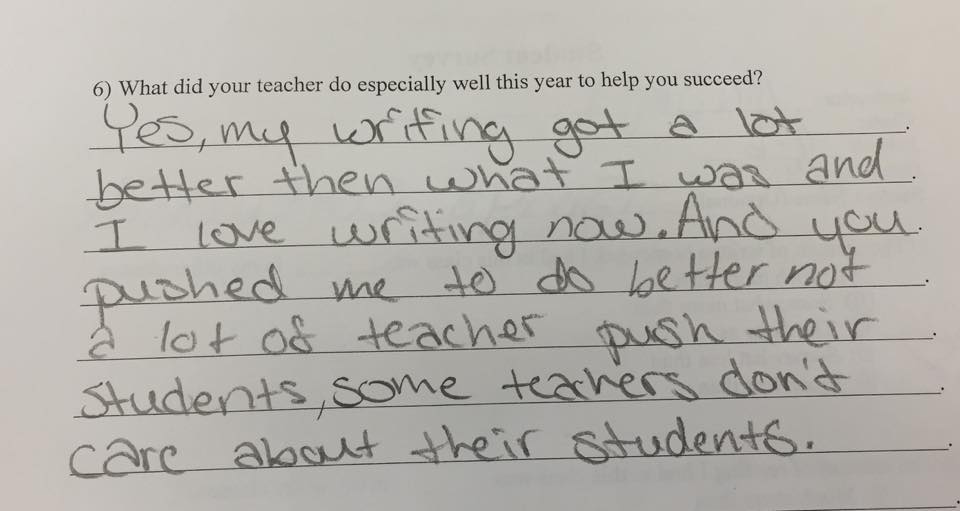
One of my 8th graders wrote that to me on the last day of school.
I had asked her class to fill out an anonymous survey about my teaching. I said that all year I get to grade THEM, but this was their chance to grade ME.
I made sure to explain that they didn’t need to put their names on it. This would not be graded. Spelling and grammar didn’t count. The only thing I wanted was honesty.
I told them I wouldn’t personally collect the surveys. They should NOT hand them to me; they should put them in a pile on the desk by the door when they leave. I promised I wouldn’t even look at what they’d written until class was over. That way they could feel free to write whatever they wanted. If I did something bad or there was some way I could improve, I wanted them to tell me. If I did something exceptionally well, they should tell me that, too.
“Please help me become a better teacher,” I said.
As an 8th grade public school educator, I get evaluated a lot. I’ve spent countless hours gathering evidence that I’m “proficient” at my job.
I’ve had to endure formal observations, informal observations, H.E.A.T. observations, Student Learning Objectives (SLOs), written explanations of specific lessons with appeals to which Common Core standards I would be teaching – and there always seems to be a new one added to this list next year.
But I’ve been giving a version of this simple student survey to my classes on the last day of school for over a decade.
It’s not something I’m required to do. I don’t share the results with administration. The responses don’t go on file, increase my pay or get recorded in the newspaper. They don’t become part of the district’s ranking in the Business Times. No one is going to withhold funding from my district or close my building and convert it into a charter school based on these results. No one ever will be on television decrying the state of public education referencing these surveys. They are low stakes, class-based, teacher-centered and personal.
But I do this because I think it actually gives me useful information. I really want to know what my students think. That’s one of the things that truly drives my instruction. Not politically motivated standards monetarily incentivized and adopted before they were even completely written. Not standardized tests that measure little more than parental income. Not the latest fad handed down by the superintendent. Not a threat shouted at us through an email or at a faculty meeting.
No. I’m motivated by my kids in the classroom and the answer to the question, “Have I helped you learn?”
The survey is quite simple really. It’s two-sided.
On the front page are 5 multiple choice questions:
1) The amount of written homework I had in this class was in my other classes.
A) much more than
B) Somewhat more than
C) The same as
D) Somewhat less than
E) Much less than
2) The amount of reading I had in this class was in my other classes.
A) much more than
B) Somewhat more than
C) The same as
D) Somewhat less than
E) Much less than
3) The amount of studying I did for this class was in my other classes.
A) much more than
B) Somewhat more than
C) The same as
D) Somewhat less than
E) Much less than
4) I received instruction and comments on my written work.
A) much more than enough
B) Somewhat more than enough
C) Just enough
D) Somewhat less than enough
E) Much less than enough
5) In this class, I learned in my other classes.
A) much more than
B) Somewhat more than
C) The same as
D) Somewhat less than
E) Much less than
When it comes to homework, students almost always say I give too much. The majority (68%) gave me an A or B.
I only require about an hour of extra-class work a week. I don’t think that’s too bad. However, many teachers give less or none. I go back and forth on the value of homework, myself, but I know that once my students get to 9th grade, they’ll have a tremendous load of it. I figure if I don’t prepare them for that, I’m doing them a disservice. So an avalanche of (one hour a week) homework it remains.
Likewise, kids often say I give a lot of reading. A language arts class should give a substantial amount of reading. So I’m glad most kids (69%) give me an A or B. I require my students to read one self-selected book a month. I don’t think that’s too burdensome. If the book is too tough or boring – hey! You picked it! Pick another one. I also provide them with 15 minutes per day to read in class.
Studying is not something I emphasize. But students are almost evenly divided whether I require too much, just enough or too little. I’m not big on having kids memorize something and then regurgitate that on a test. I’d rather spend time getting them to take good notes that they can use on the test. I’m a big fan of open notes or open book tests. But I hardly ever use the word “Test.” I give frequent short quizzes. I think tests (and even quizzes) are limited evaluation tools. I’d much rather assign a multi-day project. That tells me much more than a brief snapshot of what students were thinking at any one given point in time.
I do assign a lot of essays so I’m always anxious to know if I’ve given enough written feedback. The research seems to show that if you mark every error on an essay, you get diminishing returns. You discourage students. So instead I try to focus on a few trouble areas we’ve already discussed per essay. And students seem to appreciate it. Most of my kids (85%) gave me an A or B or C in this area.
Then comes the cumulative question. How much did you learn? I used to have my classes assign me a letter grade A-E. However, answers were all over the place. When I compared the results with surveys from students who had revealed their identities, I found that kids usually gave me the same grade they received in my class. A-students gave me As. C-students gave me Cs, and so on.
When I changed the question to “how much have you learned?” the results changed drastically. Most students (84%) gave me an A or B. Yes, that’s the result I’m aiming for, but I think it’s a more honest answer, too. It doesn’t focus on grades. It focuses on each child’s assessment of his or her own progress. That’s really what I want to know.
But this side of the survey still provides very limited answers. It is multiple choice, after all. It’s useful for a brief overview but not very deep.
The second side of my questionnaire only has two open-ended queries. Students can write as much or as little as they want to the following questions:
6) What did your teacher do especially well this year to help you succeed?
7) In what areas can your teacher improve his/her instruction?
To be honest, when looking at the surveys, I usually skip right to these questions. This is what I want to see – not a bunch of alphabet soup. I want to know what they really think.
What have I done well? Here are some answers from this year’s kids:
-He understood the learning abilities of certain students and helped them to the best of his ability.

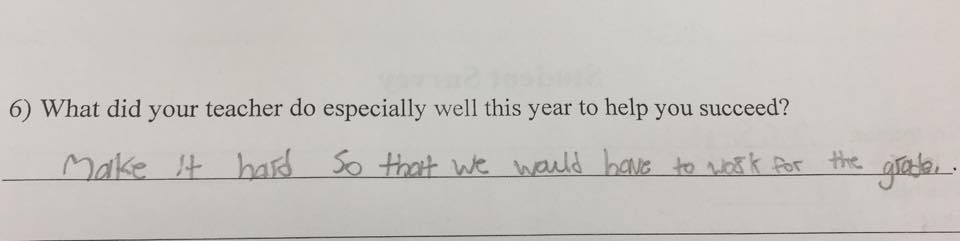
-You made it hard so that we would have to work for the grade.
-Before we could ask him for help, he asked us if we needed help. He’d help everyone, even the person who didn’t ask for it.

-He was really good at explaining and pushed me to never give up. Therefore, Mr. Singer is one of my favorite teachers.

-Well, I didn’t like as much work as he was giving us, but then I understood he was trying to help us with our grades and trying to make our grades higher.

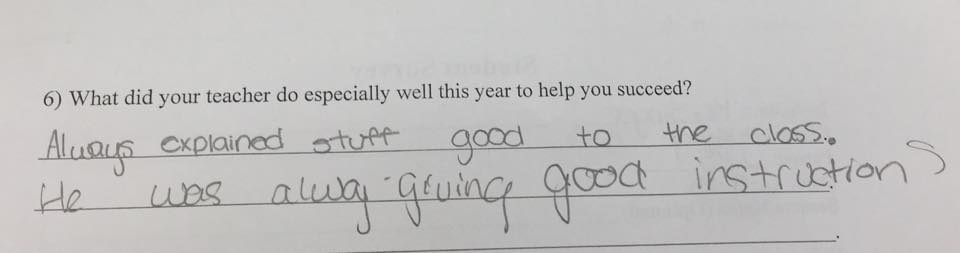
-Always explained stuff good in class. He was always giving good instructions.
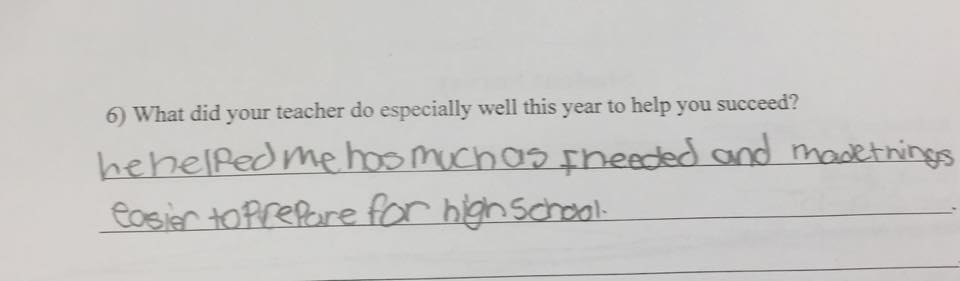
-He helped me as much as I needed and made things easier to prepare for high school.
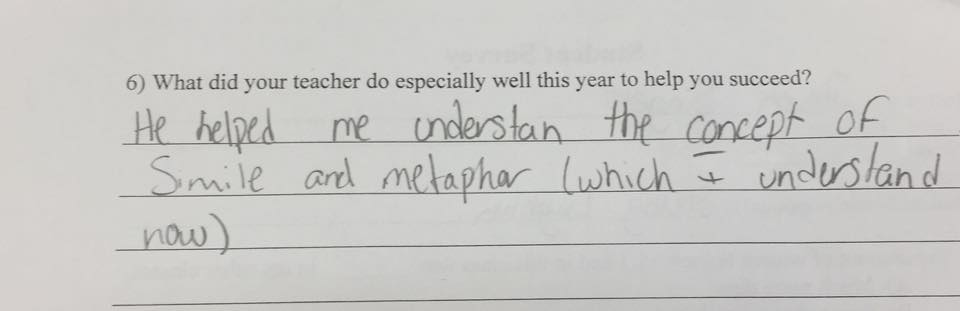
-He helped me understand the concept of simile and metaphor (which I understand now)
-What my teacher especially helped me do to succeed is writing essays.

I was just floored by these responses. Talk about data I can use! But there was one answer that stood out above even these:
-He helped me learn what I needed to do and he helped me by being a mockingbird because I think he tried his best to teach me what I needed to be taught.
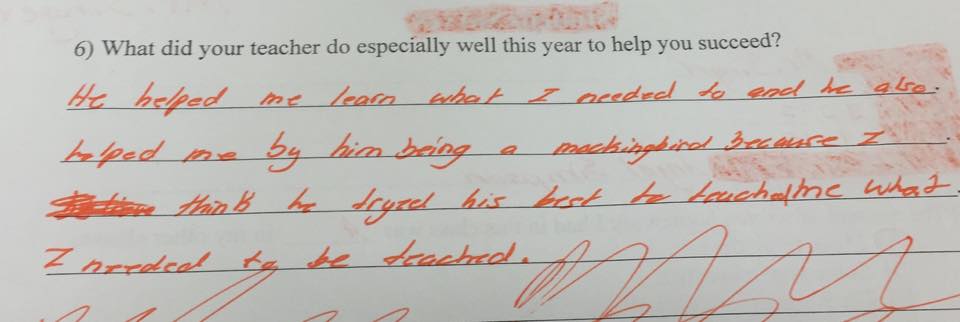
No, she wasn’t literally calling me a bird. She was relating me to our last novel – To Kill a Mockingbird. In the text, some characters are innocent victims. They try to help others but come under fire because of it. The author, Harper Lee, symbolizes them as “mockingbirds.” These include: Tom Robinson, the black man wrongly accused of rape; Atticus Finch, the lawyer standing up for a fair trial despite social criticism; Arthur “Boo” Radely, the recluse who saved lives at the expense of his privacy.
And here my sweet little student was including ME in this venerable list!
That choked me up a bit I can tell you.
When it comes to areas for improvement, my students aren’t the most forthcoming. Answers include:
-I don’t think he needs to because he already does his best to teach us kids what we need to be taught and his instruction is easy to understand.

-None. He was the best teacher! 🙂
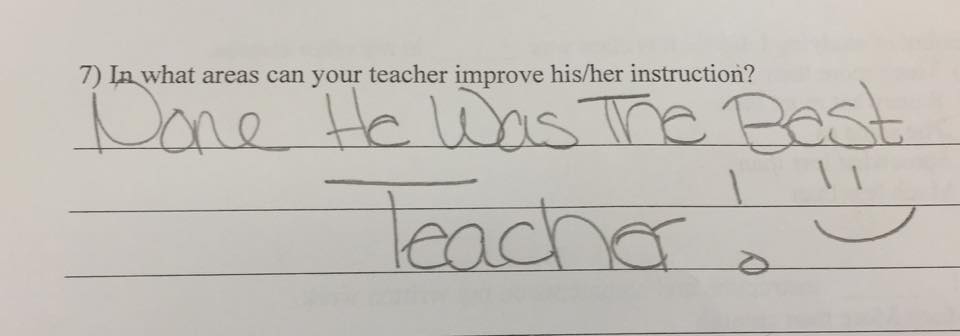
I appreciate the approbation but I wouldn’t mind constructive criticism. I do get complaints about the amount of homework and writing I assign. I also get requests for more free time.
I think if I wasn’t in the room when students took the survey, I might get more criticism. Ideally, I would leave the room for the last 15 minutes of the class, and kids could fill out their surveys. However, this is impractical. I don’t see how I could arrange it given the current climate, lack of subs and skeleton crew staff.
These surveys have given me much to think about over the summer. Maybe I should try to include more group work in next year’s class. Maybe I should revisit the homework situation.
But as June turns to July and then August, I know I’ll be thinking about all that happened this school year.
Some kids came in and out of shelters and juvenile detention. Some were present at a shooting at the local mall. Parents and I had to fight administration over valuing standardized test scores over classroom grades for student placement. The School board enacted a pointless student uniform policy. Students were demoralized and angry over national racial tensions involving Michael Brown, Eric Garner and the Baltimore uprising. Teachers had an active shooter drill for the first time as part of our professional development.
But most of all I’ll think about my students – well, no longer mine – off to the high school and bigger, better things.
For a brief moment I was an important part of their lives and they were an important part of mine. I’ll forget their names. (It’s like my mind is making space for the new ones I’ll have to learn.) But I’ll never forget their struggles and triumphs.
It’s easy to lose sight with all the privatizers and standardizers trying to dismantle our public schools. But even with all the political nonsense, selfishness and small-mindedness, teaching is the best job in the world.
Yes, it really is!
Every day I get a chance to positively impact dozens of lives!
I am truly blessed.
That’s what these surveys tell me.
And that’s why they’re the only evaluation that really matters.
NOTE: Here is a copy of the survey I use in class.
-This article also was published on the Badass Teachers Association blog.

 gadflyonthewallblog