If One More White Person Asks Me to Condemn the Baltimore Riots…

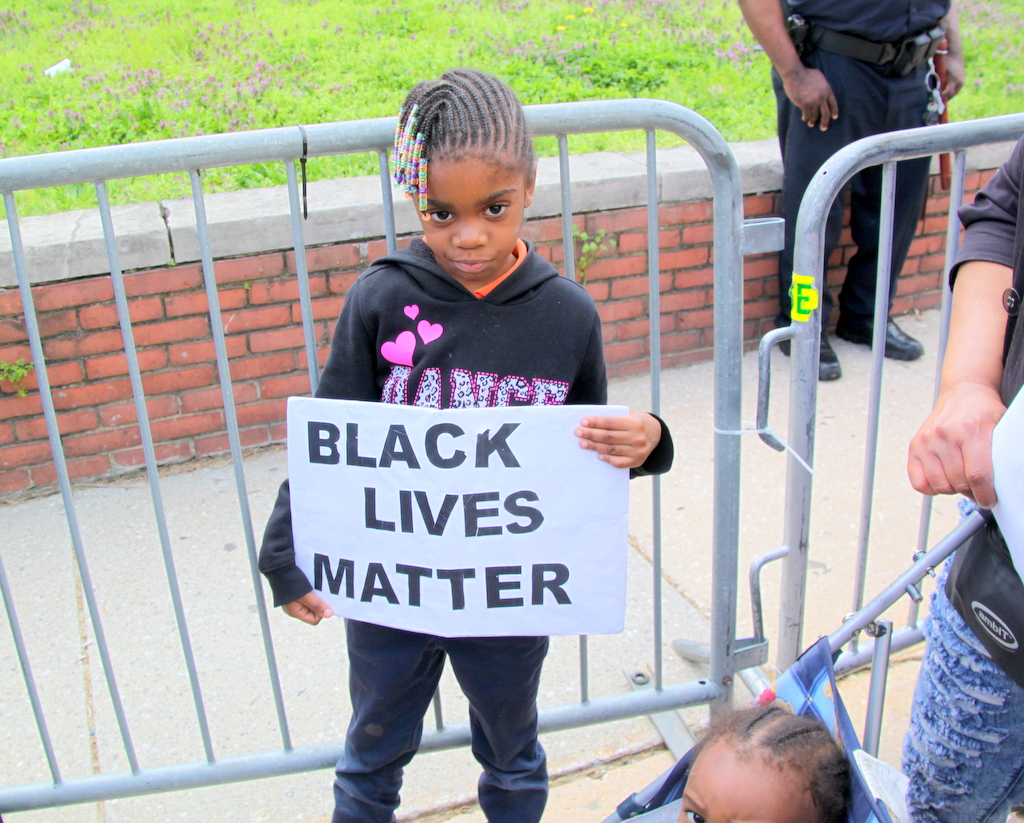
many-children-among-crowd-at-Freddie-Gray-protest

It started as soon as I got to work.

“Bet you’re glad the history club isn’t going to Baltimore this year!”

A comment between two social studies teachers. Nudge. Nudge.

I moved on to my morning duty and a science teacher asked me, “How about all that looting and rioting in Baltimore?”

Smirk. Chuckle. Conspiratorial tone.

Then at lunch, they were talking about a “hilarious” video where a black mother was yelling and hitting her son for being part of the riots.

Ha. Ha. Ha.

Am I the only white person who doesn’t need reassured?

Because that’s what they’re doing. They’re asking for confirmation, comfort, soothing.

It’s not white people’s fault. It’s those uppity… uh… black people.

Freddie Gray, a 25-year-old black man, died under mysterious circumstances two weeks ago in Baltimore police custody.

His spine was allegedly “80% severed” at his neck. He had three fractured vertebrae, and his larynx was injured.

Police say he was arrested without any violence. Bystanders say he was beaten with batons. A cell phone video shows him being dragged into custody while in visible agony.

And what did he do to attract police attention? He met an officer’s eyes and then ran. After tackling him to the ground, the police found a knife on him.

And now he’s dead.

It doesn’t take much to see why people are upset – especially people of color.

Yet another police encounter that leaves an African American dead with no provocation.

Peaceful protests took place on Saturday and no one paid much attention. Some protestors turned violent by Sunday and the story suddenly became those crazy black folks are destroying their own communities again.

And every white face I see wants me to join in the condemnation.

It’s the black people’s fault. They keep acting out.

What does this solve? What does it prove?

PLEASE! Do not assume that a lack of melanin in my cheeks means a lack of common sense.

Freddie Gray’s death is not an “excuse” to riot. No one sits around all day checking the headlines for a reason to go wild and set cars on fire. That kind of violence doesn’t just turn on at the flip of a switch.

It’s a slow burn in the pit of your belly, quietly consuming your insides until there’s no recourse left that makes sense. All you can do is scream and go crazy for a while.

Everyone’s done it. After a particularly bad day, the garbage disposal won’t open, so you kick it. You get some terrible news and scream at the neighbor’s dog.

You get it out. You take it out – usually on someone or something that doesn’t deserve it. Often hilariously so. The garbage disposal had nothing to do with my bad day. The neighbor’s dog didn’t cause my bad news.

It’s called being human. Looting and rioting are a more extreme version of the same thing. They don’t solve anything. But how dare you say you don’t understand!

Black people – especially men – are being murdered, and our justice system seems unable or unwilling to do anything about it.

Maybe there’s some strange extenuating circumstance that exonerates police in Gray’s death. But I doubt it. Even if they had nothing to do with his injuries, they certainly should have gotten him medical attention immediately after the arrest.

They are culpable. They were wrong.

Why can’t white people admit it?

We’re so afraid if we acknowledge white folks have done any wrong to black folks, it will start some kind of moral accountancy. Once we start, we’ll have to go through the racial debt point-by-point.

Freddie Gray will lead to Eric Garner, Trayvon Martin and Michael Brown. That will lead to unfair incarceration rates and sentencing. That will lead to Jim Crow laws. And before you know it, we’ll be talking about S-L-A-V-E-R-Y.

Can’t have that! It might make white people feel bad.

Some of us already feel bad. We feel bad that our black brothers and sisters have to keep putting up with defensive, frightened white people.

I am not afraid of black people. They are my friends, my neighbors, my students.

I am not afraid of exposing grievances. The truth deserves to be told.

I love black people. I love justice. And I want it for all of us.


NOTE: This article also was published in the LA Progressive and the Badass Teachers Association blog.

American Public Schools Could Defeat Racism by Confronting Our Dark Past

x_2163_801502570_0_0_2044_300

We’re a country of dreamers.

High ideals of democracy, fair play, and freedom are nothing more than our nighttime reveries forced into the light of day.

We look about us at a world of what could be and believe with our whole hearts that it will be so.

But we’re such good dreamers that we often don’t see the reality in front of us. We walk through the day with half closed eyes and never see the shadow and dirt in which we live. Our bodies lay in the mud while our heads are forever in the clouds.

That’s our problem. If you don’t also recognize what is, your dream will never be more than that – a mirage.

And so our greatest strength is also our greatest weakness. The American dream has become the American delusion.

Nowhere is this more apparent than with race.

So many of us – mostly Caucasians – don’t even think it’s an issue anymore.

“Hate crimes are a thing of the past,” says the police departments blaming Black teens for getting in the way of officers’ bullets.

“Everyone’s treated equally,” says a court system that disproportionately locks away people of color for the same crimes it practices leniency on for Whites.

“Racism is over,” says the US Supreme Court as it strips away much of the teeth of the Voting Rights Act.

“There’s nothing wrong with naming your sports team after a racial epithet,” says the Washington football franchise as it sues Native Americans with the temerity to be offended.

These are not issues of mere prejudice. This is out-and-out institutionalized racism.

Howard Prof. Denisha Jones explains the difference between the two:

“Using derogatory terms about a person’s race, attributing negative behaviors to a person because of their race, and treating someone poorly because of their race, are all examples of prejudice. Anyone can be prejudiced towards another person based on race. Black people can harbor racial prejudice towards White people. Latino people can harbor racial prejudice towards Black people. White people can exhibit racial prejudice toward people of color.

Now racism is more than just racial prejudice. To understand the difference you can define racism as prejudice + power. See racism is a system that confers advantages on one group while systematically disadvantaging another group (for every advantage there is disadvantage). In America, racism is a system of White supremacy that advantages White people over people of color.”

This is an issue that Americans, frankly, don’t want to deal with – in fact, most of us refuse to see it at all.

We’re finally a color blind society, I suppose.

No, we don’t treat people of color equally because we can’t see any reason to discriminate against them.

We treat them unequally because we refuse to acknowledge how our privileged actions and power affect them.

This willful blindness is so pervasive we don’t even see it under the most extreme circumstances – brutality and genocide.

Compare our attitude with that of the country most associated in the American mind with mass murder of ethnic groups – Germany.

Deutschland, or the Federal Republic of Germany, has a history of civil rights abuses and factory murder.

During WWII, Germany committed some of the worst atrocities against humankind in a century know for atrocity. As Hitler and the Nazi regime conquered much of Europe, his government was responsible for the systematic extermination of 6 million Jewish people and 5 million non-Jewish people. Taken together, we call this dark period the Holocaust.

We all know that. But, the United States has a similar history of racism and murder.

In the 18th and 19th centuries, the US allowed legal chattel slavery of human beings stolen from Africa. These people were taken from their homes and families and sold into generational servitude. Of the 12 million enslaved people brought from Africa to the Americas, only about 600,000 were taken to the 13 Colonies and (later) the United States. The great majority of slaves were taken to sugar colonies in the Caribbean and Brazil where they were often worked to death and had to be replenished with new arrivals. Life expectancy was higher in the US and slaves often reproduced their numbers. By 1860, there were 4 million slaves in the country.

Treatment, however, was severe. Beatings and rapes were commonplace. Punishments often included whipping, shackling, hanging, burning, mutilation, branding, and imprisonment. It was most often meted out in response to disobedience or perceived infractions, but sometimes abuse was carried out simply to re-assert the dominance of the master or overseer over the slave. Most captive laborers weren’t allowed literacy or to congregate in large groups – except for church services – for fear these things would inspire thoughts of rebellion or escape. The economic prosperity of a large section of our country was built upon the blooded and beaten backs of these people.

But that’s not all.

Furthermore, the United States and its precursor British government practiced outright genocide against Native American peoples living here before the arrival of European settlers. The extent of this brutality is hard to calculate. Estimates of the pre-Columbian population for what today constitutes the U.S. vary significantly. More recent efforts put the number at approximately 18 million. As of 2010, only 5.2 million US citizens claim Native American ancestry. Of that, 2.9 million claim to be descended solely from indigenous peoples, while 2.3 million claim some combined heritage.

Arguments explaining this drastic plunge in population are numerous and heated. Certainly Native Americans weren’t able to cope with European diseases such as Smallpox. To what extent this was exacerbated by purposeful attempts to murder First Peoples with primitive biological warfare (“gifting” them smallpox infected blankets, etc.) is hard to determine. But since 1830, the national policy turned from assimilation to outright displacement. The Indian Removal Act authorized the government to forcibly deport tribes west of the Mississippi. But as Europeans encroached even further, this resulted in the genocide or near-genocide of many tribes, with brutal, forced marches including the infamous Trail of Tears, which alone caused 4,000 casualties.

Over time, the United States forced indigenous peoples into smaller plots of land until they were on reservations where they were coerced to change their hunter-gatherer life-style to a more agrarian culture which neither they nor the lands they were forced to live on were suited. Mass starvation was common. It wasn’t even until 1924 that all Native Americans were even granted US citizenship.

The point is this – no matter how much the depopulation of Native Americans can be attributed to natural causes, there was certainly a large factor of purposeful, government-sanctioned racism, and murder involved.

The bottom line? Both Germany and the United States have a history of brutality and genocide. It is not important to determine which atrocity is worse – American Slavery, Native American Genocide or the Holocaust. That’s irrelevant. Murder is murder. Genocide is genocide.

The crux of the matter is that both countries have a dark history of aggression and inhumanity to face. But each chose a much different path to do so.

In Germany, there is a policy of education and acceptance. They don’t hide from their past. They teach it.

The Holocaust is a mandatory, binding subject in all schools.

Students begin studying the Nazi persecution of the Jews between ages 12 and 15. At that point all students study the history of the 20th century – in general – and National Socialism – in particular. The Holocaust is a central topic of this instruction. So much so that students who who pass the Abitur exam (prerequisite for university) take it up again at age 18.

German-sanctioned genocide pervades the entire curriculum – not just history and civics, where it is central. It is also frequently taught in classes on German literature, religion, ethics, biology, art and music. It’s not uncommon for science classes to disprove racist theories, art classes to study works produced by Holocaust survivors, etc. Students engage in long-term educational projects that often focus on these issues, as well.

Finally, students continue to learn about the Holocaust outside the classroom. Numerous class trips are scheduled to the nearly 100 memorial museums every year. Dachau, Bergen-Belsen, Buchenwald, and Sachsenhausen have several hundred thousand visitors – most of whom participate in guided tours for students and teachers.

But that’s Germany.

Q: How does the United States deal with its dark past?

A: Haphazardly.

In the USA, there is no such systematic educational approach to either American Slavery or Native American Genocide. While neither subject is completely ignored, there is no national push to ensure anything but a superficial knowledge of these events.

American school children know that we used to have slaves; they may even know that we didn’t treat the Native Americans so nicely. But they don’t know nearly the scope and fallout of these events.

Slavery is one thing. The Civil Rights movement is another. They may have some vague connection, but little is taught about the generations of nationally-endorsed racist laws that kept African Americans from voting or exercising the same freedoms available to White people. And after the Civil Rights movement!? It must have been all good, because there’s little else you’ll learn about it in most schools.

Likewise, students learn there used to be a whole civilization of Native Americans before Columbus arrived. They might learn a bit about a few of the skirmishes and disagreements between the US government and the indigenous peoples. But genocide!? That concept is usually reserved for WWII and European history when it could equally be applied to events at home.

You’d think the Common Core State Standards – our ill-conceived de facto national norms – would have solved this problem. However, they are exceedingly general when it comes to social studies and history. Criterion focus on “conflict and cooperation,” “evaluating patterns of change” and “interpreting historical events.” No emphasis is placed on particular historical occurrences.

It’s ironic that when it comes to skills such as Language Arts, the standards are – in fact – too specific. They prescribe things like close reading, an emphasis on nonfiction texts, comprehension without context, and the New Criticism literary point of view of the 1940s. But when it comes to fact-based pursuits like Social Studies, the standards are as watered down as weak tea. How else could they pass political muster for all concerned?

None of this stops individual teachers, schools or states from being comprehensive and specific. In fact, some states such as Virginia have their own state standards that emphasize local history and norms. For instance, one Virginia benchmark prescribes studying “the effects of segregation and ‘Jim Crow’ on life in Virginia for Whites, African Americans, and American Indians.” That’s a far cry from “evaluating patterns of change!”

Let me be clear. I am not advocating a rigid national curriculum. But I am in favor of a national desire to have some specific social studies standards at some level. Those standards should definitely be fleshed out by states and school districts, but the national emphasis should be on confronting our past, not ignoring it. Otherwise, our students will continue to be left with a vague idea of these events and their importance.

So I’d like to make a suggestion.

If the United States is serious about its ideals – if we really want to achieve our dreams of freedom and equal opportunity – we need to be more like Germany.

We need a comprehensive educational program that teaches our history – all of our history – even the nasty parts.

We need to emphasize American Slavery and Native American Genocide the same way Germany emphasizes the Holocaust.

Starting in middle school, students should learn about the events leading up to both tragedies.

Lessons should be plentiful and multidisciplinary. It shouldn’t be something that’s only the prerogative of the social studies classes. Literature courses should teach texts such as Beloved, Native Son and Bury My Heart at Wounded Knee in this context. Biology classes should do experiments to discredit racist theories of eugenics. Music and art classes should examine the rich heritage produced by these two peoples.

Schools should institute field trips to former slave markets, plantations, reservations, battle sites and massacres. This, in turn, would necessitate turning some of the historical sites into museums of equal quality to those explicating the Holocaust in Europe. No more fond reminiscences on life in the Antebellum South. They would show in stark detail what it meant to be a slave, how these people were housed, worked, penalized, etc. Battle grounds, in so much as they exist, wouldn’t just be about numbers killed and instruments of war, but instead show in detail the inhumanity practiced by our forebears.

The point is not to rub our children’s noses in the brutalities of the past. The truth of history should be inescapable, yes, but we must also teach the value of tolerance and acceptance of those different than us. To do this, we need a comprehensive program of ethnic studies. We need to teach the stories, histories, struggles and triumphs of people of color on their own terms.

For this to have any lasting effect, it is essential that such courses occur at all of our schools – not just those made up of mostly minority students. Our children need to know that it’s okay to be who they are. There’s nothing wrong with being non-White just as there’s nothing particularly special about being Caucasian. We’re all people. We all deserve respect, acceptance and love.

Isn’t that really one of our most cherished ideals?

We hold these truths to be self evident – that all men are created equal.

They are endowed with certain unalienable rights.

That among these are life, liberty, and the pursuit of happiness.

If our actions matched our words, maybe then we’d finally realize the American Dream.


NOTE: A shorter version of this article appeared in the LA Progressive.

My heartfelt THANK YOU to the following people without whom I could not have written this piece: Dr. Mark Naison (Fordham Univeristy), Dr. Yohuru Williams (Fairfield University), Dr. Denisha Jones (Howard University) and Traci Churilla. Any faults are my own.

The Final Straw: Cancel Our Labor Contracts, We Cancel Your Tests

the-straw-that-broke-the-ca1-300x273

You can’t do that.

All the fear, frustration and mounting rage of public school teachers amounts to that short declarative sentence.

You can’t take away our autonomy in the classroom.

You can’t take away our input into academic decisions.

You can’t take away our job protections and collective bargaining rights.

You can’t do that.

But the state and federal government has repeatedly replied in the affirmative – oh, yes, we can.

For at least two decades, federal and state education policy has been a sometimes slow and incremental chipping away at teachers’ power and authority – or at others a blitzkrieg wiping away decades of long-standing best practices.

The latest and greatest of these has been in Philadelphia, Pennsylvania.

Earlier this week, the state-led School Reform Commission simply refused to continue bargaining with teachers over a new labor agreement. Instead, members unilaterally cancelled Philadelphia teachers contract and dictated their own terms – take them or get out.

The move was made at a meeting called with minimal notice to hide the action from the public. Moreover, the legality of the decision is deeply in doubt. The courts will have to decide if the SRC even has the legal authority to bypass negotiations and impose terms.

One doesn’t have to live or work in the City of Brotherly Love to feel the sting of the state SRC. For many educators across the nation this may be the last straw.

For a long time now, we have watched in stunned silence as all the problems of society are heaped at our feet.

Nearly half of all public school children in the United States live in abject poverty. This is not our fault. We did not pass the laws that allowed this to happen.

We did not crash the economy and then allow the guilty parties to get away Scott free – in most cases to continue the same risky financial practices all over again.

We did not cut funding to programs designed to help the poor – public assistance, childcare, counseling , job placement, etc.

We did not slash state and federal taxes for the wealthiest Americans, corporations and big businesses resulting in less public money to do the jobs we give the government.

We didn’t even get to provide more than the most minimal input into the dominant education policies of the land. School Choice, No Child Left Behind, Common Core, Race to the Top – those were written and enacted by bureaucrats, politicians and billionaire philanthropists.

But somehow we’re to blame.

Teachers dedicate their lives to fight the ignorance and poverty of the next generation and are found guilty of the very problem they came to help alleviate. It’s like blaming a doctor when a patient gets sick, blaming a lawyer because his client committed a crime or blaming a firefighter because an arsonist threw a match.

The Philadelphia decision makes clear the paranoid conspiracy theories about school privatization are neither paranoid nor mere theories. We see them enacted in our local newspapers and media in the full light of day.

Step 1: Poor schools lose state and federal funding.

Step 2: Schools can’t cope with the loss, further reduce services, quality of education suffers.

Step 3: Blame teachers, privatize, cancel union contracts, reduce quality of education further.

Ask yourself this: why does this only happen at poor schools?

You never see a rich school dissolve its contract with its teachers. You never see a rich school declare it will become a charter to increase educational outcomes.

Why is that? Is it because rich schools are so poorly managed they can’t see the benefits of these excellent strategies – or is it because no one cares about the poor?

Poverty has been the driving factor behind the Philadelphia Schools tragedy for decades.  Approximately 70% of district students are at or near the poverty line.

To meet this need, the state has bravely chipped away at its share of public school funding. In 1975, Pennsylvania provided 55% of school funding statewide; in 2014 it provides only 36%. Nationally, Pennsylvania is 45th out of 50 for lowest state funding for public education.

Such chronic neglect by the state left poorer Philadelphia neighborhoods unable to make up the difference financially. In 1998, exasperated school administrators threatened to close the district unless the state paid its fair share.

The matter went to the courts with the district suing the state for not providing “thorough and efficient” funding and discriminating against the district’s largely non-White population. After a long series of negotiations, in 2001 lawmakers quickly created contentious legislation to take over management of the district.

Since the schools were in distress (read: poor), the state decided it could do the following: put the district under the control of a School Reform Commission; hire a CEO; enable the CEO to hire non-certified staff, reassign or fire staff; allow the commission to hire for-profit firms to manage some schools; convert others to charters; and move around district resources.

And now after 13 years of state management with little to no improvement, the problem is once again the teachers. It’s not mismanagement by the SRC. It’s not the chronic underfunding. It’s not crippling, generational poverty. It’s these greedy people who volunteer to work with the children most in need.

We could try increasing services for those students. We could give management of the district back to the people who care most: the citizens of Philadelphia. We could increase the districts portion of the budget so students could get more arts and humanities, tutoring, wraparound services, etc. That might actually improve the educational quality those children receive.

Nah! It’s the teachers! Let’s rip up their labor contract!

Take my word for it. Educators have had it.

There will come a time – that time may have come already – when teachers refuse to be the scapegoats for poor policies made by poor decision-makers to fleece and rob the poor.

It all comes down to standardized tests. Bureaucrats don’t know how to measure educational achievements without them. After all, they’re not, themselves, educators. That’s why every major educational “reform” of recent years requires more-and-more of these fill-in-the-bubble falsely objective, poorly written and cheaply graded tests.

In fact, standardized test scores are used to determine whether a school is “failing” or not. It was, after all, one of the chief justifications used for the state takeover of Philly schools.

However, educators know the emperor has no clothes. We know the best predictor of high test scores is a student’s parental income. Rich kids score well, poor kids score badly. Standardized tests don’t measure knowledge. They measure economics.

That’s why parents across the nation are increasingly refusing to let their children take them. It’s why colleges are increasingly lifting the requirement that applicants even take the SAT.

Teachers, too, have begun refusing to administer the tests. However, this is risky because in doing so they are in jeopardy of being fired for insubordination.

But times are changing. The two biggest teachers unions in the country recently came out in favor of protecting educators who take this principled stance.

Alice O’Brien, head of the NEA Office of the General Counsel:

“NEA supports parents who chose to exercise their legal right to opt their children out of standardized tests. When educators determine that a standardized test serves no legitimate educational purpose, and stand in solidarity with their local and state association to call for an end to the administration of that test in their schools, NEA will support those educators just as it did in the case of the teachers who protested the administration of the MAP test at Garfield High School.”

AFT President Randi Weingarten:

“We supported teachers at Garfield High School in Seattle when they refused to give redundant tests. We supported early childhood teachers in New York when they shined the light on how abusive it is to give bubble tests to 5-year-olds. On the testing madness that’s sapping the joy from our classrooms, teachers are the canaries in the coal mines, and we support their advocacy. Ultimately, though, it’s up to parents to make the decision whether to opt out.”

It follows then that educators should refuse to administer standardized tests across the country – especially at poor schools.

What do we have to lose? The state already is using these deeply flawed scores to label our districts a failure, take us over and then do with us as they please.

Refuse to give them the tools to make that determination. Refuse to give the tests. How else will they decide if a school is succeeding or failing? They can’t come out and blame the lack of funding. That would place the blame where it belongs – on the same politicians, bureaucrats and billionaire philanthropists who pushed for these factory school reforms in the first place.

This would have happened much sooner if not for fear teachers would lose their jobs. The Philadelphia decision shows that this may be inevitable. The state is committed to giving us the option of working under sweatshop conditions or finding employment elsewhere. By unanimously dissolving the union contract for teachers working in the 8th largest district in the country, they have removed the last obstacle to massive resistance.

Teachers want to opt out. They’ve been chomping at the bit to do this for years. We know how destructive this is to our students. But we’ve tried to compromise – I’ll do a little test prep here and try to balance it with a real lesson the next day. Testing is an unfortunate part of life and I’m helping my students by teaching them to jump through these useless hoops.

But now we no longer need to engage in these half measures. In fact, continuing as before would go against our interests.

Any Title 1 district – any school that serves a largely impoverished population – would be best served now if teachers refused to give the powers that be the tools needed to demoralize kids, degrade teachers and dissolve their work contracts. And as the poorer districts go, more affluent schools should follow suit to reclaim the ability to do what’s best for their students. The standardized testing machine would ground to a halt offering an opportunity for real school reform. The only option left would be real, substantial work to relieve the poverty holding back our nation’s school children.

In short, teachers need to engage in a mass refusal to administer standardized tests.

“But you can’t do that,” say the politicians, bureaucrats and billionaire philanthropists.

Oh, yes, we can.


This article was published on Diane Ravich’s blog and the Badass Teachers Association blog.

Perfect Strangers: Racial Injustice as a Symptom of Continuing School Segregation

Teenager-Sad-Depressed_t580

I remember faces.


Names fade over time, but after more than a decade of teaching in impoverished Western Pennsylvania schools, I still remember all my students’ faces. I remember the smiles, the mischievous looks, the winks, the fronting, the brows knit in concentration and the rare honest smiles when they surprised themselves that they really can do the impossible.


Most of those faces are brown though mine is white.


Does that matter? Sometimes I lie to myself and say it doesn’t. We’re all just people, after all. Sure we have different stories, different cultures. What does it matter how much melanin we have in our skins?


But it does matter.


All those brown-skinned faces walking in-and-out of my life everyday are in real danger. I’ve seen their pictures in the newspaper – gunned down, wounded by a stray bullet, sometimes even pulling the trigger. These aren’t strangers. They were my students. They came to my class almost every day and sat right there in those desks. I may still have their writing journals locked away in a drawer and I can read about what they wanted from life. I can read my pen-marked critiques on their papers – a beautiful image here, bad spelling and grammar there, did that really happen to you, excellent creativity…


And in a week there will be a whole new group. They’ll take those same seats and look up to me with the fear of the future shinning in their eyes. As time goes on, it’ll get easier to hide, but on that first day it will be piercing like a knife. It’ll be my job to calm them, to let them know it’ll be alright – at least for a while.


I love my students, but I don’t know what they go through. Even when they tell me. The only gun I ever saw as a child was a BB gun. The only dead body I saw was on TV or in the movies. The police never followed me through a department store. I never knew what it was like to go hungry, to wonder who my father is, to wonder when he’s coming back from prison, to wonder what he did to end up there so far away from me.


Michael Brown, Trayvon Martin – they could have been my students. Eric Garner could have been any of their fathers. And they were murdered – each and all – for no reason except they had brown faces. Meanwhile, white lips strained, white cheeks filled with blood and white foreheads creased with furrows as they killed these boys and men. But it didn’t matter. The White World – my world – would let their murderers go. They had only shut the eyes on black faces. A misdemeanor at most.


It’s a shock to me, but not to my students. It just reaffirms the fear I’ve seen in their eyes. And no matter what I do, I will always be a part of that White World where they can be gunned down for nothing. Will I rise my voice in protest once their bodies lie cold in the ground? Is that what I’m doing now? Does it matter?


In the adult world, black and white keep so apart, so distinct. We live in different areas of the city, work at different jobs, go to different entertainments. Separation breeds fear. Maybe if we knew each other better, maybe if we saw each other every day, maybe it would make a difference.


It used to be the job of the public schools to introduce us to each other. We used to go to class together side-by-side. Many of us even ate lunch together, played sports together, even got in trouble together.


Maybe it wasn’t such a big deal but it taught us something important: we couldn’t know what it was like to BE each other – you have to live a life to really know what that’s like – but at least we knew the other person was human, too.


Among all the educational “advances” of increased standardized testing, ipads and data walls, we’ve lost one of the most important lessons we could teach each other: each other.


Some schools – not all schools – still teach that. Certain schools that are given the most oversight, squeezed financially and bad mouthed in the press – the kind that serve impoverished populations. They’re the only kind that still mix. My kind.


But our educational policy of the past few decades has been to segregate public schools of all stripes – encouraging charter schools and private schools and taking the remaining public schools and making sure they serve mostly one race or another.


Charter schools have always been about segregation. They were invented in The South after Brown v. Board of Education as a means to facilitate white flight. Now these mostly for-profit ventures are set up in impoverished neighborhoods to suck out the black kids and bleach the public schools a more respectable color. Or sometimes they do just the opposite – enticing away the white kids. Remember charters can accept whoever they want. They don’t have to take everyone. The bottom line is profit.


School vouchers are just the same. What’s a school voucher but a free ticket to get away from all those brown faces? Marketers claim they want to help the black kids go to private schools, yet those same vouchers never provide enough money to completely cover tuition. They end up being a boast for more affluent white kids to get away from all those stifling black faces.


For those left behind in public schools, we have Common Core. It’s job is to feed the School-to-Prison Pipeline by sucking the life out of education. For instance, imagine being told to constantly read every text three times looking for different things each time. A poem – three times. A short story – three times. A nonfiction piece – three times. That will kill any love of reading for sure – especially if you didn’t have much to begin with! Policymakers like Bill Gates decry low graduation rates but then make huge dividends from the for-profit prisons that sweep up these same dropouts.


For a country that prides itself on being a melting pot, we certainly work hard to keep the various ingredients separate. I wonder if changing our education policies would make a difference. After all, it’s harder to fear the known. It’s harder to kill someone when you see them as a person. It’s harder to ignore the injustices of lost opportunity, unfair funding, senseless murder.


I live my professional life among brown faces. Most days I give my time, my strength, my thoughts to helping them, loving them. I don’t want to keep losing them. I want to be able to do more than just dim the fear in their eyes. I want to do more than just give them platitudes. I want more than to dry their tears after the violence is done. I want to stop if from happening in the first place.


Please help. Fight segregating education policies. Or else be haunted by the faces of all colors we fail.