I am Racist and (If You’re White) You Probably Are, Too

Screen shot 2015-06-02 at 1.42.34 PM

I am a white man.

I am racist.

But that’s kind of redundant.

It’s like saying, “I am a fish, and I am soaking wet.

In some ways, I can’t help it. I don’t even notice it. I live my life immersed in a world of white privilege that most of the time I frankly can’t even see.

That doesn’t excuse me. It doesn’t mean I should just shrug and say, “What are you gonna’ do?”

But it does mean that the first step in removing that racism – in undoing the systematic subjugation of people of color – is recognizing my own culpability in that system.

It’s like being an alcoholic. The first step is admitting the truth.

I know I’ve pissed off a lot of people with what I’ve just written. This article isn’t about gaining new friends. But I’m sure I’ll have a lot of death threats to delete from the comments section tomorrow.

The initial reaction white people usually have to being called racist is – Who? Me? I can’t be racist! I have a black friend! I dated a black girl once! I listen to rap music!

Or a whole host of other excuses.

First of all, relax. I don’t know you. For all I know you’re that one white guy out there who has somehow escaped the pervasive societal attitudes that the rest of us unknowingly took in with our baby formula.

But chances are – yeah, you’re a racist, too.

Second of all, I’m not talking to people of color. None of you are racist. Congratulations!

You might be a hate-filled bigoted, misogynistic, xenophobic, homophobic, prejudiced asshole.

Again, I don’t know you. But racist? No. You can’t really be that.

Here’s why. Racism doesn’t mean hating someone because of their race. That’s a kind of prejudice. And anyone can be prejudiced.

Racism is hate plus power. If a black person says, “I hate white people,” he is prejudiced. However, there is no system that then backs up his hatred. The police don’t arrest white people more than black people for the same crimes. The judicial system doesn’t give harsher sentences to white people than it does black people for the same crimes. Public schools serving a majority of white students aren’t chronically underfunded. It isn’t harder to get a loan or a job if you have a white-sounding name. If it did, THAT would be racism!

Get it?

So I’m sorry, white people. This means there is no such thing as reverse racism. Despite what you may see on Fox News, the only racists in America have white skin.

Don’t get me wrong. There are degrees of racism. If you have a Confederate flag prominently displayed in your home in front of your personally autographed picture with David Duke, well you’re probably a bit more racist than most Caucasians. But no matter what, if you’re white, you’ve probably benefited from white supremacy and are de facto racist.

Maybe your folks gave you a middle class upbringing in a quiet suburb. Maybe you went to a well-funded public school in a wealthy neighborhood. Maybe your dad was convicted of white collar crime and got little to no jail time. Heck! Maybe you just walked down the street once and the police didn’t follow you through a convenience store or reached for their guns.

If your upbringing was in any way favored due to wealth amassed over a few generations, you benefited from white privilege. If the judicial system let you or a loved one go with a lighter sentence, you benefited. If you were not harassed by law enforcement because of your complexion, you benefited. And when you benefit from a system, you’re part of it.

For every white person in America, it is almost certain that something like this happened to you at some point in your life. And you probably had no idea it was even occurring.

Good fortune becomes a self-fulfilling prophecy. People start to think they deserve it. And maybe they do, maybe they don’t. But people of color who don’t have such privileges certainly don’t deserve their inequitable treatment.

When we fail to acknowledge that white supremacy exists or that it benefits us, white folks, we’re just perpetuating that same system.

Some of you will say I’m putting too much emphasis on race. We’re all the same under the skin. We shouldn’t bring up the topic of racism. It just makes things worse.

Easy for you to say! You’re on top of the social food chain! If we don’t talk about the inherent inequalities entrenched in the system, nothing will change. Us, white folks, will continue to benefit, and black folks will continue to get the short end of the stick.

One of the biggest obstacles to solving racism is its invisibility – to white folks.

We’re shielded from it because its negative effects don’t reach us, and its positive effects to us are either shrugged off or we assume we deserve them.

Being racist rarely involves overt action anymore. It’s become covert, an entrenched sickness in all our social systems. And the only way to cure it is to make it visible – to recognize, isolate and destroy it.

I know. Some of you will say you had it tough, too. And you probably did. Few people live charmed lives. There are poor white folks. There are white people who are discriminated against because of their gender, nationality, sexual preference and/or religion. But this doesn’t mean you didn’t benefit. There is a crossroads of American prejudice and racism is only one of many intersecting avenues.

Maybe you were the victim sometimes, but you were probably the victor in others, and you never even saw it coming.

The point isn’t to say which malady is worse. They’re all bad and all deserving of a cure. But if you really don’t want to be a racist, you have to look it straight in the eye and call it by its rightful name.

You probably didn’t ask to be treated differently. Most of us just want fairness. But to be on that side we have to proclaim our allegiance. We have to take a stand.

Whenever you see injustice against people of color, you must call it out. You must make yourself a part of the solution and not the problem. You must be a voice demanding the citadel of white privilege be burned to the ground.

It’s not easy. You’ll be called all sorts of names: bleeding heart, libtard, self-hating white, maybe even cracka. Because even people of color may not understand what you’re trying to do. After so many years of racial oppression by people with melanin deficiency, they may not trust an open hand when they’ve been so used to expecting a fist.

But that’s okay. It’s understandable. The only thing to do is press on. Understanding will come – eventually.

Racism is a problem for black folks, but the solution is mostly in the hands of white people. We’re the ones doing – or allowing – racism. It’s our job to fix it.

And much of that work will not be in the public sphere. It will be in our own hearts.

Many of us have been socialized to be afraid of black folks. We get this from the news, movies, television, the internet, often even our own relatives and friends. We’re constantly told how dangerous black people are, how untrustworthy, how violent. But the facts don’t bare this out. Given the degree of aggression – both overt and covert – black people have endured from white people over time, they have been incredibly non-violent. It is us, white people, who have been violent and inhuman. That is the legacy we hide under our fear of dark skin. We’re really afraid that one day our black brothers and sisters will have had enough and give back to us all the accumulated hate of centuries.

No. We aren’t responsible for slavery or Jim Crow or lynchings or a host of other horrible things. But we still benefit from them.

So it is up to us to even the scales, to treat black folks fairly and equitably with a loving heart.

That is why I make this confession. That is why I write this article that will probably be roundly criticized or maybe just ignored.

That’s why I admit I’m a racist.

It’s the only way to stop being one.


NOTE: This article also was published on commondreams.org.

A Lesson in Resistance – The Baltimore Uprising Comes to my Classroom

Black_Lives_Matter


There was anger in the air.

You could almost taste it.

The children filing into the classroom were mumbling to each other, gesticulating violently, pointing fingers.

And out of all that jumbled noise – like a TV showing a scrambled channel – only one word came through clearly.

Baltimore.

The bell rang its muffled cry – just another dissonant note lost in the chatter.

I held up my hands and began to quiet them.

But then stopped.

Exercises about vocabulary, analogies, sentence construction and figurative language waited patiently on the board. They’d have to wait until tomorrow.

There was something going on here more than just teenage drama. My middle school kids were shaken and upset. As a white teacher who presides over classes of mostly minority students, I shouldn’t have been surprised that the events in Baltimore would weigh heavily on their minds. They were on mine, too.

So I quieted my 8th graders with a question: “Are you talking about Baltimore?”

A collective shout of various disconnected assents.

“Who can tell me what’s happening there?” I asked.

They quieted and raised their hands.

We were back in school again.

They told me what they knew, which was surprisingly little. They knew people of color were rioting in Baltimore. They thought a black man had been shot.

I said, “He wasn’t shot. Does anyone know his name?”

No one did.

“Has anyone heard of Freddie Gray?” I asked.

None of them had. So I told them.

I told them that Gray was a 26-year-old black man in Baltimore who died under mysterious circumstances while in police custody. I told them he was arrested because he met an officer’s eye, got scared and ran. The police arrested him and found a knife on him.

I told them there was a cell phone video of Gray being arrested. He was being dragged to the police car screaming in pain. After about 30-45 minutes he was taken to the hospital. His spine was 80% severed from his neck. He had a bruised larynx and broken vertebrae. He eventually died from his injuries.

They wanted to see the video. At first I refused because I clung to some optimistic hope we might get back to my lesson plans. But one look at their eager faces and I gave in.

I have never heard them so silent. Never. They watched the video and an accompanying news report as if they were the about life and death. I guess they were.

Then we went around the room discussing what we’d seen and what it meant.

More than anything, I just let my kids talk.

You’d be amazed at what they had to say. Some highlights:

  • It’s really hard to be a black person in America. Black people – especially boys – are being murdered by the police. They assume if you’re sagging your pants, you have a gun on you.


  • White people can put their hair in cornrows and dress “ghetto” but when they change their hair back and put on different clothes, they’re still white. I can’t change my face. The police still look at me like I’m an animal and a criminal.


  • Lot of boys I know sell drugs so they can support their mommas. It’s not for them. They want their mommas to have it easier. They do it out of respect for all their mommas have sacrificed to bring them up and feed them.


  • There’s no such thing as race. It’s just a color. We’re all the same.


When it came to the riots, the class was sharply divided – and not on racial lines.

Some kids said that people rioting in Baltimore are being “trashy” and “ghetto.” They’re making black people look bad. “How does stealing the new Jordan’s help Freddie Gray?”

Others thought the violence was completely justified.

In fact, some of my girls were so angry they wanted to go to Baltimore and join the tumult. They were so mad, they wanted to ditch school and riot right here in Pennsylvania.

“This didn’t start with riots,” I told them. “It started with protests. Can someone tell me the difference?”

They calmed again and tried to answer the question.

We started to define both terms. We decide that a riot was chaos, unorganized and had no purpose. A protest was just the opposite – organized and purposeful.

The anger resurfaced.

“I don’t care, Mr. Singer!” a big girl in the back shouted. “They always be out to get us, and when it goes to court no one does nothing!”

I pointed in her direction and nodded. We talked about it. Many felt the same way. If you can’t trust the police and the courts, who can you trust?

I moved forward into the middle of the room.

Dr. Martin Luther King said, ‘The arc of the moral universe is long, but it bends toward justice.’ Does anyone know what that means?”

We decoded it. We decided it meant that it might take a long time, but justice usually wins in the end.

I nodded. 

I asked them if Dr. King ever rioted. They said no. I asked them if Dr. King ever protested. They smiled and said yes.

We talked about the Civil Rights movement. We talked about how organized, peaceful protests won us many of the rights we have today. We talked about Mahatma Gandhi and how passive resistance won the country of India.

And then the talk changed.

No more talk of riots.

We talked about protests – what they looked like today and how they worked.

“I’m going to go down Main Street and protest this Sunday,” another girl said with tears in her eyes. “I have the right to think my thoughts and no one can stop me thinking them.”

Others mumbled agreement and said they’d go with her.

I asked her what she’d do – just march back and forth. She didn’t know. I told her about die-ins – how people would just drop to the ground and stay there to represent the people being murdered.

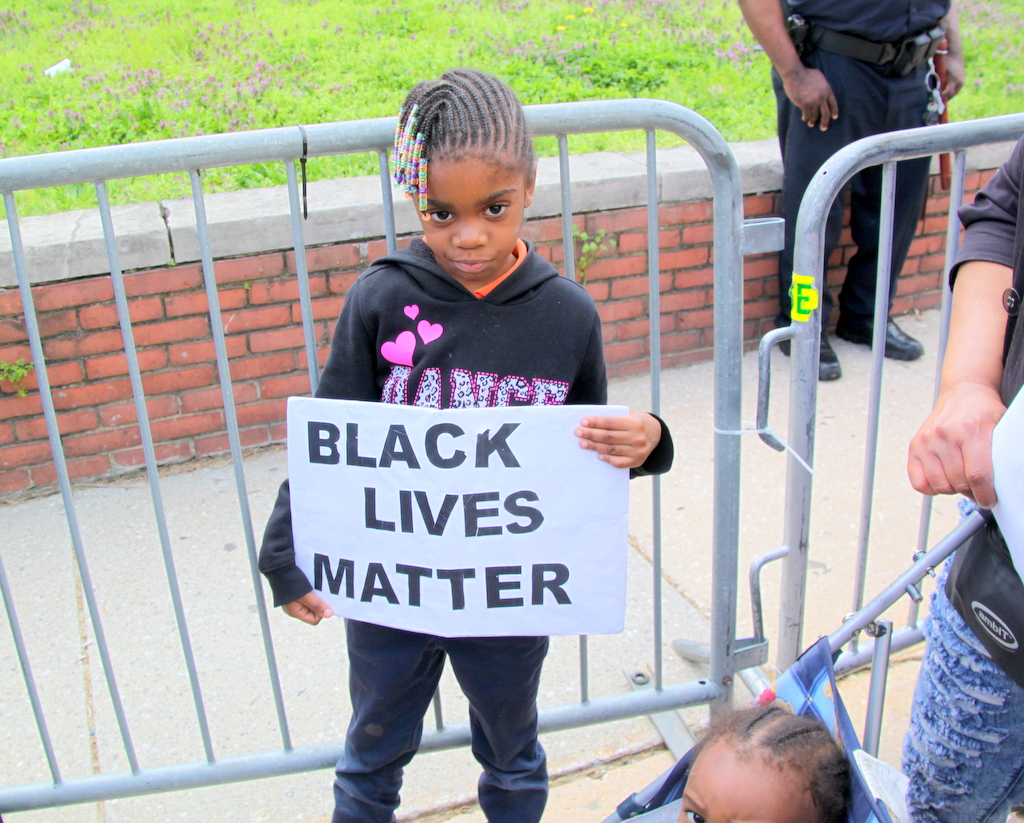
The class took it from there. They planned to do a die-in. They’d do it at the exact time Freddie Gray died. They’d bring signs that said “Black Lives Matter.”

I asked the girl who originated the idea if she went to church. She said she did. I told her she might want to tell them what she was planning. She should tell her parents. Maybe they’d join her.

She beamed. Her grandfather is a retired police officer and she thought he’d come along. She said she’d talk with her pastor Saturday.

All this in the space of 45 minutes. 

By the time the bell rang again, they were literally marching and singing “Protest!” as they walked off to lunch.

We never got to the planned lesson, but I’m not sure that matters.

Did I overstep my bounds as teacher?

I don’t think so. Something had to be done. These kids were hot. They wanted to tear something apart. But after our discussion they had an outlet, a plan.

Will they go through with it? I don’t know.

Frankly, that wasn’t the point. In the classroom, I’m not an organizer. I’m a teacher.

I’ve lost too many kids to the streets. Drugs, violence, neglect, juvenile detention.

“Promise me something,” I said in the middle of our discussion.

“Mr. Singer, it looks like your going to start crying,” one of them said awed and frightened.

“Please. Whatever you do, be safe,” I said.

“If a cop asks you to do something, you do it. Don’t run. Don’t yell and scream.”

“But, Mr. Singer!”

“Honey,” I interrupted, “I’m not saying to give up fighting for your rights. But you have to live long enough to tell your story. Freddie Gray isn’t around to have his day in court. Neither is Trayvon, Michael or Eric. You know what I mean?”

They nodded.

Teachers can’t make anyone to do anything.

The only thing they can do is get you to think.

I did that. I just hope it’s enough.


NOTE: This article also was published on Commondreams.org, ConversationED, the Badass Teachers Association blog and I talked about it at length during an interview on the Rick Smith Show.


If One More White Person Asks Me to Condemn the Baltimore Riots…

many-children-among-crowd-at-Freddie-Gray-protest

It started as soon as I got to work.

“Bet you’re glad the history club isn’t going to Baltimore this year!”

A comment between two social studies teachers. Nudge. Nudge.

I moved on to my morning duty and a science teacher asked me, “How about all that looting and rioting in Baltimore?”

Smirk. Chuckle. Conspiratorial tone.

Then at lunch, they were talking about a “hilarious” video where a black mother was yelling and hitting her son for being part of the riots.

Ha. Ha. Ha.

Am I the only white person who doesn’t need reassured?

Because that’s what they’re doing. They’re asking for confirmation, comfort, soothing.

It’s not white people’s fault. It’s those uppity… uh… black people.

Freddie Gray, a 25-year-old black man, died under mysterious circumstances two weeks ago in Baltimore police custody.

His spine was allegedly “80% severed” at his neck. He had three fractured vertebrae, and his larynx was injured.

Police say he was arrested without any violence. Bystanders say he was beaten with batons. A cell phone video shows him being dragged into custody while in visible agony.

And what did he do to attract police attention? He met an officer’s eyes and then ran. After tackling him to the ground, the police found a knife on him.

And now he’s dead.

It doesn’t take much to see why people are upset – especially people of color.

Yet another police encounter that leaves an African American dead with no provocation.

Peaceful protests took place on Saturday and no one paid much attention. Some protestors turned violent by Sunday and the story suddenly became those crazy black folks are destroying their own communities again.

And every white face I see wants me to join in the condemnation.

It’s the black people’s fault. They keep acting out.

What does this solve? What does it prove?

PLEASE! Do not assume that a lack of melanin in my cheeks means a lack of common sense.

Freddie Gray’s death is not an “excuse” to riot. No one sits around all day checking the headlines for a reason to go wild and set cars on fire. That kind of violence doesn’t just turn on at the flip of a switch.

It’s a slow burn in the pit of your belly, quietly consuming your insides until there’s no recourse left that makes sense. All you can do is scream and go crazy for a while.

Everyone’s done it. After a particularly bad day, the garbage disposal won’t open, so you kick it. You get some terrible news and scream at the neighbor’s dog.

You get it out. You take it out – usually on someone or something that doesn’t deserve it. Often hilariously so. The garbage disposal had nothing to do with my bad day. The neighbor’s dog didn’t cause my bad news.

It’s called being human. Looting and rioting are a more extreme version of the same thing. They don’t solve anything. But how dare you say you don’t understand!

Black people – especially men – are being murdered, and our justice system seems unable or unwilling to do anything about it.

Maybe there’s some strange extenuating circumstance that exonerates police in Gray’s death. But I doubt it. Even if they had nothing to do with his injuries, they certainly should have gotten him medical attention immediately after the arrest.

They are culpable. They were wrong.

Why can’t white people admit it?

We’re so afraid if we acknowledge white folks have done any wrong to black folks, it will start some kind of moral accountancy. Once we start, we’ll have to go through the racial debt point-by-point.

Freddie Gray will lead to Eric Garner, Trayvon Martin and Michael Brown. That will lead to unfair incarceration rates and sentencing. That will lead to Jim Crow laws. And before you know it, we’ll be talking about S-L-A-V-E-R-Y.

Can’t have that! It might make white people feel bad.

Some of us already feel bad. We feel bad that our black brothers and sisters have to keep putting up with defensive, frightened white people.

I am not afraid of black people. They are my friends, my neighbors, my students.

I am not afraid of exposing grievances. The truth deserves to be told.

I love black people. I love justice. And I want it for all of us.


NOTE: This article also was published in the LA Progressive and the Badass Teachers Association blog.

Dissent – The Most “Un-American” American Value

Michael-Brown-Protest-Police

Shut up!

Don’t you know that what you’ve just said has caused this horrible tragedy!?

It’s ironic that in a country born from dissent, the most popular message the powerful have for the powerless is “shut up.”

When two NYPD officers were ambushed and murdered by a madman on Saturday, the media was quick to point out his motive. Allegedly, the “execution style” shootings of Officers Rafael Ramos and Wenijan Lui were in retaliation for the deaths of Eric Garner and Michael Brown – unarmed black men killed by police.

When Mayor Bill de Blasio entered a press conference to speak about the murders, police turned their back on him. The reason? The mayor had been outspoken against a grand jury decision that Garner’s death didn’t need to be investigated with a full criminal trial of the officer who killed him.

Criticism was even worse in an internal department memo which accuses de Blasio of having his hands “literally dripping with our [NYPD’s] blood because of his actions and policies” and that the NYPD is now “a ‘wartime’ police department”  that will “act accordingly”.

It’s beyond ludicrous.

What does that even mean? Who exactly is the NYPD at war with – the people its officers swore to protect and serve?

But perhaps more troubling is the insinuation of guilt – that the mayor caused this tragedy because of his criticisms of police brutality.

Across the country, on social media, between friends and family the same pattern emerges. People complain the death of these police officers is because of the nationwide protests against a wave of police killings of unarmed black men.

If only people hadn’t spoken up, Ramos and Lui would still be alive!?

America has a history of crazy people doing all kinds of crazy things for just as many crazy reasons.

When Ted Kaczynski, the “Unabomber,” killed 3 people and injured 23 with home-made bombs because of his hatred of modern technology, no one blamed Apple computers.

When John Hinckley shot President Reagan to get the attention of Jodie Foster, no one blamed the Academy Award winning actress.

When Brenda Spencer fatally shot a principal and custodian and injured eight children and a police officer from her home across the street from a school because she “didn’t like Mondays”… Well, we still have Mondays.

But suddenly when a lunatic’s motives are politically expedient, they’re justified.

Millions of people all across the country have taken to the streets to protest a racist system of justice that doesn’t hold police accountable for killing unarmed black men. We could confront that system and change it, or we could try to shush those calling for reform.

What’s worse, protestors are shamed into silence. Before they can continue to air their grievances, they’re told they must stop and recognize the tragedy of Ramos and Lui’s death. Of course these murders were despicable! But what does that have to do with us?

Once again the powerless have to repeatedly condemn violence while the powerful have no such mandate put on them. Ex-Ferguson Police Officer Darren Wilson hasn’t offered any regret over his fatal shooting of Michael Brown. He went on national television and said he’d do the same thing again.

If people are worried about the negative image of police instilled by these protests, perhaps the cause isn’t the protests. Perhaps the cause is the negative actions of some police.

Before this story broke, the nation was reeling from the Senate Intelligence Committee report on CIA torture. The report details actions by CIA officials including torturing prisoners, lying to government officials and the media, harsher treatment than was previously disclosed, and the failure of the program to obtain accurate information.

Senator Dianne Feinstein made the rounds explaining the report to congress and the media. CNN’s Wolf Blitzer echoed many pundits when he asked her if the release of the report made America less safe.

What a stupid question!? The report didn’t make America less safe. The fact that America tortured people made us less safe!

But again we have attempts to squash dissent with appeals to shame and fear.

Why did you speak up, Sen. Feinstein? If you had remained silent about the heinous actions done in our name, we would remain safe and secure.

We used to hold freedom of speech as one of our most cherished values. It was a point of pride. Now it’s a dusty trophy on the mantle that we rarely practice in public. It’s just not worth the effort.

That’s a lesson North Korea learned this week. After hacking Sony Pictures and making threats against movie theaters that showed the Seth Rogan comedy “The Interview,” the film company pulled the picture from distribution. After all, the movie made fun of Kim Jong-un in a plot where the American government fictitiously planned to assassinate him with late night talk show hosts.

There was a time when the United States would not abide by such terrorism and threats.

That time has passed.

We not only bow down to foreign powers, we attempt the same kind of coercion for our own people.

How dare you say THAT! You are causing harm by speaking THIS WAY.

Imagine if we thought that way in 1776.

How dare you speak out against Great Britain! Sure, we have no say in our own government, but speaking out will only bring on more tragedy.

Dissent has truly become the most “Un-American” American value.


This article was also published in the LA Progressive and Badass Teachers Association Blog.