
We’re a country of dreamers.
High ideals of democracy, fair play, and freedom are nothing more than our nighttime reveries forced into the light of day.
We look about us at a world of what could be and believe with our whole hearts that it will be so.
But we’re such good dreamers that we often don’t see the reality in front of us. We walk through the day with half closed eyes and never see the shadow and dirt in which we live. Our bodies lay in the mud while our heads are forever in the clouds.
That’s our problem. If you don’t also recognize what is, your dream will never be more than that – a mirage.
And so our greatest strength is also our greatest weakness. The American dream has become the American delusion.
Nowhere is this more apparent than with race.
So many of us – mostly Caucasians – don’t even think it’s an issue anymore.
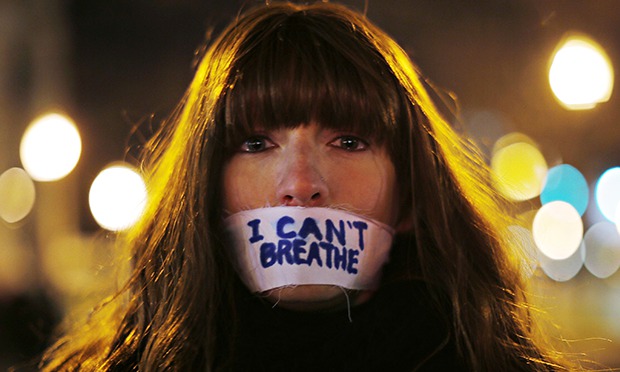
“Hate crimes are a thing of the past,” says the police departments blaming Black teens for getting in the way of officers’ bullets.
“Everyone’s treated equally,” says a court system that disproportionately locks away people of color for the same crimes it practices leniency on for Whites.
“Racism is over,” says the US Supreme Court as it strips away much of the teeth of the Voting Rights Act.
“There’s nothing wrong with naming your sports team after a racial epithet,” says the Washington football franchise as it sues Native Americans with the temerity to be offended.
These are not issues of mere prejudice. This is out-and-out institutionalized racism.
Howard Prof. Denisha Jones explains the difference between the two:
“Using derogatory terms about a person’s race, attributing negative behaviors to a person because of their race, and treating someone poorly because of their race, are all examples of prejudice. Anyone can be prejudiced towards another person based on race. Black people can harbor racial prejudice towards White people. Latino people can harbor racial prejudice towards Black people. White people can exhibit racial prejudice toward people of color.
Now racism is more than just racial prejudice. To understand the difference you can define racism as prejudice + power. See racism is a system that confers advantages on one group while systematically disadvantaging another group (for every advantage there is disadvantage). In America, racism is a system of White supremacy that advantages White people over people of color.”
This is an issue that Americans, frankly, don’t want to deal with – in fact, most of us refuse to see it at all.
We’re finally a color blind society, I suppose.
No, we don’t treat people of color equally because we can’t see any reason to discriminate against them.
We treat them unequally because we refuse to acknowledge how our privileged actions and power affect them.
This willful blindness is so pervasive we don’t even see it under the most extreme circumstances – brutality and genocide.
Compare our attitude with that of the country most associated in the American mind with mass murder of ethnic groups – Germany.
Deutschland, or the Federal Republic of Germany, has a history of civil rights abuses and factory murder.
During WWII, Germany committed some of the worst atrocities against humankind in a century know for atrocity. As Hitler and the Nazi regime conquered much of Europe, his government was responsible for the systematic extermination of 6 million Jewish people and 5 million non-Jewish people. Taken together, we call this dark period the Holocaust.
We all know that. But, the United States has a similar history of racism and murder.
In the 18th and 19th centuries, the US allowed legal chattel slavery of human beings stolen from Africa. These people were taken from their homes and families and sold into generational servitude. Of the 12 million enslaved people brought from Africa to the Americas, only about 600,000 were taken to the 13 Colonies and (later) the United States. The great majority of slaves were taken to sugar colonies in the Caribbean and Brazil where they were often worked to death and had to be replenished with new arrivals. Life expectancy was higher in the US and slaves often reproduced their numbers. By 1860, there were 4 million slaves in the country.
Treatment, however, was severe. Beatings and rapes were commonplace. Punishments often included whipping, shackling, hanging, burning, mutilation, branding, and imprisonment. It was most often meted out in response to disobedience or perceived infractions, but sometimes abuse was carried out simply to re-assert the dominance of the master or overseer over the slave. Most captive laborers weren’t allowed literacy or to congregate in large groups – except for church services – for fear these things would inspire thoughts of rebellion or escape. The economic prosperity of a large section of our country was built upon the blooded and beaten backs of these people.
But that’s not all.
Furthermore, the United States and its precursor British government practiced outright genocide against Native American peoples living here before the arrival of European settlers. The extent of this brutality is hard to calculate. Estimates of the pre-Columbian population for what today constitutes the U.S. vary significantly. More recent efforts put the number at approximately 18 million. As of 2010, only 5.2 million US citizens claim Native American ancestry. Of that, 2.9 million claim to be descended solely from indigenous peoples, while 2.3 million claim some combined heritage.
Arguments explaining this drastic plunge in population are numerous and heated. Certainly Native Americans weren’t able to cope with European diseases such as Smallpox. To what extent this was exacerbated by purposeful attempts to murder First Peoples with primitive biological warfare (“gifting” them smallpox infected blankets, etc.) is hard to determine. But since 1830, the national policy turned from assimilation to outright displacement. The Indian Removal Act authorized the government to forcibly deport tribes west of the Mississippi. But as Europeans encroached even further, this resulted in the genocide or near-genocide of many tribes, with brutal, forced marches including the infamous Trail of Tears, which alone caused 4,000 casualties.
Over time, the United States forced indigenous peoples into smaller plots of land until they were on reservations where they were coerced to change their hunter-gatherer life-style to a more agrarian culture which neither they nor the lands they were forced to live on were suited. Mass starvation was common. It wasn’t even until 1924 that all Native Americans were even granted US citizenship.
The point is this – no matter how much the depopulation of Native Americans can be attributed to natural causes, there was certainly a large factor of purposeful, government-sanctioned racism, and murder involved.
The bottom line? Both Germany and the United States have a history of brutality and genocide. It is not important to determine which atrocity is worse – American Slavery, Native American Genocide or the Holocaust. That’s irrelevant. Murder is murder. Genocide is genocide.
The crux of the matter is that both countries have a dark history of aggression and inhumanity to face. But each chose a much different path to do so.
In Germany, there is a policy of education and acceptance. They don’t hide from their past. They teach it.
The Holocaust is a mandatory, binding subject in all schools.
Students begin studying the Nazi persecution of the Jews between ages 12 and 15. At that point all students study the history of the 20th century – in general – and National Socialism – in particular. The Holocaust is a central topic of this instruction. So much so that students who who pass the Abitur exam (prerequisite for university) take it up again at age 18.
German-sanctioned genocide pervades the entire curriculum – not just history and civics, where it is central. It is also frequently taught in classes on German literature, religion, ethics, biology, art and music. It’s not uncommon for science classes to disprove racist theories, art classes to study works produced by Holocaust survivors, etc. Students engage in long-term educational projects that often focus on these issues, as well.
Finally, students continue to learn about the Holocaust outside the classroom. Numerous class trips are scheduled to the nearly 100 memorial museums every year. Dachau, Bergen-Belsen, Buchenwald, and Sachsenhausen have several hundred thousand visitors – most of whom participate in guided tours for students and teachers.
But that’s Germany.
Q: How does the United States deal with its dark past?
A: Haphazardly.
In the USA, there is no such systematic educational approach to either American Slavery or Native American Genocide. While neither subject is completely ignored, there is no national push to ensure anything but a superficial knowledge of these events.
American school children know that we used to have slaves; they may even know that we didn’t treat the Native Americans so nicely. But they don’t know nearly the scope and fallout of these events.
Slavery is one thing. The Civil Rights movement is another. They may have some vague connection, but little is taught about the generations of nationally-endorsed racist laws that kept African Americans from voting or exercising the same freedoms available to White people. And after the Civil Rights movement!? It must have been all good, because there’s little else you’ll learn about it in most schools.
Likewise, students learn there used to be a whole civilization of Native Americans before Columbus arrived. They might learn a bit about a few of the skirmishes and disagreements between the US government and the indigenous peoples. But genocide!? That concept is usually reserved for WWII and European history when it could equally be applied to events at home.
You’d think the Common Core State Standards – our ill-conceived de facto national norms – would have solved this problem. However, they are exceedingly general when it comes to social studies and history. Criterion focus on “conflict and cooperation,” “evaluating patterns of change” and “interpreting historical events.” No emphasis is placed on particular historical occurrences.
It’s ironic that when it comes to skills such as Language Arts, the standards are – in fact – too specific. They prescribe things like close reading, an emphasis on nonfiction texts, comprehension without context, and the New Criticism literary point of view of the 1940s. But when it comes to fact-based pursuits like Social Studies, the standards are as watered down as weak tea. How else could they pass political muster for all concerned?
None of this stops individual teachers, schools or states from being comprehensive and specific. In fact, some states such as Virginia have their own state standards that emphasize local history and norms. For instance, one Virginia benchmark prescribes studying “the effects of segregation and ‘Jim Crow’ on life in Virginia for Whites, African Americans, and American Indians.” That’s a far cry from “evaluating patterns of change!”
Let me be clear. I am not advocating a rigid national curriculum. But I am in favor of a national desire to have some specific social studies standards at some level. Those standards should definitely be fleshed out by states and school districts, but the national emphasis should be on confronting our past, not ignoring it. Otherwise, our students will continue to be left with a vague idea of these events and their importance.
So I’d like to make a suggestion.
If the United States is serious about its ideals – if we really want to achieve our dreams of freedom and equal opportunity – we need to be more like Germany.
We need a comprehensive educational program that teaches our history – all of our history – even the nasty parts.
We need to emphasize American Slavery and Native American Genocide the same way Germany emphasizes the Holocaust.
Starting in middle school, students should learn about the events leading up to both tragedies.
Lessons should be plentiful and multidisciplinary. It shouldn’t be something that’s only the prerogative of the social studies classes. Literature courses should teach texts such as Beloved, Native Son and Bury My Heart at Wounded Knee in this context. Biology classes should do experiments to discredit racist theories of eugenics. Music and art classes should examine the rich heritage produced by these two peoples.
Schools should institute field trips to former slave markets, plantations, reservations, battle sites and massacres. This, in turn, would necessitate turning some of the historical sites into museums of equal quality to those explicating the Holocaust in Europe. No more fond reminiscences on life in the Antebellum South. They would show in stark detail what it meant to be a slave, how these people were housed, worked, penalized, etc. Battle grounds, in so much as they exist, wouldn’t just be about numbers killed and instruments of war, but instead show in detail the inhumanity practiced by our forebears.
The point is not to rub our children’s noses in the brutalities of the past. The truth of history should be inescapable, yes, but we must also teach the value of tolerance and acceptance of those different than us. To do this, we need a comprehensive program of ethnic studies. We need to teach the stories, histories, struggles and triumphs of people of color on their own terms.
For this to have any lasting effect, it is essential that such courses occur at all of our schools – not just those made up of mostly minority students. Our children need to know that it’s okay to be who they are. There’s nothing wrong with being non-White just as there’s nothing particularly special about being Caucasian. We’re all people. We all deserve respect, acceptance and love.
Isn’t that really one of our most cherished ideals?
We hold these truths to be self evident – that all men are created equal.
They are endowed with certain unalienable rights.
That among these are life, liberty, and the pursuit of happiness.
If our actions matched our words, maybe then we’d finally realize the American Dream.
NOTE: A shorter version of this article appeared in the LA Progressive.
My heartfelt THANK YOU to the following people without whom I could not have written this piece: Dr. Mark Naison (Fordham Univeristy), Dr. Yohuru Williams (Fairfield University), Dr. Denisha Jones (Howard University) and Traci Churilla. Any faults are my own.



 gadflyonthewallblog